How to Get Diagnosed with ADHD in the UK
Think you have ADHD? Learn how to get diagnosed in the UK, explore NHS vs. private options, and understand what's involved. Start your journey today!
Written and maintained by the ADHD Private editorial team, drawing on NHS, NICE and ADHD UK guidance. This is general information, not medical advice.
So, you've started to wonder if ADHD might be the reason behind some of your lifelong struggles. Getting a diagnosis in the UK involves a few key stages: recognising the signs in yourself, talking to your GP to get a referral, and then having a full assessment with a specialist. You can go through the NHS, use the NHS Right to Choose scheme to potentially speed things up, or opt for a private clinic. The first hurdle is simply turning that inkling of suspicion into a solid plan.
Recognizing the Signs and Taking the First Step

It often starts with a quiet but persistent feeling that you’re playing life on a harder difficulty setting than everyone else. Maybe you wonder why you can never seem to hit deadlines, why your house is always in a state of organised chaos, or why your mind wanders off in the middle of a crucial conversation, leaving you feeling frustrated and a bit lost. If you've found yourself thinking, "Could this be ADHD?", you're asking the right question.
For most adults, the path to a diagnosis begins by connecting these personal challenges to the known traits of the condition. It’s not about fitting the old-school stereotype of a hyperactive little boy. It’s about seeing how those traits actually show up in adult life, affecting your career, your finances, your relationships, and even how you feel about yourself.
Beyond the Stereotypes: Understanding Adult ADHD Symptoms
ADHD in adulthood often looks very different from how it does in children. The hyperactivity can be less about bouncing off the walls and more of an internalised, relentless restlessness. Spotting these patterns in your own behaviour is the first real step forward.
You might experience things like:
- Persistent Inattention: This could be zoning out in meetings, starting projects with huge enthusiasm but never finishing them, or constantly losing your keys, wallet, or phone.
- Subtle Hyperactivity: Instead of running around, this often feels like a constant internal buzz. You might fidget endlessly, find it impossible to just relax, or talk so much you end up interrupting people without meaning to.
- Life-Altering Impulsivity: This can show up as making big, rash decisions on a whim—like quitting a job with no backup plan—or struggling to control your emotions, leading to sudden and intense mood swings.
A formal diagnosis isn’t just about getting a label; it’s about getting a toolkit. It validates years of struggle and opens the door to treatments, support, and legal protections that can genuinely change your life.
If any of this sounds painfully familiar, it's a sign that you aren't just "lazy" or "disorganised." These are well-understood medical symptoms. Our guide on ADHD symptoms can help you dig a little deeper into what to look for.
The Importance of Seeking a Formal Diagnosis
That moment of self-realisation is a huge step, but a professional diagnosis is what unlocks proper support. Sadly, countless adults in the UK are living with undiagnosed ADHD. While it's estimated to affect around 2-3% of adults, official health data reveals a massive gap in diagnosis. This is especially true for women, whose symptoms are often less outwardly hyperactive and are frequently missed during childhood. The report from the independent ADHD Taskforce sheds more light on this very issue.
Finding your way through the UK's diagnostic pathways can feel daunting, but this guide is here to give you a clear, straightforward map. By understanding the signs and taking that first step to book a GP appointment, you’re taking back control and moving from uncertainty to action. It’s time to get the answers you deserve.
Getting Ready for Your GP Appointment
Walking into your GP’s surgery to talk about ADHD can feel daunting. It’s a huge step. A lot of people worry they won’t be taken seriously, or that they'll get flustered and forget all the important things they wanted to say. The secret to a good outcome? Preparation. If you go in with clear, organised information, the appointment becomes a proper, structured conversation about your health, not just a vague chat.
Your goal is to shift the conversation from "I think I might have ADHD" to "Here's why I think I have ADHD." This means sharing real, concrete examples of how your symptoms are affecting your life – from your job and your finances to your relationships at home. Giving your GP this full picture makes it much easier for them to understand what’s going on and, crucially, makes a referral for a specialist assessment far more likely.
Start a Symptom Diary
When you’re sitting in the doctor's office, under pressure, your mind can go blank. Trying to recall a lifetime of subtle struggles on the spot is nearly impossible. This is why a symptom diary is probably the most powerful tool you can have. Think of it as your personal evidence log.
For a few weeks before your appointment, start noting down specific moments where you see ADHD traits pop up. Don't just write "I was distracted." Get really specific:
- At Work: "During Tuesday's team meeting, I completely zoned out and started mentally rearranging my living room furniture. My manager asked me a direct question and I had no idea what she'd said. It was so embarrassing having to ask her to repeat it."
- At Home: "I burnt the chicken nuggets again on Thursday. I started unloading the dishwasher halfway through cooking and completely forgot the grill was on until I smelled smoke."
- Socially: "My best friend was telling me about a really tough time she's having, and I interrupted her three times to talk about something totally random. I saw the look on her face and just felt awful."
This kind of detail gives your GP a much clearer picture of how these symptoms actually play out in your day-to-day life.
Dig Out Your Supporting Evidence
For an ADHD diagnosis to be made, there needs to be evidence that the symptoms have been around since childhood. It's not just about recent struggles. This means your GP will be looking for signs of lifelong challenges. It might feel a bit weird digging through old boxes in the loft, but it can provide some incredibly useful proof.
See if you can find any of these:
- Old School Reports: Are there any recurring comments from teachers? Things like, “bright but doesn't apply himself,” “daydreams in class,” “can be disruptive,” or “finds it hard to finish tasks.” These are classic signs.
- A Note from a Partner or Parent: Ask someone who knows you really well—and has for a long time—to jot down a few of their own observations. They often spot patterns we miss ourselves, like constant fidgeting, losing the thread of conversations, or time blindness.
- Old Performance Reviews: Sometimes, work reviews can highlight patterns. Is there consistent feedback about missed deadlines, problems with organisation, or struggling with projects that have lots of steps?
A Quick Tip: You don't need to turn up with a massive folder of paperwork. Just pick two or three of the strongest examples that really show a long-term pattern.
How to Use Self-Screening Tools
Online quizzes can’t diagnose you, but they can be a great way to structure your thoughts before seeing the doctor. Filling out a recognised screening tool, like the Adult ADHD Self-Report Scale (ASRS), helps you pinpoint which symptoms are causing you the most trouble.
The ASRS is a checklist developed in partnership with the World Health Organisation. You can find it online, complete it, and print out the results to take with you. It shows your GP that you’ve approached this thoughtfully.
When you show it to them, you could say something like, "I filled out this ASRS screener, and the results suggested it was worth looking into this properly. I’ve highlighted the points that are having the biggest impact on my life."
Bringing together your symptom diary, a few bits of evidence from your past, and the results from a self-screener gives you a solid, evidence-based foundation for your conversation. You’ll feel more confident, your GP will have the information they need, and you’ll be one step closer to getting some real answers.
Choosing Your Path: NHS vs. Private ADHD Assessments
So, you’ve spoken to your GP and they’ve agreed that an ADHD assessment is the right next step. This is a huge milestone, but it also brings you to a crossroads: where do you go from here? In the UK, you have a few different routes you can take to get a formal diagnosis, and honestly, the choice between them isn't always cut and dry.
On one hand, you have the NHS, which is the default for most of us. On the other, there’s the option of going private, which brings speed but at a significant cost. Let's break down what each path looks like so you can figure out what works best for your situation, timeline, and budget.
The Standard NHS Pathway
For most people in the UK, the first port of call is naturally the National Health Service. The process seems straightforward enough: your GP refers you to the local adult ADHD service, and you join their waiting list. The massive plus point here is obvious—it's free. An NHS diagnosis is the gold standard, universally recognised, and it sets you on a clear path for medication and any other support you might need.
But here’s the catch, and it’s a big one: the waiting times. We’re not talking about a few weeks. Depending on where you live, you could be looking at a wait of several months or, in some parts of the country, even several years. That kind of delay can feel impossible when you’re already struggling with symptoms that are turning your life upside down.
A Powerful Alternative: NHS Right to Choose
If you live in England, don't despair. There’s a brilliant, often-overlooked option called Right to Choose (RTC). This NHS scheme gives you the power to choose which qualified healthcare provider you’re referred to, provided they have a contract to deliver that service for the NHS.
Essentially, this means you can ask to be referred to a private clinic that also works with the NHS. The best part? Your assessment and any follow-up treatment are still funded by the NHS, so you don't pay a penny. The main advantage is that the waiting lists for these providers are often drastically shorter than local NHS services. It’s a fantastic way to get your diagnosis faster without having to fund it yourself.
To make it happen, you'll need to:
- Find a private provider that accepts RTC referrals (many now do).
- Specifically ask your GP to refer you to that provider under the Right to Choose scheme.
- Make sure the provider is CQC-registered and has an NHS contract.
It gives you a sense of control over your own healthcare journey, all while staying within the NHS system.
The Fully Private Route
For those who have the means, paying for a private assessment is, without a doubt, the fastest way to get answers. Wait times are usually just a matter of weeks, and the whole process can feel a lot more direct and personal. Going private lets you sidestep the NHS waiting lists completely, which for many is a price worth paying for clarity and quick access to treatment.
The infographic below shows the kind of information and documents you should get ready before your GP appointment. Being prepared like this is vital, no matter which pathway you end up choosing.
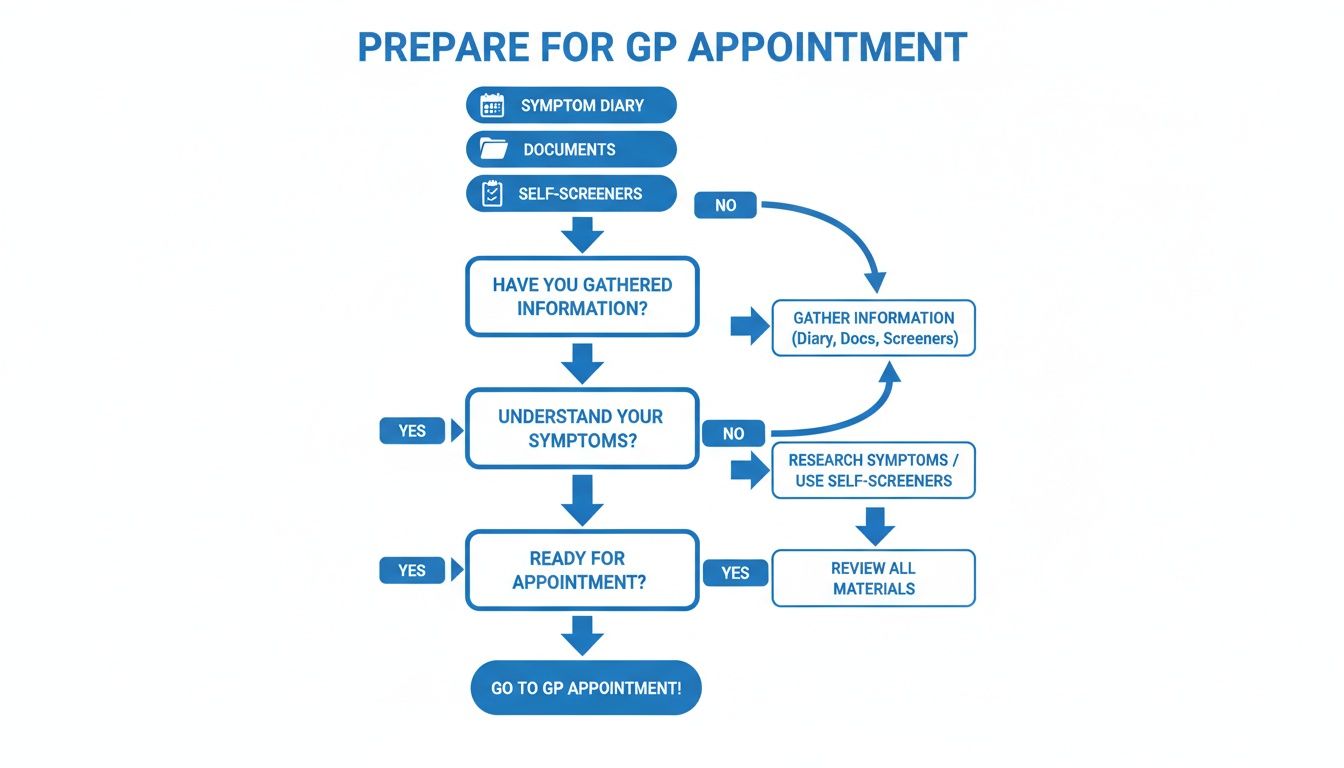
This kind of prep—bringing a symptom diary, old school reports, and maybe a filled-out self-screener—gives your GP concrete evidence to back up their referral.
Choosing a path is a balancing act between time, cost, and your own personal circumstances. There's no single "best" option; the right choice is simply the one that gets you the support you need in a way that feels manageable for you.
Of course, the major hurdle with the private route is the cost, which can be substantial. You'll need to budget for the initial assessment, but also for any follow-up appointments and the titration period—that's the process where a specialist works with you to find the right medication and dosage. All in, these costs can easily run into thousands of pounds.
The scale of the challenge in getting an ADHD diagnosis is clear from the data. One review of over 9.5 million GP records found that just 0.32% of patients had a recorded ADHD diagnosis, pointing to a massive problem with under-diagnosis in the UK. The notoriously long NHS waits are a huge part of this, pushing more and more people to look for private options. You can read more about these ADHD statistics and trends to get the bigger picture.
ADHD Assessment Pathways in the UK: A Comparison
To help you weigh your options, here’s a straightforward comparison of the three main pathways available for an adult ADHD assessment in the UK.
| Factor | Standard NHS Pathway | NHS Right to Choose | Fully Private Pathway |
|---|---|---|---|
| Cost | Free | Free | £700 - £2,000+ (for assessment, titration, and follow-ups) |
| Wait Time | Very long (often 1-5 years) | Shorter (usually 6-12 months) | Very short (typically 2-8 weeks) |
| Choice of Provider | Limited to your local NHS trust | You can choose from a list of qualified NHS and private providers | Complete freedom to choose any private clinic |
| Recognition | Universally recognised | Universally recognised | Widely recognised, but check shared-care agreements |
| Process | GP refers to local ADHD service | GP refers to your chosen provider under RTC | You contact the clinic directly and self-refer |
Ultimately, whether you wait on an NHS list, use your Right to Choose, or invest in a private assessment depends entirely on your personal circumstances. Each route leads to the same goal: getting clarity and the support you need to move forward.
Looking for a private ADHD assessment?
Answer a few questions and we’ll shortlist clinics that fit — comparing price and waiting time.
How to Choose the Right Private ADHD Clinic
Deciding to go private for an ADHD assessment, whether you're paying yourself or using the NHS Right to Choose scheme, can feel like a huge step. A quick search brings up a dizzying number of clinics, and it's hard to know where to start. But getting this choice right is about more than just finding the shortest waiting list—it's about making sure you get a credible diagnosis and quality care that your NHS GP will actually recognise down the line.
Think of it as doing your homework before making a big investment. Because that's what this is: an investment in your health. A good clinic will be upfront, properly regulated, and staffed by qualified experts who genuinely understand adult ADHD. Knowing what to look for is your best defence against providers who might cut corners.
Is the Clinic CQC Registered?
First things first: any private clinic providing healthcare services in England must be registered with the Care Quality Commission (CQC). This isn't just a nice-to-have; it's a legal requirement. The CQC is the independent regulator that makes sure health services are safe, effective, and properly run.
You can easily look up a clinic's registration status on the CQC website. Any decent provider will be proud of their rating and usually display it on their own homepage. If you have to dig for this information or can't find it at all, that's a major red flag.
Here's what the CQC's homepage looks like, where you can start your search.
This simple check gives you a baseline of confidence that the clinic meets fundamental quality and safety standards.
Who Exactly Will Be Assessing You?
This is a critical question to ask. A proper ADHD diagnosis should be made by a specialist psychiatrist who is registered with the General Medical Council (GMC). While some clinics might use other qualified professionals like specialist nurses or psychologists for parts of the process, a psychiatrist's involvement is crucial, especially when it comes to prescribing medication.
Don't feel awkward about asking the clinic directly:
- "Who will be conducting my assessment?"
- "What are their qualifications and professional registrations?"
- "Are they a GMC-registered psychiatrist with a specialism in adult ADHD?"
A trustworthy clinic will have no problem answering these questions. If they're vague or defensive, be cautious.
Understanding the True Cost
The headline price for an "ADHD assessment" is rarely the final bill. The total cost is often split into different stages, and you need to get a clear picture of every potential expense before you commit. A lack of transparency here can lead to some nasty financial surprises.
Be very wary of any clinic that only advertises a single, low "assessment fee." This often hides the much larger costs of what comes next—especially medication titration, which can easily become the most expensive part of the journey.
Before signing up, make sure you get a breakdown of the following:
- The Initial Assessment: The one-off fee for the main diagnostic appointment.
- Medication Titration: This is the process of finding the right medication and dose for you. It usually involves several appointments and private prescription costs, which can add up very quickly.
- Follow-Up Appointments: How much do they charge for routine check-ins and reviews once you're stable on your medication?
- Reporting Fees: Is there an extra charge to get your final, detailed diagnostic report?
A good provider will give you a clear, itemised breakdown of all these potential costs from the very beginning.
The All-Important Shared Care Agreement
This is probably the single most important factor for making your treatment affordable in the long term. A shared care agreement is a formal arrangement between your private specialist and your NHS GP. Once your specialist has found a stable and effective dose of medication for you, they can hand over the prescribing responsibility to your GP.
This is a game-changer. It means your ongoing prescriptions will be issued through the NHS, costing you only the standard prescription charge instead of the much higher private fees. However, not all GPs will agree to this, and some private clinics simply have a better reputation and working relationship with the NHS than others.
Before you book, ask the clinic:
- "Do you facilitate shared care agreements?"
- "Which local NHS trusts have you successfully set these up with?"
- "What is your process for handing care back over to the GP?"
Choosing a clinic with a proven track record of successful shared care agreements can save you thousands of pounds over the years. To find and compare providers that offer this service, you can use our directory to compare ADHD clinics across the UK and see which ones are set up to facilitate these crucial arrangements.
What to Expect During the ADHD Assessment

The idea of a formal assessment can feel pretty daunting, but knowing what’s actually involved can take away a lot of that anxiety. It’s important to understand that an ADHD assessment isn't a test you can pass or fail. Think of it more as a detailed, collaborative conversation designed to build a complete picture of your life, both now and in the past.
Whether your appointment is online or face-to-face, the structure is generally the same. The specialist's goal is to understand your unique challenges, how long they've been around, and the real-world impact they have on different areas of your life. It’s your chance to be completely open and honest about your experiences.
Getting an adult ADHD diagnosis in the UK is thankfully becoming more common, with experts estimating that 3-4% of the adult population has the condition. Still, services can feel disjointed, which is why getting to grips with the assessment process is so crucial. A specialist will carry out a full evaluation, digging into your personal history and using recognised diagnostic tools. If you're interested in the data, The King's Fund has some great insights into adult ADHD services in the UK.
The Structured Clinical Interview
At the heart of your assessment is a structured clinical interview. This is essentially a guided conversation where the psychiatrist or specialist asks specific questions based on the official diagnostic criteria for ADHD, usually from the DSM-5 (Diagnostic and Statistical Manual of Mental Disorders, 5th Edition).
Don't expect a quick chat; this is a deep dive. The interview will be thorough, often lasting anywhere from one to three hours.
The specialist will want to explore a few key areas:
- Your Current Symptoms: They'll ask for concrete, real-life examples of how you struggle with things like inattention, hyperactivity, or impulsivity. This is where that symptom diary you prepared becomes absolutely invaluable.
- Your Childhood and School Days: Because ADHD is a neurodevelopmental condition, symptoms must have been present before the age of 12. They’ll ask about your behaviour at school, what your old school reports said, and any academic or social struggles you remember.
- Impact on Daily Life: The conversation will cover how your symptoms affect everything from your job and relationships to your finances and general wellbeing. To meet the diagnostic criteria, the traits must cause significant problems in at least two different areas of your life (for example, at home and at work).
The Role of "Collateral Information"
To get the most accurate picture, clinicians often ask for what they call collateral information. It sounds technical, but it just means getting input from someone who knows you well and can offer another perspective on how your symptoms show up. It’s a way of confirming your own experiences and adding another layer of detail.
This person could be:
- A parent or an older relative who can talk about what you were like as a child.
- A long-term partner or spouse who sees your day-to-day struggles.
- A close friend who has known you for years.
They will usually be asked to fill out a questionnaire or might even be invited to join part of the interview (only with your permission, of course). This isn’t about checking up on you; it’s about giving the clinician more context to make a confident diagnosis.
Remember, the assessment is a safe space. Clinicians who specialise in ADHD have heard it all before. There's no need to feel embarrassed about sharing stories of missed appointments, messy rooms, or impulsive decisions. It's all part of the diagnostic puzzle.
Completing Rating Scales and Questionnaires
Alongside the interview, you’ll almost certainly be asked to complete one or more rating scales. These are standardised questionnaires designed to measure the frequency and severity of specific ADHD symptoms. You might be sent them to fill out beforehand or complete them during the assessment itself.
Some of the tools commonly used in the UK include:
- DIVA-5 (Diagnostic Interview for ADHD in Adults): This is a very structured interview that methodically goes through each DSM-5 criterion, looking for evidence in both your adult life and your childhood.
- ASRS (Adult ADHD Self-Report Scale): This is the same screener you might have used before seeing your GP, but it’s used here as part of the formal data-gathering process.
- Conners' Adult ADHD Rating Scales (CAARS): A detailed scale that gets information from both you and an observer (like your partner or parent).
These tools provide objective data that helps the specialist make an accurate diagnosis when combined with the clinical interview and the information from someone who knows you well. It's a multi-faceted approach designed to make sure nothing is missed.
Life After Diagnosis: Treatment and Support Options

Getting an ADHD diagnosis is a huge moment. For many, it brings a massive wave of relief—finally, an explanation!—mixed with a bit of "what now?". Think of this diagnosis not as the end of the road, but as the start of a new, better-informed chapter. You can now access the right support and strategies to really start thriving.
The path forward isn't just about one thing; it's about building a solid support system. While medication is a game-changer for many, it’s only one piece of the puzzle. Truly effective ADHD management blends medical treatment with practical skills, emotional support, and knowing your rights.
Understanding Your Medication Options
Medication is often the first thing people consider, and for good reason. It can be incredibly effective at managing those core ADHD symptoms like a wandering focus or acting on impulse. In the UK, ADHD medications generally fall into two main groups.
Stimulants: These are the most common and include well-known names like methylphenidate and lisdexamfetamine. They work by boosting certain brain chemicals, helping to sharpen focus and calm hyperactivity.
Non-Stimulants: If stimulants aren't a good fit or cause unwanted side effects, non-stimulants like Atomoxetine are a great alternative. They work differently and might take a bit longer to kick in, but they can be just as effective for many people.
Finding the right medicine and dose isn't an overnight thing. It’s a careful process called titration. Your specialist will start you on a very low dose and slowly increase it over a few weeks, checking in with you to see how you're feeling and if there are any side effects. It's a partnership to get the treatment just right for you.
Making Treatment Affordable: The Shared Care Agreement
One of the biggest worries after a private diagnosis is the ongoing cost of medication. This is where a shared care agreement is an absolute lifesaver. Once your psychiatrist has worked with you to find a stable and effective medication plan, they can arrange to hand over the prescribing to your NHS GP.
This means your repeat prescriptions come through the NHS, and you'll only pay the standard prescription charge. It’s a vital step for making your long-term treatment affordable and sustainable.
A shared care agreement bridges the gap between private diagnosis and NHS care. It allows you to get specialist-led treatment when you need it most, then shifts to the convenience and affordability of NHS prescriptions once you’re settled on your medication.
Support Beyond Medication
Medication can help manage the brain chemistry, but it can't teach you the life skills you may have missed out on. That’s why non-medical support is so crucial for long-term success. It's all about building the practical strategies needed to navigate a world not always designed for an ADHD brain.
Here are a few powerful options to look into:
- ADHD Coaching: A coach works with you to build practical systems for things like organisation, managing your time, and actually getting things done. It’s all about looking forward and achieving your goals.
- Cognitive Behavioural Therapy (CBT): A therapist specialising in ADHD can help you reframe negative thought patterns, handle emotional ups and downs, and work through challenges like rejection sensitivity.
- Workplace Support: Under the Equality Act 2010, ADHD is considered a disability. This means you are entitled to "reasonable adjustments" at work. The government’s Access to Work scheme can even help fund things like coaching or specialist equipment to help you succeed.
For a deeper look into all these avenues, you can find more detail on ADHD treatment pathways and figure out what might work for you. It’s also incredibly helpful to connect with people who just get it. Charities like ADHD UK and The ADHD Foundation offer fantastic resources, webinars, and forums where you can share experiences and feel understood. Your diagnosis is the key that unlocks all this support.
Finding the right clinic to start this journey can feel like a massive task, but you don't have to figure it all out alone. ADHD Private offers a free UK-wide directory to help you compare providers, check the latest wait times, and find a service that fits you. Start your search today at https://adhdprivate.co.uk.