ADHD Referral Form: A Clear Guide to NHS, Private, and GP Pathways
Need help with an ADHD referral form? Our guide explains NHS, Right to Choose, and private options with templates and tips.
Written and maintained by the ADHD Private editorial team, drawing on NHS, NICE and ADHD UK guidance. This is general information, not medical advice.
An ADHD referral form is essentially the official request your GP sends to a specialist to get you assessed. Think of it as the starting pistol for the entire diagnostic process here in the UK. It’s the formal handshake between your initial concerns and a proper evaluation by a psychiatrist or a qualified ADHD specialist.
What is an ADHD Referral Form and Why is it So Important?
I often describe an ADHD referral form as a passport. Without it, you’re stuck in the land of ‘I think I might have ADHD’ and can’t get to your destination: a formal, professional assessment. It's the one document that unlocks the gate to specialist services, regardless of whether you’re going through the NHS, using the Right to Choose pathway, or even going down some private routes that still need a GP’s sign-off.
But this form is so much more than just a bit of administrative box-ticking. Its real job is to build a clear, compelling case for why you need an assessment in the first place. It pulls together all the critical information a specialist needs to get a handle on your situation before you even walk through their door.
The Cornerstone of Your Diagnostic Journey
The referral form does several key things, all designed to make the whole diagnostic process run a lot more smoothly:
- Summarises Your Symptoms: It gives your GP a structured way to list the specific signs of inattention, hyperactivity, or impulsivity you've been struggling with.
- Documents the Real-World Impact: This is absolutely vital. The form explains how these symptoms are actually affecting your life – your job, your relationships, your studies, and just your overall sense of well-being.
- Provides Medical Context: It includes your relevant medical and mental health history, which helps the specialist rule out other conditions that can sometimes look a bit like ADHD.
- Points the Way: The form clearly states which service you’re being referred to, whether that’s your local NHS mental health team or a specific clinic under the Right to Choose scheme.
In simple terms, this document is your official 'ticket' into the system. It takes your concerns seriously, places them in a medical context, and gets the ball rolling for a proper evaluation.
Getting it Right in a System Under Strain
Getting this form filled out correctly has never been more critical. The demand for ADHD assessments has absolutely skyrocketed, and waiting lists are getting longer by the day. Research from the University of York highlighted a huge surge in referrals, with some NHS services seeing increases of 100% or more. This isn’t surprising, given the rise in public awareness, but it's putting immense pressure on services. You can read the full research on adult ADHD assessments to get a better sense of the current picture.
A well-prepared ADHD referral form makes sure your request is clear, thorough, and has everything the specialists need. Getting it right from the start can help minimise delays and give you the best chance of moving forward on your journey with a bit more confidence.
Navigating Your Three UK ADHD Referral Pathways
Trying to get an ADHD assessment in the UK can feel like you've been handed a compass without a map. There are a few different ways to go, and it’s not always obvious which one is right for you. Thankfully, it really boils down to three main routes, and your ADHD referral form is the key that gets you started on any of them.
The path you choose will determine where that form goes, how long you'll wait, and what it might cost. Let's break down the three main options: the standard NHS route, the NHS Right to Choose scheme, and going private.
The Standard NHS Referral
This is the most well-trodden path. It starts with you visiting your GP, who then fills out a referral form and sends it to your local NHS mental health service. Simple, straightforward, and fully funded by the NHS.
The biggest plus? It’s completely free. The major downside, however, is the waiting time. Demand for ADHD assessments on the NHS is incredibly high, and it's not unusual to face a wait of several months, or in some areas, even a couple of years.
NHS Right to Choose (RTC)
If you live in England, the Right to Choose (RTC) scheme is a real game-changer. This legal right lets you ask your GP to refer you to a specific NHS-approved provider, even if they aren't in your local area. Many of these providers, like Psychiatry-UK or ADHD 360, set their own waiting lists, and waits vary by NHS area.
RTC gives you a choice of provider, and the NHS pays for the assessment, so you do not pay out of pocket for it. Waits vary by provider and by NHS area, so ask the clinic about its current wait before your GP refers you.
When you use RTC, your GP fills out the same referral form but sends it to your chosen provider instead of the local NHS service. It's really important you give your GP all the correct details for the clinic you've picked. To get fully prepared, check out our in-depth guide on ADHD UK Right to Choose.
The Private Referral Pathway
For those who need answers quickly and have the means, going private is the third route. This involves paying for your own assessment at a private clinic, which allows you to bypass the long NHS queues entirely. You can often be seen within a matter of weeks.
The catch, of course, is the cost. An initial assessment can set you back anywhere from a few hundred to over a thousand pounds, plus extra for any follow-up appointments or prescriptions. Some clinics will ask for a GP referral to get your medical history, but many now accept self-referrals, meaning you can just contact them directly.
This flowchart gives you a bird's-eye view of how these pathways branch out from that first GP appointment.
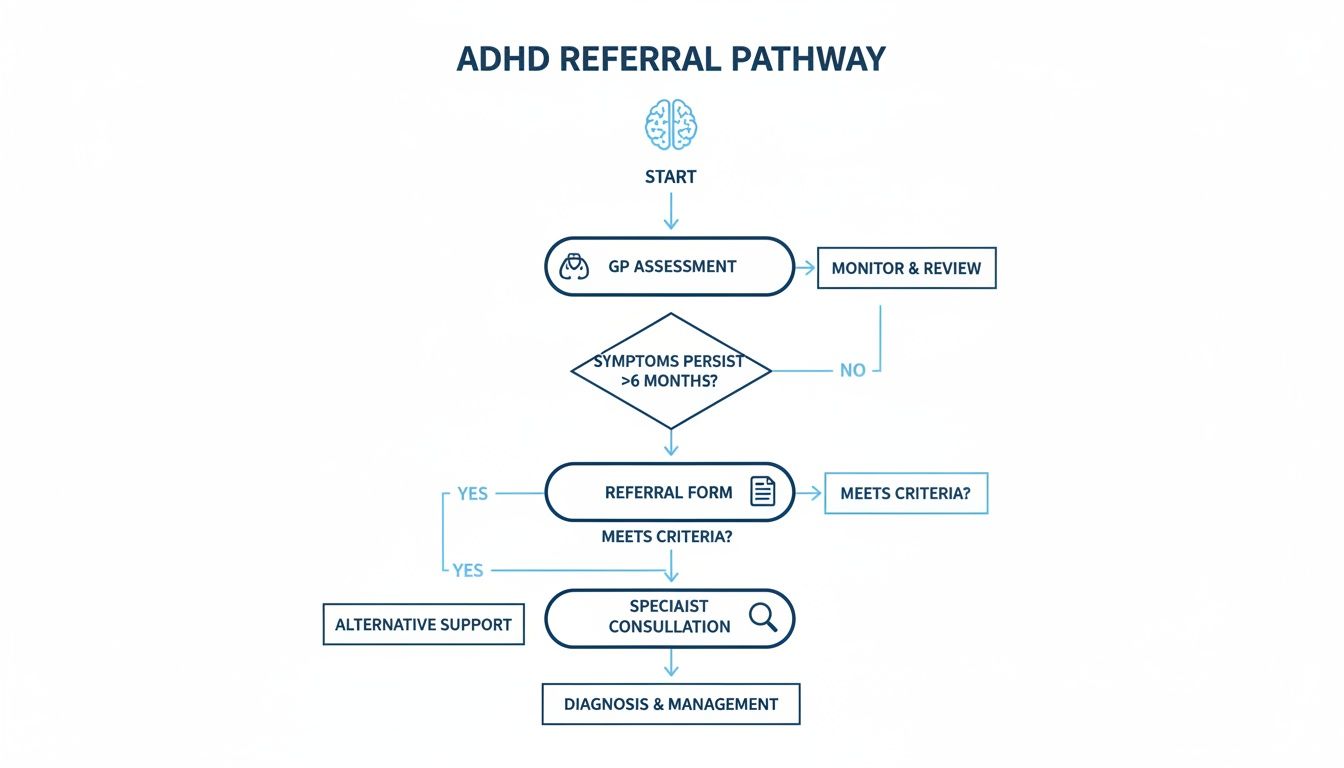
As you can see, every journey starts with recognising the signs and talking to a doctor. Where your referral form goes from there is what shapes the rest of your experience.
To give you a clearer picture, here’s how the three pathways stack up against each other.
Comparing UK ADHD Referral Pathways
| Feature | Standard NHS Referral | NHS Right to Choose (RTC) | Private Referral |
|---|---|---|---|
| Cost | Free | Free | £700 - £2,000+ |
| Waiting Time | Very long (often 1-5 years) | Varies by provider and NHS area | Very short (often 2-8 weeks) |
| Provider Choice | Limited to local NHS service | Choice of NHS-approved providers | Full choice of private clinics |
| Eligibility | All UK residents | England residents only | Anyone who can pay |
| Process | GP refers to local mental health trust | GP refers to your chosen provider | Self-referral or GP referral |
This table shows the clear trade-offs between cost, speed, and choice. There's no single "best" option—it all depends on your personal circumstances and what's most important to you.
The very existence of routes like RTC and private care is a response to a huge diagnostic gap. While an estimated 2.5 million adults in the UK are thought to have ADHD, official figures show that only a tiny fraction have a formal diagnosis. This massive gap highlights a huge unmet need, pushing thousands to find other ways to get the help they need.
Ultimately, choosing your pathway is a personal decision. By understanding these three routes, you can have a confident conversation with your GP and make sure your ADHD referral form starts you on the right track from day one.
How to Describe Your ADHD Symptoms on Paper
Trying to capture the chaotic, lived experience of ADHD on a form can feel like trying to explain a hurricane using just a few words. It's tough. But the goal here isn't just to tick boxes next to clinical symptoms; it's to paint a clear picture of how those symptoms actually affect your day-to-day life.
This is your chance to make the invisible, visible.
The real key is to go beyond generic labels. Saying "I'm disorganised" doesn't quite cut it. You need to show them what that looks like. Think of yourself as a storyteller, and this form is the story of why you need an expert's help. Your GP, and the specialist who eventually reads your referral, needs to understand the real-world impact of your symptoms, not just their names.
For instance, instead of just writing that you have trouble with focus, give them the details. Does it mean you can't finish a work report without re-reading the same paragraph ten times? Or that you zone out mid-conversation with your partner, causing arguments? Those specifics are what build a compelling case.

From Vague Feelings to Specific Examples
A great way to get your thoughts in order is to break them down by the core areas of ADHD and then tie each one to a part of your life. The main symptom clusters are inattention, hyperactivity, and impulsivity. Don't stress if you don't fit neatly into one box—most people are a combination. If you'd like to dig into this a bit more, you can learn more about the different types of ADHD in our article.
Let's look at how to translate these clinical terms into real-life experiences.
Inattention Examples
- At Work: "I regularly miss deadlines because I get completely sidetracked by small details, spending hours on the wrong part of a project. I also make careless mistakes in reports I've checked over and over, which has led to negative feedback from my manager."
- At Home: "My house is full of 'doom piles' because I get overwhelmed and can't figure out where to start organising. I'm always misplacing my keys, phone, and wallet, which often makes me late. I've even forgotten about food on the hob, which is becoming a real safety worry."
- In Relationships: "My partner often feels ignored because I zone out while they're talking to me. I forget important dates like anniversaries and birthdays, which I know causes genuine hurt."
Hyperactivity Examples
- At Work: "I find it physically impossible to sit still through an hour-long meeting. I feel this constant need to get up and walk around, which I know looks unprofessional. I'm always tapping my pen or bouncing my leg, which distracts my colleagues."
- At Home: "I can't just relax and watch a film from start to finish; I'm always jumping up to do something else. I feel an intense internal restlessness, like I'm 'driven by a motor', even when I'm completely exhausted."
- In Social Situations: "I tend to talk way too much and interrupt people without meaning to. I find it really hard to do quiet, calm activities and always need to be fiddling with something."
Impulsivity Examples
- Financially: "I have a habit of making big, impulsive purchases online that I can't really afford and then regret later. Sticking to a budget feels impossible because my immediate wants always seem to win out over my long-term needs."
- In Relationships: "I blurt out thoughts without a filter, which has definitely damaged friendships and professional connections over the years. I can also make huge life decisions on a whim, like quitting a job, without properly thinking it through."
- General Life: "I interrupt people all the time because I'm terrified I'll forget what I want to say. Waiting my turn in a queue or in traffic is incredibly frustrating for me."
The aim is to provide evidence of ‘functional impairment’. It’s not just about having symptoms; it's about showing that these symptoms create significant, ongoing problems in two or more areas of your life (like work and home).
Structuring Your Written Account
When it's time for your GP appointment, don't just rely on your memory. The stress of the situation can easily make your mind go blank. The best thing you can do is spend some time beforehand writing everything down. A simple structure can help keep your thoughts organised and make sure you don't miss anything important.
A really helpful trick is to create a bit of a timeline, noting when these challenges first started. ADHD diagnostic criteria require that several symptoms were present before the age of 12. Cast your mind back to your school days. Were you always being told you were "daydreaming," "disruptive," or "not living up to your potential"?
Here’s a practical framework to use:
- Childhood Evidence: Jot down specific memories or, even better, dig out old school reports. Look for recurring comments from teachers like "easily distracted," "fidgets constantly," or "needs to apply himself." This history is gold dust for a diagnosis.
- Current Challenges by Category: Use the inattention, hyperactivity, and impulsivity categories. Under each one, list 3-5 concrete examples from different parts of your life (work, home, social, financial).
- Impact Statement: Write a short paragraph summarising the overall effect this has on you. Don't be afraid to mention the emotional side—the constant feelings of failure, anxiety, or low self-esteem.
- What You've Tried: Briefly list the strategies you've used to cope (e.g., countless planners, apps, setting a dozen alarms) and explain why they just haven't been enough to solve the core problem.
By organising your experiences this way, you turn a confusing jumble of frustrating memories into a clear, logical case for an assessment. This prep work doesn't just strengthen your referral; it empowers you to walk into that appointment and have a much more confident and productive conversation with your doctor.
Looking for a private ADHD assessment?
Answer a few questions and we’ll shortlist clinics that fit — comparing price and waiting time.
Preparing for a Successful GP Appointment
Your GP appointment is the first real step towards getting an ADHD assessment, so it pays to be prepared. Walking in ready can be the difference between a productive chat and a frustrating dead end. Think of it less like a test and more like a meeting where you're presenting a clear, organised case for why you need help.
The aim is to make it as straightforward as possible for your GP to see your side of the story and agree that an ADHD assessment is a sensible next step. With GP appointments often squeezed into just 10-15 minutes, you haven't got a moment to waste. Getting your thoughts in order beforehand means you can use that time effectively.
This isn't about diagnosing yourself. It’s about clearly explaining what you're going through. You're the expert on your own life, and this is your chance to share that experience in a way a doctor can understand and act on.
Before the Appointment
Good preparation starts long before you're sitting in the consultation room. A few small steps can set the stage for a much smoother conversation.
Booking the right slot: When you ring the surgery, be clear about why you're calling. Instead of just asking for a routine appointment, try saying, "I'd like to book an appointment to discuss a referral for an adult ADHD assessment." This gives the receptionist a heads-up and might even land you a double slot if they're available.
Gathering your evidence: Bring everything you've put together. This means your list of symptoms and real-life examples, any old school reports you’ve dug out, and notes on how these struggles are affecting your work, home life, and relationships.
Knowing your pathway: Have a clear idea of which route you want to take. Are you asking for a standard NHS referral, using your NHS Right to Choose, or going private? If you're opting for Right to Choose or a private clinic, have their details ready to hand over.
Having all this organised in a folder doesn't just help you stay on track—it shows the GP you're serious and have done your research. It turns a vague worry into a concrete request for medical support.
Structuring the Conversation with Your GP
Once you're face-to-face, it's all too easy to feel rushed or for your mind to go completely blank. Having a simple plan for the conversation can keep you focused.
State your purpose clearly: Get straight to the point. A good opening is, "Thanks for seeing me. I've been struggling for a long time with what I believe are ADHD symptoms, and I'm here today to ask for a referral for a proper assessment."
Present your evidence: Don't just tell them, show them. Hand over your notes and say something like, "To make things easier, I've written down my main symptoms with examples, and I've brought some old school reports that show these issues go way back." This lets the GP read while you talk, which can really help get the message across.
Explain the impact: This is absolutely crucial. Focus on the "so what?" of it all. How are these symptoms actually messing up your life? For example, "My lack of focus is so bad it's putting my job at risk," or "My impulsivity is causing real problems in my marriage."
Make a specific request: Finish up by being direct about what you want. You could say, "I've looked into it and I'd like to use my Right to Choose to be referred to Psychiatry-UK. I have all their details right here for you."
Remember, your GP is a generalist, not necessarily an expert in adult ADHD. Your job is to give them the clear, compelling information they need to feel confident making the referral.
What to Do If Your GP Is Hesitant
Sometimes, a GP might be reluctant. They might suggest your symptoms are just anxiety or depression, or perhaps they're not familiar with the Right to Choose process. If this happens, try not to lose heart.
Stay calm but firm: Acknowledge their perspective but gently bring the conversation back to your concerns. You could say, "I see why you might think it's anxiety, but I’ve had these specific problems since I was a kid, and they don't go away even when my mood is fine. That’s why I feel a specialist assessment is so important."
Mention the NICE guidelines: The National Institute for Health and Care Excellence (NICE) sets the standards for ADHD diagnosis. Politely mentioning that your experiences line up with the official NICE guidelines can be very persuasive.
Know your rights: If you're using Right to Choose, you can calmly say, "My understanding is that under NHS rules, I have a legal right to choose my provider. I would really appreciate it if you could process this referral for me."
Ask for a second opinion: If you hit a complete brick wall, you are well within your rights to ask for an appointment with a different GP in the same practice.
Speaking up for yourself can feel intimidating, but arriving prepared with clear evidence and a calm attitude is your best strategy. It shifts the dynamic from a desperate plea for help to a structured conversation that’s much more likely to get you that all-important ADHD referral.
So, Your Referral Is Sent. What Happens Now?
Once your GP sends off your ADHD referral, you enter what can feel like a strange limbo. It’s easy to feel anxious or uncertain during this time, but knowing what's happening behind the scenes can make the wait a lot more manageable.
The journey from that GP appointment to an actual assessment looks very different depending on the path you’ve taken. Whether you're going through the standard NHS, using your NHS Right to Choose, or paying for a private clinic, each has its own timeline and way of doing things.
The Standard NHS Pathway Journey
After your GP refers you to your local NHS adult ADHD service, your form lands in a process called triage. Think of it as a sorting office for referrals. A clinical team will review your form to make sure it's landed in the right place and that your symptoms genuinely point towards ADHD.
If your referral gets the green light, you'll get a letter confirming you're on the waiting list. This letter might give you a rough estimate of the wait, but be prepared – these can be incredibly long. It’s not unusual for waits to be 18 months to several years in many parts of the UK.
Sadly, you might not hear much after that initial letter. The next point of contact will likely be when you’re finally nearing the top of the list and they're ready to book you in for an assessment.
It's always a good idea to ring the service a few weeks after your referral is sent, just to confirm they’ve got it. After that, it’s really a case of settling in for the long haul, which is a massive test of patience.
The NHS Right to Choose Pathway
The Right to Choose (RTC) route runs to your chosen provider's timeline, and you'll feel more in the loop. When your GP sends your referral to your chosen provider, like Psychiatry-UK or ADHD 360, the process is a bit more involved.
Acknowledgement and More Forms: The provider will usually get in touch with you directly to say they've received your referral. They'll then send you their own set of much more detailed forms to fill out. These often include self-report questionnaires and sometimes forms for a partner or family member to complete.
Triage and Waiting List: Once you've sent back all that paperwork, the provider's team will review it. If it all checks out, they'll formally accept you and add you to their waiting list.
Booking Your Assessment: Here’s the big difference – the wait. While it’s not instant, you're typically looking at a wait of months, not years. They'll contact you to book your video or in-person assessment as soon as you get to the front of their queue.
The Private Pathway Experience
Going private is by far the quickest option and involves the most direct communication. If your GP gave you a referral letter, you'll simply forward it to your chosen clinic. If you're self-referring, you'll just make the first move yourself.
The process is refreshingly straightforward:
- Initial Contact and Payment: You get in touch with the clinic, send them your referral letter (if you have one), and they'll walk you through their setup process, which includes paying for the assessment.
- Pre-Assessment Forms: Just like the RTC pathway, they'll send you detailed forms and questionnaires to fill out before your appointment.
- Booking Confirmation: The best part? You can usually book your assessment date almost straight away. The wait is often just a matter of weeks, depending on how busy the clinic is.
The private experience is built around efficiency. You're a paying customer, and the service usually reflects that. You can expect clear, consistent communication from their admin team every step of the way.
Finding and Choosing the Right ADHD Clinic

So, you've got your approved ADHD referral form. What now? This next step is a big one: choosing the right clinic. This decision is what turns that piece of paper into a real appointment, bridging the gap between your GP's sign-off and the assessment you've been waiting for.
It can feel a bit overwhelming, but a bit of structured thinking makes it much more manageable. Think of it like booking a holiday – you wouldn't just pick the first flight you see. You'd compare them on price, timing, and whether they fly to the right destination. The same logic applies here, and using a good directory is the best way to do your homework.
Using a Directory to Compare Your Options
The main goal is to find a clinic that fits your specific needs, especially when it comes to how quickly you can be seen, your budget, and the kind of care you're looking for. A decent platform will let you filter and compare providers using a few key criteria.
- Wait Times: How long until you can actually get an appointment? For many people, this is the most important factor of all.
- Costs: What’s the all-in price for the assessment package? And crucially, are there any hidden extras for things like medication titration or follow-up appointments?
- Right to Choose (RTC) Availability: Does the clinic accept NHS Right to Choose referrals? This is vital if you're hoping to get NHS funding for your assessment.
- Shared Care Agreements: Will they work with your GP for your prescriptions after you’ve been diagnosed? Getting this sorted can save you a huge amount of money in the long run.
By looking at clinics through this lens, you can quickly turn a long, confusing list of names into a shortlist of ones that are a genuine fit. It takes the guesswork out of the process and lets you make a decision you can feel good about.
Identifying Trusted and Verified Providers
Beyond the practical stuff, you need to feel you can trust the clinic. Look for providers with transparent user reviews on platforms like Trustpilot or Google. Reading about the real-life experiences of other patients gives you a priceless glimpse into a clinic's professionalism, communication, and the quality of care they provide.
For a more in-depth look at this, our guide on getting a private ADHD diagnosis has even more detailed advice.
Taking the time to choose carefully ensures your referral leads to a positive and supportive assessment, finally connecting you with the right people to help you move forward.
Got Questions About Your ADHD Referral?
It’s completely normal to have a lot of questions when you’re trying to navigate the referral process. The different rules, pathways, and timelines can feel a bit overwhelming at first. To help clear things up, here are some straightforward answers to the questions we hear most often.
Can I Just Refer Myself Without Seeing a GP?
When it comes to any NHS-funded assessment, whether that’s the standard route or through Right to Choose, the answer is no – a GP referral is essential. It’s a non-negotiable part of the process.
However, if you're looking at private options, you'll find there's a lot more flexibility. Many private ADHD clinics are happy to accept self-referrals, meaning you can contact them directly and book an assessment. It's always a good idea to check their policy first, though, as some still prefer a letter from your GP to get a clear picture of your medical history.
What Happens If My GP Says No to a Referral?
Hearing your GP refuse your request can be really disheartening, but don't give up. You have options.
Your first step should be to calmly ask the doctor to explain their reasoning and to put it in writing for you. You are always entitled to ask for a second opinion, either from another doctor at the same surgery or by registering at a different practice. When you go to that next appointment, be prepared. Bring your completed symptom checklists and be ready to clearly explain how these challenges are affecting your daily life.
If you’re asking for a referral under the NHS Right to Choose scheme, you can politely remind your GP that this is your legal right. Being informed, firm, and respectful is usually the best way to move forward.
How Long Does This Whole Referral Process Take?
This is the big question, and the answer really depends on which path you take. The timelines can vary massively.
- Standard NHS Referral: This is unfortunately the longest route. Waiting lists can stretch from several months to, in some parts of the country, over two years.
- NHS Right to Choose: Waiting times are set by the provider you choose and vary by NHS area, so ask them for their current wait.
- Private Referral: This is by far the quickest way to get an assessment. You can often be seen within just a few weeks of making your first enquiry.
Finding the right path starts with having the right information. At ADHD Private, we've created a free directory to help you compare UK clinics by wait times, costs, and services offered. Explore your options and take the next step with confidence at https://adhdprivate.co.uk.