Your Guide to ADHD UK Right to Choose
Navigate the ADHD UK Right to Choose pathway with confidence. Learn how to get a GP referral for a faster NHS-funded ADHD assessment at a private clinic.
Ever felt stuck between a rock and a hard place? That’s often how it feels when you’re seeking an ADHD assessment in the UK. On one hand, you have the standard NHS route, which is free but often comes with agonisingly long waiting lists. On the other, there's the option to go private, which is fast but can cost a small fortune.
Thankfully, there’s a third way. Think of the NHS Right to Choose pathway as a bridge between those two options. It’s a legal right for patients in England that lets you choose an approved private clinic for your assessment, with the entire cost covered by the NHS. It's a game-changer.
So, What Exactly Is NHS Right to Choose?
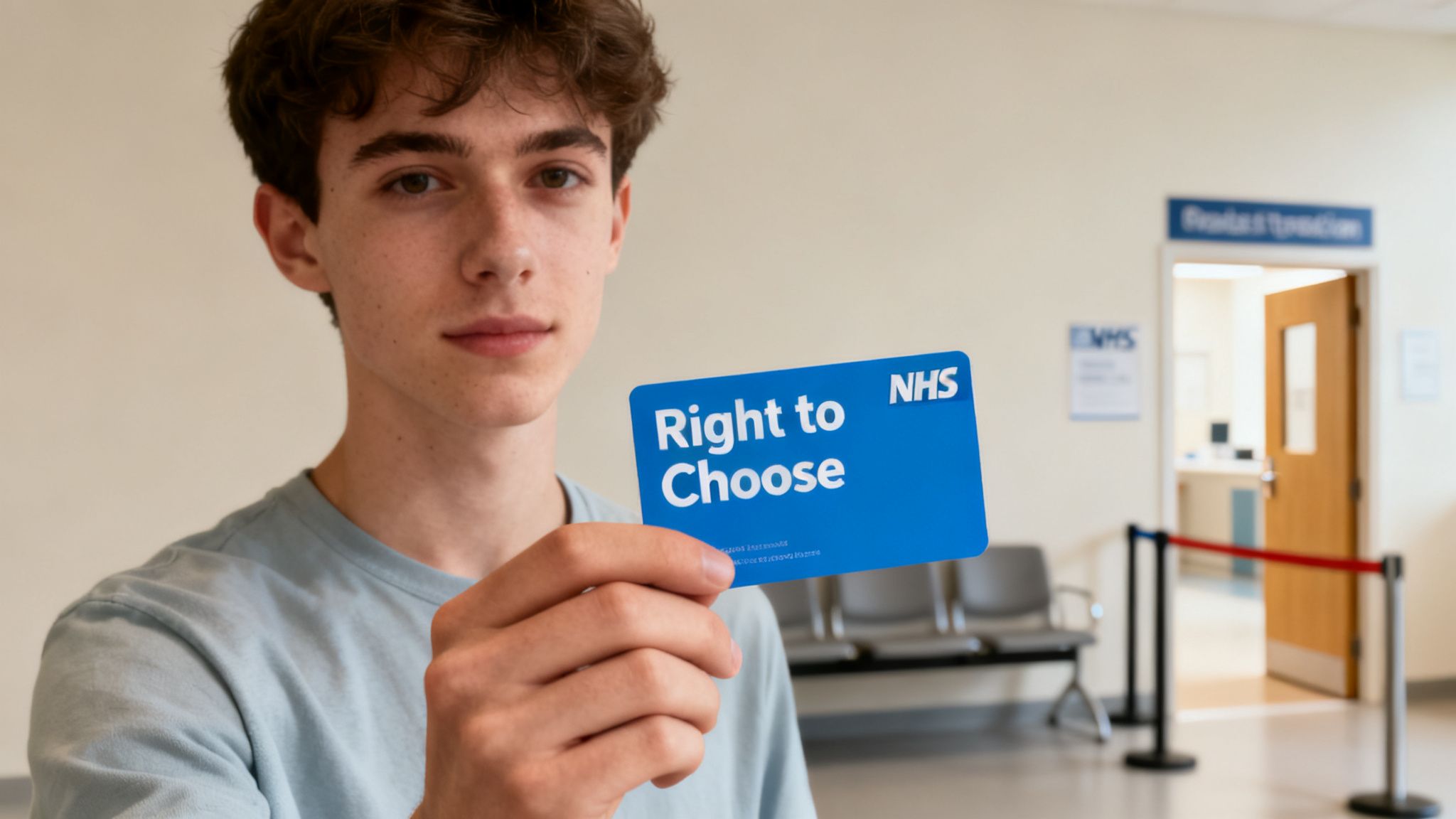
At its heart, the ADHD UK Right to Choose pathway is a piece of NHS legislation designed to give you, the patient, more control. It recognises that getting timely mental health support is vital and shouldn't depend solely on your local NHS trust's capacity.
Let's put it another way. Imagine the normal NHS route is like joining the back of a very long queue at your local post office. You know you'll get served eventually, but the wait feels endless and unpredictable. Going fully private is like paying for a premium courier to come directly to your door—incredibly fast, but also very expensive.
Right to Choose is the clever alternative. It's like discovering you can book a slot at a different, quieter post office branch. The service is still provided and paid for by the Royal Mail (the NHS), but you get to pick a more efficient location (an approved private clinic) and skip that massive queue.
Why This Pathway Is Such a Lifeline
The Right to Choose scheme has become absolutely essential as awareness of adult ADHD has grown. This surge in understanding has led to a flood of referrals, and local NHS services are struggling to keep up. The numbers are staggering: recent data shows over 549,000 children and adults in England are currently waiting for ADHD services. In some areas, people are being told they might have to wait over 10 years.
This is where Right to Choose makes a profound difference. By allowing your GP to refer you to a qualified private provider that holds an NHS contract, the pathway helps to:
- Slash waiting times, often cutting them down from several years to just a few months.
- Open up access to specialist care that might not be available in your immediate area.
- Put you in the driver's seat, giving you a say in who provides your assessment.
This legal right means you can access a much quicker diagnosis without the heavy financial burden of going fully private. It is your right to ask your GP for a referral to a qualified provider that accepts patients under this scheme.
Comparing Your ADHD Assessment Options
To help you get a clear picture, here’s a quick comparison of the three main routes to an ADHD assessment. Seeing the differences in waiting times, costs, and flexibility is the best first step in figuring out which path works for you. For a more detailed walkthrough, don't forget to check out our complete guide on how to get tested for ADHD.
| Feature | Standard NHS Pathway | NHS Right to Choose | Fully Private |
|---|---|---|---|
| Cost | Free (funded by the NHS) | Free (funded by the NHS) | £700 - £2000+ (self-funded) |
| Waiting Time | Very long (often 2-5+ years) | Shorter (weeks to several months) | Very short (days to a few weeks) |
| Provider Choice | Limited to your local NHS trust | You can choose any qualified provider with an NHS contract | Complete freedom to choose any private clinic |
| Location | Usually restricted to your local area | Nationwide choice, often with online options | Nationwide choice, including online and in-person options |
As you can see, Right to Choose offers a powerful middle ground, combining the cost-free benefit of the NHS with the speed and choice often associated with private care.
Are You Eligible for Right to Choose?
Before you can take advantage of the Right to Choose pathway for your ADHD assessment, you first need to check if you qualify. Thankfully, the rules are pretty clear-cut, so it’s not as complicated as it might sound.
The whole point of this initiative is to give you, the patient, more say in your healthcare journey. It's also a practical way to help tackle the notoriously long waiting lists for NHS mental health services, getting you the support you need much sooner.
The Main Eligibility Rules
So, what are the key criteria? It all boils down to two simple points.
To use Right to Choose for an ADHD assessment, you must:
- Be registered with a GP in England. This is the big one. The right is specifically part of the NHS England system, so where your GP practice is located is what matters.
- Have your GP agree that a referral is clinically necessary. This just means your doctor agrees that your symptoms warrant an assessment for ADHD.
If you tick both of these boxes, you have a legal right to choose which qualifying provider carries out your NHS-funded assessment.
A Few Important Caveats: Location and Age
One thing that often trips people up is the question of location. It's vital to know where this right applies to avoid any bumps in the road.
- England Only: Right to Choose is exclusive to NHS England. If your GP is in Scotland, Wales, or Northern Ireland, this pathway won't be available to you as they operate under different healthcare frameworks.
- Age Limits: While the right itself doesn't specify an age, most private clinics that accept Right to Choose referrals focus on adults (18 and over). ADHD assessments for children and teenagers are usually managed by local Child and Adolescent Mental Health Services (CAMHS).
This scheme has become a lifeline for thousands. With ADHD awareness growing, referral numbers have skyrocketed—recent NHS England data shows over 549,000 people are currently on waiting lists. Right to Choose provides a crucial alternative to years of waiting. You can find out more about these ADHD incidence rates to see just how significant the demand is.
To put it simply: if you’re an adult, you're registered with a GP in England, and that GP believes an ADHD assessment is needed, you are eligible. Your doctor cannot refuse your request based on where the clinic is located or its cost to the local health authority.
Confirming your eligibility is the first real step. It gives you the confidence to talk to your GP and advocate for your health, knowing you have a recognised right on your side.
How to Get Your GP Referral
Walking into your GP’s surgery feeling prepared is the single biggest thing you can do to get a referral for an ADHD assessment. This isn’t about having a confrontation; it's about being organised, informed, and confident. With the right preparation, you can turn what might feel like a daunting chat into a clear, successful step towards getting help through the ADHD UK Right to Choose pathway.
Think of it like building your case. You wouldn't turn up to an important meeting without your notes, and this is a critical meeting about your health. The aim is to lay out your experiences and your request so clearly that it's simple for your GP to say "yes."
Before you even book the appointment, it helps to quickly double-check that you meet the basic criteria for Right to Choose.
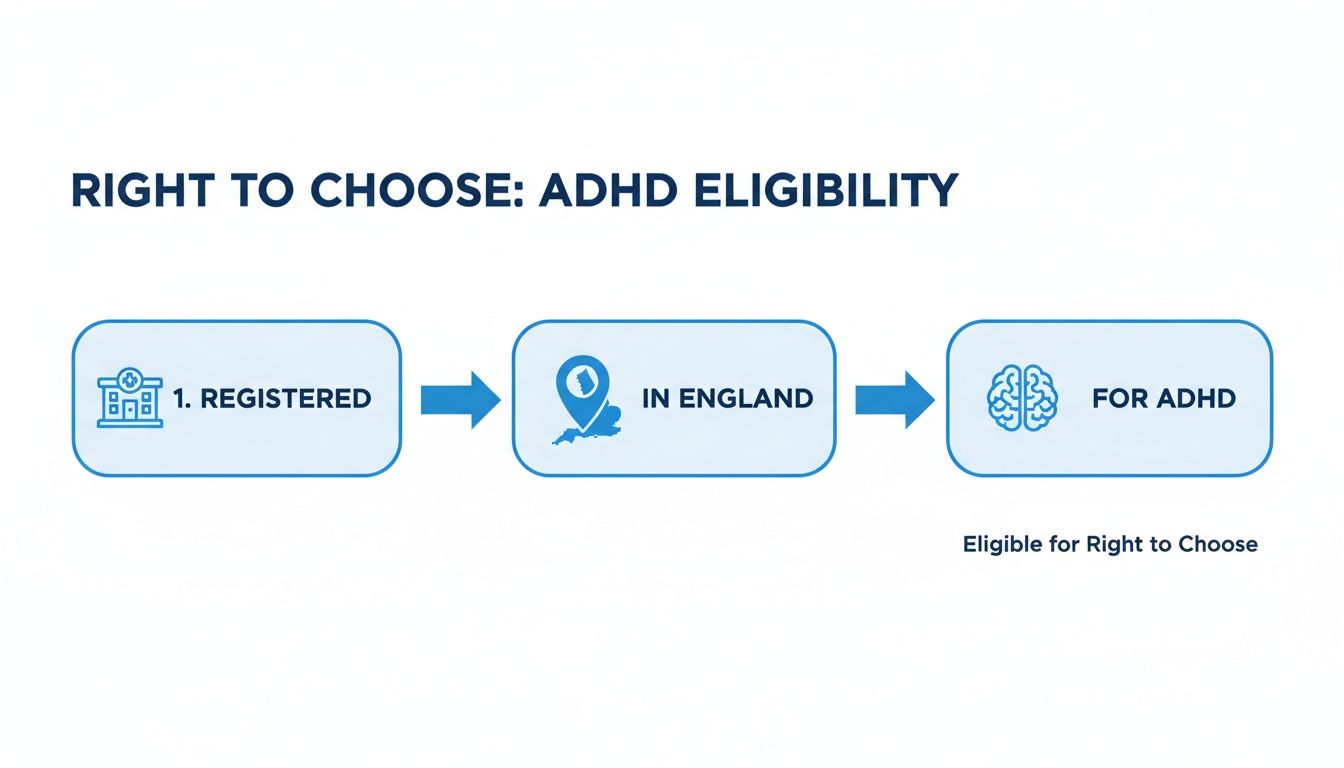
As you can see, the main pillars are straightforward: you need to be registered with a GP in England and be asking for a referral specifically for ADHD.
Your GP Appointment Checklist for a Right to Choose Referral
To make things even easier, here’s a step-by-step checklist to guide you. Following these steps will help you feel completely ready for your appointment and confident in your request.
| Step | Action to Take | What to Bring or Say |
|---|---|---|
| 1. Choose Your Clinic | Before your appointment, research and pick a specific clinic that accepts Right to Choose referrals. Check their current wait times. | "I would like to be referred to [Clinic Name] under Right to Choose." |
| 2. Book a Longer Slot | A standard 10-minute appointment is rarely enough. When you call, ask for a double appointment to discuss a mental health referral. | "I'd like to book an appointment to discuss a mental health referral. Could I please have a double slot to make sure there's enough time?" |
| 3. Complete a Screener | Fill out an ADHD self-assessment form, like the Adult ADHD Self-Report Scale (ASRS). This provides clear, evidence-based information. | Bring the completed, printed form with you to hand to your GP. |
| 4. List Your Examples | Jot down real-life examples of how your symptoms affect you at work, in relationships, and day-to-day. Think about childhood and now. | "Forgetting deadlines at work is a constant issue," or "I've always struggled with maintaining friendships because I interrupt people." |
| 5. Write a Referral Letter | This is your secret weapon. Prepare a polite letter outlining your symptoms, your request, and your chosen clinic's details. | Hand the letter to your GP at the start of the appointment. It does all the hard work for you. |
Having these things sorted beforehand transforms the conversation. You’re no longer just talking about feelings; you're presenting a clear, well-researched request for care.
What to Say to Your Doctor
When you're in the appointment, all your prep work will really shine. Start by briefly explaining the symptoms you've been experiencing, using the specific examples you wrote down.
Then, hand over your paperwork. You can say something direct and simple, like:
"I've been finding things really difficult with what I believe are symptoms of ADHD. I've filled out this self-assessment form and have written a letter to explain everything. I'd like to use my Right to Choose and ask for a referral to [Clinic Name] for an assessment, please."
What if your GP isn't familiar with Right to Choose or mentions funding concerns? Don't panic. You can calmly and politely refer back to the official NHS guidance.
A good phrase is: "My understanding from the NHS England guidance is that under Right to Choose, I'm entitled to this referral, and the funding is arranged directly between the clinic and the NHS."
Ultimately, being prepared is how you advocate for yourself effectively and respectfully. While you're weighing up your options, you might also find it helpful to read about getting a private ADHD diagnosis. But for the NHS route, this preparation is your best bet for a smooth and successful referral.
Finding Clinics That Accept Right to Choose
So, you know you have a legal right to choose your provider—that's the first hurdle cleared. Now for the practical part: finding a clinic that actually accepts these referrals. This is where you’ll need to do a bit of legwork, but it's probably more straightforward than you imagine. The goal here is to create a solid shortlist of qualified clinics to take to your GP.
The most important thing is to find providers who explicitly state they accept ADHD UK Right to Choose referrals. These clinics already have agreements in place with the NHS, which means your assessment and treatment can be funded publicly. You'll usually find this information displayed prominently on their websites.
What to Look for in a Clinic
When you're comparing clinics, you're looking for more than just a name on a list. You need to dig into a few key details to feel confident in your choice and make sure the referral process with your GP is as smooth as possible.
Here's what to focus on:
- NHS Contract Status: This is the big one. Does the clinic clearly state it works under the NHS Right to Choose scheme? If it's not obvious, move on.
- Current Waiting Times: Good clinics are upfront about how long you'll be waiting for an assessment and, just as importantly, for the medication titration period afterwards. This can vary wildly, from a few weeks to many months.
- Assessment Process: Do they conduct assessments online via video call, or will you need to attend in person? Make sure their setup works for you and your circumstances.
- Patient Reviews: Check out what real patients are saying. A quick search on Google or Trustpilot can give you a genuine feel for a clinic's level of service and how well they communicate.
Well-Known Right to Choose Providers
While the list of participating clinics is growing, a few names tend to pop up again and again. These are often a great place to start your search.
Providers like Psychiatry-UK, ADHD 360, and Clinical Partners are very familiar with the Right to Choose process. They have well-established systems for handling these referrals and usually provide clear, step-by-step guides on their websites for both you and your GP. Psychiatry-UK, for instance, is a completely online service, which is a huge advantage for accessibility, no matter where you are in England.
Choosing a provider is a personal decision. Think about what's most important to you. Is it the shortest waiting list? A particular assessment style? Or are glowing patient reviews the deciding factor? A little research now will empower you to pick the clinic that feels right for your needs.
Using Directories to Simplify Your Search
Trying to hunt down and compare all the different clinics can feel like a mammoth task. Thankfully, dedicated directories can do the heavy lifting for you. Instead of jumping between dozens of websites, you can see all the essential information in one place, making it much easier to filter and compare your options.
A well-curated directory is an invaluable tool. It brings together all the vital stats you need—from assessment costs (which can range from £400 to over £1,200 privately) and waiting times (anywhere from 1 to 12 weeks or more) to whether they offer online services. You can quickly see which clinics, like Psychiatry-UK or ADHD 360, have established Right to Choose pathways.
Taking a bit of time to find the right clinic is a crucial step. It sets you up for a smoother referral and, ultimately, a much faster journey to getting the support you need.
For an up-to-date list, you can browse our own dedicated directory of clinics that accept Right to Choose.
What to Expect After Your Referral

You’ve done the hard part. You’ve spoken to your GP, explained your reasons, and your referral is finally on its way to your chosen clinic. It's a massive step forward, but it can also feel like you’ve just entered a new kind of limbo. So, what happens now? How long will it all take, and what does the road ahead really look like?
Knowing what to expect can make all the difference, helping you manage your own expectations and reduce any anxiety around the process. It's best to think of this next phase as a series of clear steps: confirmation, assessment, and then treatment. Each stage has its own timeline, but seeing the whole picture makes everything feel much less daunting.
From Referral to First Contact
Once your GP sends the referral, the ball is officially in the clinic's court. Most providers will send you something to acknowledge they’ve received your documents, usually within a few weeks. It's worth noting that some of the most popular clinics, like Psychiatry-UK, mention it can take up to 10 weeks just to process the initial referral due to the sheer volume they handle.
You should get an email or a text confirming you're on their waiting list. This first message is important—it's your proof that the referral has landed safely. It will likely include instructions for setting up an online patient portal, which is where you’ll manage your appointments and communications from now on.
After that confirmation, the real waiting begins. While the ADHD UK Right to Choose pathway is a lot quicker than the standard NHS route, you still need to be realistic. Waiting times for an assessment can stretch to several months. A good tip is to check your chosen clinic's website regularly, as they often post up-to-date waiting list estimates.
The Diagnostic Assessment Process
When your name reaches the top of the queue, you'll get an invitation to book your assessment. These are almost always held online via a secure video call and typically last between one and two hours. The session will be led by a specialist, either a psychiatrist or an ADHD nurse prescriber.
The assessment itself is essentially a structured conversation. The goal is to build a complete picture of your experiences, covering things like:
- Your current symptoms: How they show up in your day-to-day life, from work and studies to your relationships.
- Your childhood: The clinician needs to find evidence of symptoms before the age of 12, so they'll ask questions about your school days and early years.
- Your medical history: This helps to rule out other conditions and ensures that if medication is offered, it will be safe for you.
Before your appointment, you’ll probably be asked to fill out some detailed questionnaires. It’s also incredibly useful to ask a family member or a close friend who has known you for a long time to provide their own observations—their perspective can offer valuable context.
The goal of the assessment isn't just to see if you "tick the boxes" for ADHD. It’s a collaborative effort to truly understand your unique challenges and map out your life experiences.
Life After a Diagnosis
If you do receive an ADHD diagnosis, the journey doesn't stop there. The next steps are all about treatment, which usually means medication, therapy, or a blend of both.
For many, the first step is medication. This begins with a process called titration, where you work closely with your specialist to find the right medication and the perfect dose for you. It’s a careful, gradual process that can take several months because it’s tailored completely to how your body responds. It’s important to know that there is often another waiting list just to start titration, which some clinics warn can be up to 10 months long.
Once your medication is working well and your dose is stable, the final—and most crucial—step is setting up a shared care agreement. This is a formal arrangement between your private specialist and your NHS GP. It’s what allows your GP to take over prescribing your medication on the NHS, meaning you only have to pay the standard prescription fee. Without this agreement in place, you’d be stuck paying for private prescriptions, which can easily cost over £100 a month. Making sure both your clinic and your GP are on board with this from the start is absolutely vital for affordable, long-term care.
Common Questions About Right to Choose
It’s completely normal to have questions when you first hear about the ADHD UK Right to Choose pathway. Let’s face it, navigating any part of the NHS can feel a bit like learning a new language. Here, we'll break down the most common things people ask, giving you clear, straightforward answers to help you feel confident about your next steps.
Can My GP Refuse My Right to Choose Referral?
This is a big worry for many, but let's clear it up: legally, your GP can't refuse a referral simply because of funding or because the clinic isn't local. The only valid reason for refusal is on clinical grounds – for instance, if they genuinely don't believe an ADHD assessment is clinically necessary for you.
The reality is, though, that many GPs just aren't familiar with Right to Choose. If you meet with a bit of resistance, the best approach is to stay calm, polite, and prepared.
- Go in with the facts: Bring a printout of the official NHS guidance on the 'NHS Choice Framework'. It also helps to have the letter from your chosen clinic that explains the process from their end.
- Explain the funding: Gently remind them that this is your legal right under NHS England rules. It’s important to clarify that the funding is handled directly between the clinic and your local Integrated Care Board (ICB), so it doesn't come out of the GP practice’s budget.
- Know when to escalate: If your GP still won't budge without a good clinical reason, your next step is to speak with the practice manager. You can also contact your local ICB directly for support.
What Costs Are Involved with Right to Choose?
Here's the best part: Right to Choose is funded by the NHS. Your assessment and diagnosis are provided completely free of charge, just as they would be if you were waiting for your local NHS service. No hidden fees for the core service.
The crucial part to understand, however, is what happens after a diagnosis. If you’re prescribed medication, you’ll start a process called titration. This is where a specialist works with you to find the right type of medication and the correct dosage, which can take a few months.
Be aware that some Right to Choose providers may charge private fees for this titration period before they can set up a shared care agreement with your GP. It is absolutely essential to ask about the provider's full cost structure before you commit, so you don’t get hit with any unexpected bills.
Once your dose is stable, the clinic will arrange a shared care agreement with your GP. This allows your GP to take over writing your prescriptions, meaning you'll only have to pay the standard NHS prescription fee.
How Is Right to Choose Different From Going Fully Private?
The main difference boils down to one simple thing: who foots the bill. One route is paid for by the taxpayer, and the other comes straight out of your own bank account.
With Right to Choose:
- The NHS funds the assessment and diagnosis.
- The end goal is for your long-term medication to be prescribed on the NHS via a shared care agreement.
- Waiting times are much shorter than the standard NHS path, but usually a bit longer than going fully private.
If you go fully private:
- You pay for everything – from the initial assessment (which can often be £700 - £2,000+) to every single follow-up appointment.
- You also have to cover the full cost of private prescriptions, which can easily be over £100 per month.
- This is by far the fastest option, with some clinics offering appointments within just a few weeks.
Think of Right to Choose as the perfect middle ground. It gives you the speed and choice of the private sector, but without the hefty price tag.
Does Right to Choose Cover Medication and Treatment?
Yes, absolutely. The Right to Choose pathway is designed to cover your entire journey, from the initial assessment right through to getting a stable treatment plan in place. The provider you select is responsible for all aspects of your care until that point.
Here’s what that journey usually looks like:
- Assessment and Diagnosis: This is step one, and it's fully covered by the NHS.
- Medication Titration: If medication is the right path for you, the specialist will manage this process. As we mentioned, check if the provider charges for this specific phase.
- Shared Care Agreement: This is the finish line. It's a formal agreement where the specialist hands over the prescribing responsibility to your GP, making your treatment affordable long-term.
That shared care agreement is the key to it all. Before you even ask for a referral, make sure your chosen clinic is good at setting them up and, just as importantly, that your GP practice is generally willing to accept them. Without one, you could be left paying for expensive private prescriptions indefinitely.
Finding a clinic that communicates clearly, fits your needs, and has a smooth process for shared care is the most important part of this journey. At ADHD Private, our free directory is built to make this easy. You can compare over 85 clinics, see up-to-date wait times, and find a provider that accepts Right to Choose referrals today at https://adhdprivate.co.uk.