Your Guide to Private ADHD Diagnosis in the UK
Considering a private ADHD diagnosis? Our guide explains costs, process, wait times, and NHS comparison. Make an informed choice.
Written and maintained by the ADHD Private editorial team, drawing on NHS, NICE and ADHD UK guidance. This is general information, not medical advice.
Going for a private ADHD diagnosis means you can get an assessment and potential treatment directly, cutting out the notoriously long NHS waiting lists. For so many people, it’s the difference between getting clarity and support in a matter of weeks or months, instead of the years it can often take through the public system.
Why More People Are Choosing a Private ADHD Diagnosis
If you're looking into a private ADHD diagnosis, you're definitely not on your own. There’s a growing number of people who feel a real sense of urgency, frustration, and a deep need for answers that the current NHS system is struggling to provide.
You can think of the journey to an ADHD diagnosis as two completely different paths.
The NHS pathway is like a scenic, winding country road. It's comprehensive and free at the point of use, but my word, it can be slow. You’re often met with unexpected detours and long, frustrating waits. The private route, on the other hand, is more like a direct motorway. You pay a fee, but in return, you get a clear, fast, and much more predictable journey to your destination: a diagnosis.
The Reality of NHS Waiting Times
The main reason people are turning to private healthcare is simple: the sheer length of NHS waiting lists. Demand for ADHD assessments has exploded in recent years, and services are completely overwhelmed. If you're struggling day-to-day at work, in your studies, or in your relationships, waiting several years for an appointment just isn't realistic.
And we're not talking about a minor delay here. The scale of the problem is huge. Projections suggest that NHS waiting lists for ADHD assessments in England could hit 500,000 people by the middle of 2025. What's more, over a quarter of those people will have been waiting more than two years for help.
This isn't just anecdotal; some NHS trusts saw their referral numbers triple after the pandemic, creating a bottleneck that the system just can't handle. You can dig into the full report from the NHS taskforce to see just how deep the issue runs.
This context is important because it validates that feeling of frustration. Choosing a private assessment isn't about jumping the queue; it's about taking back control, finding answers to lifelong struggles, and finally getting the support that can make a real, tangible difference to your life.
For many, a private ADHD diagnosis is the first step towards self-understanding and implementing effective strategies to manage their symptoms. It shifts the focus from waiting to actively moving forward.
Introducing a Middle Ground Option
It's also worth knowing that the choice isn't just a straight split between the slow public route and the costly private one. There's a popular middle-ground option in England known as Right to Choose.
This pathway offers a sort of hybrid approach. It allows you to choose an NHS-funded provider—which can include certain private clinics that also work with the NHS—potentially cutting your wait time down significantly without you having to foot the entire bill. We’ll explore this and other pathways in more detail, giving you the confidence to navigate the system and find what’s right for you.
What to Expect from Your Private ADHD Assessment
Thinking about getting a private ADHD assessment can be a bit daunting. It’s totally normal to feel a mix of hope and nervousness. You might be picturing a single, high-pressure interview, but the reality is much more structured and, frankly, more supportive than that.
The whole point is to build a detailed, three-dimensional picture of you and your life experiences. It’s not a one-off chat; it’s a process. Each step is designed to add another layer of understanding for the clinician, ensuring the final outcome is based on solid evidence, not just a quick conversation.
This flowchart gives you a bird's-eye view of the different routes you can take, comparing the more direct private pathway with the often longer NHS journey and the hybrid Right to Choose option.
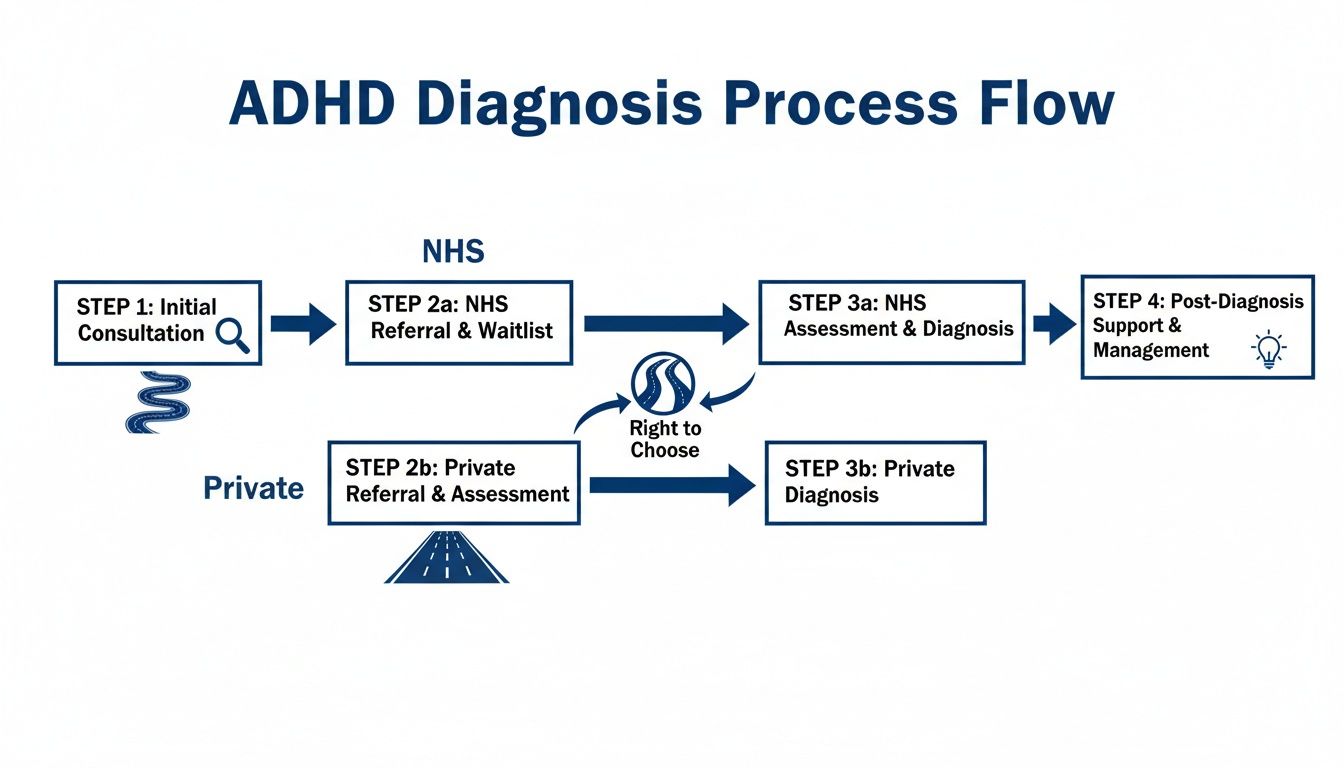
As you can see, the private route is a bit like a motorway – its main advantage is getting you to a conclusion much more quickly and directly.
Your Journey, Step-by-Step
While every clinic has its own way of doing things, the fundamental stages of a private ADHD diagnosis are surprisingly consistent across the UK. Think of it as a clear roadmap with a few key stops.
Initial Contact and Screening: It all starts with you reaching out. Most clinics will then send you a short screening questionnaire. This isn’t the assessment itself, but a quick check to see if a full evaluation makes sense for you. If you're curious about the kinds of questions they ask, this free ADHD test can give you a rough idea.
Pre-Assessment Questionnaires: Once you’re booked in, you'll get a much more detailed set of forms to fill out. These are incredibly important. They’ll dig into your symptoms, your experiences as a child, and how these traits affect your life today—from work and studies to your relationships. Often, they'll ask for someone who knows you well, like a partner or parent, to fill one out too, giving them an outside perspective.
The Diagnostic Interview: This is the main event. It's a structured conversation with a specialist—usually a psychiatrist or a specially trained psychologist—that typically lasts between one and three hours. They'll use your questionnaire answers as a launchpad, asking you to expand on them with real-life examples.
What Are the Clinicians Actually Looking For?
During that interview, the clinician's job is to connect the dots between your past and your present. They're searching for a consistent pattern of ADHD traits that started in childhood and are still causing you significant problems today.
A private ADHD diagnosis isn't about slapping a label on you. It's about deeply understanding the unique way your brain is wired, identifying those lifelong patterns, and creating a practical framework for support.
For instance, they might ask about old school reports. A teacher's comment from Year 4 saying you were "bright but easily distracted" can be a powerful piece of the puzzle. They'll then link that to your current challenges, like struggling to stay focused during long meetings at work.
They’ll also be exploring a few key areas:
- Executive Function: How do you get on with managing your time, organising projects, or even just staying on top of your finances?
- Emotional Regulation: Do you find your moods swing a lot, or do you experience emotions very intensely?
- Relationships: How have these traits affected your friendships, family life, or romantic partnerships?
- Hyperactivity and Impulsivity: This isn't just about fidgeting. It can show up as mental restlessness, making snap decisions you later regret, or frequently interrupting people.
Getting Your Diagnostic Report
After the assessment, the clinician pulls everything together—your questionnaires, the interview notes, and any other evidence you provided—into a comprehensive diagnostic report. This is a substantial document, often 10-20 pages long, and it's far more than a simple 'yes' or 'no'.
It will lay out the findings in detail, explain how your specific symptoms match the official diagnostic criteria, and give you personalised recommendations. These might include suggestions for therapy, adjustments you could ask for at work or university, and, if it’s right for you, information about medication. This report is the key that unlocks the next stage of support.
Let's be honest, one of the first questions on anyone's mind when considering a private ADHD diagnosis is: "How much is this going to cost?" It’s a perfectly valid question. While going private offers speed and accessibility that the NHS often can't match, it is a significant financial commitment. Understanding the costs upfront is key to planning properly and avoiding any nasty surprises down the line.
The important thing to realise is that the price isn't just one single number. It’s better to think of it as a series of costs covering different stages of your journey, from the initial assessment to ongoing treatment. Breaking it down this way makes it much easier to compare clinics and understand exactly where your money is going.
Breaking Down the Initial Assessment Fee
The main price you'll see advertised is for the initial diagnostic assessment. This is the big one—the cost of finding out for sure.
Here in the UK, you can expect a comprehensive adult ADHD assessment to cost anywhere from £500 to over £1,500. That’s quite a wide range, I know. The final figure often depends on things like the clinic's reputation, how senior the clinicians are, and exactly what they bundle into their assessment package.
So, what does that fee typically cover?
- The Diagnostic Interview: This is the core consultation with a specialist psychiatrist or psychologist. It’s an in-depth session that can last for several hours.
- Review of Your Paperwork: The clinician needs time to go through all your pre-assessment questionnaires and any supporting information you’ve gathered from school or family.
- A Full Diagnostic Report: You’ll receive a detailed document that explains the findings, confirms the diagnosis (if you have one), and provides initial recommendations for what to do next.
A word of advice: always check what’s included. Some clinics have a clear, all-in price, while others might have a lower headline fee but then charge you extra for the final written report.
Looking Beyond the Diagnosis Itself
Getting the diagnosis is a huge step, but it's often just the beginning of the financial journey, especially if medication is part of your plan. This is where ongoing costs start to appear, and they can catch you out if you’re not ready for them.
If you decide to try medication, you'll enter a process called titration. This isn't as simple as just being handed a prescription. It’s a carefully managed period where your specialist works closely with you to find the right medication and the most effective dose. This trial-and-error phase can take weeks, sometimes months, of fine-tuning and monitoring.
A private ADHD diagnosis gives you the "what"—the clarity and understanding. The next steps, like titration and follow-up care, are all about the "what now"—creating a practical, long-term plan to manage your symptoms effectively.
Clinics nearly always charge for titration separately from the assessment. This cost can fall anywhere between £200 and £800, sometimes more. This usually covers a certain number of follow-up appointments and the specialist's time. On top of that, you’ll have to pay for the private prescriptions themselves during this phase, which typically run from £80 to £120 per month.
The Path to More Affordable Long-Term Care
For most people, paying for private prescriptions indefinitely just isn't realistic. The good news is, there’s a standard procedure for moving your care back over to the NHS, which makes your long-term treatment much more affordable.
This is done using something called a Shared Care Agreement (SCA).
An SCA is exactly what it sounds like: a formal agreement between your private specialist and your NHS GP. Once you’re settled on a stable dose of medication, the private clinic will write to your GP to propose this arrangement. If your GP agrees to it, they will take over issuing your repeat prescriptions. This means you’ll only pay the standard NHS prescription fee (which is free in some parts of the UK). From that point on, you’ll likely only need an annual review with your private specialist, which dramatically cuts your ongoing costs.
Looking for a private ADHD assessment?
Answer a few questions and we’ll shortlist clinics that fit — comparing price and waiting time.
How to Choose the Right Private ADHD Clinic
Choosing a clinic for a private ADHD diagnosis feels like a massive decision, and honestly, it is. You're not just buying a service; you're making a real investment in your own wellbeing and finally getting some clarity. With so many clinics out there, it’s crucial to look past the price tag and dig into the quality, credibility, and long-term support they actually offer. Getting this right from the start can save you a world of stress, money, and hassle down the line.
The sense of urgency so many of us feel is completely understandable, especially when you look at the state of ADHD care in the UK. An analysis of 9 million GP records found that just 0.32% of adults had a diagnosis on file. This suggests that only about 1 in 9 people who likely have ADHD have ever been formally diagnosed, which paints a pretty clear picture of a system that's struggling to keep up. You can read more about these ADHD statistics and their impact on Priory Group.
Verifying Clinician Qualifications
First things first: who is actually going to be assessing you? This is, without a doubt, the single most important factor. A legitimate diagnosis has to come from a properly qualified specialist. If it doesn't, your report might not be recognised by the NHS, your university, or even your employer.
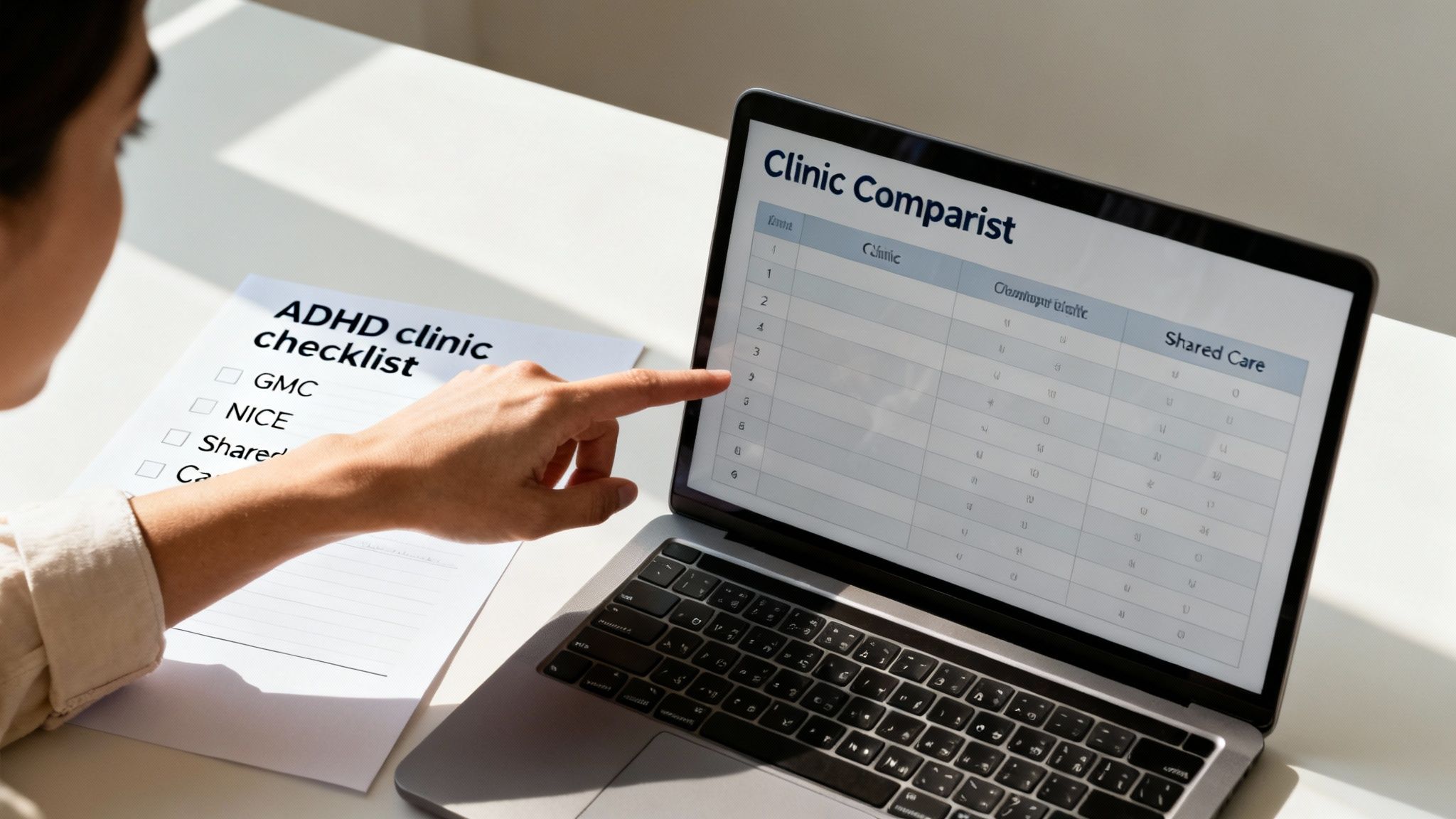
Here’s your non-negotiable checklist:
- GMC Specialist Register: The clinician, who is usually a consultant psychiatrist, must be listed on the General Medical Council's (GMC) Specialist Register for psychiatry. This is an absolute deal-breaker.
- Relevant Experience: You’re looking for someone with specific, hands-on experience in diagnosing and treating adult ADHD. It’s a specialised field, and you need an expert who gets all the nuances.
Think of it this way: you wouldn't hire a general handyman to rewire your house. You'd hire a certified electrician. Both might seem capable, but only the specialist has the verified expertise to do the job safely and correctly. It’s the same principle here.
Confirming Assessment Standards
For a private diagnosis to be worth the paper it’s written on, it needs to be robust enough to stand up to scrutiny. That means the entire assessment process must follow the same best-practice standards used by the NHS.
The goal isn't just to get a piece of paper with a diagnosis. It’s to get a thorough, evidence-based assessment that gives you genuine insight and will be accepted everywhere, from your GP's surgery to your manager's office.
In the UK, the gold standard for this is the National Institute for Health and Care Excellence (NICE) guidelines. When you’re vetting a clinic, ask them a direct question: "Do you conduct your assessments in full accordance with NICE guidelines?" A reputable provider will have no problem confirming this and explaining their process. Any hesitation or a vague answer is a major red flag.
Planning for Post-Diagnosis Support
Getting your diagnostic report is a huge moment, but it’s rarely the end of the story. What happens next is just as important. Before you commit to any clinic, you need to have a clear picture of their pathway for ongoing care.
Here are some key questions to ask them upfront:
- Medication Titration: If medication is part of your plan, do they offer a titration service to help you find the right type and dose? And crucially, what are the costs involved?
- Follow-Up Appointments: What’s the plan for annual reviews and check-ins once your treatment is stable?
- Therapy and Coaching: Do they offer other forms of support, like CBT or ADHD coaching, or can they refer you to trusted partners?
Some clinics are 'assessment-only', which can leave you with a diagnosis but no clear path forward. It’s much better to choose a provider that offers a complete care package, ensuring you have consistent support from a team that already knows your story. For those in the capital, it's worth looking for providers that specialise in delivering a private ADHD assessment in London.
The Crucial Shared Care Question
Finally, and this one is vital for your long-term finances, you have to ask about Shared Care Agreements (SCAs). Think of an SCA as the bridge that connects your private treatment back to the NHS, allowing your GP to take over prescribing your medication once you're on a stable dose.
Before you even book an appointment, ask the clinic point-blank: "Do you actively work with NHS GPs to establish Shared Care Agreements?" A good clinic will have a well-oiled process for this and can often give you support if your GP is hesitant. Without a solid plan for an SCA, you could be stuck paying for expensive private prescriptions indefinitely.
Bridging Private Care with the NHS
Getting a private ADHD diagnosis is a huge step forward, but it usually leads to one big question: what now? For most people, the thought of paying for ongoing private prescriptions is a major worry. The good news is, your private diagnosis doesn't have to stay separate from the NHS.
There are two main ways to connect the dots: Shared Care Agreements and the Right to Choose pathway. Think of them as bridges, designed to help you move from a speedy private diagnosis to affordable, long-term NHS care.

Knowing how these work is your key to having a confident chat with your GP. It puts you in the driver's seat, allowing you to get the best of both worlds – the speed of a private assessment and the affordability of NHS treatment.
Making Treatment Affordable with a Shared Care Agreement
A Shared Care Agreement (SCA) is essentially a formal partnership between your private specialist and your NHS GP. It's the official handover that moves your prescriptions from the expensive private route over to the NHS system. For many, this is the go-to solution for making long-term ADHD treatment sustainable.
Here’s how it usually plays out:
- Finding Your Balance: First, your private clinician will guide you through the titration period to find the right medication and a stable, effective dose.
- Making the Request: Once you're settled on your treatment, the private clinic drafts a formal letter to your GP, officially proposing the shared care arrangement.
- GP Takes Over: If your GP agrees to the plan, they take over the responsibility of issuing your repeat prescriptions.
Once the agreement is in place, you’ll only pay the standard NHS prescription charge, which is a massive saving compared to private medication costs. Your specialist care doesn't stop, though; you'll still have annual check-ups with your private consultant to make sure everything is on track.
It's really important to know that GPs are not required to accept a Shared Care Agreement. A lot depends on their practice policies and the quality of the report from your private clinic. This is why choosing a reputable provider that GPs know and trust is so crucial.
Fast-Tracking Your Assessment with Right to Choose
If you live in England, you have another powerful option called NHS Right to Choose (RTC). This is a real game-changer, sitting neatly between the long NHS waits and the high cost of going fully private. It gives you the legal right to choose your provider for an NHS-funded assessment – and that list of approved providers includes many well-regarded private clinics.
In short, you get the quality and speed of a private service, but the NHS foots the bill for the assessment and any subsequent treatment.
This pathway is a fantastic choice if you want to avoid a long wait but can't afford a fully private diagnosis. We cover this in much more detail in our guide to the NHS Right to Choose pathway for ADHD.
Comparing Your Options at a Glance
Navigating these pathways can feel complex, so here's a simple breakdown to help you see the key differences at a glance.
| Feature | Fully Private | NHS Right to Choose | Standard NHS |
|---|---|---|---|
| Assessment Cost | £700 - £2,000+ (Paid by you) | £0 (Funded by NHS) | £0 (Funded by NHS) |
| Wait Times | Weeks to a few months | 6-12 months (on average) | 2 - 7+ years |
| Medication Costs | Paid privately until SCA is agreed | NHS prescription charges | NHS prescription charges |
| GP Involvement | Need GP to agree to Shared Care | GP referral is required | GP referral is required |
| Availability | UK-wide | England only | UK-wide |
As you can see, each route has its own trade-offs between cost, speed, and process. The right choice really depends on your personal circumstances, budget, and how urgently you need support.
How to Discuss These Options with Your GP
Bringing this up with your GP can feel a bit daunting, but going in prepared makes all the difference. When you book your appointment, try to be clear about what you want to discuss.
Here are a few tips for a more productive conversation:
- Go in with a plan. Have a brief summary of your symptoms ready and explain why you're seeking an assessment.
- Mention Shared Care early. If you're going fully private, let your GP know you'll be aiming for a Shared Care Agreement after your diagnosis. You can ask if their practice has a specific policy on this.
- Explain Right to Choose. If you want to use RTC, explain that it's your legal right under the NHS Constitution. Most GPs know about it, but bringing a printout from the official NHS website can help clear up any confusion.
By understanding these vital links between the private and NHS systems, you can plan your journey with confidence and find a path that gets you the support you need in a way that works for you.
Got Questions About Private ADHD Diagnosis? You're Not Alone.
Even with a good grasp of the process, it's natural to have a few more questions rattling around. Deciding to go for a private ADHD diagnosis is a big step, and you want to feel sure about it before you dive in.
This section tackles some of the most frequent and practical questions we come across. We’ll give you clear, straight-up answers to help clear away any last-minute doubts so you can move forward with confidence.
Will the NHS and My Kid's School Actually Recognise a Private Diagnosis?
This is probably the biggest worry people have, and the short answer is yes, but with one crucial condition. A private diagnosis is absolutely recognised by the NHS, schools, universities, and employers, but only if it comes from a qualified specialist who follows official NICE guidelines.
What gives the diagnosis its weight is the quality of the assessment itself. For an NHS GP to even think about a Shared Care Agreement, or for a university to give you extra time in exams, they need to see a detailed, evidence-based report from a reputable clinic.
That's why checking a clinic's credentials—making sure their doctors are on the GMC Specialist Register—isn't just a tick-box exercise. It's the one thing that guarantees your diagnosis will be taken seriously wherever you go.
A good way to think about it is that a quality-assured private diagnosis carries the same authority as an NHS one. The real difference isn't its validity, but how quickly and easily you were able to get it.
What Happens if My GP Says No to a Shared Care Agreement?
It’s a really frustrating and disheartening situation, but it does happen. If your GP turns down a Shared Care Agreement, the first thing to do is not panic. You still have options.
Start by politely asking your GP for their specific reasons. Sometimes it's a simple misunderstanding about their practice's policy, or maybe they just need a bit more information from your private clinic. A clear, calm conversation can often sort things out.
If they still say no, here are your next moves:
- Stick with Private: You can simply choose to continue with private prescriptions and follow-ups, though this is obviously the most expensive route long-term.
- Get on the NHS List: Ask your GP to refer you to the local NHS service specifically for medication management. You've already got the diagnosis, so you'd be waiting for titration, not another assessment.
- Try a Different GP: It might be worth registering with another GP practice in your area. Some are simply more familiar with and open to Shared Care Agreements than others.
A good tip is to ask a clinic how they handle this before you book. The best providers often have a team or a set process in place to support patients through these tricky conversations with their GPs.
Are Online Assessments as Good as Face-to-Face Ones?
Absolutely. Over the past few years, online ADHD assessments held over secure video calls have become standard practice. They're reliable, widely accepted, and offered by many of the UK's top private clinics.
As long as the assessment is conducted by a qualified specialist who sticks to the same strict national guidelines, the diagnosis you receive is every bit as valid and recognised as one from an old-school, in-person appointment.
For many, online assessments are a game-changer. They remove the barrier of geography, meaning you can access the best specialists in the country without the time and expense of travel. It’s this convenience that has made getting a private ADHD diagnosis so much more accessible for so many people.
What Should I Bring or Prepare for My Assessment?
A little bit of prep can make a huge difference. Your clinician is trying to build a complete picture of your life—how potential ADHD traits have shown up from childhood right through to today.
To help them connect the dots, it's a great idea to pull together any bits of historical evidence you can find.
- Old School Reports: These can be absolute gold. Look for those repeated comments from teachers: "easily distracted," "very chatty," "disorganised," or "fails to work to their full potential."
- Real-Life Examples: Think about specific moments from your adult life. How do things play out at work? In your relationships? When you're just trying to manage the house? The more concrete your examples, the clearer the picture.
- Input from Someone Else: If you can, ask a parent, an older sibling, or your partner if they'd be willing to share their perspective. Their memories of your lifelong patterns can be incredibly valuable.
Bringing this information along isn't about "proving your case." It’s about giving the clinician the rich detail they need to conduct a truly thorough and accurate assessment, which ultimately results in a more insightful and helpful report for you.
Ready to find the right clinic for you? The sheer number of options can feel overwhelming, but you don't have to wade through it all alone. At ADHD Private, we've built a free, UK-wide directory to help you compare your options with total confidence. You can filter by location, check real-time wait times, and see clear pricing from over 85 clinics, all in one place. Start your journey to a private ADHD diagnosis at https://adhdprivate.co.uk.