NHS Right to Choose ADHD Assessment
Tired of long NHS waits? Learn how the NHS Right to Choose can help you get a faster ADHD assessment. Understand eligibility and steps to take.
When you're staring down the barrel of a multi-year waiting list for an ADHD assessment, it's easy to feel completely defeated. But there’s a legitimate, NHS-funded pathway that can get you seen much, much faster. It's called the NHS Right to Choose, and it's your legal right as a patient in England.
This isn't a backdoor to private healthcare. It's about choosing an alternative, NHS-funded specialist to get the timely diagnosis you need and deserve.
Your Alternative to Long NHS ADHD Waiting Lists

A long wait for an ADHD assessment is far more than an inconvenience. For many, it has a real-world impact on work, relationships, and overall mental health. The standard NHS route can involve such frustrating delays that people often feel stuck in limbo, unable to move forward.
Thankfully, the NHS Right to Choose pathway offers a powerful, and often overlooked, solution.
Think of it like having a key that unlocks a different door to the same high-quality NHS care. Instead of being automatically funnelled into your local mental health service, you have the legal right to choose a different qualified provider from an approved list—even if they're based on the other side of England. That simple choice can slash your waiting time from years down to just a few months.
Why Is This Pathway So Important?
The need for this alternative has never been more pressing. The NHS Right to Choose (RTC) pathway is a vital lifeline for adults who suspect they have ADHD. With an average diagnostic delay of five years through traditional routes, and some local waiting lists stretching to five years or more, the standard process can feel completely broken.
It’s estimated that over 1 in 25 UK adults are living with undiagnosed ADHD, a staggering figure that highlights just how many people are being let down by these crippling waits. This right empowers you to take back some control over your healthcare journey. It gives you the ability to research providers, compare their waiting times, and pick one that works for you, all while staying firmly within the NHS system.
The core idea behind Right to Choose is simple: to give patients more control over their care and encourage a more responsive, efficient healthcare system by introducing genuine patient choice.
This guide is designed to walk you through exactly how to exercise this right. Whether you're just starting to explore a diagnosis or you're looking for clearer information, understanding this process is your first, most important step. For those weighing up all their options, you might also find our guide on private ADHD diagnosis in the UK useful.
Checking if You're Eligible for Right to Choose
Before you get too far down the rabbit hole of research, the first thing to do is check if you can actually use the Right to Choose pathway. Think of it as checking your passport is in date before booking a holiday – it's a simple step that saves a lot of hassle later.
Luckily, the eligibility criteria are pretty clear for most people. If you meet the handful of core requirements, you're almost certainly good to go.
The Core Eligibility Checklist
At its heart, Right to Choose is designed to be straightforward. You're eligible if you can tick these two main boxes:
- You're registered with a GP in England. This is the big one. Your GP practice has to be in England because this right is part of the NHS England constitution.
- This is your first specialist appointment for ADHD. The pathway is for getting that initial assessment. You can't use it to switch providers if you're already getting treatment or are under the care of an existing ADHD team.
This applies to both adults and children, so it’s a great option for families too. The only other major condition is that your chosen clinic must have an official contract with any NHS group to provide the service you need – in this case, an adult or child ADHD assessment.
A crucial point to remember: your GP can't refuse to refer you simply because a provider is in a different part of the country or because they think it costs too much. As long as you're eligible and the provider has a valid NHS contract, your right is legally protected.
Who Isn't Eligible?
It's just as important to know who can't use this route. The NHS Right to Choose does not apply if you:
- Live in Scotland, Wales, or Northern Ireland. They have their own healthcare systems with different rules.
- Are already under the care of a specialist NHS team for your ADHD.
- Need urgent help or are in a mental health crisis.
- Are currently serving in the armed forces or are in prison or a secure hospital.
Getting this sorted first is your foundation. Once you know for sure that you're eligible, you can start looking for the right provider and prepare for your GP appointment with confidence.
Your Step-by-Step Guide to Getting a Referral
So, you've checked that you're eligible for Right to Choose. Fantastic! Now comes the part where you take the lead. This process might seem a bit daunting, but if you break it down into a few clear steps, it's much more manageable. Think of it like a recipe – follow the instructions, and you’ll get the right result.
Your mission is to find a provider you’re happy with and then confidently ask your GP for the referral. Being well-prepared is the secret sauce here; it can transform what might be a tricky conversation into a simple, successful request.
Step 1: Do Your Homework and Pick a Provider
First things first, you need to find a suitable ADHD clinic that actually accepts referrals through the NHS Right to Choose pathway. It's a crucial point – not all private providers do, so you need to look specifically for ones that state this on their website.
As you start shortlisting potential clinics, here are the non-negotiables to check:
- Do they have an NHS contract? This is the absolute deal-breaker. The clinic must hold a current NHS contract for adult or child ADHD assessments for a Right to Choose referral to be valid.
- What are their waiting times? Let's be honest, this is probably why you're here. Check their website for the most up-to-date estimate from referral to assessment.
- What's their shared care policy? This is incredibly important for what happens after a diagnosis. A good Shared Care Agreement with your GP is what allows you to get your prescriptions on the NHS.
Taking the time to research these points means you're not just picking the quickest option, but the one that will actually work for you in the long run.
This checklist covers the basic eligibility you should have already confirmed before you even start looking for a provider.
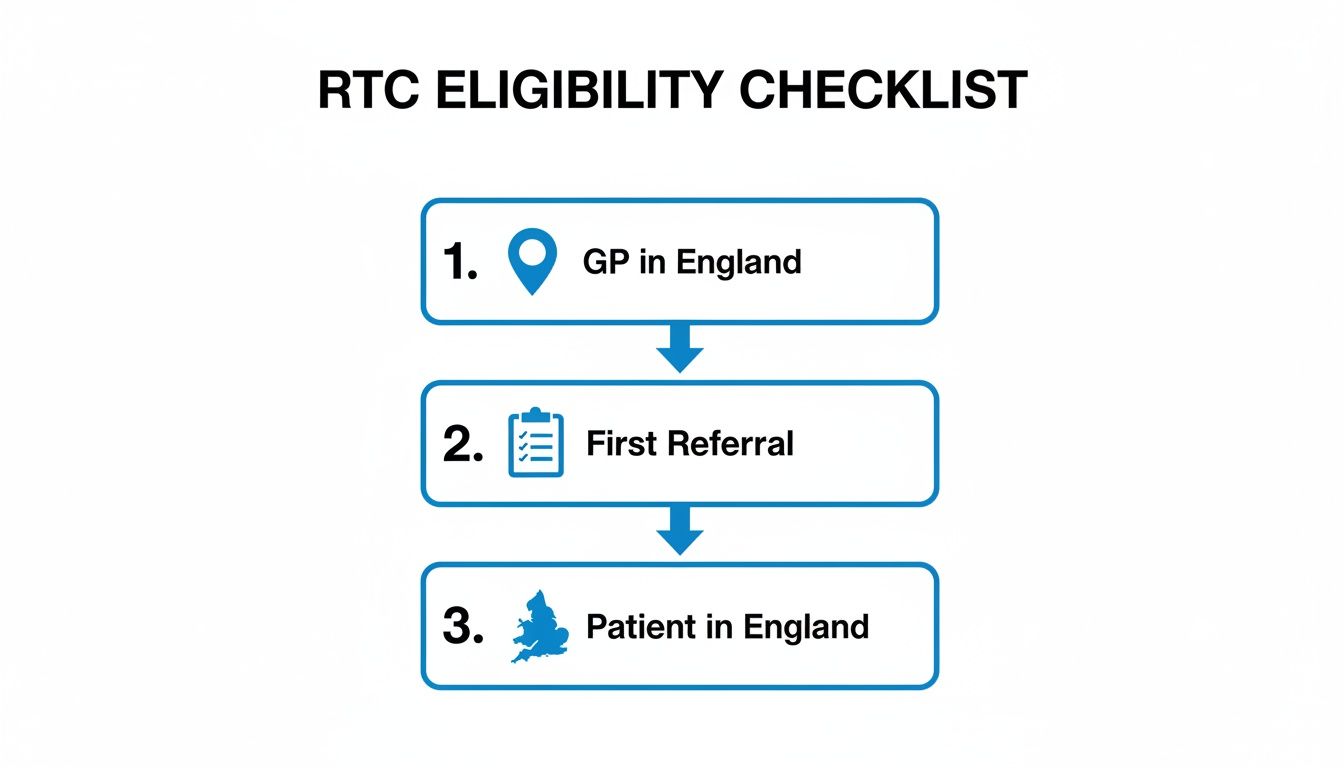
Making sure you tick these three simple boxes—being registered with an English GP and this being your first specialist referral—is the bedrock of a successful application.
Step 2: Get Your Paperwork Ready for the GP
Once you've settled on a provider, it's time to book that GP appointment. My advice? Don't go in empty-handed. Many GPs are incredibly busy and may not be fully up to speed on the ins and outs of Right to Choose. Bringing all the necessary documents makes their job easier and your request stronger.
Thankfully, most clinics that accept Right to Choose referrals have a downloadable pack on their website. This usually contains everything you need:
- A letter for your GP: A pre-written template that formally outlines your request to use your legal Right to Choose.
- Referral forms: Any specific forms the clinic needs the GP to fill out.
- ADHD screening questionnaires: Things like the ASRS checklist. It's a good idea to fill this out honestly beforehand.
Print everything out, pop it in a folder, and take it with you. It shows you’re organised, you’ve done your homework, and you’re serious.
Step 3: Having the Conversation with Your GP
This is the part that often makes people the most anxious, but all your prep work is about to pay off. When you're in the appointment, aim to be clear, calm, and direct.
Start by explaining why you think you might have ADHD and need an assessment. Then, state your intention plainly: "I would like to exercise my legal NHS Right to Choose for an ADHD assessment, and I have chosen [Provider's Name]."
If your GP seems unsure or isn't familiar with Right to Choose, don't panic. You can calmly refer them to the official NHS guidance (it helps to have the link ready on your phone). Politely explain that as long as your chosen provider holds an NHS contract for the service, you are legally entitled to this choice.
Then, hand over your neatly prepared documents. You've just given them everything they need to make the referral. By making it as easy as possible for them, you give yourself the best possible chance of walking out with your referral sorted.
To make things even clearer, here's a simple checklist you can follow to keep yourself on track.
Patient Action Checklist for Right to Choose Referral
| Step | Action Required | Key Considerations |
|---|---|---|
| 1. Research | Identify 2-3 potential ADHD clinics that accept Right to Choose referrals. | Confirm they have a valid NHS contract. Check their current waiting times and read their Shared Care Agreement policy. |
| 2. Prepare | Download and print the chosen provider's GP referral pack. | This usually includes a letter to the GP, clinic-specific referral forms, and an ADHD screening tool (e.g., ASRS). |
| 3. Fill Out Forms | Complete any patient sections of the forms, especially the ADHD screening questionnaire. | Be honest and thorough. This information provides the GP with essential context for your referral. |
| 4. Book GP Appointment | Schedule an appointment with your GP specifically to discuss an ADHD referral. | When booking, you could mention it's to discuss a referral under 'Right to Choose' to give them a heads-up. |
| 5. Discuss & Refer | At the appointment, clearly state your request and provide your prepared document pack. | Be ready to calmly explain Right to Choose if needed. Have the official NHS link handy on your phone. |
| 6. Follow Up | After a week or two, check with the GP surgery to confirm the referral has been sent. | You can also contact the chosen clinic to see if they have received it. Stay proactive. |
Following these steps methodically will help demystify the process and put you in the best position to get the assessment you need.
Finding and Vetting the Right ADHD Clinic

Choosing a clinic for your ADHD assessment involves more than just hunting down the shortest waiting list. While getting seen quickly is a massive plus of using your NHS Right to Choose, it’s just as important to pick a provider who will be a good partner for your entire journey.
Being an informed patient right from the start can help you sidestep some common frustrations and make the whole process—from assessment to ongoing care—run much more smoothly.
This means you’ll need to do a bit of homework before you even approach your GP for a referral. It’s about looking past the headline waiting times and getting into the nitty-gritty details that will affect you down the line. Asking a few key questions upfront empowers you to find a clinic that’s a genuinely good fit, not just a quick fix.
Your Essential Vetting Checklist
When you start comparing providers, put on your investigator's hat. Your mission is to gather a few key bits of information so you can make a decision you feel confident about. Trust me, being proactive now can save you a world of stress later.
Here are the critical questions to get answers for before settling on a clinic:
- Do they have a current NHS contract? This is non-negotiable. A provider must have an active NHS contract to accept Right to Choose referrals. Check their website for a clear statement confirming this.
- What’s the full timeline? Don’t just look at the wait from referral to assessment. You also need to ask about the delay between getting a diagnosis and actually starting medication titration. This is often a hidden bottleneck.
- What’s their medication process like? Get a clear picture of how they handle the titration period, which is when your medication type and dose are carefully adjusted. Who manages it—a nurse or a psychiatrist? How frequent are the check-ins?
- How do they carry out assessments? Are they online, in-person, or do you get a choice? This could be a dealbreaker depending on your location and what you’re comfortable with.
The single most important thing to clarify is the clinic's policy on Shared Care Agreements. This is the crucial step that allows your GP to take over prescribing your medication on the NHS once you're on a stable dose. Without a solid shared care process, you could be facing significant ongoing private prescription fees.
The incredible rise in people using NHS Right to Choose for ADHD has caused a huge shift in how mental healthcare is accessed in the UK. Recent figures show that the number of patients seen by Right to Choose providers has doubled compared to the previous year. This surge is fuelled by people trying to escape NHS waits that can stretch to an average of five years.
However, this boom in demand means some providers are hitting funding caps set by local health boards, leading to wait times that can vary from 6-8 months depending on where you live. You can read more about these Right to Choose referral limits on PulseToday.com.
Finding a psychiatrist for an ADHD assessment who ticks all these practical boxes is the key to a positive outcome. By checking these points, you’re not just choosing an assessment; you’re choosing a partner for your long-term health.
Navigating GP Reluctance and Common Hurdles
Using your NHS Right to Choose should be straightforward, but in reality, you might hit a few speed bumps along the way. The most common one? A GP who’s unfamiliar with the process, has been given some dodgy information about the rules, or is simply hesitant to refer you to a clinic outside their local system.
This isn’t usually coming from a bad place. GPs are juggling an immense workload and may have never handled a Right to Choose request for an ADHD assessment before. Your role here is to be prepared, polite, and persistent—armed with the right information to make their job easier and get your referral over the line.
Knowing what these hurdles look like ahead of time is half the battle. If you can anticipate why your GP might pause and have clear, helpful answers ready, you can guide the conversation and keep things moving forward without any unnecessary stress.
When Your GP Is Unsure or Says No
If you’re met with a bit of confusion or even a flat-out "no," don't panic. The first thing to do is to calmly figure out why they're hesitant. More often than not, it boils down to a few common myths.
Here’s a quick guide on how to tackle the most frequent reasons for pushback:
"We have to refer you locally." This is a very common but incorrect assumption. You can politely point out that the NHS Right to Choose rules specifically empower patients to choose a qualified provider anywhere in England, provided they have an NHS contract for that service.
"It will cost our practice too much money." Another complete misconception. The funding for your assessment actually comes from your local Integrated Care Board (ICB), not the GP practice’s budget. Reassure them that your choice won’t cost their practice a penny.
"I don't know this clinic." This is an easy one to solve. Let them know you’ve already checked that the provider holds a current NHS contract to carry out ADHD assessments. It's a great idea to have the clinic's website and contact details handy to share with them.
Top Tip: It’s a good idea to have the official NHS guidance on Right to Choose bookmarked on your phone. If your GP seems unsure, you can gently offer to show them, saying something like, "I know this is a pretty specific part of NHS policy, but the official NHS website explains it all here."
Other Roadblocks to Watch Out For
A hesitant GP isn't the only potential hurdle. Being aware of a couple of other systemic issues can help you manage your expectations and navigate the process a bit more smoothly.
One major issue is that some Integrated Care Boards (ICBs) put a cap on how many Right to Choose referrals they’ll fund each month. This can mean that even if a clinic has appointments available, they might have to temporarily stop taking new patients from your area once that funding limit is hit.
Another crucial point to consider is the Shared Care Agreement. This is the arrangement that allows your GP to take over prescribing your medication once you're on a stable dose. Some GPs are unwilling to enter into these agreements. It's absolutely vital to ask your chosen clinic what their policy is if this happens, otherwise you could be stuck paying for private prescriptions long-term.
By preparing for these potential snags, you can handle them calmly and effectively, keeping your assessment journey on track.
How a Directory Makes Your Search So Much Easier
Trying to find and compare providers for your NHS Right to Choose referral can feel like wading through treacle. It often means spending hours bouncing from one clinic website to another, each with its own layout, trying to stitch together the basic facts you need to make a good choice. Frankly, it’s a confusing and stressful process, which is the last thing you need when you're already trying to manage potential ADHD symptoms.
This is where a good, specialised directory really comes into its own. Think of it as having all the vital stats from dozens of different clinics laid out for you in one, easy-to-read place. The endless searching stops, and you get a clear overview in moments.
Bringing Everything Into One Place
A directory essentially does all the heavy lifting for you. It lets you filter your search to show only the clinics that are currently accepting NHS Right to Choose referrals, which immediately clears out the noise. That simple step alone can save you hours of wasted time and the crushing disappointment of finding what looks like the perfect clinic, only to discover they aren’t an option for you.
You can then compare the most important details side-by-side, such as:
- Current estimated wait times from the moment your GP refers you to your first assessment.
- Assessment formats—do they offer online appointments, or will you need to travel for an in-person visit?
- Shared care agreement policies, which is a crucial detail for avoiding unexpected prescription costs down the line.
By putting all this information in one place, a directory turns a messy, complicated research project into a simple comparison. It helps you quickly build a solid shortlist of verified, suitable providers that you can confidently take to your GP.
Using a platform built specifically for this purpose takes the guesswork out of the equation. You can explore a curated list of UK clinics that accept Right to Choose, making your search faster, clearer, and a whole lot less overwhelming.
Common Questions About Right to Choose
Even with a roadmap in hand, it's completely normal to have a few questions about the journey ahead. Getting your head around the NHS Right to Choose pathway for an ADHD assessment is a big step, so let's clear up some of the common uncertainties.
We've gathered some of the most frequently asked questions to help you understand the finer points and move forward with confidence.
Will I Lose My Place on the Local NHS List?
Yes, you will, and that’s a standard part of how this works. When your GP refers you to a different provider using Right to Choose, you're essentially picking a new lane. This means you'll be taken off the local NHS waiting list.
This is a practical step to avoid having two active referrals for the same thing clogging up the system. The major upside, of course, is that you'll almost certainly be seen much, much faster than if you'd stayed on a local list that can often stretch on for years.
Is a Diagnosis from a Right to Choose Provider Valid?
Absolutely. It's a common worry, but you can put it to rest. Any clinic offering services under the NHS Right to Choose scheme has to meet the same rigorous NHS standards and hold a proper NHS contract.
A diagnosis from an approved Right to Choose provider is every bit as valid as one from your local NHS team. It will be recognised by employers, universities, and for any ongoing NHS care you might need down the line.
What if My GP Rejects a Shared Care Agreement?
This is a really important one to get clear on from the start. A Shared Care Agreement is the formal arrangement that lets your GP take over prescribing your medication on the NHS after you're settled on it. If your GP isn't willing to sign one, the prescribing responsibility stays with the specialist clinic.
Most providers have a plan for this, but it usually involves you paying privately for ongoing prescriptions and follow-up appointments. You must ask your chosen clinic how they handle this before you get referred. It’s the only way to avoid any surprise costs later.
Can My Child Use Right to Choose for an Assessment?
Yes, they can. The Right to Choose rules apply to mental health services for children and young people just as they do for adults, and that includes ADHD assessments. The process is the same – you’ll need to work with your GP to get the referral sorted.
The key thing to check, however, is that your chosen provider is actually set up to see patients in your child's age group. Not all clinics that see adults are equipped or contracted to assess children and teenagers, so always confirm this first.
Trying to find and compare all the providers that accept NHS Right to Choose can feel like a mammoth task. At ADHD Private, we've done the legwork for you by putting all the information in one place. You can easily compare wait times and services to find the clinic that’s the right fit for you. Start your search for an ADHD clinic today.