A Guide to ADHD Diagnosis Private UK: Private ADHD Assessment
Considering a private ADHD diagnosis in the UK? Learn steps, costs, and how to pick a trusted UK clinic for a private ADHD assessment.
If you're looking into getting a private ADHD diagnosis in the UK, you're taking a really important step towards getting clarity and support. For many, it's a way to bypass the notoriously long NHS waiting lists, offering a much faster route to assessment and treatment. You could have answers in months, not years.
Why So Many People Are Choosing a Private ADHD Diagnosis
You’re definitely not alone in this. The truth is, while the NHS is an incredible service, it's stretched to its limit. This has created massive waiting lists for adult ADHD assessments—some people report waiting several years just to be seen for the first time.
This isn't just a minor inconvenience. A delay like that can seriously affect your mental health, your job, and your relationships. Trying to get by with undiagnosed ADHD means grappling with symptoms like a lack of focus, impulsivity, and problems with organisation, all without knowing the reason why or having the right tools to manage.
The Problem of Underdiagnosis
The gap between the number of people who likely have ADHD and those who actually have a diagnosis is staggering. A huge UK study looked at 9 million GP records and found that only 0.32% of the population had a recorded ADHD diagnosis. That's about 1 in every 300 people.
This figure is a stark contrast to what population surveys suggest. They estimate the true prevalence of ADHD is closer to 2.8%, which means only around 1 in 9 people with the condition ever gets a formal diagnosis. You can explore more on these statistics00431-2/fulltext) to get a clearer picture of the scale of the issue.
Making the Private Route Easier to Navigate
Given the long waits, going private often feels less like a choice and more like a necessity. But figuring out where to start can be daunting. There are dozens of clinics out there, all with different services and price tags.
This is where a good directory can make a world of difference. It cuts through the noise by:
- Putting everything in one place: It gathers reputable clinics together, saving you countless hours of searching.
- Being upfront about the details: It clearly lists costs, wait times, and the services available, like online assessments or Shared Care agreements.
- Helping you choose with confidence: It includes verified patient reviews, so you can make a decision based on real experiences.
A directory gives you back a sense of control over your own journey. Instead of just being a name on a waiting list, you're in the driver's seat, able to compare your options and choose the clinic that best fits your needs, budget, and schedule.
By laying out a clear, manageable path, these resources take the mystery out of getting a private ADHD diagnosis and help you connect with the right professional support, much sooner.
Finding and Vetting the Right ADHD Clinic
Once you've decided to go down the private route for an ADHD diagnosis, your next big step is picking the right clinic. It’s a crowded field out there, with a mix of online services and traditional in-person clinics, and it’s easy to feel a bit lost. But getting this choice right is crucial—it ensures your diagnosis is credible, respected, and genuinely helpful for you.
The first fork in the road is usually deciding between an online assessment or a face-to-face one. Each has its pros and cons, and the best fit really depends on your personal circumstances, where you live, and what makes you feel most comfortable.
Online assessments offer incredible convenience. You can speak to a specialist from anywhere in the country without the hassle or cost of travel, which is a massive bonus for many. It also means you’re not limited to the clinics in your immediate area; you have a much wider pool to choose from.
On the other hand, some people simply prefer an in-person appointment. It can feel more personal, and there's a different dynamic when you're in the same room as the clinician. If you happen to live near a well-regarded clinic or you just feel better discussing sensitive health topics face-to-face, this might be the way to go.
Comparing Private ADHD Clinic Options: Online vs In-Person
To help you figure out what's best for you, it's worth weighing up the key differences. Is speed your priority? Cost? Or is it the type of interaction you have with the specialist? This quick comparison should help clarify things.
| Factor | Online Assessment | In-Person Assessment |
|---|---|---|
| Convenience | Hugely convenient. You do it all from home, saving time and travel costs. | You'll need to travel to a physical clinic, which can be a barrier for some. |
| Choice of Clinic | You can choose from clinics across the UK, not just your local ones. | Your options are limited to clinics within a reasonable travelling distance. |
| Cost | Often a bit cheaper as online clinics have lower running costs. | Can be more expensive once you factor in the clinic's overheads and your own travel. |
| Comfort | Many people find it less intimidating and more comfortable to be in their own space. | Some prefer the structure and formality of a traditional clinical setting. |
| Technology | You'll need a stable internet connection and be okay with using video calls. | No tech needed, just the ability to get to your appointment on time. |
As you can see, there’s no single "right" answer. Your personal situation and what you value most will steer your decision. For many, the sheer accessibility and slightly lower price point of online assessments are what make a private diagnosis possible in the first place.
What to Look for in a Reputable Clinic
Whether you go for an online or in-person clinic, doing your homework is non-negotiable. A diagnosis is only as good as the professional who gives it. Here’s a checklist of the absolute must-haves to ensure you’re dealing with a legitimate and high-quality service.
CQC Registration: The Care Quality Commission (CQC) is the independent body that regulates health and social care in England. If a clinic is CQC-registered, it means they’ve been inspected and meet national standards for quality and safety. This is your first and most important stamp of legitimacy.
GMC-Registered Specialists: Check that the psychiatrists or other specialists doing the assessments are registered with the General Medical Council (GMC). This is your guarantee that they are fully qualified, up to date with professional standards, and legally allowed to practise medicine in the UK.
Follows NICE Guidelines: The clinic should be very clear that its entire assessment process adheres to the guidelines from the National Institute for Health and Care Excellence (NICE). This is the gold standard for healthcare in the UK and is vital for your diagnosis to be taken seriously by the NHS.
Transparent Pricing: A trustworthy clinic will be completely upfront about its fees. That means the cost of the initial assessment, any follow-up appointments, medication titration, and ongoing prescription charges. If a provider is cagey about their pricing, consider it a red flag.
A diagnosis from a clinic that cuts corners on these standards might not be accepted by your GP for a Shared Care Agreement. This could leave you footing the entire bill for private prescriptions indefinitely. A little bit of due diligence now can save you a world of frustration and a lot of money down the line.
Using a Directory to Compare Your Options
Trying to find and compare all this information on your own can feel like a full-time job. This is where a good directory can be a lifesaver. Instead of juggling dozens of open tabs and spreadsheets, a directory puts all the key information in one easy-to-search place.
When you’re looking for a private ADHD diagnosis in the UK, for example, you can use a directory to filter your options instantly. You can narrow your search to clinics offering online assessments, find ones in your county, or even see who accepts NHS Right to Choose referrals. To see how it works, have a look at our complete UK private ADHD clinic directory.
This approach lets you compare crucial details like wait times and assessment costs at a glance. Even better, you can read reviews from other patients, giving you a real feel for what the experience is actually like. Using these tools helps you move forward with confidence, knowing you've made a properly informed choice that’s right for you.
What to Expect During Your Private ADHD Assessment
Stepping into a private ADHD assessment can feel a bit daunting, but knowing what's on the cards can make the whole thing feel much more straightforward. The process is designed to build a complete, 360-degree picture of you, right from your school days to your life today. Let’s break down the typical stages so you know exactly what’s coming.
It all usually kicks off the moment you make that first enquiry. The clinic will send over a welcome pack, which almost always includes a set of pre-assessment questionnaires. Don't mistake these for simple admin forms; they’re the foundation of your assessment and give your clinician a huge head start before you even have your first conversation.
You’ll probably get a questionnaire for yourself and another for someone who knew you as a child—a parent or an older sibling is ideal. These forms dig into your developmental history, what you were like at school, and the specific hurdles you faced growing up. Be as honest and detailed as you can here; it really helps to paint a clear picture from the outset.
The Core of the Assessment: The Diagnostic Interview
Once the paperwork is out of the way, it’s time for the main event: the diagnostic interview. This is a one-on-one session with a psychiatrist or a specialist ADHD clinician, and it usually lasts between 90 minutes and two hours. Whether you do it online or in person, the aim is the same—to explore your life experiences in real depth.
The conversation isn’t just a casual chat; it’s guided by established clinical tools. One of the most common is the DIVA-5 (Diagnostic Interview for ADHD in Adults). This is just a structured way for the clinician to systematically ask about ADHD symptoms and see how they've impacted different parts of your life, both now and back then.
To give you a flavour of what to expect, you might be asked questions like:
- Looking back at childhood: "What was your concentration like in primary school? Do you remember teachers saying you were a daydreamer or a bit disruptive?"
- Life at work or uni: "In long meetings or lectures, do you find your mind just drifts off? How do you cope with deadlines and big projects?"
- Friends, family, and relationships: "Do you ever find yourself blurting things out or interrupting people without meaning to? How does that go down with your partner or mates?"
- Day-to-day organisation: "Be honest—what's your home like? Are you constantly losing your keys or forgetting important appointments?"
Your clinician isn't trying to catch you out or looking for "correct" answers. They're piecing together a lifelong pattern of traits and challenges to see if it all lines up with the diagnostic criteria for ADHD. Being open is the most helpful thing you can do.
The whole thing should feel like a collaboration. Good private clinics often use a multidisciplinary approach, taking a thorough look at your history and getting information from others who know you well. This lines up with the Royal College of Psychiatrists' guidelines for a solid diagnosis, ensuring you get credible, genuinely helpful support.
Getting Your Supporting Evidence Ready
To help your clinician get the most accurate picture, it’s a brilliant idea to come prepared. It’s not always a strict requirement, but bringing along some supporting documents can add invaluable context. Think of it as bringing evidence to back up your own story.
Before you even get to this stage, you’ll have needed to find a clinic you can trust. This simple infographic breaks down that initial vetting process.
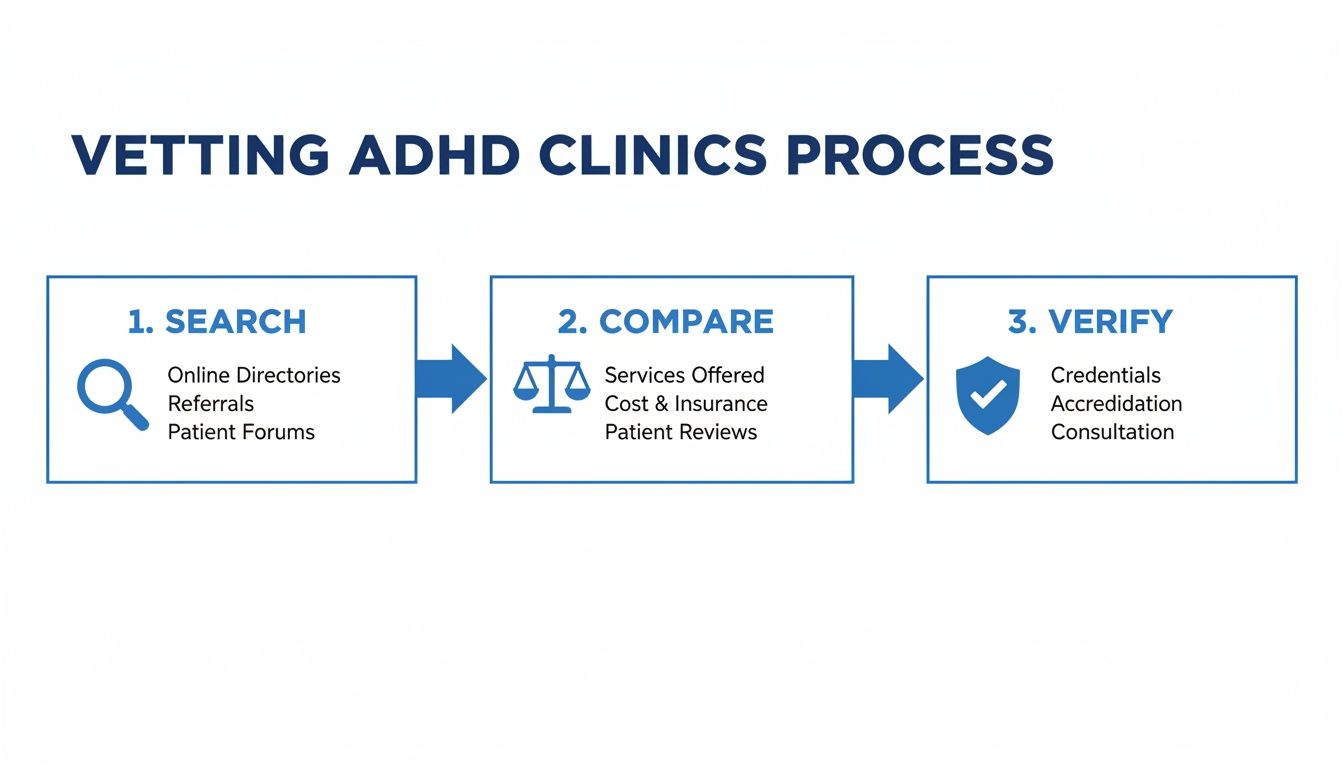
Following these steps—searching, comparing, and verifying—is key to landing with a reputable provider who will give you a high-quality assessment.
Once you're booked in, try to gather any of these to share with your clinician:
- Old School Reports: These are absolute gold. Teacher comments like "easily distracted," "doesn't fulfil his potential," or "very disorganised" are powerful, objective evidence of your traits in childhood.
- A Symptom Diary: In the weeks before your assessment, jot down real-life examples of how your suspected ADHD shows up. Did you forget a dentist appointment? Struggle for hours to start a report for work? Get completely overwhelmed by the washing pile? Write it down.
- A Note from a Loved One: A short letter or email from your partner, a close friend, or a parent describing the challenges they see you face can add a really useful perspective.
The Final Report and What Comes Next
After the interview, the clinician will take some time to analyse everything—your questionnaires, the interview itself, and any documents you brought along. This all comes together in a detailed diagnostic report, which you should receive within a couple of weeks.
This report is a really important document. It will state clearly whether or not you meet the criteria for an ADHD diagnosis. If you do, it will lay out your treatment options, which could include medication, therapy, or specialised ADHD coaching.
Think of this report as your key to unlocking support, whether that’s setting up a Shared Care Agreement with your GP, getting workplace accommodations through Access to Work, or accessing help at university. The assessment isn't the end of the road; it's the beginning of a new, much better-informed chapter.
Getting to Grips with Costs, Medication and Shared Care
Let's talk about the financial side of things, because getting a private ADHD diagnosis is an investment in yourself, and you need to know what you’re signing up for. The price you see advertised for the initial assessment is really just the starting line. To avoid any nasty surprises down the road, it’s crucial to understand the whole picture, from follow-up appointments to the cost of medication.

That headline figure for the diagnostic assessment itself usually falls somewhere between £500 and over £1,500. This can vary a lot depending on the clinic and the experience of the specialist. But that's not where the costs end. If you get a diagnosis and decide medication is the right path for you, you'll move into the next financial stage of the process.
The Medication Titration Period
Once you have a diagnosis, you don't just walk away with a prescription. You begin what’s called the titration period. This is a careful, collaborative process where your specialist works with you to find the right medication and the right dose. It’s a bit of trial and error, and it can take several weeks, sometimes a few months, to get it just right.
During this phase, you'll need a number of follow-up appointments to check how you're getting on and monitor for any side effects. Each of these appointments has its own fee, often in the region of £150 to £300.
It's so important to budget for the titration phase properly. Think of it as a mandatory part of your treatment. Trying to rush this stage to save money is a false economy and can lead to you ending up on the wrong dose or medication. The time and money spent here are vital for your long-term success.
On top of the consultation fees, you’ll be paying for the medication itself through a private prescription. The monthly cost for ADHD medication can be a bit of an eye-opener, typically landing somewhere between £80 and £120. This continues until your dose is stable and you're in a position to potentially move your care over to the NHS.
What is a Shared Care Agreement?
For most people, the long-term goal is to transition the prescription to the NHS to make it affordable. This is done using a Shared Care Agreement (SCA). It’s essentially a formal contract between your private specialist, your NHS GP, and you.
With an SCA in place, your GP takes over the day-to-day prescribing of your medication. This is a game-changer, as you’ll then only pay the standard NHS prescription charge (or nothing, if you're exempt in your country). Your private specialist doesn't just disappear; they'll still be responsible for your annual reviews to make sure your treatment is on track.
But here’s the catch: a Shared Care Agreement isn't guaranteed. Your GP can say no. They might decline if they're not confident in the quality of the private assessment or feel they don't have the capacity to manage the agreement safely. For a deeper dive into the numbers, our guide on the cost of a private ADHD assessment breaks it all down.
How to Talk to Your GP About Shared Care
Bringing up a Shared Care Agreement with your GP can feel a bit daunting, but going in prepared makes all the difference. How you approach this conversation can have a big impact on the outcome.
Here are a few tips I always give people:
- Give them a heads-up early. Let your GP know you’re thinking about a private assessment before you’ve booked it. It keeps them in the loop and shows that you value their role in your overall healthcare.
- Choose a reputable clinic. When you speak to your GP, make it clear that your chosen clinic is CQC-registered and sticks to all the official NICE guidelines. A solid diagnostic report from a GMC-registered specialist gives a GP the confidence they need to agree to shared care.
- Arm them with the paperwork. As soon as you have your diagnostic report, give your GP a full copy. This is the evidence they need to see that a thorough, professional assessment has taken place.
- Frame it as a partnership. Explain that you see this as a team effort to manage your health. Reassure them that the specialist will still handle the annual reviews, so they won't be shouldering the specialist oversight alone.
Getting a Shared Care Agreement signed is a huge milestone. It’s what makes long-term treatment sustainable and brings your ADHD care back into the NHS, creating a practical path forward after your initial private investment.
Tapping into NHS Right to Choose for a Faster Assessment
Facing a multi-year NHS waiting list for an ADHD assessment can feel incredibly defeating. On the other hand, the high cost of going fully private just isn't an option for most people.
Thankfully, there’s a powerful middle ground that many don't know about: Right to Choose (RTC). This NHS patient right, which applies specifically to England, lets you pick a qualified private healthcare provider for your assessment, with the bill being picked up by the NHS.
Essentially, you get the speed of the private sector without the financial burden. If you can't afford a purely private ADHD diagnosis in the UK but can't bear the thought of waiting years for help, this could be the perfect solution.
Who Is Eligible for Right to Choose?
Before you get started, it's vital to check if you can actually use this pathway. The good news is that the eligibility criteria are pretty straightforward.
You can generally use Right to Choose if:
- You are registered with a GP surgery in England.
- Your GP agrees that you have a clinical need for an ADHD assessment.
- The private clinic you’ve picked holds a valid NHS contract to provide adult ADHD services.
It's crucial to remember that RTC doesn't apply in Scotland, Wales, or Northern Ireland, as their healthcare systems operate differently. The main hurdle is getting your GP to agree that a referral is the right next step. They aren't allowed to refuse your choice of provider just because they haven't heard of them, but they do need to agree that an assessment is necessary in the first place.
The Right to Choose Process Explained
So, how does this actually work in practice? The key is being proactive and well-prepared before you even talk to your doctor. The first step is on you: research and find a suitable private clinic that accepts RTC referrals.
Once you have a provider in mind, book an appointment with your GP. In that meeting, you'll need to explain your symptoms and why you think you need an ADHD assessment. This is where you must be direct and clearly state that you wish to exercise your Right to Choose and be referred to the specific provider you've found.
To make things as smooth as possible, I always recommend bringing a pre-written letter with you. This letter should outline your request, reference the NHS rules on patient choice, and give the GP all the details they need for your chosen clinic. For more help with this, our complete walkthrough on the Right to Choose ADHD assessment process breaks it down step-by-step.
Taking a prepared letter to your GP isn’t just about being organised—it’s about advocating for yourself. It shows you've done your homework, you understand your rights, and you’re serious about your health. For a busy GP, this makes it much easier to process your request correctly and without any hold-ups.
Key Points for Your GP Letter
Your letter doesn't need to be an essay. It just needs to be clear, professional, and contain all the crucial information to prevent any confusion.
Here are the four vital things to include:
- Your Personal Details: Your full name, date of birth, address, and your NHS number.
- A Clear Statement: Explicitly state that you are requesting a referral for an adult ADHD assessment under your NHS Right to Choose.
- Your Chosen Provider: Name the specific clinic you’ve chosen. Make sure to include their contact details or referral information, which you can almost always find on their website.
- Reference to NHS Guidance: Briefly mention the legal basis for your request by citing the NHS Constitution and official patient choice guidance.
By laying this all out, you’re not just asking for a referral; you're guiding your GP through the process. This simple act of self-advocacy is often the key to unlocking a much faster, NHS-funded diagnosis and getting the support you need months, or even years, sooner.
Got Questions About Private ADHD Diagnosis? You're Not Alone.
It's completely normal to have a long list of practical questions when you're thinking about going private for an ADHD diagnosis. After all, it’s a big decision involving your time, money, and health. Let's walk through some of the most common queries to clear things up and help you move forward with confidence.
Will the NHS Even Recognise a Private Diagnosis?
This is probably the number one question on everyone's mind. The short answer is: yes, if it's done properly.
A diagnosis from a reputable private clinic that follows the official NICE (National Institute for Health and Care Excellence) guidelines holds just as much weight as an NHS one. It’s considered valid by GPs, universities, and employers.
The key here is the credibility of the clinic. You must choose a provider with GMC-registered specialists who are open about their assessment methods. Down the line, when you ask your GP about a Shared Care Agreement, they will scrutinise the diagnostic report. They need to be sure it meets NHS standards before they'll agree to take over your prescriptions.
So, How Long Does the Whole Private Process Actually Take?
Going private is certainly faster than waiting for the NHS, but it's not an overnight solution. It helps to have a realistic idea of the timeline.
- Getting the first appointment: You can usually get booked in for an initial assessment within just a few weeks. That’s a world away from the multi-year waits many face with the NHS.
- Receiving the report: After the main assessment appointments, you should have your full diagnostic report in your hands within a week or two.
- Finding the right medication (Titration): If you decide medication is for you, the next step is titration. This is the crucial period where your specialist works with you to find the right type and dose. It's a careful process that can take several weeks or sometimes a few months.
All in all, a realistic timeframe from first contacting a clinic to being settled on a stable medication plan is often between two and four months. It takes a bit of patience, but it’s a far quicker journey.
What Happens After I'm Diagnosed?
Getting your diagnosis is a huge step, but it’s really the beginning of the next chapter. Your clinician will immediately start discussing a treatment plan that’s built around you. This often combines medication with other strategies like ADHD coaching or therapy (such as CBT).
If you're starting medication, the titration process begins right away with the private clinic. Your diagnostic report also becomes an incredibly useful document. It's the official proof you'll need to get workplace adjustments through the government's 'Access to Work' scheme or to arrange for extra support at university.
Can I Get a Private Diagnosis for My Child?
Yes, absolutely. Many private clinics are dedicated to assessing children and teenagers. The process is much the same as for adults, but with a much stronger focus on gathering information from parents and the child's school to get the full picture.
You’ll need to dig out old school reports and fill in detailed questionnaires about your child’s behaviour and development over the years. When you're searching for a clinic, you can usually filter to find specialists who work specifically with under-18s, making sure you find someone with the right experience.
Finding the right path to a diagnosis can feel overwhelming, but you don't have to do it alone. ADHD Private provides a free, comprehensive directory of UK clinics, helping you compare costs, wait times, and services to make an informed choice. Start your search today at https://adhdprivate.co.uk.