Your Guide to an ADHD Assessment for Adults in the UK
Considering an ADHD assessment for adults? This UK guide explains NHS, private, and Right to Choose pathways, costs, and how to prepare for a diagnosis.
Written and maintained by the ADHD Private editorial team, drawing on NHS, NICE and ADHD UK guidance. This is general information, not medical advice.
So, what exactly is an adult ADHD assessment? It's a comprehensive clinical evaluation designed to see if you meet the diagnostic criteria for Attention-Deficit/Hyperactivity Disorder. This isn't just a simple quiz; it's an in-depth conversation with a specialist who will delve into your symptoms, both as they are now and how they were in your childhood. Think of it as the crucial first step towards clarity, support, and potential treatment.
Why an ADHD Assessment Is Your First Step to Clarity
If you’ve spent what feels like a lifetime swimming against the current—battling with focus, wrestling with organisation, or acting on impulse—the idea that you might have ADHD can be both a relief and a little scary.
Getting an adhd assessment for adults isn’t about slapping a label on yourself. It’s about finally understanding the unique way your brain is wired. Imagine getting the correct user manual for your mind after years of trying to figure it out with no instructions.
This formal evaluation is the only route to a confirmed diagnosis, and that diagnosis is the key that unlocks proper support. This could mean medication, specialised therapy, or accommodations at work. Perhaps most importantly, it brings self-understanding, reframing what you might have seen as personal failings into the recognisable symptoms of a neurodevelopmental condition.
The Growing Need for Adult Diagnosis
Many adults with ADHD were simply missed as children. Back then, the condition was less understood, especially in girls and those who were primarily inattentive rather than hyperactive. This has created a huge gap between the number of adults who likely have ADHD and the number who have actually been diagnosed. This isn't just a number; it represents millions of people trying to get by without the right tools or understanding.
In the UK, it's estimated that 3-4% of adults have ADHD. Yet, a massive study of 9 million GP records found that only 0.32% had a diagnosis on file. This suggests that for every nine adults living with the condition, only one has been officially identified. The rest are left to manage on their own. You can dive deeper into these ADHD statistics and their impact on mental health services.
This "under-diagnosis crisis" is exactly why seeking an assessment is so important. It's a way to close that gap for yourself, finally getting the validation and resources you need to not just cope, but to thrive.
The whole journey starts by acknowledging that your daily struggles might have a name. Once you're there, you can start looking at the different routes to getting a formal evaluation in the UK—whether that’s through the NHS, a private clinic, or the Right to Choose scheme. Each path has its own process, costs, and waiting times, but they all lead to the same destination: a clear, accurate understanding of your own mind.
Comparing Your Assessment Pathways: NHS, Private, and Right to Choose
Deciding how to get an ADHD assessment for adults is probably the biggest choice you'll make at the start of this journey. Here in the UK, you've got three main routes to consider, and each one has its own timeline, cost, and process. Getting your head around these options is the key to picking the path that actually works for you and your situation.
The three routes are the traditional NHS pathway, the much faster private option, and a clever hybrid model called Right to Choose. Each one caters to a different priority, whether that's keeping costs down or getting answers quickly.
Let's break them down.
The Standard NHS Pathway
The journey through the National Health Service usually starts with a conversation with your GP. If they agree your symptoms warrant a closer look, they can refer you to your local NHS adult ADHD service for a full assessment. The big advantage here is that it's funded by the NHS, so you won't pay a penny for the assessment or any treatment that follows.
The reality, however, is the waiting time. NHS adult ADHD services are completely overwhelmed with demand, and the backlog is enormous.
The situation is now at a crisis point, with some waiting lists stretching to an unbelievable 10 years. A 2024 report from an independent NHS England ADHD Taskforce laid bare the scale of the problem. As highlighted in a national report on the findings, there are no national waiting time targets for ADHD, leaving people in limbo for years.
This staggering wait is precisely why so many people start looking for other ways forward. If waiting several years simply isn't an option for you, it’s time to consider the alternatives.
The Private Assessment Pathway
For anyone who needs answers sooner rather than later, going private is a direct and much faster route. You can typically refer yourself straight to a private clinic without even needing to speak to your GP first.
The undeniable benefit is speed. Wait times for a private ADHD assessment for adults are usually measured in weeks or maybe a few months, not years. This can be genuinely life-changing, getting you a diagnosis and access to support when you’re struggling now.
Of course, the trade-off is the cost. A private assessment alone can set you back anywhere from £600 to over £1,500. It's also really important to know that this fee doesn't cover the whole process. You'll need to budget for follow-up appointments and the medication titration period, which can add a significant amount to the final bill.
The Right to Choose Pathway
This third option is a fantastic bridge between the NHS and private sectors. Right to Choose is a legal right within the NHS in England that lets you decide where you receive your specialist assessment, funded by the NHS.
What this means in practice is that you can ask your GP to refer you to a private clinic that accepts Right to Choose patients. The NHS then picks up the tab for your assessment and treatment. You get the speed of a private service without the hefty price tag.
Key Takeaway: Right to Choose lets you use a private ADHD service with NHS funding. It can slash your wait time from several years down to just a few months, making it an incredibly powerful and popular choice.
To use this route, you must be referred by your GP in England, and the clinic you pick has to hold a contract with an NHS body. It’s a real game-changer, but you have to be proactive and ask your GP specifically for a Right to Choose referral. For a more detailed walkthrough, check out our guide on how Right to Choose works for ADHD.
This decision tree gives you a visual map of how the NHS, private, and Right to Choose pathways compare.
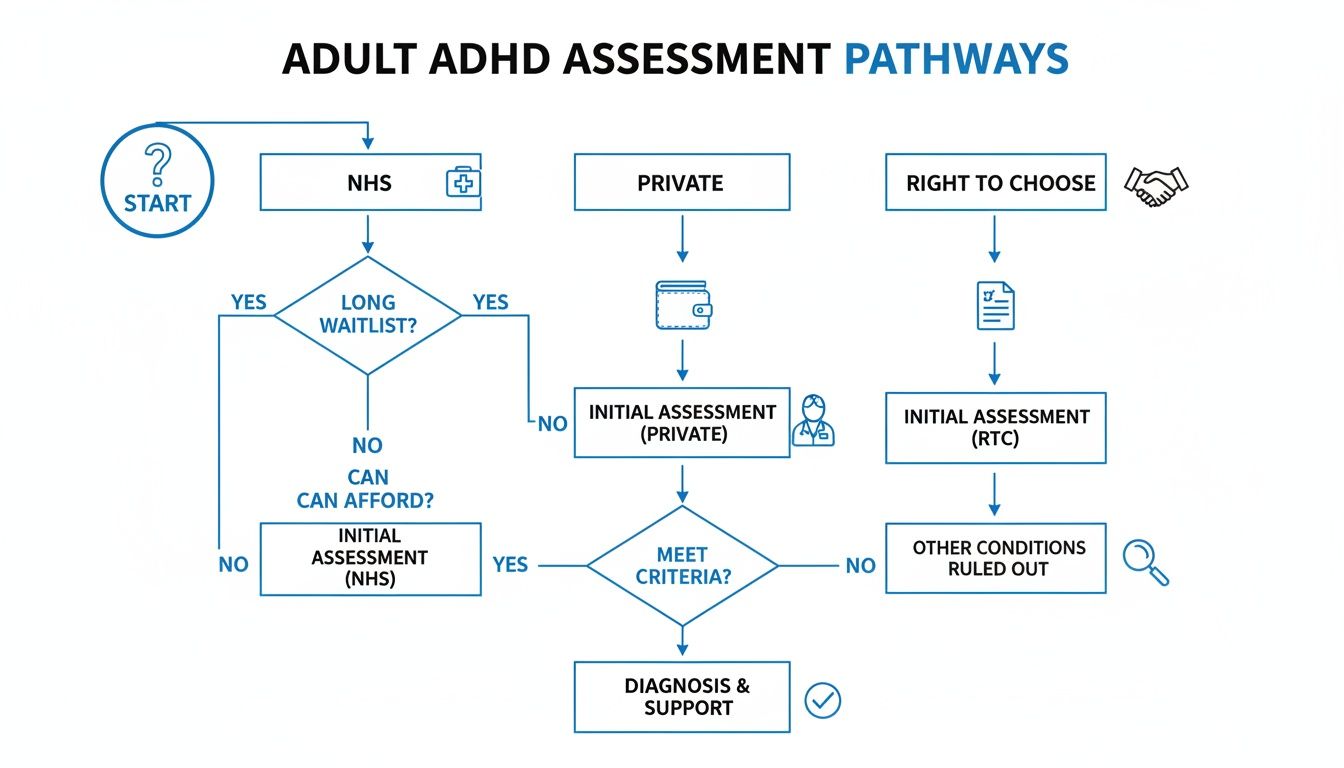
As you can see, the path you take really depends on whether your priority is cost or speed, with Right to Choose sitting perfectly in the middle.
Comparing ADHD Assessment Pathways
To make things even clearer, here's a quick side-by-side comparison of the three routes. Seeing the key differences laid out like this can really help you weigh up the pros and cons for your own circumstances.
| Feature | NHS Pathway | Private Pathway | Right to Choose Pathway |
|---|---|---|---|
| Wait Time | Extremely long (often 2-10 years) | Very short (weeks to a few months) | Short (typically 6-12 months) |
| Cost | Free (NHS funded) | High (£600-£1500+ for assessment) | Free (NHS funded) |
| Referral | Requires GP referral | Self-referral is usually possible | Requires GP referral |
| Flexibility | Limited to local NHS service | High choice of clinics and specialists | Choice of approved private providers |
Ultimately, there’s no single "best" option—only the one that’s right for you. Your decision will likely come down to balancing your budget against how urgently you need support.
What Happens During an Adult ADHD Assessment

The thought of any kind of clinical assessment can be a bit daunting, so let’s pull back the curtain on what actually happens. An adhd assessment for adults isn't a test you can pass or fail. It’s much more like a guided conversation—a deep dive with a specialist to piece together the full story of your life.
The whole point is to see whether your experiences and struggles match the official diagnostic criteria for ADHD. Think of it as a methodical investigation, tracing a line from your school days right up to the challenges you face today. The aim here is to take the mystery out of it, so you can walk in feeling prepared and ready to share your story.
The Diagnostic Interview
The diagnostic interview is the absolute heart of the assessment. This is a detailed chat that usually takes between one and three hours. The clinician—often a psychiatrist or another ADHD specialist—will guide you through a series of questions about your life.
They're looking to understand two main things:
- Your childhood: A core part of an ADHD diagnosis is establishing that symptoms were noticeable before you were 12 years old.
- Your life now: They’ll want to know how these traits affect at least two different areas of your adult life, like your career, your home life, or your relationships.
This is your chance to give real, specific examples. Talk about your struggles with focus, staying organised, memory, acting on impulse, or managing your emotions. It’s all about painting a clear picture of what day-to-day life is really like for you.
Gathering a Complete Picture
A diagnosis is never made based on one conversation alone. To be thorough, clinicians gather information from a few different places to build a complete, three-dimensional view. It's a bit like putting together a puzzle—each piece brings more clarity.
Here’s what that usually involves:
- Standardised Rating Scales: You’ll almost certainly be asked to fill out some questionnaires. These are standardised tools, like the Adult ADHD Self-Report Scale (ASRS), which help measure your symptoms against established clinical benchmarks.
- Collateral Information: Because our own memories aren't always perfect, getting another perspective is incredibly helpful. The clinician might ask to speak with someone who knows you well, like a partner, parent, or a close friend, to hear their take on your challenges.
- Reviewing Past Records: Old school reports can be gold dust. Teacher comments like "doesn't fulfil their potential," "easily distracted," or "disruptive in class" can be powerful evidence of symptoms in childhood.
A robust diagnosis is built on a foundation of evidence from multiple sources. It’s not just about what you say, but about building a consistent narrative that shows a lifelong pattern of ADHD-related impairments.
Online vs In-Person Assessments
Over the last few years, online ADHD assessments have become a really common and completely valid option. What’s important to know is that a properly conducted online assessment meets the very same clinical standards as an in-person one.
The only real difference is the setting. You’ll meet the specialist over a secure video call, so you can do it from the comfort of your own home. For many, this takes the stress out of travelling and can feel a bit less formal, which sometimes makes it easier to open up. If you want a more detailed breakdown, you can read more about what an online ADHD assessment in the UK involves.
Whether you choose online or in-person, the nuts and bolts of the diagnostic process are the same. You'll still have the in-depth interview, fill out the rating scales, and be asked to provide supporting information. The crucial thing is to pick a reputable, CQC-registered provider that follows NICE guidelines. That way, you know your assessment will be thorough and your diagnosis will be properly recognised.
Looking for a private ADHD assessment?
Answer a few questions and we’ll shortlist clinics that fit — comparing price and waiting time.
How to Prepare for Your Assessment and Choose a Clinic
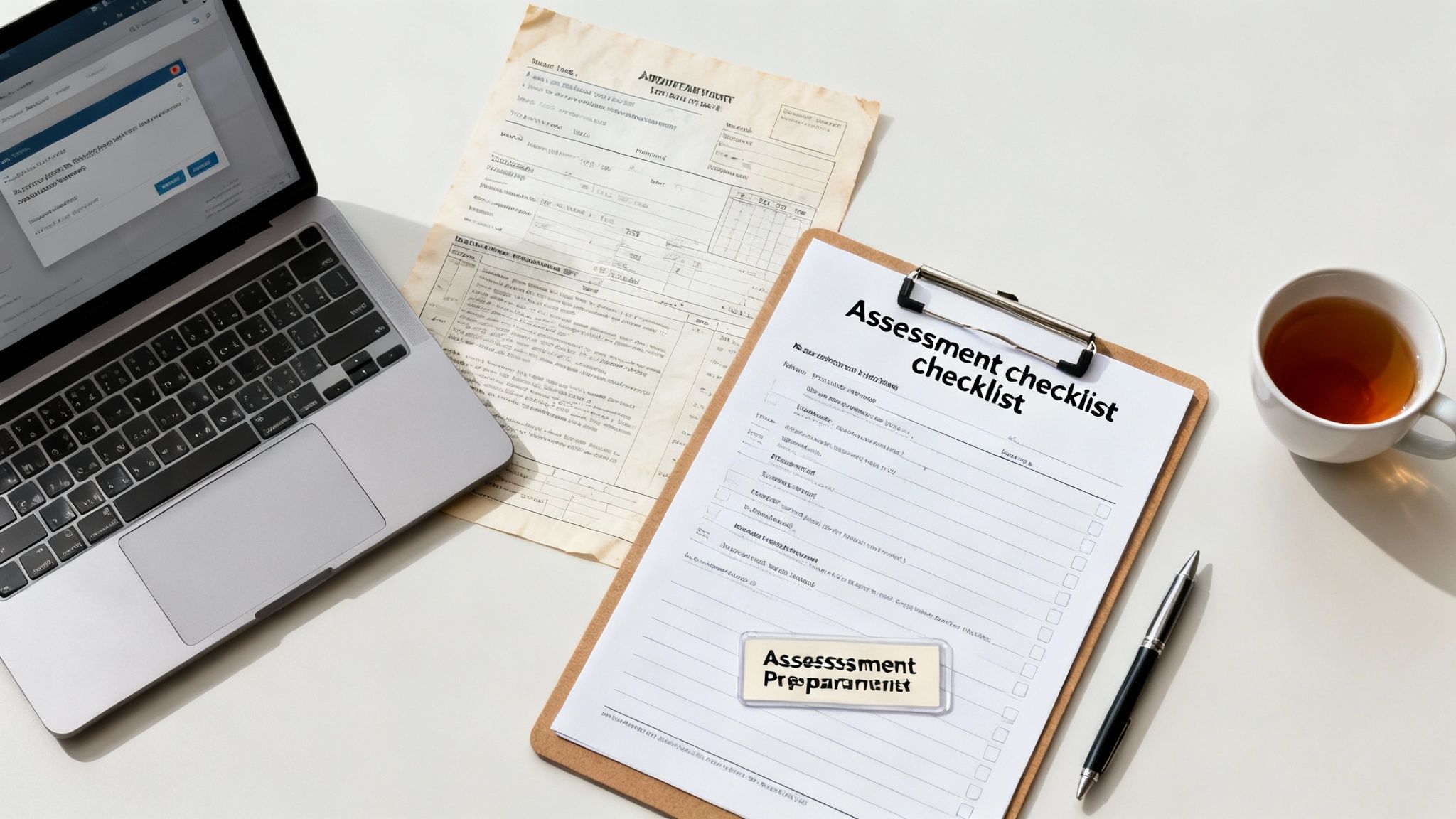
Okay, this is where theory turns into action. Getting ready for your ADHD assessment for adults can genuinely make a world of difference to the outcome. And if you're going private, picking the right clinic is probably the single most important decision you'll make in this whole process.
Let's walk through how to do it right. We'll cover a practical checklist for gathering your 'evidence' and, crucially, how to spot a high-quality clinic from a distance. A little preparation now empowers you to be a confident advocate for your own health.
Your Pre-Assessment Preparation Checklist
Think of this as a joint project between you and your clinician. The more information you can bring to the table, the clearer the picture will be for them. Relying on memory alone, especially when you’re feeling nervous, is a recipe for forgetting key details.
Try to gather these things well before your appointment:
- Specific Examples: Don't just say, "I'm disorganised." Get specific. Think along the lines of, "I missed three major work deadlines last month because I lost track of them," or "I've paid over £200 in late payment fees on bills this year."
- Old School Reports: These are gold dust. Dig them out and look for those classic teacher comments: "daydreamy," "disruptive," "bright but doesn't apply themself," or "easily distracted." This is your proof of symptoms before the age of 12.
- Input from Others: If you can, ask a parent, an older sibling, or your partner for their honest take on how they see you – both now and as a child. They often remember things you don't. You could even ask them to jot down a few notes you can share.
- Previous Medical History: Make a note of any past diagnoses like anxiety or depression. These conditions often go hand-in-hand with ADHD, and it's important for the clinician to have the full picture.
- Your Questions: Write down a list of everything you want to ask. In the moment, it's so easy for your mind to go blank. This way, you'll walk out with the answers you need.
Pro Tip: Keep all of this in one folder or a single document on your computer. Having everything organised and ready to go will massively reduce your stress on the day and help you present your situation clearly.
How to Vet a Private ADHD Clinic
If you’re going down the private or Right to Choose route, choosing a reputable clinic is absolutely non-negotiable. Frankly, not all providers are created equal. A low-quality assessment can be a very expensive dead end, leaving you with a diagnosis your GP won't accept.
Here are the essential things to check before you commit.
1. CQC Registration
The Care Quality Commission (CQC) is the independent regulator for health and social care in England. CQC registration is a non-negotiable mark of quality and safety. If a clinic isn’t registered, walk away. It’s that simple.
2. Genuinely Qualified Specialists
Your assessment must be carried out by a specialist psychiatrist or a properly qualified clinician with deep expertise in adult ADHD. Don't be afraid to check the clinic's website and look up the credentials of their team. Finding the right psychiatrist for an ADHD assessment who truly understands how it presents in adults is crucial.
3. Transparent and All-Inclusive Pricing
A good clinic is upfront about costs. The headline assessment fee is often just the start. You need a full breakdown of what you'll be paying for. Ask them directly about:
- The initial diagnostic assessment cost.
- Fees for follow-up appointments (especially during medication titration).
- The private prescription costs for medication before you're stable.
- Any extra admin fees for reports or letters.
4. A Clear Path to a Shared Care Agreement
This is perhaps the most critical point for your long-term finances. You must confirm that the clinic has a solid track record of setting up Shared Care Agreements (SCAs) with NHS GPs. Ask them about their process and their success rate. An SCA is the mechanism that moves your prescription over to the NHS, saving you from paying for private medication indefinitely.
By working through this checklist, you put yourself in the driver's seat. This prep work doesn't just help your clinician reach an accurate diagnosis; it ensures your investment leads to recognised, sustainable, long-term care.
Navigating Life and Treatment After Your Diagnosis

Getting an ADHD diagnosis isn’t the finish line. Far from it. Think of it as getting the right map after being lost for years—it’s the start of a new, much clearer journey where you can finally get the support you need. This isn't just about managing the difficult bits; it's about learning how to build a life where your unique way of thinking becomes a strength, not a constant source of frustration.
For most people, this journey involves a mix of medication and practical, skills-based therapies. It's about creating a personal toolkit that helps you move from just getting by to properly flourishing. So, let’s look at what comes next.
Understanding ADHD Medication and the Titration Process
For many adults, finding the right medication is genuinely life-changing. It works by helping to balance key chemicals in the brain, which can dial down the internal noise, sharpen your focus, and make impulsivity much easier to manage.
But you don’t just get handed a prescription and sent on your way. The first stage is a careful, collaborative process called titration.
It’s a bit like tuning a radio. You and your specialist work together to find the right medication and, crucially, the exact dose that brings the signal in clearly without any distracting static. This means starting on a very low dose and slowly increasing it over a few weeks, with regular check-ins to see how you're feeling and functioning.
The goal of titration isn’t to change who you are; it’s to help you be more of who you are. It clears away the brain fog, making it easier to focus on what actually matters to you.
This period typically lasts anywhere from four to twelve weeks. It's important to remember that during this time, you'll be paying for the medication privately, so it's a cost you'll need to factor into your budget.
The Role of a Shared Care Agreement
Once you and your clinician have found the right medication and a stable dose, the next step is to make your treatment affordable for the long haul. This is where a Shared Care Agreement (SCA) comes in.
An SCA is a formal arrangement between your private specialist and your NHS GP. Essentially, it allows your GP to take over writing your repeat prescriptions. This is a huge deal for your wallet, as it means you’ll only have to pay the standard NHS prescription fee instead of the full private cost of the medication.
It's a really good idea to speak to your GP about the possibility of an SCA before you even start the private assessment process. While the vast majority of GPs are happy to enter into these agreements, they aren't obligated to. A reputable private clinic will be very familiar with this process and can help make the transition to NHS prescribing as smooth as possible.
More Than Medication: Building Your Support System
Medication can be a fantastic tool, but it's rarely the whole answer. The most effective way to manage adult ADHD is to combine medical support with practical strategies that help you work with your brain instead of constantly fighting against it.
Here are some of the most effective non-medical options:
- ADHD-Specific Therapy: Cognitive Behavioural Therapy (CBT) that has been adapted for ADHD is incredibly useful. It moves beyond just talking about feelings and gives you real-world tools for beating procrastination, managing your time, and finally getting organised.
- ADHD Coaching: A coach is like a personal trainer for your executive functions. They work with you to set goals—both personal and professional—and act as an accountability partner to help you build better routines, systems, and habits that actually stick.
- Psychoeducation: This is simply the process of learning everything you can about how ADHD affects you. Understanding the 'why' behind your struggles is incredibly empowering. It helps you stop blaming yourself for things that are a genuine part of your neurotype.
Putting this kind of support system in place is what creates real, lasting change. It takes you from simply treating symptoms to actively designing a life that plays to your strengths.
Still Have Questions About Adult ADHD Assessments?
It's completely normal to have a few lingering questions, even after you've got a handle on the basics. Getting an ADHD assessment for adults is a big step, so let's tackle some of the most common queries we see.
Think of this as a quick FAQ from someone who's been there. We'll clear up the confusion around online assessments, get real about the costs of going private, and figure out what to do if you hit a wall with your GP. The idea is to swap that feeling of uncertainty for a bit of confidence.
Are Online ADHD Assessments Actually Legitimate?
Yes, absolutely. A well-conducted online ADHD assessment is every bit as valid as one done in a clinic room. The crucial thing is that it has to be carried out by a qualified UK-based clinician whose clinic is registered with the Care Quality Commission (CQC) and sticks to the official National Institute for Health and Care Excellence (NICE) guidelines.
Good online providers use secure video calls to have the exact same in-depth conversation you'd have face-to-face. A diagnosis from a CQC-registered online clinic is fully recognised. It allows you to access treatment, including medication, and set up a Shared Care Agreement with your GP later on.
For many people, the sheer convenience of an online assessment is a game-changer. It cuts out the stress of travel and lets you talk openly from a place where you feel comfortable.
What’s the Real Cost of a Private ADHD Assessment?
This is a big one, and the answer isn't just a single number. While the headline price for the assessment itself usually falls somewhere between £600 and £1,500, that’s rarely the final figure you'll pay.
To get a true picture of the investment, you need to think about the entire journey from diagnosis through to starting treatment.
Here’s a more realistic breakdown of the costs involved:
- The Initial Assessment Fee: This is the one-off charge for the main diagnostic appointment.
- Follow-Up Appointments: You'll need these while you're finding the right medication and dose (this is called titration). Each session can cost between £150 and £300.
- Private Prescriptions: During the titration phase, you have to pay the full private cost for your medication, which can add up to a significant monthly bill.
- Admin and Reports: Some clinics might charge extra for things like writing a report for your employer or letters to your GP.
Crucial Tip: Before you sign up with anyone, ask for a complete, transparent breakdown of all possible costs, from the first appointment to the final handover. A reputable clinic will be upfront about the total expected investment so there are no nasty surprises.
How Does a Shared Care Agreement Actually Work?
A Shared Care Agreement, or SCA, is basically a formal handshake between your private ADHD specialist and your NHS GP. The whole point is to make your long-term medication affordable by moving your prescription from the private clinic over to the NHS.
Here’s how it unfolds: once your private clinician has found the right medication and a stable dose for you, they'll write to your GP. This letter confirms your diagnosis and your now-stable treatment plan, and it formally asks the GP to take over prescribing your medication.
If your GP agrees, they’ll start issuing your repeat prescriptions. That means you’ll only have to pay the standard NHS prescription fee (currently £9.65 per item in England) instead of the much higher private cost. It's really important to have a chat with your GP about their willingness to accept an SCA before you start the private process, as they aren't obligated to say yes.
What Can I Do If My GP Refuses a Referral?
It can feel incredibly disheartening when your GP says no, but it doesn't have to be the end of the road. If you're met with resistance when asking for an ADHD assessment for adults, the key is to be prepared and gently persistent.
Try going back to your appointment with a completed ASRS self-report checklist. It also helps to have a written list of specific, real-life examples of how your symptoms affect you at work, at home, and in your relationships.
Politely ask them to explain their reasoning for the refusal. Sometimes, it’s simply down to a lack of awareness about the proper pathways for adult ADHD. If you're going for a Right to Choose referral, bringing the provider's template letters can often clarify the process for them. If they still say no, you have every right to ask for a second opinion from another doctor at the practice.
Finding the right clinic is the most important step you'll take. At ADHD Private, we’ve built a free directory to help you compare over 85 CQC-registered clinics across the UK. You can check transparent pricing, wait times, and services to find the best fit for you at https://adhdprivate.co.uk.