Your Guide to Adult ADHD Assessment in the UK
Considering an adult ADHD assessment in the UK? This guide explains the signs, NHS vs. private routes, costs, and how to get a confident diagnosis.
Written and maintained by the ADHD Private editorial team, drawing on NHS, NICE and ADHD UK guidance. This is general information, not medical advice.
An adult ADHD assessment is a thorough evaluation carried out by a qualified healthcare professional.An adult ADHD assessment is a thorough evaluation carried out by a qualified healthcare professional. Its purpose is to figure out if your persistent struggles with focus, staying organised, or acting on impulse are actually signs of Attention-Deficit/Hyperactivity Disorder.
This isn't just a simple checklist or a quick online quiz. Think of it more as a deep dive into your life story, piecing together experiences from childhood to now, to get a clear and accurate picture.
Do I Need an Adult ADHD Assessment

If you're asking yourself this question, you're in good company. Countless adults live for years, sometimes even decades, feeling like they’re constantly trying to tune in an old radio that’s stuck between stations. There’s this persistent static—a background noise of distraction, missed appointments, and emotional rollercoasters—that makes feeling clear-headed seem impossible.
An assessment is the official process of finding out whether ADHD is the reason behind these lifelong patterns. It’s about finally connecting the dots between struggles you might have always thought were just personal failings.
Understanding the Signs
This isn't about having an occasional 'off day' or misplacing your keys every now and then. The difficulties that usually lead someone to seek an assessment are persistent, they show up in multiple areas of your life, and they have a real impact on everything from your career to your relationships.
It’s about recognising a consistent pattern of challenges that no amount of willpower or 'trying harder' seems to solve.
To help you see if these patterns resonate, here’s a look at some common challenges that often signal it's time to consider an assessment.
Signs It Might Be Time for an ADHD Assessment
| Area of Life | Common Challenges Suggesting an Assessment May Be Helpful |
|---|---|
| Workplace Performance | Consistently missing deadlines despite long hours, finding project management chaotic, or struggling to stay engaged and focused during meetings. |
| Relationships | Forgetting important dates and promises, unintentionally interrupting your partner, or having emotional reactions that feel out of proportion to the trigger. |
| Daily Life Management | Feeling constantly overwhelmed by household chores, battling to keep finances in order, or having a trail of a dozen half-finished projects around the house. |
| Internal Experience | A mind that feels like it never switches off, making it hard to relax, fall asleep, or just enjoy a quiet moment without a hundred thoughts racing. |
These examples get to the heart of what an assessment explores. It's less about fleeting moments of forgetfulness and more about a lifetime of feeling held back.
The real question an adult ADHD assessment aims to answer isn't "Are you sometimes forgetful?" but rather, "Has a lifelong pattern of inattention, impulsivity, or hyperactivity significantly held you back from functioning well and reaching your potential?"
Why So Many UK Adults Are Undiagnosed
It’s incredibly common for adults with ADHD to have been missed in childhood. This is especially true for women, girls, and those who weren't hyperactive or disruptive at school. Often, high intelligence or sheer determination helped mask the underlying executive function challenges for years.
This has led to a massive gap in diagnosis and care. In the UK, while it’s estimated that 3-4% of adults have ADHD, a huge analysis of 9 million GP records revealed that only 0.32% had an official diagnosis. This suggests that as few as 1 in 9 adults with the condition have been properly identified, leaving millions to navigate life without answers or support.
Deciding to get a formal evaluation is a huge step towards gaining clarity and self-compassion. By pursuing a professional ADHD diagnosis in the UK, you can finally get to the "why" behind your challenges and start building a life that works with your brain, not against it.
What to Expect From Your ADHD Assessment Journey
The thought of an adult ADHD assessment can be nerve-wracking. It’s easy to feel unsure about what the process actually involves. But the good news is that it’s a structured, collaborative journey designed not to test you, but to understand you. This isn’t a scary interrogation; it’s a deep, supportive conversation about your life experiences.
Think of your clinician as a detective and you as the expert witness on your own life. Together, you’ll look at the clues from your childhood, school days, work life, and relationships to build a complete, accurate picture. The whole point is to turn that anxiety into clarity and give you a clear path forward.
The Initial Steps: Your GP and Referral
For most people, the journey starts with a chat with their GP. This first conversation is key, as it's your first proper step towards getting a referral. Come prepared to talk about why you think you might have ADHD, and have some real-life examples ready of how it's affecting you at work, at home, and in your social life.
After that chat, your GP will refer you to a specialist service. This could be an NHS mental health service or a private clinic, depending on which route you’ve decided to take. This referral is what officially kicks off the assessment process.
Pre-Assessment Questionnaires: Setting the Stage
Before you actually speak to a specialist, you’ll almost always be asked to fill out some pre-assessment questionnaires. These forms aren't a test you can pass or fail. They’re simply tools to give the clinician a baseline understanding of your experiences and symptoms before you meet.
You'll probably be asked to rate how often you struggle with certain things related to inattention, hyperactivity, and impulsivity. It’s also very common for clinics to ask someone who knows you well—like a partner, close friend, or parent—to fill out a similar form. This gives the clinician an outside perspective on how your traits show up to other people.
An adult ADHD assessment is a multi-faceted evaluation. It combines your self-reported experiences, observations from others, your developmental history, and a clinical interview to ensure a thorough and accurate diagnosis that aligns with established guidelines.
The Core Diagnostic Interview
The heart of any adult ADHD assessment is the diagnostic interview. This is a detailed, semi-structured conversation with a psychiatrist or another qualified specialist, which usually lasts somewhere between two and four hours. The clinician will guide you through a chat covering several key areas of your life:
- Childhood and Schooling: They’ll ask about your behaviour, ability to focus, and friendships back in your school days. This is because the official criteria require some evidence of symptoms before the age of 12. Don't worry if your memory is a bit fuzzy; clinicians are skilled at asking questions that can help jog your memory.
- Adult Life: You’ll talk through your experiences in university or college, your career history, relationships, and general day-to-day life. The focus here is on spotting persistent patterns of behaviour that have carried on into adulthood.
- Specific Symptoms: The interview will dig into the classic symptoms of inattention (like struggling to hold focus or being disorganised) and hyperactivity/impulsivity (like fidgeting, feeling restless, or interrupting others).
The clinician’s job is to see if your lifelong experiences line up with the official diagnostic criteria for ADHD. To get a diagnosis, your symptoms must be present in two or more settings (for example, at work and at home) and significantly get in the way of you living your life.
Gathering Supporting Information
To build the most complete picture possible, your clinician will need more than just the interview. This is where supporting information becomes so important. If you can get your hands on them, old school reports can be incredibly revealing, often containing little comments from teachers like "daydreams in class" or "is easily distracted," which provide fantastic objective evidence from your childhood.
Input from family members or your partner can also be hugely helpful. They offer a different angle on how your symptoms affect your life and relationships. This team approach makes sure the final diagnosis is based on a well-rounded understanding of your life story, not just a single conversation. If you are interested in different formats, you can learn more about how an online ADHD assessment in the UK works and how it compares to in-person options.
Looking for a private ADHD assessment?
Answer a few questions and we’ll shortlist clinics that fit — comparing price and waiting time.
Navigating Your Options: NHS vs Private Assessment
Deciding how to pursue an adult ADHD assessment is a huge first step. In the UK, you generally have a few different routes you can take: going through your local NHS service, using a provision called NHS Right to Choose, or paying for a fully private assessment.
Each path has its own timeline, cost, and process, so getting your head around them is key to making a choice that works for you. It can feel like standing at a crossroads. One path is free but often involves a very long wait. The other is much faster but requires a significant financial investment. Let's break down what each option really looks like.
The Standard NHS Pathway
The traditional journey starts with your GP. You'll discuss your symptoms and how they're affecting your life, and if they agree, they can refer you to your local NHS adult ADHD service for a full assessment. The big advantage here is that it's completely funded by the NHS—there are no costs for the assessment, diagnosis, or any treatment that follows.
The major drawback, however, is the wait. NHS waiting lists for adult ADHD assessments have become incredibly long. In some areas, people are being told they might have to wait over 10 years. This dire situation is pushing many to either go private or simply give up.
Official figures from the NHS England independent ADHD Taskforce show a huge gap between how many people likely have ADHD (2-3% of adults) and how many are actually diagnosed (0.20% in women and 0.74% in men). Unlike other conditions, there's no national target for ADHD wait times, which only makes these delays worse. You can read more about the state of ADHD services on the BDA website.
NHS Right To Choose: A Funded Shortcut
If you live in England, there's another option that not enough people know about: NHS Right to Choose (RTC). Think of it as a way to get the speed of a private assessment but still have it funded by the NHS. It's a fantastic middle-ground.
With RTC, you can ask your GP to refer you to a private clinic that holds an NHS contract. The assessment and any follow-up treatment are still covered by the NHS, just like they would be through your local service, but you get to bypass the local waiting list.
Right to Choose genuinely offers the best of both worlds for many: the speed and choice of the private sector, but without the personal cost. If you're in England, it's absolutely worth looking into.
Here’s how it generally works:
- Find an RTC Provider: You research and choose a qualified private clinic that accepts RTC referrals.
- Request the Referral: You take your choice to your GP, often using pre-filled forms from the clinic to make it easier.
- GP Makes the Referral: Your GP then sends your referral to the clinic you've chosen instead of the local NHS service.
Wait times are much shorter than the standard NHS route—usually a matter of months, not years. They are, however, a bit longer than if you were paying entirely out of pocket.
This flowchart gives a simple visual guide to help you weigh up the different paths.
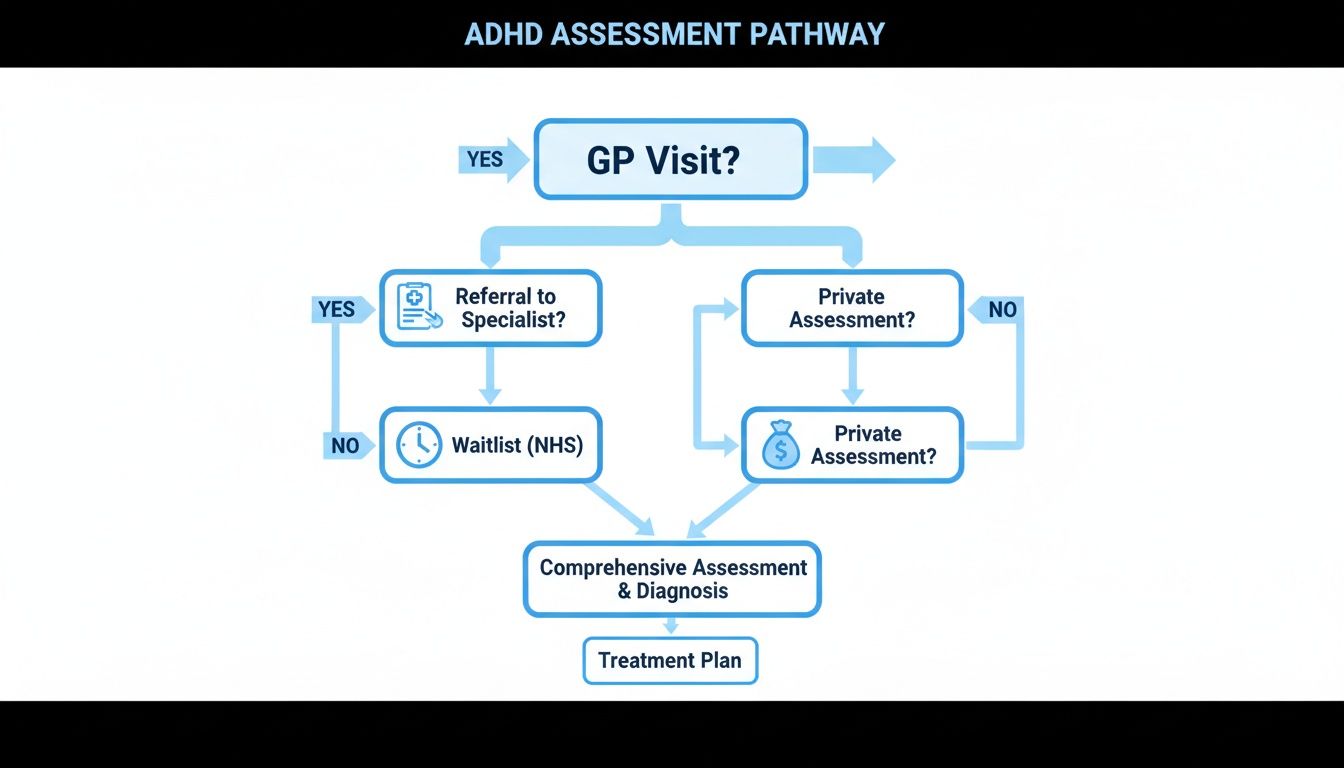
As the visual shows, the main decision comes down to a trade-off between how long you can afford to wait and how much you are able to pay.
The Fully Private Pathway
For those who need answers as quickly as possible and have the money to do so, going fully private is the fastest route by a long shot. Waiting times are minimal, and many clinics can see you for an assessment within just a few weeks of your first contact.
This speed is the main appeal. It means you can get a diagnosis and start a treatment plan much, much sooner, which can be genuinely life-changing if your symptoms are causing serious problems at work or in your relationships. But this speed and convenience come at a price.
You'll need to budget for a few different costs:
- The Initial Assessment: The main diagnostic appointment itself usually costs between £700 and £2,000.
- Follow-Up Appointments: After a diagnosis, you'll need several follow-ups to get medication started and find the right dose (this is called titration). These can cost £150 to £400 each.
- Medication Costs: You'll also have to cover the cost of private prescriptions during the titration period until your treatment is stable.
The end goal for most people who go private is to set up a shared care agreement with their NHS GP. This is where the specialist hands over the prescribing responsibility to your GP, meaning you only have to pay the standard NHS prescription fee for your medication long-term, which is far more affordable.
UK Adult ADHD Assessment Pathways Compared
To make things clearer, here’s a side-by-side look at the three main routes for getting an adult ADHD assessment in the UK. This table breaks down the key differences in cost, waiting times, and what you can expect from each pathway.
| Feature | Standard NHS Pathway | NHS Right to Choose (England) | Fully Private Pathway |
|---|---|---|---|
| Cost to You | Free (fully NHS funded) | Free (fully NHS funded) | Self-funded (£1,000 - £3,000+ total) |
| Typical Wait Time | Extremely long (1-10+ years) | Moderate (typically 6-12 months) | Very short (often 2-8 weeks) |
| Provider Choice | None (referred to local service) | You choose from a list of approved providers | Total freedom to choose any clinic |
| Geographic Access | Limited to your local NHS trust | England only | Available UK-wide |
| Main Advantage | No financial cost | NHS-funded with much shorter waits | The fastest possible route to diagnosis |
| Main Disadvantage | Potentially life-altering delays | Not available outside England | Significant financial investment required |
Ultimately, choosing between the NHS, Right to Choose, and private pathways is a personal decision. It depends entirely on your location, your financial situation, and how urgently you feel you need support.
How to Choose a Reputable Private ADHD Clinic
Deciding to go private for an ADHD assessment can feel like a huge step, but the next question is often even bigger: which clinic do you choose? A quick search brings up a dizzying number of options, and it’s vital to pick the right one. This isn't just about getting a diagnosis; it’s about finding a partner you can trust for your long-term care.
Think of it like this: you're hiring a specialist guide for a really important expedition. You need someone with the right qualifications, a clear map, and transparent pricing. Let’s break down the essential checks to make sure you find a clinic that's both reputable and right for you.
Verify Clinician Credentials and Clinic Accreditation
This is the absolute first thing you should check. The quality of your assessment rests entirely on the expertise of the person conducting it. A good clinic will be proud of its team and make their credentials easy to find.
Here's what to look for, no exceptions:
- GMC Registration: Any psychiatrist diagnosing ADHD in the UK must be on the General Medical Council (GMC) register. You should be able to look them up by their name or GMC number on the official register to confirm they are a specialist.
- Specialist Experience: The clinician should be a consultant psychiatrist or another highly qualified professional with a clear background in diagnosing and treating adult ADHD. This isn't a job for a generalist.
- CQC Rating: In England, healthcare services are regulated by the Care Quality Commission (CQC). A rating of 'Good' or 'Outstanding' is a solid sign that the clinic meets high standards for safety and quality of care.
If you have to hunt for this information, that’s a major red flag. Transparency here is non-negotiable.
Ensure the Process Aligns with NICE Guidelines
The National Institute for Health and Care Excellence (NICE) sets the gold standard for ADHD diagnosis in the UK. For a private diagnosis to be recognised by the NHS (which is crucial for later), it must follow these guidelines to the letter.
A proper, NICE-compliant assessment is thorough. It’s not just a half-hour chat and a quick questionnaire. It involves a deep dive into your entire life history, from your experiences as a child to the challenges you face today at work and at home. It should also include input from someone who knows you well, like a partner or parent.
A reputable private clinic doesn't offer a shortcut to a diagnosis; it offers a faster route to a thorough, evidence-based assessment that meets the same high standards as the NHS.
Scrutinise Costs and Financial Transparency
Hidden costs can turn a manageable private assessment into a financial nightmare. A trustworthy clinic will be completely upfront about the entire financial commitment, not just the initial assessment fee.
Before you commit, ask for a full breakdown of all potential charges:
- Initial Assessment Fee: The one-off cost for the diagnostic appointment itself.
- Follow-Up Appointments: How much does each session cost during the medication titration phase (where you find the right dose)?
- Private Prescription Fees: The administrative charge for the clinic to issue a prescription.
- Medication Costs: The actual price you'll pay the pharmacy for the medication while you're under private care.
- Reporting Fees: Are there extra costs for reports or letters to your GP or workplace?
Getting a clear picture of the total investment is essential for your peace of mind. For a deeper look into the costs, our guide on getting a private ADHD diagnosis in the UK breaks it down even further.
Confirm a Path to Shared Care
For most people, the long-term goal is to move their care back to the NHS to make it affordable. This is achieved through something called a shared care agreement. It's an arrangement where your private specialist stabilises your treatment and then hands over the prescribing to your NHS GP. After that, you'll only pay the standard NHS prescription charge.
This is a critical point to clarify before you book an assessment. Ask the clinic directly: "Do you support patients in establishing shared care agreements with their GPs?" A clinic focused on your sustainable wellbeing will have a clear process for this. Without it, you could be facing the high cost of private prescriptions indefinitely.
Life After Diagnosis: Understanding Your Next Steps

Getting an adult ADHD diagnosis isn't the finish line; it’s the starting block for a new, more informed chapter of your life. For many, it's a lightbulb moment that reframes years of unexplained struggles, shifting the story from "What's wrong with me?" to "This is just how my brain is wired."
So, what now?
The journey ahead is all about building a personalised toolkit for success. There's no magic bullet here. Instead, it’s about finding the right mix of medical support and real-world strategies that fit your unique brain and your life.
This is where you take back control. It’s your chance to move from just about coping to actively thriving, learning to lean into your strengths while supporting your challenges.
Exploring Medical Treatment Options
For a lot of people, medication is a hugely effective piece of the ADHD puzzle. It’s crucial to know that medication isn’t a ‘cure’ or something you have to do—it's a personal choice. It's simply a tool designed to help your brain’s neurotransmitters work a bit more efficiently.
Think of it like putting on glasses for the first time. You could still see before, but now everything is in sharp focus, making the world much easier to navigate. ADHD medication does something similar by helping to quiet the constant mental 'chatter,' allowing you to focus, manage impulses, and get through your day more smoothly.
In the UK, there are two main types of medication prescribed:
- Stimulants (e.g., Methylphenidate, Lisdexamfetamine): These are the most common first-line treatment. They work by increasing levels of brain chemicals like dopamine, which boosts focus and attention. They get to work quickly, and you’ll usually feel the effects within an hour or so.
- Non-stimulants (e.g., Atomoxetine): These work a bit differently. They take longer to build up in your system but provide a smoother, 24-hour effect. They're a fantastic alternative if stimulants aren't a good fit for you.
The Titration Process: Finding Your Focus
Once you and your specialist agree to try medication, you'll start a process called titration. This is a careful, methodical journey to find the right medication and the exact dose that works for you. It's anything but a one-size-fits-all approach.
Your clinician will start you on a very low dose, slowly increasing it over several weeks. You'll have regular check-ins to talk about how it's working and discuss any side effects. This teamwork ensures the treatment is fine-tuned to your specific needs, giving you the best possible benefits with minimal downsides.
Self-compassion is one of the most powerful tools you can cultivate after a diagnosis. For years, you may have blamed yourself for challenges that were neurological. Now, you have the chance to be kind to yourself as you learn a new way of living.
Building Your Support System Beyond Medication
While medication can be a game-changer, it’s rarely the whole story. A truly solid support system combines medical treatment with powerful, practical strategies. This is where you start building skills that last a lifetime.
Unfortunately, the demand for support often far outstrips what's available. While ADHD prescriptions in England have doubled in six years, this only hints at the scale of the need. Statistics suggest that of the estimated 2.5 million adults in the UK who may have ADHD, only a tiny fraction get any kind of treatment at all. You can explore more ADHD treatment statistics on Priory Group's website.
Here are some of the most effective non-medical supports to look into:
- ADHD Coaching: A coach helps you build practical skills for executive functions. That could mean creating organisational systems that actually work, learning time management techniques like 'body doubling', or finding ways to finally beat procrastination.
- Cognitive Behavioural Therapy (CBT): CBT that’s specifically adapted for ADHD is brilliant for helping you unpick the negative thought patterns that often come with the condition, like low self-esteem or anxiety.
- Workplace Adjustments: In the UK, you might be able to get help through the government's Access to Work scheme. This can provide funding for things like noise-cancelling headphones, a workplace coach, or specialised software to help you do your job well.
Ultimately, life after an ADHD diagnosis is a journey of discovery. It’s about learning to work with your brain, not against it, armed with a newfound understanding and a bespoke set of tools that empower you to truly thrive.
Common Questions About Adult ADHD Assessments
Thinking about getting an ADHD assessment can bring up a lot of questions. That’s completely normal. You might be feeling a mix of hope, nervousness, and maybe a bit of confusion about how it all works. To help clear things up, let’s walk through some of the most common queries people have.
Getting your head around the practicalities—like how long an appointment takes or whether an online assessment is even legitimate—can make the whole process feel less daunting. It helps you feel more prepared and in control of this important step.
How Long Does an Adult ADHD Assessment Appointment Take?
It’s easy to assume the assessment is just a single, quick chat, but that’s rarely the case. The main diagnostic interview—the really in-depth conversation you'll have with the specialist—typically lasts between two and four hours. This gives them enough time to properly explore your experiences, from your school days right up to the challenges you're facing today.
But it's better to think of the assessment as a whole process, not just one meeting. The entire journey includes filling out forms beforehand, the main interview, gathering information from others (like a parent or partner), and then waiting for your detailed report. This whole thing can take several weeks because it's designed to build an accurate, 360-degree view of you.
Are Online ADHD Assessments Legitimate?
Yes, absolutely. In the last few years, online assessments (sometimes called telehealth) have become a standard, effective, and perfectly valid way to diagnose adult ADHD. Most reputable private clinics, and even some NHS services, now offer this as an option.
As long as it's carried out by a qualified specialist who sticks to the official NICE (National Institute for Health and Care Excellence) guidelines, an online assessment is every bit as thorough as one done in person. The core of the process is identical: detailed interviews, questionnaires, and a deep dive into your history, just done over a secure video call.
The legitimacy of an assessment has nothing to do with whether it's online or face-to-face. It’s all about the clinician’s expertise and their commitment to using rigorous, evidence-based diagnostic standards.
For many people, going online is actually a huge plus. It removes the hassle of travel and makes it much easier to fit the appointment into a busy life.
How Should I Prepare for My Assessment?
Preparing for an ADHD assessment isn't like revising for an exam. Think of it more like gathering the evidence for your life story. The more detail and context you can provide, the clearer the picture will be for the clinician trying to understand the patterns you've lived with.
Here are a few practical things you can do to get ready:
- Dig Out Old Documents: If you can find any old school reports, they can be gold dust. Look for comments from teachers about being "easily distracted," "a daydreamer," or "fidgety." These provide a brilliant historical snapshot.
- Jot Down Current Struggles: Make a list of specific examples of where you're struggling now, both at work and at home. Think about things like missed deadlines, trouble managing money, tensions in your relationships, or just feeling constantly overwhelmed by simple chores.
- Think Back to Childhood: Try to recall memories or even little anecdotes related to focus, behaviour, and organisation as a kid. What did your parents say? How did you find making friends? These memories are often crucial clues.
- List Your Questions: You’ll definitely have your own questions for the specialist. Write them down beforehand so you don’t forget to ask them in the moment.
Doing this little bit of prep work means you can give a really rich account during your session, which ultimately leads to a more accurate and helpful outcome.
Will an ADHD Diagnosis Affect My Driving Licence?
This is a really common worry, but let me put your mind at ease. For the vast majority of people, an ADHD diagnosis has no impact on their driving licence. A diagnosis on its own does not automatically mean you have to stop driving or even tell the DVLA.
The only time you’re legally required to inform the DVLA is if your ADHD symptoms—or the side effects of any medication—are so severe that they consistently affect your ability to drive safely. For instance, if your inattention was causing frequent near-misses on the road, that's something you'd need to discuss with your doctor and potentially report.
For most people, getting a diagnosis and starting treatment actually makes them a safer and more focused driver.
Finding your way through the world of ADHD assessments can feel complicated, but you don't have to figure it all out alone. At ADHD Private, our free UK-wide directory helps you compare over 85 clinics, see transparent pricing and wait times, and find the right provider for you. Find the right ADHD clinic