Your Guide to ADHD Diagnosis in the UK: How to Get an Assessment
Get clear steps for the ADHD diagnosis process in the UK: what to expect, how to book referrals, and prepare for your appointment.
Written and maintained by the ADHD Private editorial team, drawing on NHS, NICE and ADHD UK guidance. This is general information, not medical advice.
Trying to get an ADHD diagnosis in the UK can feel like you've been given a complex puzzle without the instructions. You're faced with different routes—NHS, private, or Right to Choose—and each one has its own set of rules, costs, and waiting times. It's enough to make anyone feel overwhelmed before they've even started.
Your First Steps on the UK ADHD Diagnosis Journey
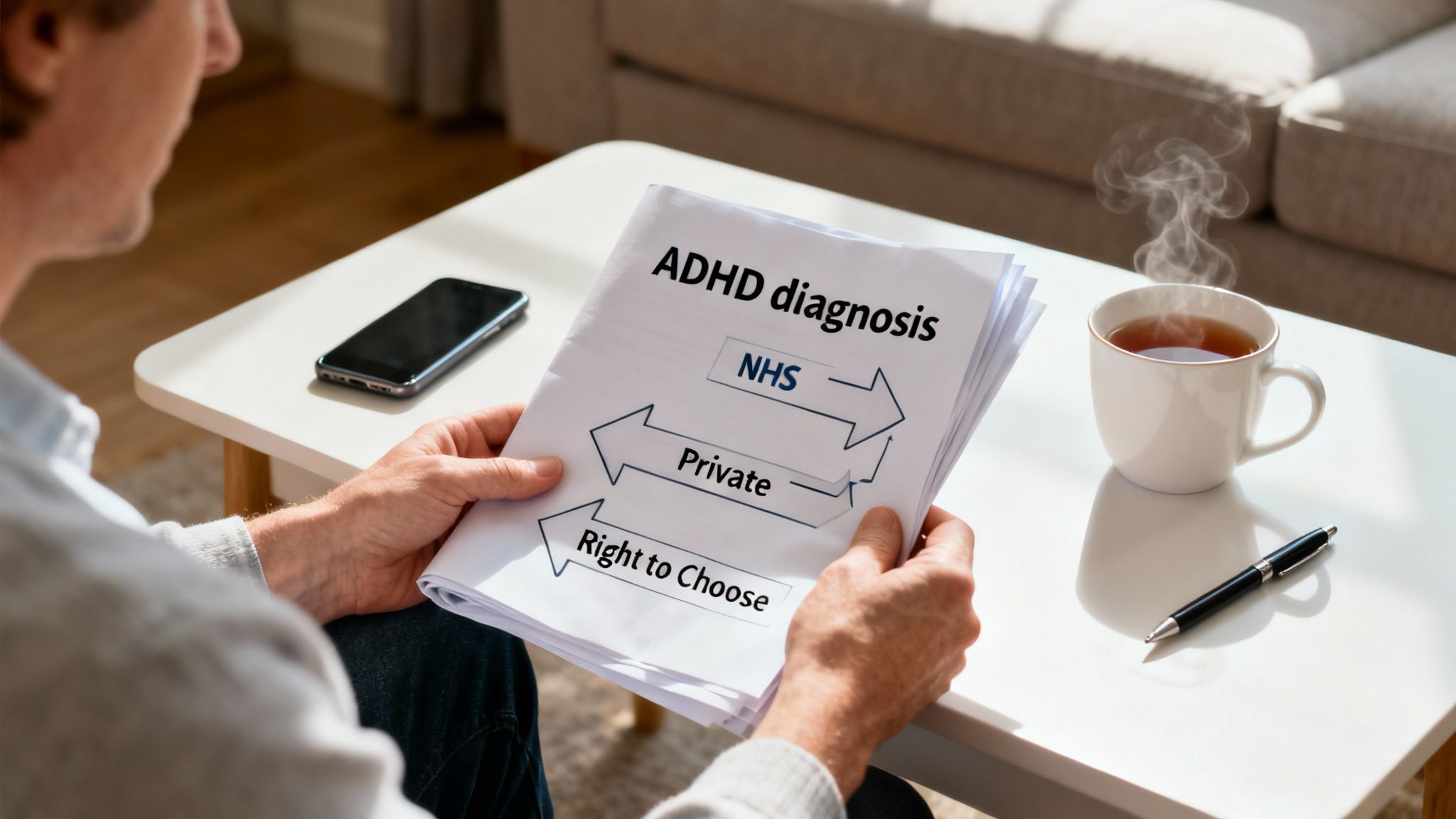
If you're feeling lost in the system, you're definitely not alone. It’s a common experience to be met with long waiting lists, conflicting information, and a real sense of uncertainty about which path to take. This guide is designed to be your practical roadmap, cutting through the confusion to give you clarity.
Think of this as the moment you take back control. We'll demystify what an assessment actually involves, explain how each pathway really works, and look at what kind of support you can expect to get afterwards. At its heart, this journey is about understanding yourself better and finding the tools to make life work for you.
Acknowledging the Diagnosis Gap
That feeling of being overlooked isn't just a feeling; it's backed up by some pretty stark numbers. While an estimated 2.5 million people in England have ADHD, there's a huge gap between how many people have it and how many have been diagnosed. In fact, an analysis of 9 million UK GP records revealed only 0.32% had a recorded ADHD diagnosis.
According to a report on ADHD statistics from the Priory Group, this means as few as one in nine people with the condition have a formal diagnosis. This is a critical reality. It means countless adults and children are navigating daily life with unrecognised symptoms that affect everything from their work and relationships to their mental health. Getting a diagnosis is the first, crucial step to closing that personal gap.
A diagnosis isn't about getting a label. It's about finally getting the right instruction manual for your brain—one that helps things make sense and shows you a clear path towards support and treatment.
What This Guide Covers
We’ve structured this guide to build your understanding step-by-step, giving you the knowledge you need to make the best decisions for yourself or your child. We will walk you through:
- What Really Happens in an Assessment: We’ll break down the entire clinical process, from the initial interviews to the questionnaires, so you know exactly what to expect.
- Choosing Your Path: A clear, honest comparison of the NHS, private, and Right to Choose routes, covering the pros and cons of each.
- Child and Adolescent Diagnosis: Specific, practical advice for parents who are navigating the process for their children.
- How to Prepare: Actionable tips on what information to gather to make sure your assessment is as thorough and productive as possible.
- Life After Diagnosis: A look at what comes next, including treatment options, medication, and getting support at work or school.
What Really Happens in an ADHD Assessment?
It's easy to picture an ADHD assessment as some kind of exam you can pass or fail, but that's not how it works at all. It's much closer to a detailed, structured conversation with a specialist who genuinely gets neurodiversity. The whole point is to build a complete picture of you and how your mind is wired.
This isn't just about ticking off a list of symptoms. It’s about digging deeper to understand how these traits actually affect your day-to-day life. Think of it as a collaborative investigation between you and the clinician, piecing together patterns that have probably been there for years.
The Core Components of an Assessment
Every clinic has its own way of doing things, but a proper, thorough assessment in the UK will almost always be built around a few key pillars.
These elements are like a detective gathering different types of clues – each one adds another layer to the picture, helping the specialist arrive at an accurate conclusion.
- The Clinical Interview: This is the absolute cornerstone of the assessment. You'll sit down with a psychiatrist or a specialist nurse for an in-depth chat about your current struggles, your history, and the symptoms you're experiencing.
- Standardised Questionnaires: You'll be asked to fill out some rating scales, and often a partner, parent, or close friend will be asked to as well. These aren't tests, but they help the clinician measure the frequency and severity of ADHD traits like inattention or hyperactivity in a structured way.
- A Look Back at Your Childhood: The clinician will want to know all about your early years. That’s because ADHD is a neurodevelopmental condition, which means the signs have to have been present before the age of 12.
Why Your Childhood Matters So Much
That trip down memory lane is non-negotiable. ADHD doesn't just show up out of the blue in adulthood; the wiring has been there since childhood. The clinician needs to find evidence that the difficulties you're facing now have roots in your younger years.
This is where old school reports can become gold dust. A throwaway comment from a Year 4 teacher saying you were "easily distracted" or "always fidgeting" can be a massive clue. Your parents' memories or even your own recollections are just as important in building this developmental history.
A formal ADHD assessment is never about judgment. It's purely about understanding. The clinician’s job is to connect the dots between your past and your present to see if your life experiences match the established diagnostic criteria for ADHD.
Using Diagnostic Criteria for Clarity
To keep things consistent and accurate, clinicians in the UK rely on internationally recognised diagnostic manuals. The most common one you'll hear about is the DSM-5 (the Diagnostic and Statistical Manual of Mental Disorders, Fifth Edition).
The DSM-5 lays out very specific criteria for the different 'presentations' of ADHD – inattentive and hyperactive-impulsive. This image from the American Psychiatric Association gives a great visual summary of the different symptom clusters.
As the screenshot shows, a diagnosis requires someone to have a certain number of symptoms from one or both categories. Critically, these symptoms must be persistent, show up in more than one area of your life (like at work and at home), and significantly get in the way of your ability to function.
The entire assessment process is designed to carefully gather this evidence. To get a more detailed breakdown of what to expect, you can learn more about the structure of a private ADHD assessment in the UK. This thorough approach is what ensures the final outcome is reliable, giving you a clear path forward.
Choosing Your Path: NHS vs Private vs Right to Choose
Figuring out how to get an ADHD diagnosis in the UK is a huge first step. It often feels like you’re standing at a crossroads with three very different routes ahead, each with its own map of costs, waiting times, and procedures.
You could think of it like planning a trip. The NHS is like the local bus service—it's free, which is brilliant, but the route is fixed and you might be in for a very long wait. Going private is the equivalent of hailing a taxi—it gets you there fast, but you're paying a premium for the convenience.
Then there's a third way, Right to Choose, which is only available in England. It’s a bit like a pre-booked shuttle bus that's funded by the council—faster than the bus, but without the taxi fare.
Let’s take a closer look at what each of these pathways really involves.
The Standard NHS Pathway
For most people, the first port of call is their GP. The standard NHS route involves your doctor referring you to your local NHS adult ADHD service for an assessment. The biggest draw here is that it's completely free.
But here’s the reality: the waiting lists are staggering. Due to huge demand and stretched resources, it's not uncommon to wait anywhere from two to five years for an NHS ADHD assessment. In some parts of the country, it’s even longer. This 'hidden wait' can feel agonising when you're struggling and need support now.
Once you’re finally seen, you'll be in the hands of a trusted system that provides a recognised standard of care. It’s just getting there that’s the problem.
The Private Assessment Route
If waiting for years simply isn't an option, going private offers a much faster track. You can refer yourself directly to a private clinic and often get an assessment within weeks or a few months. That speed is precisely why so many people choose this path.
Of course, that speed comes with a hefty price tag. A private ADHD assessment typically costs between £700 and £1,500. This fee usually covers the initial deep-dive evaluation, but it's vital to check exactly what you're getting for your money.
The costs don't stop there. Follow-up appointments and the medication titration process (finding the right dose) will cost extra. Private prescriptions themselves can also be expensive, often running between £80 to £150 per month, at least until you can hopefully arrange a Shared Care Agreement with your NHS GP. It’s a significant financial undertaking.
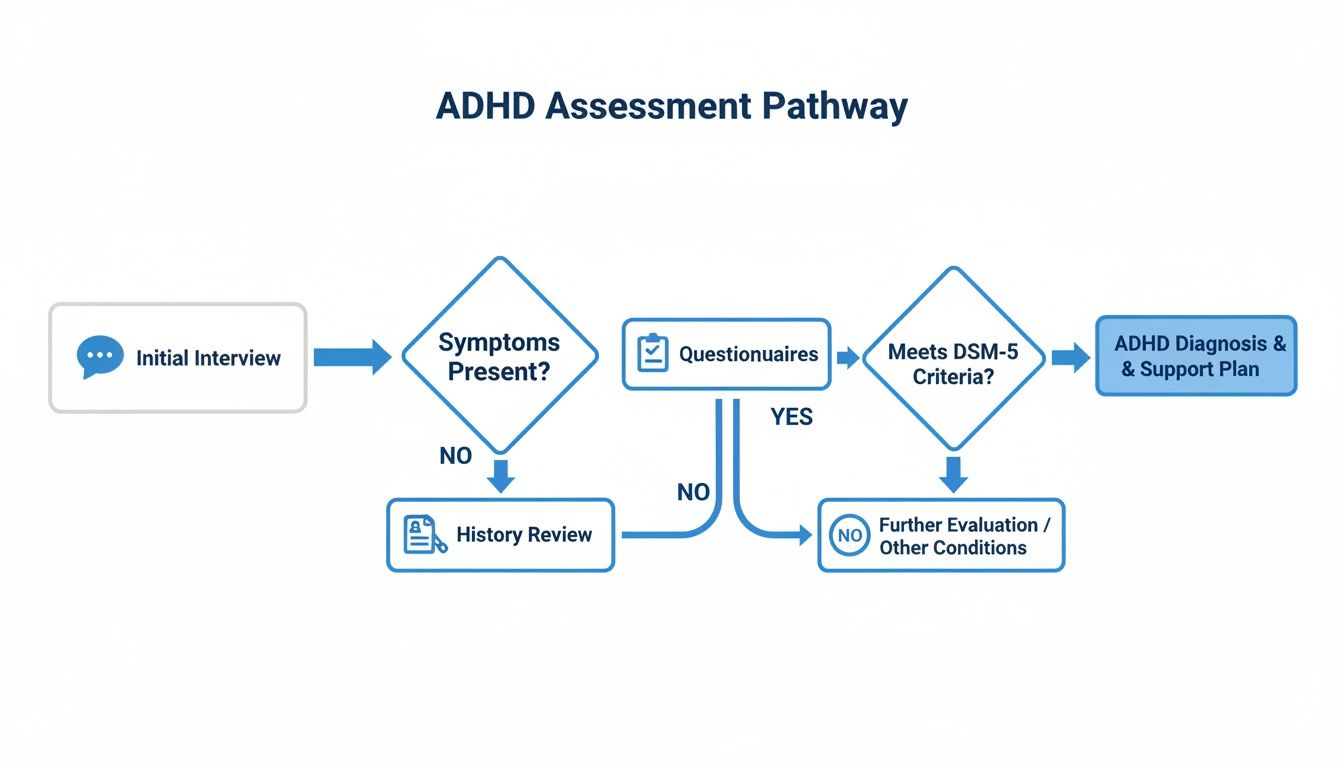
Whether you opt for the NHS or a private clinic, the core of the assessment—the clinical interview, questionnaires, and a thorough look at your history—should always be the same to ensure you get an accurate diagnosis.
Right to Choose: A Hybrid Approach
For anyone living in England, there's a game-changing third option called NHS Right to Choose (RTC). This legislation gives you the right to choose where you receive your NHS-funded assessment. The crucial part? You can choose a qualified private provider that is contracted to deliver services for the NHS.
Essentially, RTC acts as a bridge between the NHS and private routes. You get the speed of the private sector, but the entire cost of the assessment and any subsequent treatment is covered by the NHS—just as it would be if you’d waited for your local service.
Right to Choose empowers you to get a faster diagnosis without the financial headache of going fully private. It’s your legal right, specifically designed to cut waiting times and give patients more control.
To use Right to Choose, you still need that initial referral from your GP. The difference is that your GP sends the referral to your chosen qualified provider instead of the local NHS team. Waiting times with RTC providers are usually just a few months, a world away from the years-long NHS waits.
Sometimes, broaching the topic with a GP can be a hurdle, as not all are familiar with the process. Walking into that appointment prepared with information about your rights is key. To get a better handle on this, you can learn more about the process for a Right to Choose ADHD assessment and find tips on how to advocate for yourself. It’s a fantastic middle-ground option for those who are eligible.
Comparing NHS, Private, and Right to Choose ADHD Assessments
To help you weigh everything up, we've put together a table summarising the key differences between the three main pathways to getting an ADHD assessment in the UK.
| Feature | NHS Pathway | Private Pathway | NHS Right to Choose |
|---|---|---|---|
| Cost | Free. All assessment and treatment costs are covered. | High initial and ongoing costs. £700-£1,500+ for assessment, plus titration and prescription fees. | Free. Funded by the NHS, so no cost to you for assessment or treatment. |
| Waiting Time | Very long. Typically 2-5+ years. | Very short. Usually a few weeks to a few months. | Short to moderate. Often 3-9 months, much faster than the standard NHS route. |
| Referral Process | Requires a GP referral to the local NHS ADHD service. | You can self-refer directly to the private clinic of your choice. | Requires a GP referral to a specific, qualified private provider. |
| Choice of Provider | No choice. You are assigned to your local NHS mental health trust. | Full choice. You can select any private clinician or clinic you prefer. | You choose from a list of qualified providers that accept NHS funding. |
| Location | England, Scotland, Wales, and Northern Ireland. | Available UK-wide. | England only. This is a key eligibility requirement. |
| Post-Diagnosis Care | All care, including medication and follow-ups, is managed and funded by the NHS. | You pay for all follow-up care and prescriptions until a Shared Care Agreement with your GP is established (if possible). | Your care plan, including medication titration, is fully funded and managed under the NHS. |
Each path has its clear pros and cons. Your final decision will likely come down to balancing your immediate need for support against the realities of cost and waiting times in your area.
Looking for a private ADHD assessment?
Answer a few questions and we’ll shortlist clinics that fit — comparing price and waiting time.
Getting an ADHD Diagnosis for Your Child or Teen
When you’re a parent or carer, looking into an ADHD diagnosis for your child brings its own set of challenges. The journey is quite different from an adult assessment, mainly because it pulls in other crucial perspectives – especially from your child’s school.
Symptoms of ADHD can show up in ways you might not expect. In the structured world of a classroom or during the nightly homework struggle, what looks like defiance or a lack of effort could easily be the hallmarks of executive function difficulties. Getting to the bottom of this is key.
This is exactly why a teacher's view is so important. Their insights give a clinician an independent, real-world look at how your child copes in a demanding environment, helping to build a much fuller picture.
The School's Role in an Assessment
To make an accurate diagnosis, a clinician needs to see that symptoms are present in more than one area of a child's life, not just at home. This makes school reports and teacher feedback forms essential pieces of the puzzle.
They're not just scanning for comments about bad behaviour. Instead, they're searching for consistent patterns that align with the core traits of ADHD.
- Inattention: Does the teacher mention that your child often daydreams, finds it hard to follow instructions with several steps, or is constantly misplacing things?
- Hyperactivity: Are there notes about them being unable to sit still, fidgeting constantly, or talking at the wrong times?
- Impulsivity: Does the school report mention your child blurting out answers, struggling to wait their turn, or interrupting conversations?
This team effort helps ensure the diagnosis is thorough and truly reflects your child's experience. It connects the dots between what's happening at home and the struggles they face in the classroom, creating a solid foundation of evidence for the clinician.
How to Talk to Your Child About It
Bringing up the topic of an assessment can feel tricky. The best approach is to frame it as something positive and supportive, rather than a mission to "fix" them.
Try explaining it as a way to understand their brain better. You could use an analogy, like: "We're going to see a brain expert to get a user manual for your amazing mind. It’ll help us figure out how to make the tricky stuff feel a bit easier."
Keep the focus on teamwork and understanding. Let them know this is all about finding tools and strategies to make life and school less frustrating. This approach helps lower their anxiety and makes them feel like a part of the process, not just someone being studied.
An ADHD assessment for a child isn’t about finding fault. It’s about unlocking understanding. It gives a name to their struggles and, crucially, provides a clear path towards the support they need to flourish.
Diagnosis Pathways for Children and Teenagers in the UK
The referral routes for young people are separate from adult services. In the UK, the main NHS pathway is through Child and Adolescent Mental Health Services (CAMHS) or a local community paediatric service.
Your GP usually makes the referral, but the school's Special Educational Needs Coordinator (SENCO) or another health professional can also get the ball rolling. Just like with adult services, the NHS waiting lists for CAMHS can be incredibly long.
Private assessments with a paediatric specialist offer a much faster route. This can be vital during important school years, as it provides quicker access to a diagnosis and the support plan that follows. It's worth noting that ADHD diagnosis rates have climbed significantly in the UK. Research tracking data from 2000 to 2018 found that diagnoses for boys aged 10-16 more than doubled, rising from 1.4% to 3.5%. In line with this, prescriptions for ADHD treatment in England have also doubled in just six years. You can discover more insights about these trends and understand what they mean for the current healthcare system.
How to Prepare for a Successful Assessment

Walking into your ADHD assessment prepared can make a world of difference. Think of it less like an exam and more like you're a detective building a case file. Your job is to hand the clinician a clear, organised picture of your life so they can make an accurate evaluation. This isn't about diagnosing yourself, but about making sure you use your limited time with the specialist as effectively as possible.
Getting prepared is even more important when you consider the state of ADHD services in the UK. It’s thought that 3-4% of UK adults have ADHD, but most have never been diagnosed, which causes huge problems. This is especially true for young adults, a time when many mental health challenges first appear. You can learn more about these service provision challenges for adults with ADHD and see why turning up with your ducks in a row is so vital.
Gather Your Historical Evidence
One of the most powerful things you can do is dig up historical documents. A core part of an ADHD diagnosis is showing that symptoms were present in childhood, and these papers provide impartial, third-party observations of you from years ago.
Don’t just glance at them. Really hunt for specific comments that might point to ADHD traits.
- Old School Reports: Look for those classic teacher comments: "daydreams in class," "easily distracted," "disorganised," or "struggles to wait their turn." These are absolute gold.
- Performance Reviews from Work: Is there a pattern of feedback about your time management, missing deadlines, or struggling to follow complex projects through to completion?
- Statements from Family: Ask a parent, an older sibling, or even a long-time family friend to jot down what they remember about you as a child. How did you handle homework, chores, or friendships?
Create a Symptom Diary with Specific Examples
Just saying "I'm forgetful" is too vague. A clinician gets a much clearer picture if you can say, "I missed paying my council tax three times last year and ended up with fines." That’s a real, tangible example of impairment.
In the weeks before your assessment, start keeping a simple symptom diary. The focus should always be on the real-world impact. Try to capture specific moments where you think an ADHD trait caused a problem in your life.
Your goal is to move beyond general descriptions and provide the clinician with a highlight reel of specific moments. This transforms abstract symptoms into a clear narrative of how they affect your life every single day.
For each symptom you notice, make a quick note covering:
- What happened? (e.g., "I completely forgot about a crucial work meeting.")
- What was the consequence? (e.g., "My manager was frustrated, and the project was delayed.")
- How did it make you feel? (e.g., "Embarrassed and incompetent.")
Bringing this kind of organised evidence means you won’t forget crucial information when you’re feeling the pressure of the appointment. It helps the clinician build a full, detailed picture, which is the foundation of an accurate ADHD diagnosis UK assessment.
Life After Diagnosis: What Comes Next?

Getting an ADHD diagnosis isn’t the finish line; it’s the start of a whole new chapter. For many, it’s a moment of profound relief – things finally make sense. In fact, research shows that 84% of people find a diagnosis helps them accept themselves and gives them new ways to manage their lives.
This new beginning is all about using your diagnosis as a tool. It's the key that unlocks the right support, treatments, and accommodations that can genuinely improve your quality of life. The focus shifts from searching for an answer to building a solid foundation for your future.
Understanding Your Treatment Options
Once you have a formal diagnosis, your specialist will work with you to map out a treatment plan. This isn't a one-size-fits-all solution; it's a personalised combination of medication and therapeutic support designed around your specific needs and goals.
The two main pillars of post-diagnosis care are:
- Medication: Often the first port of call, medication can be incredibly effective for managing the core symptoms of ADHD. But it's not as simple as just getting a prescription – it involves a careful process called titration.
- Therapy and Coaching: This is where you build practical skills. Think ADHD-focused Cognitive Behavioural Therapy (CBT) or specialised coaching to help you get a handle on organisation, time management, and emotional regulation.
Figuring out what works best for you is a journey in itself. For more ideas on finding your balance after a diagnosis, you can find some really helpful guidance on living with ADHD.
The Medication Titration Process
So, what is titration? It's the methodical process of finding the right medication and the perfect dose for you. Think of it like tuning a radio – you have to adjust the dial carefully to get a clear signal. Your specialist will start you on a very low dose, gradually increasing it over several weeks or even months.
Throughout this period, you’ll have regular check-ins to see how you're feeling, monitor any side effects, and track the benefits. This highly personalised approach makes sure your treatment is both safe and perfectly suited to your brain chemistry. It requires patience, but finding that sweet spot is worth the wait.
A diagnosis opens the door to treatment, but it's the post-diagnosis plan that builds the path forward. Medication and therapy are the tools that help you walk that path with greater confidence and control.
Bridging Private and NHS Care with a Shared Care Agreement
If you received your ADHD diagnosis UK privately and started medication, the ongoing cost of private prescriptions can be a real worry. This is where a Shared Care Agreement (SCA) comes in.
An SCA is basically a formal handshake between your private specialist and your NHS GP. Once your specialist has found a stable and effective medication dose for you (through titration), they can propose this agreement. If your GP agrees, they can take over prescribing your medication on the NHS, making it much more affordable.
This collaboration is key to making private treatment sustainable in the long run. It’s a good idea to bring this up with both your GP and your chosen private clinic early on to make sure the transition is as smooth as possible.
Accessing Workplace Support
A diagnosis can also be the key to unlocking support at work. Under the Equality Act 2010, ADHD is recognised as a disability, which means you’re entitled to "reasonable adjustments" from your employer.
The government's Access to Work scheme is a brilliant resource you should know about. It can provide a grant to pay for practical support in your job, which could include:
- Specialist software to help with planning and organisation.
- A job coach to help you develop new workplace strategies.
- Funding to provide awareness training for your colleagues.
This kind of support can make a huge difference, helping you play to your strengths and manage your challenges, turning your diagnosis into a catalyst for professional growth.
Your ADHD Diagnosis Questions Answered
Working out how to get an ADHD diagnosis in the UK often throws up a lot of very specific, practical questions. Getting straight answers is key to feeling in control and making the right decisions for you or your child. Here, we'll tackle some of the most common queries we hear from people just starting out.
Think of this as the practical stuff you need to know before you set off. Understanding the costs, your options, and what to do if you hit a bump in the road can turn a lot of that initial uncertainty into a clear plan of action.
How Much Does a Private ADHD Diagnosis Cost in the UK?
You can expect a private ADHD assessment in the UK to cost somewhere between £600 and £1,500. This price typically covers the main, detailed assessment with a specialist.
It's really important to check exactly what's included in that initial fee, though. Sometimes, things like follow-up appointments or writing up a detailed report are billed as extras. And if medication is part of your treatment plan, you'll also need to factor in the cost of private prescriptions and titration appointments (the process of finding the right dose). These can add another £80-£150 per month until you can get a Shared Care Agreement set up with your NHS GP.
Can I Get a Valid ADHD Diagnosis Online?
Yes, you absolutely can. Many of the UK's best clinics now offer ADHD assessments online through secure video calls. As long as it's carried out by a fully qualified specialist—like a GMC-registered psychiatrist who follows the official NICE guidelines—an online diagnosis is every bit as valid as one done face-to-face.
For many people, especially those living in parts of the country with few local specialists, this is a much more convenient and accessible way to get seen. Just be sure to do your homework and check the clinic's credentials before you book.
A good rule of thumb is to ensure the clinic is regulated by the Care Quality Commission (CQC) in England and that its clinicians are properly registered. This is your mark of quality and legitimacy.
What Should I Do If My GP Refuses My Referral Request?
It can be incredibly disheartening if your GP turns down your request for an ADHD referral, whether it's for the NHS or through Right to Choose. The first step is to stay calm and ask them to explain their reasoning. A lot of the time, a refusal comes down to a GP not being fully up-to-speed with adult ADHD or the different referral pathways available.
You can often help move things forward by politely providing them with official information from the NHS website or resources from reputable charities like ADHD UK. If they still say no, remember you have the right to ask for a second opinion from another doctor at the practice. If the issue is specifically with a Right to Choose referral, you can also escalate it to your local Integrated Care Board (ICB). A bit of polite persistence and having your information ready can make all the difference.
Finding the right clinic can feel overwhelming, but ADHD Private simplifies the search. Our free UK directory lets you compare over 85 private clinics, showing you clear details on pricing, wait times, and services. You can quickly filter for providers that accept Right to Choose and read verified reviews to help you make a confident choice. Start comparing your options today at https://adhdprivate.co.uk.