Your Guide to a Private ADHD Assessment UK
Considering a private ADHD assessment in the UK? This guide breaks down the process, costs, and how to choose the right clinic for a timely and trusted diagnosis.
When you're struggling with suspected ADHD, waiting years for an answer on the NHS can feel like an impossible ask. A private ADHD assessment offers a way to bypass those long queues, giving you a clear diagnosis and a plan in a matter of weeks, not years. For many, it's a practical step towards getting the clarity and support they urgently need.
Why More People Are Choosing a Private ADHD Assessment UK
Think of the NHS as a huge, vital motorway that everyone relies on. It’s an incredible public service, but right now, the lane for ADHD assessments is stuck in a massive traffic jam. Going private is like finding a clear, open express lane. It's not about turning your back on the NHS; it's simply a practical way to get where you need to go when the main road is completely gridlocked.
That analogy really gets to the heart of why thousands of people are now looking at private clinics. It’s less a choice of preference and more one of necessity. Facing a long, uncertain wait for a diagnosis can take a serious toll on your mental health, your job, your relationships—pretty much every part of your life. Choosing a private assessment is a way to take back some control.
The Reality of NHS Waiting Times
The delays people are facing are genuinely staggering. While the NHS is a cornerstone of our society, it's buckling under unprecedented demand. Recent figures show that around 196,000 adults are officially on the waiting list for an assessment. However, the NHS England ADHD Taskforce believes the real number in England alone could be over 500,000.
Worse still, more than a quarter of those people could be waiting two years or even longer just for their first appointment. You can dig deeper into these NHS and private assessment statistics to see the full scale of the problem. That kind of prolonged limbo can leave you feeling completely powerless. A private assessment offers a clear, structured path forward.
Taking Control of Your Health Journey
Choosing to go private isn't just about getting a faster diagnosis—it's about empowering yourself. It gives you the answers you need to start moving forward, whether that means exploring medication, finding the right therapy, getting adjustments at work, or simply understanding yourself better.
The benefits of taking this step are clear:
- Timely Answers: You get a full, professional diagnosis within a few weeks.
- Reduced Uncertainty: You can finally put an end to the stressful 'what if' and gain clarity.
- Faster Access to Support: You can start treatment and put helpful strategies in place much, much sooner.
- A Sense of Agency: It puts you back in the driver's seat of your own wellbeing.
By going down this route, you're making a direct investment in your health, giving yourself the tools and understanding needed to start thriving.
What to Expect from Your Private Assessment Journey
Thinking about a private ADHD assessment can feel a bit overwhelming. The best way to look at it is not as a test you can pass or fail, but as a deep-dive conversation. The whole point is to build a rich, honest picture of you and your life experiences. It’s a structured process designed to spot the patterns that explain your challenges, leading to a diagnosis and a clear path forward.
It all starts the moment you get in touch with a clinic. The first thing they'll do is send over a bunch of pre-assessment questionnaires. Don't mistake these for simple admin; they're the bedrock of the entire assessment. You'll be asked for detail about your symptoms, your childhood, and your history with school and work.
Think of it like gathering evidence for a documentary about your life. These forms help the specialist see the complete picture, not just a single moment in time. This is exactly why digging out old school reports can be so helpful. A teacher's offhand comment about you being a "daydreamer" or "always fidgeting" from twenty years ago can be a crucial piece of the puzzle.
The Clinical Interview
Once you’ve sent back all the paperwork, the main event is the clinical interview. This is usually a 60 to 90-minute chat with a specialist—often a psychiatrist or clinical psychologist. It's designed to be a comfortable, open discussion, not an interrogation.
The clinician will guide you through the conversation, using established diagnostic criteria (like the DSM-5) to explore key areas of your life. They’ll want to know about:
- Inattention: Do you struggle to focus? Are you constantly losing things? Is organisation a nightmare?
- Hyperactivity & Impulsivity: This covers everything from feeling physically restless and unable to sit still, to blurting things out or making snap decisions you later regret.
- Functional Impairment: This is a big one. A diagnosis isn't just about having the traits; it's about showing how they've significantly impacted major parts of your life, like your career, relationships, or education.
The clinician’s job is to weave together what you tell them, the information from your forms, and any other evidence you provide. They’re looking to see if your life story fits the recognised patterns of ADHD.
This flowchart below shows just how different the private journey is compared to the often painfully slow NHS route.
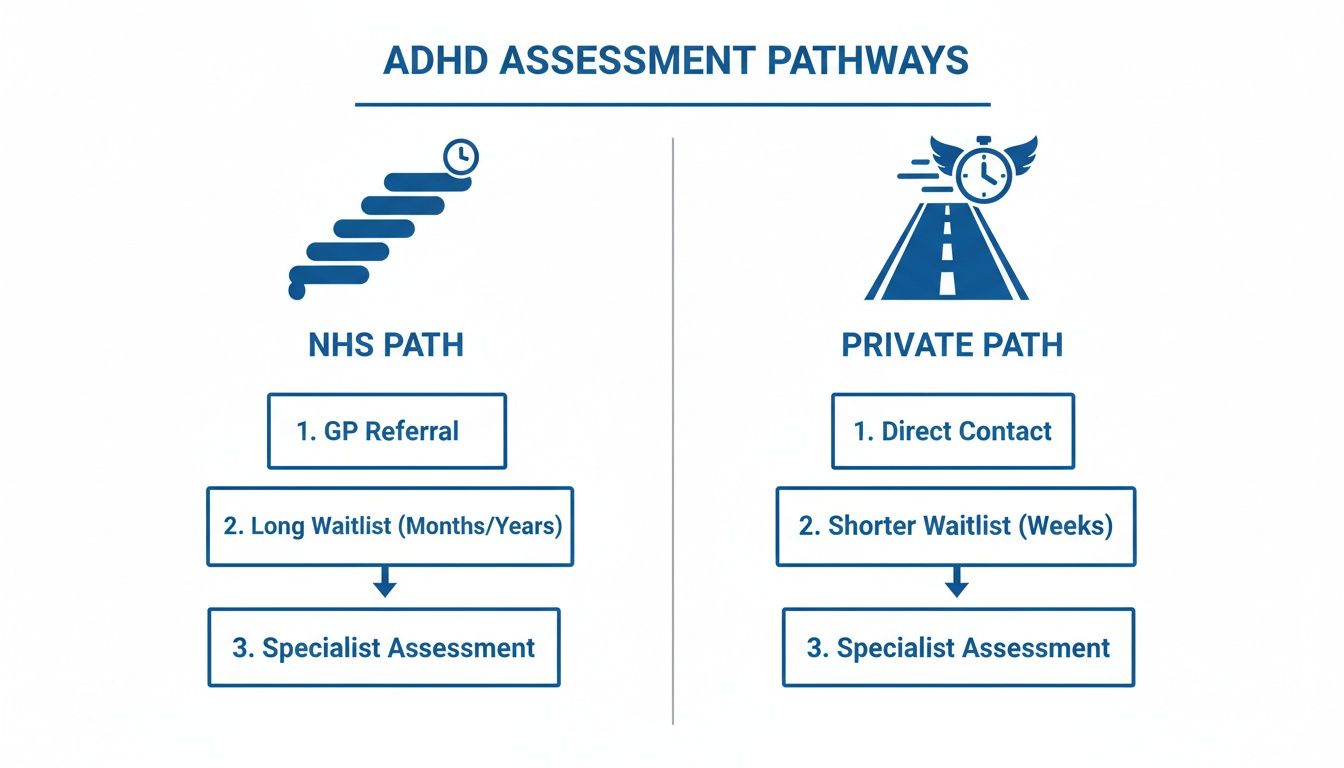
The takeaway is pretty clear: going private can slash the waiting time, giving you answers and support in a fraction of the time.
Receiving Your Diagnostic Report
The final piece of the puzzle is the diagnostic report. This is so much more than a simple 'yes' or 'no'. It's your personal roadmap, explaining the clinical findings, confirming a diagnosis (or suggesting what else might be going on), and laying out a tailored treatment plan.
Your diagnostic report is the official document that validates your experiences. It serves as the key to unlocking support, from medication and therapy to workplace adjustments, empowering you to start the next chapter with confidence and clarity.
Private clinics offer a lifeline for those stuck on long NHS waiting lists. Through a combination of in-depth conversations, detailed questionnaires, and a review of your history, they can deliver a comprehensive report in weeks, not years. Anyone looking for a private ADHD assessment UK can find directories that help sift through over 85 providers, filtering by location or online services and comparing costs. For a deeper dive into the numbers, check out these ADHD facts and figures.
A good report should always include:
- A Summary of Evidence: A clear explanation of how the clinician reached their conclusion.
- A Formal Diagnosis: A definitive statement on whether you meet the criteria for ADHD.
- Personalised Recommendations: Practical next steps, which could include medication, therapy, coaching, or other strategies.
This is the document you'll take to your GP to arrange ongoing support, so its quality and detail are absolutely vital for your future care.
Understanding the Costs of a Private Assessment
Let’s talk about money. It can feel a bit awkward, but when it comes to your health, knowing the full financial picture is absolutely essential. A private ADHD assessment is a serious investment, and you need to be clear on all the potential costs right from the start.
Think of it less like a one-off purchase and more like a journey with different stages, each with its own price tag. The initial assessment is the first big step, but you also need to factor in potential follow-up appointments and the ongoing cost of medication if that's part of your plan.
This investment gets you dedicated time with a qualified specialist who can conduct a really thorough evaluation—something that’s worlds away from a quick chat with your GP. The price reflects their expertise, the time they spend poring over your history, the in-depth clinical interview, and the comprehensive diagnostic report you'll receive at the end.
Breaking Down the Initial Assessment Fee
The main price you see advertised is for the assessment itself. For a private ADHD assessment in the UK, you can expect to pay anywhere from £500 to £1,200 for an adult. Assessments for children are often a bit more involved, so they might sit at the higher end of that scale or even cost a little more.
So, why the big range? A few things come into play:
- Who you see: A highly experienced Consultant Psychiatrist will naturally cost more than a specialist nurse or psychologist.
- Location, location, location: Clinics in pricey areas like London often have higher running costs, which usually gets passed on to the patient.
- What’s included: Some clinics bundle the assessment and a follow-up feedback session into one price, while others charge for them separately.
Always, always ask what that initial fee covers. You don't want any nasty surprises later on.
Beyond the Diagnosis: Ongoing Costs
Getting a diagnosis is a huge milestone, but it’s often just the beginning of the treatment process. If medication is part of your recommended plan, you’ll move into a phase called titration. This is where your specialist works closely with you to find the right medication and dose that works best for your body and brain.
Titration is a very personal and careful process. It can take a few weeks or sometimes a few months to get it just right. During this time, you’ll have regular contact with your clinician and will need to cover the cost of private prescriptions.
This titration phase brings a new set of costs, completely separate from the assessment fee. Here’s what to budget for:
- Titration Fees: Many clinics offer a titration package, which might run you between £150 and £400 a month. This typically covers the specialist's time for consultations and admin.
- Private Prescription Costs: The medication itself is paid for separately. This can cost anywhere from £50 to over £100 a month, depending on what you’re prescribed and the dosage.
- Follow-Up Appointments: Once you’re settled on your medication, you’ll still need to check in with your specialist for reviews, usually once a year. These appointments also have a fee.
By getting your head around the complete financial journey, from the initial private ADHD assessment cost to long-term care, you can plan properly. It empowers you to make a choice that feels right for you and helps make the whole process as smooth as possible.
How to Find a Reputable Private ADHD Clinic
Choosing a clinic for a private ADHD assessment can feel like navigating a maze. With so many options popping up online, it’s tough to know what separates a trustworthy, professional service from one that might leave you in the lurch. Making the right choice isn't just about getting a diagnosis; it’s about finding a long-term partner for your health, so you need a provider you can count on.
Think of it like getting a specialist in to work on your house. You wouldn’t just hire the first person you find online without checking their credentials, reading reviews, and making sure they’re properly registered. The same careful approach is vital when you’re choosing a healthcare provider for something as important as your mental wellbeing.
Check the Non-Negotiables First
Before you even start comparing prices or waiting times, there are a few fundamental checks you absolutely must carry out. These are the cornerstones of a reputable clinic, ensuring the care you receive is safe, effective, and actually recognised by your GP and the wider NHS.
Your initial checklist should cover these three things:
- GMC-Registered Clinicians: The specialists who conduct assessments, especially psychiatrists who handle prescriptions, must be registered with the General Medical Council (GMC). This is your proof that they are qualified doctors meeting UK professional standards.
- CQC Regulation: The clinic itself needs to be regulated by the Care Quality Commission (CQC) in England (or its equivalents in Scotland, Wales, and Northern Ireland). The CQC is the independent regulator for all health and social care, and their stamp of approval is a crucial mark of quality and safety.
- NICE Guidelines: Make sure the clinic openly states that it follows the National Institute for Health and Care Excellence (NICE) guidelines for ADHD diagnosis and treatment. This is the UK's gold standard and a key requirement for most GPs when they consider a shared care agreement.
Any clinic worth its salt will have this information proudly and clearly displayed on its website. If you have to dig for it, or can't find it at all, that’s a massive red flag.
Questions to Ask Before You Book
Once you’ve confirmed the basics are in place, it’s time to dig a bit deeper. A good clinic will welcome your questions and give you clear, straight answers. This is your opportunity to really understand how they work and make sure their approach fits your long-term needs.
Choosing a clinic is a two-way interview. You are not just a patient seeking a service; you are a partner in your own healthcare. Asking detailed questions empowers you to find a provider who respects your needs and is committed to a sustainable care pathway.
Here are the essential questions you should be asking:
- What Is Your Policy on Shared Care Agreements? This is probably the most important question of all. Ask about their success rate and what kind of support they provide if your GP initially says no. Their answer will tell you a lot about their experience collaborating with the NHS.
- How Do You Manage Medication Titration? You need to understand the whole process, the costs involved, and how long it typically takes. A clear, well-defined titration pathway is the sign of a properly organised clinic.
- Are All Your Prices Listed Upfront? Look for complete transparency. A trustworthy clinic will be totally open about the cost of the initial assessment, any titration packages, follow-up appointments, and private prescriptions. No hidden surprises.
- Who Exactly Will I Be Seeing? Ask for the name and qualifications of the clinician. A Consultant Psychiatrist is often the ideal choice, as they can oversee the entire journey from diagnosis right through to medication management.
Getting these answers before you commit can save you a world of frustration and unexpected costs down the line. To make life easier, you could use a directory to compare the top private ADHD clinics in the UK, filtering by key services like shared care and medication prescribing. This lets you quickly shortlist providers who tick all your boxes before you even get in touch. By being thorough and proactive now, you can confidently pick a clinic that will give you high-quality, sustainable care for the journey ahead.
Navigating the NHS Right to Choose Pathway
What if you could get the speed of a private assessment but have it paid for by the NHS? For adults in England, this is a real option called NHS Right to Choose (RTC). Think of it as your personal 'referral passport'. It allows you to sidestep the often years-long local NHS queues and pick an approved private provider for your assessment, with the NHS footing the bill.
Essentially, RTC is the middle ground. It’s a vital lifeline for people who can't afford to go fully private but simply can't wait years for a diagnosis. It’s a game-changer, but getting it right often comes down to being organised and knowing the steps.
Your first port of call is always your GP. You need to go to them with a specific request: to be referred to a private provider under the Right to Choose rules. This doesn't have to be a battle; it's about working with your doctor to use a system that's designed to give you more say in your care.
Preparing for Your GP Appointment
Walking into your GP surgery prepared can make a world of difference. While many GPs are fantastic, they might not be familiar with the ins and outs of Right to Choose for ADHD. Your job is to make it as easy as possible for them to say yes.
Here’s what you need to do before you go:
- Choose Your Provider: First, research and pick a private clinic that accepts RTC referrals. It’s crucial to check their current waiting times, as they can vary.
- Complete Their Paperwork: Most of these clinics have their own referral forms and pre-assessment questionnaires on their websites. Fill these out completely before your appointment.
- Draft a Letter: Many ADHD charities offer template letters you can use. These clearly explain your request and cite the official NHS guidance, removing any guesswork for your GP.
Bringing all this with you shows you’ve done your homework and are serious about getting help. It helps the whole process run much more smoothly.
Right to Choose puts you in the driver's seat of your own healthcare. By understanding the process and preparing properly, you can cut your waiting time for an assessment by months, or even years, compared to standard NHS routes.
What Happens After the Referral
Once your GP sends off the referral, the wait begins—but it's usually a much shorter one. The private clinic will handle your referral and get in touch with you directly to book your assessment.
From that moment on, your journey looks just like that of a private patient. You’ll get the same in-depth assessment from the same specialists and receive the same diagnostic report.
The key difference? The NHS is paying for it all. This also covers any follow-up treatment, like the medication titration period where you find the right dose. Your entire pathway, from diagnosis to a stable treatment plan, is funded just as it would be through the NHS.
It’s a route that requires a bit of patience and organisation on your part, but for thousands of people in England, it’s the best way to get a timely and affordable diagnosis. You can find out more by reading a full guide on the Right to Choose ADHD assessment and how the pathway works.
Life After Diagnosis: Your Next Steps
Getting an ADHD diagnosis isn't the end of the road; it's the beginning of a new one. This is the moment you can stop wondering, "What's wrong with me?" and start building a life that works with your brain, not against it. Think of your diagnostic report as the starting point—a personal roadmap for managing your symptoms and finally getting on top of daily life.
The path forward usually involves a mix of medication, therapy, and practical, real-world strategies. For many, the diagnosis itself brings a huge wave of relief and self-understanding. In fact, research shows that 84% of people feel a greater sense of self-acceptance after their diagnosis, which is a massive first step. With that clarity, you can start exploring the right kind of support for you.

The Medication Pathway: Titration Explained
If medication is part of your treatment plan, the first thing you'll do is start a process called titration. It's a bit like tuning a guitar; you and your specialist will work together to find the exact medication and dosage that works best for your brain and body. It's a careful, gradual process, not a quick fix, and it can take several weeks or even a few months to get it just right.
During this time, you'll have regular catch-ups with your clinician. They'll want to know how you're feeling, whether the medication is helping, and if you're experiencing any side effects. This close monitoring is vital to make sure your treatment is both safe and effective. Once you're on a stable dose that works for you, the goal is to make it affordable for the long term.
Securing a Shared Care Agreement
The key to accessing affordable ongoing medication is a Shared Care Agreement (SCA). This is a formal arrangement between your private specialist, your NHS GP, and you. Essentially, your private specialist stays in charge of your ADHD care, but your GP takes over the day-to-day task of issuing your repeat prescriptions.
A Shared Care Agreement is the bridge between private diagnosis and affordable NHS care. It lets you have specialist oversight from your private clinic while getting your prescriptions at the standard NHS price.
Getting an SCA in place is incredibly important. Without it, you'd be stuck paying for expensive private prescriptions indefinitely. A good clinic will know exactly how to handle this. They’ll give your GP a comprehensive report and clear, straightforward guidance to make agreeing to the arrangement as simple as possible.
Beyond Medication: Other Essential Support
While medication can be a game-changer, it’s rarely the whole picture. The most effective approach is to combine it with other types of support that help you navigate work, relationships, and the general chaos of life.
Here are a few other avenues well worth exploring:
- ADHD Coaching: A coach doesn't just give you generic advice. They help you build practical skills for things like organisation, time management, and handling overwhelming emotions—all specifically designed for the way an ADHD brain operates.
- Therapy: Cognitive Behavioural Therapy (CBT) is often recommended. It’s brilliant for helping you unpick negative thought patterns and develop healthier ways of coping with frustration or anxiety.
- Workplace Adjustments: Your diagnosis gives you the right to ask for reasonable adjustments at work. This could mean anything from noise-cancelling headphones and flexible start times to using specific software that helps you focus.
By blending medical treatment with these practical, everyday strategies, you create a powerful support system. It’s this holistic approach that helps you move from just coping with your symptoms to truly thriving and building a life you're proud of.
Your Questions Answered
It's completely normal to have a lot of questions when you're thinking about a private ADHD assessment. Let's walk through some of the most common ones to give you a bit more clarity.
Will My NHS GP Accept a Private Diagnosis?
The short answer is: usually, yes. As long as the assessment has been carried out properly by a qualified specialist (like a consultant psychiatrist) and follows the official NICE guidelines, most GPs will recognise it.
The more complicated part is medication. While your GP will likely add the diagnosis to your record, they are under no obligation to accept a Shared Care Agreement for your prescriptions. This is a really important point, which is why I always recommend having a chat with your GP surgery before you book anything privately. It can save a lot of hassle later.
Is an Online Assessment as Good as an In-Person One?
Absolutely. The top UK clinics have honed their online assessments to be every bit as thorough and clinically sound as meeting face-to-face. You'll be dealing with the same highly qualified specialists, following the exact same diagnostic criteria.
This move to online has been a game-changer, really. It's opened up access for so many people who don't live near a specialist centre, cutting down on travel time, stress, and often cost too. It means where you live is no longer a barrier to getting help.
What Evidence Should I Gather for My Assessment?
The clinic will give you a set of questionnaires to complete, but bringing your own evidence can make a huge difference. It helps the clinician see the bigger, lifelong picture.
Think about pulling together things like:
- Old School Reports: These are pure gold. Look for comments from teachers about being "daydreamy," "unable to sit still," "disruptive," or not "fulfilling potential." These provide a fantastic historical snapshot.
- Input from Someone Who Knows You Well: For adults, a letter or a completed questionnaire from a parent, partner, or a close friend can be incredibly insightful for the clinician.
- Teacher Feedback: If the assessment is for a child, getting input from their current teachers is vital to show how their symptoms affect them in the school environment.
Can I Go Private if I'm Already on an NHS Waiting List?
Yes, you can, and many people do. Getting a private assessment won't affect your place on the NHS waiting list at all. Think of it as running on two parallel tracks.
Going private while on an NHS list lets you get answers and start treatment much faster, without losing your spot for eventual NHS follow-up care. Just make sure you let your GP and the NHS service know once you have your diagnosis.
Finding the right path to an ADHD diagnosis can feel overwhelming. At ADHD Private, our free UK-wide directory is designed to make it simple. You can compare over 85 clinics, see their current wait times, and find a provider that's right for you. Start your journey to clarity today by visiting https://adhdprivate.co.uk.