Your Guide to Right to Choose ADHD Assessment
Learn how to use your Right to Choose ADHD assessment on the NHS. Our guide explains eligibility, finding a clinic, and navigating GP referrals.
If you’re staring down a long NHS waiting list for an ADHD assessment, it can feel like you’re stuck in limbo. But there's a lesser-known but incredibly powerful option called Right to Choose, which gives eligible patients in England the power to pick a qualified private provider for their assessment—all funded by the NHS.
This isn’t a loophole; it's your legal right. It can slash your wait time from several years down to just a few months, getting you the answers and support you need much, much faster.
What Exactly is the NHS Right to Choose for ADHD?

You might have heard people talking about a "shortcut" to getting an ADHD assessment, and this is what they mean. It's a fundamental patient right laid out in the NHS Constitution, designed to give you more say in your healthcare journey.
For many people, this pathway is a complete game-changer. It’s no secret that standard NHS waiting times for an adult ADHD assessment can be brutal, often stretching well beyond two years. A delay like that can take a serious toll on your job, your relationships, and your mental well-being. Right to Choose offers a vital and legitimate alternative.
Why This Pathway Is More Important Than Ever
The need for something like a right to choose ADHD assessment is clear when you look at the numbers. An analysis of 9 million GP records found that only 0.32% of patients had a recorded ADHD diagnosis. This paints a stark picture, suggesting that as few as one in nine people with the condition have been formally diagnosed, leaving millions without the right support.
This is precisely where Right to Choose comes in. It helps to break through the bottlenecks in the system by giving you access to a bigger pool of accredited providers who are ready and able to help.
The principle is straightforward: if a private clinic holds an NHS contract to provide the same specialist service as your local trust, you have the right to be referred to them. It puts you back in the driver's seat of your own healthcare.
NHS Pathway vs Right to Choose At a Glance
Seeing the two routes side-by-side really clarifies the benefits. One path often means a long, uncertain wait with no say in where you go, while the other offers control, choice, and speed. Knowing how to get an ADHD diagnosis means understanding which route works best for you.
Here’s a quick breakdown to help you see the difference.
| Feature | Standard NHS Referral | Right to Choose Referral |
|---|---|---|
| Provider Choice | Limited to your local NHS trust or commissioned service. You have no say in who you see. | You select your preferred provider from a list of accredited clinics with an NHS contract. |
| Waiting Times | Can be extremely long, often cited as 18 months to several years depending on your location. | Significantly shorter, typically ranging from a few months up to a year. |
| Process Control | You are placed on a list and wait to be contacted. The process is largely out of your hands. | You research and choose a clinic, actively participating in the referral process with your GP. |
Ultimately, this is about more than just speeding things up. Opting for a Right to Choose referral is about reclaiming a sense of control over your health. It’s a recognised and effective way to get the assessment you need without the demoralising and often damaging delays of the traditional route.
Are You Eligible for Right to Choose?
Before you dive into shortlisting clinics and drafting letters to your GP, it's worth taking a moment to double-check that you're eligible for the Right to Choose pathway. Getting this right from the start can save you a lot of time and potential frustration down the line.
Think of it as a quick pre-flight check. The rules are fairly simple, but a small misunderstanding could ground your efforts before they even take off.
The England-Only Rule
First and foremost, Right to Choose is a legal right outlined in the NHS Constitution for England. This is the most important piece of the puzzle – you absolutely must be registered with a GP practice in England to be able to use it.
Unfortunately, this specific right doesn't apply if your GP is in:
- Scotland
- Wales
- Northern Ireland
The devolved nations run their own healthcare systems with different rules. While they have their own patient choice policies, the "Right to Choose" framework for mental health that we're talking about here is an England-only affair.
Your First Referral and Clinical Need
Another key point is that this right applies to your first outpatient appointment for an ADHD assessment. If you're already on a waiting list or have had an initial appointment with your local NHS ADHD service, you generally can't use Right to Choose to jump to a different provider.
Your GP also needs to agree that an assessment is clinically necessary in the first place. They’ll want to chat about your symptoms and the real-world impact they're having on your life before they'll make a referral anywhere. It’s not about them giving you permission to choose; it’s about them agreeing that a referral is the right next step for you.
The core idea is simple: your GP confirms the need for an assessment, and you get to decide where that assessment happens, as long as the clinic you pick is eligible.
This is a really important distinction to have clear in your mind, especially if you get any pushback.
The whole reason this pathway has become so popular is the massive gap between the number of people needing help and the services available. It's estimated that ADHD affects 3-4% of adults, but the system is creaking under the strain. Self-report data shows that while one in twenty adults in England thinks they might have ADHD, less than 2% actually have a formal diagnosis. This huge difference shows exactly why a right to choose ADHD assessment has become such a lifeline. If you want to read more on this, The King's Fund has an excellent breakdown of the challenges.
What to Do If Your GP Pushes Back
While most GPs are brilliant, not all of them are fully up to speed with how Right to Choose works for mental health. It’s not unheard of for patients to be mistakenly told it's only for physical health conditions or that they have to stick with local NHS services.
The best way to handle this is to be prepared. Have the official NHS England guidance saved on your phone or even bring a printed copy with you. A polite reference to the official rules can clear things up quickly.
- Be clear and confident. You can say something like, "I understand I have a legal right to choose my provider under the NHS Constitution."
- Be specific. Make it clear you're asking for a referral for an adult ADHD assessment and that you want to use your Right to Choose.
- Frame it as a win-win. You can even mention that by choosing an alternative provider, you're helping to reduce the pressure on local NHS waiting lists. Most GPs will appreciate that.
Getting your head around these eligibility rules is the first, and most crucial, step. It gives you the confidence to have a productive conversation with your GP and sets you up for a much smoother journey.
Finding and Choosing the Right ADHD Clinic
Once you’ve confirmed you’re eligible for Right to Choose, the next step is a big one: finding the right clinic to handle your assessment. This is where you can really take control of the process. Your goal is to research and shortlist providers that not only accept Right to Choose referrals but also feel like a good fit for you personally.
Navigating the landscape of private ADHD clinics can feel overwhelming at first. Thankfully, you don't have to do it all by yourself. Specialised online directories have popped up to make the whole process much simpler, pulling all that crucial information into one place.
Using Directories to Shortlist Clinics
Think of these directories as your secret weapon. They let you filter clinics based on the most important criteria for a Right to Choose ADHD assessment, saving you from the soul-destroying task of clicking through dozens of websites just to find out they don't accept NHS referrals.
A great place to start is with a comprehensive list of UK clinics that accept Right to Choose referrals. The most crucial feature to look for is the 'Accepts Right to Choose' filter. Ticking that box instantly cuts through the noise and shows you only the clinics that are relevant to your journey.
Here's a look at how a directory can help you filter and compare your options in a few clicks.

This kind of simple, visual interface means you can see at a glance which clinics meet your core requirement. It frees you up to focus your energy on the details that really matter.
What to Look for Beyond the Basics
Once you've filtered for Right to Choose, you might still have a handful of options on your list. Now it’s time to dig a little deeper to find the best fit. Don't just automatically pick the one with the shortest waiting list; take a moment to consider the entire patient experience.
Here are a few key things I always recommend looking into for each clinic on your list:
- Current Waiting Times: This is often the biggest factor, so check their website or contact them for the latest estimate from referral to assessment. Be mindful that some providers, like Psychiatry-UK, might have much longer waits for post-diagnosis services like titration, which can be up to 10 months.
- Patient Reviews: Check out what real people are saying on places like Trustpilot or Google. Look for comments about communication, the assessment itself, and aftercare. These first-hand accounts give you a feel for the clinic that official descriptions just can't provide.
- Post-Diagnosis Support: Does the clinic actually offer medication titration? Titration is the crucial process of finding the right medication and dosage for you. Some providers only offer an assessment, which could leave you stuck with a diagnosis but no treatment plan, facing another long wait elsewhere.
- Shared Care Agreement Process: A smooth handover to a Shared Care Agreement with your GP is vital for getting your prescriptions on the NHS long-term. See if the clinic has a good reputation for this. A quick search in online ADHD forums often reveals which clinics GPs are more familiar with and willing to work with.
A diagnosis is just the first step. Choosing a clinic that provides a clear and supportive path into treatment—including medication management and a smooth shared care process—is every bit as important as the assessment itself.
Verifying Clinic Details
Once you've narrowed it down to one or two top choices, there's one final check before you go to your GP. Don't rely solely on directory information, as things like waiting lists can change in the blink of an eye.
Take five minutes to visit the clinic's own website. Look for a dedicated page about their Right to Choose service. This should confirm if they're currently accepting referrals and might even have specific instructions or a downloadable letter for your GP.
If the information isn't crystal clear, don't be afraid to reach out to them directly. A quick email or phone call to their admin team can confirm three key things:
- Are they still accepting Right to Choose referrals?
- What is their current estimated wait for an assessment?
- What is their estimated wait for titration to begin after a diagnosis?
Doing this final check ensures the information you take to your GP is accurate and up-to-date, which will make the whole referral conversation go much more smoothly. A bit of thorough research now empowers you to make a genuinely informed choice, turning a potentially confusing process into a clear, actionable plan.
Getting Ready for Your GP Appointment
This is it. The conversation that kicks everything off. Getting this appointment right is probably the single most important thing you can do to get your Right to Choose ADHD assessment underway smoothly. Walking into your GP's surgery prepared, with the right documents in hand and a clear idea of what you're asking for, makes a world of difference.
Try to see this meeting as a collaboration, not a confrontation. Your GP is the gatekeeper, but they're also your partner in getting you the right care. If you give them what they need in a clear, organised way, you make it so much easier for them to say yes.
Get Your Ducks in a Row: Evidence and Screeners
Before you even pick up the phone to book the appointment, it’s smart to pull together a bit of evidence. This isn't about self-diagnosing – it’s about showing your GP why you think an assessment is needed. A fantastic way to do this is by filling out a screening tool.
The Adult ADHD Self-Report Scale (ASRS) is the one you’ll see mentioned most often. It’s a simple, 18-question screener developed by the World Health Organization. You can find it with a quick search online, fill it out, and print the results. Bringing this along gives your GP a concrete, evidence-based starting point for the conversation.
The goal isn’t to walk in and declare, "I have ADHD." It's much more effective to say, "I'm really struggling with these specific things, and it’s affecting my life. I'd like to be assessed for ADHD to find out more."
Handing over your ASRS results immediately frames the discussion around symptoms and their impact, which is exactly what a GP needs to hear. It shifts the conversation from a hunch to a legitimate clinical question.
Talk About the Real-World Impact
Along with the screener, spend a little time writing down specific examples of how these symptoms mess with your daily life. GPs are trained to look for patterns of impairment – how these issues cause real problems. Just saying "I'm disorganised" is a bit vague.
Try to make a list that covers different areas of your life. Something like this:
- At Work/Uni: "I keep missing deadlines even when I work late because any little thing can pull my focus away." or "In meetings, I completely lose track of long verbal instructions and have to keep asking people to repeat themselves."
- At Home: "The house is always a mess because I start tidying one room, get distracted, and never finish." or "I'm constantly losing my keys and wallet, which makes me late for everything."
- In Relationships: "My partner gets really frustrated when I interrupt them or just zone out mid-conversation." or "My impulsive spending has put a real strain on our finances."
These kinds of real-world examples give your GP the clinical context they need to justify referring you. It shows them that your symptoms aren't just quirks; they're causing persistent, significant problems.
Write Your Referral Request Letter
To make things crystal clear and take the pressure off yourself during the appointment, I always recommend drafting a letter to your GP beforehand. You can hand it to them in person or, if your surgery uses an online system, send it through that. It guarantees you won't forget any crucial details.
A good letter clearly states what you're asking for and mentions your legal right to choose. Crucially, it should name your chosen provider. This shows you've done your homework and selected a clinic that actually accepts Right to Choose referrals, which can cut out a ton of admin headaches for the practice manager later on.
Feel free to adapt this template. Just copy it and fill in your details.
Sample Letter for Your GP
Dear Dr. [GP's Name],
I am writing to request a referral for an adult ADHD assessment. I have been experiencing significant difficulties with concentration, organisation, and impulsivity, which are impacting my work and personal life. I have completed an ASRS self-report questionnaire and have brought a copy with me today.
I would like to exercise my legal right to choose my mental healthcare provider, as outlined in the NHS Constitution. After researching eligible clinics, I have chosen [Name of Chosen Clinic] for my assessment.
Could you please refer me to [Name of Chosen Clinic] for an ADHD assessment under my Right to Choose? I understand this will be funded by the NHS. I have also brought the clinic’s contact and referral information for your convenience.
Thank you for your support with this.
Yours sincerely,
[Your Name]
[Your Date of Birth]
[Your NHS Number]
Coming in with this letter prepared shows you're informed and serious about your request for a right to choose ADHD assessment, and honestly, it just makes the whole process faster and more professional for everyone involved.
What to Expect After Your GP Referral
So, you’ve done it. You’ve had the conversation with your GP and your referral is on its way. That’s a massive step, and you should feel proud. It’s completely normal to now be wondering, "What happens next?" Knowing the typical timeline can really help manage that feeling of being in limbo.
Once your GP agrees to the referral, their admin team usually takes over and sends everything to your chosen clinic. Your main job is done for now; the ball is officially in the clinic's court.
The Waiting Game and First Contact
The first thing to know is that you probably won't hear anything for a few weeks. Try not to worry. Clinics get a huge volume of referrals, and it takes time for them to process the paperwork from your GP and get you registered in their system. This can take anywhere from two to eight weeks, sometimes longer depending on how swamped they are.
Your first piece of contact will likely be an email or letter from the clinic confirming they’ve got your referral. This is a great moment – it means you're officially in the queue. If eight weeks go by and you've heard nothing, it's a good idea to politely check in with both your GP surgery and the clinic, just to make sure the referral didn’t get lost along the way.
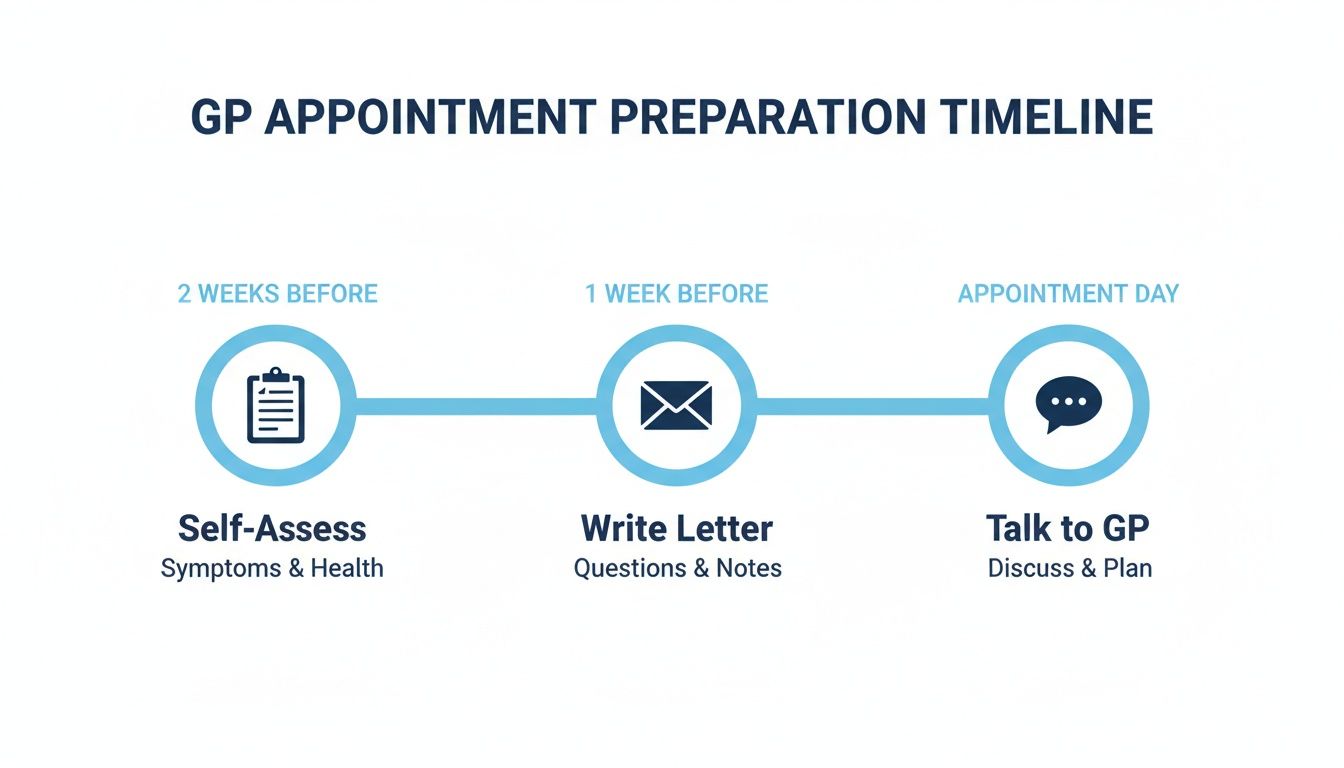
As this graphic shows, all that preparation you did for your appointment is what gets the ball rolling for this next phase.
Completing the Pre-Assessment Paperwork
That first email from the clinic will almost certainly contain a link to their pre-assessment forms. This is a really important step. Be as thorough and honest as you can with these – putting them off will only delay your assessment date, so try to tackle them as soon as you feel up to it.
You’ll usually find a few different types of forms:
- Symptom Checklists: These are often more detailed versions of the ASRS screener you might have already filled out.
- Developmental History: This is where they ask about your childhood, what you were like at school, and any early signs of ADHD traits.
- Impact Statements: You'll have a chance to explain how your symptoms affect your day-to-day life, from work and relationships to just managing the household.
- Informant Questionnaires: They will almost always ask for a parent, partner, or a close friend who has known you for a long time to fill out a form. This gives them an outside perspective on your traits.
Be prepared for this part to be a bit emotionally draining. It's okay to take your time. Don't hesitate to ask a trusted friend or family member to help you remember things from your childhood or to give their own observations.
To give you a clearer picture, here’s a rough outline of what the entire process looks like from start to finish.
Typical Right to Choose ADHD Assessment Timeline
This table breaks down the estimated timings for each part of the journey. Remember, these are just estimates – waiting times for individual clinics can vary quite a bit.
| Stage | Estimated Timeframe |
|---|---|
| GP Referral Sent | 2 - 8 weeks until clinic confirmation |
| Pre-Assessment Forms | 2 - 4 weeks for you to complete |
| Waiting for Assessment Date | 4 - 12+ months after forms are submitted |
| ADHD Assessment | A single session, usually 1.5 - 3 hours |
| Diagnosis Report | 2 - 6 weeks after the assessment |
| Start of Titration (Medication) | 1 - 4 weeks after diagnosis (if applicable) |
| Shared Care Agreement | 4 - 8 weeks after titration is stable |
Seeing it laid out like this helps manage expectations for what can be a lengthy process, but one that is well worth the wait.
The Assessment Itself
Once your paperwork is all in and reviewed, the clinic will get in touch to book your actual assessment. The vast majority of these are now done online via a video call, which makes things much more convenient.
Think of the assessment as a structured conversation, not an exam you can pass or fail. The clinician’s job is to get a full picture of your life experiences and see how they map onto the diagnostic criteria for ADHD.
They'll want to talk about:
- What you were like as a child and at school.
- The challenges you face now, whether at work, university, or just in daily life.
- How you get on in your relationships and social situations.
- Things like emotional regulation, impulsivity, and organisation.
The clinician is there to create a non-judgemental space for you to share your story. They’re experts who understand the subtle ways ADHD can show up, particularly in adults who have gone undiagnosed for years. The more open you are and the more real-life examples you can give, the better. It helps them build an accurate picture and, ultimately, helps you get the clarity you’re looking for.
What Happens After an ADHD Diagnosis? A Look at Titration and Shared Care

Finally getting your diagnosis can feel monumental. It’s often a wave of relief and a powerful moment of validation. But while the assessment journey is over, a new chapter begins: treatment. This is where you’ll start hearing two key terms: titration and Shared Care Agreements.
Getting your head around these concepts is crucial. They have a direct impact on how you access medication and what it's going to cost you long-term, so it’s worth knowing what’s coming up next.
Finding the Right Medication: The Titration Period
If you and your specialist agree that medication is the right path, you won't just get a standard prescription and be sent on your way. You'll start a carefully managed process called titration.
Think of it as a calibration period. Your specialist will work closely with you to figure out which medication and what dosage works best for your specific needs. It's a very personal process that involves starting on a low dose, keeping track of how you feel, and making small adjustments along the way.
This can take a few months, and during this time, you'll be paying for private prescriptions.
It’s really important to plan for this financially. A private prescription for ADHD medication typically costs between £80 to £150 per month, so it’s wise to budget for at least three months of these costs from the outset.
The Goal: A Shared Care Agreement
For most people, the long-term aim is to get a Shared Care Agreement (SCA) in place. This is a formal agreement between your private ADHD specialist and your NHS GP that allows your care to be, well, shared.
Once your dose is stable and working well, your specialist will write to your GP to propose the agreement. If your GP accepts, they'll take over prescribing your medication. This is a game-changer for your wallet, as you’ll switch from paying private fees to the standard NHS prescription charge (currently £9.65 in England).
Your private clinician still handles your annual medication reviews, but your GP manages the regular prescriptions. It's a collaborative setup that makes treatment affordable.
A Shared Care Agreement is the bridge that connects your private diagnosis back to the NHS system for ongoing care. It’s the key to making your ADHD treatment sustainable in the long term.
It's worth remembering that GPs aren't legally required to accept an SCA. Most are happy to, especially when the diagnosis comes from a reputable right to choose ADHD assessment provider, but a refusal can happen. Having a chat with your GP about it early on can help set expectations. You can dive deeper into this subject in our guide on how shared care works for ADHD.
This post-diagnosis phase calls for a bit of patience. The titration period and arranging shared care can feel like another wait, but it's a necessary process to ensure your treatment is safe, effective, and sustainable. Knowing the potential costs and timelines makes this final leg of the journey much less stressful.
Common Questions About Right to Choose
It’s completely normal to have a few lingering questions, even when you feel you’ve got a handle on the process. Let's be honest, navigating any part of the healthcare system can feel like you’re trying to solve a puzzle.
So, let's clear up some of the most common queries that pop up. Getting these answers straight can give you that extra bit of confidence to take the next step, especially if you’re worried about hitting an unexpected snag.
Can My GP Refuse My Right to Choose Request?
This is probably the biggest worry for most people, but the rules here are actually quite specific and reassuring. A GP can only refuse a referral on clinical grounds. This means they’d have to have a valid medical reason to believe a specialist ADHD assessment isn't necessary for you, or that the provider you've chosen isn't clinically suitable.
What they can't do is say no for administrative or financial reasons. For example, they can’t block your request just because:
- They'd rather use a local NHS service.
- Your chosen provider is on the other side of the country.
- They're concerned about the cost to the local NHS budget.
If you do get a "no," the best thing to do is politely ask for the specific clinical reason in writing. Often, any pushback comes from a simple misunderstanding of the Right to Choose rules. Pointing them towards the official NHS England guidance on patient choice can often clear things up straight away.
Are All Costs Covered Under Right to Choose?
This is a "yes and no" answer. The assessment itself—the appointments and the diagnosis—is fully funded by the NHS. You won't pay a penny for that part.
However, you do need to plan for potential medication costs right after you get a diagnosis. Your new provider can issue a private prescription immediately, but you'll have to cover the full cost, which can run anywhere from £80 to £150 per month. To switch over to the standard NHS prescription price (currently £9.65 per item), you need a Shared Care Agreement between your provider and your GP. This transition isn't instant and can take several weeks or even a couple of months.
The core assessment is free, but it's smart to budget for at least two or three months of private medication costs while your shared care is being set up. A bit of financial planning here can save a lot of stress down the line.
What Happens If I Move GP During the Process?
Life doesn’t stop for waiting lists. You might need to move house and register with a new GP practice while you’re waiting for your assessment. Since your Right to Choose is tied to your GP registration in England, this is something you need to manage carefully.
If you move, the key is to be proactive. Let your old GP, your new GP, and the private clinic know what's happening as soon as possible. In most cases, your referral can be transferred, but it relies on good communication between everyone involved to make sure it doesn’t fall through the cracks. Staying on top of it will help you avoid frustrating delays or, worse, having to start the whole process from scratch.
Is a Right to Choose Diagnosis as Valid as an NHS One?
Yes, one hundred percent. A diagnosis you receive from a qualified provider through Right to Choose is just as valid and legitimate as one from a standard NHS service. The clinics approved to offer this service have to meet strict NHS clinical and contractual standards.
Your diagnosis carries the same weight and can be used for everything an NHS diagnosis can. This includes applying for workplace adjustments through the Access to Work scheme, getting support at university, and—crucially—setting up that Shared Care Agreement with your GP for your ongoing treatment. The route you take to get the diagnosis doesn't change its clinical authority.
Feeling your way through the ADHD assessment process can be tough, but you're not on your own. At ADHD Private, we've built a free, easy-to-use directory of over 85 clinics across the UK. You can compare waiting times, check costs, and find providers who accept Right to Choose referrals, all in one place. Start your search and find the right clinic for you at https://adhdprivate.co.uk.