Your Guide to NHS ADHD in Adults Assessment and Treatment
Guide to navigating NHS ADHD process for adults, covering referrals, waiting times, Right to Choose, and what to expect from diagnosis.
Written and maintained by the ADHD Private editorial team, drawing on NHS, NICE and ADHD UK guidance. This is general information, not medical advice.
Starting your journey for an adult ADHD assessment on the NHS can feel like a huge, confusing undertaking. It’s a well-defined process, but one that comes with its own set of challenges, from long waiting times to massive differences in care depending on where you live.
Getting to grips with how it all works is the first real step towards getting the support you need.
The NHS Pathway for Adult ADHD Explained
If you're thinking about seeking an adult ADHD diagnosis through the NHS, you might be feeling a mix of hope, frustration, and sheer confusion. Many people describe it as trying to piece together a puzzle without all the pieces, especially when you've spent years, or even a lifetime, searching for answers. If that sounds like you, rest assured, you're not alone in this.
The scale of the issue is pretty stark. It's estimated that around 3-4% of adults in the UK have ADHD, but the condition is still hugely under-diagnosed. An analysis of over nine million GP records revealed that only 0.32% of patients had a recorded diagnosis. That suggests as few as one in nine adults with ADHD have actually been identified by the NHS. This gap is a clear sign that we need better awareness and more accessible services. You can dig into more of the data in the 2025 survey by ADHD UK.
Navigating the Core Stages
Think of the NHS adult ADHD pathway as a series of connected stages. Your journey kicks off at your local GP surgery and, all being well, moves on to specialist care. Knowing what these stages are can help you set realistic expectations and feel more prepared for the road ahead.
This diagram gives you a bird's-eye view of the standard NHS process.
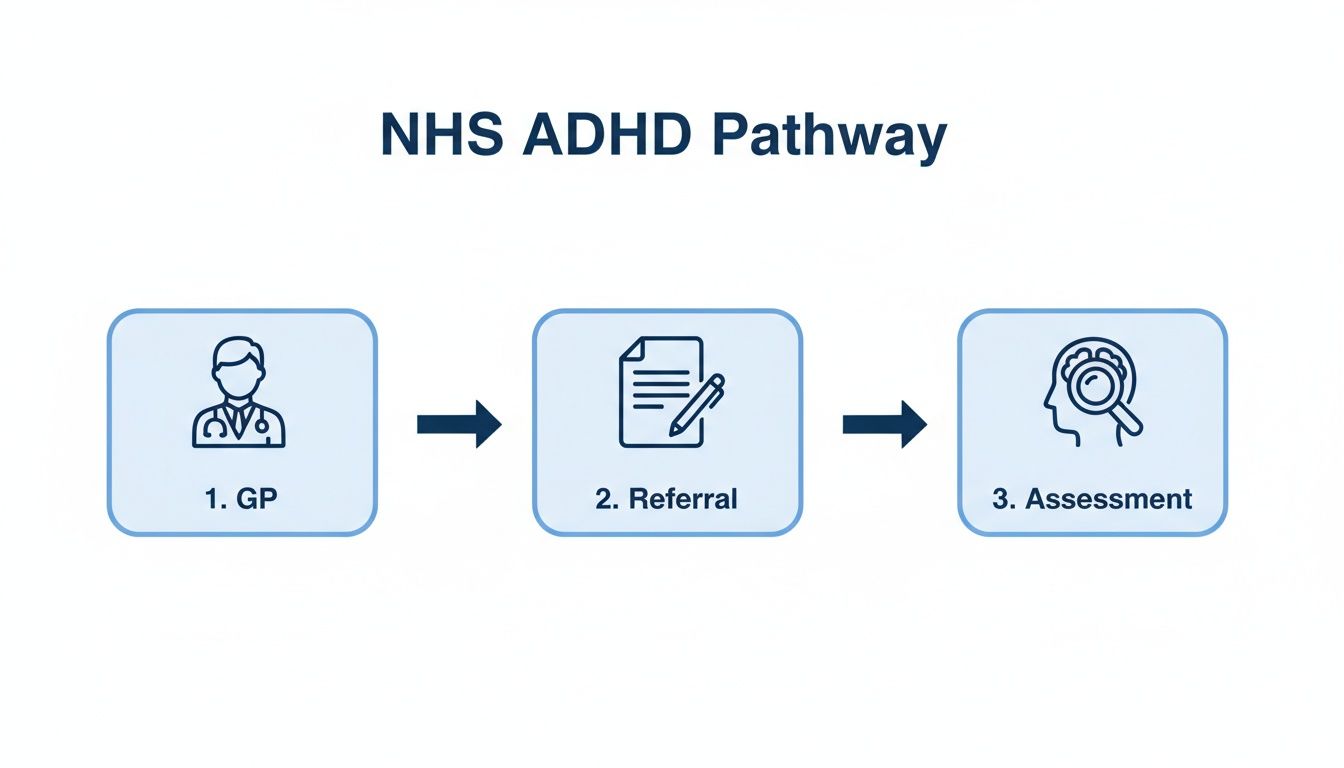
As you can see, everything starts with your GP. They are the gatekeeper to specialist services, and you can't get an assessment without going through them first.
The whole process is designed to make sure diagnoses are handled carefully by qualified experts. The flip side is that high demand and stretched resources mean you’ll need a lot of patience.
Let's break down the main stages of the journey. To give you a clearer picture, here’s a quick summary of what to expect at each step.
NHS Adult ADHD Pathway at a Glance
| Stage | What It Involves | Typical Timeframe |
|---|---|---|
| 1. GP Consultation | Discussing your symptoms and their impact on your life with your doctor. They'll use this to decide if a referral is necessary. | A single appointment (but getting one can take weeks). |
| 2. Referral | If your GP suspects ADHD, they'll send a referral to a local adult ADHD service or Community Mental Health Team (CMHT). | A few weeks for the referral letter to be sent and processed. |
| 3. Waiting List | This is the big one. You’ll be placed on a waiting list for your specialist assessment. | This varies wildly by region, from a few months to several years. |
| 4. Specialist Assessment | A comprehensive evaluation with a psychiatrist or specialist nurse, covering your symptoms, history, and life experiences. | Usually 1-2 hours, sometimes split over two appointments. |
These stages form the backbone of the NHS pathway. Here’s a little more detail on each one:
- Initial GP Consultation: This is your starting line. You'll talk to your GP about what you're experiencing and how it affects you day-to-day. Based on this, they'll decide if your symptoms are strong enough to justify a specialist referral.
- Referral to a Specialist Service: If your GP agrees, they'll refer you on. This usually goes to a dedicated adult ADHD service or your local Community Mental Health Team (CMHT). The referral includes your GP's notes and the reasons they think you might have ADHD.
- Waiting Period: Once referred, you join the waiting list. Honestly, this is often the longest and most difficult part of the whole process. Waits can range from months to, in some areas, several years.
- Specialist Assessment: Eventually, you'll have your appointment with a psychiatrist or another qualified clinician. This isn't just a quick checklist; it's an in-depth conversation about your life, your history, and your symptoms to get a full diagnostic picture.
The goal of this guide is to hand you the map for this journey, giving you the knowledge you need to take those first steps with confidence.
How to Talk to Your GP About an ADHD Referral
Your GP appointment is the first real step towards getting an NHS referral. Knowing how to approach this conversation can make all the difference between getting the ball rolling and facing a frustrating setback.
This isn't just a casual chat; it's your opportunity to clearly explain why you think you have ADHD. When you walk in with organised thoughts and concrete examples, you help your GP see the full picture. More importantly, it allows you to lead the conversation with confidence, making sure your concerns are genuinely heard.

Gather Your Evidence Before the Appointment
Before you even book the appointment, start putting together your "evidence". Think of yourself as a detective building a case for how your own brain works. The point isn't to diagnose yourself, but to show a clear pattern of behaviour that really needs a specialist's opinion.
A GP's time is incredibly tight. Presenting them with structured information helps them make an informed decision quickly and shows you’ve taken this seriously. It’s a powerful form of self-advocacy.
You'll want to gather information covering two key areas: your current struggles and your past.
H3: What's Happening Now? (Current Symptoms)
- Complete a Self-Report Scale: A fantastic place to start is the Adult ADHD Self-Report Scale (ASRS). It’s a straightforward questionnaire used by clinicians all over the world. You can easily find it online—fill it out and bring the results with you.
- List Your Symptoms with Examples: Jot down specific, real-world examples. Instead of just saying, "I'm disorganised," explain how you found a stack of unpaid bills from months ago or how you missed another crucial work deadline despite trying your best. The details matter.
- Note the Real-Life Impact: Be clear about how these issues affect your life. Are they straining your relationships? Holding you back at work? Affecting your finances or mental well-being? Connect the dots for your GP.
H3: What Happened Then? (Childhood Evidence)
For an official ADHD diagnosis, symptoms need to have been present before the age of 12. For many adults, this can be the trickiest piece of the puzzle to find.
A common misconception is that all children with ADHD are disruptive. In reality, many were quiet daydreamers whose struggles flew completely under the radar. Your job now is to unearth signs of those early traits.
Here’s where you can look for clues:
- Old School Reports: If you can, dig out your old report cards. Look for comments from teachers like "easily distracted," "doesn't live up to their potential," "very chatty," or the classic "needs to apply themselves more."
- Chat with Family: Speak to a parent, an older sibling, or another relative who knew you well as a child. Ask them what you were like—were you forgetful? Did you struggle to focus on homework? Did you seem to be "in a world of your own"? A short, written note from them can be really helpful to bring along.
Structuring the Conversation With Your Doctor
Once you're in the appointment, it's easy to feel rushed or get flustered. Having a simple plan for what you want to say will keep you focused. And please, don't be afraid to take your notes in with you!
Here’s a simple, effective way to get the conversation started:
- Be Direct: Open with a clear statement. Something like, "I've booked this appointment because I have strong reasons to believe I may have adult ADHD, and I'd like to talk about a referral for an assessment."
- Present Your Key Examples: Briefly summarise your list of current symptoms. You could say, "For years, I've really struggled with..." and then give two or three of your most powerful examples.
- Link it to Your Childhood: Connect your current struggles to your past. For instance, "I've also been looking into my childhood, and I found old school reports that mention I was constantly distracted. My mum also remembers that I..."
- Share Your Homework: This is the moment to hand over your completed ASRS form, any notes from family, and your list of examples. It gives the GP tangible information to work with.
This structured approach changes the dynamic. You’re no longer just asking for help; you're having a productive consultation by giving your GP the specific information they need to follow NICE guidelines and make a clinical decision about referring you for NHS ADHD in adults services.
If you feel you’re being dismissed, calmly ask the GP to document their reasons for refusing a referral in your medical notes.
The Reality of NHS ADHD Waiting Times
So, your GP has agreed to refer you. That’s a huge first step, and you should feel a sense of relief. But it’s also the moment you join what is often the most challenging part of the whole NHS ADHD in adults process: the wait. It's really important to go into this with your eyes open, because the waiting times for an assessment can be staggering.
Think of it like this: your referral is the ticket to a concert you’ve been desperate to see for years. The problem is, thousands of others have tickets too, and the venue is only letting a handful of people in at a time. That's pretty much the situation with NHS ADHD services right now. You're officially in the queue, but that queue is incredibly long.

Why Are the Waiting Times So Long?
These long waits are the result of a perfect storm. We've seen a massive, and frankly overdue, surge in public awareness about what ADHD looks like in adults. More and more people are finally connecting the dots in their own lives and seeking help. At the same time, NHS mental health services have been chronically underfunded for years, leaving them completely swamped and unable to keep up.
The numbers really paint a picture. Since the start of the pandemic, there’s been a consistent 18% yearly increase in ADHD prescriptions across the UK. This shows just how much pressure these services are under. The flood of new referrals isn't because ADHD is a new condition; it’s because decades of missed diagnoses are finally coming to light. The system is playing a desperate game of catch-up.
While waiting times vary hugely depending on where you live in the UK, it’s not unusual for the wait to be anywhere from several months to, in some areas, up to five years or more.
Getting a handle on why these delays happen is the first step toward managing your own expectations. If you'd like to dig deeper into the reasons behind this, our guide on why NHS ADHD waiting times are so long breaks it all down.
What Happens Behind the Scenes After Your Referral
Once your GP sends off the referral, it can feel like it’s vanished into a black hole. But there is a process, even if it’s slow. Your referral letter is sent to your local specialist service, which might be a dedicated Adult ADHD Clinic or a more general Community Mental Health Team (CMHT).
Here's what typically happens next:
- Triage: A clinical team reviews your referral. They're checking to make sure it meets their criteria and that there's enough information to suggest ADHD is a real possibility.
- Acceptance: If they accept the referral, the service should send you a letter to confirm you’ve been placed on their waiting list. This letter may or may not give you an estimated waiting time.
- The Wait: You’re now officially in the queue. This is the point where communication often goes quiet for a very long time.
It’s always a good idea to give the service a ring a few weeks after your GP sends the referral. Just a quick call to confirm they’ve received it can give you some much-needed peace of mind.
How to Stay Proactive While You Wait
Waiting for years can feel incredibly disheartening, but you don't have to be completely passive. Taking small, proactive steps can help you feel more in control and start managing your symptoms.
- Keep Your GP in the Loop: Make sure your GP surgery has your up-to-date contact details. If you move house, tell them and the ADHD service straight away.
- Tackle Related Issues: While you can't get ADHD treatment yet, you can often get help for related challenges like anxiety or depression. Have a chat with your GP about what support might be available.
- Lean on Charity Resources: Organisations like ADHD UK and the ADHD Foundation offer a goldmine of free resources. Look for their webinars, online support groups, and practical strategies for managing daily life.
- Keep Gathering Your Evidence: Use this time to build your case. Talk to more family members or keep a detailed journal of your symptoms and how they're affecting you. Every bit of information helps.
Knowing the reality of the wait and what you can do in the meantime is key to navigating the long road to a diagnosis.
Looking for a private ADHD assessment?
Answer a few questions and we’ll shortlist clinics that fit — comparing price and waiting time.
How to Use Your Right to Choose for an ADHD Assessment
The thought of waiting years for an ADHD assessment on the NHS can feel completely demoralising. But if you live in England, there's a crucial piece of patient legislation that you need to know about: Right to Choose (RTC). It puts you in control of which provider carries out your NHS-funded assessment.
RTC is your legal right to choose a different provider for your specialist assessment, as long as they have a contract to do that work for the NHS. Best of all, it’s done at no cost to you. The NHS simply pays your chosen provider instead of your local NHS service.
This isn't some secret loophole or a form of private healthcare. It's an established right for patients, written into the NHS Constitution, specifically to help manage long waits for certain specialist services—including NHS ADHD in adults.
So, How Does Right to Choose Actually Work?
The concept is refreshingly simple. Instead of being stuck on the waiting list for your local, often swamped, ADHD service, your GP can refer you to an alternative, pre-approved provider. These providers are typically private clinics that also hold official NHS contracts. Each provider sets its own waiting list, and waits vary by NHS area.
To be eligible for Right to Choose, you just need to meet three simple conditions:
- You must be registered with a GP in England.
- Your GP must agree that a referral for an ADHD assessment is the right clinical step for you.
- The provider you choose must have a valid NHS contract for adult ADHD services.
That last point is key. You can't just select any private clinic you find online; it has to be one that is officially set up to take RTC referrals.
Right to Choose empowers you to select an alternative NHS-funded provider instead of your local service. Waits vary by provider and by NHS area, and some local NHS areas now limit how many Right to Choose assessments they fund, so check with the clinic before your GP refers you.
A Step-by-Step Guide to Using RTC
Making use of your Right to Choose involves a few practical steps. It does mean you'll need to be proactive and go into your GP appointment well-prepared, much like you did when you first asked for the referral.
- Research and Choose Your Provider: First things first, you need to find a provider that accepts RTC referrals. Most of them advertise this clearly on their websites. Take a look at their current waiting times and check they offer the whole package you need, like assessment and medication titration.
- Get Your Letter Ready: The providers themselves usually make this easy by offering template letters on their websites. You just download and fill in the details. This letter formally states your request to be referred to that specific provider under your Right to Choose.
- Book a GP Appointment: Make another appointment with your GP. This time, the sole purpose is to request the RTC referral. Don't forget to bring the completed letter with you.
- State Your Case: In the appointment, explain that you want to exercise your Right to Choose for an ADHD assessment to avoid the long local wait. Hand over the letter and the information about your chosen provider.
What to Do If You Hit a Snag
Unfortunately, not every GP is fully up to speed on Right to Choose. It's not unheard of for patients to be told—incorrectly—that it doesn't apply, or that the local health board (ICB) won't fund it. This is where your preparation really pays off.
If your GP seems unsure or hesitant, here’s what to do:
- Stay Calm and Informed: Politely explain that Right to Choose is a legal right for patients in England. You can even suggest they look at the official NHS England guidance on the topic.
- Hand Over the Paperwork: The template letters you downloaded usually contain all the necessary details and links to official guidance for your GP, making their job easier.
- Stand Your Ground: Remember, if your GP has already agreed that an ADHD assessment is necessary, they can’t refuse your request to use Right to Choose based on cost or where the clinic is located. Their job is simply to make the referral to the qualifying provider you've selected.
Yes, going down this path requires a bit of self-advocacy. Instead of waiting passively to be contacted, you can take an active role in choosing who assesses you.
To dive deeper into this, you can learn more about exercising your Right to Choose in our comprehensive guide.
What to Expect During Your ADHD Assessment
The idea of a diagnostic assessment can be pretty nerve-wracking. It’s completely normal to worry about being judged, not taken seriously, or simply not being able to explain yourself properly. But try to remember this isn't a test you can pass or fail; it’s a guided conversation to build a complete picture of who you are.
Your assessment for adult ADHD on the NHS will be with a specialist, typically a psychiatrist or a qualified specialist nurse. Their job is to understand your life experiences and see how they line up with the official diagnostic criteria for ADHD. Think of it like this: the clinician is a detective trying to piece together a lifelong puzzle, and you hold all the most important clues.
Whether your appointment is in person or online, it will follow a similar path. It’s an in-depth, structured interview that usually lasts anywhere from one to two hours, and sometimes a bit longer.
The Core of the Conversation
The clinician will lead you through a series of detailed questions about different areas and stages of your life. They aren't just looking for simple "yes" or "no" answers; they want to hear the real-world stories behind your struggles.
They need to see that your difficulties are persistent and have a major impact on key parts of your life, such as your work, education, or relationships. This isn’t about finding fault; it’s about identifying a clear and consistent pattern.
The discussion will almost certainly cover:
- Your Childhood and School Years: The specialist will ask about your behaviour and ability to focus as a child. Were you known for daydreaming? Did you constantly struggle with homework? Were you seen as disruptive, or did you find it impossible to follow the rules? This is vital because the diagnostic criteria require evidence of symptoms before the age of 12.
- Your Work and Career History: Be prepared for questions about your job performance. Do you frequently miss deadlines? Is organisation a constant battle? Have you hopped between jobs out of boredom or frustration?
- Your Relationships and Social Life: The conversation will likely touch on your friendships and romantic partnerships. Challenges with emotional regulation, impulsivity, or remembering important dates can often put a strain on personal connections.
- Your Day-to-Day Life: This is all about how you manage the basics, like paying bills on time, keeping up with household chores, or even just relaxing without feeling restless and on edge.
Diagnostic Tools and Input From Others
To make sure the assessment is thorough, clinicians use formal diagnostic frameworks. In the UK, this will be either the DSM-5 (Diagnostic and Statistical Manual of Mental Disorders) or the ICD-11 (International Classification of Diseases). These manuals lay out the specific criteria that have to be met for a diagnosis.
You’ll also probably be asked to provide an "informant" – someone who knows you well and can give another perspective on your behaviour and history.
An informant isn’t there to judge you. They provide valuable, objective observations that can either confirm or add important context to your own account. This is often a parent, a long-term partner, or a close sibling.
The informant usually fills out a separate questionnaire about you. Their input is particularly helpful for providing evidence from your childhood, as your own memory of that time might be a bit fuzzy. On that note, bringing old school reports to your appointment can be incredibly useful for the same reason.
By the time you're done, the clinician will have woven together a rich tapestry of information from you and your informant. This allows them to make a confident and accurate diagnostic decision, finally giving you the clarity you’ve been searching for.
Life After Diagnosis: NHS Treatment and Support
Getting an ADHD diagnosis often brings a huge sense of relief. It’s validation. But once that initial feeling settles, the big question is: what now? This is where your journey shifts from assessment to actually getting the right treatment and support through the NHS.
It’s a path that looks different for everyone. But for adults with ADHD, the NHS approach usually combines two key elements: medication and psychological therapy. The goal isn’t to ‘cure’ ADHD – it’s about managing the symptoms so you can build on your strengths and make daily life feel less like a battle. For most people, that process starts with medication.

The Medication and Titration Process
The first step after diagnosis is usually starting medication, which is handled through a careful process called titration.
Think of it like tuning an old radio. You don’t just flick a switch and get crystal-clear sound; you have to turn the dial slowly to find the perfect frequency. ADHD medication works the same way.
Your specialist will begin with a very low dose of either a stimulant (like methylphenidate) or a non-stimulant (like atomoxetine). Over several weeks or even months, you’ll gradually increase this dose. All the while, you’ll have regular check-ins to see how you’re feeling and monitor for any side effects. The aim is to find your “sweet spot”—the lowest possible dose that gives you the best results with the fewest side effects. This is a highly personal process, led entirely by your specialist, and it can take a few months to get just right.
Shared-Care Agreements and Your GP
Once you and your specialist have landed on a stable and effective medication plan, your care is often handed back to your GP under a shared-care agreement. This is simply a formal plan that allows your specialist to give your GP clear instructions for prescribing your medication.
Your specialist still oversees your overall ADHD treatment with yearly reviews, but your GP can handle the routine repeat prescriptions. This is a standard part of the NHS ADHD in adults pathway and makes getting your medication much more convenient long-term.
A shared-care agreement is a partnership between your specialist and your GP. It ensures you receive consistent, ongoing care without needing to see a specialist for every single prescription refill, streamlining your treatment journey.
Beyond Medication: Psychological Support
Medication can be a game-changer, but it’s only one piece of the puzzle. The NHS also offers psychological support, though what’s available can vary a lot depending on where you live and the resources of your local service.
This support might come in a few different forms:
- Psychoeducation: These are sessions designed to help you understand ADHD on a deeper level. You’ll learn how it affects your brain and pick up practical strategies for things like time blindness or managing intense emotions.
- Group Therapy: Some services run group sessions where you can connect with other adults who just get it. Sharing experiences and tips in that kind of setting can be incredibly powerful.
- Individual Therapy: One-to-one therapy, like Cognitive Behavioural Therapy (CBT) adapted for ADHD, is sometimes an option, but it’s often in high demand and less commonly available.
The reality is that these services can be limited, and you might face another wait. It’s worth exploring the full range of both NHS and private ADHD treatment options to build the most comprehensive support system for yourself.
A recent report from NHS England's independent ADHD Taskforce recognised just how critical mental health support is, especially for adolescents and young adults. It emphasised that people should get the help they need without having to wait for a formal diagnosis. You can read more about the taskforce’s findings on the NHS England website.
Your Questions About the NHS ADHD Journey Answered
It's completely normal to have a lot of questions when trying to figure out the NHS system for adult ADHD. It can feel like a maze. Let’s tackle some of the most common queries head-on to help you feel more confident and in control.
What Can I Do If My GP Refuses to Refer Me?
Hitting a wall with your GP can be incredibly disheartening, but don't give up. The first step is to politely ask your doctor for their specific reasons for the refusal and request that this decision is noted in your medical records.
You always have the right to get a second opinion. You can book an appointment with a different GP at your practice or even register with a new surgery altogether. When you have this next appointment, present your notes and evidence again. It can also be powerful to mention the official NICE guidelines for adult ADHD (NG87), as this shows you're well-informed. If you’re still not getting anywhere, you can take it further by making a formal complaint to the practice manager or your local Integrated Care Board (ICB).
Can I Get Help While on the NHS Waiting List?
Yes, absolutely. The waiting period can be long and frustrating, but it doesn’t have to be a complete standstill. While you can't get ADHD-specific medication or therapy yet, there’s a lot you can do to get support.
Waiting for an assessment is tough, but you can use this time proactively. Focus on managing related symptoms and connecting with communities that understand what you're going through. This can build resilience and provide you with valuable coping strategies.
Talk to your GP about any other difficulties you're facing, like anxiety, depression, or sleep problems. They can often provide support for these issues while you wait. Also, charities such as ADHD UK and The ADHD Foundation are brilliant sources of free resources, from webinars to support groups, which can equip you with practical skills and a sense of community.
What Happens If I Move to a New Area?
Moving house while dealing with NHS ADHD in adults care requires a bit of forward planning. If you’re currently on a waiting list, you'll typically be moved to the list in your new location. Unfortunately, this could mean your waiting time changes, sometimes for the worse.
If you’ve already been diagnosed and are in treatment, get in touch with your new GP as soon as you register. Make sure you give them all the details of your diagnosis and your shared-care agreement. A really smart move is to contact the local ADHD service in your new area before you move. Ask them about their process for transferring patients—this little bit of prep can make the transition of your care much smoother.
Feeling overwhelmed by the options? ADHD Private offers a free, simple way to find and compare trusted clinics across the UK. Take control of your journey and find the right support faster at https://adhdprivate.co.uk.