Why Are NHS ADHD Waiting Times So Long?
Discover why NHS waiting times are long. Learn about systemic causes and the options open to you while you wait.
Written and maintained by the ADHD Private editorial team, drawing on NHS, NICE and ADHD UK guidance. This is general information, not medical advice.
The simplest way to explain why NHS waiting times are so long is that the system is trying to do an impossible job. It's grappling with overwhelming demand, a serious shortage of staff, and the long shadow of the pandemic.
Imagine a popular local restaurant. Suddenly, twice as many people want a table, but the kitchen is smaller than it used to be, and half the chefs have left. It’s a recipe for chaos, and that’s exactly what’s happening across the NHS, leaving millions of people waiting.
Just How Long Are NHS Waiting Times Right Now?
If you’re stuck on a waiting list, you're not alone—far from it. The official data paints a stark picture of a healthcare service stretched to breaking point, fighting to keep up with the demands of a population that's both growing and living longer.
For anyone waiting, this isn't just about numbers on a spreadsheet. It’s about living with pain, dealing with constant uncertainty, and seeing your quality of life slip away while you wait.
The True Scale of the Backlog
The sheer volume of people waiting for care is on a scale we've never seen before. It's difficult to get your head around, but right now in England, over 3.3 million people have been waiting longer than the 18-week target for routine NHS treatment.
Think about that for a moment. That's millions of families putting essential surgeries on hold and people unable to work. In total, the waiting list has climbed to a staggering 8.0 million in England—the highest it has ever been.
For specialist care, like an ADHD assessment, this system-wide strain means you face a long wait just to see a GP. Then comes the specialist referral, which can add another 12-30 weeks. All in, the journey from referral to actual treatment can stretch from six months to well over a year and a half. We dive deeper into these figures in our analysis of the NHS waiting list trap.
This chart, based on official data from NHS England, shows exactly what that looks like over time.
You can see the line climbing sharply from 2020 onwards. That spike shows the profound and lasting damage the pandemic inflicted on the NHS's ability to see and treat people promptly.
At a Glance: Why NHS Waits Are So Long
So, what are the core issues fuelling these delays? It's not one single problem but a combination of factors that feed into each other, creating a perfect storm of pressure. This table breaks down the main culprits.
| Factor | Brief Explanation | Impact on Patients |
|---|---|---|
| Soaring Demand | An aging population with more complex, long-term health needs requires more care than ever before. | More people are competing for the same limited number of appointments, diagnostic tests, and surgeries. |
| Staff Shortages | There simply aren't enough doctors, nurses, and specialists to meet patient demand due to burnout and retention issues. | Fewer available clinicians lead directly to cancelled appointments and much longer waits for specialist opinions. |
| Pandemic Aftershocks | The halt on non-urgent care during COVID-19 created a huge backlog that the NHS is still struggling to clear. | Patients whose treatment was delayed are now re-entering the system, adding to an already strained service. |
Each of these elements puts an enormous strain on the system, and together, they explain why getting the care you need is taking longer than it ever has before.
Why Demand Is Overwhelming NHS Capacity
At its core, the problem with NHS waiting times boils down to a fundamental mismatch: the demand for healthcare is consistently outrunning the system’s capacity to deliver it. This isn't a temporary blip; it's a chronic, worsening pressure that’s stretching every resource thinner by the year.
Think of it like a single country lane trying to handle rush-hour traffic from a five-lane motorway. No matter how well everyone drives, a colossal traffic jam is simply inevitable. The NHS is stuck in a similar state of permanent gridlock, fuelled by several factors that keep pushing demand to unsustainable levels.
This is a complex web of interconnected problems, where rising patient need, staffing shortages, and treatment delays all feed into each other.
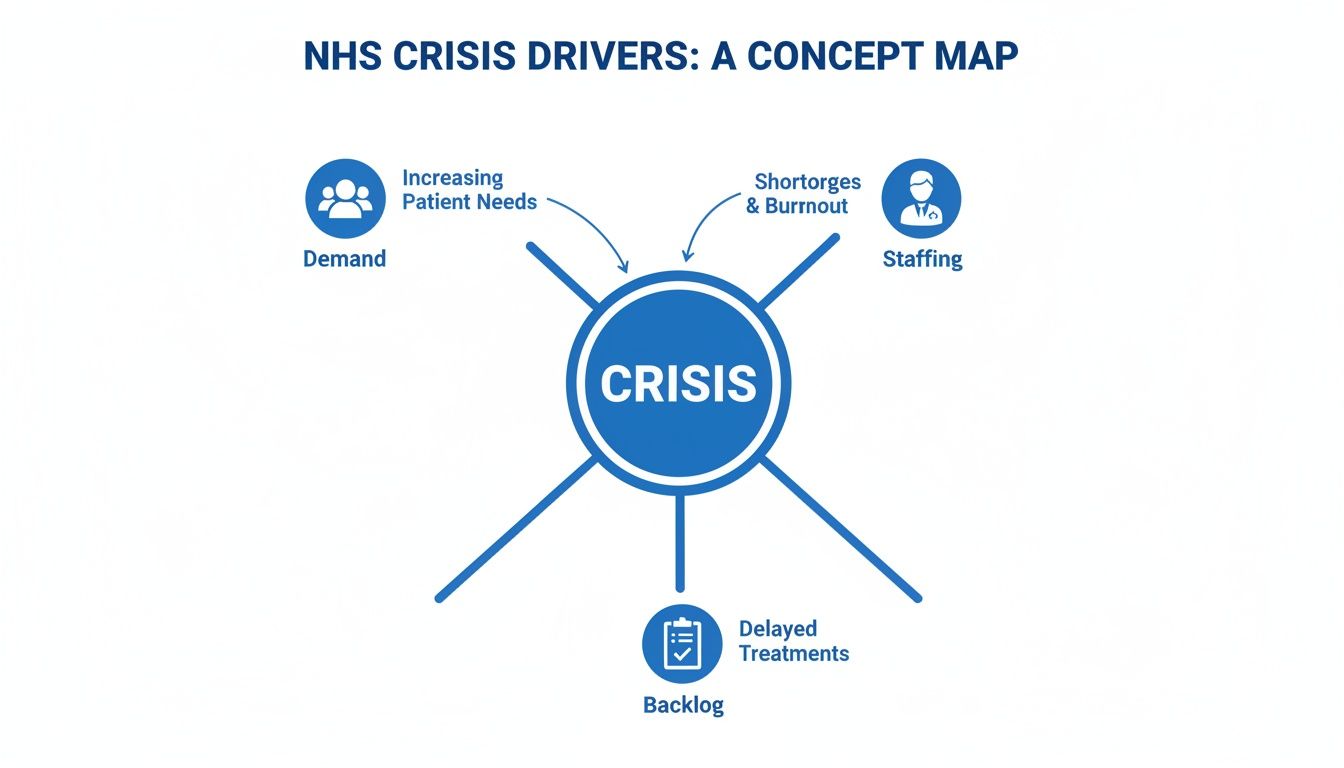
As you can see, soaring patient demand isn't an issue in isolation. It's one piece of a much bigger puzzle, putting the entire system under enormous stress.
An Ageing Population With More Complex Needs
One of the biggest drivers is actually a sign of success: we’re all living longer. The catch is that an older population naturally needs more healthcare. Today, patients often arrive with multiple, long-term conditions that require continuous management, not just a one-off fix.
This dramatically changes the type of care the NHS has to provide. The focus is shifting from treating acute, short-term illnesses to managing chronic conditions like diabetes, heart disease, and dementia. This kind of ongoing, complex care puts a huge and growing strain on every part of the service, from your local GP to specialist hospital wards.
In essence, the NHS was designed for a different era. It's now grappling with a demographic reality that demands more resources, more specialists, and more integrated long-term care than its current structure was ever built to handle.
All this means more appointments, more prescriptions, and more hospital stays are needed just to keep up with a growing number of patients whose needs are becoming more complicated.
The Pandemic's Long Shadow: Backlogs and "Demand Shock"
The COVID-19 pandemic delivered a massive shock to the system, creating a backlog of care that the NHS is still fighting to clear. To handle the waves of critically ill COVID patients, virtually all non-urgent treatments and elective surgeries were put on hold.
This created a "dam" holding back a flood of pent-up demand. Millions of screenings, operations, and appointments were postponed. Now, those patients are flowing back into the system, often with conditions that have worsened in the meantime, making their treatment more difficult and resource-intensive. This surge is hitting a system that was already running at maximum capacity before the pandemic even started.
The A&E Bottleneck Effect
Another huge pressure point is the bottleneck in emergency care. When Accident & Emergency departments are overwhelmed, it creates a domino effect that can paralyse an entire hospital. If a patient in A&E needs to be admitted but there are no free beds on the wards, they get stuck.
This gridlock has a direct and severe impact on planned care. Beds that should be for patients coming in for scheduled hip replacements or cancer surgery are instead occupied by emergency admissions from A&E. Staff get pulled from other duties to help manage the A&E crisis, further crippling the hospital's ability to tackle the routine waiting lists.
The numbers are genuinely shocking. In January alone, an incredible 71,517 patients waited over 12 hours for a hospital bed after a doctor had decided they needed to be admitted. That figure is 25 times higher than it was before the pandemic. It’s a logjam that clogs the entire system, directly delaying planned treatments for thousands of others. You can dig deeper into the data in the BMA’s analysis of how these pressures impact the NHS backlog.
The Workforce Crisis Fuelling the Delays
You can have the most advanced hospitals and the latest medical tech in the world, but they're not much use without the skilled people needed to operate them. The NHS workforce is the very engine of our healthcare system, and right now, that engine is running on fumes.
Think of it like a state-of-the-art factory. Even with the best machinery, if you only have a skeleton crew on the floor, production grinds to a halt. That’s precisely what's happening in the NHS today. A chronic shortage of staff is one of the biggest reasons why waiting times are so painfully long.

This isn't just about a few empty posts here and there. It's a systemic shortage that cuts across almost every role you can think of—surgeons, anaesthetists, specialist nurses, and the technicians who read our scans. The gaps are getting wider.
Staff Shortages and Burnout: A Vicious Cycle
For years, the NHS has been grappling with persistent staff vacancies. Put simply, the system isn't training and holding onto enough people to keep up with the ever-growing demand from patients. This has created a vicious cycle.
Existing staff are left to shoulder impossible workloads, which inevitably leads to burnout. This, in turn, pushes experienced, highly skilled professionals to leave the service altogether. When a veteran surgeon or a senior ward nurse quits, they take decades of irreplaceable knowledge with them. This just piles more pressure on the junior staff left behind, and the system’s ability to cope is stretched even thinner.
The knock-on effect for patients is clear: fewer available appointments, cancelled operations, and delays in getting vital diagnostic tests. It all adds directly to the time you have to wait.
The core of the issue is that workforce shortages and a lack of physical capacity are the hidden engines driving NHS waits to extreme levels. These constraints hold back dedicated staff who are desperate to deliver more care.
This is the very reason the NHS couldn't meet its target of treating 92% of patients within 18 weeks, even after delivering a record 1.43 million treatments in a single December recently. Despite the total waiting list falling slightly, 3.3 million people were still waiting longer than 18 weeks. For a closer look at the numbers, the Royal College of Surgeons’ analysis of recent performance data offers a sobering read.
The Specialist Bottleneck in ADHD and Mental Health
Nowhere are these staff shortages felt more sharply than in specialist services like mental health and neurodevelopmental assessments. These fields demand clinicians with very specific training and expertise, and there just aren't enough of them to go around.
For conditions like ADHD, the scarcity of qualified psychiatrists and specialist nurses creates a severe bottleneck. It’s a huge part of why the wait for an NHS ADHD assessment is often measured in years, not months. While demand for these services has shot through the roof, the specialist workforce hasn't grown to match it.
This shortage has very real consequences for patients:
- Initial Referral Delays: Your GP might agree you need a specialist assessment, but the queue to even get seen by a local mental health team is incredibly long.
- Diagnostic Delays: Once your referral is accepted, the wait for an actual diagnostic appointment with a qualified clinician can be just as long due to the sheer lack of clinic capacity.
- Post-Diagnosis Hurdles: Getting a diagnosis is often just the first step. You then face another wait for follow-up care, like medication titration, which can add many more months to your journey.
This lack of specialists doesn't just make everything slower; it creates immense frustration and uncertainty for people who are just trying to get help. It’s the human cost of a system where the will to provide care is there, but the people needed to deliver it simply are not.
Looking for a private ADHD assessment?
Answer a few questions and we’ll shortlist clinics that fit — comparing price and waiting time.
How to Navigate the Waiting List and Your Options
Knowing why the NHS waiting lists are so long is one thing, but actually being on one for months—or even years—can feel incredibly frustrating and isolating. The good news? You're not powerless in this situation.
While you can't fix the entire system, you do have rights and options that can give you back a sense of control. Moving from being a passive name on a list to an active participant in your healthcare journey starts with knowing what to ask and which pathways are open to you.
Start With Your GP
Your GP is your main ally and the gateway to specialist care, so clear and proactive communication is key. Don't just sit and wait for a letter to arrive. Book a follow-up appointment to talk specifically about your referral and the road ahead.
Going into that conversation prepared will make all the difference. Try asking these direct questions:
- Could you please confirm my referral was successfully sent and has been accepted?
- What's the current estimated waiting time for this service in our local trust?
- Are there any alternative local services or pathways I should know about?
- Could we discuss my rights under the NHS Right to Choose scheme for this referral?
This simple chat not only confirms your referral is safely in the system but also signals that you are an engaged patient. More importantly, it opens the door to other options.
Understanding NHS Right to Choose
For many people, particularly those waiting for mental health or ADHD assessments, NHS Right to Choose is a game-changer. It's your legal right, set out in the NHS Constitution, to choose where you have your first outpatient appointment with a specialist.
The crucial part is that this choice isn't restricted to your local NHS hospital. It also includes qualified private healthcare providers that hold a contract to deliver services on behalf of the NHS.
What This Means for You: You can ask your GP to refer you to an alternative provider, like Psychiatry-UK or ADHD 360, for an assessment, and the NHS foots the bill. This isn't the same as going private—it's using your NHS rights to access an NHS-funded service from a provider of your choice.
Waits vary by provider and by NHS area, so ask the clinic about its current wait before your GP refers you. For a deeper dive, our guide on getting an NHS ADHD test walks you through the process step-by-step.
Comparing Your Healthcare Pathways
With terms like 'Right to Choose' and 'private care' being used, it's easy to get confused. The lines between the standard NHS route, using your Right to Choose, and going fully private can seem blurry.
To clear things up, here’s a straightforward table breaking down the key differences.
Comparing Your Healthcare Pathways
| Option | How It Works | Key Benefit | Who Pays? |
|---|---|---|---|
| Standard NHS Pathway | Your GP refers you to your local NHS mental health trust or hospital for assessment and treatment. | Care is completely free at the point of use, with no direct cost to you. | The NHS |
| NHS Right to Choose | You ask your GP to refer you to a qualified alternative provider that holds an NHS contract. | A choice of provider, with waits set by each provider and varying by NHS area. | The NHS |
| Fully Private Care | You contact and pay a private clinic directly for assessment, diagnosis, and treatment. | The fastest possible access to care, often within weeks. | You (Self-Funded) |
By understanding these distinct pathways, you can make an informed decision that works for you. For anyone wondering what they can do about long NHS waiting times, exercising your Right to Choose offers an NHS-funded alternative to your local service, though waits vary by provider and by NHS area.
Exploring Private Care to Shorten Your Wait

When the wait for an NHS diagnosis feels unbearable, many people start to look at other options. For those who have the means, private healthcare offers a direct and often much faster route to getting answers and starting treatment. This isn't about criticising the NHS; it's a pragmatic look at an alternative path when time is of the essence.
If your quality of life is suffering, or a child is falling behind at school, the need for clarity becomes urgent. For conditions like ADHD, where early intervention can be life-changing, a long NHS wait can feel like a roadblock. Private clinics simply operate on a different model, which allows them to offer assessments in weeks or months, not years.
The speed is the main draw. By managing their own capacity, private providers can sidestep the immense systemic pressures that constrain the NHS. For patients, it means finally getting some traction on their health journey.
How Private Clinics Differ from the NHS Route
So, how can private clinics move so much faster? The simple answer is that they aren't trying to serve everyone with the same limited resources as the NHS. It's a bit like the difference between a local bus that has to stop for everyone along a long route and a pre-booked taxi that takes you straight to your destination.
A private clinic's patient list is finite, determined by those who can afford its services. This lets them maintain shorter, more manageable waiting lists and protect time for new patients.
Several factors allow them to offer quicker care:
- Dedicated Resources: Their staff, facilities, and appointment slots are reserved exclusively for their own patients, so they aren't derailed by the A&E pressures and competing priorities of a major hospital.
- Flexible Capacity: They are often more agile. If demand rises, they might bring in more consultants or add extra clinic days to keep waiting times down.
- Direct Access: In most cases, you don’t need a GP referral to book an appointment. This cuts out a significant administrative delay right at the start.
This entire structure is built for efficiency, turning a process that can take years on the NHS into one that might only take a few months from start to finish.
How to Vet Private ADHD Clinics Effectively
Deciding to go private is a big decision, and choosing the right clinic is absolutely crucial. There are dozens of providers out there, so it’s vital to do your homework. You need a reputable service that fits your needs and budget, because not all clinics are created equal.
The best place to start is by comparing providers using clear, objective criteria. Look for clinics that are completely transparent about what they offer, how much it costs, and what their process involves.
When you're researching, the goal isn't just to find a quick assessment. You need a clinic that provides a clear and supportive pathway for any treatment that follows. The quality of care after the diagnosis is just as important as the diagnosis itself.
Create a shortlist and ask them these key questions:
- What are your current wait times? Don’t settle for a vague answer. Ask for a specific estimate from your initial enquiry to the day of the assessment.
- Is your pricing transparent? Find out if they offer an all-inclusive package or if there are separate fees for appointments, reports, and follow-ups. Hidden costs can add up quickly.
- Do you support shared-care agreements? This is a critical point. A shared-care agreement allows your GP to take over prescribing your medication on the NHS, which can save you hundreds of pounds a month on private prescription fees. A clinic’s willingness and ability to set this up is the hallmark of a good provider.
- Are your clinicians GMC-registered specialists? Always verify the qualifications of the psychiatrists or paediatricians who will be handling your assessment.
Taking this structured approach helps you see past the marketing and make a truly informed choice. While the initial cost of private care is significant, finding a clinic that works collaboratively with your NHS GP can make ongoing treatment much more affordable. And for anyone exploring their options, it’s also worth looking into whether the NHS Right to Choose pathway could provide an NHS-funded alternative.
So, What Can You Actually Do About It?
It's easy to feel powerless when you're stuck in the system. Hearing about the systemic reasons for long NHS waits—the funding gaps, the workforce shortages, the sheer demand—can leave you feeling like just another number on an endless list. But that's not the full story. You have real options.
Knowing what those options are is the first, most crucial step. It moves you from a place of just passively waiting to actively managing your own healthcare journey. It's about taking back a bit of control.
Your Practical Next Steps
So, where do you start? The trick is to know which doors you can push open. Your journey doesn't have to be one long, silent wait.
Here are the three main paths you can take:
Be Proactive with Your GP Referral: Don't be afraid to check in. A quick call to the GP surgery can confirm your referral was sent, where it went, and give you a rough idea of what to expect. It keeps you on the radar.
Use Your NHS Right to Choose: This is a game-changer for many. It’s an NHS-funded option that lets you choose a different, qualified provider. Waits vary by provider and by NHS area. It’s your right, so make sure you ask about it.
Consider the Private Route: If getting an answer quickly is your top priority, looking into a private ADHD assessment in the UK is a clear and direct alternative. It puts the timeline firmly in your hands.
The real aim here is a shift in mindset. When you're armed with the facts about your rights and the different routes available, you can make a decision that feels right for you, your health, and your life.
Yes, the long waits are a frustrating reality of the current system. But you have more influence than you might realise. By using the knowledge in this guide, you can start making informed choices that lead to the care you need, sooner.
Got Questions? We’ve Got Answers
When you’re stuck on a waiting list, figuring out your next move can feel overwhelming. You’ll hear terms like ‘Right to Choose’ and ‘shared-care agreements’ thrown around, and it’s easy to get confused. Let’s clear things up.
Think of this as your practical guide to understanding the system, your rights, and the real-world differences between your options.
What’s the Difference Between Right to Choose and Going Private?
This is the big one, and it all comes down to a simple question: who pays? Both paths let you use a different provider from your local NHS service, but they work in completely different ways.
Here’s the simplest way to break it down:
- NHS Right to Choose: This is you using your legal right to receive NHS-funded care from a different provider, as long as they have an NHS contract. Your GP still refers you and the NHS foots the entire bill for your assessment. You're still on an NHS pathway, just a different one.
- Going Private: This means stepping out of the NHS system altogether. You find a clinic, book an appointment, and pay for everything yourself – from the initial consultation to any follow-ups and prescriptions. It’s usually the quickest route, but the costs can be substantial.
Ultimately, the best choice hinges on balancing how urgently you need help with what you can realistically afford.
Can a GP Say No to a Right to Choose Referral?
Yes, but only for very specific reasons. A GP can't block your referral just because they've never heard of the provider you want or because they’d rather keep things local. You have a legal right to choose.
A GP can only refuse a referral if:
- The clinic you’ve picked doesn't have an NHS contract for the service you need.
- They believe the referral is not clinically appropriate for you right now (for example, if other conditions need to be ruled out first).
If your GP refuses, they must give you a clear, evidence-based reason. It can’t be a personal preference or based on local budget quirks. If you feel your request has been unfairly rejected, you can escalate the issue to the practice manager or your local Integrated Care Board (ICB).
What Is a Shared-Care Agreement, and Why Does It Matter?
A shared-care agreement is a crucial link between your specialist (whether from a private or Right to Choose clinic) and your NHS GP. It’s a formal plan that allows your GP to take over prescribing your medication once you’ve been diagnosed and your treatment is stable.
This is a game-changer for long-term conditions like ADHD, where ongoing private medication costs can easily top £100 every single month.
Without a shared-care agreement, you’re stuck paying for those expensive private prescriptions indefinitely. But with one in place, your GP can issue your medication on an NHS prescription, meaning you only pay the standard charge. It bridges the gap between a private diagnosis and affordable, long-term NHS care.
Before committing to any private provider, always ask if they actively work with GPs to set up shared-care agreements. It could save you thousands.
At ADHD Private, we've built a free UK-wide directory to help you compare clinics on what really matters: wait times, costs, and their approach to Right to Choose and shared care. Find the right path for you at https://adhdprivate.co.uk.