Right to Choose NHS: A Clear Guide to ADHD Assessments
Explore the NHS Right to Choose for ADHD assessments, including steps, eligibility, and tips for quicker access to specialist care.
If you're in England and facing a long wait for an ADHD assessment, you might have heard about the NHS Right to Choose. This isn't private healthcare; it’s your legal right to choose where you receive specialist NHS-funded care, and that includes assessments for ADHD.
Essentially, it allows you to pick a qualified independent provider, potentially cutting down the lengthy delays you often find with local NHS services. It's a legitimate, NHS-funded alternative route to getting the help you need.
Understanding the NHS Right to Choose for ADHD

Let's imagine a common scenario: your GP agrees you need an ADHD assessment, but the local NHS service has a staggering two-year waiting list. Under NHS England rules, you have a legal right to ask for that referral to go to a different, qualified provider that holds an NHS contract—even if they’re based on the other side of the country. That's the Right to Choose in a nutshell.
This pathway was designed to give patients more control over their own healthcare. It puts the power back in your hands, letting you select a service that might have a shorter queue or a particular specialism, all paid for by the NHS. For a condition like ADHD, where getting a timely diagnosis and support can make a huge difference, this choice can be genuinely life-changing.
Why Right to Choose Is So Important Now
The Right to Choose scheme has become a lifeline for people seeking ADHD assessments in England, mainly because standard waiting times have hit crisis point. Some people are being told they might have to wait an average of five years through the usual channels, so it’s no surprise that demand for alternatives has shot up.
This surge has put a lot of pressure on the independent providers, and as a result, Right to Choose wait times now vary wildly. You might find some providers quoting waits of 6 to 8 months, while others have had to temporarily stop taking new referrals in certain areas. It's created a bit of a postcode lottery. You can read the full analysis of how NHS wait times are affecting patient choice.
This makes it more important than ever to get to grips with your options. While often faster, the Right to Choose pathway isn't a magic bullet. It takes a bit of research, clear communication with your GP, and a realistic idea of the timelines involved.
The key takeaway is this: Right to Choose is not private healthcare. It is a fully NHS-funded route that gives you, the patient, a say in where you receive your specialist mental health care.
Comparing Your Two Main Options
To help you decide which path is right for you, it helps to see how they stack up side-by-side. The traditional route sends you to your local mental health services, whereas Right to Choose opens up a nationwide list of approved providers.
Let's break down the key differences.
Standard NHS Pathway vs Right to Choose At a Glance
| Feature | Standard NHS Pathway | NHS Right to Choose Pathway |
|---|---|---|
| Provider Choice | Limited to your local NHS trust | You choose from a list of qualified providers with an NHS contract |
| Referral Process | GP refers you directly to the local service | You ask your GP to refer you to your chosen provider |
| Typical Wait Times | Often very long (can be years) | Generally shorter, but varies (can be several months) |
| Location | Usually within your local area (in-person appointments) | Can be anywhere in England (often remote/online appointments) |
| Cost | Free (funded by the NHS) | Free (funded by the NHS) |
| Patient Control | You have very little say in the process | You are actively involved in choosing your provider |
Each route has its own process, timeline, and level of patient involvement. Understanding these differences is the first step in advocating for the care that best suits your needs and circumstances.
Are You Eligible for Right to Choose?
Before you dive into researching providers or booking that GP appointment, it's worth taking a moment to check if you actually qualify for the NHS Right to Choose pathway. Think of it like checking your passport is in date before you book a holiday – it saves a lot of hassle and potential disappointment down the line. Knowing where you stand is the first step in confidently asking for what you need.
To be eligible, you just need to meet three core requirements. These aren't arbitrary rules; they're set out in the official NHS England guidance for all types of elective care, which includes mental health assessments for conditions like ADHD.
The Three Eligibility Checkpoints
The rules are actually quite straightforward. If you can say 'yes' to all three of these points, you have a legal right to choose where you're referred.
Are you registered with a GP in England? This is the big one. Right to Choose is an NHS England initiative, so it all hinges on your GP practice being based in England.
Is the referral clinically necessary? For ADHD, this simply means your GP needs to agree that an assessment is the right next step for you, based on your symptoms and their clinical judgement.
Does your chosen provider hold an NHS Standard Contract? This is crucial. You can't just pick any private clinic you find online. The provider you choose must be officially contracted to deliver that specific service for the NHS.
If you meet these conditions, you're not just asking for a favour from your GP. You're exercising a right you are legally entitled to.
Clearing Up Common Mix-Ups
One of the most frequent points of confusion is about where you live versus where your GP is. It can get a bit tricky, but the rule is simple once you know it.
Your eligibility for Right to Choose depends on where your GP practice is located, not where you live. This means the scheme doesn't apply if you're registered with a GP in Scotland, Wales, or Northern Ireland.
This is a really important distinction to grasp. For example, if you live in Cardiff but your GP is in Bristol, you are eligible. But if you live in Bristol and your GP is over the bridge in Newport, you aren't. It’s all tied to which part of the NHS funds your GP surgery.
By quickly checking these three things – your GP's location, the need for a referral, and your chosen provider's NHS contract – you can walk into your appointment ready to go. A little bit of prep work here makes the conversation with your doctor so much smoother and keeps it focused on getting you the help you need, rather than debating the rules.
How to Request Your ADHD Referral Step by Step
Knowing your rights is one thing, but putting them into action is another. Requesting a referral can feel like a daunting task, but if you break it down into smaller, more manageable steps, the whole process becomes much clearer.
Think of it like preparing for an important meeting—the more organised you are beforehand, the more confident and effective you'll be. This guide will walk you through researching your options, getting ready for your GP appointment, and making your request with confidence. With the right prep, you can turn a potentially stressful conversation into a straightforward and productive one.
Step 1: Research and Select a Provider
Before you even think about picking up the phone to book a GP appointment, your first job is to do some homework. You need to find a qualified provider that accepts referrals through the NHS Right to Choose scheme. This is a crucial first step because not all private clinics hold an NHS Standard Contract, and getting this right from the start will save you a lot of time.
You can usually find a list of eligible providers on their own websites or through special directories. As you’re browsing, keep an eye out for a few key details:
- NHS Contract: Make sure they explicitly state they accept Right to Choose referrals.
- Current Status: Check if they are actually accepting new patients. Due to high demand, many providers have had to pause their waiting lists.
- Wait Times: Look for their estimated waiting times from the point of referral to the assessment itself. This helps you set realistic expectations.
- Services Offered: Double-check that they provide the specific assessment you need (for example, for adult ADHD).
Coming to your GP with a chosen provider shows you've done your research and are serious about getting help. It also makes your doctor's job a whole lot easier, as they'll have a specific service to refer you to.
Step 2: Book Your GP Appointment and Prepare
Once you have a provider in mind, it's time to book that GP appointment. When you call the surgery, it’s a good idea to be clear about why you’re booking. You could say something like, "I'd like to discuss my ADHD symptoms and a potential referral using my Right to Choose." This gives the doctor a heads-up and helps ensure you're given a long enough slot.
To get the most out of your time with the GP, gather all the information you’ll need beforehand. Good preparation is the key to a smooth conversation.
Pro Tip: Don't just show up and hope for the best. Arriving prepared with a clear request and supporting documents makes it much easier for your GP to say yes and process your referral correctly.
Here’s what you should bring with you:
- A list of your symptoms: Jot down specific examples of how your symptoms affect your daily life—at work, at home, and in your relationships. If you're finding this part tricky, our guide on how to prepare for an NHS ADHD test can really help.
- Provider information: Have the name and contact details of your chosen provider written down and ready to hand over.
- Template letters: It's incredibly helpful to print out a letter for your GP that clearly states your request under the NHS Right to Choose legislation. Many providers even offer these templates on their own websites.
This infographic shows the simple, three-stage journey of the NHS eligibility and referral process.
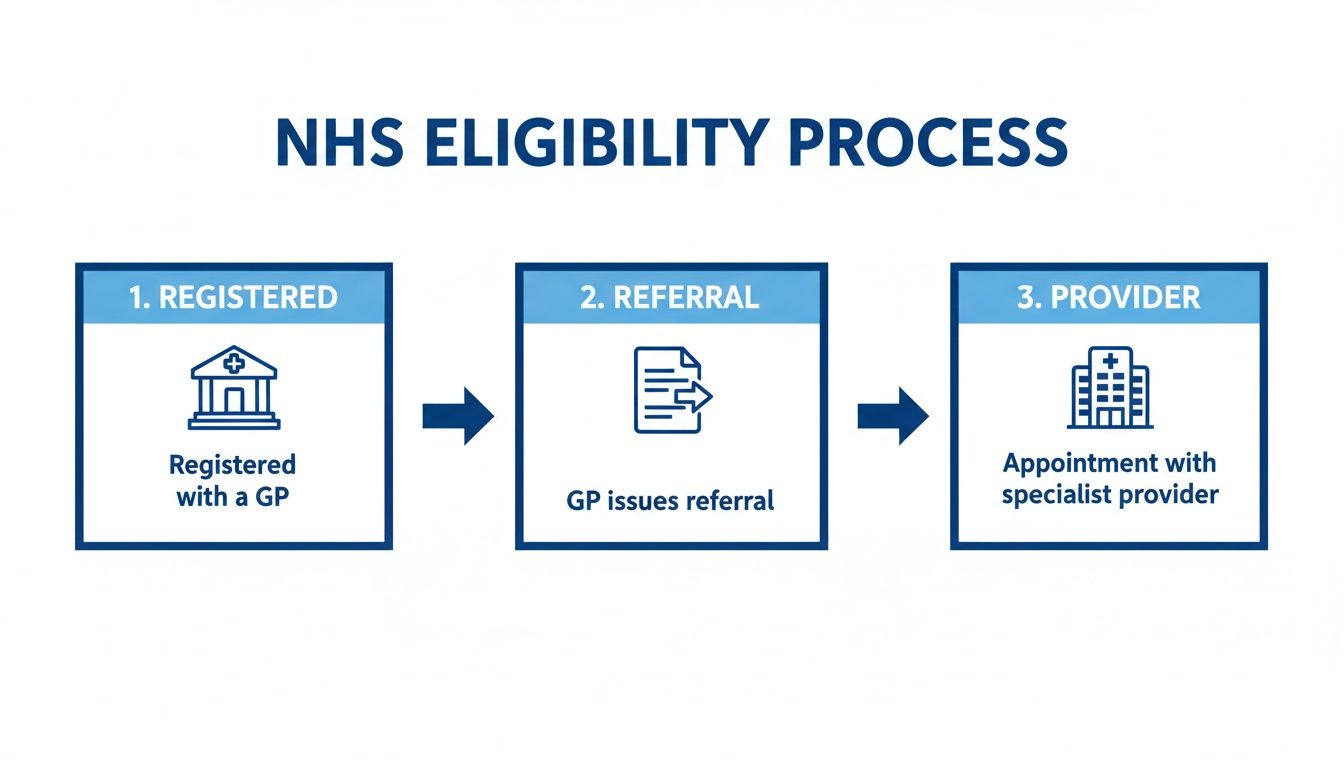
As you can see, the process is linear—it starts with you being registered with a GP, moves to getting a clinical referral, and ends with an appointment at your chosen specialist provider.
Step 3: Communicate Your Request Clearly
When you're in the appointment, your goal is to first explain your symptoms and then clearly and politely state your request. Start by talking about your experiences and why you believe an ADHD assessment is necessary. Once your GP agrees that a referral is the right clinical step, you can then bring up your choice of provider.
You could say something along these lines:
"Thank you for listening. I understand that a referral for an ADHD assessment is the next step. Under my NHS Right to Choose, I would like to be referred to [Provider Name]. I've already checked they are an eligible provider, and I have their details here for you."
If your GP seems unfamiliar with the NHS Right to Choose scheme, having a printed template letter and perhaps a link to the official NHS guidance on your phone can be a game-changer. Just stay calm, be polite, and remember that you are exercising a legal right. This structured approach helps ensure your referral is handled correctly and gets you one step closer to an assessment.
Finding a Provider and Managing Wait Times

While the Right to Choose pathway is often a much quicker route to an ADHD assessment than going through your local NHS service, it’s vital to have a realistic picture of the timelines involved. The scheme's success has created a huge surge in demand, which means pretty much every provider now has a waiting list.
Knowing what to expect from the start can save you a lot of frustration down the line. It's not just one single wait; the journey is usually split into two distinct phases.
First, there's the initial administrative period. This is the time it takes for your GP's referral to be sent out, picked up, and processed by the provider you've chosen. Just getting the paperwork checked and your details logged in their system can take several weeks.
Once that’s sorted, you’re officially on the clinical waiting list for your assessment. This second stage is almost always the longest part of the process. So, when you think about the total wait time, remember to add both these periods together—it’s going to be a multi-month journey.
How to Find a Provider That’s Actually Accepting Patients
The first hurdle is often the biggest. With many of the well-known providers pausing their intake from time to time, your most important task is to find a service that is currently open for referrals. There’s nothing more disheartening than getting your GP on board, only to find out your chosen clinic isn't taking on new patients.
You need to be proactive here. The most reliable method is to go straight to the providers' own websites. Most will have a banner on their homepage or a dedicated section with the latest updates on their Right to Choose status.
When you're doing your homework, keep an eye out for three key details:
- Referral Status: Are they clearly marked as "open" or "accepting" new Right to Choose referrals?
- Estimated Wait Times: Many will give you a current estimate of their waiting times, which is incredibly helpful for comparing your options.
- Any Exclusions: Check the small print. Some providers might only accept referrals from specific parts of the country or have paused certain services.
Putting in this bit of effort upfront will save you and your GP a headache and makes sure your referral actually goes somewhere useful. This is where a good online directory can be a massive help.
Setting Realistic Expectations for the Wait
So, your referral has been sent and accepted. Now the real waiting begins. It's a common misunderstanding that Right to Choose is an instant pass; these days, waits of six to twelve months are fairly standard, and for some providers, it can be even longer.
It's so important to remember this: while it's often significantly faster than the multi-year waits you hear about for local NHS services, it is not a quick fix. Patience is absolutely essential.
To help keep your expectations in check, bear these points in mind:
- The clock starts when the provider accepts your referral, not when your GP sends it. There can easily be a gap of a few weeks between these two events.
- Wait times are just estimates. They can fluctuate depending on staffing levels and how many referrals they're getting.
- Keep an eye out for communication. Most services will send you a confirmation once your referral is logged. If you haven't heard anything after a month, it's perfectly reasonable to send a polite follow-up email.
Providers like Psychiatry-UK are a popular choice for good reason, but it’s always smart to see who else is out there to find the right fit for you. For more specific guidance, have a look at our detailed breakdown of the Psychiatry-UK Right to Choose process. By arming yourself with the right information and understanding the timelines, you can navigate the system with much more confidence.
What Happens After Your ADHD Assessment? A Step-by-Step Guide
Getting an ADHD diagnosis can feel like a massive weight has been lifted. For many, it's a moment of pure validation, answering questions that have lingered for years. But it’s also the starting line for a new journey: learning how to manage your ADHD.
The path forward usually involves two critical stages: medication titration and setting up a Shared Care Agreement with your GP. This is where you, your specialist, and your local doctor work together to find the right treatment and build a sustainable, long-term care plan within the NHS.
Let’s break down what these steps actually involve so you can feel confident and prepared.
First Up: Medication Titration
If you and your specialist decide that medication is the right path, you’ll begin a process called titration.
Think of it like tuning a musical instrument. It’s a careful, gradual process of finding the exact medication and dosage that helps manage your symptoms with minimal side effects. There's no "one-size-fits-all" dose, so this phase is all about personalising your treatment.
You’ll start on a low dose, and over several weeks, your specialist will guide you in slowly increasing it. You'll have regular check-ins to discuss how you're feeling, track your progress, and make small adjustments. This isn't something to be rushed.
Titration is a crucial, specialist-led phase. It ensures your treatment is fine-tuned to your unique body and needs before your care is handed over to your GP. This is why it must be managed by the ADHD specialist who understands the nuances of these medications.
This phase is complete once you and your clinician have found a stable, effective dose that you're comfortable with. Only then is it time to think about the next step. For a deeper dive into the entire assessment process, have a look at our complete guide to an adult ADHD diagnosis.
Next: The Shared Care Agreement Explained
Once your medication is sorted and stable, your specialist will work on setting up a Shared Care Agreement (SCA) with your GP. This is the official handover document that makes your ongoing care possible through the NHS.
Essentially, an SCA is the bridge connecting your specialist assessment (which might have been funded through Right to Choose) to your regular, local NHS care. It clearly lays out who is responsible for what.
A typical agreement outlines three key roles:
- The Specialist: They handle the diagnosis, titration, and provide all the necessary clinical guidance for your GP.
- The GP: They agree to take over the day-to-day prescribing of your medication and keep an eye on your physical health (like your heart rate and blood pressure).
- You (The Patient): You commit to taking your medication as directed and showing up for any follow-up appointments.
This simple agreement is what makes your long-term treatment safe, consistent, and affordable, allowing you to get your prescriptions easily from your local surgery.
Provider Responsibilities in a Shared Care Agreement
To make it even clearer, here's a simple breakdown of who does what once a Shared Care Agreement is in place.
| Responsibility | Specialist Provider Role | GP Role |
|---|---|---|
| Initial Diagnosis & Titration | Conducts the full assessment and manages the entire titration process to find a stable dose. | N/A - This is a specialist role. |
| Prescribing Medication | Issues the initial prescriptions during the titration phase. | Takes over issuing repeat prescriptions once the patient is stable and the SCA is signed. |
| Physical Health Monitoring | Conducts baseline health checks (e.g., blood pressure, weight, heart rate) before starting medication. | Performs routine physical health checks as agreed in the SCA (e.g., annually). |
| ADHD-Specific Reviews | Typically conducts an annual review focused on ADHD symptoms and medication effectiveness. | Refers the patient back to the specialist if there are complex issues or a change in symptoms. |
| Communication | Provides a comprehensive report and the SCA to the GP with clear instructions. | Communicates any concerns or changes in the patient’s health back to the specialist. |
This collaborative approach ensures you receive continuous, expert-guided care from both your specialist and your trusted local GP.
A Quick Word with Your GP Can Make All the Difference
While most GPs are familiar with and willing to accept SCAs, it's not something they are legally required to do. That’s why a little proactive communication goes a long way.
It’s a great idea to have a chat with your GP surgery before you even get your assessment. Just let them know you're using your Right to Choose and that you'll likely need a Shared Care Agreement afterwards. Giving them a heads-up helps make the final handover a much smoother process for everyone.
If your GP has any reservations, your specialist provider is usually more than happy to speak with them directly to offer clinical reassurance. Understanding this partnership is the key to a stress-free journey after your diagnosis.
Common Questions About the Right to Choose Pathway
Let's be honest, navigating any part of the healthcare system can feel like a maze. The Right to Choose pathway is a fantastic option, but it naturally comes with a lot of questions. We’ve put together clear, straightforward answers to the queries we hear most often to help you feel more confident as you move forward.
Think of this as your practical FAQ for those "what if" moments. We’ll cover everything from what to do if your GP seems unsure about the process, to understanding exactly what you will and won't have to pay for.
What if My GP Doesn't Know About Right to Choose?
This is a surprisingly common scenario, so don't be discouraged if it happens to you. GPs are juggling a huge amount of information, and they might not be familiar with how Right to Choose applies specifically to ADHD.
If you find your GP is hesitant or simply doesn't know the rules, the best thing you can do is go in prepared and keep the conversation collaborative. Here’s a simple game plan:
- Bring a Template Letter: Most providers that accept Right to Choose referrals have template letters on their websites. These are brilliant because they do the hard work for you, explaining your legal rights and giving your GP all the details they need to make the referral.
- Have the NHS Guidance to Hand: It’s a great idea to have the official NHS England guidance on patient choice saved on your phone. You can gently mention it’s a national policy and offer to show them the information directly from the source.
- Stay Calm and Collaborative: Remember, you're on the same team. You're not there to challenge their knowledge, but to work together to get the care you're entitled to.
More often than not, once a GP sees the official paperwork, they're perfectly happy to proceed with the referral.
Are There Any Hidden Costs I Should Know About?
This is a really important question, and the answer is refreshingly simple: no. Your assessment and diagnosis through the Right to Choose pathway are funded by the NHS. It shouldn't cost you a single penny.
That said, there is one area where a cost might come into play later on, but it’s not a private fee.
While the assessment itself is completely free, once you're on a stable medication plan, you'll need to pay the standard NHS prescription charge for your medication in England (unless you have an exemption). This is the exact same fee you'd pay for any other NHS prescription.
So, to be clear, the cost is for the medication itself, not the clinical service. It's the standard NHS charge, not a private one.
Can I Switch to a Different Provider After My Referral?
So, what happens if you've been referred to one provider but then spot another with a much shorter waiting list? In theory, yes, you can ask your GP to send a new referral to a different clinic.
The catch is that you’ll lose your place in the queue with the first provider and start right at the bottom of the new one's list. It’s usually best to stick with your original choice unless the difference in waiting times is massive or your situation has changed significantly. It's always worth having a chat with your GP to figure out the best course of action before making a switch.
What Happens if My Chosen Provider Closes Their Waiting List?
This can be incredibly frustrating, especially after you've spent time researching and choosing a clinic. If your GP attempts to send a referral only to find out the provider's waiting list is closed, you'll have to go back to the drawing board.
You’ll need to find another eligible provider that is currently accepting Right to Choose referrals and then ask your GP to send a new referral there instead. This is exactly why it’s so important to check the provider’s website for their current status just before your GP appointment.
Finding a provider that is actually accepting new patients is the most important first step. ADHD Private offers a free UK-wide directory to help you compare clinics, check their Right to Choose status, and see real-time wait estimates, all in one place. Start your search and find the right provider for you.