Adult ADHD Diagnosis: A Clear Guide to Evaluation & Next Steps
Wondering about an adult ADHD diagnosis? Learn UK evaluation, NHS vs private options, assessment details, and next steps.
Written and maintained by the ADHD Private editorial team, drawing on NHS, NICE and ADHD UK guidance. This is general information, not medical advice.
If you’ve spent years wondering why you struggle with focus, organisation, or managing intense emotions, the answer might be ADHD. For so many adults, finally getting a diagnosis is the first real step towards understanding these lifelong challenges. It provides a reason for difficulties you might have mistaken for personal flaws, and it opens the door to effective support and treatment.
Why Getting an Adult ADHD Diagnosis Matters
Feeling like you're constantly swimming against the tide is an incredibly common experience for adults with undiagnosed ADHD. That chronic procrastination isn't laziness. Feeling completely overwhelmed by simple tasks isn't a character defect. These are often just signs of a neurodevelopmental condition that has gone unnoticed, sometimes for decades.
Seeking an adult ADHD diagnosis is about validation. It helps to reframe a lifetime of self-criticism into a clear, medical context. Suddenly, so many confusing patterns start to make sense: the difficulty in maintaining relationships, the frustration of not meeting your potential at work, or the sheer exhaustion from just trying to keep up with daily life. For many, this shift in perspective is the most powerful part of the whole process.
The Scale of Undiagnosed ADHD in the UK
The gap between the number of adults living with ADHD and those who actually have a diagnosis is staggering. Below is a quick look at the numbers, which really highlight why so many people are left struggling without answers.
| UK Adult ADHD Diagnosis at a Glance | | :--- | :--- | :--- | | Statistic | Figure | Implication for You | | Estimated Prevalence | 3-4% of UK adults | You're not alone; it's a common condition, even if it feels isolating. | | Diagnosed Adults | Only 0.32% | The vast majority are undiagnosed, meaning GPs and even some specialists may lack experience. | | The Diagnostic Gap | As few as one in nine adults with ADHD have a diagnosis | This explains why so many people struggle for years before even considering ADHD as a possibility. |
These figures, drawn from a 2025 analysis of 9 million GP records, show that countless individuals are struggling, often silently. They may have been misdiagnosed with anxiety or depression, or simply told they need to "try harder." It's a massive public health blind spot.
An ADHD diagnosis is not an excuse. It’s an explanation. It gives you permission to stop blaming yourself for the way your brain is wired and start learning how to work with it.
Common Signs That Might Lead You to Seek a Diagnosis
While ADHD looks different for everyone, many adults who eventually seek a diagnosis share a core set of experiences. These aren't just occasional lapses; they are persistent, life-disrupting patterns. It can also be really helpful to understand the different ways ADHD can present, which you can read more about here: https://adhdprivate.co.uk/symptoms/types-of-adhd.
Think about whether any of these long-term challenges sound familiar:
- Executive Dysfunction: This is a persistent difficulty with planning, prioritising, and just starting things. In real life, it looks like a messy house, a chaotic work schedule, or being physically unable to begin a project until the last possible minute.
- Emotional Dysregulation: Do you experience intense emotional reactions that feel completely out of proportion to the situation? This can show up as quick-to-erupt frustration, overwhelming mood swings, or a very low tolerance for stress.
- Inattention: This is so much more than being easily distracted. It’s the constant struggle to sustain focus, follow a conversation, or remember instructions. It's that classic "zoning out" during meetings or forgetting why you walked into a room for the tenth time today.
- Restlessness and Hyperactivity: In adults, this often isn't the stereotypical "bouncing off the walls" hyperactivity. It’s more of an internal feeling of being constantly "on the go"—fidgeting, bouncing your leg, or feeling physically unable to just sit and relax.
If these traits resonate with you, you're in the right place. This guide is designed to be your practical roadmap, helping you move from suspicion to clarity and, ultimately, to the support you need.
NHS, Right to Choose, or Private? Choosing Your Diagnosis Pathway
So, you’ve decided to seek an adult ADHD diagnosis. That’s a massive step. The next, and arguably most confusing, part is figuring out how to get there. In the UK, you’re looking at three main routes, and each comes with a very different price tag, timeline, and process.
Getting your head around these options is the key to making a choice that actually works for you, especially when you factor in how urgently you need answers.
This decision tree gives you a quick visual to help you frame your thinking. Do you feel like you’re constantly fighting an uphill battle just to manage daily life? An assessment could be the key to understanding why.
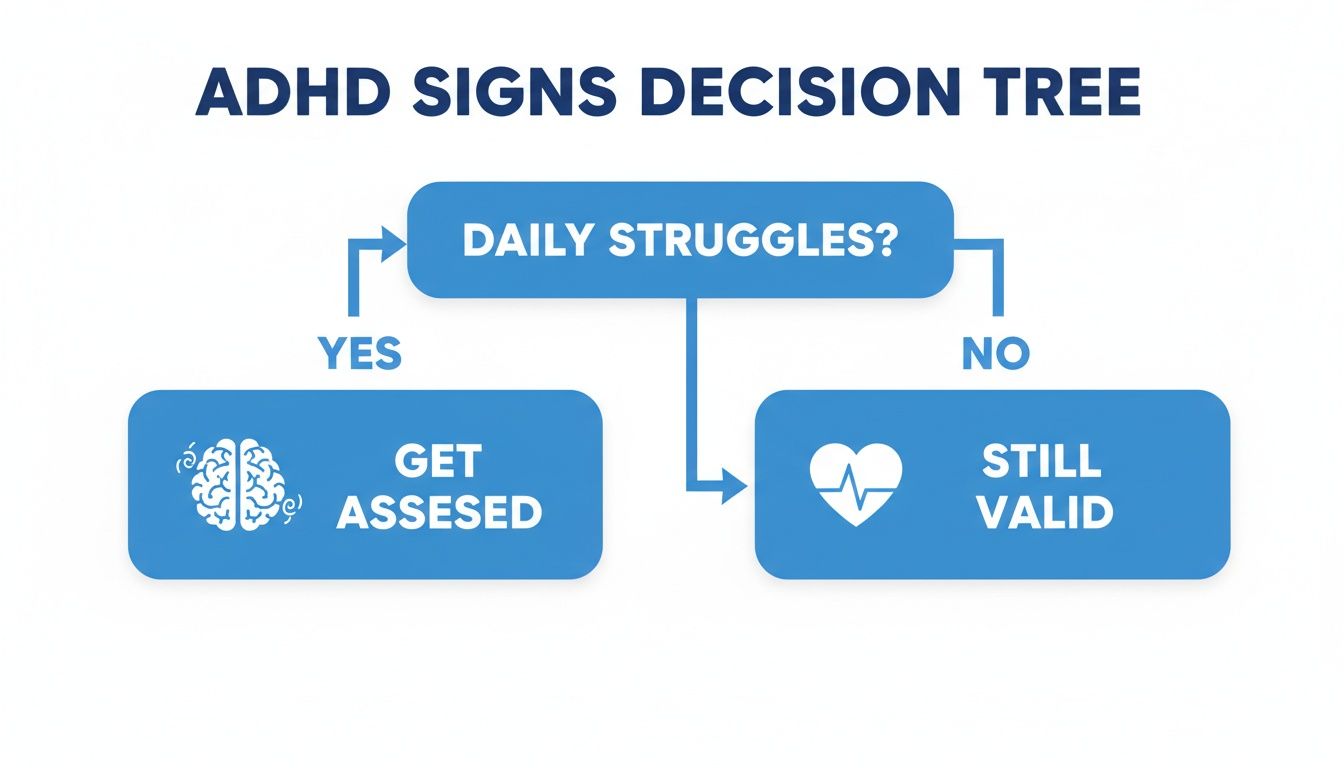
Sometimes a simple visual like this can cut through the noise. It validates that feeling of "is it bad enough?" and confirms that if you're struggling, your experience is real and worth exploring.
The Standard NHS Pathway
For most people, the journey starts with their GP. This is the traditional, publicly funded route. You’ll sit down with your doctor, talk through your symptoms, and if they agree that ADHD could be a factor, they’ll refer you to your local adult ADHD service for a specialist assessment.
The huge plus? It's free. The major, and I mean major, downside is the wait. NHS mental health services are stretched to their absolute limit, and adult ADHD services have been hit particularly hard.
Sadly, NHS waiting times have become a real crisis. People are often left waiting for years, not months. The situation is so dire because with an estimated 3-4% of UK adults (that’s around two million people) thought to have ADHD, the services are completely overwhelmed. It’s this reality that pushes so many to look for other options.
Think of the standard NHS route as a marathon, not a sprint. It’s a completely valid, cost-free option, but you have to be prepared for a potentially life-altering wait that could easily span several years, depending on where you live.
The NHS Right to Choose Pathway (England Only)
If you live in England, you have another NHS-funded option that can genuinely change the game: Right to Choose (RTC). This legislation gives you the right to choose a qualified healthcare provider for your assessment, even if they’re a private clinic, as long as they hold an NHS contract.
In simple terms, you can ask your GP to refer you to a specific provider (like Psychiatry-UK or ADHD 360) for an NHS-funded diagnosis. The assessment, follow-ups, and any medication are all covered by the NHS, just as they would be through the standard route.
The main advantage here is speed. Wait times for RTC providers are typically measured in months, not years.
If this sounds like the right fit, here’s what you need to do:
- Do your homework. Research clinics that accept Right to Choose referrals. Most have template letters on their websites you can download and take to your GP.
- Book a GP appointment. Be direct. Explain that you’re seeking an ADHD assessment and that you want to use your Right to Choose.
- Go prepared. Bring the clinic’s details and the template letter with you. Not all GPs are familiar with RTC, so having everything they need makes the process much smoother.
This route is a fantastic middle ground, giving you the speed of the private sector without the cost. We cover this in much more detail in our guide to the adult ADHD NHS pathway.
The Fully Private Pathway
The third route is to bypass the NHS completely and pay for a private assessment yourself. This is, without a doubt, the fastest way to get a diagnosis. Some clinics can offer you an appointment within a few weeks. If you’re struggling at work or university and need clarity now, this can feel like the only realistic option.
The obvious catch is the cost. A private diagnosis isn't cheap. The initial assessment alone can set you back anywhere from £700 to £1,500. On top of that, you need to budget for follow-up appointments and private prescriptions while your medication is being adjusted (a process called 'titration'), which can easily add hundreds more to the bill.
If you go private, it’s absolutely vital to check that the clinic uses GMC-registered specialists and follows official NICE guidelines. A legitimate diagnosis from a reputable private clinic is fully recognised everywhere—by employers, universities, and the NHS. This is crucial if you later hope to set up a 'Shared Care Agreement' with your GP to get your prescriptions on the NHS.
To help you see it all side-by-side, here’s a quick comparison of the three pathways.
Comparing ADHD Diagnosis Pathways in the UK
Making the right choice depends entirely on your personal circumstances. This table breaks down the key differences between the NHS, Right to Choose, and Private routes to help you weigh the pros and cons.
| Factor | Standard NHS Pathway | NHS Right to Choose | Fully Private Pathway |
|---|---|---|---|
| Cost | Free | Free | £700 - £1,500+ for assessment, plus titration & prescription costs |
| Wait Time | Extremely long (2-7+ years) | Shorter (3-9 months) | Very short (2-6 weeks) |
| Availability | UK-wide | England only | UK-wide |
| Process | GP referral to local NHS service | GP referral to chosen RTC provider | Self-referral directly to clinic |
| Medication Costs | Standard NHS prescription charges | Standard NHS prescription charges | Full private cost until Shared Care is agreed |
| Flexibility | Very little; assigned to local service | Some choice of provider | High level of choice and flexibility |
Ultimately, choosing your path is a personal balancing act between cost, urgency, and where you live in the UK. By weighing these factors carefully, you can decide on the best first step for your own diagnosis journey.
Looking for a private ADHD assessment?
Answer a few questions and we’ll shortlist clinics that fit — comparing price and waiting time.
How to Prepare for Your ADHD Assessment
Walking into your assessment prepared can make a world of difference. It’s not about passing a test; it’s about giving the clinician a clear, accurate, and comprehensive picture of your life. This groundwork helps ensure your adult ADHD diagnosis is based on your full story, not just a snapshot from a single conversation.

So many people worry they’ll forget crucial examples or downplay their struggles out of habit. A little prep can help you feel more confident and clearly articulate your experiences when it matters most.
The goal here is to move beyond just saying "I have trouble focusing" and instead provide concrete examples that bring your challenges to life for the clinician.
Documenting Your Current Symptoms
In the weeks leading up to your appointment, start keeping a "symptom diary" or even just a running list on your phone. The trick is not just to list the symptom but to connect it to a real-world scenario. This context is exactly what clinicians need to understand the true impact on your life.
Think about the different areas of your day and how these traits actually show up:
- At Work: Do you constantly miss deadlines because you’re terrible at estimating how long tasks will take? Find yourself making silly, careless mistakes in important reports? Maybe you’re the one who blurts out ideas in meetings without waiting for a gap in the conversation.
- In Relationships: Have you been told you "just don't listen"? Do you forget important dates like anniversaries or birthdays, causing hurt feelings? Perhaps your emotional reactions feel way too intense for the situation, leading to friction with your partner or friends.
- Daily Life: Think about the dreaded "ADHD tax"—the extra money you spend on late fees, spoiled food you forgot was in the fridge, or those all-too-frequent impulse buys. Note down every time you lose your keys, phone, or wallet.
Your experiences are the most important evidence you have. A clinician isn't looking for a perfect list of textbook symptoms; they want to understand how your unique brain wiring affects your day-to-day existence. Your real-life examples are invaluable.
Digging into Your Childhood
One of the key diagnostic criteria for ADHD is that symptoms must have been present before the age of 12. This is often the hardest part for adults to piece together, but it’s absolutely essential for a thorough assessment.
It’s time to do a bit of detective work. Finding evidence from your past helps build a lifelong picture of these traits, proving they aren't just a recent development.
- School Reports: These can be an absolute goldmine. Hunt for recurring comments from teachers like, "doesn't live up to potential," "is easily distracted," "can be disruptive in class," or the classic "is a daydreamer." These are often the earliest, overlooked signs.
- Talk to Your Parents or Older Relatives: Ask them what you were really like as a kid. Were you always fidgeting? Could you never find your school shoes? Their memories can fill in gaps you simply can't recall.
- Your Own Memories: Try to cast your mind back. Did you find homework agonisingly difficult? Were you always the last one picked for teams because you couldn’t quite follow the rules of the game? Did you just feel fundamentally different from your peers?
Filling Out Pre-Assessment Forms
Most clinics will send you pre-assessment questionnaires, like the Adult ADHD Self-Report Scale (ASRS), before your appointment. It can be incredibly tempting to second-guess your answers or minimise your struggles. Please, try to resist this urge.
Answer honestly, based on how you are most of the time, not just on your "good days." Think about your baseline behaviour without all the coping strategies you've painstakingly built over the years. This isn't the time to present the organised, on-top-of-it version of yourself you wish you were; it's about showing the clinician the real challenges that led you here.
If you want to get a feel for what these screeners involve, our overview of the online ADHD test process can be a helpful read. Ultimately, being prepared transforms an assessment from a daunting hurdle into a collaborative, productive conversation.
What Actually Happens During the Assessment?
It's completely normal to feel a bit anxious about your ADHD assessment. Most of us build it up in our minds to be some kind of intense, high-stakes exam. But I want to pull back the curtain and show you what it’s really like.
Think of it less as an interrogation and more as a structured conversation about your life. The specialist is there to help you connect the dots, not to catch you out. It’s a collaborative process designed to build a complete picture of who you are and how you’ve experienced the world. This isn't a test you can pass or fail—it’s just a chance to finally get some clarity.
The Core of It: The Diagnostic Interview
The heart of any adult ADHD diagnosis is the clinical interview. This is a deep-dive conversation that can last anywhere from one to three hours. The whole point is for the specialist to see if your life experiences match the established patterns of ADHD, typically using the criteria from the DSM-5 (Diagnostic and Statistical Manual of Mental Disorders, 5th Edition).
They’ll guide you through different parts of your life with specific questions. It might feel a bit like they're jumping around, but there's a clear structure to what they're trying to understand.
You can expect the conversation to cover a few key areas:
- Childhood and School Days: This part is crucial. For an ADHD diagnosis, there must be evidence of symptoms before the age of 12. They’ll ask about old school reports (if you have them), what you were like in the classroom, how you got on with friends, and your general behaviour as a kid.
- Work and Career History: They’ll likely ask about your job performance. Do you struggle to meet deadlines? How do you cope with big projects versus boring admin tasks? Have you jumped between jobs a lot? This helps them see how symptoms manifest in a professional setting.
- Relationships and Social Life: The conversation will probably touch on your relationships with partners, family, and friends. They might explore things like communication challenges, managing your emotions during disagreements, or whether you’ve made impulsive decisions that have affected others.
- Day-to-Day Life: This is where they get into the nitty-gritty. Expect questions about managing money, keeping your home tidy, remembering appointments, and general time management. It’s all about understanding the practical, real-world impact.
A quick tip: be completely honest. When a clinician asks about a messy house or late bills, they aren't judging you. They're looking for clinical signs of executive dysfunction, not making a comment on your character. Your honesty is the most important tool you have.
In-Person vs. Online Assessments
These days, a huge number of assessments happen online over video calls. This has been a game-changer, making it so much easier for people to get a diagnosis without having to travel or wait quite as long. Rest assured, a professionally conducted online assessment is every bit as valid and thorough as one done face-to-face.
Whether you’re sitting in a clinic or on your own sofa, the substance of the interview is the same. The questions they ask and the diagnostic criteria they use don’t change.
The main difference is simply the setting. If you’re having an online assessment, it’s a good idea to prepare a little:
- Find a quiet, private spot where you won’t be interrupted.
- Make sure you have a stable internet connection.
- Have any notes, old school reports, or lists of symptoms you’ve prepared handy.
Some people find they can open up more from the comfort of their own home. Others prefer the formal structure of a clinical environment. Neither is better than the other—it’s purely down to what works for you and what the clinic offers. The quality of your adult ADHD diagnosis won't be affected either way.
Ultimately, the specialist’s goal is to gather all the information they need to make an accurate, confident decision. By knowing what to expect and why they're asking certain questions, you can walk in (or log on) feeling prepared and ready to have a really productive chat.
Life After Diagnosis: Treatment and Support
Getting an ADHD diagnosis isn't the end of the road; it’s the beginning of a new one. For many people, it's the first time life starts to make sense. Finally, you have an explanation for the lifelong struggles and, more importantly, a path forward. The next phase is all about figuring out what works for you—finding the right tools to manage your symptoms and work with your brain, not against it.

This part of the process is a journey of discovery. It often involves finding the right medication and dosage, but it's also about building practical life skills through therapy and coaching. The real goal is to create a sustainable, long-term support system that makes a genuine difference to your daily life.
The Medication Journey: Titration Explained
For most people, medication is a key part of their treatment plan. The process of getting started is called titration. This isn’t a case of just being handed a prescription and sent on your way; it’s a careful, collaborative process between you and your specialist.
The aim of titration is to find two things:
- The right type of medication for you (stimulants like methylphenidate or lisdexamfetamine are common, but non-stimulants are also an option).
- The optimal dose that gives you the maximum benefit with the fewest possible side effects.
You’ll start on a very low dose, which is then gradually increased every week or two. You’ll have regular check-ins with your clinician to report back on how you're feeling, noting any improvements in focus or any side effects like trouble sleeping or a reduced appetite. It's a period of fine-tuning that definitely requires patience, but it’s crucial for getting it right.
Titration is a marathon, not a sprint. Be totally honest and detailed in your feedback to your clinician. The more information they have, the better they can tailor the treatment to your specific needs, setting you up for long-term success.
More Than Just Pills: Therapy and Coaching
While medication can be a game-changer for managing core ADHD symptoms like inattention and hyperactivity, it doesn't magically teach you the organisational or emotional regulation skills you may never have had the chance to develop. This is where non-medical support comes in, acting as the other vital piece of the puzzle.
These therapeutic approaches are all about building practical, real-world strategies.
- Cognitive Behavioural Therapy (CBT): A specialised form of CBT for ADHD helps you identify and challenge the negative thought patterns and behaviours that have likely built up over a lifetime. It focuses on tackling things like procrastination, improving time management, and developing healthier ways to cope with frustration and emotional ups and downs.
- ADHD Coaching: This is a very practical, forward-looking kind of support. An ADHD coach works with you to set achievable goals and then breaks them down into manageable steps. They can help you create systems for organising your home, managing your finances, or just staying on top of your work.
Despite how effective these treatments are, there's a huge gap in the UK. Analysis of GP data shows that adult ADHD is starkly undertreated. Only 15.6% of estimated adult cases receive medication, compared to 26.6% of children. With around 1.6 million adults affected in England alone, that leaves a massive number of people without the intervention they need. You can find out more about these findings on UCL's news site.
Bridging the Gap: Shared Care Agreements
If you went private for your diagnosis, you’ll be paying for your medication out of pocket during titration, and that can get very expensive. The long-term solution for most people is a Shared Care Agreement (SCA).
Put simply, an SCA is a formal arrangement between your private specialist and your NHS GP. Once your medication type and dosage are stable and working well, your specialist will write to your GP, asking them to take over the prescribing.
If your GP agrees, your prescription is transferred to the NHS. This means you’ll only have to pay the standard NHS prescription charge, making your ongoing treatment far more affordable. Your specialist usually stays on board for annual reviews, while your GP handles the day-to-day prescribing.
Getting this sorted can sometimes be a hurdle, but with clear communication from a reputable clinic, most GPs are willing to enter into this arrangement. It’s an essential step for making long-term ADHD management both accessible and affordable after an initial private diagnosis.
Common Questions About ADHD Diagnosis in the UK
It's completely normal to have a dozen questions buzzing around your head when you're trying to figure out the ADHD diagnosis process. Let's face it, navigating the system can feel overwhelming.
Here are some straightforward answers to the practical questions that crop up most often, designed to help you handle the details with a bit more confidence.
How Much Does a Private Diagnosis Cost?
This is the big one, isn't it? The cost of a private adult ADHD diagnosis in the UK varies quite a bit from clinic to clinic. As a ballpark figure, you should expect to budget somewhere between £700 and £1,500 for the initial assessment and your diagnostic report.
But that's not the whole story. The initial assessment fee is just the first step. You'll also need to factor in the cost of follow-up appointments and private prescriptions while you get your medication dosage right (a process called titration). These extra costs can easily add another several hundred pounds to the total bill, so always ask for a full price list before you commit.
A crucial tip is to look at the total cost, not just the headline assessment fee. Ask clinics for a clear breakdown of their charges for the assessment, titration period, and any follow-up consultations. A good provider will be completely transparent about this.
Is a Private Diagnosis Recognised by the NHS?
Yes, absolutely. A diagnosis from a reputable private clinic is perfectly valid, as long as it's conducted by a GMC-registered specialist who follows the official National Institute for Health and Care Excellence (NICE) guidelines.
This is more than just a piece of paper; it’s the key to getting the right support. A proper diagnosis should be recognised by:
- The NHS: This is vital for setting up a Shared Care Agreement with your GP, which allows you to get your prescriptions on the NHS.
- Employers: A formal diagnosis is what you need to request reasonable adjustments at work under the Equality Act 2010.
- Universities: It unlocks access to support like extra time in exams or extensions on deadlines.
Can I Get an ADHD Diagnosis Online?
You certainly can. Thanks to the growth of telepsychiatry, many of the UK’s top ADHD clinics now offer full assessments over secure video calls. Well-known providers like Psychiatry-UK and ADHD 360 have been doing this successfully for years.
These online appointments are just as thorough and clinically rigorous as face-to-face ones, and the diagnosis is equally valid. For many people, it’s a far more convenient and accessible option, cutting out travel time and geographical limitations.
What if My GP Refuses a Referral or Shared Care?
Hitting a wall with your GP can be incredibly frustrating, but don't lose heart. It's often down to a lack of awareness about the correct procedures, rather than a dismissal of your concerns. You have a few options.
If your GP refuses a Right to Choose referral, you are well within your rights to ask for the reason in writing. You can then gently direct them to the official NHS guidance on the patient's right to choose.
If they push back on a Shared Care Agreement after a private diagnosis, make sure you've given them all the documentation from your specialist. If they still say no, remember you can always register with a different GP practice. Some are simply more experienced and comfortable with ADHD pathways than others.
At ADHD Private, we're here to make finding the right clinic less of a headache. Our free UK-wide directory lets you compare over 85 private clinics, with transparent details on pricing, wait times, and services so you can make a choice that feels right for you. Start your search today at https://adhdprivate.co.uk.