Ultimate Online ADHD Test Guide for UK Adults
Explore reliable online ADHD test options in the UK. Learn about screening methods, assessment accuracy, and navigating NHS Right to Choose and private clinics.
If you’ve been wondering whether your struggles with focus, organisation, or restlessness might be ADHD, you've probably come across online ADHD tests. For many adults in the UK, these are the very first step on a journey towards getting answers. They act as a useful starting point, helping to clarify your symptoms before you dive into a formal clinical diagnosis.
An online screener can cut through some of the initial uncertainty, giving you a clearer picture and pointing you towards the right kind of professional help.
Why an Online ADHD Test is a Great First Step
Does it ever feel like your brain has too many tabs open at once? That feeling of being constantly overwhelmed by a mental juggling act is a familiar one for millions of people. The thought of navigating a complex healthcare system to get answers can feel just as overwhelming, but taking that first step is crucial.
And you're definitely not alone in this. Shocking new data suggests that over 2.6 million adults in the UK could have undiagnosed ADHD – that's more than one in every 25 people. This completely busts the old myth that ADHD is something you just grow out of.
For those who do seek help via the NHS, the reality can be a soul-crushing five-year wait for a diagnosis. A delay that long can have a massive impact on your career, relationships, and overall mental health. You can read more about these findings on WeCovr.com.
What This Guide Will Cover for You
Think of this guide as your personal roadmap. It’s designed to demystify the whole process, from that first inkling you might have ADHD to getting a formal diagnosis and figuring out what comes next. An online adhd test is a practical and powerful starting point, often giving you the confidence and information you need to take things further.
We’re here to help you bypass the long queues and confusing jargon, offering a clear, direct route to the answers you’re looking for.
We'll walk you through each stage of the journey, making sure you feel informed and in control. Here’s a look at what we’ll cover:
- Understanding the Tools: We’ll break down the crucial difference between a simple online screener (think of it as a self-check quiz) and a full clinical assessment carried out by a specialist.
- Accuracy and Trust: You’ll learn how to spot a reliable online assessment and understand why they can be just as valid as seeing someone face-to-face.
- Navigating Your Options: We'll map out the main pathways to getting a diagnosis in the UK, including the NHS, private clinics, and the incredibly useful NHS Right to Choose scheme. For a deeper dive, check out our guide on how to get tested for ADHD.
- Choosing the Right Clinic: We’ll give you a practical checklist to help you find a reputable provider that meets all the official UK standards.
- Avoiding Common Pitfalls: We’ll flag some common mistakes people make along the way and show you how to avoid them for a much smoother process.
By the time you're done reading, you'll have a much clearer sense of direction and feel ready to take that next step.
Understanding Online ADHD Screeners and Assessments
If you’ve ever Googled "online ADHD test," you'll know there's a huge mix of options out there. You’ll find everything from quick, free quizzes to full-blown clinical evaluations. It's really important to know the difference, because they do completely different jobs. Getting them mixed up can cause a lot of confusion and put you on the wrong path to getting help.
Here’s a simple way to think about it. A free online screener is a bit like a first-aid quiz. It’s a handy starting point that can flag potential issues based on the symptoms you report. It gives you a nudge that it might be time to talk to a professional, but that's all. It can't, and doesn't, give you a medical diagnosis.
A proper online assessment, however, is the real deal. It’s like a specialist consultation with a doctor, just held over video. This is a detailed, structured evaluation with a qualified clinician—like a GMC-registered psychiatrist—who has the authority to diagnose conditions and map out a treatment plan.
What Is an Online ADHD Screener?
An online ADHD screener is usually just a short questionnaire you can whizz through in a few minutes. It's designed as a quick, informal check to see if your day-to-day experiences match up with common ADHD traits. These are the kinds of tests you’ll see on various websites, asking about your ability to focus, your impulsivity, and how restless you feel.
While they can be useful for a bit of self-reflection, these screeners have some pretty big limitations. They’re based entirely on how you see your own behaviour, which isn't always objective. On top of that, they can't tell the difference between ADHD symptoms and those caused by other conditions like anxiety, depression, or even burnout—all of which can look surprisingly similar.
Ultimately, the main point of a screener is to arm you with some initial information so you can have a more meaningful chat with your doctor. It gives you a framework for your thoughts before you seek a professional opinion.
What Is a Formal Online ADHD Assessment?
A formal online assessment is a proper clinical procedure. It’s far more than a simple questionnaire and is designed to deliver a definitive medical diagnosis that’s recognised by GPs and other healthcare professionals across the UK.
This kind of assessment is a thorough, structured process, typically carried out over a secure video call. The clinician will use properly validated diagnostic tools and rating scales to get a complete picture of your symptoms, both now and throughout your life.
A crucial part of any formal diagnosis is proving that symptoms were around before the age of 12, as required by official guidelines. This is why clinicians often ask for things like old school reports or to speak with a parent or someone who knew you well as a child.
These assessments are based on established medical standards to make sure they're accurate. Here’s what you should expect from a legitimate online assessment service:
- Conducted by Specialists: Your assessment should be with a qualified psychiatrist or another specialist clinician who has deep expertise in diagnosing adult ADHD.
- Use of Validated Tools: Clinicians will use standardised tools like the Adult ADHD Self-Report Scale (ASRS) and the DIVA-5 (Diagnostic Interview for ADHD in Adults) as part of a much wider evaluation.
- Comprehensive History Taking: The specialist will take you through an in-depth interview, covering your developmental history, medical background, and school years to build a complete picture.
- Differential Diagnosis: A critical step is to rule out other conditions that could be causing your symptoms. This ensures the final diagnosis is the right one.
In short, a formal online assessment matches the rigour of a face-to-face evaluation; it’s just delivered in a more convenient format. It’s this clinical depth and professional oversight that makes the diagnosis valid and provides the foundation for any potential treatment, whether that's medication, therapy, or both.
Can an Online ADHD Assessment Really Be Accurate?
When you’re looking for answers about your health, especially something as personal as ADHD, you need to know you can trust the process. It's a question I hear all the time: can an online test truly be as accurate as seeing a specialist in person?
The short answer is yes—as long as it’s a proper, formal assessment from a reputable clinic that follows UK guidelines.
Think of it this way: a skilled mechanic can often diagnose a tricky engine problem over a video call. They know exactly what questions to ask, what sounds to listen for, and how to guide you through the right checks. In much the same way, an experienced psychiatrist uses a structured, evidence-based process to get the same diagnostic clarity online as they would in a clinic room. They’re trained to see beyond the surface.
This is because accredited online clinics don't just make up their own rules. They adhere strictly to the same gold-standard criteria used in the NHS, particularly the guidelines from the National Institute for Health and Care Excellence (NICE). They use the exact same validated diagnostic tools, structured interviews, and rating scales, making sure the process is just as thorough.
The Science Backing It Up
One of the biggest worries people have is misdiagnosis. Specifically, the fear of a "false positive"—being told you have ADHD when you actually don't. Any good online assessment is built to minimise this risk.
Clinicians are trained to perform what’s called a differential diagnosis. This is a crucial step where they carefully distinguish ADHD symptoms from those of other conditions that can look very similar, like anxiety, depression, or even burnout.
For instance, during a video consultation, a psychiatrist can pick up on your non-verbal cues and dig deeper into your answers in real time. They might ask how your focus issues feel different when you’re anxious compared to when you're relaxed. This helps untangle the true root of your struggles in a way a simple questionnaire never could.
A proper assessment isn't just about ticking boxes on a symptom list. It's about building a complete, nuanced picture of your life experiences, both past and present, to make sure the diagnosis is both accurate and reliable.
Recent research has backed up the reliability of well-designed online assessments. One important study found that a specific online tool correctly identified over 80% of genuine ADHD cases when compared to traditional clinical diagnoses. Interestingly, this method was actually more cautious, identifying 78.8% of positives versus the traditional 92.8%. This approach significantly cut the rate of false positives down to just 11.7%, helping to counter fears of overdiagnosis. You can read more in this report on adult ADHD assessment data.
What Makes an Online Assessment Trustworthy?
So, what separates a reliable online assessment from a sketchy one? The accuracy really comes down to a few core elements that mirror the best practices you'd find in any top-tier, in-person evaluation.
A high-quality online adhd test will always include:
- Clinician-Led Interviews: The assessment is guided by a real person—a GMC-registered psychiatrist or specialist nurse—not just an algorithm.
- Use of Validated Scales: They use recognised and respected tools like the ASRS (Adult ADHD Self-Report Scale) and DIVA-5 (Diagnostic Interview for ADHD in Adults) as part of a much broader evaluation.
- Comprehensive History Gathering: The specialist will take the time to explore your childhood, your school reports, and your experiences in adult life to confirm symptoms have been persistent, which is a key part of the diagnostic criteria.
- Ruling Out Other Conditions: A critical piece of the puzzle is making sure other potential causes for your symptoms have been carefully considered and excluded.
When all these elements are in place, a formal online assessment can give you a diagnosis that is just as robust, accurate, and medically valid as one you’d receive in a face-to-face appointment.
Navigating the UK ADHD Diagnosis Pathway
So, you’ve taken an online ADHD test. The results might feel like a lightbulb moment, or they might just add more questions to the pile. Either way, it’s a massive first step. But what comes next? This is where the real journey towards a formal diagnosis begins, and in the UK, you’ve got a few different roads you can take.
Think of it like planning a trip. The standard NHS route is like the local bus service – it’s reliable and free, but the journey can be incredibly long, sometimes taking years. Going private is like booking a taxi – you get there fast, but it’ll cost you.
Then there’s a third way, which not everyone knows about: the NHS Right to Choose scheme. This is a bit like the NHS funding that taxi ride for you, letting you use an approved private service without the personal expense. Each path has its own map, its own timeline, and its own set of pros and cons.
Your First Stop: The GP
No matter which path you think you’ll take, your first port of call should always be your GP. Booking an appointment to talk through your symptoms and the results of your online screener is the essential starting block. This conversation is what gets your concerns officially logged in your medical records and kicks off the referral process.
When you go, be prepared. Don’t just show up empty-handed. Bring the results of your screener, but more importantly, bring real-life examples. Make a list of your symptoms and think about how they actually affect you day-to-day – at work, at home, in your relationships. This gives your GP a much clearer picture and strengthens your case for a referral.
Once you’ve had that chat, you can decide which route is right for you.
Comparing Your Three Main Options
The choice between the NHS, private care, and Right to Choose usually boils down to one thing: time versus money. For many people, the idea of waiting years on an NHS list is a non-starter, which makes private options seem much more attractive, even with the price tag.
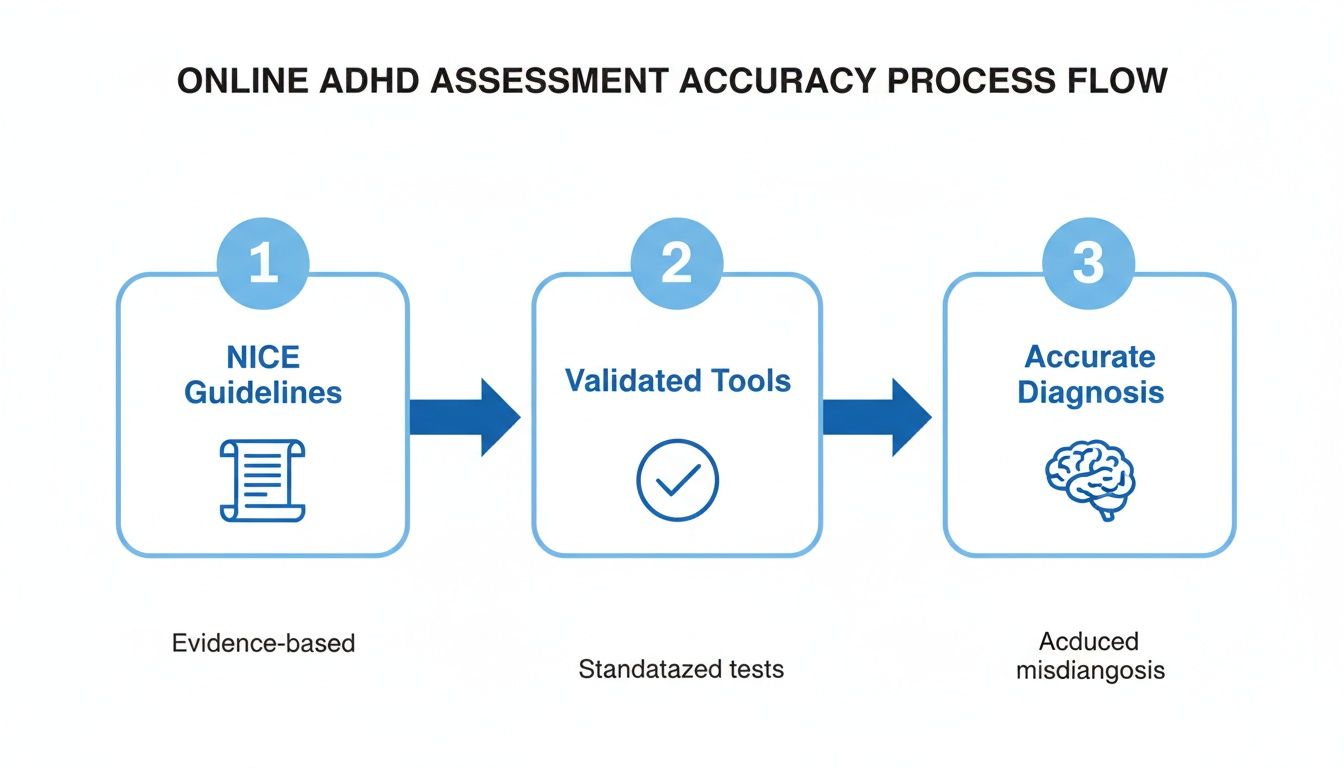
This process shows that whether you go through the NHS or a trusted private provider, a proper assessment will always be built on the foundation of NICE guidelines and clinically validated tools.
Let’s take a closer look at what each pathway really means for you. Choosing the right one is a big decision, so having all the facts laid out can make things much clearer.
Comparing ADHD Assessment Pathways in the UK
| Pathway | Typical Wait Time | Associated Cost | Key Considerations |
|---|---|---|---|
| NHS Pathway | 2 to 7 years | Free (covered by NHS) | The most common route but incredibly slow. Availability and wait times vary hugely by postcode. |
| Private Pathway | Weeks to a few months | £600 - £1,500+ for assessment | The fastest option by far, but the costs don't stop at diagnosis. Medication and follow-ups are extra. |
| NHS Right to Choose | Several months | Free (covered by NHS) | Only available in England. A fantastic middle ground, offering the speed of private care without the cost. |
This table really highlights the trade-offs you have to weigh up. The Right to Choose scheme, in particular, has become a game-changer for many, offering a powerful alternative to endless waiting lists without the financial barrier of going fully private.
The Role of Shared Care Agreements
Once you have a diagnosis and start treatment (which often involves medication), the next step is usually setting up a shared care agreement. This is a formal arrangement between your specialist (usually a private one) and your NHS GP.
In simple terms, it means your GP agrees to take over writing your prescriptions. This is a huge deal because it moves the cost of your medication onto the NHS, making it dramatically more affordable in the long run.
For this to happen, your private clinic needs to provide a thorough, NICE-compliant diagnosis report that your GP can trust. Most GPs are open to these agreements, but it’s a really good idea to have a quick chat with them before you book a private assessment to make sure they’re on board. You can find out more about how the NHS handles adult ADHD diagnosis to get a better sense of the process.
This is where finding a reputable clinic is so important. A good provider will have a solid track record of setting up successful shared care agreements, ensuring your journey from assessment to ongoing support is as smooth and straightforward as possible.
Choosing a Reputable Online ADHD Clinic
The huge demand for an online adhd test means there's now a dizzying array of private clinics to choose from. But with so many options, how do you sort the genuine experts from the unreliable services? Getting this right is about more than just a diagnosis—it's about ensuring that diagnosis is solid enough to be accepted by your GP, setting you up for effective, long-term support.
The need for accessible, quality care is massive. A landmark study analysing 9 million UK GP records found that a mere 0.32% of patients had an official ADHD diagnosis. This shockingly low figure suggests that for every nine people with the condition, only one has been formally identified, pointing to a true crisis of underdiagnosis in the UK. You can read more about the research into UK ADHD diagnosis rates.
Think of it like hiring a skilled professional for a complex job at home. You wouldn't let just anyone rewire your house; you'd check their qualifications, read reviews, and make sure they're above board. Applying that same level of care here is essential for receiving a service that meets UK medical standards.
Your Essential Vetting Checklist
To feel confident in your choice, you need a clear checklist. Any good clinic will be upfront about its credentials, making it easy for you to verify everything. Use these points as a filter to weed out any providers that don't make the cut.
- Clinician Credentials: This is the big one. Your assessment absolutely must be carried out by a psychiatrist registered with the GMC (General Medical Council) or a specialist nurse prescriber with equivalent qualifications. It's a non-negotiable backstop that guarantees professional accountability.
- Adherence to NICE Guidelines: The clinic should be loud and clear that its assessments stick to the National Institute for Health and Care Excellence (NICE) guidelines. This is the UK's gold standard and a huge factor in whether your GP will agree to a shared care plan later.
- Transparent Pricing: Look for a full, clear breakdown of costs. This means the assessment fee, any charges for medication management (titration), follow-up appointments, and report writing. Hidden fees are a massive red flag.
- Data Privacy and Security: The clinic must be GDPR compliant and use secure, encrypted platforms for your consultations and personal data. You should be able to find their privacy policy without having to dig for it.
Your goal is to find a provider whose final report is so thorough and professional that your GP can accept it without hesitation. This is the key to a smooth transition to a 'shared care' agreement for your ongoing treatment.
Focusing on these core pillars will help you shortlist clinics that provide a legitimate, professional service. To get a head start, you can explore a curated directory of online ADHD clinics which have already been checked against these criteria.
Spotting the Red Flags
Knowing what to look for is only half the battle; you also need to know what to avoid. Some online services have slick marketing but very little clinical substance behind the scenes. Keep your eyes peeled for these warning signs.
A promise of a "guaranteed" or "instant" diagnosis is a major red flag. A proper assessment is a careful, nuanced process that never guarantees a specific outcome. Another giveaway is being vague about the clinicians—if you can't easily find their names and GMC registration numbers, be very cautious.
You should also be wary of glowing testimonials that seem too good to be true, especially if you can't verify them. Instead, look for independent reviews on platforms like Trustpilot or Google. They'll give you a much more realistic feel for what other people have experienced.
Finally, if a clinic gets cagey when you ask about their process or how they work with NHS GPs on shared care agreements, it's probably best to walk away. Real transparency is the hallmark of a provider you can trust with your health.
Common Mistakes to Avoid with Online ADHD Tests
Taking that first step with an online ADHD test can feel like a massive relief, but the road from that initial quiz to a proper, helpful diagnosis is filled with a few common bumps. Even when you've found a great clinic, some simple missteps can trip you up, leading to delays, frustration, or a report that just won't be accepted by your GP.
Think of it like preparing for a really important meeting. You wouldn't just wander in and wing it. You’d do your homework, think about what you want to say, and get your paperwork in order. A formal ADHD assessment needs that same level of care and preparation to make sure the outcome is accurate and genuinely useful for you.
Knowing what these common errors are ahead of time makes it much easier to sidestep them and makes the whole journey towards clarity feel a lot less daunting.
Mistake 1: Treating a Screener Like a Diagnosis
This is, without a doubt, the most frequent stumble. It’s so easy to find a free online adhd test, click through a few questions, and get a result suggesting you have ADHD. While these screeners are a great starting point for self-discovery, they are absolutely not a medical diagnosis. They’re a signpost, not the destination.
Taking that screener result as the final word can cause a lot of unnecessary anxiety. It completely misses the crucial context a clinician brings to the table, like ruling out other conditions such as depression or burnout, which can look a lot like ADHD on the surface.
- Screener: A quick, automated quiz based on your own answers that flags potential signs of ADHD.
- Assessment: A comprehensive evaluation with a qualified professional who uses validated diagnostic tools and their clinical judgement.
It's best to see a screener as a tool that helps you decide if it's time to have a proper chat with your GP or a specialist.
Mistake 2: Not Preparing Your Personal History
A solid ADHD diagnosis hinges on showing that symptoms were causing problems long before adulthood, typically before the age of 12. Clinicians are looking for a lifelong pattern of challenges, not just a recent rough patch. Showing up to your assessment without this information is like asking someone to write your life story but only handing them the final chapter.
Forgetting this crucial piece of the puzzle can bring your assessment to a grinding halt. Clinicians have to follow the official NICE guidelines, and that means they need to see evidence from your childhood.
Before your assessment, do a bit of digging. See if you can find old school reports that mention things like being 'daydreamy' or 'disruptive'. It’s also a great idea to chat with a parent, an older sibling, or another relative who remembers what you were like as a kid.
This preparation gives your clinician the rich, detailed history they need to build a complete and accurate picture.
Mistake 3: Ignoring Clinician Qualifications
The truth is, not all online clinics are legitimate. A huge mistake is to dive in without checking the credentials of the person who will be assessing you. A diagnosis from someone who isn't properly qualified is essentially worthless—it won't be recognised by your GP, especially when it comes to getting medication through a shared care agreement.
Your assessment absolutely must be carried out by a GMC-registered psychiatrist or a specialist nurse prescriber with the right qualifications. There's no wiggle room on this. Reputable clinics are transparent about this and will often list their clinicians’ registration numbers right on their website.
Always take a minute to look up a clinician's status on the official GMC register. It's a simple check that gives you complete peace of mind that you're in safe, professional hands.
Mistake 4: Forgetting to Speak with Your GP First
Finally, skipping a chat with your GP can create headaches later on. While you can go ahead and book a private assessment directly, having that initial conversation with your doctor is invaluable. It officially logs your concerns on your medical record and opens up the conversation about a future shared care arrangement.
A shared care agreement is where your GP agrees to take over prescribing your medication on the NHS once you're on a stable dose from a private specialist. If they hear about your diagnosis out of the blue, they might be hesitant or you could face delays while they get up to speed.
A quick chat with your GP before you book anything privately just gets everyone on the same page. It makes the transition from a private diagnosis to ongoing NHS support so much smoother.
Your Questions Answered: Navigating Online ADHD Tests
As you get closer to making a decision, you're bound to have some specific questions bubble up. This final section is all about giving you clear, straightforward answers to the things people most often ask about getting an ADHD test online. Think of it as a quick guide to help you sort out the practical details so you can move forward with real confidence.
We’ll get into the nitty-gritty: what happens with prescriptions, whether your GP will recognise a private diagnosis, how much it all costs, and what you can do to prepare. Each answer is designed to be practical, reinforcing what you’ve already learned and making sure you feel completely ready for what’s next.
Can I Get ADHD Medication After an Online Test?
Yes, but it's crucial to know what kind of "test" we're talking about. You can only get medication after a full diagnostic assessment carried out online by a qualified prescriber, like a psychiatrist. Those free online quizzes and screeners? They’re great for self-reflection and deciding your next steps, but they will never lead to a prescription.
Following a formal diagnosis from a reputable online clinic, the specialist can begin the process of prescribing medication. This kicks off with a period called ‘titration’, where they work closely with you to find the right medication and dosage. It’s a careful, closely monitored process to make sure the treatment is a good fit for you.
Once your treatment is stable, the aim is usually to set up a ‘shared care agreement’ with your GP. This is a formal arrangement where your NHS GP takes over issuing your repeat prescriptions, which makes your ongoing treatment much more affordable. This is a big reason why choosing a clinic with a solid track record in arranging these agreements is so important.
Will My GP Accept a Diagnosis from a Private Clinic?
In most cases, yes. GPs in the UK are generally happy to accept a diagnosis from a private online clinic, but with one massive condition: the assessment must have been conducted by a GMC-registered specialist and must follow the UK's NICE (National Institute for Health and Care Excellence) guidelines to the letter.
This is precisely why doing your homework and picking a reputable provider is non-negotiable. A high-quality clinic makes sure its diagnostic reports are incredibly detailed and thorough. They are written to meet the exact standards a GP needs to see before they'll feel comfortable agreeing to a shared care arrangement for your medication.
It’s always a smart move to have a quick, proactive chat with your GP before you book a private assessment. Just mentioning your plans can help make the whole process much smoother when it's time to share the results and talk about ongoing care.
Taking this simple step can make all the difference in building a good working relationship between your private specialist and your NHS doctor, which is exactly what you want for long-term support.
How Much Does a Private Online ADHD Assessment Cost?
The cost of a private online ADHD assessment in the UK varies quite a bit from one clinic to another. As a general guide, you can expect to pay somewhere between £600 and £1,500 for the initial comprehensive diagnostic assessment. This fee usually covers the main evaluation session with the specialist.
However, you've got to check exactly what's included in that headline price. Some clinics have additional costs for things like:
- The initial prescription: Some services might charge a separate fee for writing your first prescription.
- Medication titration: The follow-up appointments needed to adjust your dosage are often billed separately.
- Detailed reports: While a standard report is typically included, you might have to pay extra for more in-depth versions for work or university.
This is where a directory can be a real lifesaver. By comparing services side-by-side, you get a transparent look at all the potential costs, helping you find a high-quality service that also works for your budget. And don't forget to factor in the ongoing cost of private prescriptions if a shared care agreement isn't possible right away.
What Should I Do to Prepare for My Online Assessment?
A bit of prep work can make your assessment much more effective and help you get the most accurate result. The goal is to give the clinician a clear, detailed picture of your life and the challenges you've faced, both now and in the past.
Start by digging out any relevant documents you can find. Old school reports are like gold dust because they provide third-party evidence of symptoms in childhood—a key part of the diagnostic criteria. If you can't find any, don't panic; it's not a deal-breaker.
Next, make a list. Jot down the specific difficulties you run into day-to-day. Think about:
- Work or Studies: Do you constantly fight with deadlines, organisation, or just staying focused on a task?
- Relationships: Have you had trouble with communication, impulsivity, or managing your emotions with partners, family, or friends?
- Home Life: Is keeping on top of chores, paying bills on time, or remembering appointments a constant struggle?
Try to recall when these things first started and how they've affected you over the years. It can also be incredibly helpful to ask a parent, a long-term partner, or a close friend for their take—sometimes other people notice patterns we’re too close to see. On the day of your appointment, find a quiet, private space with a good internet connection. Most importantly, just be open and honest. Your clinician is there to help you, not to judge.
Ready to take the next step towards clarity? The ADHD Private directory is a free, UK-wide resource designed to help you find the right ADHD clinic faster. Compare transparent pricing, wait times, and services from over 85 verified providers to make a confident and informed choice. Find your path to support at https://adhdprivate.co.uk.