How to Get Tested for ADHD in the UK: A Practical Guide
Thinking about how to get tested for ADHD? This guide covers NHS, private, and Right to Choose pathways in the UK.
Written and maintained by the ADHD Private editorial team, drawing on NHS, NICE and ADHD UK guidance. This is general information, not medical advice.
If you're wondering how to get tested for ADHD in the UK, it can feel like a maze. The short answer is you have three main routes: the standard NHS pathway, going fully private, or using the NHS 'Right to Choose' scheme, which is a sort of hybrid.
Your First Steps to an ADHD Assessment in the UK
Taking that first step towards an ADHD assessment is a huge deal. For many adults, it comes after years of feeling like something was 'off' or struggling with challenges that never quite made sense. It's completely normal to feel a mix of relief and nervousness. You're finally looking for answers, but the path ahead can seem a bit daunting.
The good news is that just understanding your options is the best way to feel back in control. Whether you stick with the NHS, pay for a private assessment, or use Right to Choose, each pathway has its own process, waiting time, and cost.
Understanding the Three Main Pathways
It all starts with realising there isn't one "correct" way to get an assessment. The best route for you really depends on how urgently you need answers, your budget, and your personal circumstances.
This flowchart maps out the main routes you can take, showing the journey from that initial "I think I might have ADHD" moment right through to getting an assessment.
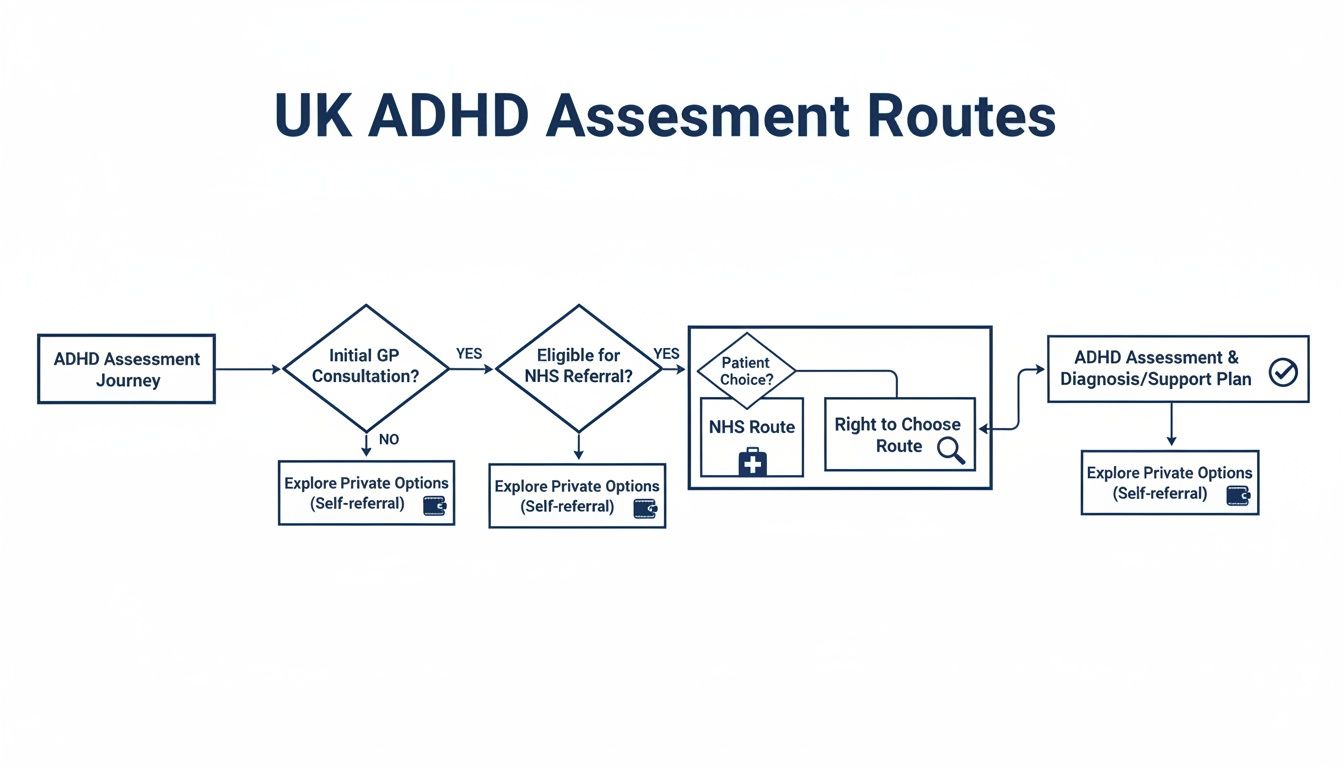
As you can see, the path you pick at the start – NHS, Right to Choose, or private – sets the stage for everything that follows, from how you get a referral to how long you'll be waiting.
Unfortunately, the standard NHS route is known for major delays. Trying to get tested for ADHD through the NHS often means joining an incredibly long waiting list; some adults wait years for an initial appointment. An analysis of 9 million GP records found that only 0.32% of patients had a recorded ADHD diagnosis. This suggests as few as one in nine people who likely have the condition ever actually get a formal diagnosis. You can dig into this more by reading the Priory Group's research on the ADHD diagnosis gap.
Just acknowledging that you might need support is the hardest part. The admin that follows is just a process. You’ve already cleared the biggest hurdle by deciding to seek clarity.
Choosing your path means weighing everything up. The NHS is free, but slow. Private is fast, but it costs a lot. Right to Choose offers a middle ground – faster, NHS-funded care with a private provider – but it’s a scheme that's only available in England. Let's break down each of these options so you can figure out what feels right for you.
UK ADHD Assessment Pathways at a Glance
To help you see the key differences immediately, here’s a quick comparison of the options available for an ADHD test in the UK.
| Pathway | Typical Wait Time | Initial Cost | First Step |
|---|---|---|---|
| Standard NHS | 1-5 years (can vary) | Free | Book a GP appointment for a referral |
| NHS Right to Choose | 6-12 months (approx.) | Free | Choose a provider and ask your GP to refer you |
| Fully Private | 2-8 weeks (usually) | £700 - £2,000 | Contact a private clinic directly to book |
This table gives you a snapshot, but remember that wait times and costs can change. It's always best to check directly with your local NHS service or the private clinics you're considering.
Getting Your Diagnosis Through the NHS
For most of us in the UK, the first step on the road to an ADHD assessment is a chat with the GP. This is your official gateway to the NHS pathway, and going in prepared can make a huge difference. Think of it less as an appointment and more as a crucial conversation. Your GP needs to understand what you're going through to make that all-important referral.
This isn't just about reeling off a list of symptoms you found online. It’s about sharing your story—how these struggles have followed you through life, affecting your work, your studies, and even your relationships. The goal is to connect the dots for your doctor, showing them the real-world impact of your experiences.

Preparing for Your GP Appointment
Walking into that room with a clear plan is the best way to feel confident and make sure you don’t forget anything important. My advice? Don't rely on memory. Bring notes.
Try to jot down specific examples. Instead of saying "I'm disorganised," talk about the time you missed a vital work deadline or how you're constantly hit with late fees on bills, even when you have the money.
It can help to break your notes down into different parts of your life:
- Work & Study: Think about feedback you've had. Have managers mentioned carelessness? Do you drift off in meetings? Have you always struggled with deadlines?
- Home & Daily Life: What about the day-to-day grind? Mention the struggle with household chores, managing money, or just the overwhelming feeling of "life admin." Forgetting appointments is a classic one.
- Relationships: Be honest about how things like impulsivity or emotional outbursts might have caused problems with partners, family, or friends.
The aim here is to paint a picture of a consistent, lifelong pattern. Real-life examples showing how these challenges affect your ability to function are far more convincing than just listing traits.
When your GP sees this isn't a new problem but a long-term struggle, they're much more likely to recognise the need for a referral.
What to Expect During the Consultation
Your GP will listen to your story and ask questions, probably digging into your childhood, school reports, and what's happening for you right now. They might use a short screening tool, but this isn't the full diagnosis. Their job is simply to decide if your symptoms are serious enough to refer you to a specialist.
If they agree an assessment is the right next step, you'll be referred to your local NHS adult ADHD service. And this is where you need to be patient. You'll go on a waiting list, and unfortunately, in many parts of the UK, that wait can be several years.
It’s good to know you have other options. For example, it's worth learning about how the NHS Right to Choose pathway could let you get an NHS-funded assessment with a private clinic, often much, much faster.
Standing Up for Yourself
Sadly, not all GPs are fully up to speed on adult ADHD, especially how it can look different in women or in high-functioning adults who've built coping strategies over the years. If you feel like you're not being taken seriously, it's so important to advocate for yourself.
If you meet a brick wall, don't give up.
- Ask for their reasoning. A simple, polite "Could you help me understand why you don't think a referral is right for me?" can open up the conversation and help you address their specific concerns.
- Bring out your notes. Calmly go through the examples you prepared. Show them, don't just tell them, how much this is impacting your life.
- Ask for a second opinion. You have every right to book an appointment with a different GP in the practice. Sometimes a fresh pair of ears is all it takes.
This first step can feel daunting, but you are the expert on your own life. By being prepared, clear, and persistent, you give yourself the best possible chance of getting the referral you need.
Private Assessments and Right to Choose: Your Other Options
Let's be honest, the prospect of waiting years for an NHS assessment can feel incredibly disheartening. If you’re at the end of your tether and need answers sooner, you really have two main avenues to explore in England: going fully private or using the NHS Right to Choose (RTC) scheme.
Both can slash your waiting time from years down to months, but they are worlds apart when it comes to the process, the cost, and what happens after you get a diagnosis. Getting your head around the differences is the first step to figuring out which path is right for you.
What Is the NHS Right to Choose Pathway?
Right to Choose is a bit of a game-changer for people in England, but it's still surprisingly little-known. It’s your legal right to choose where you receive specialist NHS care, and that includes adult ADHD assessments.
So, what does that actually mean? It means you aren't stuck with your local NHS mental health service. You can ask your GP to refer you to a private clinic that holds an NHS contract—popular examples include Psychiatry-UK and ADHD 360. The crucial part is that the entire process, from your first appointment through to starting treatment, is paid for by the NHS. You don't pay a penny.
Right to Choose is the perfect middle ground. You get the speed and convenience of a private service but without the hefty price tag, as it's all funded by the NHS.
There are a few boxes you need to tick to be eligible:
- You must be registered with a GP in England.
- Your GP has to agree that a referral for an ADHD assessment is appropriate.
- The provider you choose must have a contract to provide this service with any NHS integrated care board (ICB) in England.
The process usually involves you doing a bit of legwork—choosing an RTC provider, filling out their referral paperwork, and then taking it to your GP to get the official referral sent off. While the wait is still longer than going fully private, you're usually looking at months, not years.
The Fully Private Assessment Route
If speed is your absolute top priority, then going fully private is the fastest way to get an answer. This route lets you sidestep the entire NHS system. There's no need for a GP referral; you just find a clinic you like, book yourself in, and pay for their services directly.
The big win here is how quickly things move—you can often be seen within a matter of weeks. The major trade-off, of course, is the cost. It’s not just a one-off fee for the assessment; you're looking at a significant financial commitment that covers follow-up appointments and private prescriptions. For a detailed look at the costs, our guide on a private ADHD diagnosis in the UK breaks it all down.
Comparing Private vs NHS Right to Choose
To help you weigh it all up, here’s a side-by-side look at the fully private and Right to Choose routes. This table cuts through the noise and lays out the key differences in cost, speed, and process, giving you a clearer picture of which accelerated pathway might be the best fit.
| Feature | Fully Private Assessment | NHS Right to Choose |
|---|---|---|
| Initial Assessment Cost | £700 - £2,000+ | Free (NHS-funded) |
| Wait Time for Assessment | 2-8 weeks (approximate) | 6-12 months (approximate) |
| GP Referral Required? | No, you can self-refer | Yes, this is essential |
| Medication Titration Cost | Paid privately (£150 - £400+ per month) | Free (NHS-funded) |
| Ongoing Prescription Cost | Paid privately until Shared Care is agreed | Standard NHS prescription charge |
| Eligibility | Anyone who can pay | Must be registered with a GP in England |
As you can see, the money is the biggest sticking point. The speed of a private assessment is undeniably tempting, but the ongoing costs for medication titration and private prescriptions can easily run into thousands of pounds in the first year alone. Right to Choose takes that financial weight off your shoulders but asks for a bit more patience in return. Ultimately, it’s a personal decision that comes down to balancing how urgently you need support against what you can realistically afford.
Ready to compare clinics?
Answer a few questions and we’ll shortlist private ADHD clinics that fit — free to use, and independent.
Getting Ready for Your Assessment
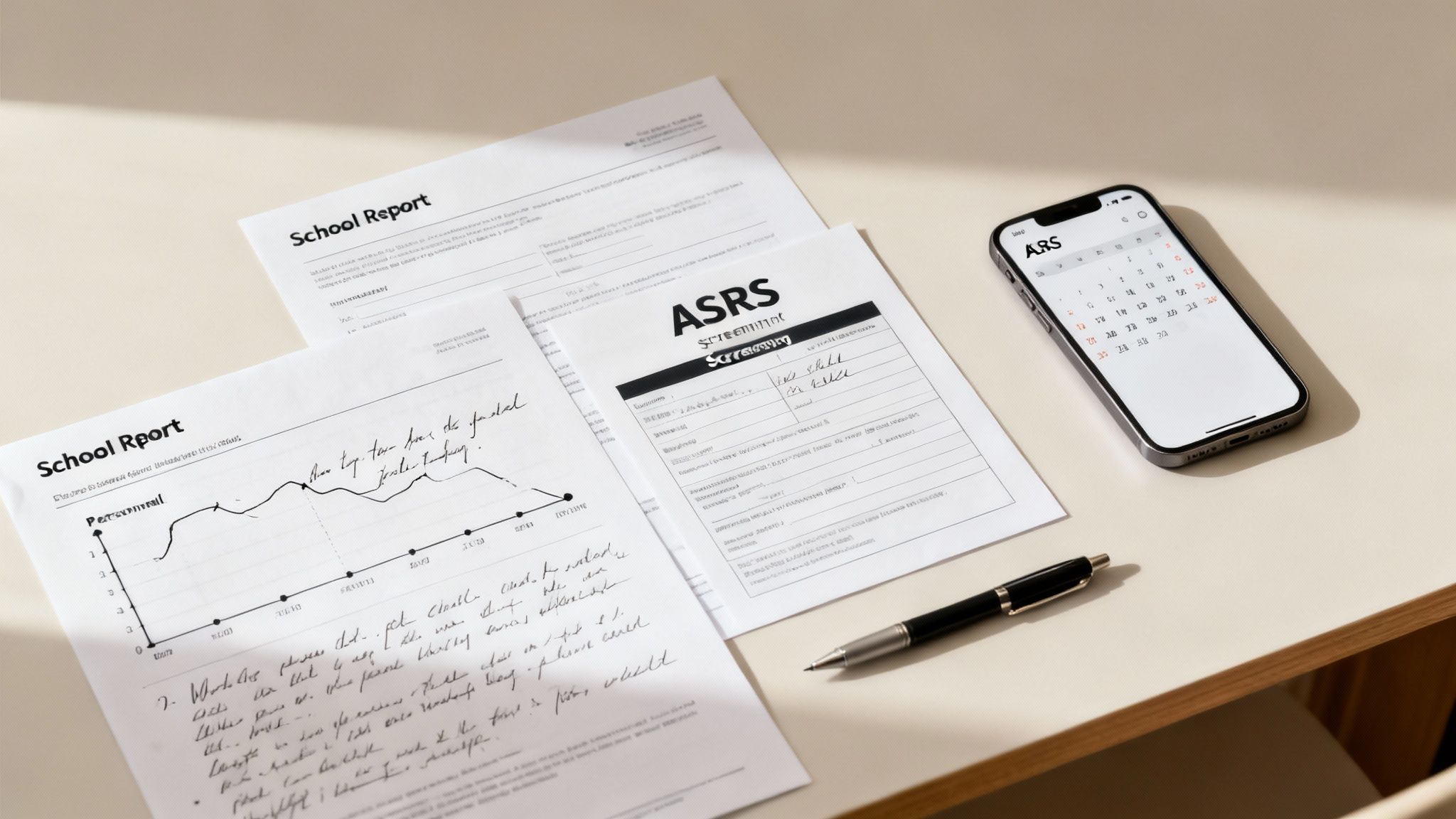
Whether you’ve been on an NHS waiting list for months or have a private assessment just around the corner, a little prep work can make a huge difference on the day. An ADHD diagnosis is built on a lifetime of evidence, so pulling your thoughts and documents together beforehand helps the clinician get a complete, accurate picture of your life.
This isn't about 'passing a test'. It's about giving the specialist the best possible information so they can give you the right answers. A bit of preparation can also help settle your nerves and make sure you don't walk away thinking, "Oh, I wish I'd remembered to mention that!"
Digging Up Your History
Think of yourself as a detective, building a case file on your own life. Because ADHD is a neurodevelopmental condition, the specialist needs to see that your traits and challenges have been around since you were a child.
Your goal is to find proof that these difficulties aren't new, but part of a lifelong pattern. Here’s what you should start looking for:
- Old School Reports: These are absolute gold. Teacher comments like "doesn't live up to their potential," "daydreams," "easily distracted," or "disrupts the class" are classic signs.
- Input from Others: Ask a parent, an older sibling, or a long-term partner for their memories. It’s amazing what others notice about us that we don’t. The clinic might even ask you to bring someone along or get them to fill out a questionnaire.
- Work Performance Reviews: Do you see the same feedback coming up time and again? Look for recurring themes like struggling with time management, missing deadlines, or making careless errors.
This kind of evidence helps the clinician connect the dots between the kid who struggled in school and the adult facing challenges today.
Don't panic if you can't find everything. Many of us don't have school reports from 20 years ago! Your own memories and the examples you can share are the most powerful evidence you have.
Tackling the Pre-Assessment Forms
Most clinics will send you some questionnaires to fill out before your appointment. Don’t just rush through them – they are vital diagnostic tools. The one you’ll almost certainly see is the Adult ADHD Self-Report Scale (ASRS).
This form asks you to rate how often you’ve experienced specific symptoms over the past six months. It’s designed to screen for common ADHD behaviours, like being unable to finish projects or feeling constantly fidgety.
My best advice? Be brutally honest. Don't answer based on your "good days" when you’re on top of everything. Think about what an average or bad day looks like, as this gives a much more realistic picture. Try to recall specific situations where a symptom caused a problem at work or home.
Thinking About the Clinical Interview
The main part of your assessment will be a long, detailed chat with a psychiatrist or specialist nurse. This is your chance to tell your story. While the clinician will lead the conversation, having your key points organised in your mind is a game-changer.
They'll ask about all sorts of things to get a holistic view of your life. Be ready to talk about:
- Your Childhood: What were you like at school? Did you get into trouble? Did you find it hard to make friends?
- Your Career: Do you tend to jump from job to job? Have you struggled to get promotions or had issues with colleagues?
- Daily Life: How do you cope with boring stuff like paying bills, doing housework, or remembering appointments?
- Relationships: How have your traits impacted your friendships, family life, and romantic partnerships?
- Emotions: Do you experience big mood swings or have a quick temper?
The point of these questions is to see how your symptoms show up in different parts of your life and to rule out other conditions that can look like ADHD, such as anxiety or depression. The more specific, real-life examples you can give, the clearer the picture becomes.
Understanding Your Diagnosis and What Comes Next
Getting the results of your assessment is a huge moment. Whether it confirms ADHD or points to something else, it finally brings an end to the uncertainty. This is the start of a new, much clearer chapter.
For many, a diagnosis brings a real mix of feelings. There's often relief and validation, but sometimes also a bit of sadness for all the years you struggled without knowing why. It’s a lot to take in, but your clinician is there to walk you through what happens next so you don't feel overwhelmed.
Deciphering Your Diagnostic Report
No matter the outcome, you’ll be given a comprehensive diagnostic report. Think of this as more than just a letter; it's a detailed medical document that pulls together everything from your assessment. It’s absolutely vital for your future care, especially if you plan to set up a Shared Care Agreement with your GP.
So, what’s actually in it? Your report will typically break down:
- Your Personal History: A summary of your developmental, medical, and mental health background, based on everything you discussed.
- Symptom Analysis: A detailed look at how your experiences line up with the official diagnostic criteria for ADHD (usually the DSM-5).
- Assessment Tools: The results from any questionnaires you filled out, like the ASRS or DIVA-5.
- The Final Diagnosis: A clear, professional conclusion confirming or ruling out ADHD.
- Treatment Recommendations: A personalised plan with suggested next steps, which could include medication, therapy, or ADHD coaching.
This report is your official proof. Keep it somewhere safe. You'll need it for everything from talking about treatment with your GP to applying for adjustments at work or university.
If You Are Diagnosed with ADHD
An ADHD diagnosis unlocks a whole new set of tools and support. The main goal is to find a blend of strategies that helps you manage your symptoms and, ultimately, make life feel a bit easier. It’s definitely not a one-size-fits-all approach.
Your specialist will likely talk you through two main routes for treatment:
- Medication: This is often the most effective first step for many adults. The process starts with something called titration, where you work closely with your prescribing clinician to find the right medication and dosage for you. You'll start on a low dose and gently increase it over several weeks, checking in regularly to see what’s working and what’s not. It’s a careful process of fine-tuning.
- Therapy and Coaching: Medication is brilliant for managing the core symptoms, but it doesn't teach you new skills. This is where other support comes in. Therapies like Cognitive Behavioural Therapy (CBT) can give you practical tools to tackle things like procrastination and emotional regulation. ADHD coaching is more goal-focused, helping you build solid habits and routines.
A diagnosis isn't the finish line; it's the starting line. It gives you the "why" behind your struggles and provides a clear map for finding the right support.
For most people, the best results come from a combination of medication to help with focus and therapy to build lasting coping strategies. You can find out more in our detailed guide on support for adults with ADHD.
The Shared Care Agreement Explained
If you've gone private, the cost of ongoing private prescriptions can be a real concern. This is exactly where a Shared Care Agreement (SCA) comes in. An SCA is simply a formal arrangement between your private specialist and your NHS GP.
Here’s how it works: once titration is complete and you’re on a stable, effective dose of medication, your specialist can propose an SCA to your GP. If your GP agrees, they take over writing your prescriptions on the NHS. This brings the cost down to the standard NHS prescription charge, making long-term treatment much more affordable. Most GPs are happy to do this, as long as the clinic that diagnosed you is reputable and followed all the official NICE guidelines.
What if You Don't Get a Diagnosis?
It can feel crushing to go through the whole assessment process only to be told you don't have ADHD. It's natural to feel invalidated or like you're back at square one, but try not to see it as a dead end.
Your struggles are real, even if they aren’t caused by ADHD. A good diagnostic report won't just say "no"; it will offer other possible explanations or suggest what to look into next. Your symptoms might be better explained by another condition, such as:
- Anxiety or depression
- Complex PTSD (C-PTSD)
- Autism Spectrum Condition (ASC)
- A specific learning difficulty
What the assessment has done is rule one possibility out, which helps you and your GP focus on finding the right answer. Your report is the key to that next conversation and getting you on the right path to support, whatever that may look like.
Your Top Questions About Getting an ADHD Test Answered
Once you’ve got your head around the main routes to an assessment—NHS, Right to Choose, and private—the practical questions usually start bubbling up. It's a journey filled with unknowns, so let's clear up some of the most common queries I hear.
Getting straight answers on things like cost, online options, and what to do if you hit a roadblock with your GP can make all the difference. It helps you feel more in control and allows you to make decisions that are right for you.
Can I Get an ADHD Test Online in the UK?
Yes, absolutely. Getting an ADHD assessment online has become a completely normal and convenient way to see a specialist in the UK. Many of the most respected private clinics now offer assessments entirely over secure video calls.
This has been a game-changer, especially for people who don't live near a big city or find in-person appointments difficult. Clinics like Psychiatry-UK and ADHD 360 are well-established names that primarily use this model. As long as the clinic is regulated by the Care Quality Commission (CQC) and its team follows official NICE guidelines, an online diagnosis is every bit as valid as one you'd get face-to-face.
What Is the Typical Cost of a Private ADHD Assessment?
This is the big one, and it's not just a single figure. The initial private ADHD assessment itself will likely set you back somewhere between £600 and £1,500. This fee usually covers the main diagnostic interview with a specialist and the formal report you get at the end.
But that’s rarely the final cost. If you're diagnosed and decide to try medication, there are other expenses to plan for:
- Titration Fees: This is the crucial stage where you work with the clinic to find the right medication and dosage. It involves follow-up appointments and can add several hundred pounds to your bill over a few months.
- Private Prescriptions: Until you can get a Shared Care Agreement in place with your NHS GP, you'll have to pay the full private cost for your medication.
All in, the total cost for diagnosis and getting stable on treatment can easily climb over £2,000. It’s so important to go in with your eyes open and budget for more than just the headline assessment price.
What Should I Do if My GP Will Not Refer Me?
It’s a scenario that’s both gut-wrenching and incredibly common. You’ve finally worked up the courage to talk to your GP, only for them to dismiss your concerns. If this happens, please don't give up.
Your first move should be to book another appointment, maybe with a different doctor at the same surgery. This time, go in even more prepared. Bring your detailed notes, the completed ASRS self-screener, and have a few real-life examples ready that show how these symptoms have affected you long-term.
If you’re trying to use Right to Choose, bring the clinic's official letter templates with you. These letters are designed to explain the GP’s legal obligations clearly and professionally.
Remember, you are always entitled to a second opinion. Sometimes, a different GP will have more up-to-date knowledge of adult ADHD. Your persistence is your best tool for getting the support you need.
How Can I Find a Reputable Private ADHD Clinic?
Choosing the right clinic is vital. A trustworthy provider not only gives you a reliable diagnosis but also makes it much more likely that your GP will agree to a Shared Care Agreement for your medication down the line.
Here are a few non-negotiables to check before you commit:
- Make sure the clinic is registered with the Care Quality Commission (CQC). This is the independent body that regulates all health services in England.
- Check that their specialists are properly accredited—psychiatrists should be on the General Medical Council (GMC) register, and specialist nurses on the Nursing and Midwifery Council (NMC) register.
- Look for genuine, recent patient reviews on independent sites like Trustpilot. This gives you a real feel for what the experience is like, from the assessment itself to the aftercare.
Finding the right clinic can feel like a job in itself. At ADHD Private, we've created a free directory to make it simpler. Compare over 85 CQC-registered clinics, check transparent pricing and wait times, and find a provider that fits your needs. Start your search with confidence by visiting https://adhdprivate.co.uk.