Your Guide to Support for Adults with ADHD in the UK
Discover the full range of support for adults with ADHD in the UK. This guide covers NHS vs private diagnosis, treatment options, and workplace adjustments.
Written and maintained by the ADHD Private editorial team, drawing on NHS, NICE and ADHD UK guidance. This is general information, not medical advice.
If you’re an adult in the UK and think you might have ADHD, trying to get help can feel like you’ve been dropped into a maze with no map. It’s confusing, frustrating, and honestly, a bit isolating. But you’re definitely not alone in feeling this way. The system is creaking under the weight of a huge, unrecognised need for support for adults with adhd. Think of this guide as your map—a way to make sense of the journey ahead.
Why Finding Adult ADHD Support Feels So Overwhelming
Picture this: you need to see a specialist in a massive hospital, but none of the signs make sense. Every corridor looks identical, the waiting rooms are packed, and the staff are too swamped to point you in the right direction. That’s a pretty good analogy for what seeking an ADHD diagnosis can feel like for many adults in the UK.
At its heart, the problem is a massive gap between the number of people who need support and the resources actually available to help them. This isn't just a feeling; the numbers are pretty stark. In England alone, it’s estimated that 1.6 million adults over 25 are living with ADHD, but our healthcare system just hasn't caught up.
In fact, a deep dive into GP records shows that a shocking 89% of adult ADHD cases might be completely undiagnosed. Let that sink in. For every ten adults out there grappling with the daily challenges of ADHD, nine haven't been given a diagnosis or the support that should follow. You can learn more about these ADHD statistics from the Priory Group.
This gap creates real barriers. It’s not uncommon to spend months, sometimes years, stuck on an NHS waiting list, only to discover that the services in your local area are pretty limited anyway. The whole experience can take a serious emotional toll, leaving you feeling unheard and alone while trying to juggle life, work, and relationships without the right support.
"So many adults struggle in silence, never connecting the dots between their daily frustrations and ADHD. Getting a diagnosis is often a huge relief—it’s the moment you realise there’s a genuine reason for the challenges you face, and that help is out there."
The Main Pathways to Getting Help
The good news is, you do have options. Just knowing what they are is the first, most powerful step you can take. In the UK, there are three main routes to getting an assessment and the support that comes after:
- The NHS Pathway: This is the standard, publicly funded route. It all starts with a chat with your GP.
- The Private Pathway: A self-funded option that can get you in front of a specialist much, much faster.
- Right to Choose (in England): This is a bit of a hybrid. It lets you choose an approved private provider for your assessment, but the NHS foots the bill, often cutting down your wait time.
Each of these paths has its own process, costs, and timeline. In this guide, we’ll break down exactly what’s involved with each one, turning that overwhelming maze into a clear, manageable journey to getting the support you deserve.
Choosing Your Path to an ADHD Diagnosis
Figuring out how to get an ADHD diagnosis is the first real step towards getting the right support. In the UK, you're looking at three main routes, and each one has its own set of pros and cons when it comes to time, cost, and the overall process. It can feel a bit overwhelming at first, but let's break them down so you can see which one makes the most sense for you.
Your main choices are the standard NHS route, going private, or using the 'Right to Choose' system if you're in England. Think of them as different tools for the same job – the best one really depends on your personal situation, like how urgently you need help and what your budget looks like.
This flowchart gives you a great visual overview of how the NHS, Right to Choose, and Private pathways compare.
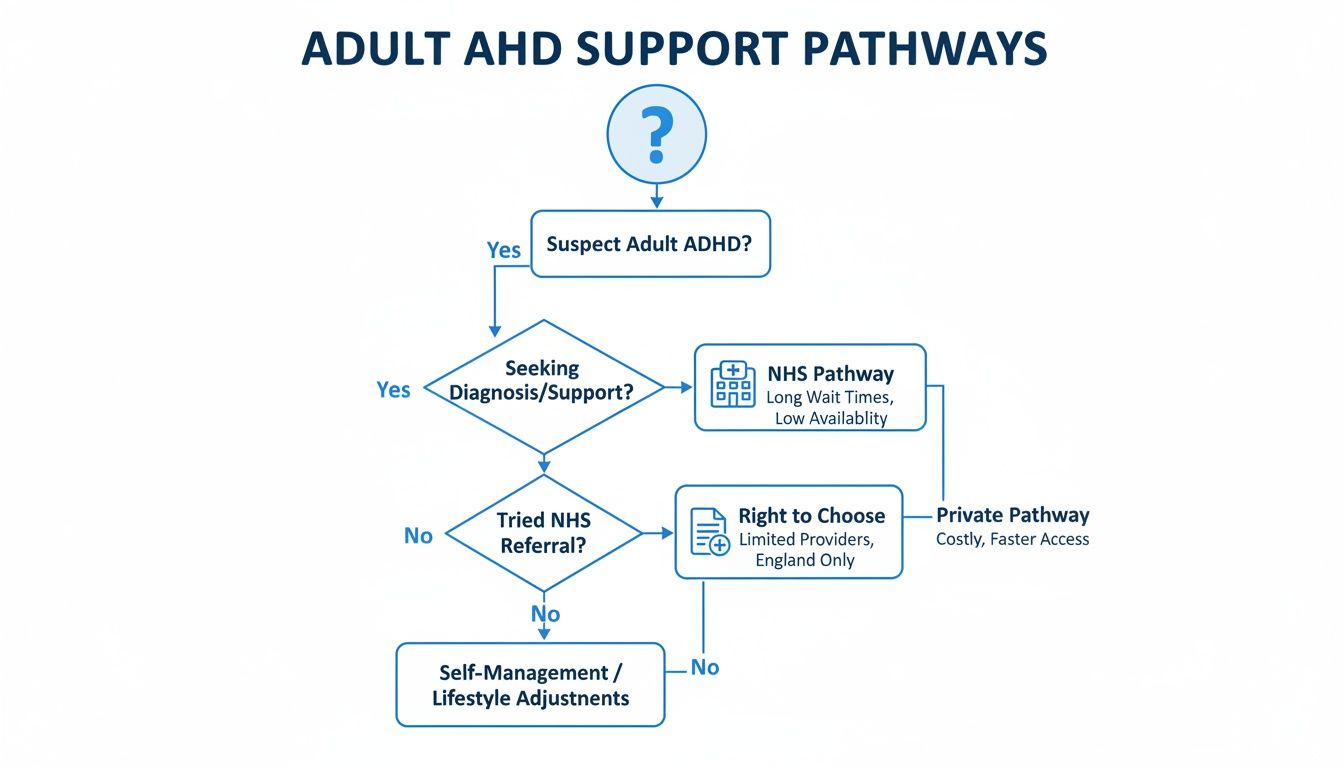
As you can see, the path you take has a direct impact on things like waiting times and cost, which are often the biggest factors in making a decision.
The Standard NHS Pathway
The traditional starting point is a chat with your GP. You'll talk through your symptoms, and if they agree that an assessment is needed, they'll refer you to your local NHS mental health service. While this route is completely free, its major downside is the time it takes.
Frankly, the waiting lists for an NHS ADHD assessment can be incredibly long. In some areas, people wait for years. For anyone who's really struggling and needs help now, that kind of delay can feel impossible.
The Private Pathway
If you're in a position to pay for your assessment, going private is a much, much faster option. You can usually contact a private clinic directly without even needing a GP referral, which puts you firmly in the driver's seat. The speed and control you get are the biggest draws here.
Of course, the assessment, any medication titration, and follow-up appointments all have a cost. But in exchange, you could have a diagnosis in a matter of weeks or months, not years. Taking the step to get a full ADHD assessment for adults privately can be a powerful way to get the answers you need, quickly.
Choosing a private assessment is really about prioritising speed and getting access to specialist care. For someone whose symptoms are making daily life a real challenge, it can be absolutely life-changing.
The Right to Choose System
'Right to Choose' is a brilliant bit of legislation in England that offers a kind of middle ground. It gives you the legal right to ask your GP to refer you to a private provider that also has a contract with the NHS. Essentially, you get the speed of a private service, but the NHS foots the bill.
This can dramatically cut your waiting time compared to the standard NHS route, although it might not be quite as quick as going fully private from the get-go. If you live in England and want faster access without the financial headache, it’s an excellent option to explore.
To give you a clearer picture, I've put together a table comparing the three pathways side-by-side.
Comparing ADHD Diagnosis Pathways in the UK
| Feature | NHS Pathway | Private Pathway | Right to Choose |
|---|---|---|---|
| Cost | Free (funded by NHS) | Self-funded (£600-£1500+) | Free (funded by NHS) |
| Wait Time | Very long (often 1-5 years) | Very short (weeks to months) | Shorter than NHS (months) |
| Referral | Requires GP referral | Self-referral is common | Requires GP referral |
| Choice | Limited to local services | Wide choice of clinics | Choice of approved providers |
Looking at the options this way helps highlight the trade-offs. Your decision will likely come down to balancing cost against how quickly you need support.
Exploring Your Treatment and Therapy Options
Getting a diagnosis is a huge milestone, but it’s really the starting line, not the finish. It’s the key that unlocks a whole range of support designed to help you not just manage your ADHD, but truly thrive. The best approach usually involves a mix of medical treatments and powerful therapeutic strategies.
It's worth knowing that getting access to this support isn't always straightforward. Recent data from the Schoen Clinic has shown a big gap in care. While prescriptions for ADHD medication have doubled in England over six years, this surge still only covers a tiny fraction of the adults who likely need help.
This just goes to show how vital it is to understand all the options out there, so you can piece together a support plan that’s right for you.
Understanding ADHD Medication
For many people, medication is a cornerstone of managing their ADHD. Think of it as helping to balance the chemical messengers (neurotransmitters) in your brain. When they're in better balance, it can make a world of difference to your focus, impulsivity, and that constant feeling of inner restlessness.
ADHD medications generally fall into two main camps:
- Stimulants: These are the most common type, including names like methylphenidate and lisdexamfetamine. They tend to work quite quickly, boosting levels of dopamine and norepinephrine in the brain.
- Non-Stimulants: For people who don't get on with stimulants, medications like atomoxetine can be a great alternative. They take a bit longer to start working but can offer smoother, round-the-clock symptom relief.
Finding the right medication and dose isn't a quick fix; it's a careful process called titration. Your clinician will work with you to gradually adjust the dosage, aiming for that sweet spot where you get the most benefit with the fewest side effects. It’s a completely personal journey.
Once you’re settled on the right medication, your private clinician will usually arrange a Shared Care Agreement with your GP. This is a crucial step that allows your GP to issue your repeat prescriptions, which makes long-term management much easier and more affordable.
Therapies That Build Real-World Skills
If medication helps to clear the mental fog, then therapy gives you the map and the driving lessons. It's where you learn the practical skills to handle the day-to-day challenges of life with ADHD. These talking therapies teach you how to work with your brain, not against it.
A few types of therapy are known to be particularly helpful:
- ADHD-Focused Cognitive Behavioural Therapy (CBT): This isn't your standard CBT. It’s specifically adapted to target the classic ADHD struggles like procrastination, poor time management, and overwhelming emotions. You learn to spot and change unhelpful thought patterns and build practical coping strategies.
- Psychoeducation: This is all about knowledge. Simply understanding the science behind your ADHD can be incredibly validating. It helps you make sense of past difficulties, let go of the shame and self-blame, and finally understand the "why" behind your experiences.
- ADHD Coaching: A coach is like a personal strategist and accountability partner rolled into one. They help you take big, overwhelming goals and break them down into small, achievable steps, helping you build routines and organisational systems that actually stick.
For many, the magic happens when medication and therapy are combined. The medication addresses the core biological symptoms, while therapy provides the lasting skills you need to navigate life successfully. If you're also interested in other approaches, you can find more on ADHD treatments without medication and other valuable strategies.
Ready to compare clinics?
Answer a few questions and we’ll shortlist private ADHD clinics that fit — free to use, and independent.
Getting ADHD Support in the Workplace
Your career is a huge part of your life, and an ADHD diagnosis should never feel like a barrier to success. If anything, understanding how your brain is wired is the first step towards finding a way of working that truly plays to your strengths. A big piece of that puzzle is getting the right kind of support for adults with adhd at work.
Under UK law, ADHD can be classed as a disability. This means you have a legal right to 'reasonable adjustments' in your workplace. It’s not about getting special treatment; it’s about making small, practical changes that allow you to do your job just as well as anyone else.
How to Ask for Reasonable Adjustments
I get it – the idea of talking to your boss about your ADHD can feel incredibly nerve-wracking. The trick is to keep the conversation focused on solutions, not problems. You don't have to disclose every detail of your diagnosis. Instead, frame your requests around what will help you be more focused and productive.
For instance, you could say something like, "To help me stay on top of my projects and deadlines, I'd find it really helpful to use a dedicated task management app. I also concentrate much better without background noise – would it be okay for me to wear noise-cancelling headphones?"
Here are a few common and effective adjustments that can make a world of difference:
- Noise-cancelling headphones to block out distractions in a busy office.
- Flexible start and finish times so you can align your work with your most productive hours.
- Getting instructions in writing rather than just verbally to help with memory and clarity.
- Access to task-management software to help you organise and prioritise your workload.
- Regular, structured check-ins with your manager to keep everything on track.
The key is to present these adjustments as tools that will boost your performance. When you frame it as a win-win for both you and the company, most employers are happy to help.
Discovering the Access to Work Scheme
Beyond asking your employer directly, there’s a fantastic government resource that many people don't know about: the Access to Work scheme. This is a grant that can pay for practical support if your ADHD affects you on the job.
It’s not a benefit you get paid directly. Instead, the grant covers the cost of things like specialised equipment, software, or even sessions with an ADHD coach to build effective workplace strategies. It's designed to fund support that goes above and beyond what an employer would normally be expected to provide as a reasonable adjustment.
To be eligible, you need to be over 16, in a paid job (or about to start one), and have a condition like ADHD that impacts your work. You apply for it yourself, not your employer, which keeps you in the driver's seat. For many, Access to Work is a total game-changer, providing personalised resources that help you not just cope, but truly thrive.
Finding Community and Lifestyle Support
While formal treatments and workplace adjustments are fantastic building blocks, they are only part of the puzzle. Living with ADHD day-to-day is a deeply personal experience, and connecting with people who just get it can be more powerful than you might imagine. It offers a kind of validation and understanding that a clinical setting can't always replicate, and it's a huge part of long-term support for adults with adhd.

This is where finding your people really makes a difference. It can take ADHD from being a lonely, internal battle to a shared, manageable experience. Suddenly, you realise you’re not the only person on the planet who has lost their keys three times today or felt completely paralysed by a simple to-do list.
The Power of Peer and Community Groups
Across the UK, ADHD charities and local support groups are an absolute lifeline for many. They provide a safe space to vent about your frustrations, celebrate the small wins that others might not understand, and exchange practical tips without any fear of being judged. When you finally find your "tribe," it can dismantle the profound sense of isolation that so many adults with undiagnosed ADHD have shouldered for decades.
These communities pop up in all sorts of places:
- Online Forums: Perfect for getting anonymous advice or having a late-night chat when your brain won't switch off.
- Local Meet-ups: Casual, in-person gatherings that help you build real-life connections.
- Social Media Groups: Bustling online communities for daily doses of encouragement and links to useful resources.
"Connecting with other ADHD adults was like seeing my life reflected back at me for the first time. It wasn't just helpful; it was healing. I realised I wasn't broken, just different."
Lifestyle Strategies That Complement Treatment
Beyond community support, tweaking your daily habits can work wonders alongside your formal treatment plan. Don't think of these as a cure, but as practical tools that help your brain operate at its best. You'd be surprised how much of a difference a few small, consistent changes can make.
Here are a few key areas to think about:
- Executive Function Hacks: Get friendly with visual timers, learn to break huge tasks into tiny, manageable steps (the Pomodoro technique is great for this), and get everything out of your head with sticky notes, apps, or whiteboards.
- Nutrition and Exercise: We all know it’s good for us, but for an ADHD brain, regular physical activity is a non-negotiable. It's proven to boost dopamine and sharpen focus. A balanced diet can also go a long way in stabilising your mood and energy levels.
- Sleep Hygiene: This one is crucial. A bad night's sleep can make ADHD symptoms like inattention and emotional dysregulation go from bad to worse. Making a consistent sleep schedule a priority is one of the kindest things you can do for yourself.
Building these habits and finding a supportive community aren't just 'nice-to-haves'; they are essential for a holistic approach to not just coping, but thriving with ADHD. To dive deeper into these skills, check out our detailed guide to living with ADHD and discover more strategies that actually work.
Getting to Grips with Private ADHD Clinics
Deciding to go down the private route for an ADHD assessment can feel like a big step. And once you've made that decision, you’re faced with another challenge: how on earth do you choose the right clinic? With a growing number of options out there, it’s easy to feel a bit lost.
The truth is, a good clinic offers far more than just a diagnosis. It should provide a clear, supportive path forward. That means you need to do a bit of detective work before you commit your time and money.
What Makes a Good Private Clinic?
To make sure you're in safe hands, you’ll want to vet any potential clinic thoroughly. A reputable service will be completely open about how they work, who they employ, and what you can expect.
Here are the absolute essentials to look for:
- CQC Registration: First things first, check if they are registered with the Care Quality Commission (CQC). This is the independent regulator for health and social care in England, and their seal of approval is a fundamental mark of quality and safety.
- A Clear Assessment Process: They should be able to walk you through their entire assessment protocol. Who will you be seeing? Is it a psychiatrist or a specialist nurse? What does the process actually involve? You should get clear answers to these questions.
- Medication Titration: If medication is part of your plan, finding the right type and dose isn’t a one-shot deal. It's a careful process called titration. Make sure the clinic provides this service to get your treatment just right.
- Shared Care Agreements: This is a big one. Ask if they will work with your GP to set up a Shared Care Agreement. This agreement is what allows your GP to take over prescribing your medication, making it much more affordable in the long run.
Getting these fundamentals right is crucial. It means your entire journey—from that initial assessment to managing your ADHD long-term—will be safe, effective, and properly recognised by the NHS and your GP.
Using a Directory to Cut Through the Noise
Let's be honest, nobody has the time or energy to trawl through dozens of clinic websites, comparing them one by one. It’s exhausting. This is where a well-curated directory can be a game-changer, pulling all that vital information into one easy-to-use place.
Take a look at how a directory makes comparing and choosing a clinic so much simpler.
As you can see, you can filter clinics and immediately see key details like starting costs, their location, and what services they offer, all at a glance.
Using a directory like this takes the guesswork out of the equation. You can quickly weigh up your options based on what’s most important to you—be it verified patient reviews, transparent pricing, or current waiting times. It gives you the power to find a trustworthy clinic that genuinely suits your needs and your budget.
Your Questions Answered: Navigating Adult ADHD Support
Getting your head around ADHD support can feel overwhelming, and it's natural to have a lot of questions. Let's tackle some of the most common ones that come up for adults starting this journey in the UK.
What’s the Cost of a Private ADHD Assessment?
When you go private, you can expect the cost of an ADHD assessment to be anywhere from £600 to over £1,500.
It’s a wide range, and that’s because clinics bundle their services differently. Some will quote you for the diagnostic session alone, while others might roll in the cost of follow-up appointments or the initial phase of getting your medication right (titration). It's crucial to get a clear breakdown of what's included before you commit.
Can My GP Say No to a Shared Care Agreement?
Yes, they can. Your GP isn't obligated to accept a Shared Care Agreement after you've been diagnosed privately.
This can be down to a few reasons – maybe their local NHS trust has tight policies, or perhaps they just don't have much experience prescribing ADHD medication. They might also have questions about the report from the private clinic. A good tip is to have a chat with your GP before you book a private assessment to see where they stand on the idea.
A good private clinic knows the ropes here. They’ll usually provide a really thorough report, specifically written to give your GP all the information and confidence they need to agree to shared care.
What Exactly Is 'Right to Choose' for ADHD?
Right to Choose is your legal right as a patient in England to choose where your first specialist mental health appointment takes place.
For ADHD, this is a game-changer. It means you can ask your GP to refer you to a specific provider – even a private one, as long as they hold an NHS contract. This can slash your waiting time dramatically compared to just going with your local service. The key thing to remember is that the referral still has to come from your GP, and your chosen provider must be fully compliant with NHS standards.
Finding the right path forward starts with having good information. At ADHD Private, our free UK directory is designed to help you compare clinics on the things that matter – price, waiting times, and what they offer. It’s all about helping you make a choice you feel good about. Start your search today at https://adhdprivate.co.uk.