Guide to Adult ADHD Diagnosis in London: Steps, Costs, Timelines
Explore adult ADHD diagnosis in London: NHS routes, private assessments, costs, waiting times, and starting your evaluation.
Written and maintained by the ADHD Private editorial team, drawing on NHS, NICE and ADHD UK guidance. This is general information, not medical advice.
If you think you might have ADHD and you’re looking for a diagnosis in London, you’ve got two main routes to consider: going through the NHS or paying for a private assessment.
It’s a straightforward choice on the surface. The NHS route won’t cost you anything, but the waiting lists are notoriously long. The private option is much quicker, but it comes with a hefty price tag.
Navigating Your ADHD Diagnosis in London
Having that "aha!" moment where you suspect you have adult ADHD can be a massive relief. Suddenly, lifelong challenges with focus, staying organised, or managing your emotions might start to make sense. But then comes the next thought: how do you actually get a diagnosis, especially in a city as busy as London?
It can feel like a maze, but there are clear paths you can take. Your biggest decision is choosing between the NHS and the private sector. This isn't just about money versus time; it's about figuring out what’s realistic for your situation right now.
NHS vs. Private Pathways
The starting line for an NHS diagnosis is always your GP. You’ll have a chat about your symptoms, and if they agree it sounds like ADHD, they'll refer you to a specialist adult ADHD service. The big catch? In London, you could be waiting for years just to get that initial assessment. For anyone struggling and needing help now, that's a massive hurdle.
This is where the private route comes in. It’s the fast track. You can often get an assessment within a few weeks, but you have to foot the bill yourself. A full diagnostic process can run into hundreds, sometimes thousands, of pounds. It’s a faster path, but one that isn't financially possible for everyone.
It's staggering to think about how many people are undiagnosed. Estimates suggest that while 2.5 million people in England have ADHD, a look at GP records revealed only 0.32% have an official diagnosis. Many experts believe this means as few as one in nine adults with ADHD in the UK are getting the help they need—a gap that feels even wider in a high-demand place like London. You can read more about these ADHD statistics and what they mean.
This chart breaks down the two main journeys for getting an adult ADHD diagnosis in London.
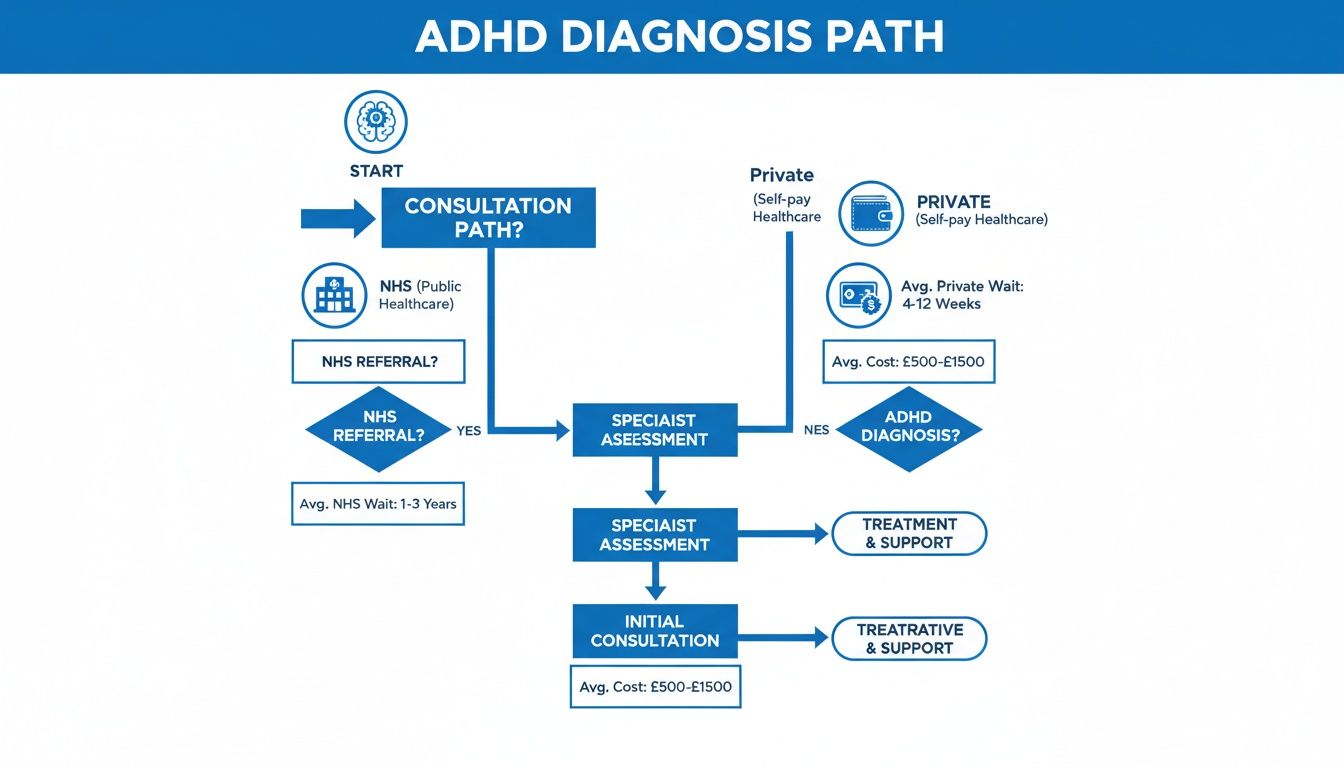
As you can see, it really boils down to a trade-off. The NHS is all about affordability, while the private sector is built for speed. Getting your head around this fundamental choice is the first real step in deciding which direction to go.
To make it even clearer, here’s a quick side-by-side look at the two pathways.
London ADHD Diagnosis Pathways at a Glance
| Feature | NHS Pathway | Private Pathway |
|---|---|---|
| Cost | Free at the point of service | £700 - £2,000+ for assessment & initial titration |
| Wait Time | 2-7+ years for assessment | 2-12 weeks for assessment |
| Starting Point | GP referral required | Self-referral is usually possible |
| Choice of Provider | Limited to your local NHS trust | You can choose any qualified clinician/clinic |
| Medication Costs | Standard NHS prescription charge | Full private cost until care is transferred to GP |
Ultimately, both paths lead to the same destination: a formal assessment by a qualified specialist. The best route for you depends entirely on how long you're able to wait and what you're able to afford.
How to Navigate the NHS Pathway in London
 If you’re seeking an adult ADHD diagnosis in London through the NHS, your journey starts with a single, vital step: booking a chat with your GP. This appointment is your gateway into the system. Think of it less as a test and more as a conversation. Your job is to paint a clear picture of why you think you have ADHD and, crucially, how it’s affecting your day-to-day life.
Going in prepared can make a world of difference. GPs are brilliant generalists, but adult ADHD isn't always their area of deep expertise. Showing up with some well-thought-out notes can be the difference between getting a referral and walking away feeling misunderstood.
Before you go, spend some time jotting down real-life examples of your struggles. Don't just say, "I'm disorganised." Try something more specific, like, "I've missed three major deadlines at work this past month because I can't seem to get my tasks in order, and I'm genuinely worried about my job." It’s this kind of concrete detail that gives your GP the evidence they need to move you to the next stage.
Preparing for Your GP Appointment
The aim here is to help your GP connect the dots between potential ADHD symptoms and their real-world impact. Structuring your thoughts beforehand is a game-changer.
List Your Symptoms: You can use an online ADHD screener (like the ASRS) to help you find the right words. Note down the symptoms that really hit home for you – things like a short-fuse, constant restlessness, or a brain that just won't switch off.
Find Real-Life Examples: For each symptom, think of a specific memory. From childhood, it might be "teachers always said I was a daydreamer," or "I was constantly losing my school jumper." For your adult life, it could be "I lose my keys and wallet almost daily," or "I keep making impulse buys online that I immediately regret."
Explain the Consequences: This is the most critical part. Link those examples to the problems they cause in your life – whether that’s in your career, your relationships, your finances, or just your general wellbeing.
If your GP agrees that your symptoms need a closer look, they'll refer you to a specialist adult ADHD service. In London, this usually means a referral to the mental health trust that covers your borough. And this, unfortunately, is where the waiting game begins.
Understanding the Referral and Long Waits
Once that referral is sent, you're officially on an NHS waiting list. The hard truth for anyone seeking an adult ADHD diagnosis in London is that these lists are incredibly long. It’s not unusual to hear of waits ranging from two to five years – and sometimes even longer, depending on your local NHS trust and the sheer volume of people seeking help.
This massive delay is a huge hurdle for people who are struggling and need support now. London's dense population and overstretched services mean it has some of the longest waiting times in the UK. While you're on that list, you often hear very little until an appointment is finally ready for you.
Waiting for years can be unbelievably frustrating. It's a long period of limbo where the very things you need help with—like managing your time and regulating your emotions—can make the wait itself feel even more impossible.
But there is another NHS-funded route, which lets you choose a different provider.
Using Right to Choose for an NHS-Funded Assessment
The NHS Right to Choose is a legal right for patients in England, giving you a say in where you get your specialist healthcare. For an ADHD assessment, this means you can ask your GP to refer you to a qualified provider outside your local area, as long as they have an NHS contract. Each provider sets its own waiting list, and waits vary by NHS area.
To be clear, this isn't private healthcare; the assessment and any treatment are still paid for by the NHS. A number of national online clinics partner with the NHS under Right to Choose, and each sets its own wait. You can find out more in our detailed guide on getting an NHS ADHD test.
To use this option, you just need to tell your GP that you want to exercise your Right to Choose and give them the name of your preferred clinic. Many of these providers even have template letters on their websites to make this as simple as possible for you and your doctor. For many Londoners, it's a route to an NHS-funded diagnosis from a provider outside their local service.
Going Private for an ADHD Assessment: What to Expect

For anyone struggling with the day-to-day realities of suspected ADHD, the thought of waiting years for an NHS appointment can feel unbearable. When work, relationships, and your general wellbeing are on the line, you need answers sooner rather than later. This is where a private adult ADHD diagnosis in London comes in as a realistic and often necessary alternative.
Going private is essentially a trade-off: you pay for speed and control. Instead of joining a lengthy regional queue, you can refer yourself directly to a specialist clinic and often get an appointment within weeks. That speed can be genuinely life-changing, opening the door to support and treatment that could otherwise be years away.
Of course, this speed and convenience come with a price tag. It’s vital to understand the full financial picture before you start, as the costs go beyond a single assessment fee. The journey is a multi-stage process, and you’ll need to budget for each step.
What Does a Private Diagnosis Actually Cost?
It’s best to view the costs in phases, as you’ll usually pay for each service as you need it. A good clinic will be completely transparent about their pricing, but here’s a general idea of what to expect.
We've put together a table to break down the typical price ranges for the different stages of the private ADHD diagnosis and treatment process.
Estimated Costs for Private ADHD Services in London
| Service | Typical Cost Range (£) |
|---|---|
| Initial ADHD Assessment | £700 – £1,200 |
| Medication Titration (per appointment) | £150 – £300 |
| Private Prescription Costs (per month) | £80 – £150 |
| Follow-up / Review Appointments | £150 – £350 |
As you can see, the expenses can mount up quickly. The titration phase, where specialists work with you to find the right medication and dosage, requires several follow-up appointments. And while you're in this phase, you’ll also be covering the full cost of the medication itself via private prescription.
A realistic budget to get from your initial assessment to a stable medication plan would be somewhere in the region of £1,500 to £2,500. It’s a significant investment, so it’s crucial to be prepared for the full journey.
Online vs. In-Person: Which Assessment is Right for You?
One of the most significant changes in healthcare recently has been the boom in online consultations, and this has opened up a world of choice for Londoners seeking a diagnosis.
An in-person assessment is the traditional route—you travel to a clinic for a face-to-face meeting. Some people simply prefer this approach; it can feel more tangible and personal. The main drawback is that it limits your options to clinics within a commutable distance.
Online assessments, held over a secure video call, are now far more common and offer some fantastic advantages:
- More Choice: You’re no longer restricted by geography. You can pick a highly-rated clinic anywhere in the UK, which might mean finding a specialist with a shorter waiting list.
- Total Convenience: No more navigating the tube or taking a whole day off work. You save time, money, and the stress of travel.
- Comfort and Familiarity: Many people find it easier to open up and discuss their experiences from the security and comfort of their own homes.
It’s really important to know that a diagnosis received online from a qualified, UK-based specialist is every bit as valid as one from an in-person appointment. The assessments all follow the same rigorous NICE guidelines to ensure they are clinically sound. For a deeper dive into this, our guide on getting a private ADHD assessment in the UK has more helpful information.
Ultimately, whether you choose to be seen online or in a clinic, the most critical factor is the provider's credibility. Always do your homework to ensure they are properly accredited and can work with your GP for any future shared-care arrangements.
Looking for a private ADHD assessment?
Answer a few questions and we’ll shortlist clinics that fit — comparing price and waiting time.
What Really Happens During an ADHD Assessment

The idea of an ADHD assessment can feel really nerve-wracking. A lot of people worry it's going to be like an exam they can somehow fail, but the reality is much more of a supportive conversation. Think of it as a guided chat where you and a specialist work together to piece together the full story of your life.
Whether you're speaking to someone online or visiting a clinic in London, the aim is always the same: to get a clear understanding of your personal challenges and strengths. The whole process is designed to be thorough, not terrifying, so that any diagnosis is both accurate and genuinely helpful.
This isn't about being judged. It's about gathering the right information to finally get some clarity. Knowing what’s coming can help turn that feeling of anxiety into one of empowerment.
The Core of the Assessment: The Clinical Interview
The heart of your adult ADHD diagnosis in London is a detailed clinical interview. This is essentially a structured conversation that usually lasts between one and two hours, led by a psychiatrist or a specialist psychologist. They’ll guide you through a wide range of questions about your life, covering both the past and the present.
The point of this chat is to see how potential ADHD symptoms have impacted different parts of your world. You should expect to talk about your experiences at school, at work, in your relationships, and even in your day-to-day routines at home. The more open and honest you can be, the clearer the picture will be for everyone.
To make sure nothing is missed, clinicians use formal diagnostic criteria to frame the discussion, most often from the DSM-5 (Diagnostic and Statistical Manual of Mental Disorders, 5th Edition). This framework ensures the assessment is comprehensive and meets recognised medical standards.
Looking Back: Why Your Childhood Matters
One of the key criteria for an ADHD diagnosis is showing that symptoms were around before you were 12 years old. That’s because ADHD is considered a neurodevelopmental condition, which means it starts in childhood, even if nobody realised it at the time.
Your clinician will ask you to think back to your younger years. They might ask things like:
- What were you like at primary school? Were you always told off for daydreaming or being disruptive?
- Did you constantly struggle with organisation, like losing your P.E. kit or forgetting homework?
- How did you get on with other kids? Did you find it impossible to wait your turn in games?
If you can dig out any old school reports, they can be incredibly useful. A teacher’s comment like "bright but doesn't apply himself" or "talks too much in class" can be a really valuable piece of the puzzle. The clinic might also ask to have a quick chat with a parent, an older sibling, or someone else who knew you well as a child to get their perspective.
The assessment is fundamentally a deep dive into your personal history. It's about connecting the dots between the challenges you faced as a child and the difficulties you're experiencing as an adult, creating a consistent narrative that helps confirm or rule out an ADHD diagnosis.
Filling in the Blanks: Questionnaires and Rating Scales
As well as the main interview, you’ll almost certainly be asked to fill out a few standardised questionnaires or rating scales. Don't worry, these aren't pass-or-fail tests. They are simply tools that help the clinician gather more objective data about your symptoms.
Typically, you'll fill out forms for yourself, and often a partner, close friend, or family member will be asked to complete one as well. This gives the clinician an outside perspective on how your traits show up to other people, which is incredibly helpful—we aren’t always the best at judging our own behaviour!
These questionnaires ask you to rate how often you experience specific things, such as:
- Difficulty finishing the final details of a project.
- Problems organising tasks and activities.
- Feeling restless or constantly "on the go."
By combining the story you tell in your interview, your developmental history, and the results from these questionnaires, the clinician builds a robust, multi-faceted profile. This detailed approach is what makes a professional adult ADHD diagnosis in London so thorough and ensures you get the right answers to move forward.
Life After Diagnosis: Navigating Medication and Support
Getting an ADHD diagnosis isn’t the end of the road; it’s the beginning of a new one. It marks the point where you can stop asking, "What's wrong with me?" and start figuring out, "What can I do about it?". This is where the real work—and the real progress—begins.
The time immediately after your adult ADHD diagnosis in London is all about building a solid foundation for the future. For many, that journey starts with medication, but that’s only one piece of the puzzle. Therapies, coaching, and new strategies are just as vital for tackling the behavioural and emotional sides of ADHD. Think of it as assembling your own personal toolkit for success.
It's a phase of discovery and, frankly, a bit of trial and error. You're learning what works for your brain and your life.
The Medication Titration Process Explained
If you and your psychiatrist agree that medication is the right path, you won’t just be given a prescription and sent on your way. You’ll begin a carefully managed process called titration.
The best way to think about it is like tuning a guitar. You start with a very low dose of medication and make tiny adjustments over weeks or even months, trying to find that perfect pitch—the dose that quiets your symptoms without introducing unpleasant side effects. You'll have regular check-ins with your specialist to report back on what's working and what isn't. This slow and steady approach ensures the treatment is perfectly calibrated for you.
During this period, you'll be paying for private prescriptions, and the cost can add up quickly. This is precisely why getting a shared-care agreement sorted is the next crucial step for most people going down the private route.
Understanding Shared-Care Agreements
A shared-care agreement is a formal arrangement between your private ADHD specialist and your NHS GP. Once you’re through the titration process and settled on a stable, effective dose, this agreement allows your GP to take over writing your prescriptions.
For your wallet, this is a game-changer. Instead of paying £80-£150 per month (or more) for a private prescription, you'll just pay the standard NHS prescription charge.
A shared-care agreement is the bridge between a fast private diagnosis and the long-term affordability of NHS care. Without it, the ongoing cost of private medication can become a serious financial burden.
But here's a word of caution: getting one isn't always a given. Some GP practices in London can be reluctant to sign them, perhaps due to their own policies or unfamiliarity with the private clinic you used. It is highly recommended that you have a conversation with your GP surgery about their policy on shared care before you even book a private assessment. A quick chat upfront can save you a world of stress later.
Beyond Medication: Other Pillars of Support
Medication can be life-changing for core ADHD symptoms like focus and impulsivity, but it isn't a magic wand. The most effective ADHD management plans are about more than just pills; they involve building skills, resilience, and a strong support system.
Here are a few other vital supports to explore:
- Cognitive Behavioural Therapy (CBT): This isn't just standard CBT; it's adapted specifically for the ADHD brain. It gives you practical tools to tackle procrastination, poor time management, and emotional rollercoaster moments. It helps you rewire the unhelpful thought patterns that have built up over years. You can start your search with this round-up of five London psychologists.
- ADHD Coaching: A good coach is like a project manager for your life. They work with you to set goals, build routines that stick, and create systems that play to your brain's strengths, not its weaknesses. They provide that all-important accountability.
- Support Groups: There is nothing quite as validating as talking to someone who just gets it. Connecting with other adults with ADHD reduces that feeling of isolation and reminds you that you’re part of a community.
Building this network around you is what turns a diagnosis from a simple label into a launchpad for a more organised, confident, and fulfilling life.
How to Choose the Right London ADHD Clinic
Choosing a private clinic for an adult ADHD diagnosis in London isn't just a big step—it's a serious financial decision. With so many options out there, it’s completely normal to feel a bit overwhelmed. But if you know what to look for and what questions to ask, you can find a reputable provider who will become a genuine partner on your journey.
Think of it like hiring a specialist for a critical project. You wouldn't just pick the first name you see. You'd do your homework: check their credentials, see what other people say about them, and make sure they really get what you're trying to achieve. Applying that same level of care here is the best way to ensure your investment leads to real clarity and top-notch support.
Your Clinic Vetting Checklist
Before you commit to anything, a bit of research is crucial. Most good clinics are more than happy to answer your questions—in fact, their willingness to be transparent can tell you a lot. A quality provider will be open and honest about their process and their team's qualifications.
Here are the essential questions you should have on your list for any clinic you're considering:
- Who exactly will be assessing me? You need to confirm they are a GMC-registered psychiatrist or an HCPC-registered practitioner psychologist who specialises in adult ADHD.
- What does the assessment actually involve? A proper assessment should be comprehensive, follow NICE guidelines, and always include a deep dive into your childhood history.
- What are all the costs, really? Ask for a complete, itemised breakdown. This should cover the initial assessment, any necessary follow-ups, and the entire medication titration process.
- What’s your stance on shared-care agreements? Ask them how often their shared-care plans are accepted by NHS GPs in London and, crucially, what happens if your GP says no.
Doing this simple due diligence is your best defence against clinics that might offer a quick diagnosis without the proper rigour or a solid plan for long-term support.
Look for Specialist Expertise
Here's something important to remember: not all psychiatrists or psychologists are specialists in adult ADHD. You want a clinician who lives and breathes this stuff. They’ll have a much deeper, more nuanced understanding of how ADHD shows up in adults, especially how it can present differently in women or co-exist with other conditions like anxiety.
A true specialist can spot the subtle, often masked symptoms that a generalist might easily miss. This expertise is absolutely vital for an accurate diagnosis, particularly in complex cases, and makes sure you get the right support from day one.
Keep an eye out for clinicians who clearly state their focus is on adult neurodevelopmental conditions. This specialisation usually means they're far more experienced in navigating the tricky parts of diagnosis and crafting treatment plans that actually work for you.
Dig into Reviews and Patient Experiences
Finally, don't just take the clinic's website at face value. Go and search for independent reviews on places like Google or Trustpilot. Of course, every clinic will have some mixed feedback, but what you're looking for are the consistent themes.
Do patients generally feel happy with the standard of care? Do they mention feeling heard and respected? Or are there recurring complaints about terrible communication, hidden costs, or a lack of support after the diagnosis? Reading about the real experiences of others gives you an invaluable peek behind the curtain.
You can also use our curated directory to compare reviews and find the best private ADHD clinics in London.
Your Questions About ADHD Diagnosis in London Answered
Getting your head around an adult ADHD diagnosis in London can feel a bit overwhelming, and it's totally normal to have a long list of questions. Let's walk through some of the most common ones to help clear things up.
Can My GP Refuse a Referral for an ADHD Assessment?
Yes, unfortunately, they can. A GP might decline to refer you if they don’t feel there’s enough evidence pointing towards adult ADHD. This is exactly why going into that first appointment prepared is so crucial. You need to have specific, real-life examples of how your symptoms are impacting you.
If you feel your concerns weren’t taken seriously, you’re well within your rights to ask for a second opinion from another doctor at the practice. It's also worth checking the websites of private and 'Right to Choose' clinics—many provide template letters that can help you lay out your case clearly, making the referral process easier for your GP.
One of the biggest worries is having your concerns dismissed by your GP, but solid preparation can change the entire conversation. The aim is to paint a clear picture of your struggles, giving them the clinical grounds they need to make the referral.
Is an Online ADHD Diagnosis as Valid as an In-Person One?
Absolutely. An online assessment with a UK-based clinician holds the same weight as a face-to-face one. As long as the psychiatrist is GMC-registered or the psychologist is HCPC-registered, they are bound by the same strict NICE (National Institute for Health and Care Excellence) guidelines.
A diagnosis from a reputable online clinic is fully recognised when it comes to getting medication, arranging workplace adjustments, or accessing other support. For many people looking into an adult ADHD diagnosis in London, the flexibility and greater choice of online providers often make it the more practical route.
What if My London GP Rejects a Shared-Care Agreement?
This is a really important point to think about because it does happen. While many GPs in London are happy to enter into shared-care agreements, some might say no. This could be down to local NHS trust policies, a lack of resources, or they might just not be familiar with the private clinic you chose.
The best advice is to speak to your GP surgery about their policy on shared care before you book a private assessment. If they won't agree to it, you'll be left covering the full cost of private prescriptions, which can get very expensive. It's a vital question to get an answer to right at the start.
Finding the right path to an ADHD diagnosis can feel complex, but you don't have to figure it all out alone. The free directory at ADHD Private lets you compare clinics, check their wait times, and get a clear idea of costs, helping you make a decision that feels right for you. Explore your options today at https://adhdprivate.co.uk.