Your Guide to Getting an NHS ADHD Test in the UK
Struggling to get an NHS ADHD test? Learn to prepare for your GP, navigate waiting times, and understand how Right to Choose works.
Written and maintained by the ADHD Private editorial team, drawing on NHS, NICE and ADHD UK guidance. This is general information, not medical advice.
Thinking about how to get an NHS ADHD test? You’re definitely not alone. It all starts with seeing your GP for a referral to a specialist, but knowing what to expect—from the referral process to the long waits—is the key to getting through it.
The Reality of Getting an NHS ADHD Test

Starting the journey towards an ADHD assessment on the NHS can feel daunting. A lot of people feel completely overwhelmed, unsure where to start or worried their concerns won't be taken seriously. Think of this guide as your map, here to walk you through the entire process without the confusing jargon.
We'll cover everything, from that first crucial chat with your GP all the way to the assessment itself. Understanding the path ahead is the first, most important step toward getting answers.
Why an Official Diagnosis Matters
Getting a formal diagnosis isn’t about getting a label; it’s about unlocking the support you need. Without it, trying to get medication, specialised therapy, or even simple adjustments at work or university is an uphill battle. An official NHS ADHD test is the key.
A diagnosis can help you access:
- Medication: To help manage core symptoms like inattention and hyperactivity.
- Workplace Adjustments: Things like flexible working hours or noise-cancelling headphones.
- University Support: This could mean extra time in exams or help with note-taking.
- Personal Understanding: It can finally give context to lifelong struggles, reframing them as symptoms of a real condition rather than personal failings.
Setting Realistic Expectations
Let’s be honest: the system has its challenges. The NHS is under incredible pressure, and the waiting lists for an adult ADHD assessment can be painfully long—we're talking years in some areas. Recent reports show demand is soaring, with hundreds of thousands of people currently waiting.
This delay isn't a reflection on you or how serious your situation is. It's a system-wide issue affecting services across the UK. Knowing this from the start can help manage the frustration and keep you moving forward.
Despite the long road, there are ways to navigate it. This guide will not only lay out the standard NHS route but also arm you with information on your rights, like the 'Right to Choose' pathway in England, which lets you choose which NHS-funded provider assesses you. The goal here is to be realistic but supportive, acknowledging the hurdles while showing you that getting help is absolutely possible. You can take control of this journey.
How to Prepare for Your GP Appointment

The conversation you have with your GP is the single most important hurdle in getting an NHS ADHD test. Honestly, being well-prepared can make all the difference. It’s what separates walking out with a referral from feeling like you've been completely dismissed.
Your main job is to shift the conversation from vague feelings of being disorganised to presenting a clear, lifelong pattern of behaviour supported by specific examples.
Instead of just saying, "I'm always losing things," you need to paint a picture. Try something like, "I've had to replace my house keys three times this year alone, and I’m constantly misplacing my wallet, which has made me late for work on several occasions." This kind of detail helps a GP grasp the real, tangible impact your symptoms have on your daily life.
You're essentially building a case that shows how these challenges affect everything—from your career and relationships to your general sense of wellbeing.
Gather Your Evidence
Think of yourself as a detective piecing together your own life story. The goal is to find concrete proof that your struggles aren’t a recent thing but a persistent, long-term pattern. This kind of evidence is what helps your GP see the full, complex picture.
Start by digging out any relevant documents you can find. You might be surprised what you uncover.
- Old school reports: These are gold dust. Look for recurring comments from teachers like "easily distracted," "bright but doesn't apply themselves," "fails to live up to their potential," or "can be disruptive in class." These are classic childhood markers of ADHD.
- Past performance reviews: If your work appraisals consistently flag issues with time management, meeting deadlines, or attention to detail, bring them along.
- Emails or messages: Sometimes, feedback from managers, colleagues, or even clients can highlight specific moments where your suspected ADHD symptoms caused a problem.
Having this documentation takes your request from a feeling you have to a fact-based history, making it much harder for anyone to brush off.
Involve People Who Know You
Let’s be honest, we're not always the most reliable narrators of our own lives. Getting input from family members or a long-term partner can offer an invaluable outside perspective that really strengthens your case for an NHS ADHD test.
Explain to them what you're exploring and ask for their honest memories. You could try asking questions like:
- "What do you remember about me as a kid when it came to homework or keeping my room tidy?"
- "Have you noticed that I struggle to finish projects I start or remember appointments?"
- "Can you think of a specific time when my forgetfulness or impulsivity caused a problem for us?"
Their insights can fill in gaps in your own memory and provide an objective view of how your behaviours affect the people around you.
It's crucial to remember just how significantly underdiagnosed ADHD is in the UK. One analysis of 9 million GP records found that only 0.32% of patients had a recorded ADHD diagnosis. This suggests that just one in nine people who likely have the condition actually have it on their medical file, leaving millions without support. This is why learning to advocate for yourself is so important.
Structure Your Symptoms and Questions
Walking into a GP appointment without a plan can feel incredibly overwhelming. It's easy to forget your main points or struggle to articulate your experiences under pressure. The best way to avoid this is to get organised beforehand.
To get started, consider bringing a completed self-screening tool with you, like the ASRS (Adult ADHD Self-Report Scale). It gives your GP a recognised framework to look at. You can also organise your symptoms into categories to make them easier to talk through.
The table below is a simple checklist to help you pull everything together before your appointment.
GP Appointment Preparation Checklist
| Task | What to Prepare | Why It Helps |
|---|---|---|
| List Your Symptoms | Write down specific, real-life examples for each symptom (e.g., inattention, hyperactivity, impulsivity). | Moves the conversation from vague feelings to concrete evidence of impairment. |
| Document Life Impact | Note how symptoms affect work, relationships, finances, and mental health. | Shows the GP that this isn't a minor issue but something significantly impacting your life. |
| Gather Historical Proof | Find old school reports or past work appraisals with relevant comments. | Demonstrates a lifelong pattern of difficulties, which is a key diagnostic criterion. |
| Get External Input | Ask a partner or family member for their observations and examples. | Provides an objective perspective and corroborates your own experiences. |
| Complete a Screener | Fill out a recognised tool like the ASRS (Adult ADHD Self-Report Scale). | Gives your GP standardised information and shows you've done your homework. |
| Prepare Your Questions | Write down any questions you have about the referral process, waiting times, or Right to Choose. | Ensures you leave the appointment with the clarity you need to take the next steps. |
Having your thoughts structured like this shows your GP you're serious and have done your research. You might also find it helpful to look at a completed ADHD referral form to understand the kind of information specialists need.
Ultimately, being organised and clear is your best strategy for securing that vital referral for an NHS ADHD test.
So, You've Been Referred... What Happens Next?
Getting your GP to make that referral is a huge relief, but it’s really just the first step on what can be a very long road to an official NHS ADHD test. Once the letter leaves your GP’s desk, it enters a sprawling and often confusing system. Knowing what to expect can make all the difference in managing the wait ahead.
Your referral doesn't just go into one big national pot. It's sent to a specific service depending on your age and where you live. For kids and teens, this is usually the local Child and Adolescent Mental Health Services (CAMHS). For adults, it’s the Adult ADHD Service. Each of these trusts has its own way of doing things and, crucially, its own waiting list.
The first thing that happens is a process called triage. A specialist team will look over the notes from your GP to decide if your case meets their criteria for a full assessment. If it does, you're on the list. If not, they might send it back to your GP asking for more details, which unfortunately can add even more time to the process.
The Hard Truth About NHS Waiting Lists
This is where you need to dig in and be patient. And I mean really patient. Waiting times for an ADHD assessment on the NHS are notoriously long right across the UK. We're often talking years, not months. This isn't a reflection on you or how serious your situation is; it’s a system-wide problem. Demand for assessments has exploded, and the NHS simply hasn't been able to keep up.
It helps to remember this is a national issue, not a personal failing. Seeing the bigger picture can help shift your mindset from pure frustration to proactively looking for ways to cope while you're in the queue.
The numbers are staggering. NHS waiting lists for ADHD assessments in England have climbed to over 549,000 people. More than a quarter of them—over 137,000—have been waiting for two years or longer. It's turned what should be a straightforward diagnosis into a marathon. The ADHD Taskforce's final report spelled out the crisis in black and white, confirming services are completely overwhelmed.
Adult Services vs. CAMHS: Two Different Journeys
The waiting experience for an NHS ADHD test can feel quite different if you're an adult compared to a child or teenager.
- Adult ADHD Services: These services are often underfunded and spread thin. It's not uncommon for adults in some parts of the country to face waits of five years or even more. The resources just aren't there.
- Child and Adolescent Mental Health Services (CAMHS): While still under incredible strain, CAMHS is a bit more established. The problem here is that they deal with a huge range of mental health issues, so ADHD cases are all competing for the same limited appointment slots. There’s also the dreaded "transition cliff," where a 17-year-old on the waiting list turns 18 and gets bumped off, forced to start all over again in the adult system.
It’s worth getting your head around these differences. You can get a clearer picture of what the process involves by reading through our in-depth guide to the adult ADHD NHS journey.
What Can You Do While You Wait?
Being stuck on a seemingly endless waiting list is incredibly frustrating, but you aren't powerless. Think of this time as a chance to get organised and build a solid foundation of evidence for when your appointment finally comes through.
Here are a few practical things you can do:
- Confirm the Referral Landed: A couple of weeks after your GP appointment, give the surgery a ring. Check that the referral was definitely sent and find out which service it went to. It's also a good idea to ask for a copy of the referral letter for your own files.
- Get in Touch with the Service: Once you know who has your referral, you can contact them directly to confirm you're on their list. Ask them for a realistic estimate of the waiting time—they might be vague, but it’s better than being completely in the dark.
- Keep Documenting Everything: Don't stop now! Use this time to keep a detailed diary of your symptoms. The more specific, real-world examples you have of how it affects your work, home life, and relationships, the better. This will be gold dust during your assessment.
- Find Other Avenues of Support: Don't wait for a diagnosis to get help. Look for ADHD coaches, check out local or online support groups, and connect with communities of people who just get it. They can offer brilliant coping strategies and a much-needed sense of solidarity.
Ready to compare clinics?
Answer a few questions and we’ll shortlist private ADHD clinics that fit — free to use, and independent.
What to Expect During Your ADHD Assessment
After what can feel like an eternity on the waiting list, finally getting that appointment letter for an NHS ADHD test can bring a wave of mixed emotions. It's often equal parts relief and nervousness. The thought of a formal assessment can be intimidating, but knowing what’s involved helps turn it from a scary unknown into a structured conversation where you can finally be heard.
First things first, it's not a single "test" with a pass or fail. The assessment is really a comprehensive clinical interview. Think of it as a guided conversation designed to build a detailed picture of your life, connecting the dots between how you were as a kid and the challenges you’re facing today.
You’ll likely meet with a psychiatrist, a specialist ADHD nurse, or another healthcare professional who's an expert in neurodevelopmental conditions. These appointments can last anywhere from one to three hours, so it's a good idea to clear your diary and make sure you won't feel rushed.
The Structure of the Conversation
The heart of the assessment is a deep dive into your personal history. While the clinician will lead the discussion, their main job is to listen. They're looking for persistent, lifelong patterns of ADHD symptoms that cause significant problems in two or more areas of your life—think work, home life, or relationships.
To get this full picture, they’ll usually explore a few key areas:
- Your Early Years: Be prepared for questions about your behaviour in primary school, how you did academically, and any comments teachers made to your parents. This is exactly why those dusty old school reports can be gold dust.
- Your Current Challenges: You'll be asked for specific, real-world examples of how things are affecting you now. This isn't about vague feelings; it's about the practical stuff, like constantly losing your keys, struggling to manage your finances, or finding it hard to maintain friendships.
- Co-occurring Conditions: The clinician will also ask about other things that often go hand-in-hand with ADHD, like anxiety, depression, or learning disabilities. It’s really important to be open about your whole mental health picture, as it all fits together.
The assessment is a team effort, not an interrogation. You're not there to "prove" you have ADHD. The specialist is there to understand your life from your perspective and see how your experiences line up with the established diagnostic criteria.
Questionnaires and Input From Others
Alongside the main interview, your NHS ADHD test will almost certainly include some standardised questionnaires. You might be sent these to fill out beforehand or be given them during the appointment. These forms are a tool to help quantify your symptoms and see how they compare to a clinical baseline.
It’s also very common practice to gather "collateral information"—a fancy term for getting insights from someone who knows you well. For adults, this is often a parent or an older relative who can speak about your childhood, and sometimes a partner who can talk about your current life. Their perspective provides a more rounded, objective view of the challenges you face day-to-day.
For a child’s assessment, this is even more central to the process. The clinical team will always ask for detailed reports from the child’s school to see how symptoms show up in the classroom. This information is a crucial piece of the diagnostic puzzle.
How the Diagnostic Criteria Work
Ultimately, the clinician is mapping everything you've told them against the official diagnostic criteria for ADHD, as set out in manuals like the DSM-5. To be diagnosed, you need to show a consistent pattern of inattention and/or hyperactivity-impulsivity that gets in the way of your functioning or development.
Here’s a simplified breakdown of what they’re looking for:
- Symptom Threshold: You need to have a certain number of symptoms of either inattention, hyperactivity-impulsivity, or a combination of both.
- Childhood Onset: Several of these symptoms must have been causing issues for you before the age of 12.
- Cross-Context Impairment: The symptoms have to be present and causing problems in at least two different settings (for example, at home and at work or university).
- Significant Impact: There needs to be clear evidence that the symptoms are genuinely getting in the way of your social, academic, or work life.
- Exclusion of Other Conditions: The symptoms can't be better explained by another mental health disorder, like anxiety or a mood disorder.
Understanding this framework can demystify the process. It helps you see the "why" behind the questions, making the whole experience feel less random and more logical. You’re simply providing the expert with the information they need to complete the clinical picture.
Using Your Right to Choose
Staring down a multi-year waiting list for an NHS ADHD assessment can feel utterly demoralising. But if you live in England, you have a powerful option that many people simply don't know exists: the NHS ‘Right to Choose’ (RTC).
This isn't some obscure loophole; it’s a patient right cemented in the NHS Constitution. It gives you the legal right to choose where you receive your mental health care, provided the clinic has a contract with the NHS.
Crucially, this includes a number of well-regarded private providers that are commissioned to deliver ADHD assessments. This means you can get the same quality of care, fully funded by the NHS. It costs you nothing.
So, How Does Right to Choose Actually Work?
Think of it as choosing a different provider from your local NHS trust. Instead of being referred to the trust's own list, you can ask your GP to refer you to a different qualified provider anywhere in England. For someone who feels like they've been waiting forever, it is worth asking each provider about its current wait, which varies by provider and by NHS area.
To use Right to Choose, you need to meet a few simple criteria:
- You must be registered with a GP in England.
- The referral must be for a mental health condition, like ADHD.
- Your chosen provider must hold an NHS Standard Contract for the service you need.
Providers like Psychiatry-UK and ADHD 360 are two of the most popular choices for RTC referrals. They're specialists in this field and have well-established processes for working with GPs and the NHS. Their websites are a great resource and often include template letters you can take straight to your doctor.
Regardless of which route you take, the assessment process itself follows a standard clinical model. This flowchart gives a good overview of the stages involved.
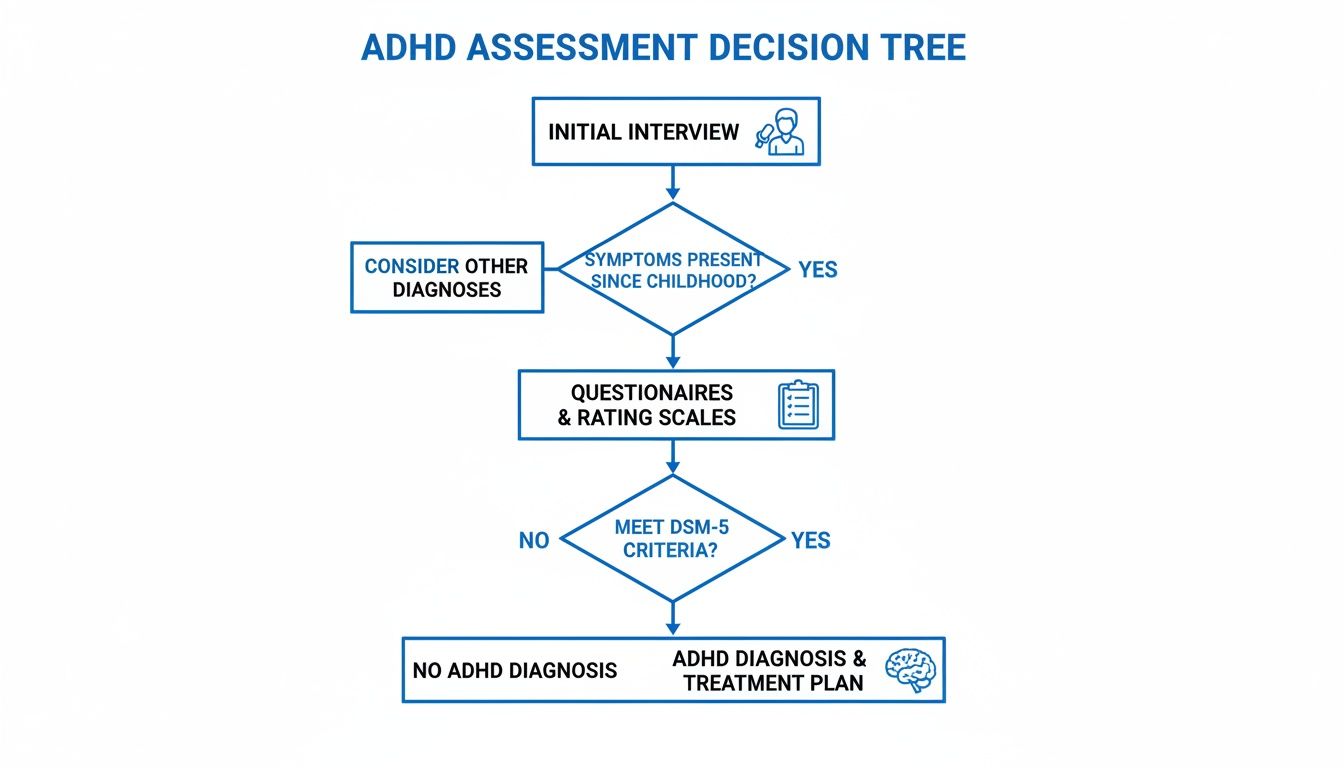
It always comes down to a detailed conversation with a clinician, backed up by standardised questionnaires and evidence, to see if you meet the diagnostic criteria.
To make sense of the two main NHS routes, here’s a straightforward comparison.
NHS Standard Pathway vs Right to Choose Comparison
| Feature | Standard NHS Pathway | NHS Right to Choose Pathway |
|---|---|---|
| Referral Origin | Your GP refers you to your local NHS mental health trust. | Your GP refers you to a qualified provider of your choice in England. |
| Provider Choice | Limited to your designated local service. | You choose from a list of providers with NHS contracts. |
| Waiting Times | Can be extremely long, often 2-5 years. | Set by each provider and varies by NHS area; ask the clinic for its current wait. |
| Cost | Free at the point of care. | Free at the point of care (funded by the NHS). |
| Patient Role | Largely passive; you wait to be contacted. | Requires you to be proactive and informed about your rights. |
Essentially, Right to Choose puts you in the driver's seat, but you need to be prepared to navigate.
Taking Action with Your GP
The first step is booking an appointment with your GP. It’s vital to go prepared, as honestly, not every GP is up to speed on how Right to Choose works for ADHD.
Be clear and direct in your appointment. Try saying something like, "I'm aware of my NHS Right to Choose, and I would like to be referred to [Provider's Name] for my ADHD assessment." Bringing a printout from the provider's website, or even a pre-filled referral form, can make a huge difference.
Unfortunately, you might encounter some resistance. Your GP might not have heard of the provider or mistakenly think RTC doesn't apply to mental health. If this happens, try to stay calm and polite, but be firm.
Remember, this is your legal right. You can refer your GP to the official NHS England guidance on Right to Choose. A polite but persistent approach is usually the most effective strategy.
The recent explosion in ADHD awareness has placed an incredible strain on services. By 2023-24, ADHD prescriptions in England had doubled in six years, reaching nearly 278,000 patients. With over 500,000 people stuck in the assessment queue, it’s no wonder so many are turning to options like RTC.
Navigating Potential Obstacles
Even with an agreeable GP, you’ll need to stay on top of the admin. It’s your responsibility to follow up and make sure the referral was sent and has been received by your chosen clinic.
What should you do if your GP refuses?
- Ask for the reason in writing. This creates a formal record and makes them justify their decision.
- Point them to the guidance. Politely show them the official NHS rules on the gov.uk website.
- Contact your local Integrated Care Board (ICB). The ICB manages local health services and can clarify the rules for your GP practice.
- Speak to the Practice Manager. Escalating the issue within the surgery can often resolve a stalemate with a single doctor.
Using your Right to Choose demands that you advocate for yourself. It can feel like more work upfront, but it gives you a say in who carries out your NHS-funded assessment. To get a complete walkthrough, you can explore our in-depth guide on using your Right to Choose for an ADHD diagnosis in the UK. It’s a crucial step towards getting the clarity and support you need.
Your Top Questions About the NHS ADHD Test
Even with a roadmap in hand, it's natural to have questions pop up along the way. Getting your head around the process for an NHS ADHD test can be tricky, and it’s completely normal to have a few lingering "what ifs".
Let's clear up some of the most common queries people have. Think of this as your quick-fire FAQ to help you feel more prepared for the journey ahead.
Can a GP Just Refuse to Refer Me?
Unfortunately, yes, they can. It's a frustrating setback, but a GP might decline a referral if they don’t think there’s enough evidence that your symptoms are causing significant problems in your daily life. They might also suspect another condition, like anxiety or depression, is the root cause.
If this happens to you, don't give up. Your first move should be to politely ask for their reasoning in writing. Sometimes, just asking for clarification is enough to make them reconsider. You can also book another appointment with a different doctor at the same practice for a second opinion. A little persistence can make all the difference.
What if the Assessment Doesn't Give a Clear Answer?
Sometimes, an assessment comes back as "inconclusive," meaning no definitive ADHD diagnosis is given. This could be because the clinician feels there isn't strong enough evidence of symptoms from your childhood, or they believe another condition is a better fit for your struggles.
If you don't agree with the outcome, you have a few options:
- Ask for a second opinion. You can go back to your GP and request a referral to a different NHS service. The downside is that you'll likely have to join another long waiting list.
- File a formal complaint. If you feel the assessment wasn't up to scratch, you can contact the Patient Advice and Liaison Service (PALS) to raise your concerns.
- Look into a private assessment. This is a much faster route, but it comes at a cost. If you do get a private diagnosis, you can sometimes bring it back to the NHS for ongoing treatment under a 'shared care agreement'.
I Have a Diagnosis! How Long Until I Get Medication?
Getting a diagnosis feels like a huge milestone, but it's often not the final step. Once the NHS ADHD test confirms you have ADHD, you'll usually be put on another waiting list for titration.
Titration is the crucial period where a specialist helps you find the right medication and dosage. It’s a slow, careful process of monitoring how you respond to treatment and managing any side effects.
The wait for titration can be a real shock – it can easily add another 6 to 12 months to your journey. It’s a good idea to ask about this timeline right after you get your diagnosis so you know what to expect.
Will My GP Accept a Diagnosis from a Private Clinic?
This is a big one, and the honest answer is... maybe. There's no rule forcing the NHS to accept a private diagnosis. However, many GPs are willing to work with you through a shared care agreement, especially if the assessment was done by a reputable clinic that follows the official NICE (National Institute for Health and Care Excellence) guidelines.
Under a shared care agreement, the private specialist gets you started on medication and finds the right dose, and then your NHS GP takes over prescribing it for you. Some GPs are reluctant, though, so it’s always smart to have a chat with yours before you spend money on a private assessment to avoid any difficult conversations later on.
Trying to figure out the path to an ADHD diagnosis can feel isolating, but you're not on your own. ADHD Private has a free UK directory with over 300 clinics, making it easy to compare wait times, costs, and what they offer. It’s a great way to find the right support and take back control.
Learn more at https://adhdprivate.co.uk