Right to Choose ADHD UK: A Guide to Faster NHS Diagnosis
Tired of long NHS waits? Our guide to Right to Choose ADHD UK shows you how to get a faster assessment. Learn the step-by-step process today.
If you've just been told you might have to wait years for an NHS ADHD assessment, it can feel like hitting a brick wall. But there's another route, a powerful, NHS-funded alternative called Right to Choose ADHD UK. It essentially lets you sidestep those long local waiting lists by picking a qualified private provider for your assessment, without it costing you a penny.
What Exactly Is The Right to Choose ADHD Pathway?

Think of the standard NHS referral process like joining the only queue at your local supermarket on a Saturday afternoon. It's long, slow, and you have no choice but to wait your turn. Right to Choose is like being handed a special pass that lets you go to an approved, much quieter shop next door to get served almost immediately.
This isn't some loophole; it's a right baked into the NHS Constitution for England. It gives patients registered with a GP in England the power to choose where they receive their specialist medical care, and that includes adult ADHD assessments.
How Does This Work in Practice?
Once your GP agrees that you need a referral for an ADHD assessment, you simply ask to be referred to a specific provider that holds an NHS Standard Contract. Instead of your referral automatically going to the local mental health service, you get to choose from a wider pool of specialist clinics across the country.
The benefits of going down this route are pretty clear:
- Shorter Waiting Times: This is the big one. We're talking about potentially cutting a wait of several years down to just a few months.
- More Control Over Your Care: You're not just stuck with your local option. You can research different providers, read their reviews, and pick one that feels like the right fit for you.
- It's Funded by the NHS: This is key. The entire assessment and diagnosis process is paid for by the NHS, just like it would be if you waited in the local queue. You won't face any bills for the assessment itself.
A Real Lifeline for Many
For countless adults stuck on impossibly long waiting lists, the Right to Choose pathway has been a genuine lifeline. It allows people to be referred to specialist providers instead of being stuck with overwhelmed local services. This often means getting seen in a matter of months, a stark contrast to the 2-5 year waits that are sadly common in many parts of the country.
To give you a clearer picture, let's compare the two routes side-by-side.
NHS Waiting List vs Right to Choose Pathway at a Glance
| Feature | Standard NHS Referral | Right to Choose Pathway |
|---|---|---|
| Provider Choice | Limited to your local NHS trust | You can choose any qualified provider with an NHS contract |
| Typical Wait Times | Often 2-5 years or more | Usually 3-9 months |
| Cost | Free (NHS-funded) | Free (NHS-funded) |
| Flexibility | Very little; you go where you're sent | High; you can research and select a preferred clinic |
As you can see, Right to Choose offers a much faster, more flexible journey to getting an assessment, without any extra cost.
Ultimately, the right to choose adhd uk pathway puts you back in the driver's seat of your own healthcare. It turns a frustrating waiting game into a proactive and empowering process. For a full walkthrough of getting the ball rolling, have a look at our guide on https://adhdprivate.co.uk/guides/how-to-get-tested-for-adhd.
Confirming You Can Use Right to Choose
Before you get too far down the road, it’s worth taking a moment to check if Right to Choose is actually an option for you. Think of it like checking your passport is valid before you book a holiday – a simple check now can save a lot of headaches later.
The criteria are pretty straightforward, but they are firm. The entire right to choose adhd uk system is built on two key conditions. If you tick both boxes, you have a legal right under the NHS Constitution to use this route for your ADHD assessment.
The Two Golden Rules
First, you absolutely must be registered with a GP in England. This is the most important rule. The money for your assessment comes from your local health authority in England (the Integrated Care Board or ICB), so this pathway is only for patients registered within the English system.
Second, the specialist provider you want to see must have an official NHS contract for adult ADHD assessments. This is a crucial quality check. It ensures they meet the same high standards for safety and care as any other NHS service. You can't just pick any private clinic you find online; they have to be an approved NHS partner.
In a nutshell: Your right is to choose from a pre-approved list of qualified providers. It’s not a blank cheque to go anywhere you like, but a structured choice designed to get you quality care, faster.
As long as you meet these two points, this pathway is a fantastic option whether you’re an adult seeking an assessment for yourself or a parent looking for one for your child.
Who Isn't Eligible?
It's really important to be clear about the geography here. The Right to Choose legislation is specific to England.
This means if your GP practice is in one of the following places, you unfortunately won't be able to use this particular pathway:
- Scotland
- Wales
- Northern Ireland
These countries have their own healthcare systems with different rules and funding. It's a common mix-up, so confirming where your GP is registered is the single most important first step.
What if You Don't Qualify?
Finding out you’re not eligible for Right to Choose isn't the end of the line, so don't lose heart. You still have good options.
The standard route is to ask your GP for a referral to your local NHS mental health service. They can get this process started for you, though wait times can be long.
Alternatively, if it's financially viable for you, going fully private is another route. This is typically the fastest way to get an assessment and start treatment, but it does mean covering the costs yourself. Many clinics offer this, so your next step would be to research their fees and what’s included. Exploring all the avenues will help you find the best way forward.
Your Step-by-Step Guide to a Successful Referral
Getting a referral for an ADHD assessment through Right to Choose can seem daunting, but it’s actually a pretty straightforward process when you break it down. Think of this as your practical game plan, designed to take you from that first flicker of "I think I might have ADHD" to a submitted referral with your GP.
Let’s walk through it together.
Step 1: Do Your Homework First
Your journey doesn't start in the GP’s surgery; it starts with a bit of research from the comfort of your own home. The first, and most important, step is to find and choose a provider that accepts Right to Choose ADHD UK referrals. These are private clinics that also hold an NHS contract, and your choice here really matters.
Don't just pick the first one you see. Look at their estimated waiting times – not just for the initial assessment, but also for the medication titration phase that comes after a diagnosis. One can be much longer than the other. It's also worth checking out patient reviews on independent sites and seeing how they communicate with people. A good provider will be transparent and helpful from the start.
Step 2: Prepare for Your GP Appointment
Once you’ve settled on a provider, it’s time to get your ducks in a row for the GP appointment. Being organised is the key to a smooth and successful conversation. Your goal is to make it as easy as possible for your GP to say "yes."
Here’s what you should have with you:
- A Pre-Written Letter: This is a must. Draft a simple, clear letter to your GP explaining that you think you may have ADHD and that you want to be referred to your chosen provider under the NHS Right to Choose rules.
- Symptom Checklists: Filling out a recognised self-assessment tool, like the Adult ADHD Self-Report Scale (ASRS), gives your GP concrete evidence. It shows them how your symptoms are impacting your everyday life, rather than you having to try and explain it all on the spot.
- Provider Information: Print out a page from your chosen clinic's website confirming they accept Right to Choose referrals, along with their contact details. This saves your GP a job and shows you’ve done your research.
Having all this prepared shows you're taking this seriously and makes it much easier for your GP to support you. To make this even simpler, you can find a pre-filled ADHD referral form online to complete and take with you.
Step 3: Having the Conversation with Your Doctor
With your paperwork ready, you can head into your appointment with confidence. Calmly explain that you're seeking an ADHD assessment and that you’d like to use your legal Right to Choose to be referred to a specific provider. Hand over your letter and the other documents you’ve prepared.
Now, it’s true that not all GPs are fully up to speed on this pathway. If your doctor seems hesitant or unsure, gently explain that Right to Choose is a legal right enshrined in the NHS Constitution for patients in England. The key is to frame it as a partnership—you’re working with them to get the specialist help you need.
Remember, a GP can only refuse a referral if they have a clear clinical reason. For instance, they might believe another condition is a better fit for your symptoms. They cannot say no simply because they're unfamiliar with the process, don't like the provider's location, or would rather use local services.
The Right to Choose scheme has become a lifeline for many, especially with NHS waiting lists for adult ADHD assessments now hitting an average of 4-5 years in some parts of the UK. This has led to over 1 in 5 people with ADHD having to seek private prescriptions. Right to Choose helps you bypass these enormous queues by using accredited providers who can often see you much faster.
The infographic below shows just how simple the core eligibility is.
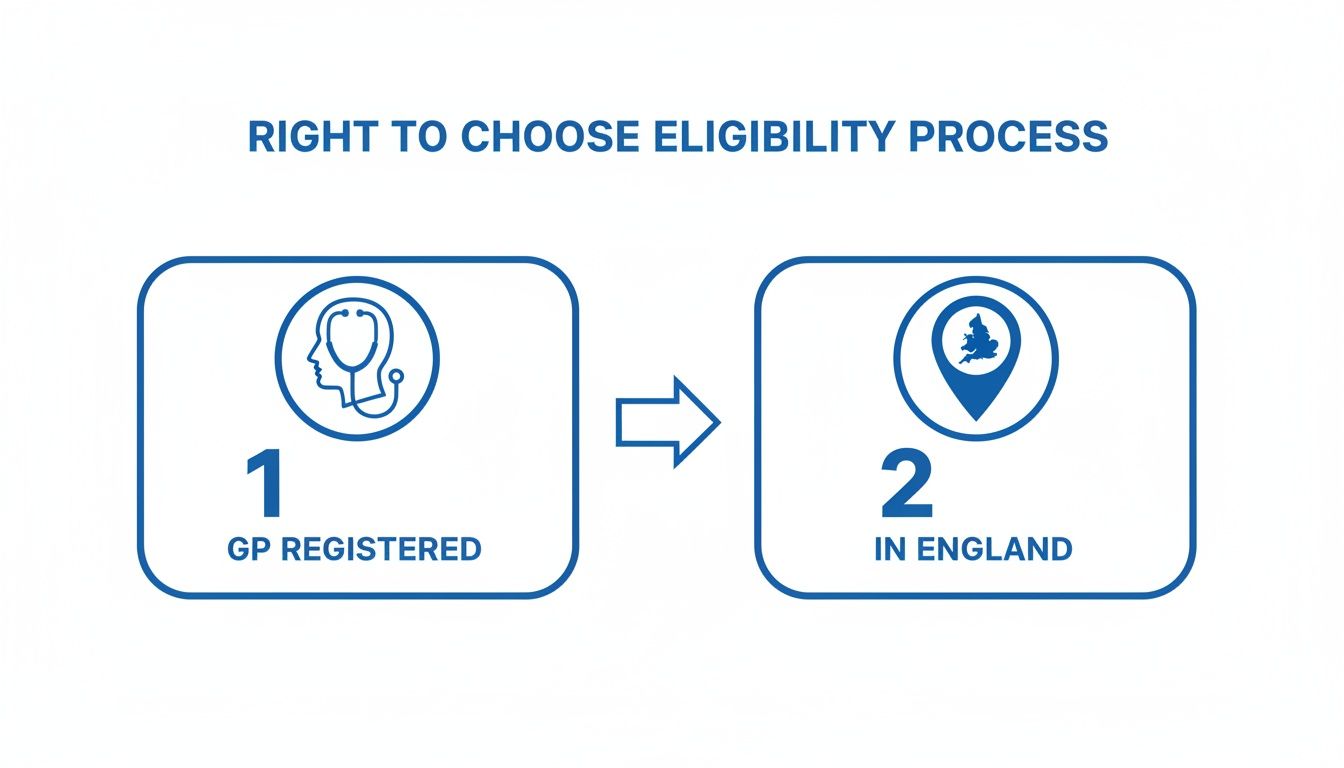
As you can see, the main requirement is simply being registered with a GP in England.
Step 4: From Submission to First Contact
Once your GP agrees to refer you, their admin team will handle sending the paperwork to your chosen clinic. It's always a good idea to phone the surgery a week or so later just to politely check that the referral has definitely been sent.
After the clinic receives your referral, they'll usually contact you directly to confirm they have it and explain what happens next. They might give you an updated idea of their waiting list and ask you to fill out some of their own screening forms. This is the last step of the referral process and the real start of your assessment journey. Just be prepared to be a little patient here, as it can sometimes take a few weeks for the clinic to process everything and get in touch.
How to Choose the Right ADHD Provider for Your Needs
Picking a clinic for your Right to Choose referral is a big decision. It’s about much more than just finding the shortest waiting list. The best provider for you is one that fits your long-term needs, ensuring a smooth and supportive journey from the initial assessment all the way through to ongoing care.
Making a smart choice now can save you a lot of frustration down the line. It's a bit like buying a car – you wouldn't just look at how fast it accelerates. You'd think about its running costs, reliability, and whether it's comfortable for long trips. The same thinking applies here; you need to see the whole picture.
Look Beyond the Initial Wait Time
That headline figure – the waiting time for an assessment – is what grabs everyone's attention. But it's only one piece of the puzzle. A crucial, and often overlooked, factor is the waiting list for medication titration. This is the process after diagnosis where a specialist works closely with you to find the right medication and dosage.
This "hidden wait" can be a real shock. Some clinics might get you assessed in a few months, but then you find yourself in another, much longer queue for titration—sometimes stretching up to a year. It's vital to ask about both wait times before you make a decision.
Choosing a provider is about balancing speed with sustainability. A slightly longer wait for an assessment might be a good trade-off if that same provider can start your titration almost immediately after diagnosis, saving you from a second long and frustrating delay.
Key Factors for Comparing Clinics
When you’re weighing up your options, it helps to have a simple checklist. This will help you make a logical choice, not just an emotional one based on getting seen quickly. For each provider on your shortlist, think about these points.
- Communication Style: How do they talk to potential patients? Do they reply to emails promptly? Is their website clear and easy to understand? Good communication from the start is often a good sign for the quality of care you'll receive later.
- Patient Reviews: Check out independent reviews on places like Trustpilot or Google. These give you a real-world peek into what the patient experience is actually like, covering everything from admin headaches to how good the clinical team is.
- Shared Care Agreement Policy: This one is non-negotiable. A Shared Care Agreement is the formal plan for your GP to take over prescribing your medication once you're on a stable dose. You absolutely must confirm that your chosen clinic has a solid track record of setting these up with NHS GPs. If they don't, you could be stuck paying for expensive private prescriptions forever.
Making Your Final Decision
To help you organise your thoughts and compare clinics side-by-side, here’s a table outlining the key things to consider.
Key Factors to Compare When Choosing a Clinic
| Factor | What to Look For | Why It Matters |
|---|---|---|
| Total Wait Time | Ask for separate wait times for both assessment and titration. | A short assessment wait followed by a long titration wait can be incredibly frustrating and delay your treatment significantly. |
| Shared Care Success | Does the clinic have a clear, established process for Shared Care Agreements with NHS GPs? | Without a successful handover to your GP, you could face ongoing private prescription costs of £80-£120 per month. |
| Communication & Support | Are they easy to contact? Do they have a dedicated support team? Read patient reviews about their responsiveness. | Good support makes the entire process less stressful. You'll want a team that's helpful if you hit any bumps in the road. |
| Costs & Fees | Are there any hidden costs? Check for fees related to prescription admin, missed appointments, or reports for your GP. | While the assessment is funded by the NHS, some providers charge extra for administrative tasks. Clarity upfront prevents nasty surprises. |
| Clinician Expertise | Look into the background of their clinical team. Do they specialise in adult ADHD? | You want to be seen by professionals with deep experience in diagnosing and treating ADHD in adults for the best possible outcome. |
By gathering this information, you can compare providers properly. The ideal choice is a clinic that not only gets you seen in good time but also offers a clear, supportive, and well-managed path for everything that comes after the diagnosis. Don't hesitate to email clinics directly and ask them specific questions about their titration waits or shared care policies.
Investing a little time in this research puts you in control. It helps you choose a genuine partner for your healthcare journey, not just a quick fix for an assessment. This thoughtful approach will make your Right to Choose experience as positive and effective as it can be.
Navigating GP Reluctance and Common Roadblocks
Even though the Right to Choose is your legal right, you might still hit a few bumps in the road when you ask your GP for a referral. The most common hurdle? A GP who’s either unfamiliar with the pathway or simply prefers to stick to local NHS services. It can be frustrating, but don't lose heart—with a bit of preparation, you can navigate this conversation smoothly.
Think of it less as a confrontation and more as a chance to inform. GPs are juggling an immense workload, and it's entirely possible they've just never come across the Right to Choose ADHD UK process before. Your aim is to make it incredibly easy for them to say yes.
If you meet with hesitation, the best approach is to be polite but firm. You're not demanding something unreasonable; you're working with them to find the quickest path to the specialist care you both agree is needed.
Handling a Hesitant GP
Being well-prepared with the right information is your strongest asset here. If your GP seems unsure, you can gently point them in the right direction without being confrontational.
Here’s a step-by-step game plan:
Bring the Official Guidance: Have the official NHS England page on Right to Choose either printed out or open on your phone. Often, seeing the rules laid out clearly by the NHS itself is enough to resolve any uncertainty.
State Your Rights Calmly: You could say something like, "Based on what I've read in the NHS Constitution, I have the right to choose my provider, as long as they have an NHS Standard Contract, which this clinic does."
Highlight the Clinical Need: Gently remind them that long waiting lists can have a serious impact on mental health. The massive demand for the right to choose adhd uk pathway exists for a reason. Shockingly, only 0.32% of 9.5 million GP records include an ADHD diagnosis code—that’s just one in every 300 patients, a fraction of the estimated 2.8% of adults who have it. You can learn more about the scale of the ADHD diagnosis challenge and see why this pathway is so vital.
It's crucial to know that a GP can only refuse your referral on clinical grounds—for instance, if they genuinely don't believe an ADHD assessment is necessary. They cannot refuse because they don't know the process, prefer local teams, or because the provider isn't local.
Other Common Hurdles and How to Fix Them
It’s not just about getting the initial agreement. A few administrative tripwires can pop up, but knowing what to look for will help keep things moving.
- Incomplete Referral Forms: Sometimes a referral gets sent off but is missing key information, leading the provider to reject it. A week or so after your appointment, it’s a good idea to politely check in with your GP's admin team to make sure your letter and any symptom questionnaires were sent across correctly.
- Communication Delays: Once the referral is sent, the silence can be deafening. If you haven't heard from your chosen provider within the timeframe they give on their website, it's completely fine to contact them directly to confirm they’ve received everything from your GP.
If you’ve done all this and your GP still refuses to refer you without a solid clinical reason, don't give up. Your next move is to get in touch with the Patient Advice and Liaison Service (PALS) at your surgery or your local Integrated Care Board (ICB). Their job is to help patients sort out issues just like this and they can act as an advocate for you.
Understanding Shared Care and Life After Diagnosis

Finally getting an ADHD diagnosis can feel like reaching the finish line, but it’s really just the start of a whole new chapter. So, what actually happens next? This is where you need to get your head around the long-term plan, particularly when it comes to medication. The key to the whole process is something called a Shared Care Agreement.
Think of a Shared Care Agreement (SCA) as the official handover document. Your Right to Choose provider is the specialist who gets the ball rolling. They handle the assessment, give you the diagnosis, and manage that initial phase of finding the right medication and dose for you—a process known as titration. Once they’ve got you on a stable treatment plan, they draw up the SCA to pass the prescribing duties back to your NHS GP.
How a Shared Care Agreement Works for You
This agreement is a game-changer because it’s how your ADHD medication costs get covered by the NHS. While you're in that initial titration phase with the specialist, you have to pay for your prescriptions privately, and that can get pricey, fast.
But once the SCA is signed by you, your GP, and the specialist, everything changes. Your GP then takes over issuing your repeat prescriptions. This means you’ll only have to pay the standard NHS prescription fee in England, making your long-term treatment much more affordable. It's a collaborative system designed to provide you with sustainable care.
A Shared Care Agreement is the bridge that connects your specialist Right to Choose diagnosis with your everyday local NHS care. Its successful implementation is the key to ensuring your treatment is both manageable and affordable in the long run.
What Right to Choose Covers and What It Does Not
It’s really important to manage your expectations about what your right to choose adhd uk referral actually pays for. The NHS funding for this route typically covers two main things:
- The Assessment: The full diagnostic process to determine if you have ADHD.
- The Titration Period: The specialist-led process of starting medication and carefully adjusting it to find the best type and dosage for you.
After titration is complete and the shared care plan is in place, the provider’s direct, funded involvement usually wraps up. Things like ongoing ADHD coaching, therapy, or help with workplace adjustments aren't typically included in the standard Right to Choose package. These are incredibly useful, but you'll likely need to seek them out separately. For more ideas, have a look at our guide to support for adults with ADHD.
This structured approach ensures you get a proper specialist diagnosis and are stabilised on the right treatment before your care transitions smoothly back to your local GP for the long haul.
Got Questions About Right to Choose? You're Not Alone.
Even when you’ve got a handle on the basics, it’s completely normal to have more questions pop up. Let’s face it, navigating any part of the healthcare system can feel like learning a new language. So, let's clear up some of the most common queries that come up on the Right to Choose ADHD UK journey.
Think of this as your go-to guide for those nagging "what if" questions, from paying for meds to dealing with a hesitant GP.
Does Right to Choose Cover Medication Costs?
This is probably the biggest point of confusion, so let's break it down. When you first start treatment with your chosen provider, you'll be in what's called the titration phase. During this time, the specialist is working closely with you to find the right medication and the perfect dose. Because this is still under the specialist's care, you will have to pay for these prescriptions privately.
The goal is to get your treatment stable so you and your provider can set up a Shared Care Agreement with your GP. Once that agreement is signed and sealed, your GP takes over writing your prescriptions. From that point on, you’ll only pay the standard NHS prescription fee. It's a really good idea to check that both your chosen clinic and your GP are happy to do this before you start.
What if My GP Refuses My Referral?
First off, don't panic. A GP can't refuse your Right to Choose referral just because they're unfamiliar with the process or because the clinic isn't local. They need a solid clinical reason to say no. If you do meet resistance, the best thing you can do is stay calm and be prepared.
Have the official NHS guidance on Right to Choose handy to show them, and politely explain that it’s your legal right. If they still won't budge without giving a valid clinical justification, your next port of call is your local Patient Advice and Liaison Service (PALS). They're there to help you and can act as an advocate to get things moving.
Remember, persistence and preparation are your best friends here. Your request is backed by official NHS rules, and being able to calmly explain that is your most powerful tool.
Can I Use Right to Choose if I Already Have a Private Diagnosis?
This one's a bit tricky. The Right to Choose pathway is really set up for getting that initial assessment and diagnosis funded by the NHS. If you've already gone through the whole process and paid for a private diagnosis, you generally can't use Right to Choose to get the same service again.
However, some people do look into using Right to Choose just for the medication titration part after they've received a private diagnosis. Whether this works really depends on the individual provider and if they're willing to take you on, and you’d still need your GP to agree to the referral in the first place.
How Long Are the Waiting Times?
This is the big win for Right to Choose. While waiting times vary a lot between providers, they are almost always significantly shorter than going the standard NHS route in your local area. Many local NHS services have waiting lists stretching 2-5 years, whereas Right to Choose providers are often looking at a few months to maybe a year.
It's absolutely essential to check the provider's own website for their most up-to-date waiting list times, as these can change pretty quickly. A good tip is to check the wait for both the initial assessment and the start of medication titration, as there can sometimes be a separate queue for that.
Finding the right clinic is the first step. At ADHD Private, our free directory helps you compare over 85 UK clinics by wait times, pricing, and services, making it simpler to find a provider that accepts Right to Choose referrals. Start your search and take control of your journey at https://adhdprivate.co.uk.