Private ADHD Assessment UK: Costs, Clinics and Process
Explore private ADHD assessment options, costs, clinics, and NHS Right to Choose for a clearer path to diagnosis and care in the UK.
Written and maintained by the ADHD Private editorial team, drawing on NHS, NICE and ADHD UK guidance. This is general information, not medical advice.
If you're looking into a private ADHD assessment in the UK, you’re probably already aware of the incredibly long waiting times on the NHS. Going private isn't just about skipping the queue; it’s about taking a proactive step to get clarity and support, often turning a wait of several years into just a few weeks or months.
Why a Private ADHD Assessment Might Be Your Best Option
Trying to get an ADHD assessment through the NHS can feel like being stuck in a slow-moving queue while an express lane sits wide open next to you. The simple truth is that a recent surge in awareness, especially among adults, has completely overwhelmed the system. This isn't a knock on GPs or public health services—it’s a straightforward case of demand massively outstripping what they can supply.
This reality has shifted private assessments from a luxury to a genuinely practical option for thousands of people. It’s a way to reclaim control over your own health journey, avoiding the kind of long, frustrating wait that can take a serious toll on your job, your relationships, and your overall mental health.
The Scale of the Waiting List Crisis
The number of people waiting for an assessment is genuinely staggering. NHS waiting times have ballooned, pushing more and more people to look for private alternatives. As of mid-2025, there are over 500,000 people in England alone waiting for an assessment, and for more than a quarter of them, that wait has stretched beyond two years.
This crisis is why resources like ADHD Private have become so vital. We offer a free directory that lets you compare over 300 clinics across the country, making it easier to find a path forward. You can learn more about the current landscape by reading up on ADHD treatment statistics and seeing how private providers are filling a crucial gap.
Waiting for a diagnosis is more than just frustrating—it can be draining. The constant uncertainty means symptoms continue to affect your daily life, and it’s easy to feel stuck. A private assessment gives you a clear timeline, replacing that feeling of helplessness with a sense of genuine progress.
The Benefits of Going Private
The main reason people go private is, of course, speed. But the advantages don't stop there.
- Fast Access to Support: Rather than waiting years, you can usually get an assessment within weeks or a couple of months. This means you can start treatment, whether that’s medication or therapy, and begin putting support strategies in place much sooner.
- More Choice and Flexibility: You get to choose a clinic that fits your needs. Maybe you want one that specialises in adult ADHD, offers online appointments for convenience, or is located close to home. You're in control of the process.
- Detailed Diagnostic Reports: Good private clinics provide comprehensive reports that are incredibly useful. They’re not just for getting a prescription; you can use them to apply for workplace accommodations or support at university.
Before diving in, it’s helpful to see how the two routes compare directly.
NHS vs Private ADHD Assessment At a Glance
This table breaks down the key differences between the NHS and private pathways to give you a clearer picture of what to expect from each.
| Factor | Typical NHS Pathway | Typical Private Pathway |
|---|---|---|
| Referral | Requires a GP referral to a local mental health service. | Often allows self-referral, though a GP referral can be helpful. |
| Wait Time | Can range from 6 months to 5+ years, depending on location. | Typically 2 weeks to 6 months for an initial assessment. |
| Cost | Free at the point of service. | £700 - £2,000+ for the assessment, plus ongoing costs for medication and follow-ups. |
| Choice of Provider | You are referred to a specific, commissioned service in your area. | You can choose from any clinic nationwide, including online specialists. |
| Medication | Prescriptions and follow-ups are covered by the NHS. | You pay for private prescriptions and titration until stable, then may move to a Shared Care Agreement with your GP. |
Ultimately, the choice comes down to your personal circumstances—your budget, how urgently you need answers, and how much flexibility you want in the process.
The Private ADHD Assessment Process Explained
So, you're considering a private ADHD assessment. It can feel like a big, daunting step, but the process is actually more straightforward than you might think. It’s less of a maze and more of a clear, signposted path.
Let's walk through it together, from that first tentative phone call to getting your final report, so you know exactly what to expect at every turn.
This image neatly sums up the two main routes you can take.
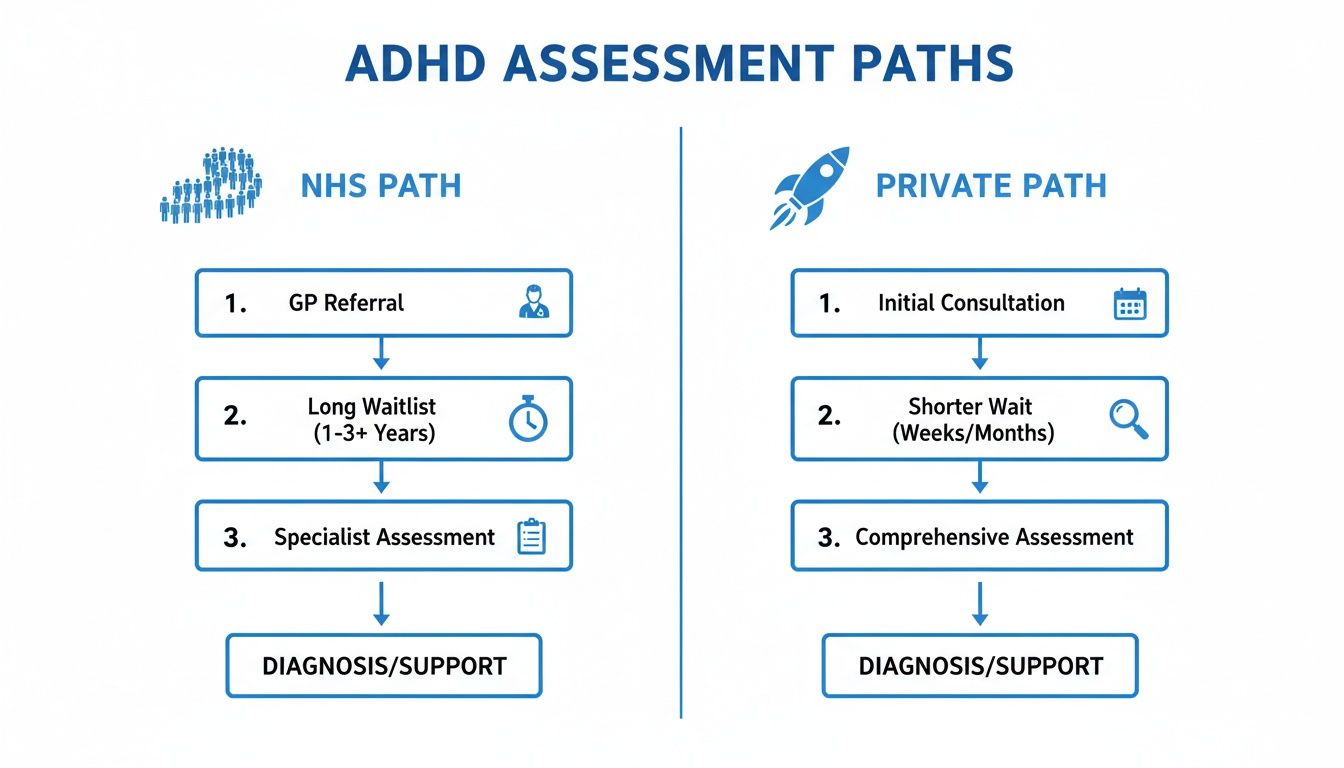
The biggest difference, as you can see, is time. Going private is a way to bypass the long waits and get answers, and support, much faster.
Stage 1: The First Contact and Screening
Your journey starts the moment you reach out to a clinic. Whether you find them through a directory like ADHD Private or a simple Google search, the first step is almost always a screening process. This is a quick, initial check to make sure a full assessment is the right path for you before you invest any time or money.
You’ll usually be sent a link to fill out some online forms. These aren't tests you can pass or fail; they're simply tools to gather some background information. Typically, you'll see things like:
- The Adult ADHD Self-Report Scale (ASRS): A standard questionnaire to see if your experiences line up with common ADHD symptoms.
- A Developmental History Form: This is where you’ll share a bit about your childhood, what school was like, and any early signs of ADHD traits.
- Symptom Checklists: You'll be asked to think about how different symptoms affect your life, both now and back when you were younger.
Once you’ve submitted these, the clinic's team will review them. If your answers suggest that a private ADHD assessment in the UK is a sensible next step, they’ll get in touch to book you in. This initial check is important because it helps filter out situations where another condition might be a better explanation for your struggles.
Stage 2: The In-Depth Clinical Assessment
This is the main event. The assessment is a detailed conversation with a qualified clinician – usually a psychiatrist or a psychologist with specialist training in neurodiversity. It's designed to build a complete picture of you.
Most good clinics follow the official guidelines set by the National Institute for Health and Care Excellence (NICE). The assessment itself usually takes between 90 minutes and three hours and covers a few key areas.
- A Deep-Dive Diagnostic Interview: The clinician will guide you through your life story, asking thoughtful questions about your symptoms, when they first appeared, and how they show up in different parts of your life – at work, in relationships, and just day-to-day.
- Using Standardised Tools: To keep the process thorough and consistent, clinicians often use structured assessment tools like the Diagnostic Interview for ADHD in Adults (DIVA-5). This ensures all the official diagnostic criteria are properly explored.
- Gathering a 360-Degree View: To get the full picture, the clinician might ask for input from someone who knows you well, like a parent, partner, or a lifelong friend. If you can dig out any old school reports, they can be absolute gold dust, providing real-world evidence of how you were doing as a child.
The assessment isn't an interrogation or a test to "catch you out." Think of it as a collaborative effort. The clinician is on your side, working with you to piece together the puzzle and see if your experiences match the diagnostic criteria for ADHD.
Stage 3: The Diagnosis and Your Report
After your conversation, the clinician will take all the information – from the questionnaires, the interview, and any supporting documents – and analyse it carefully. They're looking for a persistent, lifelong pattern of inattention, hyperactivity, or impulsivity that has a real impact on your life.
Whether you get a diagnosis or not, you will receive a comprehensive diagnostic report. This is a really important document. It should clearly explain:
- The final diagnostic outcome.
- A summary of all the evidence that led to that conclusion.
- Personalised recommendations for what to do next, which might include medication, therapy (like CBT), or ADHD coaching.
This report is yours. You can share it with your GP to arrange a shared care agreement, or with your university or employer to get the support and reasonable adjustments you need. It’s the official end of the assessment process and the start of the next chapter.
Looking for a private ADHD assessment?
Answer a few questions and we’ll shortlist clinics that fit — comparing price and waiting time.
How to Choose the Right Private ADHD Clinic
Picking the right private ADHD clinic is probably the most crucial decision you'll make on this journey. It’s not just about getting the fastest appointment; it’s about finding a healthcare partner you can trust for the long haul – someone credible, transparent, and who understands your needs. Think of it like finding a good mechanic. You want someone properly qualified, who is upfront about costs, and who you can count on for future support.
With so many providers out there, it can feel a bit overwhelming. This guide is designed to give you a practical way to compare clinics, ask the right questions, and ultimately find one that you feel confident in. We'll walk through the essentials, from costs and official accreditations to what happens after a diagnosis.
Our directory at https://adhdprivate.co.uk/clinics helps you filter and compare this key information, making it much easier to pull together a shortlist of potential clinics.
Decoding the True Cost
The headline price you see for an assessment is often just the tip of the iceberg. To avoid any nasty surprises down the line, you need to get a clear picture of the entire cost from start to finish. Any reputable clinic should be completely open about this.
Here’s what you absolutely need to ask about:
- The Initial Assessment Fee: What exactly does the main diagnostic assessment cost, and what’s included? Does it cover the full, detailed report you'll need?
- Medication Titration: This is the phase where you and your clinician find the right medication and dosage. It can take a few months and is nearly always an extra cost. Ask if they offer a package price or what the fee is per appointment.
- Follow-Up Appointments: How many follow-ups are required as part of the process, and how much does each one cost?
- Private Prescription Fees: On top of the price of the medication itself, what is the clinic's admin fee for just writing the prescription?
An assessment that looks cheap at first can quickly become the more expensive option if the titration and follow-up fees are sky-high. Always ask for a full cost breakdown before you commit to anything.
Checking for Quality and Accreditation
This part is non-negotiable. In the UK, every independent healthcare provider must be regulated to ensure they meet basic standards of quality and safety.
The single most important thing to look for is registration with the Care Quality Commission (CQC) in England (or its equivalents in Scotland, Wales, and Northern Ireland). The CQC is the independent regulator for health and social care. A clinic with a CQC registration is regularly inspected to make sure it provides safe, effective, and high-quality care.
A clinic's CQC rating is a public and reliable indicator of its quality. Think of it as an Ofsted report for healthcare. Never choose a clinic that isn't registered with the appropriate national regulator.
Online vs In-Person Assessments
One of the biggest choices you'll face is whether to go for an online or a face-to-face assessment. Both are valid options, and the best one for you really comes down to your own circumstances and what you’re comfortable with.
- Online Assessments: These offer fantastic convenience, letting you speak to a specialist from anywhere in the country without leaving your home. As long as the clinic follows official NICE guidelines, they are just as clinically valid as in-person appointments.
- In-Person Assessments: Some people just prefer a traditional clinic setting. It can also be a better fit for those with more complex situations or other conditions where a face-to-face meeting might add more value.
The good news is that many top providers now offer both, giving you the flexibility to choose. The key is that the clinical quality is high, regardless of the format.
Planning for Ongoing Care and Medication
Getting a diagnosis is the start of a new chapter, not the end of the story. Your relationship with the clinic will likely continue, particularly if you decide to explore medication. This is where something called a Shared Care Agreement (SCA) becomes incredibly important.
An SCA is basically a handover arrangement between your private specialist, your NHS GP, and you. Once your medication and dosage are stable, it allows your GP to take over prescribing it on the NHS. This can save you a significant amount of money on ongoing private prescription costs.
Before you book with a clinic, you must ask two things:
- Do you actively support and work towards establishing Shared Care Agreements with NHS GPs?
- What is your process for this, and how successful are you at getting them agreed?
It’s also a smart move to have a quick chat with your GP surgery beforehand to see if they are generally open to entering into these agreements. While many are, it’s important to know that they aren’t obligated to accept.
Navigating NHS Right to Choose for Your Assessment
What if a private provider could carry out your assessment without the price tag? For anyone living in England, the NHS Right to Choose (RTC) pathway can make this possible. It’s a powerful patient right, but one that’s still surprisingly little-known, and it can be a total game-changer for getting an adhd assessment uk private clinic, but funded by the NHS.
Think of RTC as a golden ticket. Instead of being stuck on the waiting list for your local NHS mental health service, this ticket lets you pick an approved private provider who has a contract with the NHS. You get the same assessment and treatment you would privately, but it’s all free at the point of care.
How Does Right to Choose Work?
This isn’t something that happens automatically – you need to take the lead. The most crucial part of the process is getting a referral from your GP, as they hold the key to getting the ball rolling. You'll need to explain that you want to use your legal right to choose where you're assessed for ADHD.
Here’s what that looks like in practice:
- Find an RTC Provider: First things first, you need to find a private clinic that actually accepts NHS Right to Choose referrals. Not all of them do, so you’ll need to check their websites carefully.
- Book a GP Appointment: Get an appointment with your GP to talk through your ADHD symptoms and your plan to seek a referral. A little preparation goes a long way here.
- Make Your Request: When you see your GP, state clearly: "I would like to exercise my NHS Right to Choose and be referred to [Clinic's Name] for an ADHD assessment." It really helps to bring a pre-written letter or the clinic's specific referral details with you.
- GP Makes the Referral: As long as your GP agrees the referral is clinically necessary, they will send all the paperwork over to your chosen clinic.
Following this route can slice a huge amount of time off your wait. We’re often talking about cutting a wait of several years down to just a few months.
Understanding the Potential Hurdles
While RTC sounds perfect on paper, it’s not always a completely smooth ride. A common roadblock is that many GPs simply aren’t familiar with the Right to Choose legislation, especially for mental health. They might mistakenly think it only applies to physical health or just not know how the process works.
Be prepared to gently educate your GP if you need to. Bringing along printed guidance from the NHS England website or a letter template from your chosen provider can work wonders. It clarifies the rules and makes their job a lot easier.
The other thing to keep in mind is capacity. RTC has become so popular that even the approved private providers now have their own waiting lists. Waits vary by clinic and by area, and Right to Choose does not guarantee a shorter wait than your local NHS service, so check the current wait for any adhd assessment uk private clinic you are considering via RTC. To see how the pathway works and how to find providers that accept it, read our Right to Choose guide.
Ultimately, you have to weigh up the pros and cons. If you can handle the wait for an assessment that’s fully funded, RTC is a brilliant option. But if you need answers and support more urgently, paying for a purely private assessment is still the fastest way forward.
Getting Ready for Your Assessment and Making Sense of the Outcome
The thought of an upcoming assessment can feel a bit like prepping for a big exam you can't revise for. But that’s not really the right way to look at it. Preparing for your adhd assessment uk private session isn’t about passing a test; it's about giving your clinician a clear window into your world—your life, your challenges, and your strengths.
Think of it as a collaborative effort. The groundwork you do beforehand helps the clinician connect the dots between your past and your present, leading to a much more accurate and genuinely helpful conclusion. It helps you tell your story properly.
Your Practical Preparation Checklist
To walk into your appointment feeling organised and confident, it’s worth spending some time gathering a few things. The goal is simply to collect information that paints a vivid, real-life picture for the specialist.
- Dig out historical documents: Old school reports can be absolute gold dust. Teachers' comments like "very chatty," "easily distracted," or "daydreams in class" provide crucial, third-party evidence of symptoms during your childhood.
- Ask for feedback: Get in touch with a parent, an older sibling, or maybe a long-term partner for their honest observations. What do they remember about you as a kid? How do they see your struggles affecting you day-to-day now?
- Jot down specific examples: Don't just say you're forgetful. Note down real instances. Things like, "I missed paying three bills last month," or "I was late for that important meeting because I couldn't find my keys… again." The more specific, the better.
- Fill out pre-assessment forms properly: The clinic will almost certainly send you questionnaires to complete. Take your time with them and be as honest as you can. Our guide on the ADHD referral form might help you understand the kind of detail they're looking for.
Interpreting the Outcome: A Diagnosis
If the assessment results in an ADHD diagnosis, it often brings an overwhelming sense of relief. It’s a moment of validation—an explanation for struggles you’ve likely lived with for years. It’s an explanation, not an excuse. This is where your journey pivots from seeking answers to actively building solutions.
Your clinician will provide a detailed report and walk you through the immediate next steps. This plan typically involves:
- Exploring Medication: If it's the right path for you, you'll begin the titration process. This is a careful period of finding the right type and dose of medication, which can take several weeks or even a few months.
- Therapeutic Support: They will often recommend things like Cognitive Behavioural Therapy (CBT) or specialised ADHD coaching to help you develop practical, real-world strategies for managing your symptoms.
- Shared Care Planning: The clinic will kick off the process of arranging a Shared Care Agreement with your GP, which is essential for getting your ongoing prescriptions via the NHS.
What Happens If You Don't Get a Diagnosis?
It’s also entirely possible that the clinician will conclude that your symptoms don't fully meet the diagnostic criteria for ADHD. This can feel hugely disappointing, but it is not a dead end. Instead, try to see it as a valuable step in understanding what is really going on.
A "no" for an ADHD diagnosis isn't a failure; it's a clarification. The assessment provides expert insight that rules one possibility out, allowing you and your GP to explore other potential causes for your difficulties with much greater confidence.
A good clinician will take the time to explain their reasoning clearly. They should also suggest other possibilities or avenues to explore, such as anxiety, depression, or another underlying condition. The detailed report they provide is still incredibly useful for informing your next conversation with your GP.
This whole process is part of a much bigger picture. GP-recorded adult ADHD events are up 291% in five years, with a staggering 389% spike in females, highlighting just how many people are seeking this kind of clarity.
Your Private ADHD Assessment Questions Answered
Even after you've mapped out the process, shortlisted a few clinics, and are gearing up for the day, some practical questions can still pop up. It’s completely normal to wonder about the finer details, and this final section is here to tackle those common "what ifs" and "how much" questions head-on.
Think of this as your final sanity check before you commit. We'll get straight to the point on the things people worry about most, from the real-world cost of the whole journey to the practicalities of medication and whether an online assessment is the real deal.
How Much Does a Private ADHD Assessment Cost in the UK?
This is usually the first question on everyone's mind, and the honest answer is: it varies. A lot. The initial assessment fee itself can be anywhere from £600 to over £1,500. But, and this is a big but, that’s almost never the final figure you'll pay.
Any clinic worth its salt will be transparent about costs, but you need to be the one to ask for a full breakdown. Make sure you know what you’re paying for, including:
- The Diagnostic Assessment: This covers the main consultation and the written report.
- Follow-Up Appointments: Is the first follow-up included, or is it an extra cost? You need to know.
- Medication Titration: This is the crucial process of finding the right medication and dosage for you. It's almost always a separate cost, often sold as a package or a per-appointment fee, and can easily add several hundred pounds to your total bill.
- Private Prescription Fees: Before your GP agrees to take over, you’ll be paying the clinic an admin fee every single time they write you a prescription.
A word of advice: always ask for a complete cost projection before you start. A temptingly low assessment fee can be a false economy if the follow-up and titration costs are through the roof.
Can My GP Refuse a Shared Care Agreement?
In a word, yes. A GP can refuse to enter into a Shared Care Agreement (SCA), and it's a real possibility you need to prepare for. GPs aren't contractually obliged to take over prescribing from a private provider. The decision often comes down to their practice policies, their confidence in the clinic you've used, and the rules set by their local NHS commissioning group.
To give yourself the best possible chance of a 'yes':
- Talk to Your GP First: This is non-negotiable. Have a chat with your GP surgery before you even book a private assessment. Ask them outright if they are generally open to considering SCAs with CQC-regulated private ADHD specialists.
- Choose a Reputable Clinic: GPs are far more likely to work with well-established clinics that have a reputation for high-quality, NICE-guideline-compliant assessments and good communication.
- Make Sure the Report is Top-Notch: The diagnostic report from your private clinician needs to be detailed, clear, and give your GP all the information they need to feel confident taking over your care.
If your GP does say no, you'll be stuck paying for private prescriptions and follow-ups indefinitely, which gets very expensive, very fast. That initial conversation with your surgery isn't just a good idea; it's a critical part of your financial planning.
Is an Online ADHD Assessment as Valid as an In-Person One?
For the vast majority of adults, the answer is a resounding yes. An online adhd assessment uk private service, as long as it's run by a CQC-regulated clinic that follows national NICE guidelines, is considered every bit as clinically valid as a face-to-face appointment.
The heart of the assessment is a detailed clinical interview, and that can be done just as effectively over a secure video call. In fact, online assessments have become the standard for many of the UK's top clinics for some very good reasons:
- Accessibility: You can connect with a top specialist from anywhere in the country without the hassle and cost of travel.
- Convenience: It’s so much easier to fit an appointment around your work and life commitments.
- Comfort: Let's be honest, most of us feel more relaxed and able to open up when we're talking from our own home.
The only real exception is for individuals with very complex situations, maybe with other conditions that need closer, in-person observation. A good clinician will always tell you if they think a face-to-face evaluation would be better for you.
How Long Will I Wait for a Private ADHD Assessment?
This is the big one. The main reason people go private is to bypass the enormous NHS queues, which can stretch on for years. With a private clinic, you're looking at a much shorter wait, typically somewhere between a few weeks and a few months.
But be aware, the "wait" isn't just one number. There's the wait for your initial assessment, and then, if you're diagnosed, there's often a second wait to start medication titration. It’s vital you ask about both timelines before you book. Some providers have a hidden titration waitlist that can add several more months of frustration after your diagnosis.
Demand for private services has skyrocketed, so it’s smart to contact a few different clinics to get a realistic picture of their current waiting lists for both assessment and titration. Doing your homework here can save you from months of unexpected and demoralising delays.
Finding the right path forward starts with having the best information. The ADHD Private directory is a free resource designed to help you compare over 300 UK clinics, so you can shortlist providers based on cost, wait times, and services offered. Start your search today and take the next step with confidence.