Your Guide to Psychiatry UK Right to Choose for ADHD
Discover how Psychiatry UK's Right to Choose helps secure faster ADHD diagnosis. Learn steps, eligibility, and how to speak with your GP.
Feeling stuck on an endless NHS waiting list for an ADHD assessment? You're not alone. But if you're in England, there's a powerful tool you might not know about: the NHS Right to Choose (RTC) pathway. This is your legal right to choose a qualified provider for your assessment and treatment, and it’s all funded by the NHS. Think of it as a way to bypass the local queue and get the help you need, much sooner.
How Right to Choose Can Unlock Faster ADHD Care
If you're registered with a GP in England, Right to Choose basically opens up a fast-track option for your healthcare. Instead of being stuck with only your local mental health services, you can pick any qualified provider that has an NHS contract for adult ADHD assessments. To be clear, this isn't private healthcare – it's a fully NHS-funded route designed to give you more control and cut down those agonising waiting times.

The frustration of waiting years for an assessment is a massive problem across the country. For many, the Psychiatry UK Right to Choose service has become an absolute lifeline. The scale of the issue is staggering; in January 2025, the Royal College of Psychiatrists pointed out that 1.6 million mental health cases are just sitting on waiting lists. For someone trying to get an ADHD diagnosis, this can mean a wait of two years or even more. You can read the full report on mental health waiting lists yourself to see just how bad things are.
Taking Control of Your Healthcare Timeline
Using your Right to Choose puts you back in the driver's seat. The whole system is based on a simple, powerful idea: if another provider can deliver the same NHS-standard care but faster, you should have the right to go to them.
This changes the game for you in a few crucial ways:
- Shorter Waiting Times: You could be looking at an assessment in months, not years.
- A Choice of Provider: You can pick a specialist service like Psychiatry-UK, which has deep expertise in adult ADHD.
- Fully NHS Funded: From the initial assessment right through to getting your medication sorted (titration), it won't cost you a penny.
- More Convenient: Many Right to Choose providers, including Psychiatry-UK, offer appointments online, so where you live doesn't have to be a barrier.
By simply understanding and using your rights, you can sidestep these painful delays and get the support you need on a timeline that actually makes sense. This guide will walk you through exactly how to do it, step by step.
2. Are You Eligible for Right to Choose?
Before you dive in, it’s worth taking a moment to check you tick all the right boxes for the Right to Choose pathway. Think of it as making sure you have all the ingredients before you start baking – it just saves a lot of hassle later on.
The rules are pretty clear-cut, and getting your head around them now will give you the confidence you need when you speak to your GP.
The Essential Criteria
First and foremost, the big one: you must be registered with a GP in England. This is a specific legal right within the English NHS system, so unfortunately, it doesn't extend to patients in Scotland, Wales, or Northern Ireland.
You also need to be 18 or over to use this route for an adult ADHD assessment with a provider like Psychiatry-UK. Finally, your GP needs to agree that a referral is "clinically appropriate." That sounds formal, but it just means they agree your symptoms are significant enough to need a specialist's opinion.
To make it even clearer, here’s a quick checklist to see if you meet the requirements for an NHS Right to Choose ADHD assessment.
Right to Choose Eligibility Checklist
| Criteria | Requirement | Simple Explanation |
|---|---|---|
| Location | Registered with a GP in England | This is an English NHS policy only. |
| Age | 18 years or older | Right to Choose is for adult mental health services. |
| Clinical Need | A referral is clinically appropriate | Your GP agrees your symptoms warrant specialist assessment. |
| Provider Choice | The chosen provider has an NHS contract | The clinic must be officially recognised to provide the service. |
If you can tick off each of these, you’re almost certainly good to go.
Clearing Up Common Misunderstandings
Sometimes, even GPs can get a bit mixed up about the rules, especially when it comes to location and funding. This is where being informed really helps.
A common stumbling block is the idea that you have to choose a provider in your local area. This isn't true.
Your right is to choose any qualified provider in England that holds an NHS contract for the service you need. It doesn't matter if they're based hundreds of miles away. Your GP doesn't need to get special permission or funding approval from the local health authority (the ICB) for your referral to proceed.
Knowing these details is your best tool. It allows you to have a confident, productive chat with your doctor and advocate for yourself effectively. Many people also have questions about what an adult ADHD NHS diagnosis involves and how it all works. Understanding your rights puts you in the driver's seat, ready to take the fastest route to getting the support you need.
Your Step-by-Step Guide to Securing a Referral
Right, so you’ve figured out you’re eligible. What’s next? This is where a little bit of prep work can make all the difference, helping your chat with the GP go as smoothly as possible. Let's break down exactly what you need to do to get that referral sorted.
When you know the steps, the process is actually quite simple. The real secret is walking into that appointment fully prepared, with all the right information and documents ready to go. It makes it much easier for your GP to see what you need and get the referral sent off without a fuss.
This flowchart gives you a bird's-eye view of the journey for a Psychiatry UK Right to Choose referral.
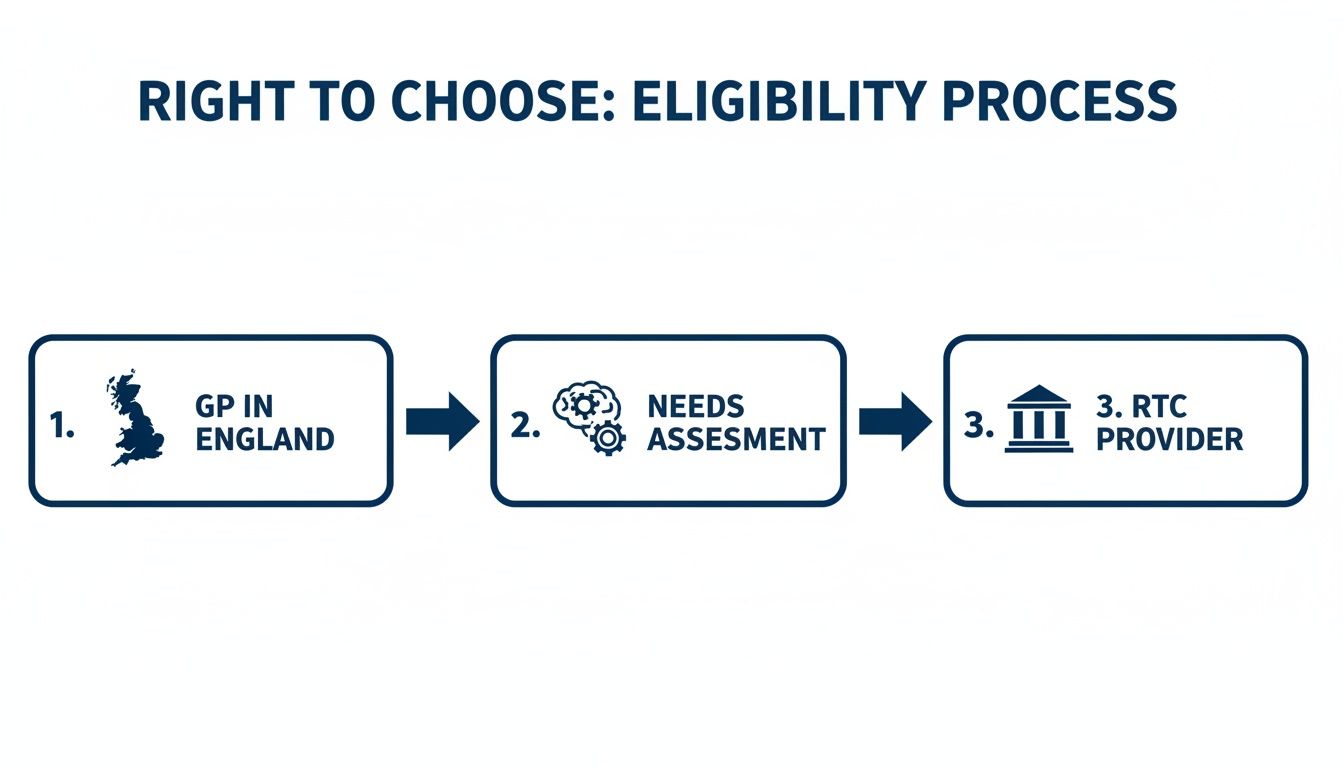
As you can see, it all starts with your GP in England. From there, it's about a clinical needs assessment before landing with the provider you've chosen, all under the NHS umbrella.
1. Research and Choose Your Provider
First things first, you need to decide who you want to be referred to. Psychiatry-UK is a popular and well-established choice for adult ADHD assessments through Right to Choose. They've been doing this for a long time, so their systems are built to work well with the NHS.
2. Get Your Documents in Order
Before you even think about booking that GP appointment, get your paperwork together. Being organised shows you’re serious and have done your homework. Providers like Psychiatry-UK usually have template letters and forms on their websites, which makes this step much easier.
This isn't just about saving time; it dramatically lowers the risk of your referral getting delayed or knocked back because something was missing. To make it foolproof, here’s a checklist of what you'll want to have ready.
Your Document Checklist:
- A Completed Self-Report Scale: For ADHD, the go-to is the ASRS (Adult ADHD Self-Report Scale). It’s a questionnaire that gives your GP a quick snapshot of why you think you might have ADHD.
- A GP Referral Letter: Find the template letter on your chosen provider's website. Fill in your details, sign it, and have it ready to hand over.
- Proof of Right to Choose: It’s a good idea to print a copy of the official NHS guidance on patient choice. It’s not always needed, but it’s a lifesaver if your GP isn't familiar with the rules.
Having these documents ready makes the appointment ten times more effective. If you're looking for templates, you can learn more about the specific ADHD referral forms and find examples to help you prepare.
3. Book and Attend Your GP Appointment
With your documents in hand, it’s time to book that appointment. When you see your GP, the key is to be clear, calm, and confident. Explain your symptoms and tell them you think you might have ADHD and would like an assessment.
Then, hand over your completed ASRS form and the filled-out referral letter. Make sure you clearly state that you want to use your NHS Right to Choose to be referred to the provider you've selected.
GP Conversation Script: "Hello Dr. [Name]. I've been really struggling with things like [mention 1-2 key symptoms, e.g., poor concentration and feeling disorganised] for a long time now. I've filled out this ASRS form which suggests I might have ADHD. I'd like to use my legal Right to Choose and be referred to Psychiatry-UK for an assessment. I've brought their referral letter with me."
This direct, polite approach gives your GP everything they need in one neat package. It removes any guesswork and makes it as straightforward as possible for them to take action.
Navigating Common Roadblocks with Your GP
So you've gathered all your documents and you're ready to go. You might feel a bit of a jolt if your GP hesitates or even pushes back on your request for a Psychiatry UK Right to Choose referral. Don't panic. This is a surprisingly common hurdle, but it's one you can get over with a bit of calm preparation.
The problem isn't usually that your GP wants to block you. It's often that they're simply not familiar with the rules, especially how they apply to mental health. They might incorrectly think Right to Choose is only for physical conditions, or they might be worried about complex funding arrangements. These are genuine concerns, but they're based on misinformation.
Remember, this isn't just a nice-to-have; it's a right that's legally baked into the NHS Constitution for England. Being ready to gently guide your GP can be the difference between a frustrating "no" and a successful referral that gets you the help you need.
Responding to Common GP Objections
When a GP raises an objection, try to see it as a question, not a rejection. They're likely just unsure about how it all works. Knowing what to say can make the conversation a lot smoother.
Here are a few of the most common things you might hear, and how to respond calmly and factually.
Objection 1: "Right to Choose doesn't apply to mental health." This is probably the biggest myth out there. You can politely explain that the guidance actually covers all consultant-led services, and that definitely includes psychiatry for ADHD assessments. Having a printed copy of the official NHS England guidance with you to show them can be incredibly effective here.
Objection 2: "We'll need to get funding approval from the local ICB." This isn't how it works. A huge benefit of Right to Choose is that your GP doesn't need to seek prior approval from the local Integrated Care Board (ICB). The funding automatically follows your referral. You can point out that Psychiatry-UK is already a qualified NHS provider, which keeps the process straightforward.
Objection 3: "I'm not sure about a Shared Care Agreement." GPs can be wary of the extra work involved in prescribing and monitoring medication. You can reassure them that providers like Psychiatry-UK have this all figured out. They manage the entire difficult bit – the diagnosis and titration process – and will only hand over to the GP once you're on a stable, optimised treatment plan. This makes ongoing prescriptions much simpler for them.
The aim here is to have a conversation, not a confrontation. You're helping your GP understand the system so they can help you. When they feel confident in the process, most doctors are more than happy to support their patients.
Why Your Advocacy Matters Now More Than Ever
Getting this right is a big deal, especially with the NHS under so much pressure. Local waiting lists for ADHD assessments can be shockingly long; we're talking years, sometimes even a decade.
At the same time, NHS England has proposed changes to the Right to Choose scheme that could slash ADHD assessment capacity by as many as 100,000 patients per year. For now, providers like Psychiatry-UK are a crucial lifeline, accepting GP referrals for the full works – from diagnosis to medication management. You can read more about the potential impact of these NHS changes to see why using your rights is so important.
By standing your ground and advocating for yourself, you’re doing more than just getting your own assessment. You're helping keep a vital pathway open for the thousands of others who desperately need timely support.
What to Expect After Your Referral Is Sent
So, you’ve had the conversation with your GP and they’ve sent off your referral. What happens now? It can feel a bit like you’re in a waiting room, but knowing the typical timeline and process helps take the uncertainty out of it.
Your chosen provider, whether it's Psychiatry-UK or another clinic, will first need to process the referral. This is basically an admin step to make sure all the paperwork is correct. Given the high demand for these services, this part alone can take a few weeks.

Once they’ve confirmed your referral, you’ll get a notification – usually by email or text message – asking you to create an account on their patient portal. This portal is your new best friend; it’s where you’ll fill out forms, communicate with the clinic, and book your appointments.
From Assessment to Diagnosis
After setting up your portal account, you’ll be asked to fill out some detailed questionnaires. It might feel like a lot of form-filling, but this is incredibly important. It gives your specialist a really solid picture of your history and symptoms before you even speak, which makes your actual assessment far more productive.
Your main assessment will be a video call with a specialist psychiatrist. This is your chance to talk through your experiences, symptoms, and how they affect your day-to-day life. If they confirm an ADHD diagnosis, you won't just be left with that information; you'll receive a detailed diagnostic report explaining everything.
The goal here isn't just about getting a diagnosis. It’s about finally getting a clear, professional understanding of what’s been going on and creating a practical plan to move forward. For many, this includes discussing medication.
Understanding Titration and Shared Care
If you and your specialist decide medication is a good option, you’ll move into the titration phase. This sounds technical, but it’s just the process of carefully finding the right type of medication and the right dose for you. It's a specialist-led process with regular check-ins to make sure the treatment is working well with as few side effects as possible.
Once your dose and medication are stable, the final step is setting up a Shared Care Agreement with your GP. Think of this as a handover plan. Your specialist transfers the responsibility for routine prescriptions and monitoring to your GP, but remains on hand to offer expert advice if needed. It’s a brilliant system that ensures you get consistent, long-term care from your local surgery, making life much easier.
Common Questions and Sticking Points
When you're first exploring the NHS Right to Choose pathway, it's natural for a few questions to pop up. Let's tackle some of the most common ones we see from people just starting out.
Can I Use Right to Choose if I Live in Scotland, Wales, or Northern Ireland?
Unfortunately, no. The Right to Choose scheme is a legal right specifically for patients registered with a GP in England.
Scotland, Wales, and Northern Ireland have their own devolved healthcare systems with different policies and referral pathways for mental health care.
Will This Cost Me Anything? Is There a Catch?
Absolutely not. The entire service—from your first assessment and diagnosis to getting your medication right (a process called titration)—is funded by the NHS, just like any other specialist service. You won't pay a penny for the actual clinical care.
The only potential cost is the standard NHS prescription fee for your medication, which is the same charge you'd pay for any prescription in England. If you're exempt from prescription charges, you won't pay anything at all.
Is It Really That Much Faster?
This is perhaps the biggest draw for most people. Local NHS waiting lists for an adult ADHD assessment can be painfully long, sometimes stretching on for 2, 3, or even 5 years.
By using your Right to Choose, you can bypass these local queues. With a provider like Psychiatry-UK, you could be seen for your assessment in a matter of months after your GP makes the referral. It's a game-changer.
What if My GP Says No to My Referral Request?
It’s not uncommon for a GP to be hesitant, but don't panic. This is usually down to them simply not being familiar with the Right to Choose rules, rather than a clinical disagreement. The best first step is to calmly share the official NHS England guidance with them.
If they still refuse your request for a non-clinical reason, you have a couple of options:
- Contact the Patient Advice and Liaison Service (PALS): Every local NHS area has a PALS team. They offer confidential advice and can help you navigate and resolve issues like this.
- Speak with the Practice Manager: You can formally raise the issue with the practice manager, who can often help sort things out internally.
Finding the right clinic can feel overwhelming, but you don't have to do it alone. The ADHD Private directory makes it simple to compare wait times, services, and costs for clinics across the UK, including those accepting Right to Choose referrals. Start shortlisting your options today at https://adhdprivate.co.uk.