Understanding the Main Types of ADHD in the UK
Explore the three main types of ADHD and how they appear in children and adults. Get clear, practical information on symptoms and diagnosis in the UK.
Written and maintained by the ADHD Private editorial team, drawing on NHS, NICE and ADHD UK guidance. This is general information, not medical advice.
When you first hear about ADHD, you might picture a kid who can't sit still. But that's just one tiny piece of a much bigger puzzle. In reality, ADHD isn't a single, straightforward condition. It shows up in different ways, which clinicians now refer to as three distinct presentations.
Think of it less as rigid "types" and more as different flavours of the same core challenge. The official terms are Predominantly Inattentive, Predominantly Hyperactive-Impulsive, and Combined Presentation. Let's unpack what that really means.
Understanding the Three ADHD Engines

To make sense of these presentations, it helps to step away from clinical jargon. Imagine the ADHD brain is like a high-performance car engine. Every engine is built for power and speed, but how it behaves on the road can be wildly different.
This analogy helps us see past the surface-level behaviours and understand the internal experience of someone with ADHD. It’s not just about a restless child or a disorganised adult; it’s about a fundamental difference in how their brain regulates energy, focus, and impulse.
The ADHD Engine Analogy Explained
So, how does this engine idea connect to the three official presentations of ADHD? Each one represents a unique pattern of symptoms and daily challenges.
Inattentive Presentation (The Idling Engine): From the outside, this engine seems to be running quietly, maybe even a bit underpowered. It struggles to get going and often stalls when it needs to accelerate, making it incredibly difficult to engage with tasks, follow conversations, or stay focused.
Hyperactive-Impulsive Presentation (The Revving Engine): This engine is constantly redlining, even when the car is parked. It’s a non-stop source of energy, leading to physical restlessness, fidgeting, and a tendency to act on impulse without hitting the brakes first.
Combined Presentation (The Erratic Engine): As the most common presentation, this engine is completely unpredictable. One moment it's idling quietly, the next it’s revving at maximum RPM. This creates a confusing and often exhausting internal world, bouncing between mental fog and physical restlessness.
A key part of diagnosis involves matching symptoms to these patterns. The Diagnostic and Statistical Manual of Mental Disorders (DSM-5) sets the standard: a person needs to show a persistent pattern of at least six symptoms in one or both categories (five symptoms for those aged 17 and over) to meet the criteria.
For a quick reference, here’s a breakdown of how each presentation typically shows up.
ADHD Presentations at a Glance
This table summarises the core characteristics you might see in each of the three main presentations.
| ADHD Presentation | Primary Characteristics | Commonly Observed Behaviours |
|---|---|---|
| Inattentive | Difficulty sustaining attention, poor organisation, forgetfulness. | Daydreaming, losing things, avoiding mentally demanding tasks. |
| Hyperactive-Impulsive | Excessive energy, restlessness, acting without thinking. | Fidgeting, interrupting others, inability to sit still for long. |
| Combined | A significant mix of both inattentive and hyperactive-impulsive symptoms. | A blend of all behaviours listed above, often shifting day to day. |
Of course, these are just snapshots. A person's experience can be far more nuanced and complex.
Why “Presentations” Matter More Than “Types”
You might have noticed the shift from "types" to "presentations." This isn't just semantics; it reflects a much deeper, more accurate understanding of ADHD.
The word "type" implies something fixed and unchanging. But we now know that's not how ADHD works. "Presentation" captures the reality that a person's symptoms can change over their lifetime.
For instance, the very visible hyperactivity of a young boy might fade as he gets older, morphing into a feeling of intense inner restlessness. As the hyperactivity becomes less obvious, his inattentive traits might suddenly seem more prominent. Recognising this fluidity is crucial for finding the right support at the right time.
You've probably also heard the term "ADD" used. To clear up any confusion, we've put together a guide explaining the differences between ADHD and ADD and why ADD is no longer an official diagnosis. Now, let’s take a closer look at what each presentation feels like for children, teens, and adults.
Recognising the Quiet Struggle of Inattentive ADHD

The Predominantly Inattentive presentation of ADHD is often the one that slips under the radar. It's frequently mistaken for laziness, carelessness, or just being a "daydreamer." Because the struggle is quiet and internal—unlike the more obvious signs of hyperactivity—it's one of the most underdiagnosed types of ADHD, especially in girls and women.
This isn't about a lack of intelligence or a refusal to try. It’s a genuine, persistent difficulty in regulating attention. Think of it like trying to tune an old radio; you can find the station you want, but the signal keeps drifting into static. It takes constant, exhausting effort just to stay tuned in to a conversation, a meeting, or a simple task.
That internal battle creates very real, everyday frustrations. It's the constant, low-level hum of anxiety that you’ve forgotten something important, but you just can't remember what.
How Inattentive Symptoms Appear Across Ages
While the core challenge of managing attention stays the same, how it shows up in daily life changes dramatically with age and responsibilities. Learning to spot these patterns is the first real step towards understanding.
In Childhood: You might see this in the child whose school bag is a jumble of crumpled, half-finished worksheets. They’re always losing their jumper or lunchbox, seem to be staring out of the window during lessons, and make silly mistakes on homework even when they know the answer.
In Adolescence: For a teenager, it can feel almost impossible to follow a lecture without their mind drifting. They can really struggle to organise their revision, often miss coursework deadlines, and get told they "aren't trying hard enough" or "just lack motivation."
In Adulthood: This often looks like chronic disorganisation. An adult with inattentive ADHD might constantly misplace their keys, phone, or wallet. They feel completely overwhelmed by administrative tasks like paying bills and often miss important deadlines at work, leading to performance issues and a huge amount of stress.
People with Predominantly Inattentive ADHD often become experts at hiding their difficulties. This constant effort to 'mask' their struggles can lead to chronic anxiety, exhaustion, and burnout, as they have to work twice as hard just to keep up.
Key Characteristics of Inattentive ADHD
For a clinical diagnosis, these signs of inattention have to be persistent and get in the way of day-to-day functioning. We all forget things now and then, but for someone with ADHD, these challenges are a constant feature of their life.
Here are some of the key symptoms a clinician will look for:
- Difficulty Sustaining Focus: Finding it tough to stay locked into lectures, long meetings, or dense reading.
- Easily Distracted: Minor things that others filter out—a phone notification, a conversation nearby—can completely derail their concentration.
- Poor Organisational Skills: A real challenge with managing time, knowing which task to do first, and keeping belongings or a workspace in some kind of order.
- Forgetfulness in Daily Activities: Frequently forgetting appointments, chores, or even to return a friend's call.
- Losing Things: Constantly misplacing essential items like keys, glasses, important documents, or their phone.
- Avoiding Mentally Demanding Tasks: A strong tendency to put off or completely avoid tasks that need sustained mental effort, like filling out forms or reviewing detailed reports.
Recognising these traits is so important because it reframes the behaviour. It’s not a character flaw; it’s a symptom of a neurodevelopmental condition. It’s a battle fought inside the mind, often completely invisible to everyone else.
Wondering what the next step looks like?
Only a qualified clinician can diagnose ADHD. Answer a few questions and we’ll shortlist clinics that assess people like you.
Beyond Energy: The Reality of Hyperactive-Impulsive ADHD

When most people picture ADHD, this is the version that usually springs to mind: the child who’s a whirlwind of energy, can’t sit still, and blurts things out. This is the Predominantly Hyperactive-Impulsive presentation, but the classic stereotype barely scratches the surface. It fails to capture the internal experience and how these traits evolve over a lifetime.
Hyperactivity isn't just about being "bouncy" or full of beans. For someone with ADHD, it's an intense, often uncomfortable compulsion to move. A child might literally run around the room, but an adult feels this as a profound internal restlessness. It can make sitting through a long meeting feel like a form of torture. The big movements often become smaller and more socially acceptable—a jiggling knee, incessant pen-clicking, or constantly shifting position—but that inner engine is still running on high.
Paired with this is impulsivity, which is much more than just being spontaneous. It's about a brain wired for immediate action, where the gap between thought and deed is incredibly short. This isn’t a choice or a lack of self-control; it's a neurological difficulty in hitting the pause button to weigh up the consequences.
Hyperactivity and Impulsivity Through the Ages
These core characteristics don't disappear as a person gets older. They just change their clothes to fit new environments and social expectations.
In Childhood: This is the kid who struggles to wait their turn in the lunch queue or during a board game. They might be climbing the furniture or interrupting conversations, not to be defiant, but because the impulse is just too strong to contain. In a structured classroom, this behaviour is often misunderstood and labelled as "naughty" or disruptive.
In Adolescence: As the stakes get higher, so do the risks. Impulsivity can lead a teenager towards dangerous behaviours without a thought for the long-term fallout. They might also grapple with intense emotional reactions, struggle to maintain friendships due to a constant search for novelty, or drop hobbies as soon as the initial excitement wears off.
In Adulthood: The consequences can become far more serious. Impulsivity might manifest as reckless spending and mounting debt, or suddenly quitting a good job out of sheer boredom. In relationships, it can lead to saying hurtful things without thinking, while in careers, it can mean a pattern of jumping from one path to another, always chasing the next new thing.
It's vital to understand that this isn't a moral failing or a sign of immaturity. These behaviours are the direct result of differences in the brain's executive function centres—the parts responsible for planning, self-regulation, and impulse control. Seeing it through this lens is the key to swapping judgement for genuine support.
Core Behaviours to Recognise
When assessing the different types of ADHD, clinicians look for a consistent pattern of specific behaviours. For a hyperactive-impulsive diagnosis, they’re often looking for several of the following:
- Constant fidgeting, tapping hands or feet, or squirming in their seat.
- Finding it difficult to stay seated during meetings, meals, or classes.
- An internal feeling of being "driven by a motor" or always needing to be on the go.
- Talking excessively, often dominating conversations.
- Interrupting others frequently or finishing their sentences.
- Struggling to wait their turn in any situation.
- Blurting out an answer before a question has even been finished.
Recognising these traits for what they are—symptoms, not character flaws—is the first and most important step toward understanding the true nature of hyperactive-impulsive ADHD.
Living with Combined Type ADHD
The Combined presentation is the most common form of ADHD we see diagnosed. This isn't just a simple 50/50 mix of inattention and hyperactivity. It’s a much more dynamic, and often chaotic, experience where both sets of symptoms are prominent and persistent enough to cause real-world problems. To be diagnosed with this type, you have to meet the diagnostic criteria for both the Inattentive and the Hyperactive-Impulsive presentations.
Think of it like having two different people constantly wrestling for control of your brain. One is all gas, no brakes – desperate to chase every new idea and burn off physical energy (that’s the hyperactivity). At the exact same time, the other is staring out the window, completely lost in a daydream and unable to focus on the road ahead (hello, inattention).
The Internal Tug-of-War
This constant internal battle makes everyday life uniquely challenging. Take an adult trying to tackle a big project at work. For the first hour, their hyperactive-impulsive side might be in charge, leading to a burst of intense, laser-like focus. They feel unstoppable, buzzing with energy and brilliant ideas.
Then, a single email notification pops up. That’s all it takes for the inattentive side to snatch the controls. The project is instantly forgotten as they tumble down a rabbit hole of unrelated tasks, interesting articles, and daydreams. Hours can vanish before they resurface, confused and frustrated, with zero progress to show for it. That initial incredible momentum has completely evaporated, replaced by the exhausting task of trying to wrestle their focus back on track.
This cycle of intense engagement followed by complete derailment is a hallmark of the Combined Type experience. It's not about willpower; it’s the result of a brain that struggles to regulate both its energy and its attention, leading to an exhausting pattern of starts and stops.
The real difficulty is the sheer unpredictability of it all. One day, hyperactivity might be the dominant force, leading to impulsive decisions and that classic feeling of being 'driven by a motor'. The next, inattention can blanket everything, making it impossible to follow a simple conversation or remember a crucial appointment. For those looking for answers, finding the right support for adults with ADHD is essential for building strategies to manage this complex interplay.
This constant switching makes tasks that seem straightforward to others feel like a monumental effort. It’s a tiring, often invisible battle fought every single day.
How to Get an Accurate ADHD Diagnosis in the UK
If you’ve been reading about the different types of ADHD and a lot of it is sounding familiar, you’re probably wondering: what next? Getting an accurate diagnosis in the UK is a process, but knowing the steps can make the whole journey feel much more manageable.
One thing is certain: a proper diagnosis doesn't come from a quick online quiz. It requires a thorough evaluation by a qualified professional, usually a psychiatrist or a specialist nurse. They'll use the official diagnostic criteria, laid out in the Diagnostic and Statistical Manual of Mental Disorders (DSM-5), to guide their assessment.
What Clinicians Look For
The diagnostic process is all about building a picture of a persistent pattern of behaviour. A clinician needs to see evidence that symptoms have been around since childhood (before the age of 12) and that they cause consistent trouble in at least two key areas of your life, like work and home, or school and social relationships.
They’re trying to distinguish between the occasional forgetfulness or restlessness everyone feels and a set of symptoms that genuinely gets in the way of your daily life. It’s about whether these traits are causing significant, real-world impairment.
This flowchart gives a great visual of how a simple task can unravel for someone with combined-type ADHD, showing that familiar cycle of focus, distraction, and derailment.
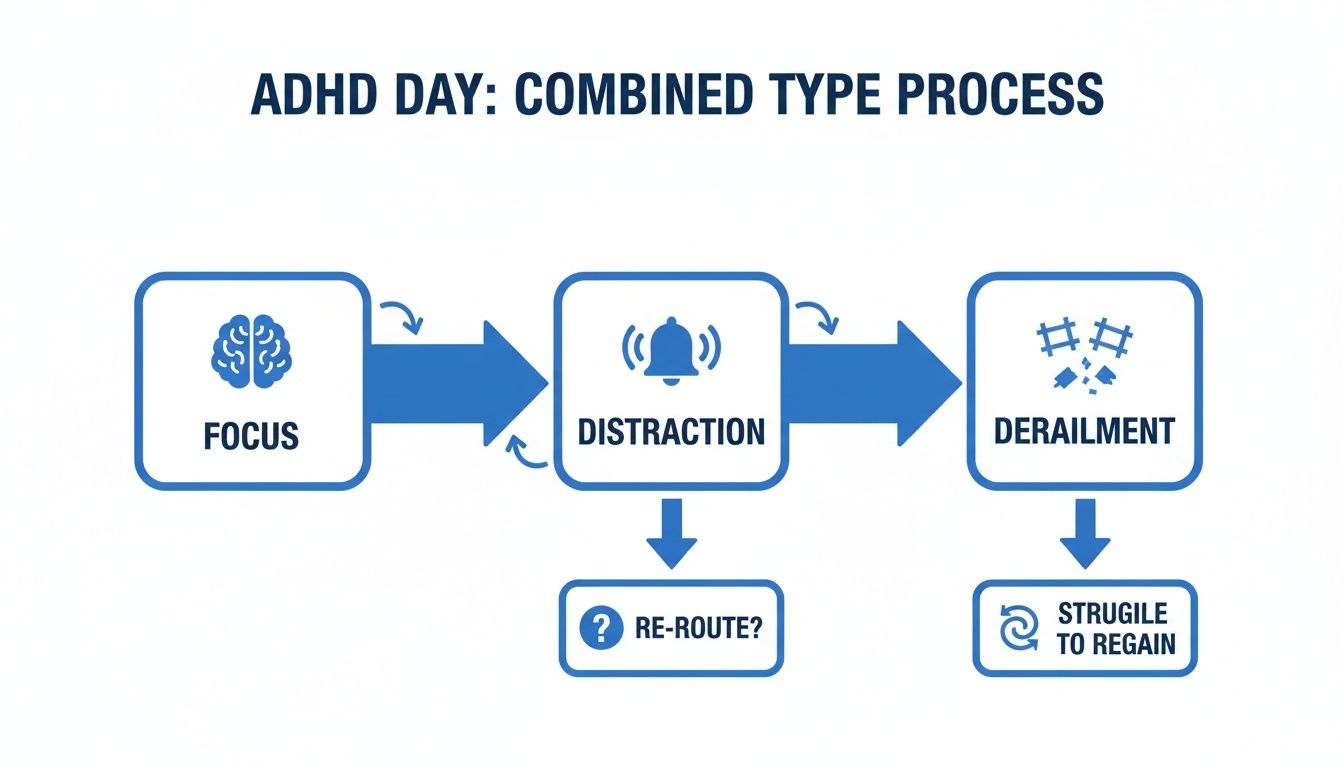
As you can see, just one little distraction can completely break your concentration, turning the simple act of getting back on track into a huge battle.
Navigating the UK Assessment Pathways
Here in the UK, there are two main routes to getting an assessment: through the NHS or via a private clinic. For the NHS route, your GP is always the first port of call. They can make a referral, but it’s important to be aware that the waiting lists for adult ADHD assessments on the NHS can be incredibly long – we’re often talking years, not months.
This lengthy delay is why so many people decide to look into private options. It does come at a cost, but it can offer a much faster path to getting clarity and starting any necessary treatment. If you go this route, take your time to research different providers to find a reputable clinic that works for you.
A Note on the Diagnostic Gap: The gap between the estimated number of people with ADHD and those who have a formal diagnosis is enormous. It's thought that 2.5 million people in England have ADHD, but only about one in nine have been officially diagnosed. This leaves a huge number of people struggling without the right support.
Comparing UK ADHD Assessment Pathways
To help you decide, here’s a quick comparison of the two main pathways for getting an ADHD assessment in the UK.
| Feature | NHS Pathway | Private Pathway |
|---|---|---|
| Starting Point | GP appointment for referral | Direct contact with a private clinic |
| Wait Times | Very long (often 1-5+ years) | Much shorter (weeks to a few months) |
| Cost | Free at the point of service | Varies (typically £700 - £2000+) |
| Flexibility | Limited appointment availability | More flexible scheduling options |
| Choice of Clinician | Little to no choice | You can research and choose your provider |
| Post-Diagnosis | Treatment and medication are NHS-funded | Initial treatment costs are private, may transfer to NHS via 'Shared Care Agreement' |
Ultimately, choosing between the NHS and private routes comes down to your personal circumstances, particularly how urgently you need an assessment and what your financial situation is.
A private assessment generally offers more speed and flexibility, but the NHS provides a comprehensive service without the direct cost. To get a more detailed breakdown, you can read our full guide on how to get tested for ADHD.
Common Questions About ADHD and Diagnosis
Getting your head around the different presentations of ADHD can be a huge lightbulb moment, but it often brings up even more questions. Let’s tackle some of the most common ones that pop up when people are starting to explore what's going on for them or someone they care about.
Can My ADHD 'Type' Change Over Time?
Absolutely. In fact, it's very common for the way ADHD shows up to shift as you move through life. The symptoms that are front and centre in childhood can look very different in your teenage years and again in adulthood.
Think about a child with the Combined Presentation. Their physical hyperactivity might be very obvious – always on the go, climbing on things. As they grow up, that outward energy can morph into a feeling of intense internal restlessness. As the more visible hyperactive traits fade, their struggles with focus, memory, and organisation might suddenly seem much more prominent. This is why any good assessment will look at your entire life story, knowing that symptoms evolve.
This is exactly why clinicians now prefer the term 'presentations' over 'types'. It captures the reality that ADHD symptoms exist on a spectrum and can change over a lifetime, rather than being stuck in fixed, rigid boxes.
So, while you'll still hear people talk about the "types of ADHD," the proper diagnostic terms are Predominantly Inattentive Presentation, Predominantly Hyperactive-Impulsive Presentation, and Combined Presentation.
Does Having Some of the Symptoms Mean I Have ADHD?
It's easy to read a list of ADHD symptoms and think, "Hey, that's me!" And it’s true – almost everyone experiences moments of forgetfulness, distraction, or impulsivity from time to time.
But the real difference for a diagnosis comes down to two key things: the symptoms have to be persistent and pervasive. This means they’ve been around since you were a kid, and they cause significant, ongoing problems in more than one area of your life – like at work and in your relationships. It’s not just about having a bad week; it’s about a pattern of challenges that genuinely gets in the way of you living your life. A qualified professional will carry out a detailed evaluation to see if your experiences meet the full diagnostic criteria.
I Really See Myself in These Descriptions. What's My First Step?
That feeling of recognition is a huge and often emotional first step. It’s the start of finding answers. The next move is to talk it through with a healthcare professional.
In the UK, you generally have two main routes to take:
Get in touch with your GP: You can book an appointment to run through your symptoms. Your doctor can then refer you to your local NHS mental health service for a formal assessment. The big thing to be aware of here is the waiting lists, which can unfortunately stretch on for several years.
Look into a private assessment: This path is a much faster way to get clarity. By researching private clinics, you can compare qualified providers across the UK, see their current wait times and costs, and find a service that feels right for you.
What’s the Difference Between ADHD 'Types' and 'Presentations'?
Honestly, you'll see these terms used interchangeably, but 'presentations' is the more modern and accurate clinical term. The older word, 'types', gave the impression that these were distinct, lifelong conditions you were locked into forever.
'Presentations' is a much better fit for how we understand ADHD today. It acknowledges that while the underlying neurodevelopmental condition doesn’t go away, the way your symptoms show up can change depending on your age, your environment, and the coping skills you’ve learned along the way. It’s just a more flexible and realistic way of describing how ADHD can look.
If you're thinking about a private assessment, trying to figure out where to start can feel like a job in itself. ADHD Private offers a free UK-wide directory to help you compare over 85 clinics, check transparent pricing and wait times, and find the right support, faster. You can start your search and take the next step toward clarity at https://adhdprivate.co.uk.