ADHD vs. ADD: Demystifying the Labels for Clear UK Diagnosis
Unsure about ADHD vs. ADD? Our guide explains the terminology, diagnostic criteria, and how to navigate the UK assessment process for ADHD.
Written and maintained by the ADHD Private editorial team, drawing on NHS, NICE and ADHD UK guidance. This is general information, not medical advice.
Here’s the deal with ADHD vs ADD: it’s not really a case of two separate conditions. The simple truth is that ADD is an old, outdated term.
What many people still call ADD is now officially known as ADHD, Predominantly Inattentive Presentation. It’s one of three ways ADHD can show up. So, the whole ADHD vs ADD debate is really just about how our understanding—and the language we use—has evolved over time.
Clarifying the ADHD vs ADD Confusion
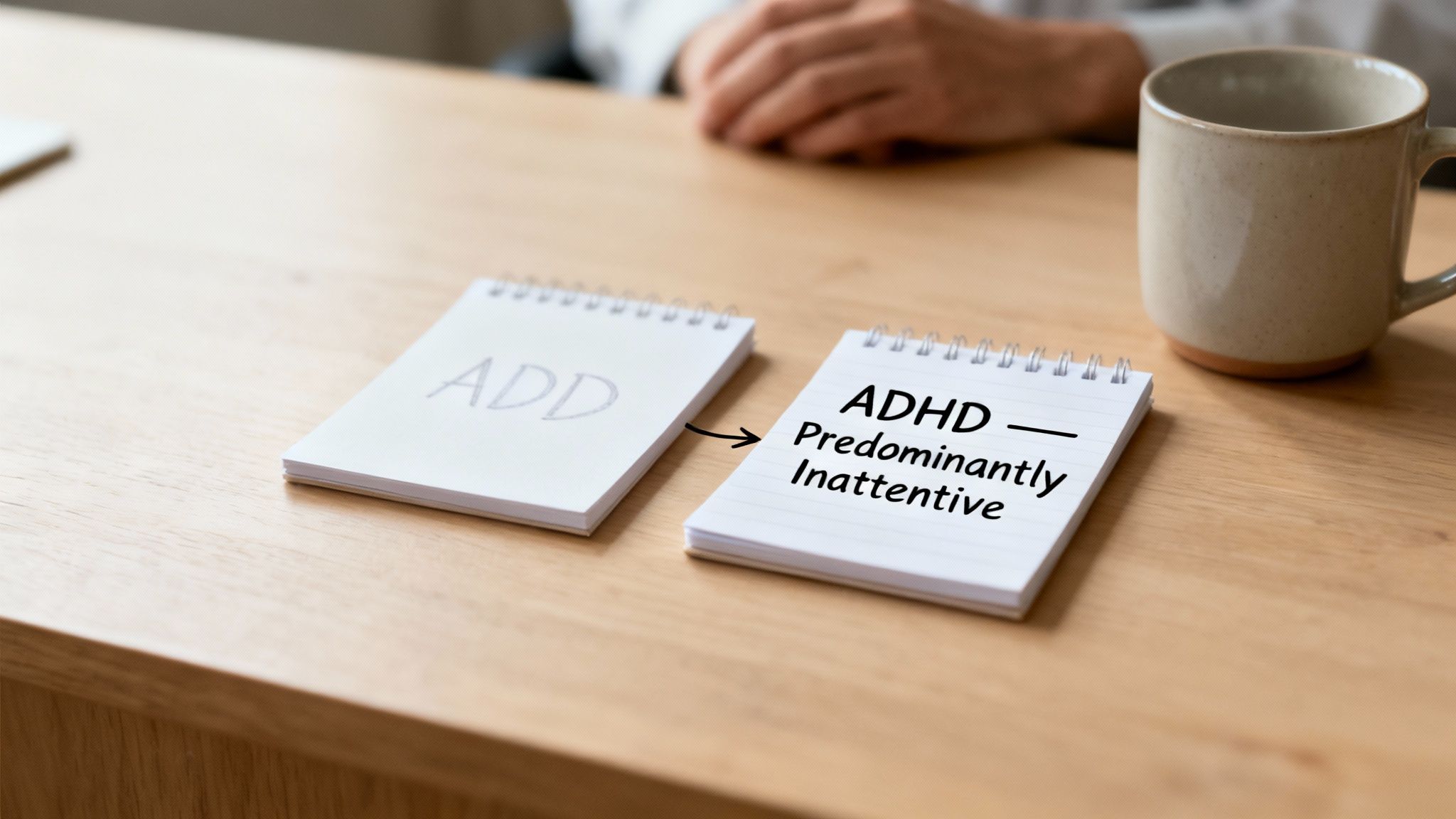
If you’ve ever used 'ADD' to describe symptoms like being disorganised, forgetful, or finding it impossible to focus, you're in good company. For years, Attention Deficit Disorder (ADD) was the common diagnosis for people who struggled with attention but weren't bouncing off the walls.
The medical world has since moved on. Experts now recognise that Attention Deficit Hyperactivity Disorder (ADHD) is more of a spectrum. You don’t have to be hyperactive to have it. The modern framework includes presentations that are primarily inattentive, primarily hyperactive-impulsive, or a mix of both.
Why the Terminology Changed
The main reason for the change was to bring everything under one, unified diagnosis. Research shows these different presentations share the same neurological roots. By grouping them all under the ADHD umbrella, clinicians can get a much clearer picture and provide better, more specific support.
This shift has been a game-changer, especially for those who don't have obvious hyperactive traits. For a long time, countless people—particularly girls and adults—were missed because their struggles were internalised. Recognising the inattentive presentation finally gives a name to their experience and helps them get the support they need. You can find out more about the modern ADHD diagnosis process and what it involves.
To make things clearer, let's break down how the language has shifted.
Understanding the Shift in Diagnostic Terminology
This table lays out the old terms alongside the current, official ones, giving you a quick reference for how things are classified today.
| Outdated Term (Commonly Used) | Current Official Term (DSM-5) | Primary Characteristics |
|---|---|---|
| ADD (Attention Deficit Disorder) | ADHD, Predominantly Inattentive Presentation | Trouble holding attention, forgetfulness, poor organisation, easily distracted, avoids tasks needing long mental focus. |
| ADHD (Attention Deficit Hyperactivity Disorder) | ADHD, Predominantly Hyperactive-Impulsive Presentation | Fidgeting, can't stay seated, talks excessively, interrupts conversations, acts on impulse, struggles to wait their turn. |
| - | ADHD, Combined Presentation | Meets the criteria for both inattentive and hyperactive-impulsive symptoms. |
This updated classification makes it clear that the diagnosis can accurately reflect your specific challenges, whether that's keeping your focus at work or managing impulsive actions. The goal is to identify the precise presentation of symptoms to create a truly effective plan for managing them.
Why We Still Talk About ADD in the UK
It’s no wonder people still use the term ‘ADD’. For decades, that’s all we had to describe attention issues, and the journey from seeing it as a simple lack of focus to understanding a complex neurodevelopmental condition has been a long one. This history is key to understanding why the whole ADHD vs ADD debate even exists, and why so many adults are only just now getting the answers they’ve been searching for.
For the longest time, the classic picture of ADHD was a young boy bouncing off the walls in a classroom. This stereotype was so powerful that it became the unofficial diagnostic filter. If you didn't fit that specific mould—especially if you were a girl or an adult with the quieter, inattentive symptoms—your struggles were often missed. Your difficulties with organisation, memory, or just staying on task were more likely to be put down to laziness or a personality flaw, not a real medical condition.
This historical blind spot meant generations of people were left to struggle, never knowing there was a name for their experience.
Finally, a Wave of Recognition
Things have really started to change over the last 20 years. A huge surge in public awareness, coupled with better diagnostic tools and a much richer understanding of how ADHD looks in different people, has led to a massive spike in diagnoses. People are finally seeing the symptoms in themselves and their children and are asking for help.
This isn't some new trend; it’s a long-overdue correction. A landmark UCL study that looked at over 7 million primary care records between 2000 and 2018 really brings this to life. It found that back in 2000, only 1.4% of boys aged 10-16 had an ADHD diagnosis. By 2018, that figure had jumped to 3.5%. The numbers for girls were much lower, starkly highlighting the diagnostic gap. It’s a clear sign that the more obvious hyperactive traits common in boys were getting picked up, while the inattentive symptoms we used to call 'ADD' were being completely overlooked.
This isn't an epidemic of a new condition. It's a reflection of society finally catching up, and a sign that people who were previously left to struggle in silence are at last being seen and heard.
The Knock-On Effect for UK Healthcare
This wave of awareness, while incredibly positive, has put immense pressure on our healthcare services here in the UK. The NHS simply wasn't set up to handle this sudden and rapid rise in people seeking an assessment. Unsurprisingly, waiting lists have ballooned, with some people now waiting years just for an initial appointment.
If you're just starting your own journey to a diagnosis, this context is crucial. The long waits and the strain on the system are the direct result of years of under-recognition finally being put right. It helps make sense of the frustration you might be feeling and explains why looking at other options, like private assessment, has become a necessary reality for so many.
Understanding this history does two important things for anyone wondering if they might have ADHD:
- It validates your experience. Your feelings and suspicions are real and shared by thousands of others who are also starting to connect the dots on their lifelong challenges.
- It provides context. It explains the current reality of NHS services and makes it clear why exploring all assessment routes is a practical, and often essential, next step.
Looking back clarifies the old ADHD vs ADD debate by showing how far our understanding has come. It reframes today’s diagnostic boom not as a problem, but as the beginning of a solution—one that brings its own new challenges for getting people the support they need.
Comparing the Three Presentations of ADHD
First things first, let's move past the old 'ADHD vs ADD' debate. That terminology is outdated and oversimplifies a condition that’s deeply personal and varies hugely from one person to the next. Today, we talk about three distinct 'presentations' of ADHD, each with its own unique flavour of challenges.
These aren't separate disorders. Think of it like a sound mixing desk with two main faders: one for inattention and one for hyperactivity/impulsivity. The specific 'mix'—how high each fader is pushed—determines which presentation a person has.
The Inattentive Presentation (What Used to be Called ADD)
This is the one that lines up with the old 'ADD' label. It’s defined more by what’s happening on the inside than what you can see on the outside. Someone with a predominantly inattentive presentation might seem quiet and calm, but their mind is often a whirlwind of thoughts, making it hard to grab hold of any single one.
You'll often see characteristics like:
- Trouble holding focus: Drifting off during meetings, struggling to get through a chapter of a book, or finding their mind wanders five minutes into a conversation.
- Persistent forgetfulness: Constantly misplacing keys, phones, or wallets. Forgetting appointments and missing deadlines is a common frustration.
- A sense of disorganisation: This can look like a perpetually messy desk, a chaotic approach to managing time, or an inability to break down a big project into smaller steps.
- Zoning out: They might seem like they're not listening when you speak to them directly, not out of rudeness, but because their attention has been pulled away by an internal thought.
In an adult, this might mean they consistently miss paying bills even when they have the money, or feel like they’re always drowning in household chores. For a child, it's often the classic case of a messy schoolbag, forgotten homework, and a school report that reads, "is very bright, but just doesn't apply themselves." You can find a much more detailed list of how these ADHD symptoms show up in daily life here.
The Hyperactive-Impulsive Presentation
This is the picture most people have in their heads when they think of ADHD—the kid who literally bounces off the walls. While it’s certainly more obvious in children (and statistically, more boys), it absolutely affects adults too. The hyperactivity just tends to go undercover, morphing into a powerful sense of inner restlessness or a feeling of being constantly on edge.
Impulsivity is the other side of this coin. It’s about acting on a whim, without that crucial pause to consider what might happen next.
Common signs include:
- Physical restlessness: Constant fidgeting, tapping fingers or feet, or just feeling an overwhelming need to be moving.
- Talking excessively: Often dominating conversations, interrupting others, or blurting out answers before the question is even finished.
- Impulsive behaviour: This can range from making sudden, unplanned purchases to abruptly quitting a job or engaging in risky activities without thinking it through.
- A real struggle with patience: Finding it almost physically painful to wait their turn, whether in a queue or a conversation.
For a teenager, this might show up as reckless driving or making rash decisions with friends. In an adult, it could be a pattern of frequently changing jobs, struggling with impulse spending, or feeling a constant, nagging need to stay busy.
The core difference often boils down to where the energy goes. With the hyperactive-impulsive type, that energy is external—it's visible, audible, and always in motion. For the inattentive type, that same frenetic energy is turned inward, creating a storm of mental noise that no one else can see.
The Combined Presentation
Just as it sounds, someone with the combined presentation meets the diagnostic criteria for both inattentive and hyperactive-impulsive symptoms. In fact, this is the most common way ADHD shows up.
Living with the combined type is a unique kind of challenge. You might have the inattentive struggle of trying to focus on a report for work, while the hyperactive side of your brain is screaming that you can't possibly stay sitting at your desk any longer. You might forget a friend's birthday (inattention), and then impulsively buy them an overly expensive gift to try and make up for it (impulsivity).
This dual-front battle can be exhausting, as the impulsive and hyperactive traits often make the consequences of the inattentive ones even worse. The infographic below tracks diagnostic trends, and you can see a clear rise as our understanding of these different presentations has grown.
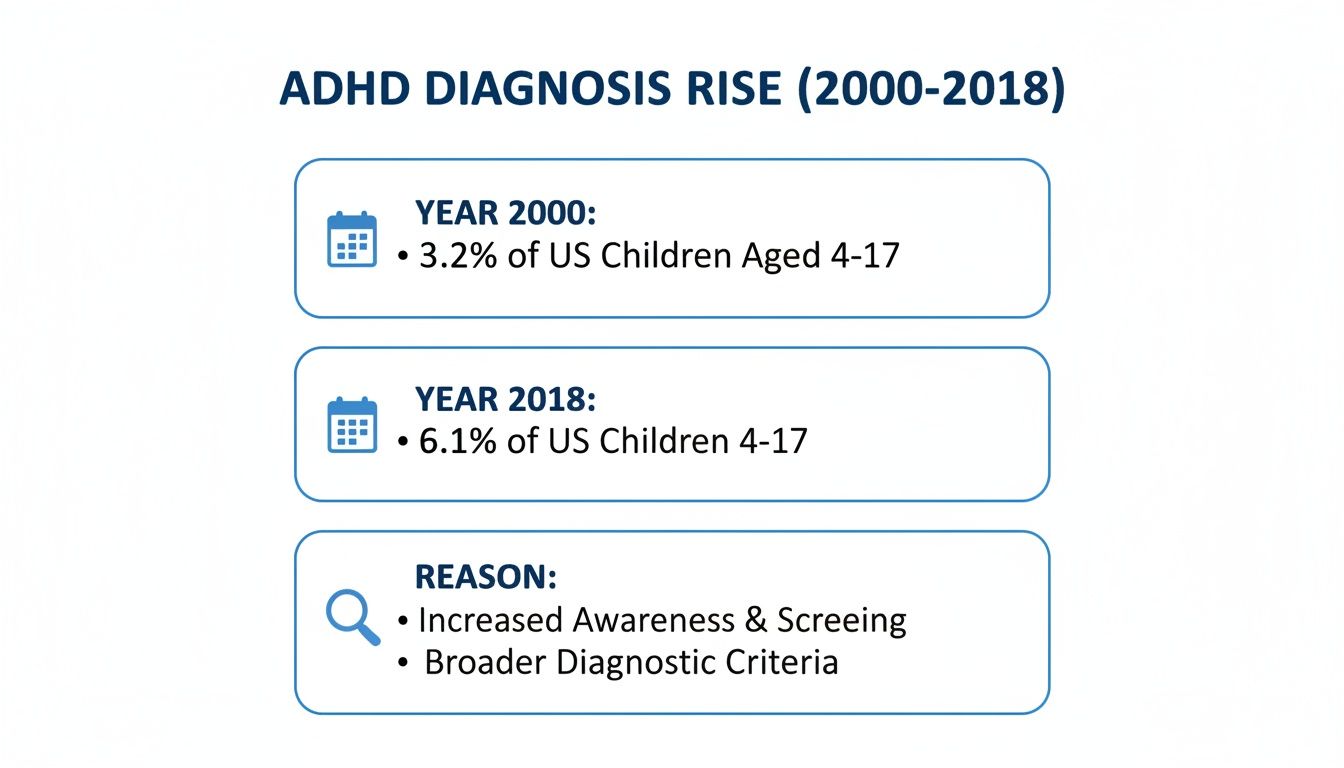
This sharp increase isn't an 'epidemic'; it's a reflection of better understanding. We've realised ADHD isn't just about hyperactive little boys, which has opened the door for so many more people—adults, women, and those with quieter, inattentive symptoms—to finally get the recognition they need. Pinpointing the correct presentation is a critical step, as it helps shape a much more effective and personalised plan for managing the condition.
Wondering what the next step looks like?
Only a qualified clinician can diagnose ADHD. Answer a few questions and we’ll shortlist clinics that assess people like you.
A Postcode Lottery: Why ADHD Diagnosis Varies So Wildly Across the UK
Trying to get an ADHD diagnosis in the UK can feel like a game of chance, and your postcode often determines the odds. The support you get, how long you wait, and whether your symptoms are even taken seriously can change drastically from one town to the next. This isn't just a feeling; it's a real, systemic problem rooted in deep regional and socioeconomic divides.
This inconsistency is why so many people feel utterly frustrated with the NHS pathway. You might hear of someone in a neighbouring county getting assessed in a reasonable time, while you're told the waiting list in your area is years long. Understanding this disparity is the first step—it validates your experience and gives you a clearer picture of the hurdles you might be up against.
These regional differences also connect back to the old confusion between ADHD and ADD. How symptoms show up—and whether they get noticed—is often shaped by a person's environment and the expertise available in their local health service.
How Socioeconomic Factors Skew Diagnosis
Research paints a complicated and often surprising picture of who gets diagnosed with ADHD in the UK. There's a stark socioeconomic divide where diagnoses are more common in deprived areas, yet getting consistent, effective treatment is much harder. It's a tough paradox for many families to navigate.
Data from 2000 to 2018 revealed that ADHD diagnoses were twice as high in the UK's most deprived areas compared to the wealthiest. But this doesn't mean better support follows. Prescription rates, which show who is getting access to treatment, are all over the map. For instance, Birmingham and Solihull saw a 51.5% increase in prescriptions, while Norfolk saw only a 4.5% rise in the same period. You can dig into the full findings on how ADHD diagnosis rates vary across the UK.
What this data suggests is a worrying trend. The more obvious, hyperactive symptoms of ADHD are more likely to be flagged in a school or home environment already under immense stress. In contrast, the quieter, inattentive symptoms—what people used to call ADD—can be easily missed or mistaken for a child being shy or unmotivated because of their circumstances, not because of a neurodevelopmental condition.
The hard truth is that a child's postcode can dictate their future. In one area, disruptive behaviour might trigger a clinical assessment. In another, it could just lead to disciplinary action, with the root cause never addressed.
This imbalance means countless individuals with inattentive ADHD are left behind, struggling in silence without a diagnosis or the support that could change everything for them.
The Knock-On Effect on NHS Waiting Times
So, why are the waiting times so wildly different? It all comes down to regional inconsistencies in funding, local commissioning priorities, and the availability of specialists. Each local Integrated Care Board (ICB) decides how much of its budget goes to mental health services, and ADHD assessments are just one piece of that puzzle.
This localised system creates a fragmented and unequal service where:
- Urban vs Rural Divides: Big cities might have more specialist clinics but are swamped with demand. Rural areas, on the other hand, often have a severe shortage of qualified clinicians.
- Funding Gaps: Some regions have simply never invested properly in adult ADHD services, leaving them completely unprepared for the recent explosion in awareness and referrals.
- Commissioning Priorities: Local health boards might decide other services are more urgent, pushing adult ADHD assessments down the list and shrinking the available budget.
The outcome is a system where your access to care is determined less by your actual needs and more by the postcode you live in. For many, this makes looking at other options feel less like a choice and more like a necessity. The long, unpredictable NHS waits are a direct result of this regional patchwork, which is why so many people decide to explore private assessments or use the NHS Right to Choose pathway to take back some control.
A Practical Guide to Private ADHD Assessment in the UK

Trying to get an ADHD diagnosis in the UK can feel like an uphill battle. Faced with frustratingly long NHS waiting lists, many people find that going private is the only realistic way to get the answers and support they need, sooner rather than later. This guide is here to walk you through that process, showing you what to look for in a clinic and how to make a decision you can feel confident about.
The biggest draw of the private route is speed. A wait that could stretch into years on the NHS can be cut down to a matter of weeks or months. For adults struggling with their careers, relationships, or mental health, that time is invaluable. Deciding to go private puts you back in control, but it does mean you need to do your homework to find a provider who is both reputable and right for you.
With NHS waiting lists now years long in some areas and research showing only 1 in 9 people with the condition are even identified in GP records, it's clear private clinics are filling a massive gap. Thankfully, there are platforms that let you compare UK-wide clinics, showing you transparent pricing and wait times, which can be just a few weeks. These also clarify what services are offered, such as online assessments. For a deeper dive into these diagnostic trends, the findings from UCL's extensive study offer some eye-opening context.
How to Choose a Reputable Private Clinic
Picking the right clinic is, without a doubt, the most important step you'll take. The quality of providers varies wildly, and a robust, thorough assessment from a qualified specialist is the only way to get an accurate diagnosis and a treatment plan that actually works.
First things first, draw up a shortlist of potential clinics. You're looking for providers who are completely open about their team's qualifications, their assessment process, and their pricing. A trustworthy clinic will have a professional website and will be more than happy to answer your questions before you spend a penny.
Here are the non-negotiables to check for:
- Clinician Qualifications: The assessment absolutely must be carried out by a consultant psychiatrist who is GMC-registered and specialises in adult ADHD. Anything less is a red flag.
- Adherence to NICE Guidelines: Make sure the clinic follows the National Institute for Health and Care Excellence (NICE) guidelines for ADHD diagnosis. This is the gold standard and ensures the assessment is comprehensive and will be recognised by the NHS.
- Transparent Pricing: There should be no hidden costs. Ask for a complete breakdown that includes the initial assessment, any follow-up appointments, and the fees for medication titration (the process of finding the right medication and dose for you).
- Shared-Care Agreements: This one is crucial for your long-term planning. You need to know if the clinic is willing and able to set up a shared-care agreement with your NHS GP once your condition is stable. This is what allows your GP to take over your prescriptions, bringing your costs down to the standard NHS fee.
Key Questions to Ask Before Booking
Once you've got your shortlist, it's time to start making calls or sending emails. Don't be shy about asking detailed questions—a good clinic will welcome them. Your goal is to get a crystal-clear picture of the entire journey, from your first appointment to your ongoing care.
Think of this as your pre-flight checklist:
- What does the assessment process actually involve? Find out how long it takes, what questionnaires they use, and if it includes interviews with you and maybe a close family member.
- Are your assessments online or in person? Many clinics now offer fully valid online assessments, which can be a much more convenient and accessible option.
- What are your current wait times for a first appointment? This is often the main reason people go private, so get a clear, up-to-date timeline.
- Can you give me a full cost breakdown for diagnosis and treatment? Get a detailed quote in writing that covers the assessment, the entire titration period, and any follow-up consultations to avoid nasty surprises.
- How do you handle shared-care agreements with NHS GPs? Ask them about their success rate and what support they offer to help get your GP on board.
Choosing a clinic isn’t just about getting a piece of paper with a diagnosis on it. It’s about finding a long-term partner in your health. Make sure their approach feels supportive and that they are genuinely committed to working with the NHS to ensure your care is sustainable.
Understanding the NHS Right to Choose Pathway
For anyone living in England, there's another brilliant option that sits somewhere between pure NHS and fully private care: the NHS Right to Choose (RTC). This is your legal right to choose which qualified healthcare provider you are referred to for your assessment and treatment, as long as they hold an NHS contract.
The RTC pathway can dramatically reduce your wait time compared to your local NHS service, but it remains funded by the NHS. To use it, you'll need a referral from your GP to your chosen provider. Many private clinics, like Psychiatry-UK and ADHD 360, also hold NHS contracts and accept RTC referrals. Our detailed guide explains more about how to navigate a private ADHD diagnosis and how it stacks up against other routes.
Whether you decide to go fully private or use the Right to Choose pathway, the key is to be your own best advocate. By researching your options thoroughly and asking the right questions, you can navigate the system and finally get the clarity and support you deserve.
Common Questions About ADHD Diagnosis and Assessment
Getting to grips with the ADHD diagnosis process can feel overwhelming, and it’s completely normal to have a lot of questions. As you start looking into an assessment, you'll likely run into queries about how it all works, especially in the UK. Let's clear up some of the most common ones to help you feel more prepared.
Think of this as a practical FAQ, tackling everything from different types of ADHD to the logistical hurdles you might face. The aim is to give you the confidence that comes from knowing what to expect.
Can You Have ADHD Without Being Hyperactive?
Yes, absolutely. This is precisely why the old 'ADD' term causes so much confusion. What people historically called ADD is now officially diagnosed as ADHD, Predominantly Inattentive Presentation.
This form of ADHD is all about the internal experience—the constant battle with focus, organisation, and memory—rather than the outwardly visible hyperactivity. The challenges are real and valid, they just don't look like the classic stereotype of a kid who can't sit still. It's often diagnosed later in life, particularly in adults and women, whose symptoms were missed for years because they didn't fit that narrow, outdated mould.
What Is a Shared-Care Agreement and Why Is It Important?
A shared-care agreement is a formal arrangement between your private specialist and your NHS GP, and it's one of the most important things to understand about private ADHD care in the UK.
Essentially, once your private clinician has diagnosed you and found the right medication and dosage to stabilise your symptoms, this agreement lets your GP take over writing the repeat prescriptions.
This is a game-changer for two big reasons:
- Cost: It moves you from paying for private prescriptions to paying the standard NHS prescription charge. This makes long-term treatment affordable for most people.
- Joined-up Care: It brings your ADHD treatment into your mainstream NHS healthcare, making sure your GP is kept in the loop about your condition and medication.
Before you book a private assessment, always ask if the clinic actively helps set up shared-care agreements. A clinic's commitment to working with the NHS is a pretty good sign that they're credible and focused on your long-term health, not just a one-off diagnosis.
Are Online ADHD Assessments as Credible as In-Person Ones?
Yes, as long as it’s done properly by a qualified clinician from a reputable clinic. A well-conducted online assessment is considered just as valid and reliable as a face-to-face appointment. The quality of the assessment is what matters, not where it happens.
Virtual assessments follow the exact same diagnostic rulebooks—the DSM-5 or ICD-11—that all clinicians use. The process is still rigorous, involving in-depth clinical interviews, a thorough review of your symptoms, and the use of standardised rating scales. Good clinics make sure their online process is robust and meets all the official NICE guidelines.
For many, online assessments are a huge help. They cut down on travel, reduce costs, and can often mean you get seen much sooner. They've become a standard, trusted way to diagnose ADHD in the UK.
Can I Get a Private Assessment if My GP Is Dismissive?
You certainly can. Most private ADHD clinics in the UK don't require a GP referral, allowing you to book an assessment directly. This is known as self-referral.
While a letter from your GP can be useful for sharing your medical history, it isn't essential. This is incredibly empowering if you feel your concerns aren't being taken seriously by your local surgery. It means you can still take the next step.
Just bear a couple of things in mind:
- You will need a GP referral if you want to use the NHS Right to Choose pathway to access a private provider through the NHS.
- Even with a private diagnosis, you’ll eventually need your GP on board to set up that all-important shared-care agreement for medication.
If you meet resistance from your GP, try going in prepared. A written list of your symptoms, clear examples of how they affect your daily life, and a printout of the official NICE guidelines for adult ADHD can sometimes help shift the conversation onto a more clinical footing.
Finding the right path to an assessment is the first real step toward getting the support you need. ADHD Private offers a free directory of over 85 clinics across the UK, so you can easily compare wait times, costs, and services.
Find the right ADHD clinic for you and take control of your journey today.