Your Guide to ADHD Test Free: Find an Online Screening Today
Explore free ADHD test options with online screeners and learn what to do next for a proper UK diagnosis.
Written and maintained by the ADHD Private editorial team, drawing on NHS, NICE and ADHD UK guidance. This is general information, not medical advice.
If you've ever typed "free ADHD test" into a search bar, you've probably seen dozens of quizzes pop up, all promising a quick answer. It's crucial to understand what these tests actually are—and what they aren't.
Think of them less as a test and more as a screener. They're a fantastic starting point for self-discovery, but they can't give you a medical diagnosis.
The Truth About Free ADHD Tests Online

Let's be honest, if you're struggling with constant disorganisation, a wandering focus, or an inability to just relax, you've likely wondered if there's a reason. Those online quizzes can feel like a lifeline, offering a potential explanation for challenges you've faced for years. But what do the results really tell you?
A good way to think about a free online screener is to compare it to a smoke detector. It’s an incredibly useful early warning system, designed to tell you that something might be wrong. When it beeps, it's a signal to pay attention and investigate.
But the smoke detector itself can't tell you if you've just burnt your toast or if there's a serious fire in the next room. It simply alerts you to the presence of smoke.
In the same way, an online ADHD test flags traits and behaviours commonly associated with the condition. It can be a genuine lightbulb moment, helping you connect the dots between your everyday experiences and recognised ADHD symptoms. It is not, however, the firefighter who comes in to assess the situation and decide what needs to be done. That vital role belongs to a qualified healthcare professional.
Screeners vs Clinical Assessments
A formal clinical assessment is a whole different ball game. It's a comprehensive investigation, not just a simple questionnaire. A specialist will conduct a deep dive into your entire history—from your childhood and school days to your current work and personal life.
They'll also work to rule out other conditions that can look a lot like ADHD, such as anxiety, depression, or even thyroid issues. This meticulous approach is the only way to get a truly accurate diagnosis.
A high score on a free ADHD test isn't a diagnosis. It's a sign that it’s time to investigate further and a brilliant way to structure a conversation with your GP or a specialist.
Understanding this distinction is key. It helps you manage your expectations and figure out what to do next. Taking a screener is a proactive, helpful first step, but it’s the beginning of the journey, not the final destination.
To spell it out, let's break down the key differences.
Online ADHD Screener vs Clinical Assessment
The table below highlights how a quick online screener differs from a comprehensive clinical evaluation conducted by a healthcare professional.
| Feature | Free Online ADHD Screener | Full Clinical Assessment |
|---|---|---|
| Purpose | To identify potential ADHD traits and suggest if a formal evaluation is a good idea. | To provide a definitive medical diagnosis and create a personalised treatment plan. |
| Process | Usually a short, self-reported questionnaire based on common symptoms (like the ASRS). | In-depth interviews, reviewing developmental history, and ruling out other conditions. |
| Conducted By | You, on your own, usually in just a few minutes. | A qualified healthcare professional, like a psychiatrist or specialist psychologist. |
| Outcome | An informal score suggesting a low, medium, or high likelihood of having ADHD traits. | A formal, recognised medical diagnosis that can be used to access treatment and support. |
Ultimately, seeing the difference helps you use the results from any ADHD test free of charge in the most empowering way possible: as the catalyst for seeking out the professional guidance you need.
What an Online ADHD Screener Actually Measures
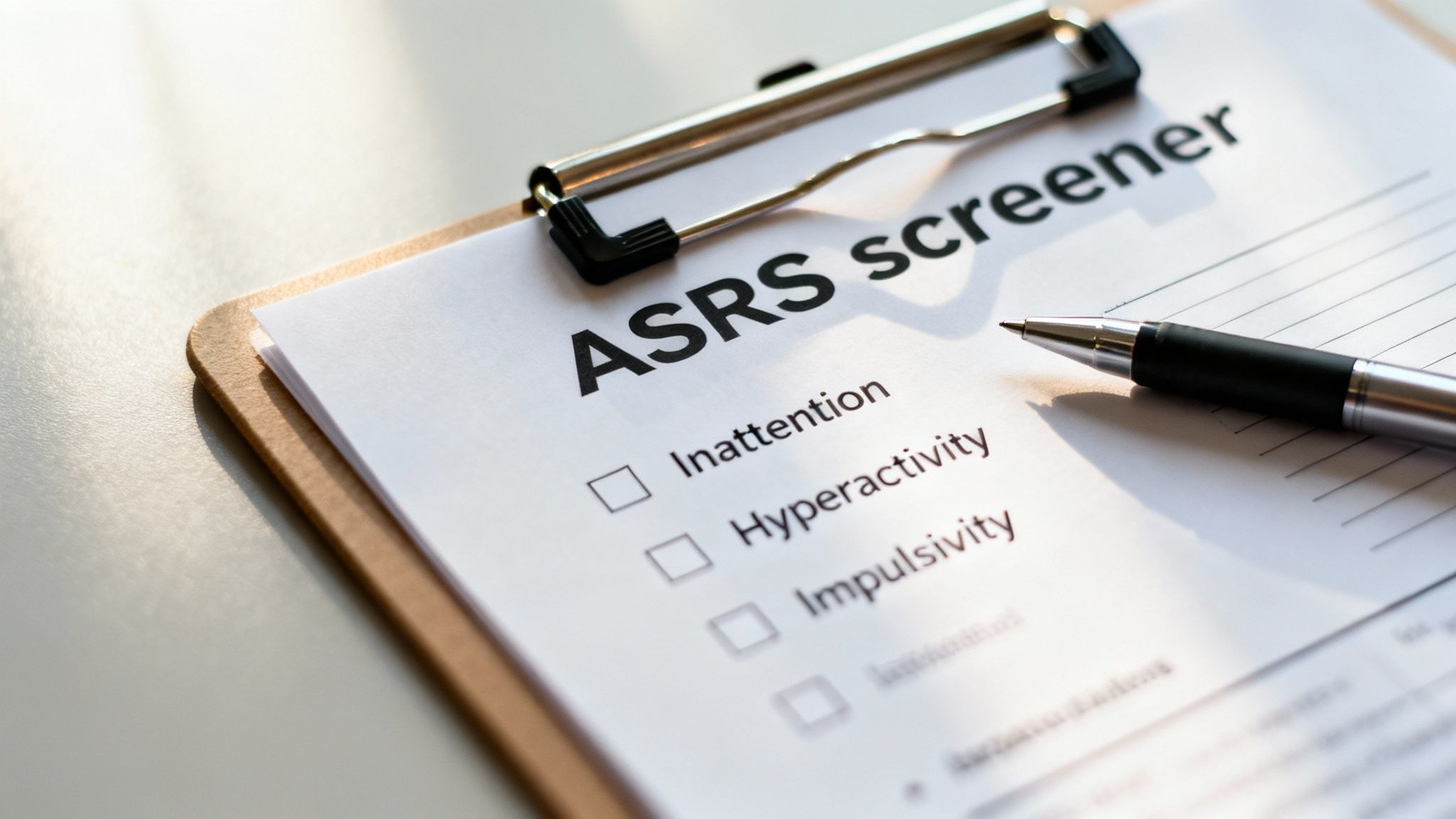
When you take a free online ADHD test, you're not just answering a random personality quiz. You’re engaging with a tool designed to mirror established clinical screeners, like the Adult ADHD Self-Report Scale (ASRS), which was developed in partnership with the World Health Organisation.
Think of it less as a test and more as a structured self-reflection. These screeners are built to help you spot patterns of behaviour that align with the core traits of Attention-Deficit/Hyperactivity Disorder. Their purpose isn't to slap a label on you, but to give you a framework for your experiences before you even think about speaking to a professional.
Decoding the Core Symptom Categories
The questions in a screener almost always fall into two buckets, which directly reflect the criteria clinicians use for a formal diagnosis: inattention, and the combined category of hyperactivity and impulsivity. To get a diagnosis, a professional needs to see a persistent and life-impacting pattern of symptoms in one or both of these areas.
Let's unpack what these categories actually mean day-to-day and how a screener tries to measure them.
1. Exploring Inattention
This is about so much more than just getting distracted or daydreaming. In the context of ADHD, inattention points to difficulties with executive functions—your brain's very own project manager.
A good screener translates these complex concepts into relatable, everyday frustrations.
- Sustaining focus: A question like, "How often do you have difficulty concentrating on what people say, even when they are speaking directly to you?" isn't asking if you get bored. It’s probing your brain’s ability to hold focus during a simple, direct interaction.
- Organisation and details: You might see, "How often do you depend on others to keep your life in order and attend to details?" This gets to the heart of managing tasks, appointments, and all the small things that keep life from falling apart.
- Avoiding mental effort: The classic procrastination question, "How often do you put things off until the last minute?", is a direct look at task initiation—a huge executive function hurdle for many with ADHD.
By framing these struggles as straightforward questions, a free ADHD screener provides a non-judgemental way to measure how often these issues really affect you. It helps turn vague feelings of being "disorganised" or "lazy" into something more concrete.
2. Identifying Hyperactivity and Impulsivity
This is probably the most misunderstood part of ADHD, especially in adults. It rarely looks like a child bouncing off the walls. Instead, adult hyperactivity is often an internal feeling of being driven by a motor, an intense inner restlessness you can't switch off.
Impulsivity is about acting without thinking, often with frustrating or significant consequences.
- Restlessness: A question like, "How often do you have difficulty unwinding and relaxing when you have time to yourself?" is a clever way of assessing that internalised hyperactivity. It asks if your mind and body are ever truly at ease.
- Physical fidgeting: You might be asked, "How often do you leave your seat in meetings when you are expected to remain seated?" This checks for the more classic, outward signs of hyperactivity that can definitely stick around into adulthood.
- Impulsive communication: "When you’re in a conversation, how often do you find yourself finishing other people's sentences?" is a perfect example. It highlights that struggle where the urge to speak overpowers the social skill of patient listening.
Each question is just one piece of a much bigger puzzle. Answering "often" to a single question doesn't mean much on its own. But if you see a consistent pattern of high-frequency behaviours across the board, it’s a strong signal that seeking a professional evaluation is a very sensible next step.
For a clearer picture of what that formal process involves, our guide to getting a professional online ADHD assessment in the UK breaks it all down.
What to Do With Your Screener Results
Getting a high score on a free ADHD test can be a huge moment. For many people, it’s the first time a lifetime of seemingly random difficulties—from missing deadlines to feeling constantly restless—suddenly makes sense. It can feel like a massive relief, but it’s also easy to get ahead of yourself.
The first thing to remember is this: an online screener is not a diagnosis. Think of it more like a well-informed nudge in the right direction. It’s a strong signal that your experiences are worth looking into more formally, but it's the start of the journey, not the final stop.
A High Score Is a Starting Point, Not a Conclusion
One of the biggest limitations of any online quiz is that it can't see the whole you. Self-reporting is a great first step, but a questionnaire can't distinguish between ADHD and other conditions that have similar, overlapping symptoms.
Lots of challenges that look and feel like ADHD on the surface can actually be rooted in something else entirely. For example:
- Trouble concentrating? That’s also a classic sign of anxiety.
- Low motivation and struggling to get going? That's a hallmark of depression.
- Feeling constantly on edge and fidgety? That could easily be chronic stress.
A simple quiz just isn't built to untangle these complex threads. That's precisely why the next logical step is to take your results and use them to start a conversation with a healthcare professional. Only a proper clinical assessment can rule out other possibilities and give you a clear, accurate picture of what's going on.
How to Turn Your Results into a Useful Tool
So, what now? Your goal is to take that screener score and transform it into something tangible and useful for your first GP appointment. A list of symptoms is one thing, but real-life examples are what truly paint the picture.
A high score gives you the 'what'—the symptoms you’re dealing with. Your job now is to gather the 'how'—the specific ways these issues affect your life at work, at home, and in your relationships.
Go back through your screener results. For every question where you scored highly, jot down a couple of specific, recent examples of it happening in your life. This turns abstract ideas into concrete evidence.
Documenting Your Real-Life Experiences
Let’s walk through what this looks like. Say the screener asked, "How often do you put things off until the last minute?" and your answer was "Very often."
Instead of just telling your doctor, "I procrastinate a lot," you can show them. You could say:
- At Work: "I had a major report due last month. I’d known about it for three weeks but couldn't bring myself to start until the night before. I ended up staying up until 3 AM, the work was rushed, and my manager even commented on the quality."
- At Home: "My car’s MOT was due. The reminder letter sat on the fridge for a month, but I only booked the appointment on the very last day it was valid. It cost me more because I had to take the only expensive slot left."
Doing this for your main symptoms builds a detailed personal log. This document is gold. It helps your GP immediately grasp the real-world impact of your struggles, making your conversation far more focused and ensuring you're taken seriously. Preparing like this is the single best way to go from a simple online adhd test free result to taking a meaningful step towards getting the clarity you deserve.
Wondering what the next step looks like?
Only a qualified clinician can diagnose ADHD. Answer a few questions and we’ll shortlist clinics that assess people like you.
Your Pathways to a Formal ADHD Diagnosis in the UK
So, you've taken a free online ADHD test and the results are pointing strongly towards ADHD. That’s a huge first step. It gives you a framework for understanding your experiences, but the real journey begins now: seeking a formal, clinical diagnosis.
In the UK, there isn't just one road to getting answers. You've got a few different options, and each comes with its own timeline, process, and cost. Getting your head around these pathways is the key to making a smart choice that actually works for you. Think of it like planning a trip – knowing the routes helps you avoid the traffic jams.
The Standard NHS Pathway
For most of us, the first thought is to go through the NHS, starting with a trip to the local GP. This is the traditional, and most well-trodden, path.
It usually unfolds like this:
- Book a GP Appointment: First things first, you’ll need to get in to see your doctor to talk about your symptoms and the screener results you have.
- Lay It All Out: In the appointment, be ready to explain exactly how these symptoms are impacting your day-to-day life. This is where bringing those notes and real-world examples we talked about earlier becomes so important.
- Get the Referral: If your GP agrees that an assessment is the right next step, they will refer you to your local NHS adult ADHD service.
The big hurdle here? Time. It's no secret that waiting lists for NHS ADHD assessments can be incredibly long. We’re often talking months, and in many parts of the country, it can stretch to several years. While this route won't cost you anything, that long wait can be a massive barrier if you need support sooner rather than later.
It's easy to feel disheartened by a long wait, but try to remember it's a reflection of system-wide pressures, not a judgement on you or your struggles. Just getting that referral in the system is a win.
This lengthy delay is exactly why many people start looking for other ways to get an assessment.
The Right to Choose Pathway in England
If you're based in England, you have access to a fantastic option called Right to Choose (RTC). In a nutshell, this NHS policy gives you the right to choose your provider for an ADHD assessment, as long as they hold an NHS contract. This includes a growing number of private clinics.
Think of it as the NHS giving you a voucher. The assessment is still funded by the public purse, but you can take that "voucher" to an approved private provider instead of being stuck on your local NHS waiting list. The result? A much, much shorter wait.
To go down this route:
- Find an RTC Provider: You’ll need to do a bit of homework to find a private clinic that accepts Right to Choose referrals.
- Tell Your GP: You must specifically ask your GP to refer you using Right to Choose and give them the name of the clinic you've picked.
- The GP Refers You: Your doctor then sends the referral directly to your chosen provider, bypassing the local NHS service.
This pathway can slash your waiting time from years down to just a few months, all without you having to pay a penny. It has become an absolute lifeline for thousands of people who need a timely diagnosis.
For a deeper dive, check out our complete guide on the ADHD diagnosis UK process, which walks you through every step.
The Fully Private Pathway
For anyone who needs answers as quickly as possible, or for those living outside of England, going fully private is the most direct route. This means you pay for the assessment and any follow-up treatment yourself.
The undeniable advantage here is speed. Wait times at private clinics are often just a matter of weeks. This gives you fast-track access to a diagnosis, medication if it's right for you, and other professional support.
This flowchart maps out what happens after a high screener score, guiding you towards a GP who can talk you through all these options.
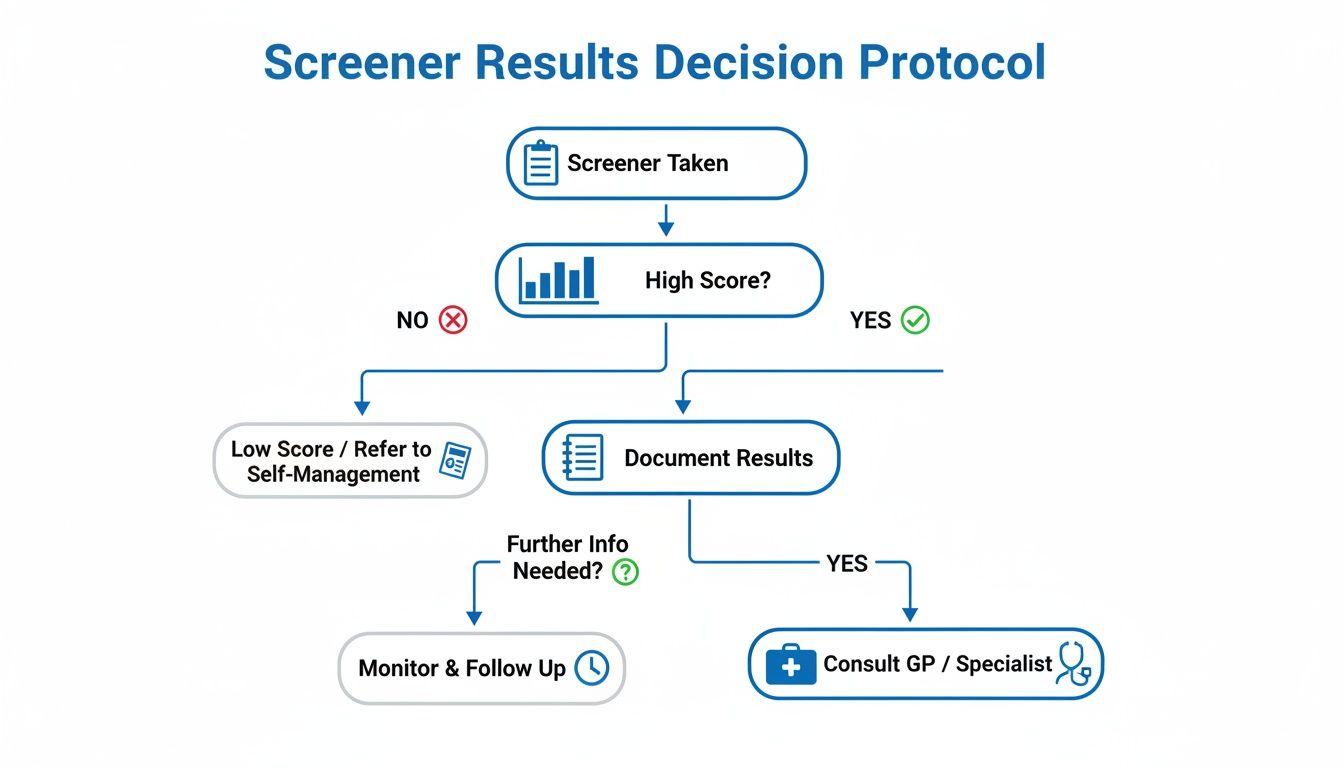
The cost for a private assessment varies quite a bit from one clinic to another, so it’s really important to shop around and compare what’s on offer.
Ultimately, the best path for you comes down to your personal circumstances—where you live, your budget, and how urgently you feel you need that support. Using a directory like ADHD Private can make this so much easier, allowing you to compare clinics, see their waiting times, and check if they offer Right to Choose, all in one place.
Here is the rewritten section, designed to sound more human and natural:
The Reality of Getting an ADHD Assessment in the UK
If you’re looking into pathways like Right to Choose or private care, you’re not alone. There's a very real and growing challenge with ADHD diagnosis in the UK, and understanding this bigger picture helps explain why finding an assessment can feel like such an uphill battle.
Struggling to get an appointment isn't a personal failure. Far from it. It’s a symptom of a healthcare system stretched to its limits, trying to keep up with a huge surge in demand that has only become apparent in recent years.
When you look at the numbers, you start to see the massive gap between how many people likely have ADHD and how few have ever been formally diagnosed.
The UK's ADHD Diagnosis Gap
The statistics paint a pretty stark picture. Research points to a major ADHD diagnosis gap, with some evidence suggesting that only 1 in 9 people in the UK with the condition have actually received a professional diagnosis. One deep dive into nine million GP records found that a tiny 0.32% had an ADHD diagnosis noted down.
What does that mean in real terms? It suggests around three million people across the UK are probably living with ADHD, yet fewer than 340,000 of them have a formal diagnosis. This problem is only getting bigger. NHS England alone has over 549,000 children and adults currently on a waiting list for an ADHD assessment, and that number keeps climbing. You can dig into the full research on the ADHD diagnosis rate in the UK to see the data for yourself.
This enormous backlog puts everyone in a difficult position. The NHS is full of incredibly dedicated professionals, but the resources simply haven't kept pace. It’s this system-wide pressure that has caused waiting lists to swell, often stretching out for several years in some parts of the country.
The immense pressure on NHS services is why exploring other avenues makes so much sense. It’s not about skipping a queue; it’s about finding a practical way to get the support you need when the system is struggling to cope.
For many people, waiting years for an assessment just isn't an option. When your symptoms are impacting your job, your relationships, and your mental health, getting answers becomes urgent. This is exactly why alternative pathways have become so crucial.
Why Alternatives Are So Important
These long waits are what make options like Right to Choose in England and private care so vital. They’re not just about convenience; they’re a necessary solution to a system that’s completely overwhelmed.
- Right to Choose: This pathway is like a release valve for the NHS. It allows people in England to get NHS-funded care from an approved private provider, often with a much, much shorter wait.
- Private Care: For anyone who needs help as quickly as possible, or for those living outside of England, paying for a private assessment provides direct access to specialists without the long delays.
Both of these routes offer a lifeline to people who would otherwise be stuck in limbo, struggling without a diagnosis or any kind of treatment plan. Understanding this context is key to seeing why a resource like the ADHD Private directory can be so helpful.
Our directory is more than just a list of clinics. It’s a tool built to help you navigate this complicated and often frustrating landscape. By pulling together information on wait times, costs, and Right to Choose availability, it gives you the power to make an informed choice and take control of your journey. It helps you turn the hunch you got from a free online ADHD test into a real, actionable plan.
Finding the Right ADHD Clinic for You
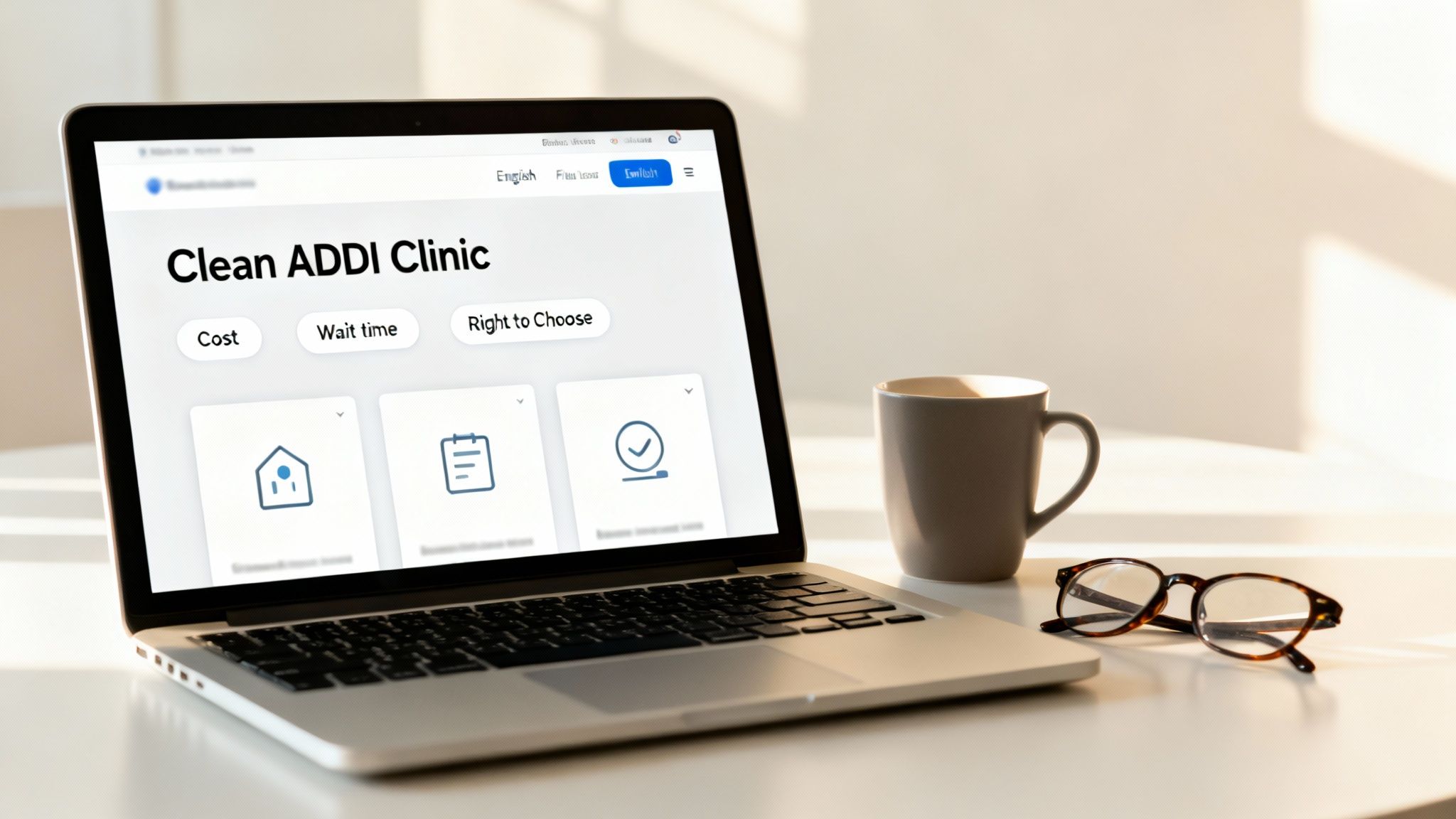
So, you’ve taken an online ADHD test, and the results have given you some food for thought. But what’s next? Making the leap from a simple screener to seeking a formal assessment can feel like a mammoth task.
If you’ve started looking, you’ll know the feeling. You spend hours clicking through clinic websites, trying to decode confusing fee structures and work out what "shortly" means in terms of waiting times. It’s easy to get lost and feel completely overwhelmed. That's where a bit of organisation can make a world of difference.
You need a way to cut through the noise and get straight to the facts. That's exactly why we built the ADHD Private directory. It’s a completely free-to-use tool that we designed to put you back in the driver's seat, pulling all the crucial details into one simple, searchable place.
Using the Directory to Filter Your Options
Think of our directory as your own personal research assistant. Instead of juggling a dozen open tabs and a messy spreadsheet, you can see a clear comparison of clinics in just a few minutes. Our filters are there to help you narrow the field and find providers that actually match what you need.
You can instantly sort clinics by the things that matter most to you:
- Filter by Cost: See the starting price for an assessment at a glance, so you can immediately find options that work with your budget.
- Check Wait Times: Get a realistic idea of how long you’ll be waiting for an appointment, helping you find a faster route if that's a priority.
- Verify Right to Choose: If you’re in England, this is a big one. You can quickly see which clinics accept NHS Right to Choose for ADHD referrals, saving you the headache of digging for that information yourself.
The whole point is to turn that feeling of uncertainty into one of confident action. When you can see all the key data side-by-side, you can make a choice based on clear facts, not frustration.
From Self-Reflection to Decisive Action
Taking a free ADHD test is a moment of self-reflection; it helps you connect the dots and see patterns in your life. The next logical step is turning that insight into action. Our directory is built to bridge that exact gap, making the process of finding a professional assessment as straightforward and transparent as possible.
You can also see other important details, like whether a clinic offers online assessments, if they have shared-care agreements with the NHS after diagnosis, and what other people’s experiences have been like.
Ultimately, this is all about giving you the information you need to move forward. By using the ADHD Private directory, you can create a shortlist of suitable clinics, feel confident about your choice, and take that next big step towards getting the clarity you’re looking for. It transforms a daunting task into a manageable, focused search.
Your Questions Answered: What to Do After a Free ADHD Test
Taking that first step with an online screener can open up a flood of questions. What do the results really mean? What happens next? Let's clear up some of the most common queries to help you feel more certain about your path forward.
How Accurate Are Free Online ADHD Tests?
Think of a free online test as a signpost, not a destination. It’s pretty good at pointing out that you might have ADHD traits, which makes it a genuinely useful first step.
However, it is not accurate enough to give you a clinical diagnosis. A high score on a free ADHD test is simply a strong signal that it’s time to chat with a professional. A proper diagnosis can only come from a specialist who can dig deeper, understand your full history, and make sure other conditions with similar symptoms, like anxiety or depression, aren't the real issue.
Should I Show the Results to My GP?
Yes, definitely. Taking your results to a GP appointment is a brilliant idea. It provides a clear, structured starting point for the conversation and demonstrates that you've already put serious thought into your symptoms.
To make that conversation as productive as possible, don't just show them the score. Come prepared with specific, real-life examples of how these struggles affect you day-to-day – at work, at home, or in your relationships. This context turns a number on a screen into a compelling story.
What’s the Difference Between a Screening and an Assessment?
This is a really important distinction, and it's easy to get the two mixed up. They sound similar, but they're completely different parts of the process.
- An ADHD Screening: This is the quick, preliminary check you've just done online. Its job is simply to flag whether you have enough signs of ADHD to justify a closer look. It’s the starting line.
- An ADHD Assessment: This is the real deal – a comprehensive medical evaluation carried out by a qualified clinician, like a psychiatrist. It involves in-depth interviews, looking back at your personal and developmental history, and ruling out anything else that could be causing your symptoms. Only a full assessment leads to a formal, recognised diagnosis.
Knowing the difference helps you see your screener results for what they are: a valuable tool to start a conversation, not the final word on your health.
Ready to find a clinic for a formal assessment? The free directory from ADHD Private makes it easy to compare private clinics across the UK. Check wait times, compare costs, and see which providers accept Right to Choose referrals all in one place. Start your search for a private ADHD assessment.