Your Guide to Right to Choose ADHD Assessments
Understand how Right to Choose ADHD works in the UK, covering eligibility, GP referrals, and choosing a provider for your NHS-funded assessment.
If you're facing a seemingly endless NHS waiting list for an ADHD assessment, it can feel incredibly disheartening. But there's a lesser-known route that can make a huge difference: the Right to Choose ADHD pathway. This is your legal right as a patient in England to choose a qualified provider for your assessment, even if it's a private clinic, and have the NHS fund it.
Essentially, it lets you bypass those long local delays and get seen much, much faster—all without costing you a penny.
Understanding Your Right to Choose ADHD Assessment
Think of the Right to Choose pathway like having a special pass for your healthcare. Instead of being automatically funnelled into your local mental health service and joining its queue, you're given the power to pick an alternative provider—as long as they have a contract to provide that service to the NHS.
This isn't some loophole; it's a right written into the NHS Constitution for England. It hands you back some control, letting you find a specialist clinic that might have significantly shorter waiting times than your local service.
To break it down, here are the core principles of how Right to Choose works for you.
Right to Choose at a Glance
| Key Aspect | What It Means for You |
|---|---|
| Patient Choice | You can choose any qualified provider in England that has an NHS contract for ADHD assessments. |
| NHS-Funded | The assessment is completely free. The NHS pays the provider directly, not you. |
| Eligibility | You must be registered with a GP in England to use this right. |
| GP Referral | You still need a referral from your GP, but you direct them on where to send it. |
| Reduced Wait Times | This is the biggest win. It often cuts the wait for an assessment from years down to months. |
This pathway exists for a very good reason, and it's a game-changer for so many people.
Why Is This Pathway So Important?
The stark reality is that countless people are living with undiagnosed ADHD. A massive analysis of 9 million GP records found that only 0.32% of the population had a formal diagnosis. This suggests there could be over two million people in the UK grappling with unmanaged symptoms, highlighting a huge gap between how common ADHD is and how often it's actually diagnosed. You can read more about this ADHD diagnosis data in the UK.
This isn't about skipping the queue; it's about choosing a different, often faster, queue that the NHS has already approved and will pay for. It puts you back in the driver's seat of your own health journey.
This pathway offers a practical solution for anyone who feels stuck in limbo. It directly addresses the urgent need for timely assessments and support, which can be genuinely life-changing. For many, getting that diagnosis is the first crucial step towards self-understanding and finding strategies that finally work.
It's important to be clear: when you exercise your Right to Choose, you're not "going private" in the traditional sense. You're simply using your entitlement to access NHS-funded care through a different, approved, and often more efficient provider. The whole process is free at the point of use, exactly as it would be through your standard local NHS service.
Confirming Your Eligibility for Right to Choose
Before diving into the process, it’s worth taking a moment to make sure the Right to Choose pathway is actually open to you. Think of it as checking your passport is in date before you book a holiday – it’s a simple but vital first step that can save a lot of headaches down the line.
Thankfully, the eligibility rules are pretty straightforward.
The absolute number one requirement is that you must be registered with a GP in England. This is the big one. Right to Choose is a legal right set out in the NHS Constitution for England, so it’s specific to the English healthcare system. Unfortunately, this means it isn’t an option for residents of Scotland, Wales, or Northern Ireland, as their healthcare systems operate differently.
The Core Eligibility Checklist
Once you've ticked the 'GP in England' box, there are just a couple of other things to confirm. Getting these sorted ensures the whole process is much smoother when you speak to your doctor.
Here’s exactly what you need to be eligible:
- You are registered with a GP practice in England. This is true for both adults and children needing an ADHD assessment.
- The referral is clinically necessary. This just means your GP has to agree that your symptoms warrant an assessment for ADHD. Our guide on how to get an ADHD diagnosis has some great tips on how to prepare for this conversation.
- You choose a provider that has an NHS contract. The clinic you pick must hold a standard NHS contract to deliver ADHD services. You'll find that most well-known providers who accept Right to Choose referrals make this very clear on their websites.
It’s no secret that there’s been a huge increase in people looking for support recently. The UK has seen a massive spike in ADHD referrals, not because ADHD is suddenly more common, but because awareness has grown. We're finally starting to recognise how many people, especially adults, were missed in the past. If you're interested, you can read more about the trends in ADHD diagnosis rates to understand the bigger picture.
Fundamentally, if your GP agrees you need an ADHD assessment and you are registered in England, you have the legal right to choose where that NHS-funded assessment takes place.
Knowing you meet the criteria is empowering. It gives you the confidence to walk into your GP appointment, have a productive conversation, and move forward. It takes away the guesswork and confirms you're using a recognised and valid route to get the answers you need. Your location and your clinical need are the only real hurdles.
How to Secure a Referral from Your GP
Walking into your GP's office to talk about a possible ADHD assessment can feel like a massive step. It’s completely normal to worry about not being taken seriously or even just figuring out how to start the conversation. The good news is that a little preparation can make all the difference, turning what feels like a daunting task into a straightforward, successful appointment.
The aim here isn't to ask for permission. It's to confidently explain your symptoms and state that you're using your Right to Choose for an ADHD assessment. You're simply informing your GP of your legal right and asking them to make the referral to the provider you've selected.
Preparing for Your Appointment
Going into your appointment with everything ready makes the entire process smoother for everyone involved. When you’re well-prepared, it shows your GP you’ve done your homework and helps them understand your request without any fuss. This drastically reduces the chance of any mix-ups and makes it much easier for them to simply say yes.
Before you go, make sure you have these things with you:
- A Symptom List: Jot down specific, real-life examples of how you think ADHD is affecting you. Think about your work, your relationships, and how things are at home.
- Your Chosen Provider: Have the name and contact details of the clinic you've picked. Most qualified providers have a page on their website with information specifically for GPs, which is incredibly helpful.
- A Template Letter: A pre-written letter that clearly lays out your request is a game-changer. You can hand it straight to your GP during the appointment or attach it to an online consultation form.
This simple flowchart lays out the exact eligibility criteria your GP needs to confirm.
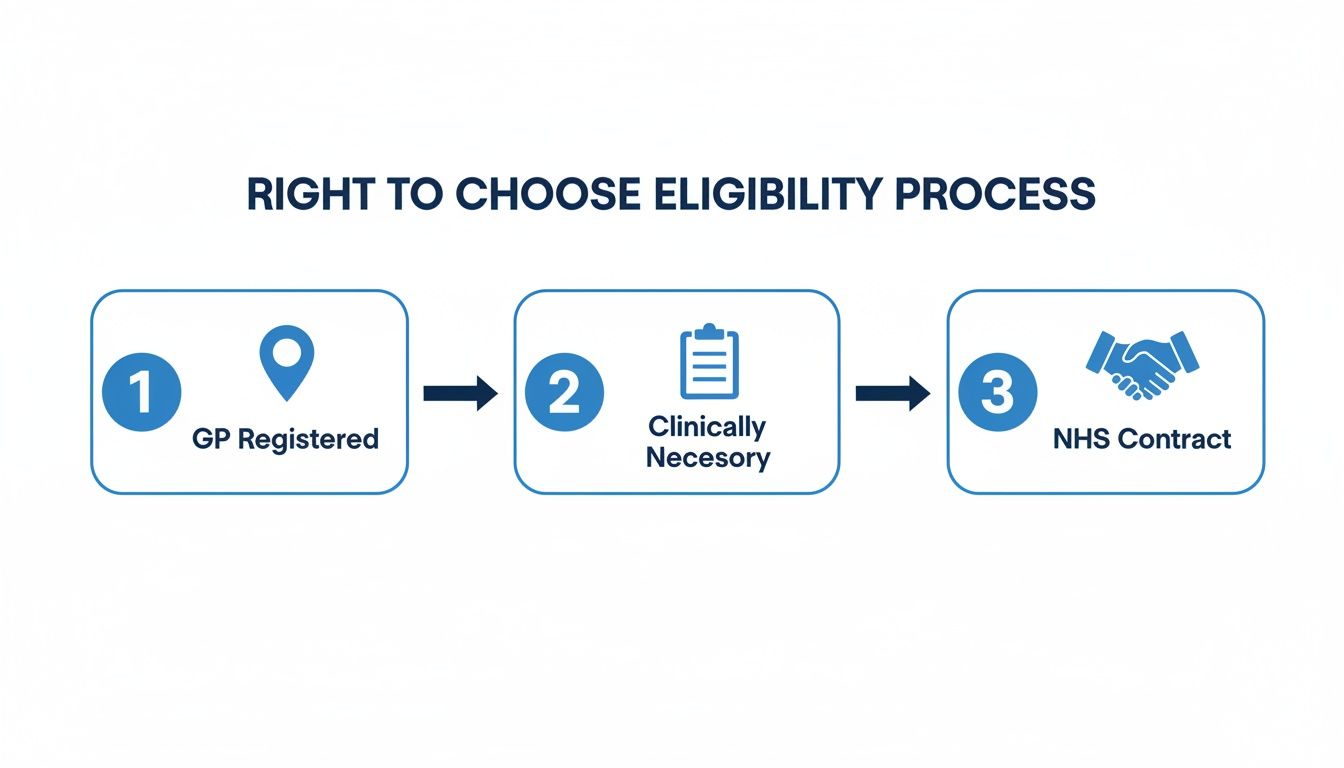
As the visual guide shows, it all boils down to three core points: being registered with a GP in England, having a genuine clinical need for the assessment, and choosing a provider that holds an NHS contract.
To help you feel fully prepared, use this checklist to gather your thoughts and documents.
| GP Conversation Checklist |
|---|
| Preparation Step |
| Write Down Your Symptoms |
| Research and Select a Provider |
| Print Your Provider's GP Info Pack |
| Prepare or Print a Template Letter |
| Familiarise Yourself with NHS Guidance |
Having these items ready will boost your confidence and show your GP that you've come prepared for a collaborative conversation.
What to Say to Your GP
Getting the conversation started is often the hardest part. You don't need a complicated opening; simple and direct works best.
You could try opening with something like, "I've been struggling with some issues that I believe could be symptoms of ADHD, and I'd like to talk about getting a referral for an assessment."
From there, you can briefly explain what you've been experiencing and then introduce your request to use the Right to Choose pathway.
Example Script: "I've been looking into the options and I'd like to use my legal Right to Choose to be referred to [Provider's Name] for my ADHD assessment. They are a qualified provider with an NHS contract, and I've brought a letter with all their details for you."
This approach is polite but also firm and informative. You’re making your request clear while giving the GP everything they need to act on it.
Handling Potential Pushback
Now and then, you might find a GP isn't fully up to speed with the Right to Choose rules, particularly for mental health. They might mistakenly think it only applies to physical health, or that they have to refer you to the local NHS service first.
If you meet any resistance, the key is to stay calm and advocate for yourself politely.
- Point to Official Guidance: You can gently mention that the Right to Choose is a legal right set out in the NHS Constitution for England and that it absolutely covers most mental health services, including ADHD assessments.
- Share Your Information: Offer to show them the provider's information pack or send them a link to the relevant page on the NHS website.
- Stay Firm but Polite: You could say something like, "I appreciate there can be some confusion around the rules, but the NHS guidance is quite clear that I am entitled to this choice. I would be really grateful if you could make the referral as I've requested."
Remember, knowledge is your best tool here. Understanding your rights and having the right documents to hand changes the dynamic. It's no longer just a request for help; it's a collaborative and informed step towards getting the support you need.
Choosing the Best ADHD Assessment Provider

So, your GP is on board with the referral. Great! Now comes the really important part: picking the right provider for your assessment. It’s tempting to just go with the first one you find, but taking a bit of time here can make a massive difference to your whole experience.
Think of it like choosing the right specialist for any other health concern. You want someone you trust, whose approach fits you, and who makes the process as clear and supportive as possible. A little research now will pay off down the line.
Key Factors to Compare
Your main goal is to find a clinic that balances a reasonable waiting time with high-quality care and a process you’re comfortable with. As you start looking at different providers, try to get a clear picture of a few key things to help you narrow down your options.
Here are the absolute must-knows for any provider you're considering:
- Current Waiting Times: Let’s be honest, this is probably why you're using Right to Choose ADHD in the first place. Check each clinic's website for their latest wait times. A crucial detail to look for is whether they have a second, separate waiting list for starting medication (called titration) after you get a diagnosis.
- Assessment Process: Are they fully remote, or do they offer in-person appointments? A lot of people love the flexibility of doing it from home, and you can get a good idea of what an online ADHD assessment in the UK involves. Just think about which setup would work best for you.
- Patient Reviews: What are real people saying? Scour sites like Google and Trustpilot for reviews. First-hand accounts are gold dust for understanding how a clinic actually operates – things like their communication, how they treat patients, and the overall quality of their service.
- NHS Contract Verification: This is the deal-breaker. The clinic must have a standard NHS contract to qualify for Right to Choose. Any legitimate provider will shout about this on their website, usually in a section for GPs or on their FAQs page. If you can't find it, be wary.
Making a Confident Decision
Once you've got this info, you can start comparing your shortlist. One clinic might have a super-short wait for the assessment itself but a much longer one to start treatment. Another might have a slightly longer initial wait but brilliant post-diagnosis support.
The best choice is simply the one that fits your unique situation. Be clear on what you need most. Is it a fast diagnosis above all else? Or is the long-term support structure more important to you?
Try to look at the entire journey, not just the first step. A quick assessment is a huge relief, but knowing what happens next with treatment and shared care is just as vital. By weighing up all these points, you can pick a provider with confidence and give your GP a clear, well-researched choice for your referral.
Navigating Shared Care After Your Diagnosis
Getting your ADHD diagnosis is a massive milestone, but it's really just the start of the next chapter: figuring out how to manage things for the long haul. This is where something called a Shared Care Agreement (SCA) comes into play.
Think of it as a formal handshake between your specialist ADHD provider and your local GP. It’s a practical document that clearly spells out who does what, paving the way for your GP to take over prescribing your medication. Essentially, this agreement bridges the gap between your specialist diagnosis and getting affordable, ongoing prescriptions through the NHS.
This kind of teamwork is vital. Under NHS guidelines, only a specialist can kick off ADHD medication and oversee that initial trial-and-error phase to get your dose right (a process called titration). Once you’re settled on a stable medication plan, the SCA lets your GP seamlessly take over the day-to-day care.
Understanding Each Person's Role
For a Shared Care Agreement to work, everyone needs to be on the same page. It’s a three-way partnership, and each person has a distinct job to do to keep your treatment safe and effective.
Here’s a simple breakdown of who is responsible for what:
- Your Specialist's Role: They handle the diagnosis and manage the titration process to find the perfect medication and dose for you. They draw up the Shared Care Agreement and will still need to see you for annual reviews to check in on your ADHD.
- Your GP's Role: After signing the agreement, your GP becomes the one who issues your regular prescriptions. They’ll also keep an eye on your physical health, like checking your blood pressure and heart rate, and be your first port of call for any immediate health worries.
- Your Role: It's up to you to take your medication exactly as prescribed, show up for all your appointments (with both your GP and specialist), and speak up immediately if you notice any side effects or have any concerns.
This setup ensures you get consistent, joined-up care from the experts who know your condition and the doctor who knows your overall health best.
When a GP Declines a Shared Care Request
Unfortunately, things don't always go to plan. A GP might decline to enter into a Shared Care Agreement, which can feel incredibly disheartening after everything it took to get a diagnosis.
A GP is not legally obligated to accept a Shared Care Agreement. Their decision often comes down to their confidence in the diagnosing provider, their own clinical capacity, or local NHS commissioning policies.
If this happens to you, the first step is to have a calm, open conversation with your GP to find out why. They might have valid concerns about the provider you used, or perhaps they’re just not familiar with the process. You can ask your specialist to send the GP more detailed information to help put their mind at ease.
If they still say no, you have the right to ask for a second opinion from another GP at the practice or even switch to a new surgery altogether. Our in-depth guide to ADHD shared care can give you a clearer plan for handling these bumps in the road. Without a signed SCA, your only option is to continue paying for private prescriptions, which can get very expensive over time.
Got Questions About Right to Choose? Let's Clear Things Up
Even when you know the basics, it's completely normal to have a few questions buzzing around your head about how Right to Choose works in the real world. Healthcare systems can feel like a maze, and you want to be sure you're getting it right.
Let's dive into some of the most common queries we see. We'll give you straight, simple answers to help you feel confident, covering everything from costs to what to do if your GP seems a bit hesitant.
So, How Much Does a Right to Choose ADHD Assessment Actually Cost?
This is usually the first thing people ask, and the answer is refreshingly simple: it costs you nothing. A Right to Choose ADHD assessment is 100% free. The provider you choose sends the bill directly to the NHS, so you never see it.
The part you do need to think about is the cost of medication right after you get a diagnosis. While the assessment is free, you will likely need to pay for your private prescriptions while your medication is being adjusted. This initial period is called titration.
These private prescription costs will continue until your GP officially takes over your care through something called a Shared Care Agreement. Before you commit to a provider, always ask them for a clear breakdown of their medication and titration fees. That way, there are no nasty surprises down the line.
What if My GP Says No to My Referral?
It’s a real gut-punch when your GP refuses your Right to Choose request, but don't panic. More often than not, this comes down to a simple misunderstanding of the rules, not a deliberate attempt to block you.
Your first move should be to politely ask them why they've said no. They might not realise the rules apply to mental health services, or they might think they can only refer you to the local NHS team.
If this happens, here’s your game plan:
- Share the Official Guidance: Gently point them towards the official NHS guidance on Right to Choose. It clearly states that the rules cover most mental health conditions, including ADHD.
- Ask for a Second Opinion: You are well within your rights to book an appointment with a different GP at the same practice.
- Go a Step Higher: If the whole practice is being unhelpful, you can raise the issue with your local Integrated Care Board (ICB) or contact the NHS England Customer Contact Centre for help.
A GP's refusal is rarely the end of the story. Think of it as an information gap. With a bit of patience and the right official documents, you can usually get things sorted.
I've Already Paid for a Private Diagnosis. Can I Still Use Right to Choose?
This is a common one. Generally speaking, the Right to Choose pathway is for getting your first assessment. If you've already gone to a private clinic and paid for a diagnosis, you can't use this route to get the NHS to pay you back for it.
The pathway is all about future care, not past expenses. In some very specific situations, you might be able to use Right to Choose to get NHS-funded follow-up care or medication titration from a qualifying provider. However, this can be tricky and really depends on the policies of your local ICB. Your GP is the best person to ask about the options available in your specific area.
How Long Will I Be Waiting for a Right to Choose Provider?
This is the main reason most people go down the Right to Choose route: the waiting lists are dramatically shorter. While you could be waiting for years on your local NHS list, most Right to Choose providers can see you within a few months.
That said, it isn't instant. The exact wait time can vary quite a bit from one clinic to another, depending on how popular they are and how many people they can see. Some of the well-known providers might have waits of six months or more, so it's vital to do your homework.
Before you ask your GP to send off a referral, always check the provider’s website for their latest estimated waiting times. This helps keep your expectations realistic and ensures you pick a clinic with a timeframe that works for you.
At ADHD Private, we've built a free directory to help you compare over 85 clinics across the UK. You can check their transparent wait times, pricing, and services to find the right provider for your ADHD assessment journey. Find your ADHD clinic on ADHD Private