A Quick Guide: Online ADHD Assessment for UK Residents
Discover online adhd assessment uk options, how private assessments work, and find trusted UK clinics with clear costs.
Written and maintained by the ADHD Private editorial team, drawing on NHS, NICE and ADHD UK guidance. This is general information, not medical advice.
If you're facing a seemingly endless wait for an ADHD assessment in the UK, you're not alone. An online ADHD assessment has become a popular and effective alternative, cutting potential wait times from several years down to just a few weeks. It's a full clinical evaluation, just like one you'd have in person, but conducted from the comfort of your own home via video call with a qualified specialist.
Why Online ADHD Assessments Are a Lifeline in the UK

The rise of online ADHD assessments isn't just a trend; it's a direct response to a healthcare system straining at the seams. For thousands of adults, the traditional NHS route involves frustratingly long waiting lists that can stretch for years. This isn't just an inconvenience—a long delay can seriously affect your job, relationships, and overall mental health.
This is where private online clinics have stepped in to fill a crucial gap. They offer a genuine lifeline for people who simply can't put their lives on hold. Think of the NHS pathway as a motorway stuck in rush hour traffic, where you're barely moving. An online assessment, in contrast, is like finding a clear, open A-road—it gets you where you need to be, much, much faster.
The Core Benefits of a Virtual Assessment
Opting for an online assessment brings some real-world advantages that tackle the biggest hurdles in getting a diagnosis. For many, these benefits make the entire process feel more achievable.
Speed and Accessibility: This is the big one. You can often get an appointment within a matter of weeks, which means a quicker diagnosis and, if needed, a much faster start to treatment.
Convenience and Comfort: Being assessed from your own home cuts out the travel time, cost, and stress of getting to a clinic. This is a huge plus if you struggle with anxiety, have mobility issues, or are juggling a busy work and family life.
Access to Specialists: Online clinics give you access to a much wider pool of ADHD specialists from all over the UK. You’re no longer stuck with who's available in your local area, so you have a better chance of finding a clinician who really understands you.
It's important to remember that a proper online ADHD assessment isn't a shortcut or a "diagnosis-lite." When done right by a reputable clinic following NICE guidelines, it's a thorough and clinically valid process fit for today's world.
Ultimately, the aim is to give you a clear, supportive, and efficient route to understanding how your brain works. By knocking down the old barriers, these services help you take back control, get timely support, and finally find the answers you've been looking for.
The UK's ADHD Diagnosis Crisis: Why Waiting Lists Are Years Long
To understand why so many people are turning to online ADHD assessments in the UK, you first need to see the bigger picture. The current NHS system isn’t just slow; for many, it's completely gridlocked. Think of it less as a clear path to help and more like a single-lane motorway at rush hour, with a diagnosis potentially years down the road.
This isn't a new issue. It’s a crisis that’s been brewing for decades, fuelled by a historic misunderstanding of ADHD, especially in adults and women. The system simply wasn't built to handle the number of people who need help, and now, the demand has completely swamped the limited NHS services available.
The True Scale of the Problem
The numbers really bring the issue into focus. A huge study looking at over 9.5 million GP records found something shocking: only 0.32% of people had an ADHD diagnosis on file. That’s just a little over 30,000 individuals.
When you compare that to the estimated 2.8% of the population thought to have ADHD, the gap is massive. You can read the full details in ADHD UK’s diagnosis rate report.
What this really means is that for every nine people with ADHD, only one has actually been diagnosed. With an estimated 2.5 million people in England living with the condition, we’re looking at over two million people struggling without any official recognition, support, or understanding of why they find certain things so difficult.
The impact of this goes far beyond statistics. It's personal and it's profound.
For an adult fighting to keep their job, a parent desperate to get the right support for their child, or anyone whose mental health is unravelling from the stress of it all, waiting years for an assessment just isn't an option. That wait is filled with self-blame, frustration, and the feeling of life passing you by.
It’s this desperate need for timely answers that’s really driving the shift towards private online assessments. For most, it's not a choice of convenience—it's a choice born of necessity.
So, Why Are NHS Waiting Lists So Long?
It’s not one single thing, but a perfect storm of issues that have clogged up the system for years. Getting your head around these makes it clear why looking for alternatives has become so common.
- Chronic Underfunding: For years, specialist adult ADHD services have been at the back of the queue for funding. This has stopped them from growing to meet the tidal wave of demand.
- Workforce Shortages: There's a serious national shortage of psychiatrists, clinical psychologists, and specialist nurses who are actually trained to diagnose and treat adult ADHD.
- Increased Awareness: It's a good thing that more people now recognise the signs of ADHD, but this has led to a huge spike in referrals, overwhelming services that were already at breaking point.
- A Postcode Lottery: How services are set up by local Integrated Care Boards (ICBs) means that the quality and speed of care can be wildly different depending on where you live.
This combination of factors means the NHS, despite its best intentions, simply isn’t set up to cope. While the NHS pathway is free, it comes with the heavy price of time—a resource many people can’t afford to lose while their well-being is on the line. Going for a private online ADHD assessment is often a practical, necessary step to get that time back.
What to Expect During Your Online ADHD Assessment
The idea of an online ADHD assessment might seem a bit mysterious, but knowing what's involved can take the edge off. It’s not a quick online quiz or a tick-box exercise. Think of it more as a deep, guided conversation with an expert who’s there to piece together a full picture of you, all from the comfort of your own home.
The whole process is designed to be really clear and supportive. You’ll be guided every step of the way, making sure the clinician gets all the information they need to make a careful and accurate diagnosis. It’s all about demystifying things so you can just focus on sharing your story.
Kicking Off with Screening Forms
First things first, you'll almost always start by filling out some detailed questionnaires. These aren't just a bit of admin to get through; they’re vital screening tools that give the clinical team an initial feel for the challenges you're up against.
A common one you're likely to see is the Adult ADHD Self-Report Scale (ASRS). This is a standardised form, developed with the World Health Organisation, that helps to pinpoint symptoms that are consistent with ADHD in adults.
You'll see questions asking you to rate how often you struggle with things like organising tasks or fidgeting when you’re meant to be sitting still. This gives the clinician a quick snapshot of your symptoms and helps them prepare for the main chat. You’ll probably also fill out other forms about your childhood, medical history, and what’s going on in your life right now.
The Main Diagnostic Interview
The heart of any online ADHD assessment UK is the diagnostic interview itself. This is a proper video call with a psychiatrist or a specialist nurse, usually lasting somewhere between one and two hours. It's not an interrogation – it's a collaborative chat to help understand your life through an ADHD lens.
During this session, the clinician will dig into a few key areas:
- Your Current Symptoms: They'll want to know about the specific difficulties you’re having today, whether that’s at work, in your relationships, or just getting through the day.
- Your Childhood: A really crucial part of any ADHD diagnosis is showing that the symptoms were there before you were 12 years old. So, they’ll ask about things like old school reports, what you were like with friends, and your general behaviour as a kid.
- The Impact on Your Life: It’s not just about having the symptoms. The focus is on how those symptoms have genuinely and significantly affected different parts of your life over the years.
- Other Conditions: They’ll also check for other things that often go hand-in-hand with ADHD, like anxiety or depression, to make sure the diagnosis is as accurate as it can be.
This whole conversation is guided by internationally recognised diagnostic criteria, like the DSM-5. The aim is to see if your experiences, both now and in the past, consistently match the established pattern for ADHD.
The Importance of Collateral Information
To get that complete, 360-degree view, clinicians will often ask for "collateral information." In simple terms, this means getting input from someone who knows you really well, especially someone who knew you as a child. This is usually a parent, but it could be an older sibling or another close relative.
This step is so important because it gives an outside perspective on your early years. Our own memories can be a bit fuzzy, so hearing from someone else helps the clinician confirm that the symptoms were definitely there in childhood – a real cornerstone of a solid diagnosis. This is usually done through a separate questionnaire or a quick chat.
The flowchart below shows the two main routes to a diagnosis here in the UK. It really highlights just how different the wait times are between the NHS and private options.
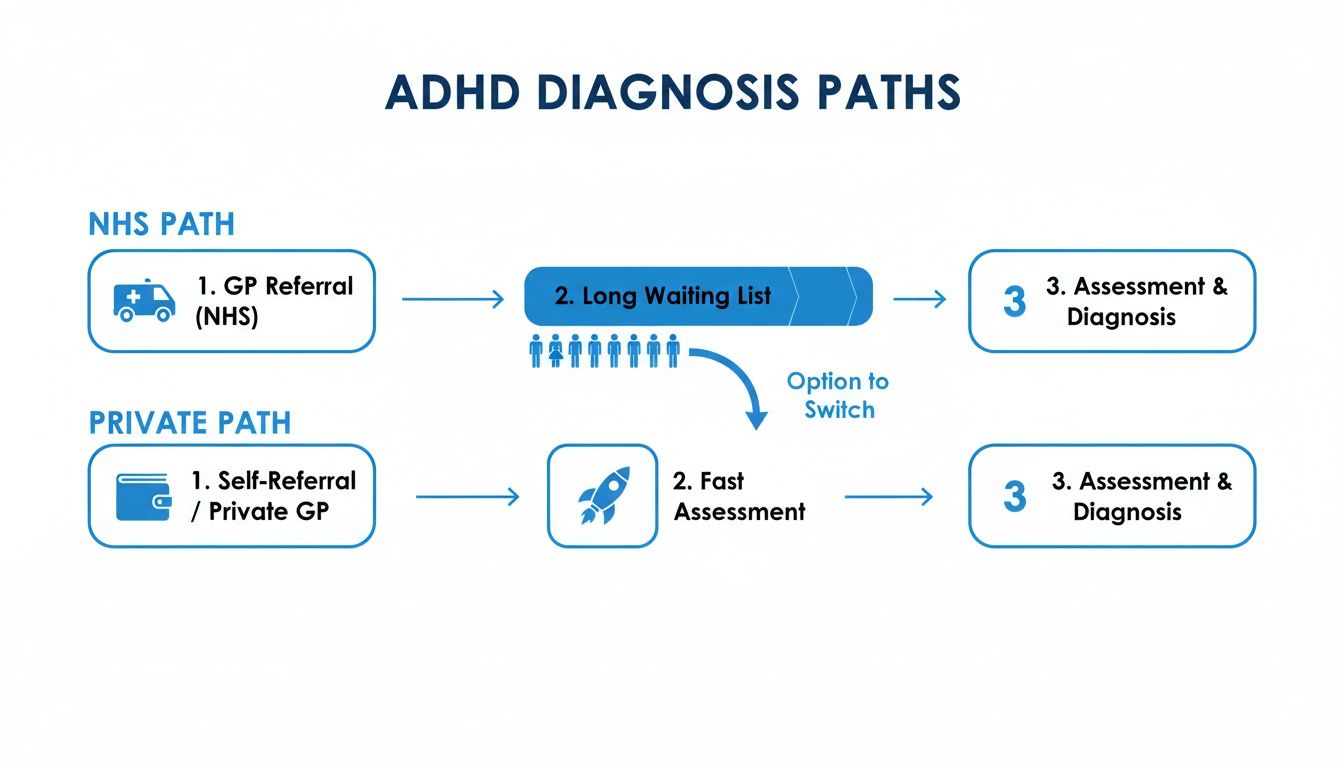
As you can see, the private online path is a much faster way to get an assessment, which is why so many people are going down that route. By understanding each step, from the first forms to the final report, you can go into it feeling prepared and confident, ready to get the clarity and support you need.
Looking for a private ADHD assessment?
Answer a few questions and we’ll shortlist clinics that fit — comparing price and waiting time.
Using NHS Right to Choose
While many people go down the fully private route for an online ADHD assessment in the UK, there's another brilliant option for those in England. It bridges the gap between private speed and NHS funding. It’s called NHS Right to Choose (RTC), and it can dramatically shorten your wait time without you having to pay for it.
Think of Right to Choose as your ticket to jump the lengthy local NHS queue. It gives you the legal right to pick an approved private provider for your assessment and treatment, but the NHS covers the cost. This makes it an incredible middle-ground solution.
How Does Right to Choose Actually Work?
At its heart, RTC is about giving patients more control. It legally allows you to choose where you get your NHS-funded care for certain conditions, and that includes ADHD. This means you’re not stuck with your local NHS mental health service if their waiting list stretches on for years.
Instead, you can opt for any qualified provider that holds a standard NHS contract. Many of these are online clinics, like ADHD 360 or Psychiatry-UK, who can often see you within a few weeks or months. It’s a way of getting the specialist care you need on a much more realistic timeline.
Your Step-by-Step Guide to Using RTC
The process might sound a bit complicated, but it's actually quite straightforward once you break it down into a few key steps. A little bit of preparation goes a long way.
- Choose a Qualified Provider: First, you'll need to research and find a private clinic that accepts RTC referrals. Make sure they are CQC-registered and have a contract with the NHS.
- Speak to Your GP: You must get a referral from your GP. The best approach is to book an appointment specifically to talk about your ADHD symptoms and tell them you want to use your Right to Choose.
- Give Them the Paperwork: Make things as easy as possible for your GP by bringing along pre-filled forms from your chosen provider. Most clinics that work with RTC have template letters on their websites you can download. These letters explain the RTC pathway clearly and have all the details your GP needs to send the referral correctly.
Taking this proactive step saves your GP a lot of time and makes it far less likely that there will be mistakes or hold-ups. You're essentially handing them everything they need on a plate.
The key thing to tell your GP is this: "Under NHS Right to Choose legislation, I am requesting a referral to [Provider's Name] for an ADHD assessment, as they are a qualified provider with an NHS contract."
Navigating Common Roadblocks with Your GP
It's a frustrating reality, but not all GPs are up to speed on the Right to Choose policy. If you find they're a bit confused or hesitant, it's important to stay calm and advocate for yourself.
- If your GP is unsure: Gently point them towards the official NHS guidance. The template letters from providers usually include links to the relevant pages on the NHS website.
- If your GP refuses: Politely ask them to explain their reason in writing. Sometimes, speaking to a practice manager or another GP in the surgery can help, as they might be more familiar with the policy.
- If the referral is sent to the wrong place: It pays to follow up. Double-check that the referral was sent directly to your chosen provider and not accidentally routed to the local NHS mental health team.
Getting an RTC referral is all about clear communication and being prepared. By understanding the process and helping your GP through it, you can access a faster, NHS-funded online ADHD assessment. For a more detailed look at the process, check out our comprehensive guide on navigating the Right to Choose ADHD assessment process. This is your right, and with a bit of organisation, it can open the door to the support you need, when you need it.
Costs, Timelines, and Medication: What to Expect
Going down the private route for an online ADHD assessment in the UK is often a much faster way to get answers, but it's important to be realistic about the costs and time involved. Unlike the NHS, where things are generally covered under one umbrella, the private journey is split into different stages, each with its own price tag. Knowing this upfront will help you plan and avoid any nasty surprises.
The first step, naturally, is the assessment itself. This is the big diagnostic appointment with a specialist clinician, and you can expect this to cost somewhere between £600 and £1,200. The exact figure often comes down to the clinic’s reputation, the clinician’s experience, and whether the assessment is for an adult or a child, as assessing children can sometimes be more involved.
If you receive a diagnosis and medication is recommended, the next phase is called titration. This is a really crucial period where you and your clinician fine-tune your treatment, working together to find the right medication and the most effective dose for you. It’s a very personal process that requires careful, regular monitoring.
Getting to Grips with Titration Costs
Think of titration as a calibration period for your body and brain. It’s definitely not a one-size-fits-all approach. Your specialist will start you on a very low dose and then gradually increase it over several weeks. Along the way, you'll have regular check-ins to see how you're getting on and to watch out for any side effects. This methodical process ensures your treatment is both safe and works for you.
This phase comes with its own set of costs to budget for:
- Follow-Up Appointments: During titration, you'll need several short review appointments. These typically cost between £150 and £300 each.
- Private Prescriptions: You'll also pay for the medication itself directly at the pharmacy. This can run from £80 to £150 per month, depending on the specific drug and dosage.
- Titration Packages: Some clinics simplify this by offering a titration package. These might cost £500 to £1,000+ and usually cover a set number of appointments and admin fees over a couple of months.
For a really detailed breakdown of what to expect financially, it’s worth reading this guide on the ADHD assessment cost breakdown in the UK. It’s a great resource for comparing providers and getting your budget in order.
Moving to a Shared Care Agreement
Once you’re on a stable, effective dose of medication, the end goal for most people is to hand the prescribing back to their NHS GP. This is done through a Shared Care Agreement (SCA) and is the key to bringing down your long-term medication costs.
An SCA is basically a formal contract between your private specialist, your GP, and you. It clearly states who is responsible for what when it comes to prescribing and monitoring your treatment. If your GP agrees, they’ll start issuing your prescriptions, and you'll only pay the standard NHS prescription fee.
Here’s a crucial tip: GPs are not obligated to accept a Shared Care Agreement. It is always a good idea to have a chat with your GP before you even book a private assessment to gauge their willingness to enter into one later. A simple conversation upfront can save a world of headaches down the line.
Of course, the whole reason so many people look to private options is because of the huge NHS waiting lists. The scale of the problem is genuinely staggering. Recent data from ADHD UK, covering just 21% of local health boards, found 19,000 adults and 7,200 children waiting for an assessment. If you scale that up to cover all of England, it suggests a waiting list of around 131,000 people. It paints a clear picture of a system under enormous strain. You can read the full NHS ADHD assessment waiting lists report to understand the full extent of the issue.
Finally, a quick heads-up: national medication shortages can and do happen, affecting both NHS and private patients. These supply issues can cause delays in getting your prescriptions filled. Keeping the lines of communication open with your clinic and pharmacy is the best way to manage this if it happens.
How to Choose the Right Online ADHD Clinic
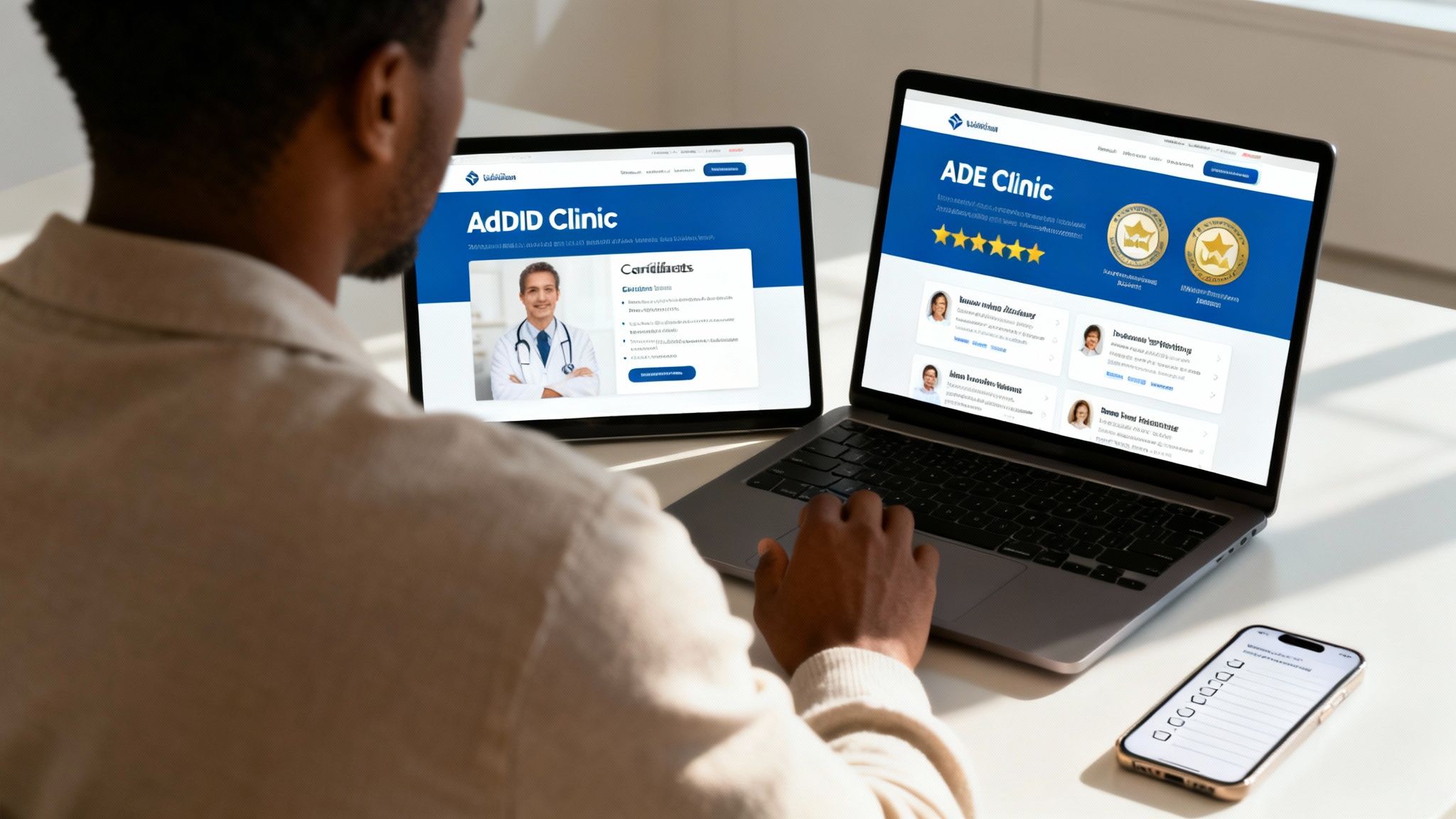
Choosing the right online ADHD clinic is probably the most important step you'll take on this journey. With more and more providers popping up, it can feel a bit like the Wild West trying to figure out who to trust. A good clinic is always transparent, properly qualified, and puts your care first, from the moment you get in touch to long after your diagnosis.
Think of this section as your practical guide to making a smart, confident decision. It’s a checklist to help you sort the excellent providers from those that might not meet the mark. Making the right choice means your diagnosis will be thorough, accurate, and recognised by other healthcare professionals, including your GP.
Verifying Clinician Credentials and Clinic Regulation
First things first: the single most critical factor is the expertise of the clinicians and the clinic's official regulatory status. In the UK, healthcare services operate under very strict standards, and it's essential to confirm that any provider you're considering is playing by the rules. This isn't just a box-ticking exercise; it’s about protecting yourself and making sure your diagnosis holds weight.
Before you go any further, check for these non-negotiables:
- GMC Registration: All psychiatrists must be registered with the General Medical Council (GMC). You can easily check their details on the official GMC register online to confirm they are on the specialist register.
- CQC Rating: In England, independent healthcare providers must be registered with the Care Quality Commission (CQC). Look for their CQC rating on their website. A ‘Good’ or ‘Outstanding’ rating is a powerful sign of a safe, high-quality service.
A legitimate clinic will have this information front and centre. If you find yourself hunting for a clinician’s GMC number or can't locate a CQC report, that’s a major red flag. Transparency is everything here—it’s a clear sign you’re dealing with professionals.
Asking the Right Questions Before You Book
Once you’ve done your background checks, it’s time to get into the details of what they actually offer. Knowing exactly what’s included in an assessment package—and what isn’t—will save you from surprises and hidden costs down the line. Remember, you’re paying for a specialist service, so don’t be shy about asking direct questions.
To help you compare providers, it's a good idea to have a list of questions ready. You can start by browsing a directory that helps you compare different online ADHD clinics based on what they offer and how long you might have to wait.
Here are a few essential questions to get you started:
- What does the assessment package actually include? Is the fee just for the diagnostic interview, or does it cover the full written report and a follow-up consultation?
- What’s your policy on Shared Care Agreements? Find out about their process and, crucially, their success rate in setting up shared care with NHS GPs.
- Do you accept NHS Right to Choose referrals? This is a key question if you live in England and want the NHS to fund your private assessment.
- What are the complete costs for titration and ongoing care? Get a full breakdown of any and all potential costs beyond that initial assessment fee.
Choosing a provider is a big decision, and it pays to be thorough. I've put together a quick checklist to help you vet potential clinics systematically.
Provider Vetting Checklist
Use this table to ensure you've covered all the essential checks before committing to a provider.
| Verification Point | What to Look For | Where to Check |
|---|---|---|
| Clinician Credentials | Psychiatrists on the GMC Specialist Register | Official GMC website |
| Clinic Regulation | Registered with the CQC (in England) | Clinic’s website or the CQC website |
| Assessment Process | Follows NICE guidelines; uses multiple information sources | Clinic’s 'About Us' or 'Our Process' page |
| Cost Transparency | Clear, itemised breakdown of all fees (assessment, titration, reports) | Pricing page or by direct enquiry |
| Shared Care Policy | A clear process and willingness to work with your NHS GP | FAQ section or by direct enquiry |
| Patient Reviews | Independent reviews on platforms like Google, Trustpilot, or Doctify | Third-party review sites |
| Right to Choose | Explicitly states if they accept NHS Right to Choose referrals | Clinic’s website or FAQ page |
Taking the time to work through these points will give you peace of mind that you're placing your trust in a reputable and professional service that can genuinely help you.
Got Questions? We’ve Got Answers
Stepping into the world of private ADHD care can feel a bit overwhelming, and it's only natural to have a lot of questions. Getting clear, straightforward answers is the best way to feel confident about taking the next step with an online ADHD assessment in the UK. Let's break down some of the most common queries.
Are Online ADHD Diagnoses Legit?
Yes, they absolutely are. Provided the assessment is conducted by a fully qualified specialist who adheres to the official NICE guidelines, an online diagnosis holds the same clinical weight as one done face-to-face.
Proper UK-based clinics have designed their virtual assessments to be incredibly thorough. This means the diagnosis you receive is recognised by employers, universities, and, in many cases, by NHS GPs who may later agree to a shared care arrangement for your medication.
Do I Need to See My GP First?
Not always. If you're paying for the assessment entirely yourself, most private clinics allow you to self-refer. This is a huge plus, as it means you can book an appointment directly without waiting for your GP to get involved.
However, if you're in England and want to use the NHS Right to Choose pathway, a GP referral is non-negotiable. It's also a really good idea to speak with your GP beforehand if you hope to set up a shared care agreement for medication down the line. Keeping them in the loop from the start can make that whole process much, much smoother.
So, I Have a Diagnosis… What Now?
Getting a diagnosis isn't the finish line; it's the starting block. Your clinician will sit down with you (virtually, of course) to map out a treatment plan that’s built around you.
This plan typically involves a mix of things:
- Education: Finally understanding what ADHD is and how it shows up in your life.
- Practical Strategies: Learning new ways to manage your symptoms through lifestyle tweaks and coping mechanisms.
- Medication: If this is the right path for you, the process of finding the right medication and dose (called titration) will begin.
You’ll also be given a detailed diagnostic report. This is an official document you can use to get the support you need, whether that's sharing it with your GP, your boss, or your university's disability support team.