A Complete Guide to the Signs and Symptoms of ADHD
Think it might be ADHD? Our guide outlines signs in UK adults and children, plus next steps for assessment.
Written and maintained by the ADHD Private editorial team, drawing on NHS, NICE and ADHD UK guidance. This is general information, not medical advice.
The first clues that point towards ADHD often show up as a relentless pattern of inattention, hyperactivity, or impulsivity – sometimes all three. These aren’t just occasional quirks; they're persistent challenges that can seriously disrupt daily life, affecting everything from work and school to relationships. Too often, these struggles are mistaken for character flaws or a simple lack of effort.
Decoding the Core Signs of ADHD

Does it ever feel like your brain is a web browser with way too many tabs open, all playing music at the same time? That popular analogy really gets to the heart of what it can feel like to live with Attention-Deficit/Hyperactivity Disorder (ADHD).
It’s crucial to understand that ADHD isn't about being "lazy" or lacking willpower. It's a recognised neurodevelopmental condition, meaning it affects how the brain is wired, particularly in areas that manage focus, impulse control, and crucial "executive functions" like planning and organising.
In the UK alone, it's estimated that ADHD affects roughly 3–4% of adults. The shocking part? The vast majority of them don't have a formal diagnosis. Many people only start looking for answers when the cumulative impact of these challenges becomes too much to bear.
In fact, research based on English GP records suggests that only about 1 in 9 people who likely have ADHD actually get diagnosed. This leaves countless others struggling in silence, often blaming themselves for things that are completely outside their control. You can explore more of these ADHD statistics and their impact from Priory Group.
This guide is here to cut through the myths and give you some real clarity. By getting to grips with what the signs actually look like in day-to-day life, you can start to make sense of your own experiences and take that vital first step towards finding support.
The Three Main Presentations of ADHD
ADHD doesn't look the same for everyone; it’s not a one-size-fits-all diagnosis. Instead, the signs and symptoms tend to cluster into one of three main types, or "presentations." Figuring out which pattern sounds most familiar can be a really helpful part of your journey.
To make this easier to digest, here's a quick breakdown of how these presentations differ.
Quick Guide to the Three Presentations of ADHD
| ADHD Presentation | Key Characteristics | Commonly Observed Behaviours |
|---|---|---|
| Predominantly Inattentive | Difficulty sustaining focus, poor organisation, and a tendency to forget details. | Losing things, being easily distracted, avoiding tasks needing long mental effort, trouble following conversations. |
| Predominantly Hyperactive-Impulsive | An inner sense of restlessness, impulsivity, and an inability to sit still. | Fidgeting, talking excessively, interrupting others, acting without thinking through consequences. |
| Combined | A mix of significant symptoms from both the inattentive and hyperactive-impulsive categories. | The experience is a blend of both sets of challenges, which can be particularly disruptive. |
Thinking about these presentations can help you connect the dots with your own life. Do you see yourself more in the "daydreamer" who can't find their keys, or the "human motor" who can't stop fidgeting? Or perhaps a bit of both?
It's really important to remember these aren't rigid boxes. They're just frameworks to help describe the main challenges someone is facing. What's more, a person's symptoms can shift and evolve over their lifetime, looking very different in adulthood than they did in childhood. At the end of the day, only a professional assessment can provide an accurate diagnosis.
Unpacking the Inattentive Signs of ADHD

When we hear “ADHD,” the image that often springs to mind is one of constant motion – the fidgeting, the restlessness, the visible hyperactivity. But that’s only half the story. One of the most common and profoundly misunderstood sides of the condition is inattention. These symptoms are far quieter and more internal, often being mistaken for laziness, carelessness, or even shyness.
Imagine your brain is a computer with dozens of internet tabs open at once. Music is playing from one, a half-written email sits in another, a recipe you wanted to try is open somewhere else, and pop-up ads keep appearing. This is a glimpse into what living with inattentive ADHD can feel like. Your mental bandwidth is constantly split, making it incredibly difficult to focus on the one tab that actually matters.
This isn’t just a bit of disorganisation; it’s a constant, internal distraction that creates very real, everyday challenges. It's a genuine struggle with the brain's executive functions: the very systems that control our focus, planning, and memory.
Inattention in Adults: A World of Lost Keys and Missed Details
For adults in the UK, the signs of inattentive ADHD can throw up major hurdles at work and at home. The daily grind often involves a pattern of behaviours that, individually, seem like minor frustrations. But when they happen day after day, they add up to serious stress, anxiety, and self-doubt.
Many of these symptoms fly under the radar because they don't fit the classic "bouncing off the walls" stereotype. Instead, the battle is fought internally: a quiet, exhausting effort just to keep track of life's demands.
Here are a few common examples for adults:
- Drifting off in meetings or finding you’ve read the same page of a report three times without taking anything in.
- Making careless mistakes at work, like missing a crucial detail in an email or miscalculating figures on a spreadsheet.
- Constantly misplacing essentials: keys, phone, wallet, often leading to a frantic, last-minute search before leaving the house.
- Struggling to follow conversations, especially in a group, because your mind has wandered onto something else entirely.
- Putting off tasks that need sustained mental effort, like filling out forms, planning a project, or studying for an exam.
This isn't a choice. It’s the result of a brain that’s wired differently, one that’s constantly seeking novelty. This makes mundane but necessary tasks feel almost physically painful to get through. The sheer effort it takes to override this wiring is mentally draining.
It's crucial to understand that these challenges say nothing about a person's intelligence or capability. Many adults with inattentive ADHD are incredibly bright and creative, but their struggle to direct their focus where it needs to go can hold them back from their true potential.
Inattention in Children: The Quiet Daydreamer
In children, inattentive ADHD can look very different, and it's something that often gets missed in a busy classroom, especially with girls. A child with these symptoms might not be disruptive at all. In fact, they’re often the quiet one staring out of the window, completely lost in their own world.
Their struggle is easily misinterpreted. A teacher might comment, "She's very bright, but she just doesn't apply herself," or "He never seems to be listening when I give instructions." While these observations might be technically true, they completely miss the why.
Here’s what inattentive ADHD can look like in a child:
- Failing to give close attention to details, which shows up as silly mistakes in homework or classwork.
- Appearing not to listen when spoken to directly, as if their mind is a million miles away.
- Difficulty organising tasks and activities, leading to a messy bedroom, a chaotic school bag, or a forgotten PE kit.
- Losing things needed for school time and time again, like homework folders, textbooks, or stationery.
- Being easily distracted by the smallest things, like a noise in the corridor or someone walking past the window.
Because these children aren't causing any trouble, their difficulties can go unnoticed for years. They learn to get by, often working twice as hard as their peers just to keep up, but this silent struggle can take a huge toll on their self-esteem. Spotting these quieter signs is the first, vital step to getting them the right support.
Spotting the Signs: Hyperactivity and Impulsivity
When people think of ADHD, this is often what comes to mind: the child who can’t stop moving or the adult who blurts things out. While the quiet struggle of inattention can be hidden, the hyperactive and impulsive side of ADHD tends to be much more obvious. But it’s a lot more complex than the classic stereotype suggests.
Think of hyperactivity not just as having too much energy, but as a deep, relentless need for movement and stimulation. It’s like an engine that’s always revving, even when the car is supposed to be parked. This creates a constant internal buzz that makes staying still feel physically uncomfortable, driving a near-constant need to be in motion.
Impulsivity, on the other hand, is less about impatience and more about having faulty brakes. For someone with ADHD, the space between having a thought and acting on it can be almost non-existent. Decisions are often made in a split second, long before the potential consequences have been weighed up.
How Hyperactivity and Impulsivity Show Up in Children
In children, these traits are hard to miss, especially in structured places like the classroom or during family meals. It’s crucial to understand that this isn't wilful defiance: it’s a neurological wiring that the child finds incredibly difficult to manage.
You’ll often hear a child with these symptoms described as being "driven by a motor." They just seem to be in constant motion, unable to find an 'off' switch.
Here’s what that looks like in practice:
- Constant Fidgeting: They're always tapping their feet, drumming their fingers on the table, or wriggling in their chair.
- Can't Stay Seated: They'll often get up and run about when everyone else is sitting down, like during assembly or story time.
- Talking Endlessly: They can dominate conversations, talk non-stop, and often at the most inappropriate times.
- Jumping in: They might blurt out an answer before the teacher has finished the question or interrupt other children’s games and conversations.
- Trouble Waiting: Waiting in a queue or for their turn in a game can feel like torture.
This behaviour can make it hard for them to make friends and can lead to them being told off a lot, which inevitably takes a toll on their self-esteem. They genuinely aren't trying to cause trouble; their brain is just wired for action.
How These Symptoms Evolve in Adults
As children with ADHD grow up, the overt, 'bouncing-off-the-walls' hyperactivity often quiets down. It doesn't vanish, though. It simply goes undercover, morphing into a powerful sense of internal restlessness. The engine is still revving, but now it’s humming quietly beneath the surface.
This inner agitation can be just as disruptive. An adult might not be climbing the curtains, but they’ll often feel a constant, nagging urge to be doing something.
In adulthood, hyperactivity is less about running around and more about a mind that won't stop racing. The need for stimulation is still there, driving everything from career choices to hobbies.
In adults, the signs of hyperactivity and impulsivity are often more subtle, but their impact is just as significant:
- Inner Restlessness: A persistent feeling of being on edge, antsy, or easily bored. Relaxing, even during downtime, can feel impossible.
- Drawn to High-Paced Jobs: Many find themselves in careers that are fast-paced or high-pressure, like working in emergency services, sales, or starting their own business.
- The Need to Be Busy: They often fill every single moment with activities, taking on far too many projects and feeling deeply uncomfortable with quiet or stillness.
- Impulsive Spending: This can range from frequent online shopping sprees to making huge, unplanned purchases like a car or a last-minute holiday.
- Sudden Life Changes: A pattern of impulsively quitting jobs, ending relationships, or deciding to move house with very little forethought.
These examples show that hyperactivity is so much more than just a surplus of energy. It's a fundamental neurological trait that colours every aspect of how a person experiences the world around them.
Wondering what the next step looks like?
Only a qualified clinician can diagnose ADHD. Answer a few questions and we’ll shortlist clinics that assess people like you.
How ADHD Symptoms Change from Childhood to Adulthood
One of the biggest myths about ADHD is that it's just a childhood condition. The reality is that the signs don't just vanish; they transform as we grow up. This is precisely why so many adults only begin to suspect they have ADHD later in life: their current struggles look nothing like the classic textbook image of a hyperactive child.
A kid who was constantly being told off for running around the classroom doesn't just wake up one day as a calm, still adult. That restless energy has to go somewhere. More often than not, it turns inward, creating a different, and often more complex, set of challenges.
Understanding this progression is crucial. It helps adults connect the dots between their past and present, and it gives parents a clearer picture of how their child's needs might shift over time. The core difficulties with attention, impulse control, and hyperactivity are still there, but they wear a completely different disguise.
From Bouncing Off Walls to Internal Restlessness
The most dramatic change is often seen in hyperactivity. A child might physically climb the furniture or tear around the playground, but adults learn (often the hard way) that this isn't socially acceptable. So, that physical urge gets suppressed.
But the engine is still running just as fast under the surface.
This is where that feeling of being constantly "on edge" or having a "motor running inside" comes from. It's the same neurological drive for stimulation, just channelled differently.
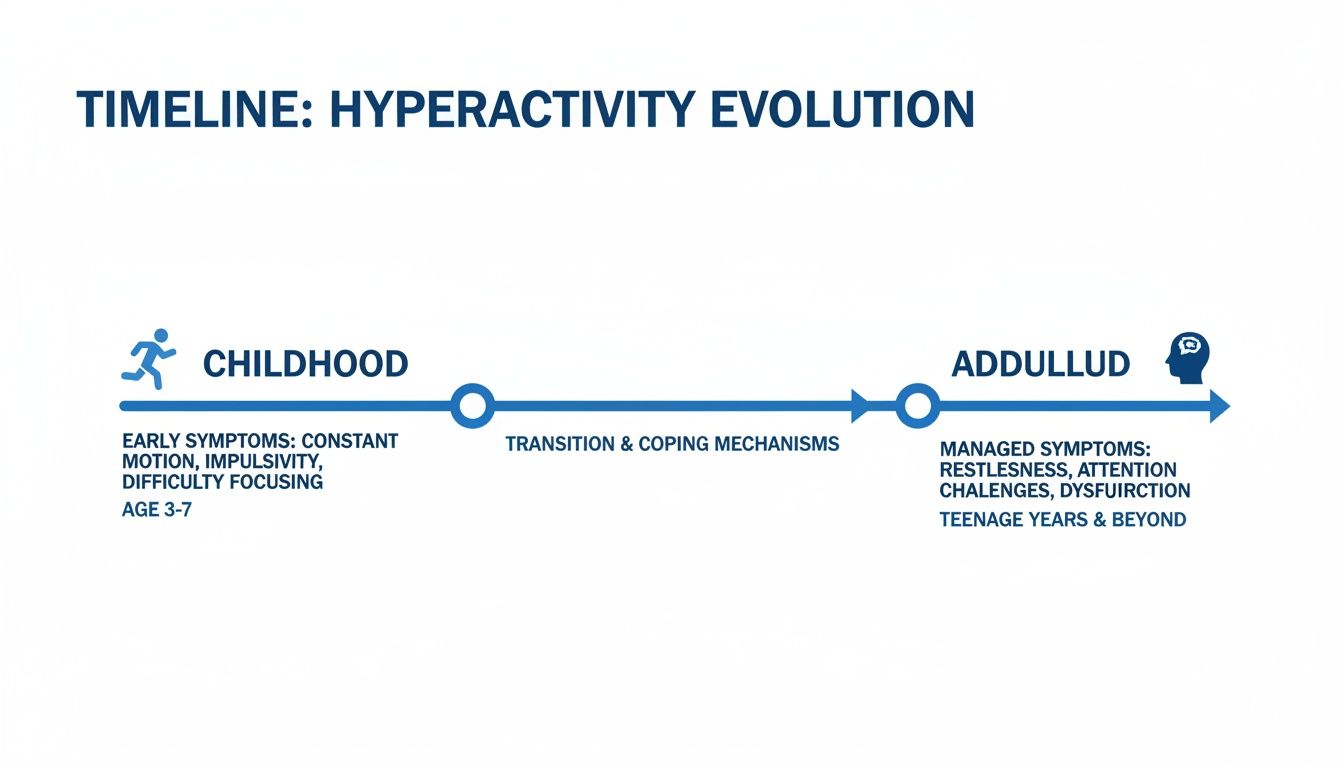
The key thing to grasp is that the need for stimulation and movement doesn't disappear. It simply finds new, often more subtle, ways to express itself.
This transformation happens across the board. The child who couldn't wait their turn in a game might become the adult who makes impulsive career moves, struggles with road rage, or abruptly ends relationships. The root issue (a struggle with impulse control) remains the same, but the real-world consequences become far more serious.
To make this clearer, let's look at how these core symptoms often appear at different stages of life.
ADHD Symptom Progression from Childhood to Adulthood
This table shows how the outward expression of ADHD often evolves to fit the demands and expectations of adulthood.
| Core Symptom | Common Presentation in Childhood | Common Presentation in Adulthood |
|---|---|---|
| Inattention | Daydreaming in class, constantly losing homework, not seeming to listen when spoken to. | Zoning out during meetings, misplacing keys and phones daily, overlooking crucial details in emails. |
| Hyperactivity | Running and climbing excessively, unable to sit still for story time or meals. | An intense inner restlessness, a constant need to be busy, fidgeting discreetly, choosing high-energy jobs. |
| Impulsivity | Interrupting conversations, blurting out answers before the question is finished, grabbing toys from others. | Making rash financial decisions, frequent job hopping, interrupting colleagues, oversharing personal information. |
As you can see, the fundamental challenges are lifelong. The disorganised schoolchild who could never find their PE kit often becomes the adult overwhelmed by household bills, project deadlines, and life admin.
Why Girls and Women Are So Often Overlooked
It’s impossible to talk about ADHD symptoms without discussing gender. For decades, the go-to image of ADHD was a disruptive, hyperactive boy, and this stereotype has resulted in a massive diagnostic gap for girls and women.
Research in the UK bears this out. One large survey found that 3.62% of boys and just 0.85% of girls met the criteria for ADHD. It’s not that fewer girls have it; it’s that their symptoms are less likely to be noticed.
Girls often present with the predominantly inattentive type of ADHD. Instead of being disruptive, they might be quiet, withdrawn, and lost in their own world. This is easily mislabelled by teachers and parents as shyness, anxiety, or simply being a "daydreamer."
Because their struggles are internal and less disruptive to others, many girls fly completely under the radar. The diagnosis often doesn't happen until the academic and social pressures of secondary school, university, or work become too much to handle. The executive function skills needed for complex schedules and long-term planning can push their coping strategies past the breaking point. This is especially true in higher education, which is why we've put together a guide on effective study skills for students with ADHD.
For many women, a diagnosis only arrives in adulthood—frequently after one of their own children is diagnosed. In their child's behaviour, they finally see a reflection of their own lifelong struggles, kick-starting a journey of rediscovery and self-understanding.
This story is incredibly common. It offers validation for countless women who have spent their lives feeling "different" without ever knowing why, finally giving a name to something they've always known was there.
The Emotional Side of Living with ADHD

The classic signs of ADHD, like trouble focusing or feeling restless, are really just the tip of the iceberg. For so many people, the toughest parts are the hidden emotional struggles that bubble away under the surface. Living with an ADHD brain often feels like being on an emotional rollercoaster you can't get off.
These intense feelings aren't a sign of a character flaw or a personal weakness. They're a direct result of how the ADHD brain is wired, particularly in the areas that manage emotional responses and impulses. Getting to grips with this is the first real step towards self-compassion and finding ways to cope with these invisible battles.
It’s this emotional dimension that explains why a person with ADHD might feel their reactions are completely out of proportion to what's happening around them.
What is Emotional Dysregulation?
Ever had a tiny setback (like spilling your coffee) trigger a wave of frustration so huge it ruins your entire morning? That right there is a classic example of emotional dysregulation, a huge but often missed piece of the ADHD puzzle. It isn't about being 'too emotional'; it's about feeling everything at a much higher intensity.
Think of it like an emotional volume knob. For most people, a minor annoyance might turn the dial to a 2 or a 3. But for someone with ADHD, that same little thing can crank the knob all the way to 10 in a split second. The feeling is absolutely real and incredibly powerful, but its sheer force just doesn't seem to match the trigger.
This can show up in a few key ways:
- Rapid Mood Swings: You might go from feeling cheerful to suddenly being incredibly sad or irritable with no warning.
- Low Frustration Tolerance: Small hurdles, like getting stuck in traffic or a website taking too long to load, can feel utterly unbearable.
- All-Consuming Feelings: Whether it’s excitement, disappointment, or anger, the emotion can feel so big that it completely takes over your thoughts.
Living with this kind of emotional intensity is draining. It can put a massive strain on relationships and feed a nasty cycle of shame and self-criticism when you feel like you just can't get your reactions under control.
The Agony of Rejection Sensitive Dysphoria
Tied closely to emotional dysregulation is something called Rejection Sensitive Dysphoria (RSD). While it’s not an official diagnosis on its own, it perfectly describes an almost unbearable emotional pain that flares up when you think you’ve been rejected, criticised, or have let someone down.
RSD isn't just about getting your feelings hurt. It’s a deep, gut-wrenching emotional pain that can feel almost physical, often sparked by a perceived slight rather than an actual one.
For someone with RSD, a neutral comment from a boss could be misinterpreted as a damning critique, or a friend cancelling plans might feel like a personal attack. The internal reaction is immediate and severe, often spiralling into intense shame or rage. To cope, many people either become chronic people-pleasers to avoid any chance of disapproval or they pull back from social situations entirely to protect themselves from potential hurt.
How Executive Function Struggles Impact Your Emotional World
The emotional side of ADHD is also tangled up with executive function challenges: the brain's command centre responsible for things like planning, organising, and just getting started. When you’re constantly fighting to meet deadlines, remember appointments, or keep your home from descending into chaos, it really takes a toll on your spirit.
After years of being told you’re “lazy” or “just not trying,” it's easy to develop a deep-seated belief that you're simply not good enough. You might know exactly what you need to do but feel completely frozen, unable to make that first move. This gap between what you want to do and what you can actually do isn't a moral failure; it's a neurological one.
This daily battle can make the workplace feel like a minefield. But it’s so important to know that help is available. Exploring things like ADHD reasonable adjustments at work can make a world of difference. Realising that these struggles stem from your brain's wiring (not from a lack of character) is the key to breaking free from self-blame and building a healthier emotional life.
When to Seek an ADHD Assessment in the UK
Realising that you or a loved one might have ADHD is a huge first step. But at what point does a suspicion become something you should act on? The answer lies in two key things: impact and persistence.
Let's be honest, everyone misplaces their keys or gets distracted in a long meeting from time to time. The difference with ADHD is that these aren't just one-off moments. They're part of a chronic, often lifelong pattern that consistently makes life harder. It’s when these challenges are actively getting in the way of your work, your relationships, or your general wellbeing that it’s time to listen.
If the symptoms we've talked about feel less like occasional hurdles and more like a daily battle, it's probably worth considering a formal assessment. This isn't about getting a label for the sake of it; it's about getting clarity so you can find the right kind of support.
Is It Time for an Assessment?
A few honest questions can help you figure out your next move. Think about whether you, or your child, regularly find yourself in these situations:
- Significant Impairment: Are these challenges consistently holding you back at work, university, or school?
- Relationship Strain: Do issues with emotional control, impulsivity, or just not being ‘present’ cause ongoing friction with your partner, family, or friends?
- Daily Frustration: Do you feel like you’re constantly wading through treacle just to manage everyday things like paying bills, keeping the house tidy, or sticking to appointments?
- Mental Health Impact: Are you also grappling with anxiety, depression, or a sense of low self-worth that feels tangled up in all these other struggles?
If you found yourself nodding 'yes' to a few of those, seeking a diagnosis is a really sensible step. It's the only way to know for sure if ADHD is at the root of it all and to open the door to effective strategies and treatment.
An ADHD assessment isn't a test you pass or fail. Think of it as a collaborative process to map out your unique brain wiring. The goal is to give you a clear path forward, helping you move from struggling to thriving.
Navigating Your Options in the UK
So, you’ve decided to go for it. What now? In the UK, there are three main pathways to getting an assessment. Each has its own pros and cons, so knowing what they are will help you make the right choice for your situation.
1. The NHS Pathway via Your GP
The traditional starting point is a chat with your GP. You'll explain your symptoms, and if they agree an assessment is needed, they can refer you to your local NHS adult ADHD service. While this route is free, the reality is that NHS waiting lists can be incredibly long – we’re often talking years, not months.
2. The Private Assessment Pathway
If you can't afford to wait, going private is a much faster option. By choosing a private clinic, you can often be seen within a few weeks. The obvious benefit is speed, but the trade-off is the cost, which can be significant. You’ll also need to budget for ongoing private prescriptions and follow-up appointments.
3. NHS Right to Choose
There’s a fantastic third option if you live in England: NHS Right to Choose. This legislation gives you the right to choose a qualified private provider for your assessment and treatment, but the NHS foots the bill. It’s a brilliant middle ground between the NHS and paying privately. To find out exactly how it works, have a look at our detailed guide on how to get an ADHD diagnosis in the UK.
Your Top Questions About ADHD Symptoms Answered
Trying to make sense of ADHD symptoms can feel like navigating a maze. It’s completely normal to have questions, so let’s clear up a few of the most common ones.
Can You Suddenly Get ADHD as an Adult?
In short, no. ADHD is what we call a neurodevelopmental condition, meaning it starts in childhood. Its roots are always there, even if they aren't obvious.
So, why do so many people only get diagnosed later in life? Often, especially for women, they’ve developed incredibly effective coping strategies that mask the underlying challenges. It's only when life gets more demanding (juggling a career, managing a household, raising a family) that these strategies start to buckle and the symptoms become impossible to ignore.
Is Being Inattentive the Same as Just Being Forgetful?
They're related, but definitely not the same thing. Everyone misplaces their keys now and then. But the forgetfulness that comes with ADHD is on a different level: it's persistent, disruptive, and can make daily life feel chaotic.
This isn't a character flaw; it's a genuine challenge with working memory, which is like the brain's temporary notepad. If you have ADHD, that notepad might be a bit slippery. You might forget instructions you were given just seconds ago, not because you weren’t paying attention, but because your brain didn't have a firm grip on the information in the first place.
Forgetting where you put your keys is a normal part of life. Forgetting where you put your keys, phone, and wallet multiple times a day, to the point where you're constantly late or overwhelmed, is a classic sign of an ADHD-related struggle.
Do ADHD Symptoms Get Mistaken for Anxiety or Depression?
Absolutely, and this is a huge reason why getting a proper, professional assessment is so crucial. The constant battle to stay focused, organised, and on top of your emotions is exhausting. It can easily lead to intense anxiety or a deep sense of failure and low mood that looks a lot like depression.
The statistics back this up: research suggests that around 80% of adults with ADHD have at least one other co-occurring condition. A specialist has the training to untangle the symptoms and see what’s really going on, ensuring you get the right diagnosis and the right support.
Finding the right path to an assessment can feel overwhelming. At ADHD Private, we simplify the process by providing a free, UK-wide directory of private clinics. You can compare wait times, costs, and services to find the support that fits your needs, faster. Start your search and take the next step with confidence.