Your Guide to ADHD Reasonable Adjustments at Work and School
Discover your rights to ADHD adjustments at work and school. Get practical examples and clear steps to request the support you need.
Written and maintained by the ADHD Private editorial team, drawing on NHS, NICE and ADHD UK guidance. This is general information, not medical advice.

When we talk about 'reasonable adjustments' for ADHD, we're not talking about asking for special favours or an unfair advantage. Quite the opposite. Under the UK's Equality Act 2010, these are simply legally required changes to a workplace or educational setting that level the playing field. They're designed to remove the specific barriers ADHD can create, allowing someone to show what they're truly capable of.
Your Legal Rights to ADHD Adjustments
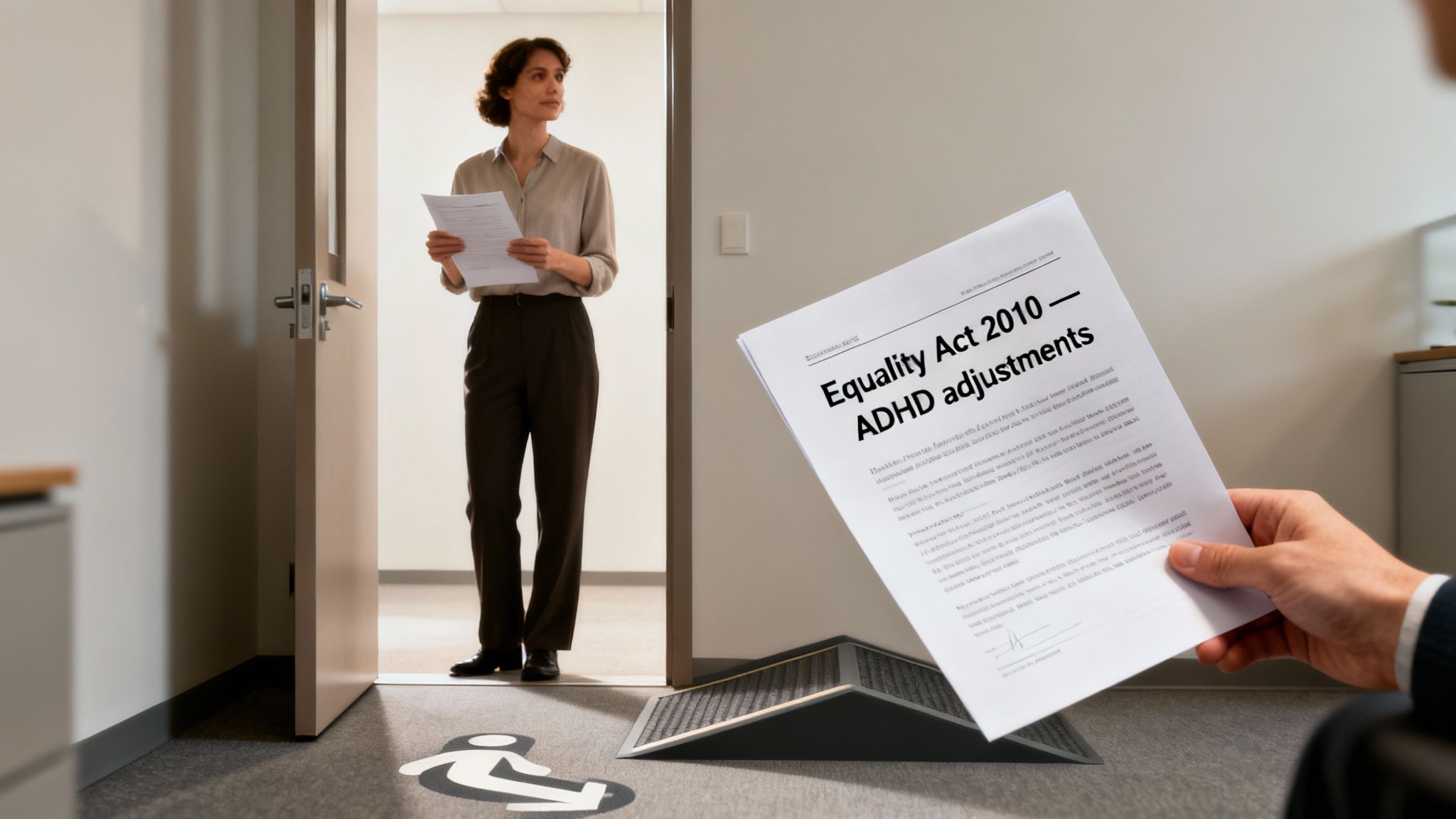
Navigating your rights can feel like a minefield, but the core idea is straightforward. The Equality Act 2010 protects you if your ADHD has a ‘substantial’ and ‘long-term’ negative effect on your ability to do normal day-to-day things. If it does, it's legally considered a disability, and that's the foundation for getting the support you need.
A helpful way to think about it is like a wheelchair ramp. A ramp provides physical access to a building. In the same way, reasonable adjustments for ADHD provide cognitive access, creating an environment where your brain can function at its best, free from unnecessary hurdles.
Understanding the Legal Framework
This legal duty puts the onus on employers, schools, colleges, and universities. They are legally obligated to make changes to ensure you aren't put at a major disadvantage compared to someone without ADHD. The key word here is ‘reasonable’—the adjustment shouldn't impose a massive or disproportionate burden on the organisation.
But even with the law on your side, the reality on the ground can be very different. With an estimated 2.6 million people in the UK living with ADHD, these adjustments are a critical need. Yet a shocking 69% of workers with ADHD report getting no support at all, often because they're worried about the stigma that comes with disclosing their condition.
This isn't about asking for special treatment. It’s about securing the conditions that give you an equal opportunity to demonstrate your skills, knowledge, and potential. Understanding this is the first step in confidently advocating for your needs.
What This Means for You
Knowing your legal standing changes everything. It turns a difficult conversation about perceived personal weaknesses into a practical one about environmental solutions. Requesting adjustments isn't you asking for a favour; it's you claiming a legally protected right.
This legal backing strengthens every part of the process, from gathering your evidence to writing the actual request. The support available isn't just about managing daily challenges, either; it can extend to financial help. Our guide on getting disability allowance for ADHD explains this in more detail.
Ultimately, understanding your rights gives you the confidence to ask for the support you need to thrive, not just survive.
Practical ADHD Adjustments for the Workplace

Knowing your rights under the Equality Act is one thing, but seeing those rights translate into real, practical support is where the change truly happens. ADHD reasonable adjustments aren't just legal jargon; they are real-world changes to your environment, your tasks, and your routines that let your talents come to the forefront.
They’re the difference between just about keeping your head above water and genuinely excelling in your role.
These adjustments work because they directly tackle the specific challenges that come with having an ADHD brain. For instance, if the constant buzz of an open-plan office makes it impossible to think, a simple adjustment can create the pocket of quiet you need. If you struggle to remember verbal instructions from a fast-paced meeting, a small tweak to how information is shared can be a game-changer.
Think of this section as your playbook of tried-and-tested strategies. We’ll break down concrete adjustments you can request, linking each one back to the specific ADHD trait it helps to manage.
Managing Your Work Environment
Your physical surroundings have a huge say in your ability to focus. An office designed for a neurotypical brain can feel like an assault course for someone with ADHD, draining your cognitive energy before you’ve even started on your to-do list.
The goal here is to reduce that cognitive load by turning down the volume on distractions and sensory input.
Common environmental adjustments often include:
- Noise-Cancelling Headphones: A simple but incredibly effective tool for blocking out office chatter, ringing phones, and all the other sounds that can instantly shatter your concentration.
- A Quiet Workspace: This could mean getting a desk in a less busy part of the office, having permission to use a private room for tasks requiring deep focus, or being allowed to work from home a couple of days a week.
- Minimising Visual Clutter: Asking for a desk facing a wall or with privacy screens can cut down on the constant movement and visual ‘noise’ that pulls your attention away from the task at hand.
It’s not about being antisocial. It’s about creating a controlled space where your brain can actually do its best work.
Structuring Your Workday and Tasks
ADHD directly impacts executive functions—the brain’s management system for things like timekeeping, organisation, and simply getting started on a task. Adjustments that introduce structure and clarity can make an enormous difference, turning a massive, overwhelming project into a series of achievable steps.
Unfortunately, many managers simply aren’t trained to provide this kind of support. A shocking one-third of neurodivergent employees feel let down by their employer's support systems. This is made worse by the fact that 37% of managers report having received zero training on neurodiversity, leaving them unsure how to help. You can read more about the impact of neurodiversity training on People Management.
Here are some of the most effective structural adjustments you can ask for:
- Flexible Start and Finish Times: Your brain’s peak productive hours might not fit neatly into a 9-to-5 box. Flexi-time allows you to work when you're most focused and energetic.
- Written Instructions and Summaries: To give your working memory a helping hand, ask for important verbal instructions or meeting action points to be confirmed in a quick follow-up email.
- Breaking Down Large Projects: Ask your manager to help break down big, long-term projects into smaller, more manageable chunks, each with its own clear deadline. This makes it much easier to get started and track progress.
- Regular Check-ins: Brief, structured catch-ups with your manager (even just for 10 minutes a few times a week) can be brilliant for staying on track, clarifying priorities, and maintaining accountability.
To show how these adjustments directly address ADHD-related difficulties, this table connects the challenge to a practical solution.
Linking ADHD Challenges to Workplace Solutions
| Common ADHD Challenge | Potential Reasonable Adjustment | How It Helps |
|---|---|---|
| Distractibility / Hyperfocus | Noise-cancelling headphones; quiet workspace; flexible work-from-home options. | Minimises sensory input, allowing for sustained focus on tasks without constant interruption. |
| Working Memory Deficits | Written instructions; meeting minutes and action points sent via email; use of checklists. | Provides an external record of information, reducing the cognitive load of trying to remember everything. |
| Time Blindness / Poor Estimation | Use of timers (e.g., Pomodoro); digital calendars with alerts; breaking tasks into timed blocks. | Makes time tangible and provides external cues for deadlines and transitions between tasks. |
| Task Initiation / Procrastination | Breaking large projects into smaller steps; regular, brief check-ins with a manager for accountability. | Reduces the feeling of being overwhelmed, making it easier to start and maintain momentum. |
| Impulsivity / Interrupting | Taking notes in meetings before speaking; using a "parking lot" for off-topic ideas to discuss later. | Creates a pause between thought and action, allowing for more considered contributions. |
By mapping solutions directly to challenges, it becomes easier to explain why a certain adjustment is needed, not just what it is.
Leveraging Technology and Tools
In today's workplace, technology can be a double-edged sword—a source of endless distraction or a powerful ally. With the right approach, it can become an external support system for your executive functions. Many of these tools are free or low-cost, which makes them a very 'reasonable' request for any employer.
Consider asking for permission to use or for a license for:
- Project Management Software: Tools like Asana, Trello, or Monday.com help you visualise tasks, deadlines, and project workflows in a clear, structured way.
- Time Management Aids: A physical timer on your desk or an app that uses the Pomodoro Technique (short bursts of focused work followed by a break) can be fantastic for maintaining concentration.
- Digital Reminders and Calendars: Using shared calendars with automated alerts for meetings and deadlines is a simple but effective way to combat time blindness.
- Speech-to-Text and Text-to-Speech Software: These can be invaluable. Speech-to-text helps get ideas down quickly for reports, while text-to-speech can make it easier to process long or dense documents.
At the end of the day, the goal of any ADHD reasonable adjustment is to build a supportive framework that allows you to do your job to the best of your ability. By focusing on practical, problem-solving changes, you can create a work life that works with your brain, not against it.
Want professional support alongside this?
Answer a few questions and we’ll shortlist private ADHD clinics that fit what you’re looking for.
Adjustments in Education and Exams: Levelling the Playing Field
The same principles that apply in the workplace are just as critical in the world of education. Under the Equality Act 2010, every educational setting, from your child's primary school right through to university, has a legal duty to make sure students with ADHD aren't at a disadvantage. It’s all about giving them a fair shot to learn, take part, and show what they know.
Let's be honest, academic life is a huge test of executive functions – the very things that ADHD makes so difficult. Juggling assignments, organising notes, or even just staying tuned in during a long lecture can feel like climbing a mountain. ADHD reasonable adjustments are the tools and support structures that build a bridge over those gaps.
The key is to be proactive. Getting in touch with the disability support services at the school, college, or university as early as you can makes all the difference. Having a solid plan in place long before exam season hits can save a world of stress for everyone involved.
Support That Starts in the Classroom
It’s easy to think adjustments are just about exams, but real support begins in the day-to-day learning environment. The idea is to make the classroom itself more accessible. By reducing the mental effort it takes just to keep up, you free up a student’s brainpower to actually absorb the information.
These tweaks are specifically designed to help with common ADHD hurdles like a shaky working memory, processing what’s being said, and maintaining focus.
A few simple but effective adjustments can include:
- Getting lecture slides in advance. This is a game-changer. It lets you get a feel for the topic beforehand, so you’re not scrambling to follow along and can take much better notes.
- Permission to record lectures. An audio recording is an amazing backup. It lets you go back over complex ideas or fill in the blanks for those moments when your attention inevitably wandered.
- A seat near the front. It sounds simple, but sitting away from the distractions of an open door or a noisy window can make a massive difference in staying locked in on the lesson.
- Using a laptop for notes. For many people with ADHD, typing is simply faster and neater than handwriting. It helps get thoughts down on the page in a clear, organised way, especially when the pressure is on.
These aren't huge, complicated changes, but they can completely reshape the learning experience, turning a constant struggle into something genuinely engaging.
Making Exams and Assessments Fair
Exams are stressful for anyone, but for someone with ADHD, the intense pressure can throw challenges like time blindness, distractibility, and anxiety into overdrive. It’s crucial to remember that exam adjustments aren't about making the test easier; they’re about creating a fair environment where you can actually show what you’ve learned.
Think of it this way: extra time doesn't give a student an unfair advantage. It just levels the playing field, giving a brain that processes things differently the time it needs. The final mark should reflect their knowledge, not their neurology.
Here are some of the most common and vital adjustments for exams:
- Extra Time: This is probably the most well-known adjustment. An extra 25% is a common starting point, giving you enough breathing room to read the questions properly, structure your answers, and check your work without that frantic, last-minute rush.
- A Separate, Quiet Room: Being away from the main exam hall means you’re not distracted by hundreds of other people coughing, rustling papers, or tapping their pens. For maintaining focus, this can be absolutely essential.
- Rest Breaks: Having supervised breaks lets you step away, stretch your legs, and reset your brain without losing any precious exam time. It's a brilliant way to manage restlessness and fight off mental fatigue during a long test.
- Using a Word Processor: If handwriting is a slow or messy process for you, typing on a laptop can help you get your thoughts down clearly and quickly, ensuring you don’t lose marks just because you couldn’t write fast enough.
To get these things in place, you’ll need to provide evidence, which is typically your formal diagnostic report. Your best bet is to connect with the student support or disability services team well ahead of time. They’ll help you get a formal plan sorted, so everything is ready to go long before you have to walk into that exam room.
How to Confidently Ask for the Adjustments You Need
Knowing what adjustments could make a difference is one thing, but actually asking for them can feel like a huge hurdle. Let’s walk through how to approach that conversation, so you can frame your needs in a way that feels collaborative, not confrontational.
The trick is to see this as a partnership. You're not just highlighting a problem; you’re bringing a solution to the table that helps everyone. When you can work at your best, productivity goes up and the quality of your work improves—that’s a clear win for any employer or university.
Preparing for the Conversation
Before you even draft an email or book a meeting, a little prep work can make all the difference. This isn't about building a legal case against someone; it's about organising your thoughts so you can communicate your needs clearly and calmly.
Get specific. "I find it hard to focus" is too vague. Instead, think about the direct cause and effect. A better way to put it might be, "The constant background noise in our open-plan office makes it incredibly difficult for me to concentrate when I'm working on detailed data tasks."
Here are the key things to get straight in your own mind first:
- Pinpoint the Barriers: Make a short list of 2-3 specific work or study tasks you genuinely struggle with because of your ADHD.
- Suggest Solutions: For each barrier, think of a specific, reasonable adjustment that would help.
- Explain the 'Why': Be ready to explain exactly how that adjustment will fix the problem and improve your output.
- Gather Your Evidence: This is where a formal diagnostic report becomes your best friend. It provides credible, professional evidence that changes the conversation from a personal preference to a documented medical need.
This groundwork transforms a vague plea for help into a structured, solution-focused proposal that’s much easier for others to understand and act on.
Frame Your Request as a Win-Win
The most successful requests are always framed as a mutual benefit. You're not asking for special treatment; you're asking for the tools you need to do your job to the best of your ability. This approach makes it far easier for managers or tutors to say yes because they can see the clear return on their support.
Put yourself in their shoes for a moment. A manager's main goal is a productive, effective team. If a simple adjustment—like letting you wear noise-cancelling headphones—helps you deliver better work, it's an easy decision for them to make.
When you ask for an adjustment, you are actively trying to improve your performance. Frame it like this: "By implementing [the adjustment], I'll be able to deliver [a positive outcome] more effectively." This shows you're invested in your role and committed to doing great work.
This collaborative tone takes any defensiveness out of the equation and opens the door for a genuinely constructive chat. It’s all about finding a practical solution that works for everyone.
This flowchart maps out a typical support journey for students, showing key areas where adjustments can be made.
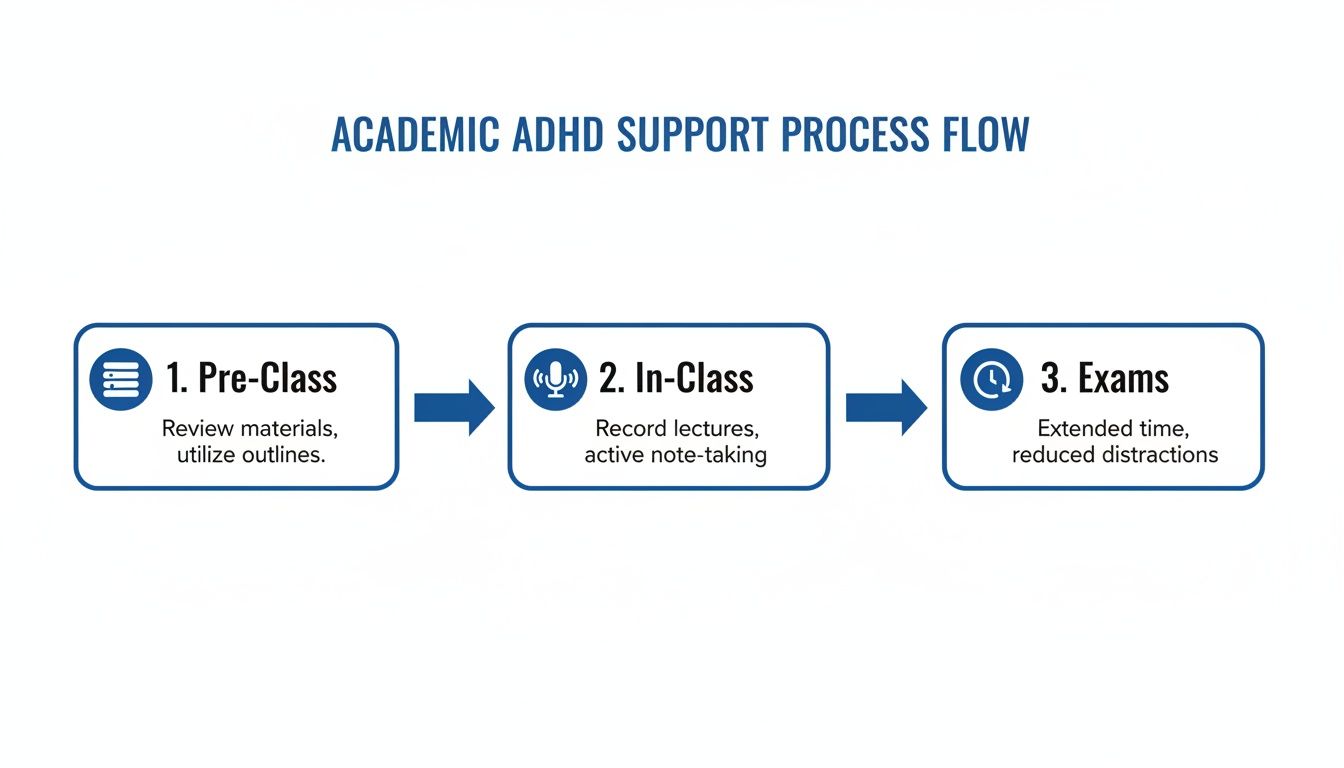
As you can see, support is a continuous process, starting with pre-class preparation and flowing through to in-class strategies and exam accommodations, all designed to create a level playing field.
A Professional Template to Get the Ball Rolling
Starting with a well-structured email is often the best first move. It gives the person you're contacting time to consider your request properly and creates a written record of your conversation.
While you don't legally need a formal diagnosis just to ask, having a report from a private assessment can seriously speed things up. It's particularly useful if you're navigating the different pathways to support, like exploring your options with NHS Right to Choose for ADHD.
Here’s a simple, professional template you can adapt to start the conversation about ADHD reasonable adjustments.
Sample Email for Requesting an Adjustments Meeting
Use this professional, adaptable template to formally initiate a conversation about reasonable adjustments with your manager or tutor.
| Email Section | Sample Wording | Purpose |
|---|---|---|
| Clear Subject Line | Meeting Request: Discussion about workplace adjustments | Immediately tells them what the email is about. |
| Opening | Dear [Manager's/Tutor's Name], I'm writing to request a brief meeting to discuss some potential adjustments to my work/study environment that I believe would help me perform at my best. | States your request politely and professionally. |
| Context | As you may know, I have ADHD. I'm really committed to my role here and have identified a few small changes that would allow me to manage my workflow more effectively. | Gives necessary context without oversharing, linking your ADHD to a desire for high performance. |
| Proposed Agenda | In our meeting, I'd like to talk through a couple of specific challenges and propose some simple solutions, such as [e.g., using noise-cancelling headphones] or [e.g., receiving key instructions in writing]. | Shows you are prepared and solution-focused, and gives them a heads-up on the topics. |
| Closing | Please let me know what time would be convenient for you to chat next week. I’m confident that with these adjustments, I can contribute even more effectively to the team. | Ends on a positive, collaborative note and includes a clear call to action. |
This template helps you lay out your needs with clarity and confidence, setting a professional tone right from the start. By approaching the process with solid preparation and a focus on mutual benefits, you empower yourself to get the support you need to truly thrive.
The Power of a Formal ADHD Diagnosis
Legally, you don't need a formal diagnosis just to ask for help at work or university. But let’s be realistic—having one completely changes the conversation. It transforms a tentative request into a solid, evidence-backed case for ADHD reasonable adjustments.
Think of it like this: without a diagnosis, you're saying, "I think this would help me." With a diagnosis, you're handing over a specialist's report that explains exactly why it will help.
An official assessment provides the credible, documented proof that employers and education providers often need to act decisively. It takes the guesswork out of the equation and gives them a professional roadmap for the specific support that will genuinely make a difference. This is especially critical when you consider the long and often frustrating wait times for NHS assessments, which can put essential support on hold for years.
Putting Your Toolkit to Work
The unfortunate reality of the NHS system is that many people are left in limbo. They know they’re struggling but can't get the formal paperwork needed to unlock support. This is where a private assessment can make a world of difference.
A private diagnosis delivers the same robust, credible report as an NHS one, but on a much quicker timeline. It isn’t about jumping the queue; it's about getting access to the tools you need to succeed, right when you need them most. The report you get will lay everything out clearly, usually including:
- A clear, official diagnosis from a qualified specialist.
- A detailed breakdown of how your specific ADHD traits affect you day-to-day.
- Actionable, specific recommendations for reasonable adjustments in your workplace or place of study.
This kind of documentation gives you the confidence and authority to advocate for yourself effectively.
An ADHD diagnosis isn't just a label; it’s a toolkit. It gives you the language, the evidence, and the right to have a structured, productive conversation about getting the support you are legally entitled to.
Turning Self-Advocacy into a Structured Plan
Once you have that diagnostic report in hand, your request for adjustments is no longer just a personal plea. It becomes part of a formal process backed by medical evidence. That shift is incredibly powerful.
It moves the dialogue away from your personal struggles and towards implementing practical, professionally recommended solutions that help everyone involved. Your manager or tutor gets a clear basis for their decisions, making them far more likely to approve the adjustments you need.
For many, taking a first step like an online ADHD test can provide the initial clarity to pursue a full assessment. The final report is what truly makes the process of securing reasonable adjustments smoother, faster, and far more effective.
What to Do When Your Request Is Denied
It’s tough to hear ‘no’ when you’ve asked for support, and it can feel like a real setback. But it’s important to see this not as a final answer, but as the next stage of the conversation. The key is to stay calm and think strategically.
First off, don't assume the worst. A refusal isn't always a hard 'no' forever. It could be a simple misunderstanding about what you need or what their legal duties are. The best first move is almost always an informal chat.
Ask for a few minutes of their time to get to the bottom of their decision. Was it the cost? Did they think it would be too disruptive or just not practical to implement?
This chat is your opportunity to clear the air. Really listen to their worries and come prepared with a Plan B. Maybe there's a different bit of software that does the same job, or perhaps a small tweak to your flexible hours would work for them while still giving you the support you need.
Understanding Why an Adjustment Might Be Refused
It’s worth remembering that an employer or university doesn’t have to say ‘yes’ to every single request. The law—the Equality Act 2010—insists on reasonable adjustments. This means they can legally decline a request if it genuinely falls into one of these buckets:
- It wouldn't help: The adjustment wouldn't actually remove the barrier or disadvantage you're facing.
- It's not practical: Putting it in place would be genuinely difficult or cause significant disruption to how things run.
- The cost is too high: The expense would be disproportionate, considering the organisation's size and financial resources.
Knowing these valid reasons can help you see things from their perspective and build a stronger case in your follow-up conversation.
When an Informal Approach Fails
If a friendly chat doesn't get you anywhere, it’s time to take a more formal route. This usually involves putting your concerns in writing and raising a formal grievance with your HR department or the student support services.
Your letter should lay everything out clearly: what you originally asked for, why they said no, and why you believe this is a failure on their part to provide the necessary ADHD reasonable adjustments.
It can also help to gently remind them of the business case for this. Failing to support an employee with ADHD can lead to an average productivity loss of 22 days per year. With 69% of workers with ADHD getting no support at all, the cost of doing nothing quickly adds up. You can learn more about the workplace impact of ADHD in the UK.
Top Tip: Keep a paper trail. Make sure you have a dated record of every email, letter, and note from any meetings. This documentation is absolutely essential if you need to take things further.
If the internal process still doesn't lead to a solution, remember you're not on your own. There are fantastic organisations that offer free, impartial advice and can help you figure out what to do next. Two of the best are:
- ACAS (Advisory, Conciliation and Arbitration Service): The experts on workplace rights. They can offer advice and even help mediate the dispute.
- EASS (Equality Advisory and Support Service): They are the specialists in the Equality Act and can advise you if you think you're facing discrimination.
Facing a refusal is never easy, but by being informed and taking a step-by-step approach, you can stand up for your rights and get the support you need to do your best work.
Frequently Asked Questions
When you start digging into reasonable adjustments for ADHD, it's natural for questions to pop up. Let's tackle some of the most common ones we hear, giving you clear, straightforward answers to help you navigate your rights.
Do I Have to Tell My Employer I Have ADHD?
Legally? No, you're under no obligation to disclose your ADHD. But here's the catch: an employer's duty to provide reasonable adjustments only kicks in once they know about your disability.
Telling them is often the key that unlocks the support you're entitled to under the Equality Act 2010. It's a personal decision, but without that conversation, you can't get formal help.
Are ADHD Adjustments Expensive for Companies?
That's a common worry, but the answer is almost always no. The most effective adjustments for ADHD often cost nothing at all. Think about it: things like flexible start times, written instructions, or permission to use noise-cancelling headphones are about changing a process, not buying expensive kit.
And for anything that does have a price tag, like specialised software, the UK's Access to Work scheme can step in with grants to cover the costs. This means the employer doesn't have to foot the bill.
The whole point of adjustments is to remove barriers, not create a financial headache for the business. It’s all about finding practical, easy-to-implement solutions that make a real difference to the employee.
How Is an Adjustment Different From an Unfair Advantage?
This is a really important one to get your head around. Reasonable adjustments aren't about giving someone an unfair leg-up; they're about levelling the playing field so that a person with ADHD has the same opportunity as everyone else to show what they can do.
Think of it like this: giving a student 25% extra time in an exam doesn't make the questions any easier. It just gives a brain that works a bit differently the time it needs to process the information and properly demonstrate its knowledge. The final grade reflects their ability, not a disadvantage caused by their neurology.
Finding the right professional to support your request is a vital first step. ADHD Private offers a free UK-wide directory to help you compare private clinics, check wait times, and find the best fit for your assessment needs. https://adhdprivate.co.uk