Understanding ADHD and Anxiety: What They Are and How to Manage
Discover how ADHD and anxiety relate, how to distinguish them, and practical strategies for diagnosis and management.
Written and maintained by the ADHD Private editorial team, drawing on NHS, NICE and ADHD UK guidance. This is general information, not medical advice.
Living with both ADHD and anxiety can feel like your brain is being pulled in two directions at once. One part is darting between a million thoughts, while the other is stuck in a loop of constant worry. It's a confusing, exhausting experience, but it’s not just a feeling—it's a well-documented clinical reality. Understanding how these two conditions intertwine is the first real step towards finding some clarity and control.
The Intricate Link Between ADHD and Anxiety
For so many people, the connection between ADHD and anxiety isn't just a concept; it's the daily reality of navigating a complex web of overlapping challenges. It’s rarely a simple case of one causing the other. It’s more of a feedback loop, where the core traits of ADHD can easily spark and fuel anxiety, and the worry from anxiety can make ADHD symptoms feel a hundred times worse.

This relationship is incredibly common. Here in the UK, the overlap is striking. Research shows that up to 50% of adults with ADHD also grapple with clinically significant anxiety. That’s a massive jump compared to the roughly 20% seen in the general population, and it’s no coincidence. The link is rooted in both shared brain chemistry and the very real, practical consequences of living with ADHD. If you want to dive deeper, you can explore more about these mental health statistics and their implications.
Brain Chemistry and Lived Experience
On a biological level, both ADHD and anxiety are connected to how the brain manages key neurotransmitters like dopamine and norepinephrine. These are the chemical messengers that handle focus, regulate mood, and keep our emotions in check. ADHD involves a fundamental disruption in their signalling pathways, which can lay the groundwork for anxiety to take hold.
But it’s not all about brain chemistry. The day-to-day experience of having ADHD often creates the perfect storm for anxiety to develop. Just think about these common scenarios:
- Chronic Stress: The constant pressure of missing deadlines, losing your keys for the tenth time, or just trying to keep your home organised creates a persistent, exhausting state of stress.
- Social Difficulties: When impulsivity makes you interrupt people or you struggle to follow the thread of a conversation, it can lead to social blunders. This easily fuels social anxiety and a deep-seated fear of rejection.
- A Lifetime of Criticism: Hearing "you're not trying hard enough" or "you're just lazy" your whole life can lead to a harsh inner critic and a constant, nagging fear of failure.
This is what experts often call "secondary anxiety." It's not a separate, random condition but an emotional response that grows directly from the daily chaos and functional challenges of untreated ADHD. It’s a completely understandable reaction to the constant struggle.
Distinguishing Symptoms: ADHD vs Anxiety
At first glance, the symptoms of ADHD and anxiety can look remarkably similar. Both can cause restlessness, difficulty concentrating, and sleep problems. But the reason behind these symptoms is often quite different. Untangling them is crucial for getting the right diagnosis and support.
This quick comparison can help you spot the key differences between common symptoms of ADHD and Generalised Anxiety Disorder.
ADHD vs Anxiety At a Glance
| Symptom Area | Typical in ADHD | Typical in Anxiety |
|---|---|---|
| Inattention | Caused by a wandering mind, boredom, or distraction by external stimuli. | Caused by intrusive worries that steal focus. The mind is preoccupied, not scattered. |
| Restlessness | A physical need to move (fidgeting, tapping) due to an under-stimulated brain. | A physical manifestation of inner tension, worry, and a feeling of being "on edge." |
| Organisation | Chronic difficulty planning, prioritising, and managing time due to executive dysfunction. | Can lead to over-planning and perfectionism as a way to control worry and prevent mistakes. |
| Motivation | Procrastination on tasks that are boring or overwhelming ("task paralysis"). | Avoidance of tasks that trigger fear of failure or negative outcomes. |
| Sleep Issues | A "busy brain" that won't switch off at night, often leading to a delayed sleep cycle. | Difficulty falling or staying asleep due to racing, anxious thoughts and physical tension. |
Remember, this table is just a guide. The reality is often a lot messier, especially when both conditions are present. That’s why a professional assessment is so important.
Why This Connection Changes Everything
Recognising this deep connection is absolutely critical because it completely changes the game for diagnosis and treatment. If you only treat the anxiety without getting to the root of the ADHD, it’s like bailing water out of a boat without plugging the hole. You might feel better for a little while, but the problem will keep coming back.
By understanding how the two conditions feed off each other, you and your clinician can build a much smarter plan—one that addresses the underlying ADHD symptoms and the anxiety they create. This integrated approach is the key to finally breaking the cycle and finding a calmer, more manageable way forward.
Why Do ADHD and Anxiety So Often Go Hand in Hand?
It’s no accident that ADHD and anxiety often show up together. This connection isn't just a coincidence; it's a tangled relationship, woven from shared brain chemistry and the sheer friction of navigating daily life with an ADHD mind.
To really get to the bottom of it, we need to look at two things: the biological wiring of the brain and the emotional fallout from living with ADHD symptoms day in, day out. This isn't a simple case of one causing the other. It’s more of a vicious cycle, where the brain's unique setup creates a vulnerability, and life's challenges flip the switch, trapping you in a loop that can feel impossible to break.
The Brain Chemistry Connection
Deep down, the link starts with neurotransmitters – the brain's tiny chemical messengers. Both ADHD and anxiety are heavily influenced by how the brain manages key players like dopamine and norepinephrine.
In a brain with ADHD, the systems that regulate these messengers are a bit off-kilter. This directly messes with our executive functions – the mental toolkit we rely on for planning, focusing, and resisting impulses. But here's the kicker: those same neurotransmitters are also essential for keeping our mood stable. When their levels are all over the place, it doesn’t just torpedo your focus; it can also leave you wide open to feelings of worry, stress, and overwhelm.
This creates a kind of biological predisposition. The very same neurological quirks that cause ADHD symptoms also lay down a welcome mat for anxiety. Think of it like a house with dodgy wiring: it can make the lights flicker (inattention), but it can also make the burglar alarm go off randomly (anxiety).
How ADHD Symptoms Can Fuel "Secondary Anxiety"
While brain chemistry sets the stage, it's the real-world experience of living with ADHD that often pushes anxiety into the spotlight. This is what many experts call secondary anxiety—anxiety that sprouts directly from the constant struggle of managing ADHD.
Picture the daily grind. You're constantly losing your keys, forgetting a friend's birthday, or zoning out during an important conversation. Each slip-up might feel small on its own, but they pile up, creating a constant, low-level hum of stress in the background.
When you consistently feel like you’re failing to meet life's demands, no matter how hard you try, it's only natural for chronic anxiety to take root. This isn't a character flaw; it's a predictable consequence of a world built for brains that work differently.
We see this pattern very clearly in young people. Research shows that children with ADHD visit their GPs twice as often and are hospitalised 1.8 times more frequently than their peers. On top of that, parents report that a staggering 30-40% also have a diagnosed anxiety disorder, which turns school and socialising into a minefield. You can find more eye-opening ADHD statistics that paint a fuller picture of these challenges.
The Vicious Cycle of Stress and Avoidance
When ADHD and anxiety team up, they create a self-fuelling cycle that is incredibly tough to escape. It usually plays out something like this:
- The ADHD Hurdle: You have to tackle a task that demands focus or organisation, like starting a big project for work or revising for an exam.
- The Emotional Gut-Punch: The struggle immediately kicks off feelings of frustration, shame, or overwhelm. Your inner critic starts piping up: "Why can't I just get this done? What is wrong with me?"
- Anxiety Takes Over: Those negative feelings quickly curdle into full-blown anxiety. You start to dread the task itself, worrying about failing, what others will think, or the consequences of not finishing it.
- The Escape Hatch: Avoidance: To get away from that horrible, anxious feeling, you put the task off. Procrastination brings a wave of temporary relief, but it only makes the original problem bigger.
- Rinse and Repeat: Now the deadline is screamingly close, the pressure is immense, and both the ADHD paralysis and the anxiety are at fever pitch. The whole cycle starts over, but even stronger this time.
This isn't just "feeling a bit worried." It's a dynamic where the core challenges of ADHD create the perfect breeding ground for anxiety to flourish, making both conditions that much harder to manage.
Want professional support alongside this?
Answer a few questions and we’ll shortlist private ADHD clinics that fit what you’re looking for.
How to Tell the Difference Between ADHD and Anxiety Symptoms
Trying to get a clear diagnosis when ADHD and anxiety are both in the mix can feel like untangling a seriously knotted pair of headphones. Is your mind racing because you’re riddled with worry, or is it just your ADHD brain constantly looking for the next interesting thing? Figuring this out is the first, most crucial step toward getting the right kind of help.
The real challenge is that the exact same behaviour can be driven by completely different internal engines. For instance, both conditions can make you feel restless and fidgety. But the why behind that restlessness is the key. Learning to spot these subtle differences helps you explain what you're going through to a clinician, which makes a world of difference in getting an accurate diagnosis.
Pinpointing the Root Cause
To really get to the bottom of it, you have to become a bit of a detective. It’s not just about what you’re doing, but why you’re doing it. The motivation behind a behaviour is often the biggest clue. Think of it this way: two people might be running. One is running for the sheer joy of it, while the other is running away from a bear. The action is identical, but the internal experience couldn't be more different.
This is where understanding the pathway from one to the other is so important.
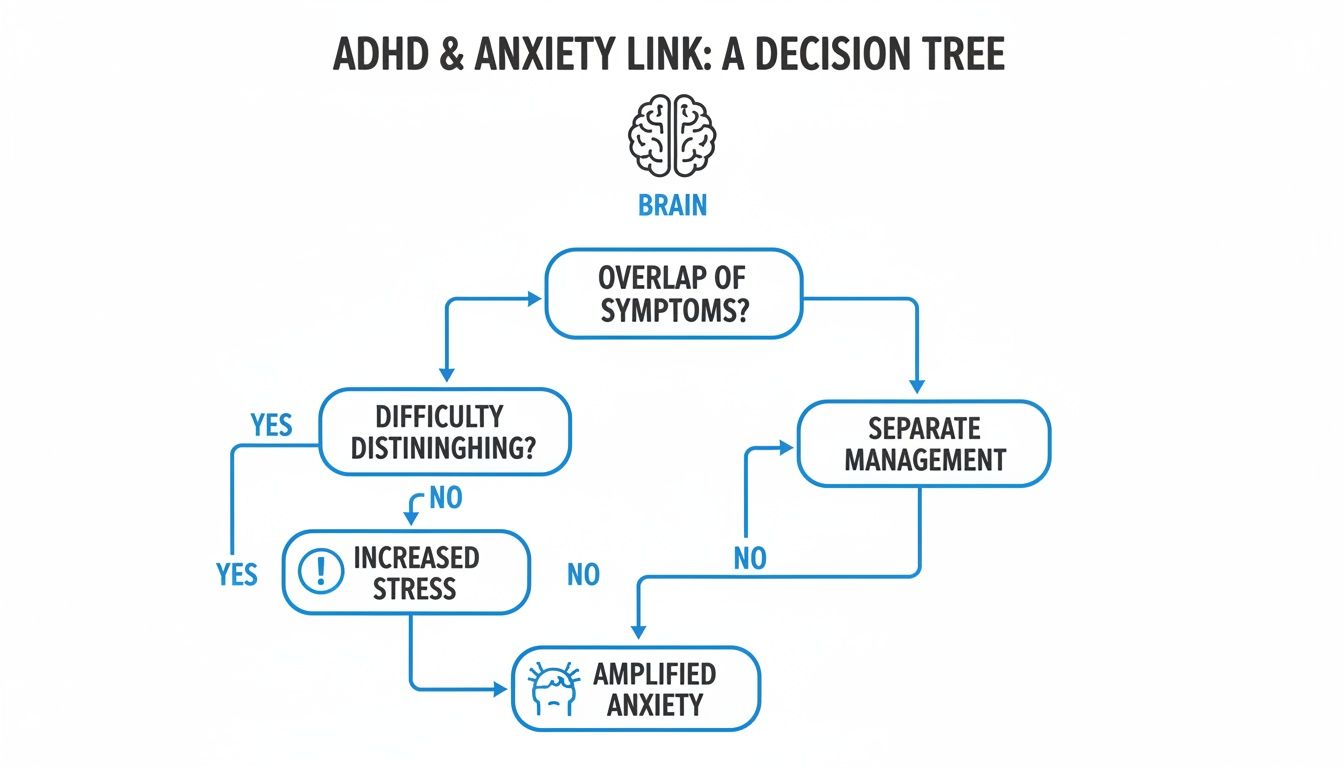
As you can see, the core executive function struggles that come with ADHD often create a life of chronic stress. Over time, that constant stress can easily spiral into a full-blown anxiety disorder.
Symptom Breakdown ADHD vs Anxiety
Let's dig into some of the most common points of confusion. By looking at how these symptoms typically show up, you can start to build a clearer picture of what might be driving your own experience. Of course, this is just a guide to help you understand the nuances—it’s not a replacement for a professional diagnosis.
This table breaks down how common symptoms can look very different depending on their root cause, which is a massive help when trying to differentiate between the two conditions.
| Overlapping Symptom | How It Manifests in ADHD | How It Manifests in Anxiety |
|---|---|---|
| Inattention | Your mind wanders off easily, pulled away by more exciting thoughts or something happening outside. It can feel like you're trying to tune into ten radio stations at once. This is all about difficulty with attentional regulation. | Your mind is completely consumed by specific worries or fears, making it impossible to focus on anything else. This is a preoccupation with a threat or a negative outcome. |
| Restlessness | This is usually a physical, internal buzz that makes you need to fidget, tap your feet, or just get up and move around. It’s your under-stimulated brain crying out for more input. | This is more of an internal feeling of being tense, wound up, or "on edge." It's the physical side effect of a mind caught in a relentless worry cycle. |
| Procrastination | You put things off because a task feels painfully boring, overwhelming, or just not stimulating enough. We often call this "task paralysis"—you know what you need to do, but you just can't make yourself start. | You avoid tasks because you're terrified of failing, being judged, or not doing them perfectly. The avoidance is a way to escape the anxious feelings the task brings up. |
| Sleep Problems | You have a tough time falling asleep because your brain simply won't switch off. It's buzzing with creative ideas, random thoughts, or replaying conversations from the day. This often leads to a delayed sleep cycle. | You can't sleep because you're stuck in a loop of anxious thoughts about what might happen tomorrow or what went wrong yesterday. It's often paired with physical symptoms like a racing heart or tense muscles. |
| Emotional Outbursts | You might have sudden, intense flashes of frustration or anger, usually when you feel overwhelmed, misunderstood, or rejected. This is tied to emotional dysregulation, a core part of ADHD. | Outbursts here are more likely to be an explosion of pent-up worry or fear. They usually happen after a long period of escalating internal anxiety finally becomes too much to handle. |
The key difference really boils down to this: ADHD-driven behaviours are often a search for stimulation and a struggle with self-regulation, while anxiety-driven behaviours are a reaction to a perceived threat or fear. Grasping this distinction is a game-changer.
Putting It All Together for Your Assessment
When you're getting ready for an assessment, thinking about these differences can be incredibly helpful. Instead of just telling your clinician, "I have trouble focusing," you can give them much more specific, useful details.
For example, compare these two statements:
- "I can't focus in meetings because my mind keeps drifting off to more interesting projects, but I can get lost for hours playing a video game." (This points more towards ADHD)
- "I can't focus in meetings because I'm constantly worrying about what my boss thinks of my performance." (This points more towards anxiety)
Providing this level of detail gives a clinician a much richer, clearer picture of your internal world. It helps them look past the surface-level symptoms to see the underlying mechanisms at play. Ultimately, that’s what leads to a more precise diagnosis and a treatment plan that actually works because it targets the true source of your struggles.
Building Your Personal Management Plan
Trying to manage both ADHD and anxiety can feel like you're fighting a battle on two fronts. It's not about finding a single magic bullet, but about building a smart, personalised strategy that works for you. Think of it as creating a personal toolkit—one that combines professional support with practical, everyday habits.
This approach is about tackling the problem from all angles. We need to address the underlying brain chemistry that drives the symptoms, as well as the real-world behaviours that keep the cycle of distraction and worry going. It’s about creating a solid foundation for your mental well-being.

Therapeutic Strategies for Dual Management
Therapy is where you learn the skills to untangle the knotted thoughts that both ADHD and anxiety create. It’s not just about talking; it’s about learning actionable techniques to get a handle on your mind and, ultimately, your behaviour.
One of the most powerful tools in the box is Cognitive Behavioural Therapy (CBT). While standard CBT is brilliant for challenging the catastrophic thinking that fuels anxiety, it needs a bit of an upgrade for an ADHD brain. An ADHD-informed therapist knows how to adapt the approach to tackle executive function challenges head-on.
This means you’ll learn how to:
- Break Down Tasks: Get skilled at slicing overwhelming projects into tiny, manageable steps so you can sidestep that feeling of being completely paralysed.
- Challenge Anxious Thoughts: Pinpoint and reframe the worry-fuelled thoughts that pop up after a missed deadline or a social misstep.
- Build Organisational Systems: Develop practical, external structures—think planners, apps, and reminders—to make up for the internal organisational struggles.
Think of therapy as getting a personal trainer for your brain. They give you the structure, accountability, and specific exercises to build mental muscle, helping you manage both the anxious thoughts and the ADHD-related habits that trigger them.
Demystifying the Medication Process
Medication can be a total game-changer, but when both ADHD and anxiety are in the picture, the approach needs to be strategic. A common and often very effective strategy is to treat the ADHD first. Why? Because when you get the core ADHD symptoms under control—like impulsivity, inattention, and disorganisation—the secondary anxiety that’s been feeding off that chaos often drops significantly.
It’s a bit like fixing a leaky roof instead of constantly mopping the floor. By sorting out the source of the problem, a lot of the resulting stress and worry just naturally fades away.
There are two main types of ADHD medication:
- Stimulants (e.g., Methylphenidate, Lisdexamfetamine): These are usually the first port of call. They work by increasing dopamine in the brain, which helps sharpen focus and improve impulse control.
- Non-stimulants (e.g., Atomoxetine): These are a great alternative if stimulants make you feel more anxious or have other unwanted side effects. They work differently but can be just as effective for many people.
It's worth noting that since the COVID-19 pandemic, ADHD prescriptions have shot up by 18% each year. Even so, it's estimated that only about 15% of adults with the condition receive medication, leaving a huge number of people trying to cope without this vital support. You can read more about the rise in ADHD treatment and statistics.
Actionable Lifestyle Adjustments
Alongside professional treatment, the small changes you make to your daily routine can have a massive impact. These lifestyle adjustments create a stable baseline that makes therapy and medication work even better. They are the bedrock of your management plan.
1. Prioritise Movement: Exercise is non-negotiable. It’s one of the most effective natural ways to boost dopamine and norepinephrine—the very neurotransmitters ADHD medications target. Even a brisk 20-minute walk can be enough to calm a racing mind and reset your focus.
2. Master Your Sleep Hygiene: An ADHD brain often puts up a fight at bedtime. But poor sleep is a massive amplifier for both ADHD symptoms and anxiety. Create a proper wind-down routine that tells your brain it's time to switch off. That means no screens an hour before bed, a consistent bedtime, and a dark, cool room.
3. Fuel Your Brain: What you eat has a direct line to your mood and focus. A balanced diet with plenty of protein, complex carbs, and healthy fats helps stabilise your blood sugar and prevents the energy crashes that make inattention and irritability so much worse.
Pulling these elements together—therapy, the right medication, and smarter lifestyle choices—creates a powerful, holistic strategy. It’s a proactive approach that puts you in the driver’s seat, helping you manage the complex relationship between ADHD and anxiety and pave the way for a calmer, more focused life. If you're curious about non-pharmacological routes, you can also explore our guide on ADHD treatments without medication.
Getting a Private ADHD Assessment in the UK
When you’re facing an NHS waiting list that feels endless—sometimes stretching for years—going private for an ADHD assessment can feel less like a choice and more like a lifeline. If you’re trying to untangle the combined knots of ADHD and anxiety, getting clear, timely answers is the only way to start moving forward. The whole process can seem a bit intimidating, but it’s really about taking back control.
The first thing to understand is that navigating the private healthcare world takes a bit of savvy. You aren't just trying to get a diagnosis ticked off a list; you're looking for a genuine, credible partner for your health. A proper assessment isn't a quick chat. It's a deep dive, involving detailed interviews, recognised diagnostic questionnaires, and a good look at your history, from childhood right up to the struggles you're facing today.
Ultimately, you should walk away with a comprehensive clinical report. This is the document you’ll need to take to your GP to discuss your ongoing care. It's the key to setting up a shared-care agreement, which is where your GP agrees to prescribe your medication based on the specialist's guidance. Without one, you could be left paying for expensive private prescriptions indefinitely.
Key Questions to Ask Any Clinic
Before you book anything, you need to do a bit of detective work. Arming yourself with the right questions helps you spot the good clinics and sidestep the ones that aren't up to scratch. Think of it like you're interviewing them for a crucial role—because, really, you are.
Here are the non-negotiables to ask about:
- Are your clinicians GMC-registered specialists? The person assessing you should be a psychiatrist on the General Medical Council's (GMC) Specialist Register. No exceptions.
- What diagnostic tools do you use? A quality assessment will always use validated tools, like the DIVA-5 (Diagnostic Interview for ADHD in Adults), alongside an in-depth clinical conversation.
- Do you help set up shared-care agreements with NHS GPs? This is a massive one for managing long-term medication costs.
- What are the total costs? Get a full breakdown. Ask about the assessment, any follow-up appointments, and prescription fees before a shared-care agreement is active.
- How do you look for co-occurring conditions? With the massive overlap between ADHD and anxiety, you want to know if their process is designed to spot both.
Choosing a provider is a big deal. A good, transparent clinic will have no problem answering these questions clearly. If they get defensive or vague about their clinicians, process, or costs, treat it as a serious red flag.
Comparing Your Options Effectively
The sheer number of private clinics out there can feel overwhelming, making it tough to even know where to begin. For anyone in the UK trying to figure this out, directories are incredibly helpful, letting you quickly compare over 85 private clinics. They lay out pricing and wait times in black and white, often showing you can be seen in weeks instead of years. It’s also a great way to compare well-known online providers like Psychiatry-UK or ADHD 360.
Using a directory lets you filter providers by what's most important to you—be it cost, location, or whether they offer online appointments. Even better, you can often read reviews from real people who have been through it themselves, which gives you a much better sense of what to expect. It cuts through the noise and helps you make a choice you can feel good about.
Taking this route is an investment in yourself. By vetting clinics carefully and knowing what the process involves, you can find a reliable professional who provides the support you need to finally get some clarity and a solid plan for the future. For more on this, have a look at our guide to getting a private ADHD diagnosis in the UK.
Knowing When and How to Seek Urgent Help
Learning to manage the day-to-day of ADHD and anxiety is a marathon, not a sprint. But sometimes, you hit a wall. It’s absolutely crucial to know the difference between a rough patch and a real crisis, and to have a plan for when things feel like they’re spiralling out of control.
This isn’t about being weak—it's about knowing when your coping mechanisms are completely overwhelmed. The reality is, when severe anxiety crashes into untreated ADHD, the fallout can be serious. It’s projected to cost the UK economy £17 billion a year in lost productivity and increased care needs, a figure that highlights just how damaging it can be to leave acute symptoms unchecked. You can read more about the economic impact and ADHD statistics.
Recognising the signs that you or someone you care about needs help right now is the most important first step you can take.
Red Flags for Immediate Support
A mental health crisis isn't always a Hollywood-style breakdown. Often, it’s a slow burn that suddenly ignites, or a sudden, terrifying spike in symptoms. Keep a close eye out for these warning signs:
- Escalating Panic Attacks: If panic attacks are happening more often, feel far more intense, or are dragging on for longer than they used to.
- Thoughts of Self-Harm or Suicide: This is the most urgent red flag. It includes any thought about wanting to hurt yourself, or feeling like life just isn’t worth living anymore.
- Inability to Function: When you genuinely can’t manage the basics—getting out of bed, eating, or looking after your personal hygiene.
- Extreme Social Withdrawal: Pulling away completely from friends, family, and all your usual responsibilities.
If you are experiencing any of these, especially thoughts of self-harm, please treat it as a medical emergency. You are not overreacting. Reaching out for help in that moment is the bravest and most important thing you can do.
Your UK Emergency Action Plan
When you’re in a crisis, you don't need a complicated flowchart. You need a simple, clear list of who to call.
- Call 999 or go to A&E: Do this immediately if you feel you are in danger of harming yourself or someone else.
- Contact your local NHS urgent mental health helpline: These are available 24/7 across England and you can find your local one on the NHS website.
- Call NHS 111: They can give you advice and put you in touch with the right local crisis teams.
- Speak to Samaritans: Call 116 123 anytime, for free. You'll speak to a trained volunteer in complete confidence.
- Text "SHOUT" to 85258: This is a free, confidential text service for when you need support but can't talk.
Save these numbers in your phone right now. For more guidance, we've also put together a curated list of ADHD and mental health resources. Knowing exactly where to turn takes the guesswork out of a moment when you need help the most.
Frequently Asked Questions
When you're trying to get your head around the relationship between ADHD and anxiety, a lot of practical questions naturally come to mind. Getting straight answers is a huge part of feeling more in control of the situation, so let's tackle some of the most common queries we hear from people across the UK.
Can ADHD Medication Make My Anxiety Worse?
This is a big one, and it’s a perfectly reasonable question to ask. The short answer is: it depends. For many, treating their ADHD with the right medication actually reduces their anxiety. Think about it – when the root causes of your stress, like constant disorganisation or missed deadlines, start to fade, the anxiety that’s been feeding off that chaos often fades too.
However, it's also true that some people find stimulant medications can ramp up feelings of jitteriness or physical tension, which can mimic or worsen anxiety. This is exactly why it's so critical to work with a specialist who really listens to you.
A good clinician will:
- Keep a close eye on you during the initial titration period (when you're finding the right dose).
- Tweak your dose to find that sweet spot where focus improves without making you feel on edge.
- Suggest trying a non-stimulant medication if stimulants just aren't the right fit.
The key is open and honest conversation with your doctor. That partnership is what ensures you land on a treatment that works for your brain, tackling the ADHD without dialling up the anxiety.
Do I Need Two Separate Diagnoses?
Yes, if you think both conditions are present, you'll need a formal diagnosis for each to get the best possible treatment. ADHD and an anxiety disorder (like Generalised Anxiety Disorder, or GAD) are distinct conditions with their own specific sets of diagnostic criteria.
A clinician conducting a thorough assessment will carefully check your symptoms against the official criteria for both, figuring out if you meet the threshold for one, the other, or a combination.
Getting this dual diagnosis isn't just about labels. It’s about creating a holistic treatment plan that addresses the whole picture, not just one piece of the puzzle while another continues to cause problems.
Can I Use NHS Right to Choose for a Combined Assessment?
Absolutely. The NHS Right to Choose pathway in England gives you the option to pick a qualified provider for your ADHD assessment. Many of these providers are very experienced in assessing for co-occurring conditions like anxiety, which can be a fantastic way to get a full diagnostic picture much faster than traditional NHS wait times.
When you're looking into Right to Choose providers, it’s a good idea to ask them upfront if their standard assessment covers common comorbidities. A little homework at this stage can help you get a much more effective and personalised treatment plan from the get-go.
Finding the right path forward always starts with finding the right support. ADHD Private provides a free directory to help you compare over 85 private clinics across the UK. You can see transparent information on pricing, wait times, and services all in one place. Take the first step towards clarity and find the right clinic for you.