Study Skills ADHD: Master Your Learning and Focus
Discover ADHD study strategies to boost focus and time management with actionable tips for students and adults.
Staring at a blank page or an open textbook, feeling like your brain wants to be anywhere else but here? It's a deeply familiar frustration for anyone with ADHD. Trying to develop effective study skills with ADHD has nothing to do with intelligence or willpower. It's about working with a brain that's hardwired for novelty and interest, which can make the grind of traditional study methods feel completely impossible.
The ADHD Study Challenge Is Real, But You Can Beat It
This guide isn't about generic advice. We're getting straight to what actually works. It's an all-too-common experience for students with ADHD to feel like they're putting in double the effort for half the reward. The root of this struggle often lies in executive functions—those crucial mental skills covering working memory, flexible thinking, and self-control.
When these functions don't work as expected, simple tasks can feel monumental. Things like planning a revision timetable, staying focused in a lecture, or just starting that dreaded essay become huge hurdles. Many of these difficulties are key signs of ADHD in adults, and without the right support, they can have a real impact on your academic and professional life. But here's the good news: with the right strategies, you can learn to work with your brain's unique wiring, not against it.
It All Starts With a Mindset Shift
First things first, let's reframe the challenge. Instead of viewing ADHD as a roadblock, think of it as a different kind of operating system. Your job is to find the right 'software'—the study techniques and tools that are actually compatible with your system. It’s a big shift, moving away from forcing yourself to use methods that don't work and instead embracing approaches that cater to the ADHD mind.
This guide is your toolkit for making that happen. We'll dive into how you can:
- Create a study environment that minimises distractions instead of adding to them.
- Manage your time in a way that feels liberating, not restrictive.
- Use active learning techniques that genuinely engage your brain and make information stick.
- Get to grips with the practical steps for accessing support and assessments in the UK.
The goal isn't to 'fix' your ADHD traits. It's about building a solid system of support around them. Real success comes from understanding what you need and learning how to ask for it.
Think of this as more than just a list of tips; it's a blueprint for building study habits that can last. Whether you're looking for university adjustments or seeking professional help, you’ll find the knowledge you need to turn academic challenges into achievable goals. Let's start building your personalised toolkit for success.
How to Build an ADHD-Friendly Study Environment
Your study environment can either be your greatest ally or your biggest enemy. For someone with ADHD, just finding a ‘quiet spot’ is rarely the whole story. The real secret to boosting your study skills isn't about fighting distractions—it's about deliberately engineering a space that works with your brain, not against it. Think of it as actively managing the sensory input that can so easily throw you off track.

What you're really doing is creating powerful, clear signals for your brain. When you walk into this space, it should feel like you're mentally clocking in for a study session. The aim is to lower the barrier to getting started and staying focused, making it less of a constant battle.
Master Your Sensory World
The ADHD brain often processes surroundings with incredible sensitivity. A flickering light, the low hum of the fridge, or even visual clutter can feel like a siren going off, making concentration feel impossible. Getting a handle on this sensory input is a game-changer.
Start by pinpointing what distracts you most and tackle it head-on.
- Sound Control: A quality pair of noise-cancelling headphones can be a lifesaver, blocking out unpredictable background noise and creating your own calm audio bubble. You could also try a white noise machine or an app that plays focus-friendly sounds, like ambient café chatter or binaural beats.
- Visual Simplicity: A cluttered desk often leads to a cluttered mind. Before you begin, spend literally two minutes clearing your space of everything that isn't essential for the task at hand. It also helps to face a blank wall instead of a window or a busy room to cut down on visual ‘noise’.
- Lighting Matters: Harsh, flickering fluorescent lights can be a nightmare for agitation and eye strain. If you can, stick with warm, natural light. Otherwise, a good desk lamp with adjustable brightness and warmth can help you create a much calmer, more focused atmosphere.
The Power of Body Doubling
Ever noticed how it’s sometimes easier to get things done when someone else is just… there? Even if they’re working on something completely different, their presence can make a huge difference. That’s the magic of body doubling, and it’s a surprisingly effective strategy for the ADHD brain.
Having another person nearby creates a gentle, external pressure that boosts accountability and helps keep you anchored to your task. It’s not about them actively helping you; their quiet companionship is the tool itself.
Body doubling is a powerful reminder that focus isn't always a solo mission. Sometimes, the simplest form of support—just being there—can make the biggest difference in productivity and motivation.
You don’t even need someone in the same room. Virtual body doubling has exploded in popularity. You can easily find focus partners through online communities or just set up a video call with a friend where you both work quietly with your cameras on.
Tame Your Digital Distractions
Let's be honest, our biggest source of distraction is often the very device we need for studying. That constant pull of notifications, social media, and the endless rabbit holes of the internet requires a solid defence plan.
Organising your digital space is every bit as important as your physical one. Here are a few practical ways to create some digital boundaries:
- Use Website Blockers: Browser extensions like Freedom or Cold Turkey are brilliant. They let you block access to your most tempting websites for a set period, removing the temptation at its source.
- Create 'Work' Profiles: Try setting up a separate user profile on your computer just for studying. Keep it completely clean—no social media apps, no games, no distracting bookmarks. When you log in, it’s an immediate signal to your brain that it’s time to focus.
- Silence Notifications: This is more than just putting your phone on silent. Go into your laptop or tablet settings and turn off all non-essential notifications. Those little pop-ups are specifically designed to hijack your attention, and every single one forces your brain to hit the reset button on its focus.
The right environment is a crucial piece of the academic puzzle, but it's often overlooked. Research shows that students with ADHD in UK higher education frequently face an 'attainment gap', partly due to a lack of tailored support. With only around 19.7% of students with ADHD receiving academic skills support and 34% getting specialised tutoring, taking control of your own study environment is a powerful act of self-advocacy. You can discover more about the support structures in UK universities and why they matter so much.
Time Management That Works With Your Brain, Not Against It
If you’ve ever stared at a pristine planner, filled with rigid schedules, and felt a wave of dread, you're not alone. For many people with ADHD, traditional time management systems feel like they were designed for someone else entirely—because they were. The ADHD brain thrives on novelty and interest, not long-term, abstract goals. That's why forcing it into a neurotypical box so often backfires, leaving you feeling unproductive and overwhelmed.

The secret isn’t to find a fancier planner or to just "try harder." It's about finding clever ways to work with your brain's unique wiring. This means building flexibility into your routines, breaking big tasks into tiny, satisfying chunks, and making the abstract concept of 'time' something you can actually see.
Rethink the Pomodoro Technique
The classic Pomodoro Technique is often recommended: work for 25 minutes, take a 5-minute break. It's a solid starting point, but its rigidity can be a deal-breaker. Some days, 25 minutes feels like an eternity. On others, you might finally hit a glorious state of hyperfocus, and the last thing you want is a timer telling you to stop.
The trick is to make it flexible. Think of it less as a rule and more as a tool you control.
- Try 15-Minute Sprints: On low-energy days or when you’re facing a task you dread, just committing to 15 minutes feels manageable. It’s often enough to overcome that initial inertia.
- Ride the Hyperfocus Wave: If you're in the zone and making progress, let yourself go for longer—maybe 45-50 minutes. Don't break a good flow state just because a timer tells you to.
- Make Breaks Count: Your breaks are for recharging, not derailing. Mindless scrolling can easily turn a 5-minute break into a 30-minute one. Instead, do something physical or sensory. A few stretches, grabbing a cold drink, or listening to one high-energy song can reset your brain without pulling you into a digital rabbit hole.
Master the Art of Time Blocking
"Write essay" on a to-do list is a recipe for procrastination. It’s too big, too vague, and just plain scary. The ADHD brain gets paralysed by huge, undefined projects. This is where time blocking becomes your superpower. You break that mountain down into tiny, concrete steps and then, crucially, assign each one a specific slot in your calendar.
For instance, that monster of an essay could become:
- 20 mins: Find and download three academic sources.
- 15 mins: Read just the abstract and conclusion of each source.
- 25 mins: Write a rough, one-paragraph introduction.
- 20 mins: Create a simple bullet-point outline.
Suddenly, "write essay" isn't one huge task anymore. It's a series of small, achievable wins. Every time you tick one off, you get a little hit of dopamine, which is the very chemical that helps you stay motivated for the next block.
Overcome "Time Blindness"
If you frequently find that an hour has passed when it felt like only five minutes, you’re likely experiencing "time blindness." It’s a core ADHD trait where you have a poor internal sense of time's passage, leading to missed deadlines and constant rushing.
To counter this, you need to make time a physical, visible thing.
For a brain that struggles with abstract concepts, making time visible isn't a life hack—it's a necessity. It externalises your internal clock, providing the constant, gentle reminder you need to stay anchored and on track.
Digital countdown timers are a good start, but visual timers are a game-changer. Tools like the Time Timer, which has a red disc that physically disappears as time elapses, are brilliant. You can literally see your minutes shrinking. Placing one on your desk creates a gentle sense of urgency and makes time impossible to ignore.
Many popular time management techniques can be adapted to be more ADHD-friendly. Here's a quick look at how to adjust them to suit your brain.
ADHD-Friendly Time Management Techniques
| Technique | Traditional Approach | ADHD-Friendly Adaptation |
|---|---|---|
| Pomodoro | Strict 25-minute work intervals followed by 5-minute breaks. | Use flexible sprints (e.g., 15-50 mins) based on your energy and focus levels. Make breaks active and screen-free. |
| Time Blocking | Schedule your entire day in rigid, back-to-back blocks of time. | Focus on blocking out just 1-3 key study tasks. Leave buffer time between blocks for transitions and unexpected distractions. |
| Eat the Frog | Tackle your biggest, most dreaded task first thing in the morning. | Start with a small, easy "warm-up" task to build momentum first. This "dopamine snack" can provide the motivation needed for the bigger "frog". |
By tweaking these established methods, you’re not abandoning structure; you’re customising it to provide support without feeling restrictive.
Schedule Your Rewards (and Your Rest)
For the ADHD brain, reward isn't just a nice bonus; it’s the fuel. Don't leave rewards to chance. Build them directly into your study plan as something to look forward to. The anticipation of a reward can make the effort of focusing feel much more worthwhile.
These rewards don’t have to be huge—they just need to be immediate.
- Finish a 20-minute reading block? Watch one short, funny YouTube video.
- Complete your essay outline? Spend 10 minutes playing a game on your phone.
- Get through all your planned study for the day? Enjoy an episode of your favourite show, completely guilt-free.
Just as vital is scheduling proper downtime. This isn't a 5-minute break; this is protected time where there is zero pressure to be productive. By consciously putting rest into your calendar, you help break the all-or-nothing cycle of burnout and recovery that is so exhausting. It teaches your brain that rest is a crucial and planned part of your success.
Active Learning Strategies That Make Information Stick
If you have ADHD, just re-reading your notes is probably one of the least effective ways to make information stick. It often feels like pouring water into a leaky bucket, doesn't it? The ADHD brain thrives on engagement and novelty. To genuinely learn something for the long haul, you have to get your hands dirty, interact with the material, and fire up as many senses as you can.
Think of it this way: dynamic study methods aren't just a nice alternative; for us, they're essential. The whole point is to shift learning from a passive chore into an active process of creating and connecting. This builds stronger, more reliable memory pathways that you can actually count on when you walk into that exam.
Explain It Like I’m Five
One of the most powerful tricks up your sleeve is something called the Feynman Technique. The idea sounds almost too simple, but it works wonders: take a complex topic and try to explain it in the plainest language possible, as if you were talking to a child.
This simple act forces you to go way beyond just recognising a few keywords. You can't explain something simply until you truly understand it yourself. You’ll immediately spot the holes in your own knowledge—those moments where your explanation gets a bit woolly are exactly where you need to focus your revision.
Let's say you're trying to get your head around the circulatory system. Instead of just memorising names of arteries and veins, grab a piece of paper and try to talk through the whole process out loud.
- Start simple: "Right, so the heart is basically a big pump..."
- Find the fuzzy bits: "...and then the blood shoots into the... uh, that big blue tube thingy."
- Go back and fill the gap: Look up the specific term (pulmonary artery), figure out what it does, and then slot it back into your simple explanation.
Speaking your thoughts out loud and simplifying things solidifies your understanding in a way that staring at a page never will.
Make Your Learning Visual and Vibrant
Let's be honest, linear, text-heavy notes are often a total nightmare for the ADHD mind. There are no visual hooks to grab onto, nothing to keep your attention from wandering. So, stop creating pages of uniform text and start turning your notes into something dynamic and memorable.
Mind mapping is a brilliant place to start. Pop your main topic in the centre of a page and draw branches shooting off for key concepts, sub-topics, and little details. Use different colours, symbols, and even little doodles to forge connections and highlight the important stuff. This method actually mirrors how our brains naturally link ideas, making it far more intuitive to follow and recall.
When you create a mind map or a colourful diagram, you're not just taking notes; you're building a mental model of the information. This visual architecture makes complex topics easier to navigate and remember.
For example, instead of writing a boring list of historical dates for an essay, create a visual timeline. Draw a long line across a massive sheet of paper, mark the key events, and colour-code different themes or figures. Suddenly, a dull list becomes an engaging story you can actually see.
Gamify Your Revision with Spaced Repetition
Working memory can be a real struggle with ADHD, which is why last-minute cramming rarely pays off. For information to move from your short-term to your long-term memory, you have to revisit it over time. This is where spaced repetition comes in, and it can feel much more like a game than a study session.
Spaced repetition is a learning method where you review information at increasing intervals. The core idea is to catch a concept just as you're about to forget it, which strengthens the memory each time you do.
Thankfully, you don't have to track this all yourself. Apps like Anki or Quizlet are designed specifically for this.
- Create digital flashcards for key terms, formulas, or concepts.
- Let the algorithm do the heavy lifting. The app shows you cards you find tricky more often and the ones you know well less frequently.
- Practise in short bursts. Just 15-20 minutes a day can make an incredible difference, turning revision into a consistent, low-effort habit.
Turn Studying into a Multi-Sensory Experience
The more senses you can pull into the learning process, the more memorable the information will be. Start thinking about how you can turn abstract concepts into something you can see, hear, or even touch.
Here are a few ideas to get you started:
- Record yourself reading. Turn a dry textbook chapter into your own mini-podcast. Read the key points into your phone's voice recorder and listen back while you're walking the dog or on the bus. Hearing the information engages your brain in a completely different way.
- Get hands-on with physical objects. If you're studying molecular biology, get some modelling clay and build the structures you're learning about. The physical act of creating the model will help cement its shape and function in your mind far better than a 2D diagram.
- Watch documentaries and videos. Find engaging YouTube channels or documentaries related to your subject. Hearing a passionate expert explain a topic and seeing it brought to life with animations can make it click in a way a textbook never could.
By making learning truly interactive, you give your brain the stimulation it craves to stay focused. It can transform study time from something you dread into an activity you actually find rewarding.
Navigating ADHD Assessments and Support in the UK
Figuring out how to get support can feel like the biggest hurdle when you're trying to improve your study skills with ADHD. In the UK, a formal diagnosis is the key that unlocks official support, especially at university. Without that piece of paper, getting essentials like extra time for exams or a bit more leeway on deadlines is often a non-starter.
The whole process can seem completely overwhelming, but getting your head around the options is the first step toward getting the help you need.
Understanding Your Assessment Options
In the UK, there are generally three paths you can take to get an ADHD assessment. Each comes with its own timeline and quirks, so knowing what they are helps you decide which route works best for your situation.
Your first port of call is usually your GP. They can refer you down the standard NHS pathway. The good news? It's free. The bad news? The waiting lists can be incredibly long – we're talking years in some areas. For a student on a two or three-year course, that’s just not going to work.
A much better NHS option, if you're in England, is Right to Choose (RTC). This legislation gives you the right to choose your provider for certain mental health services, including ADHD assessments, as long as they hold an NHS contract. It can cut your wait time down from years to just a few months. Clinics like Psychiatry-UK and ADHD 360 are well-known for accepting RTC referrals.
The third route is to go private. It's by far the quickest way to get seen, often with appointments available within weeks, but it does come with a hefty price tag. If you can afford it, just make sure you pick a reputable clinic whose diagnosis will be accepted by your university and, ideally, your local NHS trust for any future medication arrangements.
The Importance of Reasonable Adjustments
Once you have that formal diagnosis, you can access what are known as reasonable adjustments. These are simply changes your university makes to ensure you're not at a disadvantage because of your ADHD. The diagnosis is your evidence, letting you sit down with the disability support team and create a plan that works for you.
These adjustments aren't just minor tweaks; they can completely change your academic experience. Common examples include:
- Extra time in exams, which is usually 25%.
- Penalty-free extensions on assignment deadlines.
- Access to a note-taker or permission to record your lectures.
- Specialist mentoring or study skills support for neurodivergent students.
- Assistive technology like text-to-speech software.
Getting a diagnosis isn’t about gaining an unfair advantage; it’s about levelling the playing field. Reasonable adjustments are there to remove barriers so you can show what you actually know and can do. You can find out more about specific examples of ADHD reasonable adjustments and how to ask for them.
This flowchart gives you a simple way to think about which active study methods to use once you have your support in place.
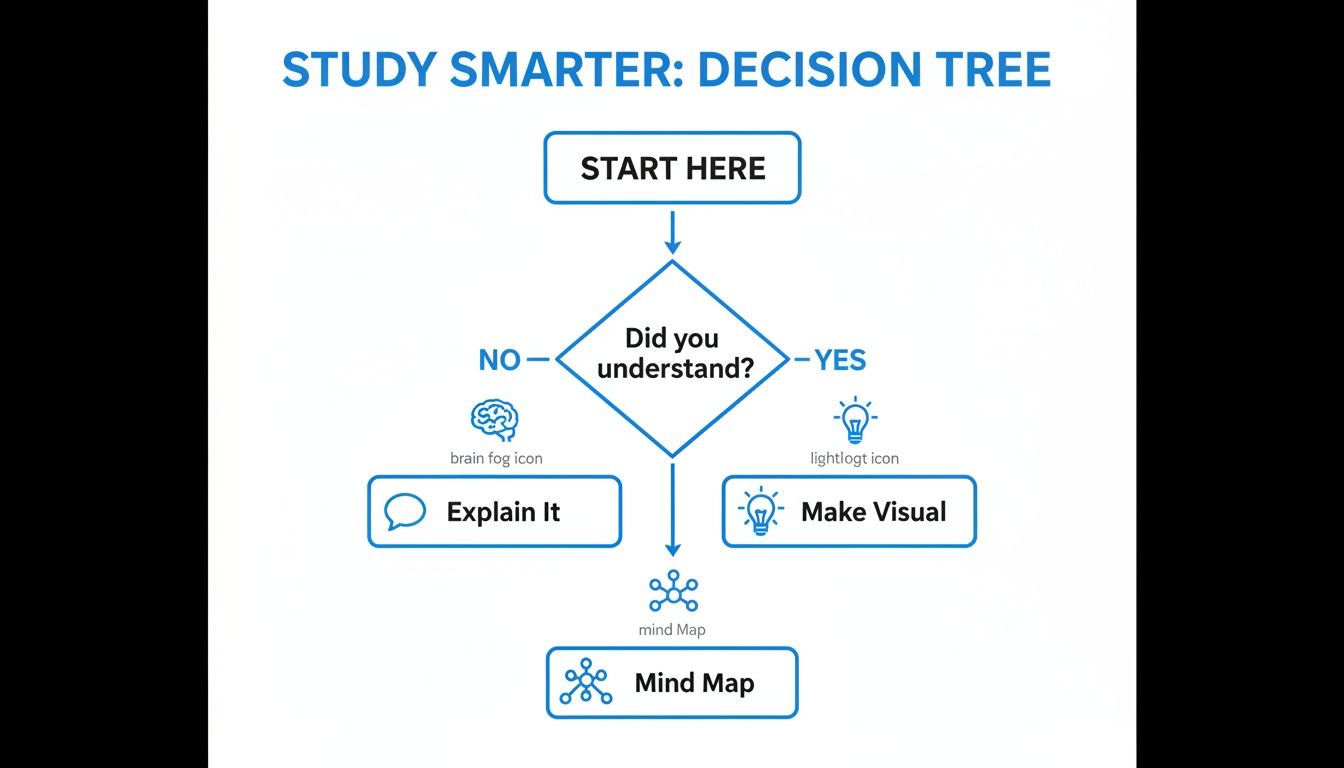
As you can see, it all starts with checking if you truly understand a concept before deciding whether to explain it to someone else or create a visual map of the idea.
Finding the Right Clinic For You
With the number of UK university students with ADHD estimated to be somewhere between 2% and 8%, the demand for assessments is huge. This has led to a boom in private clinics, which makes choosing the right one more important than ever. This trend also shines a light on potential inequalities in healthcare access. Research on ADHD prevalence actually shows that diagnoses are more common in deprived areas, which suggests a lot of students might be falling through the cracks.
When you're searching for a private clinic, keep these things in mind:
- Wait Times: How soon can they actually see you?
- Cost: What are the fees for the assessment itself, the final report, and any follow-up appointments?
- RTC Acceptance: Do they take on patients through the NHS Right to Choose scheme?
- Reviews: What are real patients saying about them on sites like Google or Trustpilot?
Looking for a directory that pulls all this information together can save you a ton of time and stress. It lets you compare your options and find a provider that fits your budget and timeline, empowering you to finally get the support you're entitled to.
Building Your Toolkit for Academic Success
Thriving academically with ADHD isn’t about trying to force your brain to work in a neurotypical way. It’s about building a personalised toolkit of strategies that actually work for you. By now, you should have a great foundation of practical ideas to get you started.
We’ve covered everything from creating a study space that minimises distractions to using flexible time management techniques and getting stuck in with active learning. We’ve even looked at the practical steps for getting the right support here in the UK. The next move is yours.
Putting Your ADHD Study Skills into Practice
Finding what clicks for you is often a case of trial and error, so the most important thing is to be patient and kind to yourself. Your journey will be unique.
- Start small. Don't try to change everything at once. Just pick one or two new things from this guide to try out this week. Maybe that's giving the Pomodoro method a go with a visual timer, or creating your first mind map for a tricky topic.
- Keep track of what works. Pay attention to what feels right and what doesn’t. Even a quick note on your phone about what helped you focus during a particular session can reveal incredibly useful patterns over time.
- Celebrate the small wins. Did you manage to study for 20 minutes without getting sidetracked? That is a massive achievement worth acknowledging. Celebrating these little victories is what builds momentum and keeps you going.
Your toolkit will grow and change along with you. The real key is to start experimenting, stay curious about what your brain needs, and keep adapting your methods without judging yourself. You are absolutely capable of hitting your academic goals.
Think of this guide as your starting point. Alongside these study-specific techniques, looking at the bigger picture can make a huge difference. For more ideas, you might find our guide on how to manage ADHD without medication helpful, as it offers other lifestyle and behavioural strategies that can really support your focus and overall well-being.
Your Questions Answered
Here are some of the questions I get asked most often about studying with ADHD, along with my advice for students and learners here in the UK.
How On Earth Do I Study a Boring Subject?
I get this one a lot. When a subject just doesn't spark your interest, you have to find a way to make it stimulating enough to keep your ADHD brain hooked. The trick is to "gamify" your study sessions.
Set yourself tiny, achievable challenges and give yourself a small, immediate reward for ticking them off. It’s all about creating those little dopamine hits your brain is looking for.
Don't just stare at the same page in the same chair for hours. Shake things up a bit:
- Change your scenery: If the desk isn't working, try the comfy armchair, the kitchen table, or even a different room altogether.
- Get sensory: Ditch the black biro. Use colourful pens, bright highlighters, and sticky notes. Sketch out mind maps on a massive whiteboard.
- Use soundscapes: Put on some instrumental focus music – lo-fi beats, classical, or even binaural beats can create an audio bubble that helps you tune out distractions.
Making these small changes can genuinely make it easier to get through dense or dry material without your mind wandering off.
What’s the First Step to Get Reasonable Adjustments at a UK University?
It all starts with a formal diagnosis. As soon as you have that diagnostic report in hand, your very next step should be to get in touch with your university's Disability Support or Student Services team. Please, don't wait until you're already behind or overwhelmed.
They’ll walk you through the process, which usually involves a private chat to put together your personalised support plan. This is the official document that outlines your adjustments, which could include things like 25% extra time in exams or more leeway with assignment deadlines. The earlier you do this – ideally right at the start of the academic year – the better. It ensures everything is set up and ready long before the pressure of exams and deadlines kicks in.
It's so important to remember that these adjustments aren't giving you an unfair advantage. They are there to level the playing field, removing barriers so you can show what you truly know.
Are There Any Apps That Actually Help with ADHD?
Yes, definitely! The right tech can be a game-changer. For pure focus and time management, apps like Forest and Flora are brilliant. They use a simple, rewarding game to keep you off your phone while you're meant to be working.
When it comes to getting organised, visual tools are often a winner. Something like Trello or Todoist helps you break down massive essays or revision plans into small, non-scary chunks.
For taking notes, apps like GoodNotes and Notability are fantastic if you have a tablet, as they let you be creative and visual. And for lectures, a tool like Glean is amazing. It records the audio, so you can actually listen and engage in the moment instead of frantically trying to scribble everything down.
Finding the right support is the first step. At ADHD Private, we've created a free directory to help you easily compare private ADHD clinics across the UK. Check wait times, pricing, and services to find the right path for you. Visit us at https://adhdprivate.co.uk.