How to Manage ADHD Without Medication: A Practical Guide
Discover ways to manage ADHD without medication using strategies and expert guidance to boost focus and well-being.
Written and maintained by the ADHD Private editorial team, drawing on NHS, NICE and ADHD UK guidance. This is general information, not medical advice.
Managing ADHD without medication isn't just a possibility—it's a path many people choose, often with great success. The key is to build a solid foundation of behavioural therapies, smart lifestyle changes, and practical supports that work with your ADHD brain, not against it.
This approach gives you a powerful set of tools, whether you're looking for an alternative to medication or something to complement it.
Exploring Your Options Beyond Medication
Taking charge of your ADHD management can feel incredibly empowering. For many in the UK, choosing non-medication strategies is also a practical necessity. Let's be honest: long NHS waiting lists often mean that individuals and families start exploring these avenues out of need.
This guide is designed to be your roadmap. We'll walk through how targeted therapies, meaningful lifestyle adjustments, and structured environments come together to create a robust system for success. These aren't just quick fixes; they are sustainable skills that can genuinely improve executive function, emotional regulation, and your overall sense of well-being.
The diagram below gives you a bird's-eye view of how these different pillars—therapy, lifestyle, and environment—work together.

As you can see, a successful plan is all about balance. It’s not about finding one single solution but combining different strategies to create a personalised approach that fits your life.
Understanding the UK Context
Interest in non-medication approaches has been on the rise across the UK. With over 549,000 children and adults currently waiting for assessments, the demand for accessible and effective strategies has never been higher.
And the evidence backs this up. Research shows that structured behavioural interventions can lead to a significant reduction in ADHD symptoms for 70-80% of UK children. A 2023 study also found that parent training programmes boosted child behaviour scores by an average of 45%. You can dig deeper into these ADHD statistics on the Priory Group's website.
Non-Medication ADHD Management Strategies at a Glance
To give you a clearer picture of what's out there, the table below provides a quick overview of the main strategies. It breaks down what each one involves and the kind of benefits you can expect, helping you figure out which options might be the best fit for you or your child.
| Strategy | Core Focus | Key Benefits |
|---|---|---|
| Therapy & Coaching | Building practical skills like time management, emotional regulation, and planning using methods like CBT and specialised ADHD coaching. | You'll see improved executive function, less procrastination, and better ways to handle frustration and overwhelm. |
| Lifestyle Changes | Fine-tuning nutrition, sleep, and exercise to support brain function and keep energy levels stable. | This leads to better focus, more stable moods, and a feeling of mental clarity throughout the day. |
| Environmental Support | Creating structured routines, decluttering physical spaces, and setting up clear systems to reduce cognitive load and decision fatigue. | Expect less daily chaos, better organisation, and a much greater sense of control over your tasks and responsibilities. |
This framework gives you a solid starting point. It’s a launchpad for understanding and implementing real-world strategies that can make a tangible difference in managing ADHD.
Building Skills with Therapy and Coaching
Beyond just tinkering with your environment and daily habits, getting professional guidance can give you the mental toolkit you need to really thrive. This is where therapy and coaching come in – they are brilliant assets when you’re learning how to manage ADHD without turning to medication.
The goal here isn't to "fix" your brain. Instead, it's about building practical, lasting skills so you can work with it. These approaches offer a dedicated space to unpack unhelpful thought patterns, build solid coping strategies, and create a personal playbook for the challenges ADHD throws your way. It’s all about shifting from just reacting to your symptoms to proactively managing your life.
What is Cognitive Behavioural Therapy for ADHD, Really?
Cognitive Behavioural Therapy, usually just called CBT, is one of the most well-researched and effective therapies for adults with ADHD. Don't confuse it with traditional talk therapy that might dig deep into your past; CBT is very much focused on the "here and now." It’s designed to help you spot and change the negative thought loops and behaviours that so often go hand-in-hand with ADHD.
Think about a common ADHD trap: catastrophising. You look at a big project at work and your brain immediately jumps to, "This is impossible. I'll never get it done, and I'm going to get fired." That single thought triggers a wave of anxiety and overwhelm, which, almost inevitably, leads to procrastination. Sound familiar?
A CBT therapist helps you press pause on that spiral. You learn to catch that initial thought and challenge it. Instead of "it's impossible," you reframe it: "Okay, this project is big, but I can break it down. What's the absolute smallest first step I can take?" It seems like a simple shift, but it’s incredibly powerful. You turn a scary, overwhelming mountain into a series of small, manageable hills.
This kind of tailored approach genuinely works. A major 2022 UK trial across 15 NHS trusts showed that CBT specifically designed for ADHD helped reduce symptoms in 60% of adults. After just 10 sessions focused on things like time management and emotional regulation, participants saw their hyperactivity scores drop by a massive 42%.
Finding Your Ally in an ADHD Coach
While therapy is great for tackling the underlying thought patterns and emotional side of things, ADHD coaching is all about practical, forward-looking action. A great coach is like a non-judgemental partner in crime, helping you build the systems and habits that actually work for your unique brain. They're your accountability buddy who truly gets the daily struggles with executive function.
Let's say a university student is falling behind on lectures and assignments. An ADHD coach would jump in to help them:
- Design a "brain-friendly" study plan: Forget long, gruelling study blocks. They might introduce something like the Pomodoro Technique (25 minutes of focused work, then a 5-minute break).
- Create a visual workflow: Using a simple whiteboard or an app like Trello to map out the stages of an essay can make progress feel tangible and way less daunting.
- Develop "transition rituals": This could be a short, consistent routine – like making a specific cup of tea and putting on a particular playlist – to signal to the brain that it's time to switch from chilling out to study mode.
Coaching is less concerned with why you struggle and much more focused on how to build the support structures you need to succeed. It effectively bridges that frustrating gap between knowing what you need to do and actually doing it. A coach helps you figure out what ADHD means for you and your life. If you're just starting to explore these ideas, our guide on what ADHD is in adults is a great place to begin.
The Surprising Power of Mindfulness
At first glance, mindfulness might seem like the complete opposite of what a fast-paced ADHD brain needs, but it's a surprisingly effective tool. The core issue in ADHD isn't really a lack of attention; it's the struggle to regulate it. Mindfulness is like taking your "attention muscle" to the gym.
This doesn't mean you have to sit in silent meditation for an hour every day. It can be as simple as a three-minute breathing exercise to ground yourself when you feel your thoughts racing. Or it could be mindfully washing the dishes—just focusing on the feeling of the warm water and the scent of the soap.
These small, consistent practices help you get better at noticing when your mind has wandered off and gently guiding it back. Over time, this strengthens your focus and gives you more control over where you place your attention.
Creating an ADHD-Friendly Environment
Your surroundings can be a source of chaos or a powerful ally. When you have ADHD, your physical and digital spaces aren't just backdrops; they're active players in your day-to-day life. The goal is to set up your environment to work for you, providing the external structure your brain needs to cut through the noise. This is a game-changer when learning how to manage ADHD without medication.
Think of it less as forcing yourself to fit into a neurotypical world and more as shaping your world to fit your brain. A few smart, deliberate changes can mean the difference between a day spent feeling frazzled and one where you actually get things done.

This isn't about achieving some kind of pristine, minimalist ideal you see online. It’s about creating practical, livable systems that simplify your life and save your precious mental energy for what really matters.
The Everything Has a Home Principle
For an ADHD brain, physical clutter translates directly into mental clutter. Every item left out is another thing vying for your attention, another tiny decision that needs to be made ("Where does this go? Do I need it? Should I deal with it now?"). It’s exhausting.
The most effective counter-strategy is dead simple: give every single thing you own a specific, logical home. It sounds almost too basic to work, but the impact is massive.
When your keys live on a hook by the door, you stop wasting 10 frantic minutes every morning tearing the house apart. When your important documents have a dedicated tray, you avoid that spike of panic when you need to find something urgently.
Key Takeaway: Organising your space isn't just about being tidy. It's a strategic move to quieten the environmental 'noise' that constantly pulls at your focus. A clearer space really does help create a clearer mind.
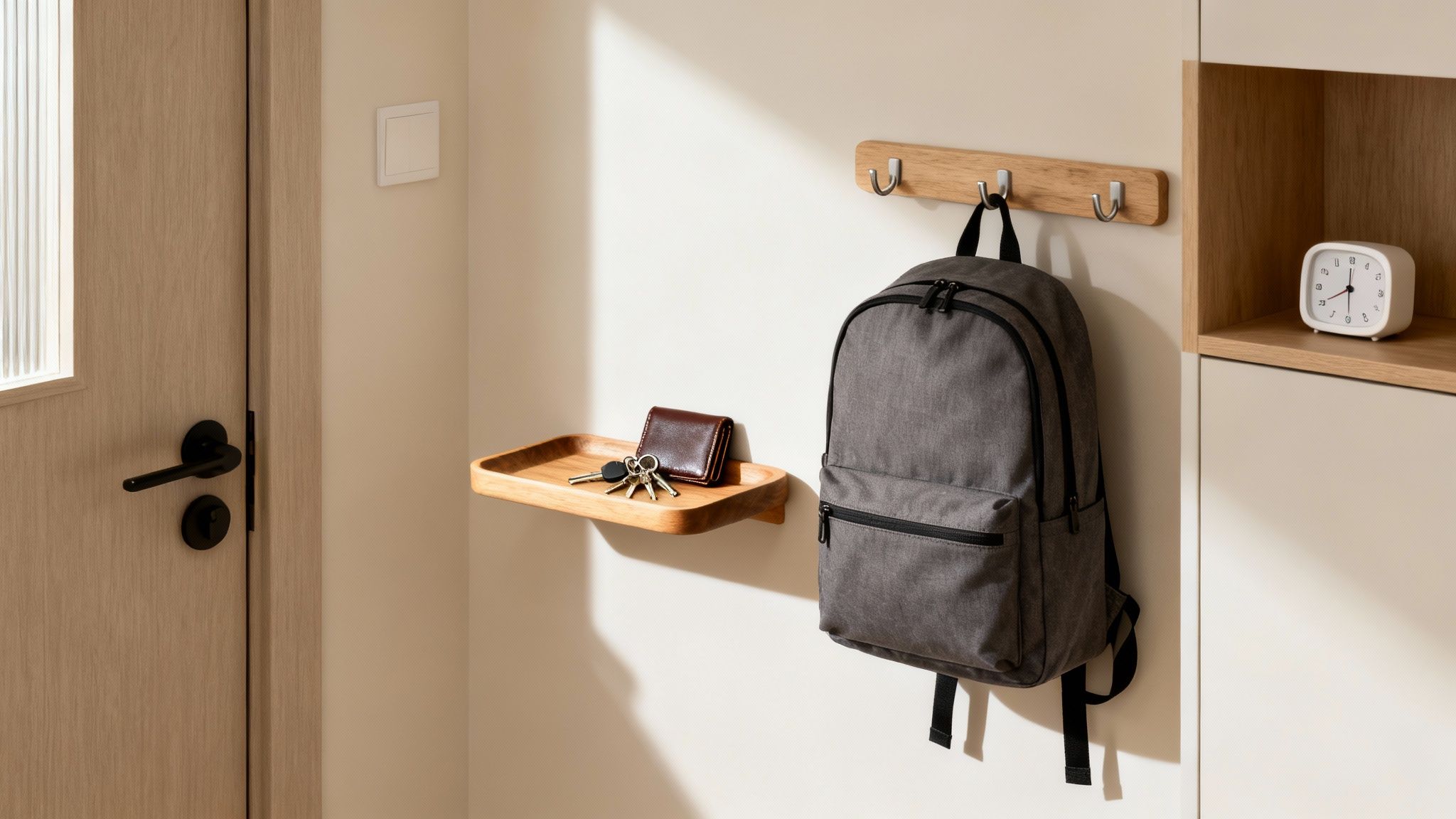
Build Your "Launch Pad"
A fantastic way to put this principle into action is to create a 'launch pad' right by your front door. This is your mission control for leaving the house, a designated spot for all the essentials you need to grab on your way out.
Keep it simple. A small table, a shelf, or a few wall hooks will do the trick. The magic is in the consistency.
- Key Hook: A non-negotiable spot for your house and car keys.
- Charging Station: The only place you charge your phone overnight.
- Essentials Bowl: A tray for your wallet, travel pass, or work ID.
- Outgoing Box: A box for letters to post, library books to return, or that thing you need to give back to a friend.
This one system can completely eliminate the frantic morning scramble, a classic ADHD stress point. It automates the process of getting out the door, saving your brainpower for the day ahead.
Make Time Tangible with Visual Timers
"Time blindness" is a real thing for many people with ADHD. It’s that tricky inability to sense the passage of time, where an hour can vanish in what feels like five minutes. This is why visual timers are such a brilliant tool—they make time a physical, concrete thing you can see.
Unlike a digital clock on your phone, a visual timer shows you how much time is left in a clear, graphical way.
- For focused work: Set a timer for a 25-minute work sprint (like a Pomodoro session). Watching the block of colour shrink gives you a tangible sense of urgency and helps you stay on task, knowing a break is coming.
- For transitions: If you need to leave in 30 minutes, setting a visual timer makes that block of time real and helps you pace yourself without rushing at the last second.
- For chores: A vague task like "tidy the kitchen" can feel overwhelming. Setting a timer for just 15 minutes turns it into a manageable challenge with a definite end.
These timers provide the external cues needed to regulate focus and manage transitions, often without the jarring anxiety a sudden alarm can cause.
Reduce Decision Fatigue with Routines
Every decision you make, no matter how small, chips away at your mental energy. For the ADHD brain, that energy is a finite and precious resource. By building predictable routines, you can slash the number of decisions you have to make each day.
Instead of waking up and having to figure out your morning from scratch, a simple routine automates the sequence: get up, drink a glass of water, get dressed. It removes the friction and conserves your executive function for bigger things.
Try establishing simple routines for key parts of your day:
- Morning Kick-start: A consistent sequence to get you up and ready without having to think too hard.
- Workday Wind-down: A small ritual to signal that work is over, like clearing your desk and jotting down the top three priorities for tomorrow.
- Evening Unwind: A calming sequence to prepare your brain for sleep, like dimming the lights and reading a chapter of a book.
These aren't meant to be rigid, restrictive schedules. They’re supportive frameworks designed to help your brain run more smoothly.
Ready to compare clinics?
Answer a few questions and we’ll shortlist private ADHD clinics that fit — free to use, and independent.
Fuelling Your Brain: Nutrition, Sleep, and Exercise
Think of nutrition, sleep, and exercise as the bedrock for your brain's performance. While therapy helps you build new skills and an organised environment provides support, these three lifestyle pillars have a direct line to the core neurobiology of ADHD. Making deliberate, consistent changes here can have a huge impact on your focus, emotional regulation, and energy levels. It's a critical part of any plan for managing ADHD without medication.
This goes way beyond just "being healthy." It's about strategically giving your brain the raw materials and conditions it needs to function at its best.
Fine-Tuning Your Nutrition for Focus
What you eat directly affects your brain chemistry. For the ADHD brain, which is often sensitive to dips and spikes in energy and neurotransmitters, food isn't just fuel—it's a regulation tool.
A classic pitfall for many of us with ADHD is grabbing high-sugar or high-carb snacks for that quick dopamine hit and energy boost. It works for a moment, but the inevitable crash that follows can make irritability and brain fog so much worse. The better strategy? Build your meals around protein.
Protein is a game-changer because it helps keep your blood sugar stable, preventing those energy rollercoasters. Even more importantly, it provides the essential amino acids your brain uses to produce key neurotransmitters like dopamine and norepinephrine—the very ones central to attention and focus.
Simple Nutrition Swaps to Try:
- Instead of a sugary cereal for breakfast, try scrambled eggs or Greek yoghurt with a handful of nuts.
- When that mid-afternoon slump hits, swap the biscuit for a handful of almonds or a cheese stick.
- Work in sources of omega-3 fatty acids, like salmon, walnuts, or flaxseeds, which are well-known for supporting brain health.
Mastering the Art of Sleep
The link between ADHD and sleep problems is undeniable. Many people with ADHD have a "busy brain" that refuses to switch off at night, trouble falling asleep, or a delayed body clock that makes them natural night owls. This poor-quality sleep then makes ADHD symptoms a lot worse the next day, locking you into a vicious cycle.
Getting your sleep hygiene in order is one of the most powerful things you can do. It's all about creating a consistent, calming routine that signals to your brain that it's time to wind down.
Start with a few simple adjustments tonight:
- Limit Blue Light: The blue light from phones, tablets, and computer screens can mess with your production of melatonin, the hormone that tells your body it's time to sleep. Try putting all screens away at least an hour before bed.
- Create a Bedtime Ritual: This could be reading a physical book (not on a screen!), listening to a calming podcast, or doing some gentle stretches. The specific activity doesn't matter as much as the consistency.
- Craft a Sleep Sanctuary: Make sure your bedroom is cool, dark, and quiet. It should be a place reserved for rest.
Even small improvements in your sleep can lead to big gains in your daytime focus and emotional stability. Understanding these challenges is a huge part of the journey, and our insights into living with ADHD can offer more helpful perspectives.
Exercise as a Natural Brain Booster
If there's one thing that comes close to being a natural treatment for ADHD, it's physical activity. Exercise, especially cardio, has been shown to boost levels of dopamine and norepinephrine in the brain—the exact same neurotransmitters targeted by stimulant medication.
This isn't just about "burning off excess energy." Regular movement can directly improve executive functions like planning and working memory. It's like hitting a reset button for your brain, helping to dial down restlessness and improve mental clarity.
The real secret is finding something you actually enjoy, so it doesn't feel like another chore on your to-do list.
- A brisk 20-30 minute walk on your lunch break can be enough to feel a real difference.
- Dancing around the living room to your favourite music is a brilliant and fun option.
- Team sports or activities like climbing give you a physical workout and valuable social connection at the same time.
The aim here is consistency, not intensity. A short burst of activity you can stick with is far more beneficial for the ADHD brain than an intimidating, hour-long gym session you'll constantly put off. By weaving these three elements—thoughtful nutrition, prioritised sleep, and regular movement—into your life, you create a powerful biological foundation that makes every other management strategy more effective.
Navigating Support at School and Work
Figuring out how to manage ADHD often comes down to getting the right support in the places you spend most of your time: work and school. Advocating for your needs—or your child's—can feel a bit intimidating, but it's one of the most important things you can do to create an environment where you can actually thrive.
Thankfully, the UK has specific frameworks in place to provide these essential adjustments. Understanding your rights is the first step. This isn't about getting special treatment; it's about levelling the playing field so your natural talents can shine through.

Whether you’re navigating office politics or liaising with your child's school, knowing what to ask for and how to frame it makes all the difference. This knowledge empowers you to build the external scaffolding that complements all your internal efforts to manage ADHD.
Workplace Accommodations in the UK
In the workplace, ADHD can be legally considered a disability under the Equality Act 2010. This means your employer has a duty to make 'reasonable adjustments' to support you.
A brilliant—and often overlooked—resource is the government's Access to Work scheme. It’s a grant that can help pay for practical support, like specialist equipment or coaching, to help you do your job.
Broaching the subject with your manager is often the biggest hurdle. The key is to frame the conversation around solutions, not problems. Instead of saying, "The open-plan office is too distracting," try something like, "I've noticed I produce my best work in a quieter space. Would it be possible to use noise-cancelling headphones, or maybe book a quiet room when I'm working on a complex report?"
A few common and effective adjustments include:
- Flexible start and finish times to work with your natural energy cycles, not against them.
- Noise-cancelling headphones to block out the buzz of a busy office.
- Written instructions and meeting summaries to support working memory.
- Regular check-ins with a manager to help break down big projects into smaller, less overwhelming tasks.
A supportive work environment is simply a more productive one. When employees with ADHD get the right tools and flexibility, they can lean into their unique strengths—like creativity and hyperfocus—which is a huge asset for any company.
Securing Support in Educational Settings
For parents, navigating the school system can feel like learning a completely new language. Your best ally here is the school's Special Educational Needs Coordinator (SENCo). For a child with significant needs, you might be looking at an Education, Health and Care Plan (EHCP), which is a legally binding document outlining the specific support they need to get.
The evidence for this kind of support is incredibly strong. UK research shows that school interventions without medication can improve academic outcomes by as much as 40% in children with ADHD. In fact, a 2023 evaluation found that daily focused routines and teacher-led breaks boosted maths scores by an average of 22 points. You can find more practical insights in these ADHD diagnostic and support guidelines.
This really drives home that structured, non-medical support has a direct impact on learning and achievement. It’s not just about managing behaviour; it’s about giving a child the chance to succeed academically.
Even without a formal EHCP, many simple adjustments can be put in place. Think of it as a toolkit of options:
| Accommodation Type | Examples |
|---|---|
| Classroom Adjustments | Strategic seating (away from the window or door!), allowing the use of fidget tools, and building in regular movement breaks. |
| Learning Support | Providing instructions in multiple formats (spoken and written), using visual aids and timers, or breaking assignments into smaller chunks. |
| Exam Concessions | Extra time, a separate and quiet room for exams, or the use of a word processor for written answers. |
Proactive, open communication is your best friend here. Regular check-ins with teachers and the SENCo ensure that the strategies are actually working and can be tweaked as your child grows and their needs change. By understanding these frameworks, you can help build a supportive setting that makes a real, tangible difference every single day.
Finding the Right Professional Support
Putting all this knowledge into practice often begins with a single, crucial step: getting professional guidance. A formal diagnosis isn't just a label; it’s often the key that unlocks the right support, helps secure accommodations, and gives you a much deeper understanding of what you're experiencing. But let's be honest, figuring out where to even start with assessments and therapies in the UK can feel like a mammoth task.
This is where you can turn overwhelm into a clear, actionable plan. It’s so important to make an informed choice about where you go for help, especially if you’re focusing on non-medication strategies like therapy and coaching. You need to find a professional who not only understands these approaches but actively supports them.
Using a Directory to Compare Your Options
Finding the right clinic shouldn't add more stress to your plate. A good directory simplifies the whole process, letting you compare different providers based on what actually matters to you. This is a game-changer when you're specifically looking for professionals who specialise in the non-medication techniques we've talked about.
As you start looking, keep these points in mind:
- Wait Times: How long will you or your child be waiting for an assessment?
- Cost: Are the prices for an assessment and any follow-up care clear and upfront?
- Availability: Do they offer the flexibility of online appointments, or are they conveniently located nearby?
- Expertise: Does the clinic provide the specific services you’re after, like CBT for ADHD or specialist coaching?
How to Find Your Ideal Clinic
A fantastic place to start is a free UK-wide directory like ADHD Private. It’s built to cut through the noise, bringing details on over 300 private clinics into one easy-to-use platform. You can filter by location, whether you’re searching in London, Manchester, or need online services that cover the whole country.
The most empowering step you can take is to find a professional who aligns with your management goals. A good diagnosis is not just a label; it's a launchpad for building a life where your ADHD is understood and effectively supported.
The platform lets you see the essential details at a glance—things like starting costs and whether a clinic offers the specific therapies you're interested in. This makes shortlisting potential partners for your journey so much easier.
To see how it works and start exploring your options, you can learn more about finding a private ADHD assessment in the UK. It’s a clear, practical next step to connect with the right support, so you can start putting these strategies into action with confidence.
Frequently Asked Questions
It's natural to have questions when you're exploring ways to manage ADHD. Let's tackle some of the most common ones that come up.
Can I Really Replace ADHD Medication With These Strategies?
That's the big question, isn't it? For some people, a combination of behavioural therapy, lifestyle changes, and solid support systems is genuinely enough to manage their ADHD symptoms well. For many others, these strategies are most powerful when they work in tandem with medication.
It’s rarely a simple 'either/or' situation. The best plan is always the one that’s built around you, with a professional who gets your specific situation. Think of these non-medication strategies as a powerful toolkit; you can use that kit on its own or to make your medication even more effective.
Your management plan is as unique as you are. The goal is to build a system of support—whether that's therapy, routines, medication, or all of the above—that helps you live your best life. A successful approach is one you can actually stick with.
How Long Until I Start Seeing Results?
This is where patience really comes into play. Unlike medication, which can often have a noticeable effect quite quickly, these approaches are about building new habits and skills over time.
You might feel small but significant shifts from lifestyle changes, like getting into a good exercise routine, within a few weeks. Deeper work, like CBT or ADHD coaching, usually starts to pay off after a couple of months of consistent effort. It takes time for those new thought patterns and behaviours to become second nature. Remember, these are long-term skills for a lifetime, not a quick fix.
Are These Non-Medication Strategies a Good Fit for Children?
Absolutely. In fact, many of these approaches are the go-to, first-line treatments for children with ADHD here in the UK, as backed by NICE guidelines.
For kids, some of the most effective strategies are:
- Behavioural support that establishes clear, predictable rules and rewards positive actions.
- Parent training programmes designed to give you the tools to create that essential structure at home.
- School accommodations, such as allowing for movement breaks or giving a bit more time on tests.
The key is to tailor everything to the child’s age and individual needs, working closely with their school and healthcare team.
Finding the right professional is often the most important first step. At ADHD Private, we've simplified the process of comparing clinics across the UK, making it easier for you to connect with specialists who can guide you on your journey. Find your ideal ADHD clinic today at adhdprivate.co.uk.