What Is ADHD in Adults: A Guide to Symptoms and Diagnosis
Understand ADHD in adults with our guide to symptoms, UK diagnosis pathways (NHS, private), and effective treatment options.
Written and maintained by the ADHD Private editorial team, drawing on NHS, NICE and ADHD UK guidance. This is general information, not medical advice.
For many, the term ADHD conjures up an image of a hyperactive kid who can't stay in their seat. But that’s only half the story, and it largely misses what ADHD looks like in adulthood.
ADHD in adults is a neurodevelopmental condition, meaning the brain is wired differently. It specifically impacts what are known as executive functions – think of these as your brain's project manager. They're responsible for planning, focusing, remembering details, and managing emotions. It’s absolutely not a character flaw or a lack of willpower, but a recognised medical condition that often looks very different once you’ve left the classroom behind.
Understanding What ADHD Is in Adults

So, if it’s not just about being bouncy, what is it?
Imagine your brain’s management system is an orchestra conductor, tasked with organising your day, managing your time, and keeping your impulses in check. In a neurotypical brain, that conductor is on the podium, confidently guiding each section to play in harmony. The music flows.
Now, picture the ADHD brain. The conductor is just as brilliant and capable, but they’re trying to direct the orchestra while also juggling flaming torches, answering a phone call, and chasing a squirrel that just ran across the stage. The result? Missed cues, chaotic pacing, and a constant, overwhelming feeling that you’re falling behind, even when you know exactly what you’re supposed to be doing.
This internal chaos is the daily reality for millions. It’s not about being lazy; it's about operating with a brain that finds it incredibly difficult to filter out the noise and put tasks in the right order.
To give you a clearer picture, here’s a quick breakdown of what adult ADHD really involves.
Adult ADHD at a Glance
| Core Aspect | What It Means for Adults |
|---|---|
| Neurodevelopmental Condition | Your brain is fundamentally wired differently. It's not something you can "snap out of." |
| Executive Dysfunction | This is the heart of ADHD. It’s a struggle with the brain’s management system: planning, organising, and emotional control. |
| Internalised Symptoms | Hyperactivity often turns into a constant inner restlessness, racing thoughts, or a feeling of being driven by a motor. |
| Emotional Dysregulation | Intense emotional responses, quick frustration, and mood swings are very common and often misunderstood. |
| Focus and Attention Issues | It's not a lack of attention, but difficulty regulating it. You might "hyperfocus" on things you love but can't focus on "boring" tasks. |
This table shows that ADHD is far more complex than the common stereotypes suggest, touching on almost every aspect of daily functioning.
The Scale of Undiagnosed Adult ADHD
For decades, the common belief was that kids simply grew out of ADHD. We now know that's not true. Research shows the condition persists into adulthood for around 65% of children who are diagnosed. This outdated thinking has left a massive gap in diagnosis for an entire generation.
In the UK, it’s estimated that 3-4% of the adult population has ADHD – that’s roughly 1.875 million people. The most shocking part? It’s believed that 80% or more of these adults are completely undiagnosed, navigating life without any understanding of why they find certain things so hard. The NHS programme update on adult ADHD acknowledges the scale of this challenge.
Without a diagnosis, countless adults blame themselves for their struggles, leading to a lifetime of anxiety, rock-bottom self-esteem, and burnout. Recognising ADHD for what it is – a manageable medical condition – is the first, crucial step toward self-compassion and getting the right support.
The Three Pillars of Adult ADHD
To really get a handle on what ADHD feels like for an adult, it helps to look at its three main pillars. These aren’t just personality quirks; they are persistent patterns that have a real impact on day-to-day life.
- Executive Dysfunction: This is the big one. It’s the breakdown in your brain’s self-management skills. This shows up as chronic disorganisation, poor time management, a terrible working memory (like forgetting why you walked into a room), and difficulty regulating emotions.
- Inattention: In adults, this isn't just daydreaming. It’s being easily pulled off-task, frequently losing keys or your phone, struggling to finish projects, or finding your mind wandering completely during important conversations.
- Hyperactivity & Impulsivity: The classic "can't sit still" symptom often goes undercover in adults. It might feel like a constant internal restlessness, a need to fidget, talking over people, or making big, impulsive decisions (like quitting a job or making a large purchase) without fully thinking them through.
Understanding these core components helps shift the narrative from "what's wrong with me?" to "how does my brain work?" – and that change in perspective is everything.
Spotting the Signs: What ADHD Really Looks Like in Adults

When we talk about ADHD in adults, the first thing to do is throw out that outdated image of a disruptive kid who can’t sit still in class. The symptoms don't just vanish with age; they evolve. They often turn inwards, becoming more subtle and a lot easier to miss.
This is a core reason why so many adults with ADHD go undiagnosed. Instead of visible, disruptive behaviour, their ADHD shows up as a life of quiet chaos, a constant feeling of being overwhelmed, and a frustrating gap between what they know they can do and what they actually get done.
These symptoms generally fall into two main groups, which lead to three distinct "presentations" of ADHD. Think of these not as separate conditions, but as different flavours of the same underlying neurology. In fact, how ADHD presents can even change throughout your life as your responsibilities shift.
A Closer Look at Inattentive ADHD
This is the classic "daydreamer" – but in adult life, the consequences are far more serious. The issue isn't a lack of attention, but an inability to regulate it. The brain struggles to decide what’s important, so the sound of a passing car can feel just as urgent as a direct question from your boss.
Adults with predominantly inattentive symptoms often find themselves wrestling with:
- Difficulty Holding Focus: You might dive into a task with real enthusiasm, only for your mind to wander off minutes later, especially if the work is tedious. This can make getting through reports, long emails, or even a movie feel like climbing a mountain.
- Chronic Disorganisation: We're talking about more than just a messy desk. This is a deep-seated struggle to create and stick to systems, which leads to missed appointments, lost keys, and a constant, draining feeling of being two steps behind.
- Poor Working Memory: Often called "brain fog," this is that maddening experience of walking into a room and forgetting why, or losing the thread of a conversation you were just having.
- Making "Careless" Mistakes: Rushing through tasks and missing obvious details is a hallmark. It’s not because you don't care; it’s because the brain is wired for speed and struggles to slow down enough to proofread its own work.
Inattentive ADHD is frequently overlooked, especially in women. Because its symptoms are less disruptive to others, it’s often misinterpreted as laziness, spaciness, or a character flaw rather than a neurological condition.
Hyperactive-Impulsive ADHD in Adulthood
While the stereotypical image is a child bouncing off the walls, hyperactivity in adults feels very different. It’s usually an intense inner restlessness – a feeling of being constantly revved up, as if you’re driven by a motor that just won't switch off.
This internal energy can show up in a few key ways:
- Constant Fidgeting: This could be tapping your foot, clicking a pen, or just being unable to sit still for long without squirming. It’s a physical outlet for that inner buzz.
- A Feeling of Restlessness: Many adults describe a powerful need to always be doing something. Trying to relax can feel impossible, leading to boredom, agitation, or edginess.
- Impulsive Actions: This can be as small as interrupting people before they’ve finished speaking or as big as making snap decisions about money, jobs, or relationships without thinking through the consequences. It’s the "act now, think later" trait in full force.
The Combined Presentation
The most common diagnosis is the Combined Presentation, which is exactly what it sounds like: you meet the criteria for both inattentive and hyperactive-impulsive symptoms. This means you could be dealing with a mountain of paperwork on a messy desk while also feeling that relentless internal hum and struggling not to blurt things out in meetings.
It’s a mistake to see these categories as rigid boxes. Most people with ADHD experience a mix of symptoms, but one type might be more prominent than the other. To get a fuller picture, you can explore our detailed guide on the full range of ADHD symptoms.
Why Adult Symptoms Are a Different Beast
So, why does ADHD look so different after childhood? The main reason is coping mechanisms. Over decades, adults learn to "mask" their difficulties. They might build elaborate systems of reminders to compensate for a poor memory or become chronic people-pleasers to avoid the social fallout from interrupting others.
While these strategies can help you get by, they are incredibly draining and can lead to high rates of anxiety and burnout. It's no surprise that up to 70% of adults with ADHD also struggle with significant sleep problems, trapped in a vicious cycle of a racing mind at night and a foggy brain the next day. Recognising these nuanced presentations is the crucial first step toward getting the right support.
Wondering what the next step looks like?
Only a qualified clinician can diagnose ADHD. Answer a few questions and we’ll shortlist clinics that assess people like you.
How to Get an ADHD Diagnosis in the UK
So, you’ve started to connect the dots and think you might have ADHD. Realising this is a massive step forward, but what happens next? The journey to getting an official diagnosis can feel a bit like navigating a maze, but once you understand the map, it becomes much clearer.
No matter which route you end up taking, the process always starts in the same place: a chat with your GP.
Booking that appointment is the single most important first move you can make. It might feel a bit intimidating, but GPs are the gatekeepers for all specialist mental health services in the UK, including ADHD assessments. They’ve heard it all before, and they're there to help point you in the right direction.
Preparing for Your GP Appointment
Let's be realistic—GP appointments are short. To get the most out of your ten minutes, it pays to go in prepared. Having your thoughts organised helps you get your concerns across clearly and gives your GP the information they need to help you.
Your goal isn't to diagnose yourself, but to lay out the evidence so they can see why a specialist referral is the right next step. Think of it as building a case for yourself.
Here’s what you could bring along:
- A list of your symptoms: Don't just say "I'm disorganised." Jot down real-life examples. How does it affect your work? Your relationships? Your ability to manage your home?
- Proof from your past: ADHD doesn't just appear in adulthood. Dig out any old school reports that mention you being "easily distracted," "chatty," or "failing to meet your potential." Even asking a parent or an older sibling for their memories of you as a kid can be incredibly helpful.
- The real-world impact: Be honest about how these struggles are affecting you now. Are you struggling with your mental health? Is your career stalling? Are you finding it hard to manage money? This context is crucial.
Understanding the Assessment Pathways
Once your GP agrees that an assessment is needed, you’ve got three main options here in the UK. Each has its own pros and cons when it comes to time, cost, and process, so it’s worth knowing what they are.
The three primary pathways are:
- The Standard NHS Pathway: Your GP refers you to the local adult ADHD service. This route is completely free, but the waiting lists are notoriously long. We’re often talking years, not months, depending on where you live.
- The 'Right to Choose' (RTC) Scheme: If you live in England, you have a legal right to choose your provider for an NHS-funded assessment. This means you can ask to be referred to a private clinic that has a contract with the NHS, all at no cost to you.
- The Fully Private Pathway: This is the fast track. You pay for an assessment directly with a private clinic, and you can often be seen within a few weeks. The downside, of course, is the significant cost involved.
Choosing the right path comes down to your personal circumstances—how urgently you need help, where you live, and your financial situation. While the NHS provides fantastic care, the stark reality of the wait times pushes many people to explore RTC or private options.
What Happens During an ADHD Assessment
Whichever route you take, the assessment itself is pretty similar across the board. It’s a thorough, formal process run by a specialist—usually a psychiatrist—to see if you meet the official diagnostic criteria for ADHD.
Don't expect a quick chat. This is a deep dive into your entire life. It typically involves:
- A Clinical Interview: A structured conversation covering your symptoms now, your childhood, school experiences, career history, and how these challenges have shown up throughout your life.
- Questionnaires and Rating Scales: You’ll be asked to fill out self-report forms to score your symptoms. Often, they'll ask a partner, parent, or close friend to fill one out too, giving them another perspective.
- A Look at Your History: The clinician will review any evidence you’ve brought, like those old school reports, to help build a complete and accurate picture.
The whole point is to get a clear and accurate diagnosis. It's the key that unlocks the door to the right support and treatment. For a more detailed look at what to expect, check out our guide on how to get diagnosed with ADHD.
Comparing NHS vs Private ADHD Assessments
Once you’ve decided to seek a formal diagnosis for suspected ADHD, you’ll find yourself at a major fork in the road. In the UK, the path you take usually boils down to a trade-off between time and money. Getting to grips with the differences between the NHS and private routes is the first step to making a decision that feels right for you.
The NHS offers fantastic care, and for many, it's the only practical option. Every step, from your GP referral to the final diagnosis and treatment plan, is free. The catch? The system is under enormous pressure, and that pressure translates directly into waiting lists that can stretch for years.
On the other hand, the private pathway’s main selling point is speed. It’s a significant financial commitment, but it lets you jump the long NHS queues, often getting you an assessment in weeks rather than years. For anyone whose symptoms are causing serious problems at work, in relationships, or with their mental health, that speed can feel like a lifeline.
The Reality of NHS Waiting Times
The biggest hurdle on the NHS pathway is, without a doubt, the wait. We're not talking about a small delay; in many parts of the UK, it can be a multi-year wait just for an initial assessment. With an estimated 2.5 million adults in England alone having ADHD, the delays are a massive barrier to getting help.
This situation leaves countless people in a frustrating limbo—knowing something isn’t right but being unable to get the validation and support that a diagnosis brings. These long waits can hit people from less privileged backgrounds the hardest, widening the gap in healthcare access. You can find out more about the impact of these waiting lists on the BDA website.
Navigating the Private Pathway
For those who can afford it—or feel they simply can't wait any longer—going private is a much faster alternative. Private clinics are set up to be efficient, and many now offer assessments online, which adds a layer of convenience.
But that speed comes with a hefty price tag. Here’s a rough breakdown of the costs you'll need to think about:
- Assessment Fee: A full private ADHD assessment typically costs between £700 and £2,000. This usually covers the main diagnostic interview and the final report.
- Medication Titration: If medication is part of your treatment plan, you'll have extra costs for the 'titration' process—the period where a specialist works with you to find the right medication and dose. This can add several hundred pounds to the bill, on top of paying for the private prescriptions.
- Follow-Up Appointments: Any ongoing check-ins with your private psychiatrist will also have their own fees.
This flowchart maps out the typical journey to an ADHD diagnosis in the UK, showing the key decision points along the way.
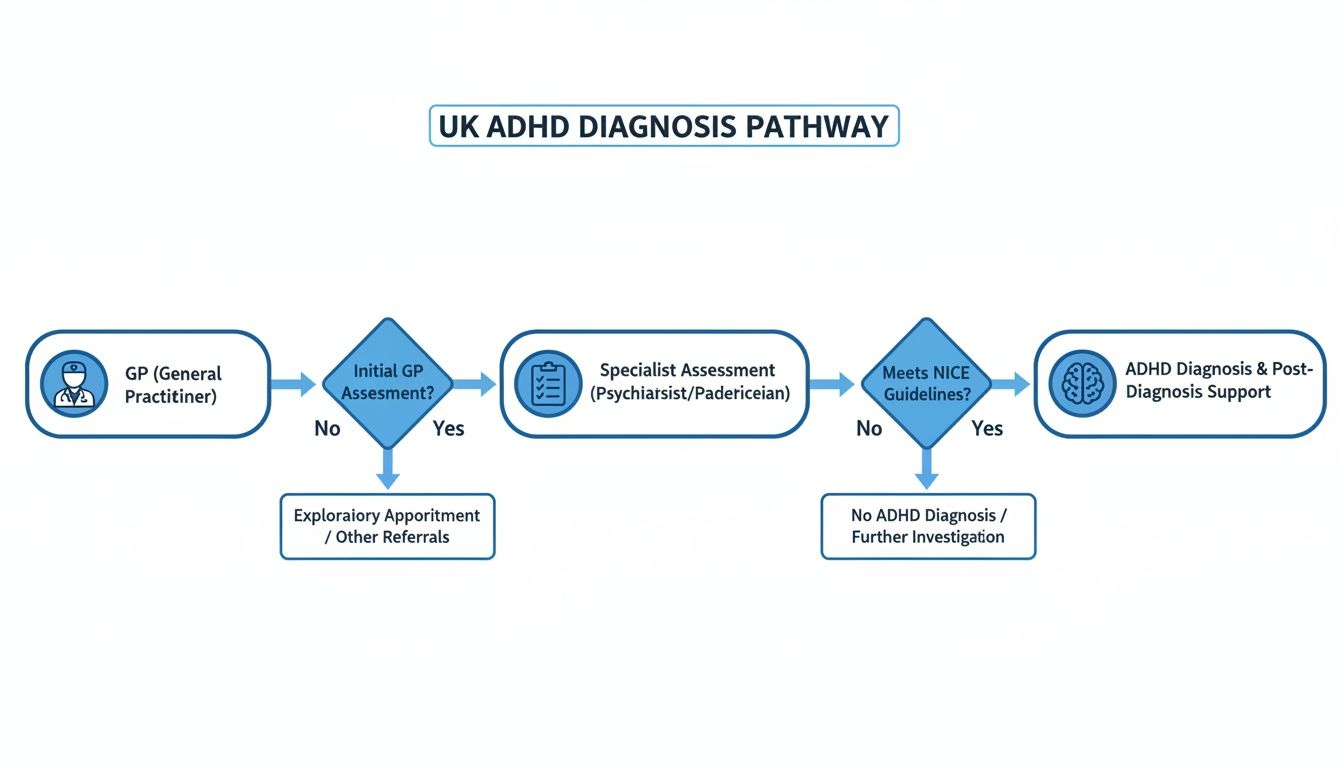
As you can see, the journey almost always starts with a GP, who acts as the gatekeeper for both the NHS and private routes.
UK ADHD Assessment Pathways Compared
To help you see the options side-by-side, this table breaks down the key differences between the NHS, Right to Choose, and fully private pathways.
| Feature | NHS Pathway | Right to Choose (England) | Fully Private Pathway |
|---|---|---|---|
| Cost | Free (covered by the NHS) | Free (covered by the NHS) | £700 - £2,000+ for assessment, plus ongoing costs |
| Waiting Time | Very long (2-7+ years in some areas) | Varies by provider and NHS area | Very short (often 2-8 weeks) |
| Accessibility | Available UK-wide | England only | Available UK-wide |
| Choice of Provider | No choice; referred to local NHS trust | Choice of pre-approved private providers | Complete choice of any private clinic/specialist |
| GP Referral | Required | Required | Sometimes required, but often self-referral is possible |
Each route has clear pros and cons. The best choice really depends on your location, your budget, and how urgently you need support.
Shared Care Agreements: Bridging Private and NHS
If you go private, one of the most important things to understand is the Shared Care Agreement. This is basically an arrangement where your private specialist, once your treatment is stable, hands over the responsibility for prescribing your medication back to your NHS GP. If your GP agrees, you can then get your prescriptions through the NHS, which makes the long-term cost much more manageable.
It’s incredibly important to choose a private clinic with a good reputation for setting up Shared Care Agreements. Not all NHS GPs will agree to them, so it's a very good idea to have a chat with your GP about their policy before you book a private assessment.
Ultimately, this is a personal decision based on your unique circumstances. To help you weigh everything up, you can get a more detailed look at what's involved in our guide to the private ADHD assessment process.
How We Treat and Support ADHD in Adults

Getting an ADHD diagnosis can be a huge, often emotional, moment of validation. But it's really just the start of the journey. The next step is all about building a personal toolkit of strategies that work with your brain, not against it.
There's rarely a single silver bullet for managing adult ADHD. Instead, the most effective path forward is almost always a multi-faceted approach. This means combining the right medication with targeted therapy and practical, real-world life adjustments. It’s this combination that helps tackle the core symptoms while also building the skills you need to thrive.
The Role of Medication in Adult ADHD
For many adults, starting ADHD medication feels like finally getting the right pair of glasses after a lifetime of squinting at a blurry world. It doesn’t "cure" ADHD, but it can turn down the volume on the static, allowing your brain’s natural abilities to come through much more clearly. In fact, studies show that for up to 80% of adults, medication is incredibly effective at improving focus and managing emotional responses.
There are two main types of medication prescribed for adult ADHD:
- Stimulants: These are the most common and often the most effective. They work by boosting the levels of certain neurotransmitters, essentially improving the communication lines between brain cells. The result? Better focus, less impulsivity, and often a surprising sense of calm.
- Non-Stimulants: These are a great alternative when stimulants aren't a good fit. They work differently and can take a few weeks to build up in your system, but for some people, they provide a smoother, longer-lasting effect on concentration and impulse control.
Finding the right medicine and dose is a careful process called titration, which is always managed closely by a specialist to get it just right for you.
While awareness is growing, many adults still struggle to access treatment. In England, prescriptions for ADHD medication almost doubled to nearly 278,000 patients in 2023-24. Yet, this is just the tip of the iceberg. One estimate suggests that only 12.6% of adults with ADHD in England actually have a prescription. You can explore more about the landscape of ADHD treatment from Priory Group.
Powerful Support Beyond Medication
If medication helps clear the fog, then therapy and coaching provide the roadmap and teach you how to drive. These non-medical strategies are vital for building lasting skills and, just as importantly, unlearning a lifetime of negative self-talk and ineffective coping mechanisms.
A combined treatment plan is the gold standard for adult ADHD. While medication adjusts the brain's chemistry, therapy and coaching rewire your habits and mindset, creating a powerful synergy for success.
Some of the most effective therapeutic supports include:
- ADHD-Specific Cognitive Behavioural Therapy (CBT): This isn't your standard CBT. It’s been adapted to zoom in on the specific challenges of ADHD, focusing on practical skills for time management, organisation, and emotional regulation. It helps you connect the dots between your ADHD brain, your thoughts, and your actions.
- ADHD Coaching: A great ADHD coach acts as your strategist and accountability partner. They help you set achievable goals and build practical systems for everyday life—from sorting out your finances to just getting out the door on time in the morning.
- Workplace Adjustments: Under the Equality Act 2010, ADHD can be classed as a disability, which means you’re entitled to "reasonable adjustments" at work. This could mean getting noise-cancelling headphones, having more flexible working hours, or being provided with software to help you plan and prioritise.
By weaving these elements together, you create a genuinely robust support system. Medication helps you access your brain's full potential, while therapy and coaching teach you how to use that potential effectively. This holistic approach is the key to turning an ADHD diagnosis from a source of struggle into a genuine strength.
Common Questions About Adult ADHD
That moment when you first suspect you might have ADHD can be a huge relief, but it’s often followed by a flood of practical questions. What do you actually do now? Where do you even start? Let’s cut through the confusion and get you some clear, straightforward answers.
How Do I Talk to My GP About ADHD?
Walking into your GP’s office to talk about ADHD can feel intimidating. The key is to be prepared. Your goal isn’t to get a diagnosis on the spot, but to clearly explain why you think you need a referral to a specialist.
The best way to do this is to keep it simple and focused. Before you go, jot down a few notes organised into two main points:
- Your symptoms: Be specific. Think about your daily life. "I constantly misplace my keys and phone," "I zone out in meetings, even when I'm trying to listen," or "I feel like I have a motor running inside me and can never truly relax."
- The impact: How is this actually affecting you? "My partner is frustrated with my disorganisation," "I've had warnings at work about missing deadlines," or "My impulsive spending is causing real financial problems."
This approach gives your GP a clear picture of what’s going on and why an assessment is the logical next step.
Can I Have ADHD if I Succeeded in School?
This is a huge one, and a myth that stops so many people from seeking help. The answer is an emphatic yes. It’s incredibly common for adults with undiagnosed ADHD to have done well academically, sometimes even excelling at school or university.
So, how does that work? Often, it's down to sheer effort and a complex web of coping mechanisms. This is sometimes called masking—working twice as hard as everyone else just to appear "normal." It might mean obsessively re-reading emails to catch careless mistakes, or relying on the adrenaline rush of a last-minute deadline to get anything done.
For many high-achieving adults, success doesn't come easily. It comes at the cost of chronic stress, anxiety, and eventual burnout. Realising that your academic or professional success doesn't disqualify you from having ADHD is a crucial step towards getting the right support.
Is a Private Diagnosis Recognised by the NHS?
Generally, yes—a diagnosis from a reputable private clinic is valid and recognised. The real sticking point, however, is the ongoing treatment, especially medication. This is where something called a Shared Care Agreement comes into play.
Think of it as a handover. A private specialist gets you started on the right medication and dosage, and once you're stable, they can ask your NHS GP to take over writing the prescriptions. This is a game-changer, as it means you pay the standard NHS prescription fee instead of costly private fees every month.
But here’s the crucial part: GPs don't have to agree to this. It’s their decision. It’s always a good idea to chat with your GP surgery about their policy on shared care before you book a private assessment to avoid any surprises down the line.
What Are the First Steps After a Diagnosis?
Getting a diagnosis can bring a wave of emotions, from relief to a sense of validation. The next phase is all about building a support system that works for you. There’s no single roadmap, but these are some of the most helpful first steps people take.
- Explore your treatment options: Talk openly with your specialist about medication and therapy. Get a feel for the pros and cons of each and figure out what fits your life.
- Find your people: Connecting with other ADHD adults is incredibly powerful. Suddenly, you’re not alone. Online forums, local groups, and social media communities are full of people who just get it.
- Consider an ADHD coach: If the practical stuff—planning, organising, managing your time—is a struggle, a coach can be brilliant. They provide personalised strategies and accountability to help you build better habits.
- Learn about workplace adjustments: If ADHD affects you at work, you have rights under the Equality Act 2010. Simple things like noise-cancelling headphones, written instructions, or flexible hours can make a world of difference.
Finding the right path to a diagnosis can feel overwhelming, but you don't have to do it alone. ADHD Private provides a free, UK-wide directory to help you compare over 300 private clinics, making it easier to find the right support, faster. Browse clinics and compare your options today at https://adhdprivate.co.uk.