A Guide to Private ADHD Assessment in the UK
Considering a private ADHD assessment? This guide explains the process, costs, NHS comparisons, and how to choose a reputable clinic for your diagnosis.
So, what exactly is a private ADHD assessment? In simple terms, it's a comprehensive medical evaluation for Attention Deficit Hyperactivity Disorder carried out by a qualified specialist outside of the NHS. Many people choose this route to get answers and access support much faster, often within weeks instead of the years it can take on the NHS.
Why Are So Many People Choosing Private ADHD Assessments?
If you’re thinking about a private ADHD assessment, you've probably hit a wall. The NHS pathway, while fantastic in principle, is completely overwhelmed right now.
Think of it like a motorway during rush hour after a huge concert has just finished. A massive, recent wave of awareness about adult ADHD has flooded every lane, creating a gridlock where the wait for an assessment can stretch on for years. This isn't about being impatient; it's about needing help when your life, career, or relationships feel like they're falling apart.

That traffic jam is the single biggest reason thousands of people are turning to private clinics. As we've started to better understand how ADHD shows up in adults—not just as hyperactivity, but as chronic disorganisation, emotional dysregulation, or professional burnout—countless people have had that 'lightbulb moment' and sought a diagnosis. The public healthcare system just wasn't built to handle this sudden, enormous surge in demand.
The Search for a Clearer Path
For many, the cost of waiting is simply too high. Living with undiagnosed and untreated ADHD can take a huge toll on everything from your career and finances to your relationships and overall mental health. When you look at it that way, going private starts to feel less like a luxury and more like a necessity. It offers a direct, faster alternative, bypassing a system where waiting lists have become a major barrier to getting care.
Opting for a private assessment allows you to skip the long GP referral queues and get straight to a specialist, putting you back in the driver's seat of your own health journey. Of course, this path has its own bumps in the road, from figuring out the costs to finding a clinic you can trust.
This guide is designed to be your roadmap. We'll navigate the complexities of the private ADHD assessment process together, step-by-step, so you can feel confident in your decisions and find the right support for you.
By understanding what's involved, you can move from a place of confusion and uncertainty to one of empowerment. We’re going to break down every part of the journey, covering:
- Key Differences: A straight-up comparison of the NHS and private assessment pathways.
- The Process Explained: A walkthrough of exactly what happens during a private assessment.
- Understanding Costs: A transparent look at what you can expect to pay for the assessment, medication, and follow-ups.
- Post-Diagnosis Support: Guidance on managing medication and setting up long-term care with your GP.
This information will give you the clarity you need to decide if a private assessment is the right choice for you and how to get started.
Comparing the Private vs NHS Assessment Pathways
Deciding whether to go private or use the NHS for an ADHD assessment is often the first big crossroads you’ll face. On the surface, it seems like a simple trade-off: time versus money. But the reality is a lot more nuanced, with differences that touch everything from how you get started to the kind of long-term support you can expect. Getting to grips with these distinctions is the key to choosing the right path for you.
Let's start with how you even get in the door.
The Referral Hurdle: GP vs Self-Referral
With the NHS, your journey almost always begins at your local GP surgery. You’ll have to book an appointment, lay out your symptoms, and explain why you believe a referral to a specialist ADHD service is the right next step. Frankly, this first conversation can be a barrier in itself, sometimes taking a few visits before a GP agrees to refer you on.
The private route completely sidesteps this. You can self-refer, meaning you do your own research, find a clinic you like, and contact them directly. No GP gatekeeper required. This puts you firmly in the driver's seat, allowing you to kickstart the process on your own terms. For many people desperate for clarity, this is a massive advantage.
You can find a more detailed breakdown in our guide on how to get diagnosed with ADHD.
Choosing Your Specialist
Another major difference is your ability to pick who assesses you. If you're referred via the NHS, you're generally placed in a queue and assigned to the next available clinician in your local trust. You get who you're given, with very little say in the matter.
Going private is a completely different story. It gives you the freedom to choose. You can research individual psychiatrists, read their professional bios, see if they have a special interest (like ADHD in women or complex co-occurring conditions), and look up patient reviews. This lets you find an expert whose approach feels right for you, making the whole experience feel much more personal.
Why Are So Many People Going Private?
The recent explosion in demand for a private adhd assessment isn't just about skipping the queue; it's a direct result of an NHS system stretched to its breaking point. An independent ADHD Taskforce recently highlighted the scale of the crisis, revealing that over 500,000 people in England are stuck on NHS waiting lists that can drag on for years. The situation has only worsened since COVID-19, forcing many to look for private options not as a luxury, but as a necessity.
The Assessment and Aftercare
While any reputable clinic, private or NHS, must adhere to the official NICE (National Institute for Health and Care Excellence) guidelines, the way the assessment is delivered can feel different. Some private clinics might include more detailed pre-assessment questionnaires or offer longer, more in-depth interviews as part of their standard service.
But the most critical long-term difference is what happens after a diagnosis.
With the NHS, your medication, titration (the process of finding the right dose), and follow-up care are all handled and funded within the system. If you're diagnosed privately, you’ll initially have to cover the cost of your prescriptions and any follow-up appointments yourself. The ultimate goal for most is to set up a Shared Care Agreement, where your NHS GP agrees to take over the prescribing. It’s a common pathway, but it’s never guaranteed.
The bottom line is this: the NHS offers a complete, publicly funded route, but it requires a huge amount of patience. The private path gives you speed and control, but it comes with a significant financial cost and requires you to be proactive about managing your long-term care.
To make the choice clearer, let's lay out the key differences side-by-side.
Private vs NHS ADHD Assessment At a Glance
This table breaks down the main factors to consider when weighing up your options.
| Feature | Private Assessment | NHS Assessment |
|---|---|---|
| Referral Process | Self-referral directly to a clinic of your choice. | Requires a GP referral to a local NHS service. |
| Waiting Time | Typically a few weeks to a few months. | Can be 2 to 5 years, sometimes longer. |
| Cost | You pay for the assessment, follow-ups, and initial medication. | Free at the point of service. |
| Choice of Clinician | You can choose your specialist based on their expertise and reviews. | You are assigned to the next available clinician. |
| Post-Diagnosis Care | Initially private, aiming for a Shared Care Agreement with a GP. | Fully managed and funded by the NHS. |
Ultimately, there's no single "best" option—only the one that's best for your personal circumstances, budget, and urgency.
Your Step-by-Step Guide to the Private Assessment Process
Thinking about a private ADHD assessment can feel like a huge step, but understanding how it all works can make the whole journey feel much more manageable. The best way to think of it is as a collaborative investigation, where you and a specialist piece together a complete picture of your life experiences. It’s a thorough process, and for good reason—it’s designed to make sure any diagnosis is accurate and built on solid evidence.
The infographic below lays out the private, self-referral pathway next to the traditional GP-led NHS route.
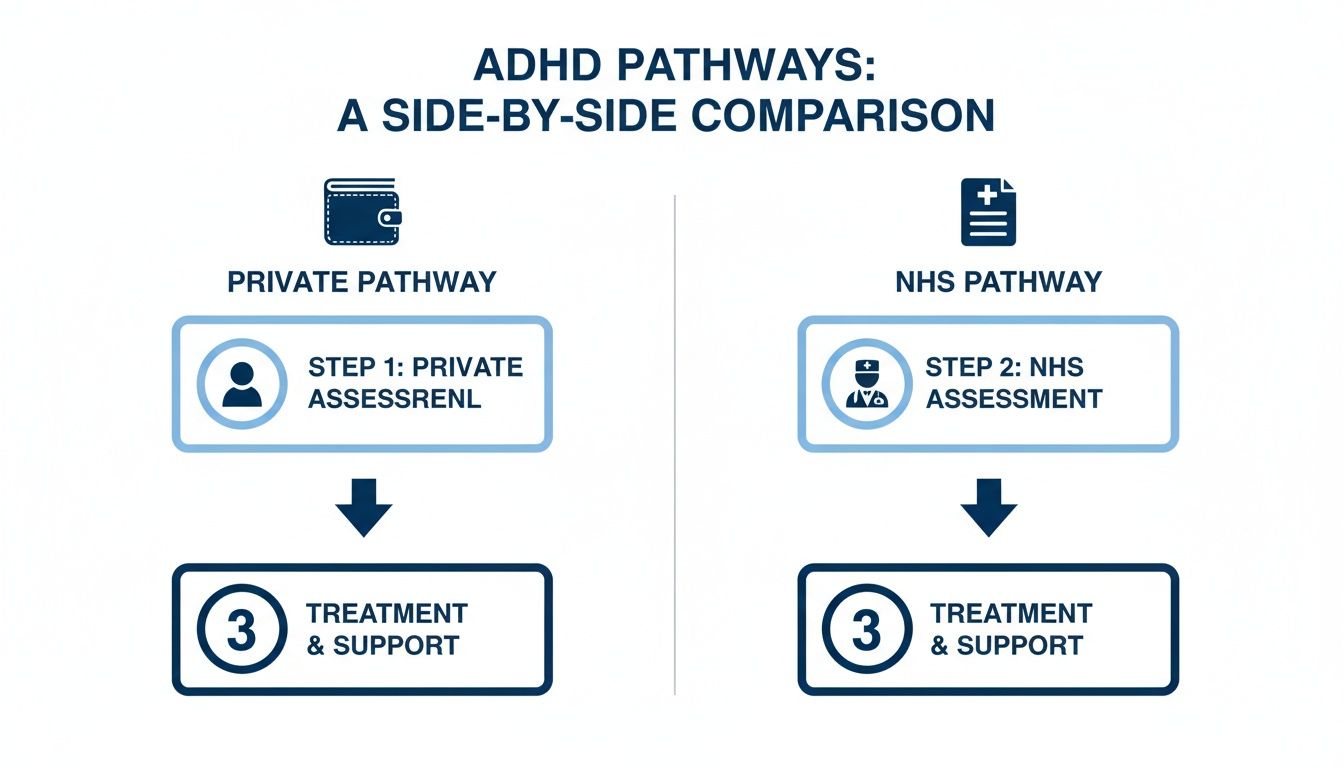
As you can see, the main difference is right at the start. Going private means you can contact a specialist clinic directly, bypassing the initial GP appointment and subsequent NHS waiting list.
So, let's walk through what actually happens once you make that first move.
Stage 1: The Initial Enquiry and Screening
The first step is straightforward: you get in touch with your chosen clinic. They'll usually follow up by emailing you a set of pre-assessment questionnaires.
It's important to know these forms aren't a diagnosis in themselves. They're more of an initial filter, gathering key information about your current difficulties and your childhood to see if your experiences match up with the common signs of ADHD. You’ll probably also need to ask someone who knew you well as a child—like a parent, older sibling, or even a long-term friend—to fill out a separate form to give an outside perspective.
Important Takeaway: Be as honest and detailed as you can with these forms. This is the foundational information your clinician will build on during the main interview, so it’s worth taking your time.
Once you’ve sent them back, a clinician will review everything. If your answers suggest a full assessment is the right next step, they'll invite you to book the main diagnostic appointment.
Stage 2: The Diagnostic Interview
This is the heart of the private ADHD assessment. It’s essentially a long, structured conversation with a specialist, usually lasting anywhere from 90 minutes to three hours. The whole point is to explore your life story through the lens of potential ADHD symptoms.
To get the most out of this session, it helps massively if you can pull together some supporting evidence beforehand. It just makes the conversation flow better and gives the clinician a much richer, more accurate picture to work with.
- School Reports: Old report cards can be goldmines. Look for comments from teachers like "daydreams in class," "is easily distracted," or "struggles to finish work"—these can be powerful indicators of early signs.
- Anecdotes from Loved Ones: Have a chat with a parent, partner, or sibling. Ask them for specific examples of times they've noticed you battling with focus, organisation, or impulsivity.
- Your Own Notes: Before the appointment, jot down a few key examples from your job, relationships, and day-to-day life where you feel your suspected ADHD has created real problems for you.
The psychiatrist will combine this information with a structured clinical interview based on the DSM-5 (the official diagnostic manual) to see if your symptoms meet the criteria for a diagnosis.
Stage 3: Psychometric Testing and Objective Data
On top of the interview, some clinics use psychometric tests to gather more objective data. These aren't pass-or-fail exams at all; they're clever tools designed to measure cognitive functions like your attention span, working memory, and executive function.
Common tests you might encounter include:
- Continuous Performance Tests (CPTs): These are usually computer-based tasks that look at how well you can maintain focus and resist making impulsive responses over time.
- Rating Scales: Standardised questionnaires like the Conners' Adult ADHD Rating Scales (CAARS) or the Wender Utah Rating Scale (WURS) are used to quantify your symptoms in a structured way.
This kind of data adds another layer of evidence to the clinical interview, helping the specialist make a confident and well-rounded decision.
Stage 4: Receiving Your Diagnostic Report
A few weeks after your assessment, you’ll receive a comprehensive diagnostic report. This is a crucial document that summarises the entire process from start to finish.
It will clearly lay out all the evidence gathered, explain how your symptoms map against the official diagnostic criteria, and give the final conclusion—whether you have ADHD or not. If you are diagnosed, the report will also include personalised recommendations for what to do next, which could cover anything from medication and therapy to adjustments at work.
What's the Real Cost of a Private ADHD Assessment?
Going private for an ADHD assessment is a big decision and a significant financial investment. But the price you see advertised upfront often isn't the whole story. To get a clear picture and avoid any nasty surprises down the line, you need to understand that the final bill is made up of several different costs, not just a single fee.
Think of it like buying a car. You've got the main sticker price, but then you have to factor in insurance, tax, and fuel before you can actually drive it. It’s the same with a private assessment. The initial fee gets you through the door and a diagnosis, but getting your treatment stable involves follow-up appointments and medication costs, which all add to the total.
This financial pressure is a real issue. The ADHD Taskforce has raised concerns about a growing 'two-tier' system, where massive NHS waiting lists are forcing people who can afford it to go private. This unfortunately creates a huge gap in access to care. It's no surprise, then, that statistics now show just over 1 in 5 ADHD patients are getting their medication through private prescriptions. You can read more about these ADHD statistics and what they mean for patients.
Breaking Down the Main Expenses
So, what are these extra costs you need to budget for? Every clinic has its own way of charging, but the journey to getting a diagnosis and starting treatment usually involves three key expenses. Knowing what they are will help you ask the right questions when you’re comparing your options.
The Initial Assessment Fee: This is the big one, typically ranging from £600 to £1,200, sometimes more. It pays for the specialist’s time to conduct the deep-dive diagnostic interview, go through all your pre-assessment forms, and put together your detailed report.
Follow-Up Appointments: Once you have a diagnosis, the next step is usually a treatment plan involving medication. You'll need a series of follow-up appointments to check how you're getting on, manage any side effects, and get the dosage just right. These sessions can cost anywhere from £150 to £350 each, and you should expect to need at least two or three in the first few months.
Medication and Titration Costs: This is where the costs can really vary. Before your GP can agree to take over your prescriptions under a shared-care agreement, you have to go through a period called titration.
Titration is simply the process where your clinician carefully adjusts your medication and dose to find the sweet spot – what works best for you with the fewest possible side effects. This can take several weeks or even a few months, and during this time, you'll be paying for private prescriptions, which often run between £80 and £150 per month.
Factors That Influence the Price
You'll quickly notice that not all private assessments cost the same. A few key things can affect the final price tag, and understanding them helps explain why some clinics charge more than others.
Clinician's Expertise and Location
It stands to reason that a top consultant psychiatrist with years of experience, especially one based in a pricey area like London, will likely command a higher fee than a specialist nurse in another part of the country. Clinics with a stellar reputation and long waiting lists might also price themselves at a premium.
Online vs In-Person Assessments
Online assessments can sometimes work out a bit cheaper because the clinic doesn't have the same overheads as a brick-and-mortar office. But this isn’t a hard and fast rule, so it’s always best to compare prices directly. Both methods are considered equally valid for a diagnosis.
The Complexity of Your Case
If your situation is fairly straightforward, the cost will probably be exactly what was quoted. But if you have other conditions, like anxiety or depression, that need to be carefully considered during the assessment, the process might take longer and, as a result, cost more. The best advice is to always ask for a clear, itemised quote before you agree to anything.
What Happens After You Receive a Diagnosis?
Getting an ADHD diagnosis can be a huge, often emotional, moment. For many, it's a mix of relief and validation. But it’s not the end of the road. Really, it's the start of a new chapter where you finally get to understand how your brain works and access the support you need.
The immediate next steps are all about building a solid plan for managing your ADHD long-term. This usually involves a combination of medication and therapy, moving you from simply having a label to actively improving your day-to-day life.
The Medication Titration Process
If your plan includes medication, the first step isn't just getting a prescription—it's a careful process called titration.
Think of it like tuning a guitar. Your specialist needs to find the precise string (the type of medication) and the exact tension (the dosage) to get the perfect sound. It’s a delicate balance to get your brain in focus without introducing any unwanted side effects.
This isn’t a quick fix. Your clinician will start you on a very low dose and book regular follow-ups, typically every few weeks, to see how you're getting on. This period can last for several weeks or even a couple of months, during which you'll need to pay for the medication privately.
It’s a team effort. Your feedback on how you're feeling is crucial for your specialist to make the right adjustments. You can learn more about how specialists develop ADHD treatment and medication plans.
Understanding Shared Care Agreements
Once you and your specialist find a stable, effective dose, the next big goal is to set up a Shared Care Agreement with your NHS GP. This is a formal arrangement where your private specialist hands the prescribing responsibility over to your GP.
This is the absolute key to making your treatment affordable in the long run. Once this agreement is in place, you’ll get your prescriptions at the standard NHS price, not the much higher private rate. Your specialist will still be in the picture for annual reviews, but your GP will handle the regular prescriptions.
A Shared Care Agreement is the bridge connecting your private diagnosis to affordable, long-term NHS support. It formalises the teamwork between your private specialist and your local GP, making ongoing care sustainable.
It's important to know, however, that GPs are not required to accept a Shared Care Agreement. Their decision often comes down to the quality of the report from your private ADHD assessment and their confidence in the clinician who diagnosed you.
Preparing to Approach Your GP
When it's time to talk to your GP, think of it as a collaborative conversation. Go prepared. Take your full diagnostic report and any letters or documentation from your specialist.
Explain that you've been stabilised on your medication by a UK-based psychiatrist and that you're hoping to continue this care under the NHS.
Sadly, getting access to treatment is a real struggle for many. Treatment rates with medication are just 26.6% for children and an incredibly low 15.6% for adults with ADHD. With private healthcare providing one in five ADHD prescriptions, knowing how to navigate the shared care process is vital. You can read more about these findings in the report from the independent ADHD Taskforce.
If your GP seems hesitant, try to understand their specific concerns. Often, they just need a bit more information from your specialist. A good private clinic will know this and provide you with comprehensive documentation from the start, giving you the best possible chance of getting the agreement signed.
How to Find and Choose a Reputable Clinic
With so many people seeking private ADHD assessments, the number of clinics offering them has shot up. On one hand, more choice is great. On the other, it means you have to be extra careful. Not all clinics are created equal, and picking the right one is vital if you want a diagnosis that's not only accurate but also recognised and respected by your NHS GP.

Think of it like getting a major repair done on your house. You wouldn't just hire the first person you find online. You’d check their qualifications, read reviews, and make sure they’re properly accredited. You need to apply that same level of diligence here – it’s your health and your money on the line.
Your Essential Vetting Checklist
To help you sort the good from the bad, here’s a practical checklist of things that are simply non-negotiable. Use it to vet any clinic you’re considering for your private ADHD assessment.
Check Professional Registration: The person assessing you must be a specialist psychiatrist who is registered with the General Medical Council (GMC). Don't just take their word for it; you can look them up on the official GMC register online. This is your proof that they are a real doctor, qualified to practise in the UK.
Confirm NICE Guideline Adherence: Ask the clinic straight up if their assessments follow the National Institute for Health and Care Excellence (NICE) guidelines. This is the official rulebook for ADHD diagnosis in the UK, and any clinic worth its salt will be following it to the letter.
Investigate Patient Reviews: Go looking for real-world feedback on independent sites like Trustpilot or Google. A few grumpy reviews are normal for any business, but watch out for patterns. If you see repeated complaints about poor communication, chaotic admin, or rushed appointments, treat it as a serious red flag.
Crucial Insight: A trustworthy clinic will be totally transparent about their process, their team's qualifications, and their prices. If getting straight answers feels like pulling teeth, walk away and look somewhere else.
Scrutinise Pricing and Aftercare Plans
A reputable clinic will never be shy about its costs. You should get a clear, itemised breakdown of everything you'll pay for – the assessment itself, any follow-up appointments, and the private prescription fees while you're getting the medication dosage right (the titration period). If the pricing feels vague or you suspect hidden costs, be very wary.
Most importantly, you need to know what their plan is for your long-term care before you commit.
- Shared Care Agreement Support: Ask them this specific question: "Do you actively help patients set up a Shared Care Agreement with their NHS GP?" A clinic that knows how to create detailed reports that meet NHS requirements will give you the best possible chance of a smooth handover.
- Post-Diagnosis Pathways: What happens once you have a diagnosis? A good clinic will have a clear, well-trodden path for managing your medication, scheduling follow-ups, and perhaps even offering therapy or coaching.
Trying to find and compare all this info clinic by clinic can feel like a full-time job. To make life easier, our free directory lets you compare private ADHD clinics across the UK, showing you key details like costs, waiting lists, and what they offer all in one place.
By methodically working through these checks, you can filter out the dodgy operators and choose a clinic that provides a professional, high-quality service. This isn't just about getting an accurate diagnosis; it's about setting yourself up for a successful partnership with your GP for your ongoing care.
Your Top Questions Answered
Even with a clearer picture of the private ADHD assessment process, you probably still have a few questions swirling around. That's completely normal. Let's tackle some of the most common concerns people have when they're considering this route.
Will My NHS GP Actually Accept a Private Diagnosis?
This is the big one, isn't it? The question that keeps many people up at night. The straightforward answer is that most GPs do accept them, but it’s not a given.
A GP is more likely to accept a diagnosis from a reputable private clinic that provides a detailed, comprehensive report. The key is ensuring the assessment adheres strictly to the official NICE guidelines and is conducted by a GMC-registered psychiatrist. The real hurdle isn't usually the diagnosis itself; it's getting your GP to enter into a Shared Care Agreement to take over prescribing your medication. This is precisely why picking a clinic known for its high standards and NHS-friendly reports is so critical.
What Exactly Is 'Right to Choose' and How Can I Use It?
Think of NHS Right to Choose as a brilliant shortcut. If you live in England, you have a legal right to choose where you receive your NHS-funded healthcare, and this includes certain private providers who also have contracts to deliver services for the NHS.
In simple terms, Right to Choose lets you access a private-style service (quicker, more choice) but have it paid for by the NHS. You get the best of both worlds.
The waiting lists for these providers are often a happy medium—significantly shorter than the standard NHS wait, but perhaps a bit longer than going fully private. It’s a fantastic option to discuss with your GP, as it can save you thousands of pounds while still fast-tracking your assessment.
Is an Online Assessment as Good as an In-Person One?
Yes, absolutely. Since 2020, online assessments have become the norm for many of the UK's leading ADHD clinics, and they are considered just as valid and effective as meeting a specialist face-to-face.
As long as it's done correctly, a video consultation with a qualified psychiatrist is just as rigorous. The assessment must still follow the same strict NICE guidelines, involving a deep-dive clinical interview and collecting evidence from your past and present. The real advantages are convenience and access—you can connect with a top specialist anywhere in the country from your own home. Just do your homework and choose a provider with a great reputation and a clear, transparent process for everything from the initial chat to long-term medication management.