ADHD Study Skills for UK Students
Explore ADHD study skills for UK students to enhance focus, organization, and time management through proven strategies.
Written and maintained by the ADHD Private editorial team, drawing on NHS, NICE and ADHD UK guidance. This is general information, not medical advice.

Studying with ADHD isn't about forcing your brain to work like everyone else's. It's about finding smart ways to work with its unique wiring. Forget battling distractions head-on; the real secret lies in building systems that manage your energy, make learning active, and essentially create an external hard drive for your memory.
This means swapping those long, draining library sessions for short, intense bursts of focused work and interactive revision.
Why Traditional Study Methods Don’t Work for ADHD
If you have ADHD, you’ve probably heard it all before: "Just focus," "Get organised," "Stop procrastinating." It’s well-meaning advice, but it completely misses the mark. It assumes the problem is a lack of willpower, when it's actually rooted in fundamental differences in how the brain handles executive functions.
Most study advice is built for a neurotypical brain—one that can easily start boring tasks, sustain attention, manage time internally, and tune out the world. The ADHD brain just isn't built that way.
The Executive Function Mismatch
Think of executive functions as your brain's project manager. They handle planning, prioritising, and getting things done. For someone with ADHD, that project manager has a very different style.
Task Initiation: Ever stared at a blank page, knowing you have to start, but your brain just won't engage? That's 'task paralysis'. It’s not laziness; it’s a genuine difficulty activating the brain for tasks that aren’t urgent or interesting.
Time Perception: Many with ADHD have 'time blindness', a warped sense of time. Five minutes can feel like an hour, and an hour can vanish in what feels like five minutes. This makes it almost impossible to accurately guess how long an essay will take or stick to a rigid revision timetable.
Working Memory: This is your brain's mental notepad, holding information temporarily while you work with it. The ADHD brain's notepad is often smaller or less 'sticky', which is why you might read a paragraph and immediately forget it, or struggle to hold a complex question in your head while formulating an answer.
Emotional Regulation: The sheer frustration or boredom of studying can feel physically painful, triggering an intense urge to escape and do literally anything else.
The real problem is that standard study techniques demand strong internal structure, memory, and self-regulation—the very skills that ADHD directly impacts. Expecting these methods to work is like trying to build a cabinet with only a hammer. You're missing most of the tools you need.
From Self-Blame to Smart Strategy
Getting your head around this mismatch is the single most important step. It lets you shift your thinking from a personal failing ("I'm lazy," or "I'm bad at this") to a strategic challenge ("These methods are wrong for my brain"). Once you make that switch, you can stop fighting yourself and start building a support system that actually works.
This guide is all about those practical, ADHD-friendly strategies. We’ll look at how to build an 'external brain' to keep track of deadlines, use tech to your advantage, and create a study routine that gets results without the constant cycle of burnout and self-criticism.
For students in the UK, a formal diagnosis can be a game-changer. It opens the door to academic accommodations like extra time in exams or one-to-one study support. These aren't unfair advantages; they are essential adjustments that level the playing field.
Building Your External Brain for Planning and Organisation
If you have ADHD, trying to keep track of deadlines, revision schedules, and complex assignments all in your head is a losing battle. Your working memory is already juggling a constant flow of thoughts and distractions from the world around you. Asking it to also act as your personal planner is a surefire recipe for feeling overwhelmed and watching deadlines fly by.
This is where the single most important adjustment comes in: you have to get it all out of your head.
You need to build what I call an ‘external brain’—a reliable, visual, and physical system that lives outside your mind. This is where all your planning, organising, and prioritising will happen from now on. We're not just talking about a simple to-do list; this is about completely offloading the mental work of planning so you can free up that precious brainpower for what really matters: learning, thinking, and engaging with your course material.
The diagram below shows exactly why this is so critical. It illustrates the frustrating cycle that so many students with ADHD get stuck in when they try to use conventional study advice.
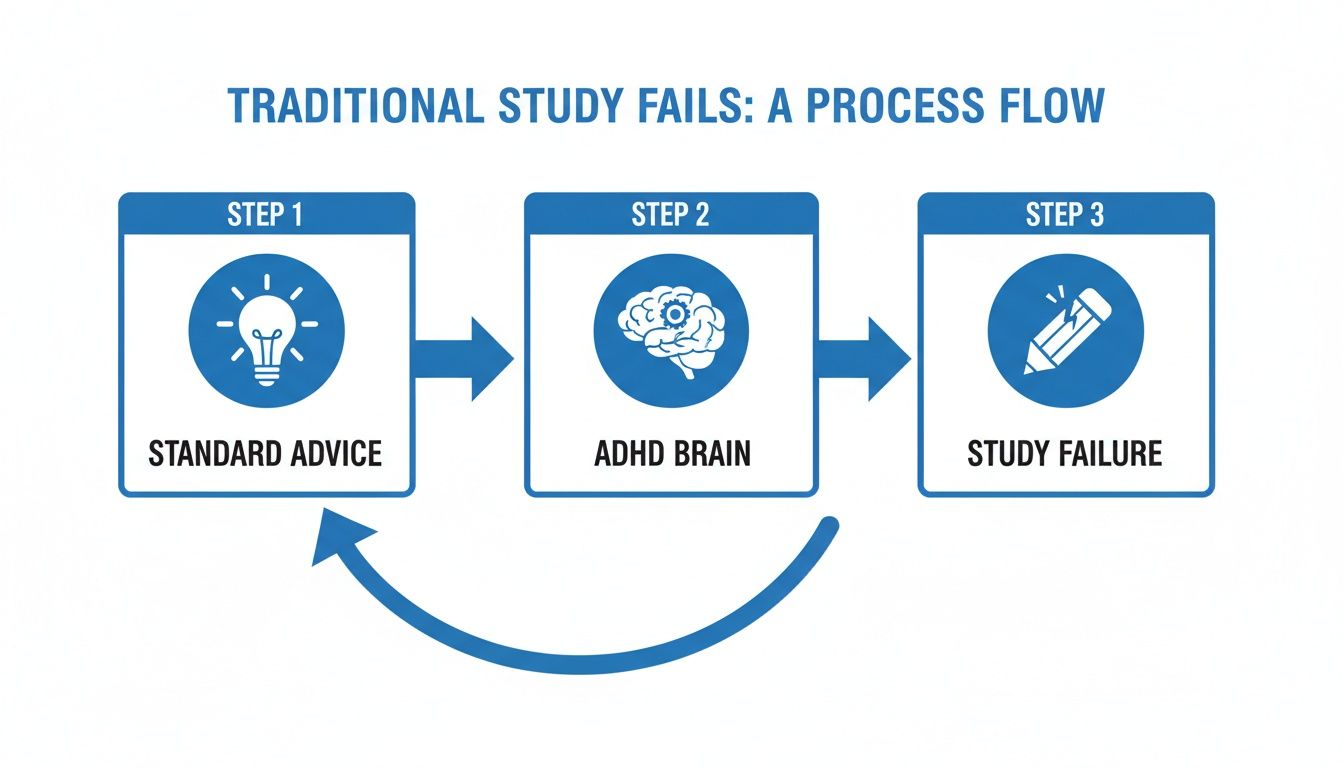
As you can see, the problem isn't that you're not trying hard enough. It's a fundamental mismatch of strategy. The key is to build systems that work with your brain, not against it.
Start with a Comprehensive Brain Dump
Before you can organise a single thing, you have to get it all out into the open. That feeling of being so overwhelmed you can't even start—often called task paralysis—is usually just a mental traffic jam. Thoughts, worries, and deadlines are all competing for space. The fix? A brain dump.
Grab a massive piece of paper, find a whiteboard, or open a fresh digital document. Set a timer for 10-15 minutes and just write. Pour out every single thing related to your studies that pops into your head. Don't try to organise it or filter it. Just get it out.
- Every upcoming essay and a few notes on its topic.
- That chapter you keep meaning to read.
- The email you need to send to your tutor.
- That nagging worry you have about a specific exam.
- All the notes you need to review before the end of term.
The entire point of this exercise is to clear your mental cache. Once it's all down on paper, that heavy cloud of anxiety often starts to lift. You can finally see the individual tasks instead of one giant, impossible monster.
Break Down Mountains into Molehills
With your brain dump complete, it's time to tackle the big, scary items. An ADHD-friendly approach means breaking things down visually, going from the huge and overwhelming to the small and manageable.
Imagine a UK university student staring down the barrel of a 10,000-word dissertation that's due in ten weeks. Just thinking about it is enough to make you want to hide. But with a large whiteboard or a digital tool like Trello, they can pull the project apart.
- Create Major Columns: First, they might map out the timeline with columns like "Weeks 1-2: Research," "Weeks 3-4: Outline," "Weeks 5-7: First Draft," "Weeks 8-9: Editing," and "Week 10: Final Review."
- Add Specific Task Cards: Under the "Weeks 1-2: Research" column, they'd add smaller, concrete tasks. Things like: "Find 10 primary sources," "Read Chapter 3 of key text," and "Book a library study room for Tuesday."
- Break It Down Even Further: Even a card that says "Write Chapter 1 (Introduction)" is still too vague and intimidating. So, that gets broken down into even smaller, bite-sized steps: "Write opening paragraph," "Draft literature review section (500 words)," "Finalise thesis statement."
Suddenly, the ten-week monster has been transformed into a series of clear, approachable daily tasks. The student is no longer thinking about "writing a dissertation"; their only job right now is to tackle the very next small step.
By externalising the entire project plan, you bypass the need for your working memory to hold all the steps. You only need to focus on one small, manageable action at a time, making it significantly easier to get started and maintain momentum.
Prioritise with Your Brain in Mind
Classic prioritisation methods, like the Urgent/Important matrix, often fall flat for the ADHD brain. Why? They completely ignore the most critical factor for us: Interest. The ADHD brain runs on an interest-based nervous system. It's energised by novelty, challenge, and curiosity—not just a sense of duty.
So, let's adapt. Instead of a complex grid, try creating three simple lists for your day:
- Must-Do Today: These are your non-negotiables with hard deadlines. Keep this list short—no more than three items.
- Could-Do Today: Important stuff, but it won't be a disaster if it slides to tomorrow.
- Want-To-Do Today: These are tasks you actually find interesting or rewarding. Maybe it's mind-mapping a new essay idea or watching a documentary related to your course.
Start your study session by knocking out one "Must-Do" item. Then, immediately reward yourself with a "Want-To-Do" task. This approach gives you the dopamine hit you need to power through the less exciting work, creating a rhythm you can actually stick with.
For more guidance on managing your academic life, you can explore other helpful ADHD resources.
Making Your Study Sessions Actually Work
 Okay, so you’ve made a plan. Now for the hard part: actually sitting down and studying. For anyone with ADHD, the real battle begins the moment you open the book. It’s not just about ignoring the noise outside; it’s about quieting the thousands of thoughts buzzing around inside your own head.
Forget forcing yourself into a rigid, soul-crushing routine. That’s a recipe for burnout. The trick is to build a study environment and a workflow that keeps your brain hooked and engaged. It’s about finding flexible, stimulating methods that give you the instant feedback your mind is searching for. With the right approach, a dreaded study session can genuinely turn into a productive flow state.
Go Beyond the Basic Pomodoro
You’ve probably heard of the Pomodoro Technique—study for 25 minutes, then take a 5-minute break. It’s a solid starting point, but it can be too rigid for an ADHD brain. Our energy and focus levels aren't that predictable.
On a good day, that 25-minute timer can interrupt you right when you've finally hit your stride. On a bad day, 25 minutes feels like an impossible mountain to climb.
A much better approach is something I call 'Pomoflex'. It's all about adapting the timer to you, not the other way around.
- Work in a Range: Instead of a fixed 25 minutes, give yourself a window, like 15-45 minutes. The only rule is you have to do at least 15. If you're in the zone after that, great! Keep going until your focus naturally wanes.
- Match Breaks to Effort: The standard 5-minute break doesn't always cut it. If you’ve just wrestled with a complex topic, you'll need a proper 10-15 minute break to reset. But if you just breezed through an easy task, a quick 3-5 minute stretch is probably all you need.
This method lets you ride your natural waves of motivation while still giving you that small, structured push to get started when you're struggling.
Engineer Your Environment for Focus
Your surroundings can make or break your ability to concentrate. An ADHD-friendly study space is deliberately set up to cut out distractions and provide just the right amount of sensory input to keep you engaged.
Try making a few of these tweaks:
- Control Your Sound: A decent pair of noise-cancelling headphones is non-negotiable. They do more than just block out your flatmates; they create a psychological bubble that tells your brain, "it's time to focus." Play around with brown noise, white noise, or instrumental study playlists to see what helps you concentrate without becoming another distraction.
- Fidget on Purpose: That urge to move isn't a flaw; it's your brain trying to stay awake and alert. Instead of fighting it, give it a job. A quiet fidget toy, a stress ball, or some thinking putty can provide just enough physical feedback to stop your mind from wandering. It's one of the most underrated adhd study skills.
- Get the Lighting Right: Harsh, overhead fluorescent lights are a known focus-killer. A simple desk lamp with adjustable brightness and warmth can make a huge difference. Many people find that bright "daylight" settings help with alertness, while warmer tones are better for more relaxed reading.
The Magic of Body Doubling
One of the most surprisingly effective adhd study skills is body doubling. This is simply working quietly alongside someone else, either in the same room or on a silent video call. They aren't there to help you; their presence alone creates a gentle social pressure that keeps you on task.
It works by making your intention to study "real." Just knowing someone else is there, also working, can be enough to stop you from picking up your phone for the tenth time. This is a game-changer for university students. Given that ADHD is thought to affect around 3.8% of UK university students—meaning about 27,000 first-year students could have the condition—it’s clear that traditional solo study methods don't work for everyone. A literature review on this topic provides more insight into the challenges faced by university students with ADHD.
Body doubling isn't a study date. The goal is focus, not socialising. Set some ground rules first: agree on how long you'll work for, mute your mics if you're online, and save the chat for your planned breaks.
Make Technology Your Ally
The right app can be a powerful motivator, but the wrong one is just another shiny distraction. The key is to find tools that give you visual feedback and a sense of accomplishment—that little dopamine hit your brain needs to stay on track.
Here's what to look for in an app or tool:
| Feature | Why It Works for ADHD | Example App Type |
|---|---|---|
| Gamification | Turns boring tasks into a game with points, levels, and rewards. | Apps like Forest, where staying off your phone grows a virtual tree. |
| Visual Progress | Shows you how far you’ve come with checklists or progress bars. | Task managers like Trello or Todoist. |
| Accountability | Uses social pressure or public goals to keep you committed. | Virtual study groups or goal-setting communities. |
Finding your perfect mix of timers, environmental tweaks, and supportive tech is a journey of trial and error. As you figure out what works for your unique brain, you'll find that managing your focus becomes less of a constant battle and more of a skill you can use whenever you need it. If you're exploring different strategies, you might be interested in learning about the variety of ADHD treatment and support options available.
Want professional support alongside this?
Answer a few questions and we’ll shortlist private ADHD clinics that fit what you’re looking for.
Note-Taking and Revision Strategies That Stick

If you have ADHD, you've probably experienced the lecture nightmare. You're trying to listen, process, and write things down all at once, but your working memory feels less like a whiteboard and more like a sieve. Information just seems to vanish before you can get it onto the page.
Then comes revision, where passively re-reading those notes feels like a total waste of time. The information doesn't sink in because there are no mental 'hooks' for it to grab onto. To build effective adhd study skills, you need to shift from being a passive recipient of information to an active participant in your own learning. This means getting hands-on and making learning a multi-sensory experience.
Make Your Notes Dynamic and Visual
Standard, line-by-line note-taking just doesn't work for many of us. It’s a passive activity that doesn't encourage your brain to make connections. How many times have you looked back at pages of notes and had zero memory of writing them? It’s time to try something that turns note-taking into an active process of thinking and organising.
Here are a few ADHD-friendly approaches that I’ve seen work wonders:
- Mind Mapping: This is a classic for a reason. Start with your main topic in the centre of the page and let your ideas branch out. Use different colours for different themes and don't be afraid to add little drawings or symbols. This visual, non-linear format often mirrors how an ADHD brain naturally connects thoughts, making it feel much more intuitive.
- The Cornell Method: This one is brilliant for forcing you to engage with your notes straight away. Divide your page into three bits: a big section on the right for your notes during the lecture, a smaller column on the left for keywords or questions you add after, and a space at the bottom for a quick 2-3 sentence summary of the whole page. It makes you process the material multiple times.
- Hybrid Digital Notes: Tools like Notability or OneNote can be a lifesaver. You can record the lecture audio and link it directly to what you're typing or drawing. If you find you've zoned out for a few minutes, you can just tap on your notes to hear what the lecturer was saying at that exact moment. It’s an incredible safety net.
The real goal here isn’t just to copy down what's being said. It's to create a set of notes that are already a powerful revision tool. When you make them colourful, structured, and interactive, you’ve done half the learning before you even leave the room.
Master Revision with Active Recall
Let’s get one thing straight: revision isn't about re-reading. Real learning happens when you actively pull information out of your brain. This process, known as retrieval practice, is what strengthens the neural pathways and cements information in your long-term memory. It's infinitely more effective than just glazing over your notes for the tenth time.
One of the best ways to put this into practice is with spaced repetition. The idea is simple: you test yourself on information at increasing intervals. A tricky concept might pop up daily, while something you know well might only appear once a month. This system takes the guesswork out of what to study and when.
Powerful Active Recall Techniques
Not all revision techniques are created equal, especially for a brain that craves engagement. Some methods are simply better suited to our wiring.
Here’s a quick comparison of a few techniques that are incredibly effective because they are active and engaging.
ADHD-Friendly Revision Techniques Comparison
| Technique | Best For | How It Helps The ADHD Brain |
|---|---|---|
| Spaced Repetition (Anki) | Memorising facts, vocabulary, and key definitions. | Automates your revision schedule, provides instant feedback, and gamifies memorisation, making it feel less like a chore. |
| Teaching Someone Else | Deeply understanding complex concepts. | Forces you to structure your thoughts clearly and immediately shows you where the gaps are in your own knowledge. |
| Creating Mnemonics | Remembering lists, steps, or ordered information. | Turns dry, boring data into a creative and memorable story, song, or acronym, which is far more engaging and easier to recall. |
These methods leverage novelty and creativity, which helps keep the ADHD brain focused and interested.
So, how does this look in the real world? Instead of just reading a chapter on the causes of the First World War, try this: close the book and explain the M.A.I.N. causes (Militarism, Alliances, Imperialism, Nationalism) out loud. It doesn't matter if you're talking to a friend, your cat, or an empty room. The simple act of verbalising forces your brain to retrieve and structure the information, making it stick.
By combining dynamic note-taking with these active revision strategies, you build a complete learning system that works with your brain's need for novelty and engagement, not against it. That’s the core of developing truly effective adhd study skills—turning learning from a passive chore into an active, memorable, and much less stressful experience.
Getting the Right Academic Support in the UK
Figuring out how to study effectively with ADHD isn't just about what you do at your desk. It’s also about building a solid support network around you. The good news is you don’t have to go it alone. The UK education system has support frameworks, but getting access to them means knowing how to communicate your needs and advocate for yourself.
Asking for help can feel daunting, but it’s one of the smartest, most strategic things you can do. It's not a sign of weakness; it’s a sign that you're taking control. By getting to grips with the available accommodations and learning how to ask for them, you give yourself a real chance to show what you're capable of. Honestly, this is one of the most powerful ADHD study skills you can ever develop.
Talking to Your University About Your Needs
So, where do you start? Your university's Disability Service or Student Support team is your first port of call. These departments are there specifically to help students with learning differences like ADHD, staffed by professionals who get it.
It really helps to go into that first meeting prepared. Have a think about the specific hurdles you face. Is it the race against the clock in exams that gets you? Or maybe you find it impossible to take useful notes because the lecturer speaks at a hundred miles an hour?
Bring any diagnostic documents you have. If you’re still waiting on an assessment, don’t let that stop you. Just jot down a list of the difficulties you experience and be ready to explain how they affect your studies. This groundwork makes it so much easier for the advisor to pinpoint the best way to support you.
It's all completely confidential. Your tutors will be told what adjustments they need to make for you, but they won't be told the details of your diagnosis unless you decide you want to share that.
What Kind of Support Can You Actually Get?
Once you’ve connected with the support team, they can put a range of "reasonable adjustments" in place. These aren't designed to give you an unfair advantage—they’re there to level the playing field so your ADHD isn't a barrier to your success.
Here are some of the most common accommodations you'll find at UK universities:
- Extra Time in Exams: This is a classic, often an extra 25%. That little bit of breathing room can make all the difference when it comes to processing questions and structuring your answers without panicking.
- Flexible Deadlines: Let's face it, executive function challenges can make long-term planning a nightmare. Having some flexibility with submission dates is a total game-changer.
- Note-Takers: Imagine being able to just focus on listening and absorbing the lecture, knowing that a peer or a dedicated note-taker is capturing all the key information for you.
- Specialist Mentoring: These are one-to-one sessions with a mentor who can help you develop study strategies that are actually designed to work with, not against, your ADHD brain.
Of course, to unlock most of this support, you typically need a formal diagnosis. If you're just starting that journey, our guide on getting an NHS ADHD assessment is a great resource to walk you through the process.
Helping Younger Students and Children in School
For parents, building a collaborative relationship with your child’s school is absolutely vital. Thankfully, the conversation around ADHD in education is changing. A recent survey revealed that 89% of UK teachers have taught pupils with ADHD, so it’s something they are increasingly familiar with.
Research from experts at places like Queen's Online School consistently shows that when parents and teachers work together, it creates a support system that massively boosts a child's academic and social progress.
To make those school meetings really count, go in with a plan.
- Bring Specific Examples: Instead of saying, "She can't focus," try something more concrete, like, "I've noticed that after about 10 minutes of reading, she starts to fidget and will often get up and wander." This gives the teacher a clear picture.
- Suggest, Don't Demand: Frame your ideas as a team effort. For instance, "We've found a wobble cushion really helps with concentration during homework. Is that something we could possibly try in the classroom?"
- Ask for an Individual Education Plan (IEP): This is a formal plan that details your child’s needs and the specific strategies the school will use to help. It's a fantastic tool for making sure everyone—teachers, support staff, and you—is on the same page.
By approaching the school as a partner, you can build a consistent, supportive environment that helps your child not just cope, but truly thrive.
Your Questions on ADHD Study Skills Answered
Even with the best strategies in your toolkit, navigating your studies with ADHD means you’re bound to hit some unique roadblocks. It's completely normal to have questions as you figure out what works for your brain. This section dives into some of the most common hurdles, offering practical answers to get you unstuck and back on track.
We've pulled together the questions we hear most often to help you troubleshoot those frustratingly common ADHD study challenges.
How Can I Start Studying When I Feel Completely Overwhelmed?
Ah, task paralysis. It’s that classic ADHD hurdle where you feel completely frozen by the sheer size of a task. The anxiety about where to even begin becomes so intense that you just… don’t. The secret to breaking free is to make the first step so ridiculously small it feels almost silly.
Forget 'write my essay'. Your new, much smaller goal is 'open a new document and type my name'. That's it. This tiny action is just enough to break the inertia. Another great trick is the 'two-minute rule'—just commit to working on the task for 120 seconds. Getting started is always the hardest part; once you’re over that initial hump, finding momentum becomes much easier.
If your mind is still racing, try a 'brain dump'. Grab a big piece of paper and scribble down every single thought, worry, and to-do item related to the project. Getting it all out of your head clears up your crowded working memory and helps you spot one tiny, manageable first step.
Are There Any Apps That Genuinely Help with ADHD?
Absolutely, but the trick is finding tools that simplify your life, not complicate it. A good app should reduce your mental load, not become another overwhelming thing you have to manage. For the ADHD brain, the best apps tend to be highly visual, give you instant feedback, and inject a bit of fun into otherwise dull tasks.
Here are a few types of apps that can be a real game-changer:
- Visual Task Management: Tools like Trello or Asana are brilliant for breaking down big projects. You can turn an entire essay plan into a series of small, moveable cards, which gives you a satisfyingly clear picture of your progress.
- Gamified Timers: Apps like Forest can be surprisingly effective. It turns your focus sessions into a game where you grow a virtual tree. The catch? If you get distracted and leave the app, your tree dies. This creates a gentle consequence and a real sense of accomplishment when you succeed.
- Multi-Sensory Note-Taking: Check out apps like OneNote or Notability. They let you combine typing, drawing, audio recordings, and even photos all in one place. This is perfect for a brain that learns best with multi-sensory input.
The single most important feature of any app is its simplicity. If it takes more than a few minutes to set up, you’ll probably abandon it. Pick tools that feel intuitive and are visually engaging, so they actually become a sustainable part of your routine.
My Motivation Disappears So Quickly. What Can I Do?
This is incredibly common. The ADHD brain is wired to run on an interest-based nervous system, not an importance-based one. This means it’s primarily motivated by whatever is new, challenging, or personally fascinating—not by what a tutor tells you is important. To work with this, you have to deliberately build in novelty and immediate rewards.
Try gamifying your study sessions with a clear reward system. For instance, after finishing a 25-minute block of revision, you get 10 minutes to play your favourite game or watch a funny video. This creates the kind of tight, satisfying feedback loop of effort-then-reward that your brain thrives on.
You can also harness the power of social accountability with 'body doubling'. This is as simple as studying alongside a friend, either in person or just on a silent video call. The gentle, unspoken pressure of having someone else there can work wonders for keeping you on task.
Another great strategy is to connect boring tasks to something you genuinely find interesting. If you have to study a dry historical period for an exam, start by watching an exciting documentary or reading a thrilling novel set in that era. This helps generate the dopamine you need to engage with the less stimulating textbook material. It’s all about finding clever ways to make the work feel less like work.
What Is the Single Most Important ADHD Study Skill?
If you only take one thing away from this guide, let it be this: externalise everything. Your brain is not designed for reliably storing plans, deadlines, or complex instructions internally. Stop trying to force it to be something it’s not. Instead, focus your energy on building a robust external system that does all that heavy lifting for you.
- Use a physical planner or a digital calendar for every single deadline and appointment. No exceptions.
- Get a large whiteboard or use mind-mapping software to visually break down every big project.
- Set loud, obvious timers to help you feel the passage of time during study sessions.
- Create detailed checklists for everything from packing your bag in the morning to completing an assignment.
By creating this external 'scaffolding', you free up your precious mental energy for what your brain actually excels at: learning, making creative connections, and thinking outside the box. This one habit is the foundation for every other ADHD study skill. It’s the most reliable way to bring structure and calm to the natural chaos of the ADHD mind.
This is more important now than ever. A huge study of 7 million people in the UK revealed a dramatic rise in ADHD diagnoses between 2000 and 2018, particularly among young people. The data also highlighted significant health inequalities, with diagnoses being roughly twice as high in the most deprived areas. You can learn more about these UK ADHD diagnosis trends and their implications on the UCL website. The growing need for support just underscores why developing these external systems is such a critical life skill.
At ADHD Private, we simplify the process of finding the right support for your needs. Our free UK-wide directory allows you to compare private clinics, check wait times, and view transparent pricing, empowering you to make an informed choice about your ADHD assessment and care. Start your search today at https://adhdprivate.co.uk.