Finding Your Tribe: 12 ADHD Support Groups in the UK
Discover our 2025 guide to the top 12 UK ADHD support groups for adults and parents, both online and local, and find your community today.
Written and maintained by the ADHD Private editorial team, drawing on NHS, NICE and ADHD UK guidance. This is general information, not medical advice.

Living with ADHD, or caring for someone who does, can feel profoundly isolating. The daily challenges of managing symptoms, navigating healthcare systems, and explaining your reality to others can be exhausting. This is precisely why so many people search for "ADHD support groups near me" – they are looking for a community that just gets it. Finding the right group provides more than just a listening ear; it offers a space for shared understanding, practical strategies, and the vital reminder that you are not alone.
This guide is designed to make that search easier. We have curated a comprehensive list of 12 key resources available across the UK, from established national charities to dynamic online communities and local peer-led meetups. We go beyond a simple directory, offering a detailed breakdown of each option to help you find the best fit for your specific needs, whether you're an adult seeking peer connection, a parent looking for guidance, or a teen wanting to meet others.
For each resource, we provide a clear overview of who it’s for, how to join, what to expect from meetings, and an honest assessment of its potential pros and cons. You will find direct links and practical details to connect you with groups in your local area or online. Our goal is to equip you with the information needed to move from feeling isolated to feeling supported, understood, and empowered within a community that shares your experience.
1. AADD-UK
AADD-UK is an excellent starting point for anyone searching for peer-led ADHD support groups near me in the UK. Run by and for adults with ADHD, this long-standing charity maintains one of the most comprehensive, non-commercial lists of local support groups available. It functions as a national directory, centralising information that is often scattered across different community websites and social media platforms.
The website’s core feature is its "Support Groups (Full List)" page. This directory is organised by region, allowing you to quickly scan for groups in your area. Each entry typically provides essential details such as the group's name, the audience it serves (e.g., adults, parents, partners), meeting frequency, and a contact email for the organiser.
How to Use AADD-UK Effectively
To get the most out of the directory, it's best to contact a few potential groups directly. Since AADD-UK is a listing service and not a booking platform, you must reach out to each organiser individually to confirm meeting times, locations (whether online or in-person), and availability. Be prepared that some listings may be slightly out of date, so sending a brief introductory email is a crucial first step.
AADD-UK’s strength lies in its grassroots focus. It connects you directly with independent, community-run groups that offer genuine peer-to-peer connection, moving beyond clinical settings to foster shared understanding and validation.
Key Information:
- Best for: Finding local, independent, and peer-led ADHD support groups across the UK.
- Cost: Free to access the list. Individual groups may have small fees to cover running costs.
- Coverage: Nationwide (England, Scotland, Wales, and Northern Ireland).
| Pros | Cons |
|---|---|
| One-stop national list focused on ADHD peer groups. | Some entries can be dated if organisers change. |
| Non-commercial and run by a trusted UK charity. | You must contact each group individually. |
| Includes practical details like meeting cadence. | The webpage layout is text-heavy and basic. |
Website: https://aadduk.org/help-support/support-groups/
2. ADHD UK
For those who find in-person meetings challenging or can't find ADHD support groups near me, the charity ADHD UK offers a lifeline with its extensive programme of online video sessions. As a national organisation, it provides a crucial alternative for individuals in remote areas or those needing more flexible support options. It is an ideal resource for anyone who has recently undergone an ADHD test for adults and is seeking immediate community connection.
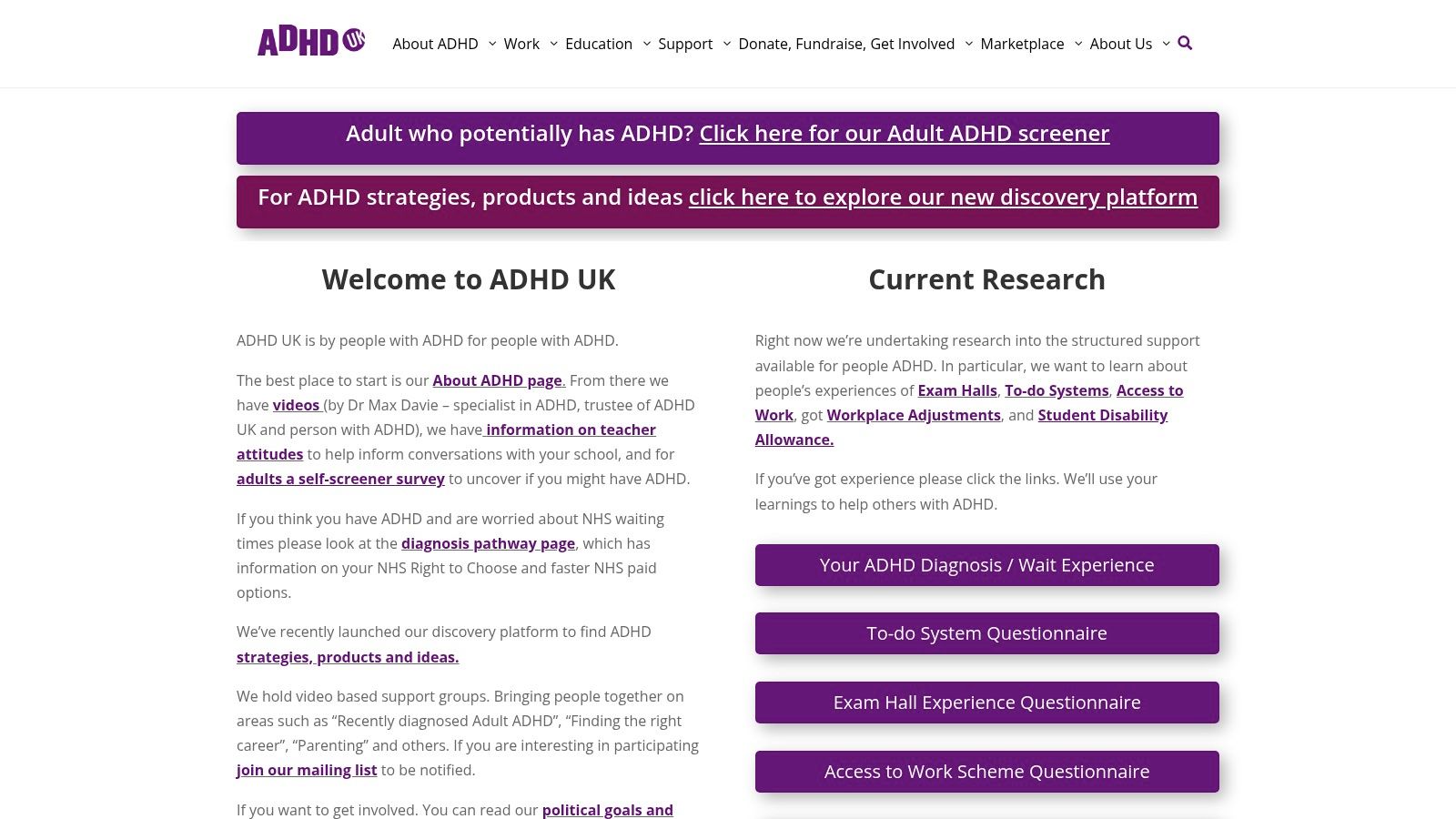
The platform is best known for its live, facilitated online support groups and topic-specific webinars. These cover a wide range of needs, from groups for newly diagnosed adults to sessions focused on parenting a child with ADHD. Alongside these scheduled events, ADHD UK manages active Facebook communities, creating a space for continuous peer support and discussion outside of formal meetings.
How to Use ADHD UK Effectively
To make the most of ADHD UK, it's wise to join their email list. This ensures you are notified as soon as new sessions are announced, as popular groups can fill up quickly. Be sure to check the calendar regularly, as the schedule varies from month to month, offering a diverse but ever-changing selection of events. It's a good idea to register for sessions in advance to secure your spot.
ADHD UK’s strength lies in its accessibility and professional structure. It removes geographical barriers by providing structured, well-moderated online spaces, ensuring that expert advice and peer solidarity are available to everyone, regardless of their location.
Key Information:
- Best for: National online support, topic-specific groups, and those without a local in-person option.
- Cost: Free to attend, with options for voluntary donations.
- Coverage: Nationwide (accessible online from anywhere in the UK).
| Pros | Cons |
|---|---|
| Easy national access from anywhere in the UK. | Places can fill quickly and schedules vary. |
| Mix of peer-to-peer and expert-led events. | Primarily online with fewer in-person options. |
| Offers topic-based sessions for specific needs. | Requires reliable internet access to participate. |
Website: https://adhduk.co.uk/
3. Hub of Hope
Hub of Hope is the UK’s largest and most comprehensive mental health support database, making it a powerful tool for finding ADHD support groups near me. Created by the charity Chasing the Stigma and used by NHS trusts, it acts as a central signposting service. Its primary advantage is its hyper-local search function, which pinpoints services right down to your postcode.

Unlike ADHD-specific directories, Hub of Hope covers all mental health, so you need to be specific with your search. By entering terms like "ADHD," "neurodiversity," or "autism" alongside your location, the platform returns a map and list of relevant local charities, peer groups, and community services. Its integration with the NHS provides an extra layer of trust and reliability.
How to Use Hub of Hope Effectively
Start by entering your postcode or allowing the site to use your current location. In the search bar, type "ADHD" to filter the results. You can then further refine the search by service type, such as selecting "Peer/Community Support" to find groups run by and for people with lived experience. Since listings are provided by the organisations themselves, always click through to their website or contact them directly to confirm details before attending.
Hub of Hope’s strength is its scale and ease of use. It centralises thousands of local services, from grassroots meetups to established charities, into one searchable map, making it an invaluable first stop for anyone seeking immediate, local connection.
Key Information:
- Best for: Finding a wide range of local mental health services, including peer support for ADHD.
- Cost: Free to use.
- Coverage: Nationwide (England, Scotland, Wales, and Northern Ireland).
| Pros | Cons |
|---|---|
| Comprehensive UK-wide database with NHS backing. | Not ADHD-specific, requires using search filters. |
| Excellent postcode search for hyper-local results. | Quality and detail of listings can vary by area. |
| Available as a user-friendly website and app. | Primarily a signposting service, not a booking tool. |
Website: https://hubofhope.co.uk/about-us
4. Mind – Local Minds finder
Mind, a leading mental health charity, offers a powerful tool for finding local support through its Local Minds network. While not exclusively for ADHD, this finder is a valuable resource for locating professionally supported ADHD support groups near me. It connects you to one of the approximately 100 independent Local Minds across England and Wales, many of which run peer or condition-specific groups.
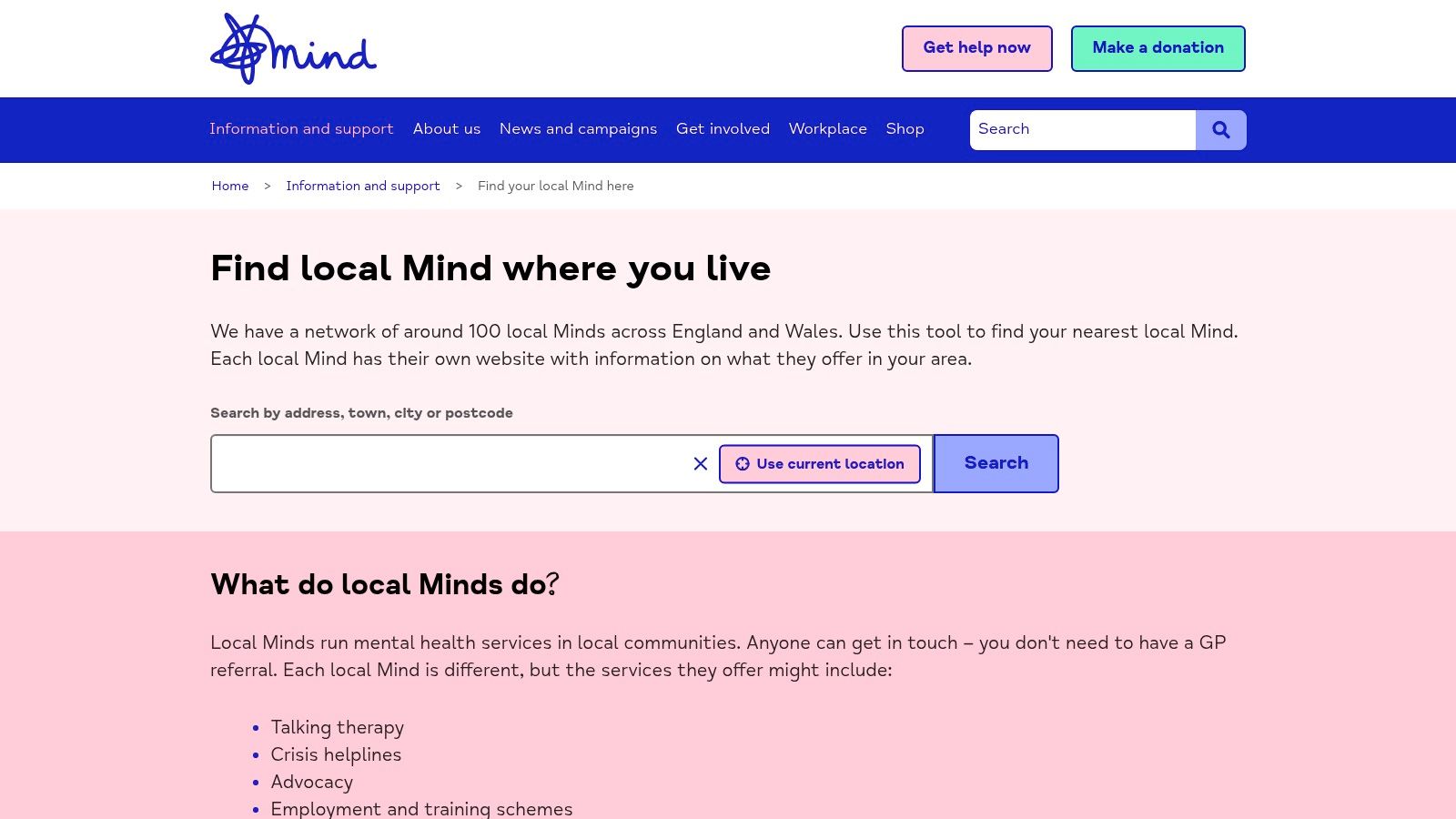
The website features a simple postcode or city search that directs you to your nearest Local Mind’s dedicated webpage. These pages detail all the services offered, including any available mental health or neurodiversity support groups. This provides a clear, direct route to community services without needing a GP referral first.
How to Use the Local Minds Finder Effectively
Start by entering your postcode to find your nearest branch. Once on your Local Mind’s page, look for sections titled "Our Services," "Support for You," or "Groups." Since services are hyper-local, you may need to check the websites of a few nearby branches if your closest one doesn’t offer an ADHD-specific group. Contacting the branch directly by phone or email is the best way to get up-to-date information on group availability and meeting details.
Mind’s key advantage is its infrastructure. The groups are often facilitated or overseen by trained staff within a trusted national charity, offering a layer of structure and reliability that complements independent peer-led groups.
Key Information:
- Best for: Finding structured, professionally supported groups in your local community.
- Cost: Free to access the finder. Most local groups are free or ask for a small donation.
- Coverage: England and Wales.
| Pros | Cons |
|---|---|
| Trusted national charity with established local branches. | Not ADHD-specific; availability varies by location. |
| Groups are often professionally facilitated or supported. | You may need to search a few local sites. |
| Clear route to local services without a GP referral. | Some areas may not have an ADHD-focused group. |
Website: https://www.mind.org.uk/information-support/local-minds/
5. ADHD Aware
ADHD Aware is a fantastic resource, particularly for those looking for a well-organised mix of online and in-person support. Based in Brighton, this peer-led charity has built a strong reputation for its welcoming and structured meetings. While its physical events are local, its online offerings make it a valuable hub for anyone in the UK seeking a reliable ADHD support group near me virtually.
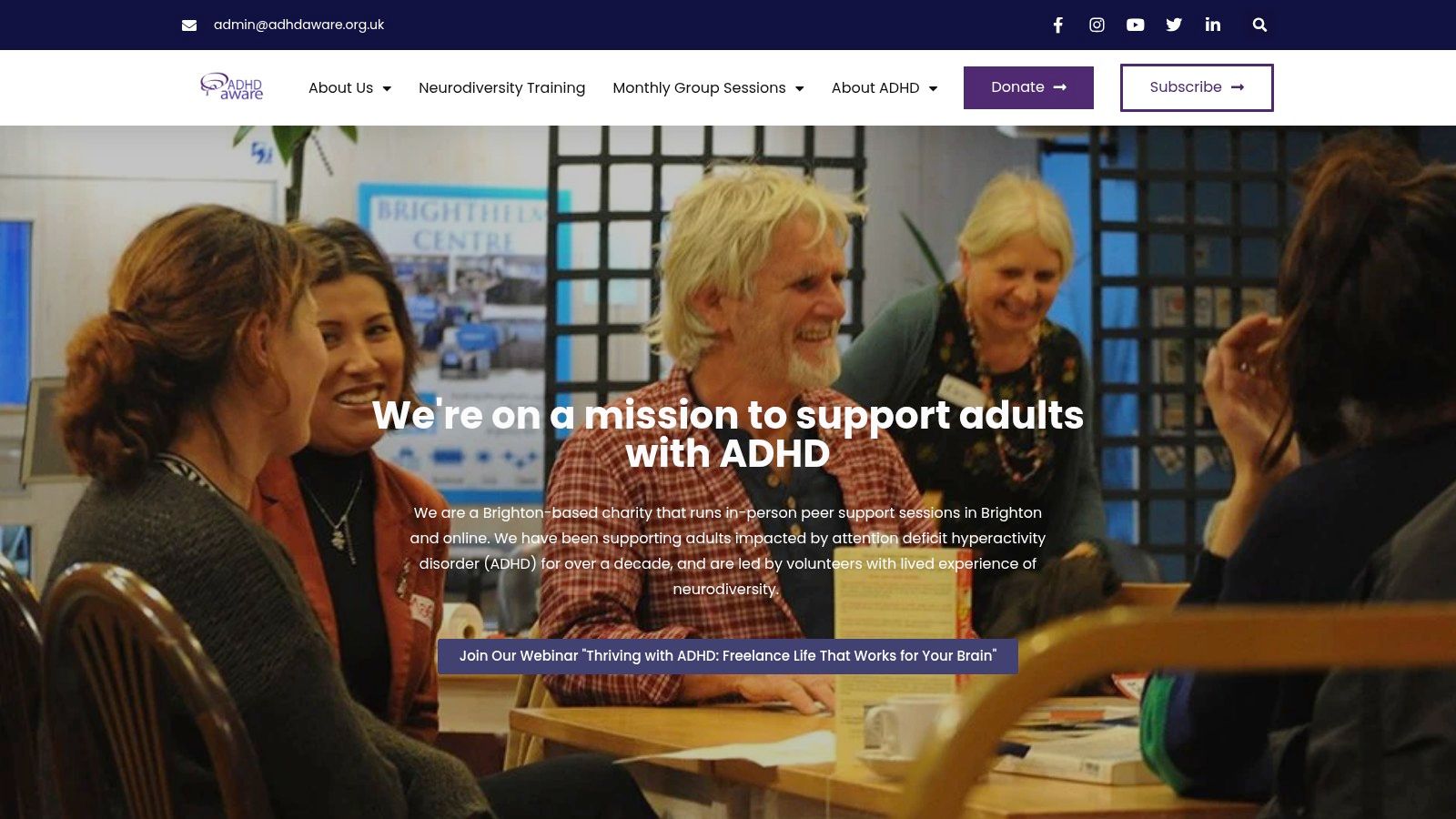
The organisation hosts a variety of meetings, including drop-in sessions for adults with ADHD, specific discussion groups, and dedicated meetings for partners and family members. This diverse schedule caters to different needs within the ADHD community, providing tailored spaces for connection and shared experience. The booking system is clear and managed professionally via their newsletter and Eventbrite.
How to Use ADHD Aware Effectively
To participate, you must subscribe to their newsletter. This is the primary way they release booking links for their monthly online Zoom meetings and in-person Brighton events. Places for the online sessions are limited and in high demand, so it’s wise to book as soon as the newsletter arrives. Check their website for the schedule so you know when to expect the booking announcement.
ADHD Aware excels at creating a safe, structured, and friendly atmosphere. Its clear booking process and variety of meeting types, including sessions for partners, make it an accessible and highly-regarded community for peer support.
Key Information:
- Best for: Adults seeking structured online peer support or in-person meetings in the Brighton area.
- Cost: Free, with donations welcomed.
- Coverage: In-person meetings in Brighton & Hove; online meetings are UK-wide.
| Pros | Cons |
|---|---|
| Large, active community with a clear schedule. | In-person events are exclusive to the Brighton area. |
| Friendly, peer-led environment with practical signposting. | Online places can book up very quickly. |
| Offers specific groups for partners and families. | Requires newsletter sign-up to access booking links. |
Website: https://adhdaware.org.uk/
6. Meetup
Meetup is a versatile social platform that excels at helping users find informal ADHD support groups near me. Rather than a directory of formal charities, it lists a diverse mix of peer-led meetups, community socials, and online Zoom circles organised by individuals across the UK. Its primary strength lies in its powerful city-level search function, making it ideal for discovering recurring, hyperlocal events that foster community connection.
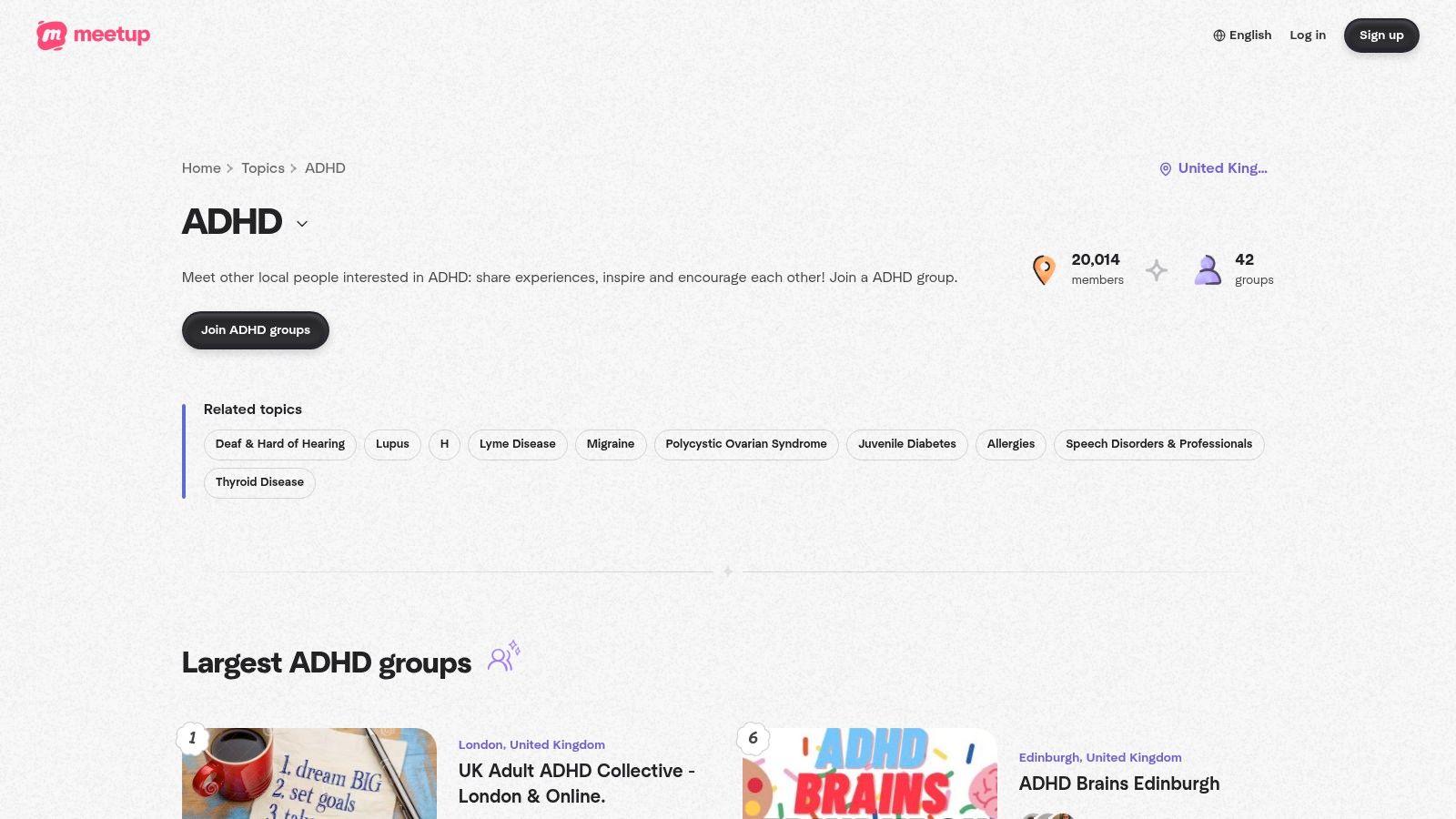
The platform is built around searchable group pages, each featuring member counts, event calendars, group ratings, and organiser details. This transparency allows you to gauge a group's activity and focus before joining. From coffee mornings in Manchester to walking groups in Edinburgh, Meetup offers a more casual and social alternative to structured support meetings.
How to Use Meetup Effectively
To find relevant groups, use search terms like "ADHD," "neurodivergent," or "neurodiverse" combined with your city name. Once you find a potential group, check its past events to see how active it is. Since anyone can start a group, it's wise to read member reviews and the group's "About" section to ensure it aligns with your needs. Always RSVP through the app to receive updates and communicate with the organiser.
Meetup's unique value is its social focus. It helps you find your tribe in a relaxed setting, perfect for those who want to build friendships and share experiences with other ADHD adults without the structure of a formal support programme.
Key Information:
- Best for: Discovering informal, social, and peer-run ADHD meetups in your local UK city.
- Cost: Free to join and browse. Some event organisers may ask for small contributions to cover costs.
- Coverage: Nationwide, with the highest concentration of groups in major cities.
| Pros | Cons |
|---|---|
| Excellent discovery tool for informal, peer-run groups. | Moderation and quality vary significantly by organiser. |
| Built-in calendars, reminders, and in-app communication. | Groups can become inactive if an organiser steps back. |
| Mix of in-person social events and online meetings. | Focus is more on social connection than structured support. |
Website: https://www.meetup.com/topics/resources-for-adhd/gb/?utm_source=openai
Want professional support alongside this?
Answer a few questions and we’ll shortlist private ADHD clinics that fit what you’re looking for.
7. Eventbrite
Eventbrite may be a general ticketing platform, but it has become a surprisingly effective tool for finding ADHD support groups near me. Many independent organisers, ADHD coaches, and small charities use it to manage bookings for both online and in-person meet-ups, “ADHD café” style social events, and structured peer support sessions. Its location and date-based search function makes it easy to discover what’s happening in your local area on any given week.
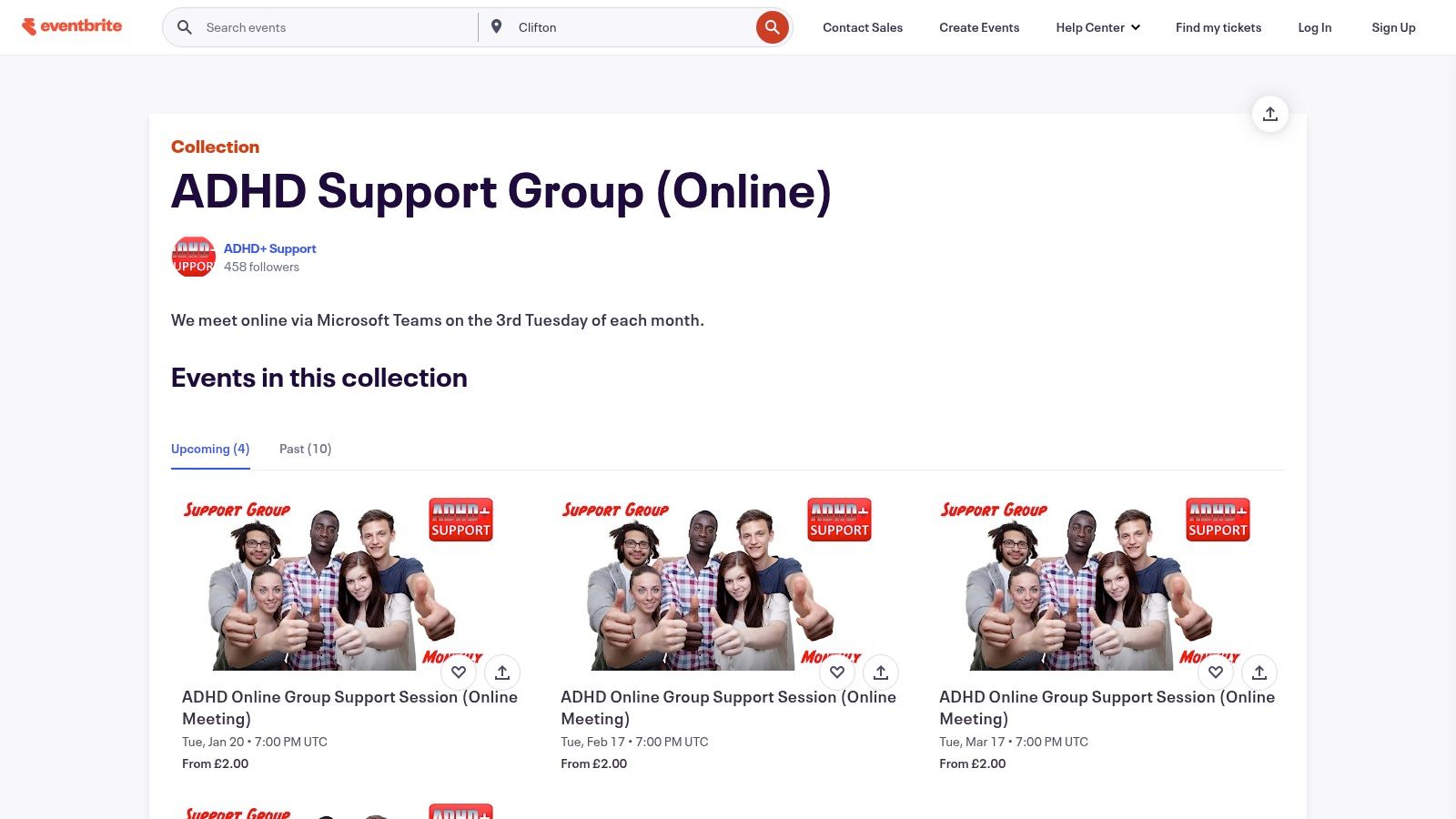
The platform’s strength is its convenience. You can filter by location, date, and price (many events are free), and then book your spot in just a few clicks. The site handles ticketing, calendar reminders, and provides a direct line of communication with the event host, streamlining the entire process of joining a group for the first time.
How to Use Eventbrite Effectively
To find relevant groups, use specific search terms like “ADHD support Manchester” or “neurodivergent social London”. Always check the organiser’s profile page to understand their background and the nature of the group. Since quality can vary, look for recurring events with positive feedback. Booking a ticket, even a free one, is essential as it confirms your spot and ensures you receive any updates or online meeting links.
Eventbrite’s value lies in its simplicity and accessibility. It lowers the barrier to entry, making it easy to find and book a spot at a casual, one-off ADHD social or a recurring local group without a lengthy sign-up process.
Key Information:
- Best for: Discovering and easily booking one-off or recurring local and online ADHD meet-ups.
- Cost: Many events are free. Paid events vary in price, set by the organiser.
- Coverage: UK-wide, but availability depends on what organisers have listed in your area.
| Pros | Cons |
|---|---|
| Straightforward booking with automatic reminders. | Event reliability and quality vary by organiser. |
| Easy to find both one-off and recurring events. | Not an ADHD-specific site; you must refine searches. |
| Clear details on dates, times, and capacity. | Popular events can "sell out" of free tickets quickly. |
Website: https://www.eventbrite.com/cc/adhd-support-group-online-3918023?utm_source=openai
8. Facebook Groups
Facebook is an incredibly active hub for finding ADHD support groups near me, hosting a vast ecosystem of private communities for adults, parents, and carers across the UK. Many official charities and local independent groups use Facebook as their primary platform for communication, announcements, and organising both online and in-person meetups. It’s often the fastest way to find immediate peer interaction and day-to-day conversation.
The platform's strength lies in its real-time, community-driven nature. You can find groups specific to your city, profession, or life stage (e.g., "ADHD Parents of Teens UK"). These spaces are excellent for asking quick questions, sharing daily struggles, and seeing event posts for local coffee mornings or webinars. Many groups listed on charity websites require you to join their Facebook counterpart to get involved.
How to Use Facebook Groups Effectively
When searching, use specific terms like "ADHD support [your city]" or "ADHD parents UK". Always read the group rules and description before joining, as moderation quality varies significantly. Prioritise closed or private groups for better confidentiality. Be mindful that while the support is valuable, the information shared isn't always clinically verified, so it’s best used for peer connection rather than medical advice.
Facebook Groups excel at providing continuous, informal peer support. They bridge the gap between scheduled meetings, offering a space for immediate connection and resource sharing with people who understand your daily experience.
Key Information:
- Best for: Ongoing daily chat, finding local informal meetups, and joining the community hub for official charities.
- Cost: Free to join and participate.
- Coverage: Nationwide, with highly localised groups available for most towns and cities.
| Pros | Cons |
|---|---|
| Very active peer spaces for instant connection. | Information quality and accuracy can be inconsistent. |
| Many local charity groups use it as their main hub. | Privacy depends on group settings and moderator quality. |
| Easy to find hyperlocal and niche interest groups. | Can be overwhelming with high post volume. |
Website: https://www.facebook.com/groups/
9. ADHDadultUK
ADHDadultUK is a UK-based charity run by and for adults with ADHD, offering an invaluable online community rather than traditional local meetings. Its core offering is a moderated Discord server, providing a modern, always-on alternative for those seeking ADHD support groups near me without the constraints of scheduled, in-person gatherings. This platform is ideal for immediate, anonymous peer-to-peer connection.
The charity focuses entirely on the adult ADHD experience within the UK, providing highly relevant resources, FAQs, and evidence-based content. Its strength is in creating a safe, moderated digital space where adults can share experiences, ask questions, and find solidarity at any time of day or night, which is particularly useful for those whose schedules don't align with fixed group meeting times.
How to Use ADHDadultUK Effectively
To join the community, you'll need to sign up for Discord and then use the link on the ADHDadultUK website. Take some time to familiarise yourself with the different channels, as they are organised by topic (e.g., diagnosis, medication, work, relationships). Start by observing conversations or introducing yourself in a general channel to ease into the community dynamic. The platform also provides excellent resources for those exploring non-medical strategies, complementing advice on how to manage ADHD without medication.
ADHDadultUK excels at providing an immediate, anonymous, and moderated community. It’s a powerful resource for instant validation and practical advice from peers who truly understand the nuances of adult ADHD in the UK.
Key Information:
- Best for: Adults seeking an instant, anonymous, and UK-focused online peer support community.
- Cost: Free to join and participate.
- Coverage: Online only (accessible nationwide).
| Pros | Cons |
|---|---|
| Anonymous, always-available peer chat support. | Primarily online, not for finding in-person groups. |
| Strong focus on adult life with ADHD in the UK. | Discord can feel busy or overwhelming for new users. |
| Moderated community ensures a safe environment. | Less structured than a formal, scheduled meeting. |
Website: https://www.adhdadult.uk/
10. ADDISS
ADDISS is a long-standing national ADHD charity in the UK, offering structured and reliable online support groups. While not offering in-person ADHD support groups near me in the traditional sense, its virtual meetings provide consistent, professionally-facilitated support accessible from anywhere in the country. This makes it an invaluable resource for those who lack local provisions or prefer the convenience of online sessions.
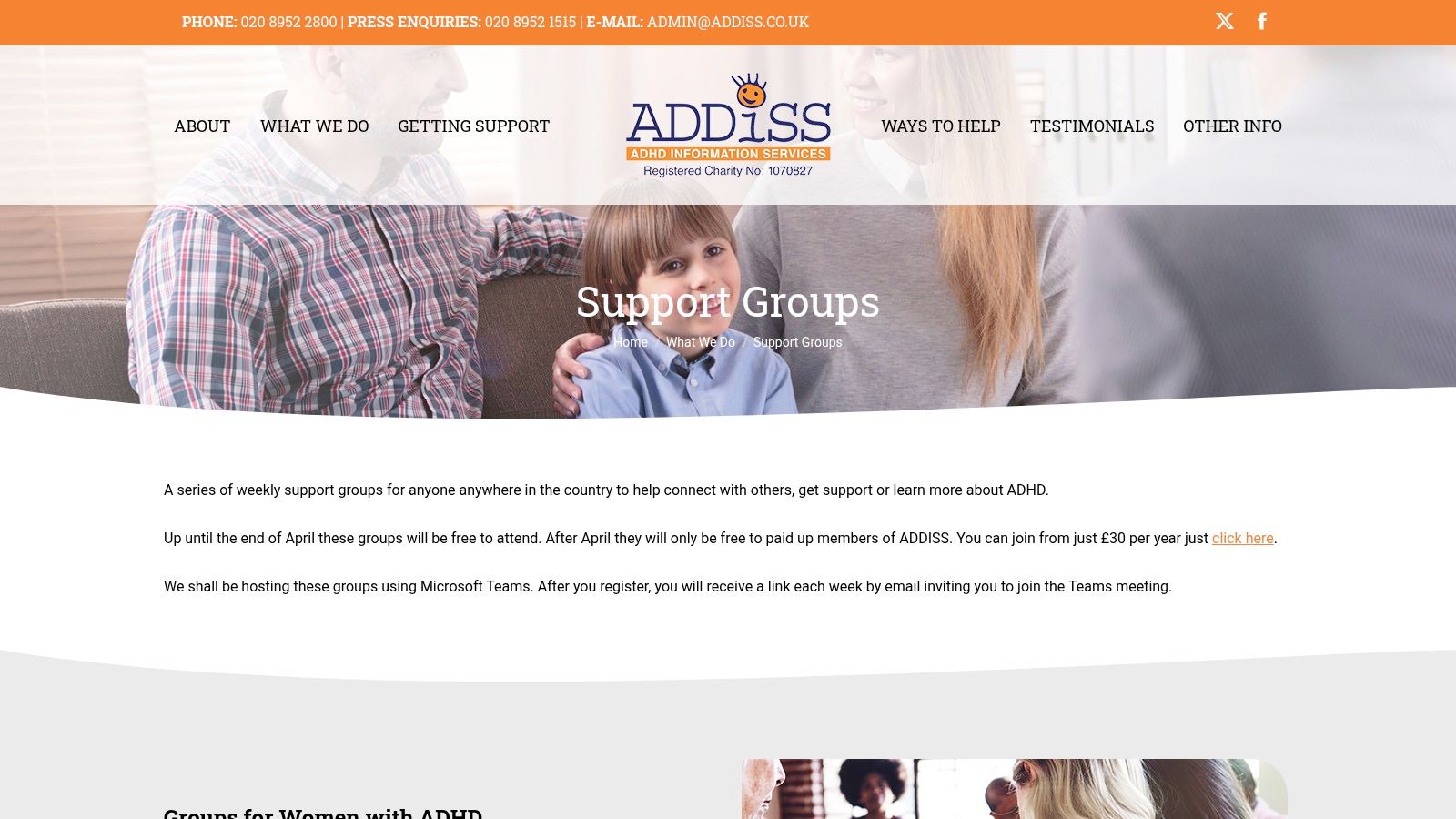
The organisation runs a recurring timetable of groups via Microsoft Teams, with dedicated weekly slots for different audiences. These include sessions specifically for adults with ADHD, parents of children with ADHD, and a group just for women. The structure provided by a national charity ensures a dependable and well-managed experience.
How to Use ADDISS Effectively
First, check the "Support Groups" page on the ADDISS website for the latest weekly schedule. Meetings have fixed times, making it easy to plan your attendance. You will need to have Microsoft Teams installed to join. Be aware that while many sessions are free, some may eventually require a paid membership to the charity, so it's wise to confirm any access requirements before you plan to attend regularly.
ADDISS’s key advantage is its reliability and professional oversight. Unlike informal peer groups, these sessions are facilitated by a specialist ADHD charity, ensuring a structured, safe, and consistently available support network.
Key Information:
- Best for: Individuals seeking structured, professionally facilitated online support with a reliable weekly schedule.
- Cost: Mostly free, but some groups may require a paid membership to ADDISS for continued access.
- Coverage: Nationwide (Online via Microsoft Teams).
| Pros | Cons |
|---|---|
| Reliable schedule with predictable weekly slots. | Some groups may move to members-only access. |
| Run by a national specialist ADHD charity. | Primarily online, with limited in-person meetups. |
| Specific groups for adults, parents, and women. | Requires using the Microsoft Teams platform. |
Website: https://www.addiss.co.uk/what-we-do/support-groups/
11. Scottish ADHD Coalition
For those based in Scotland, the Scottish ADHD Coalition offers a vital, region-specific resource for finding an ADHD support group near me. This national charity provides a centralised map and directory dedicated solely to signposting local, peer-led groups across the country, making it an essential first stop for Scottish residents. It simplifies the search by focusing on community-based connection points, from formal meetings to informal Facebook communities.
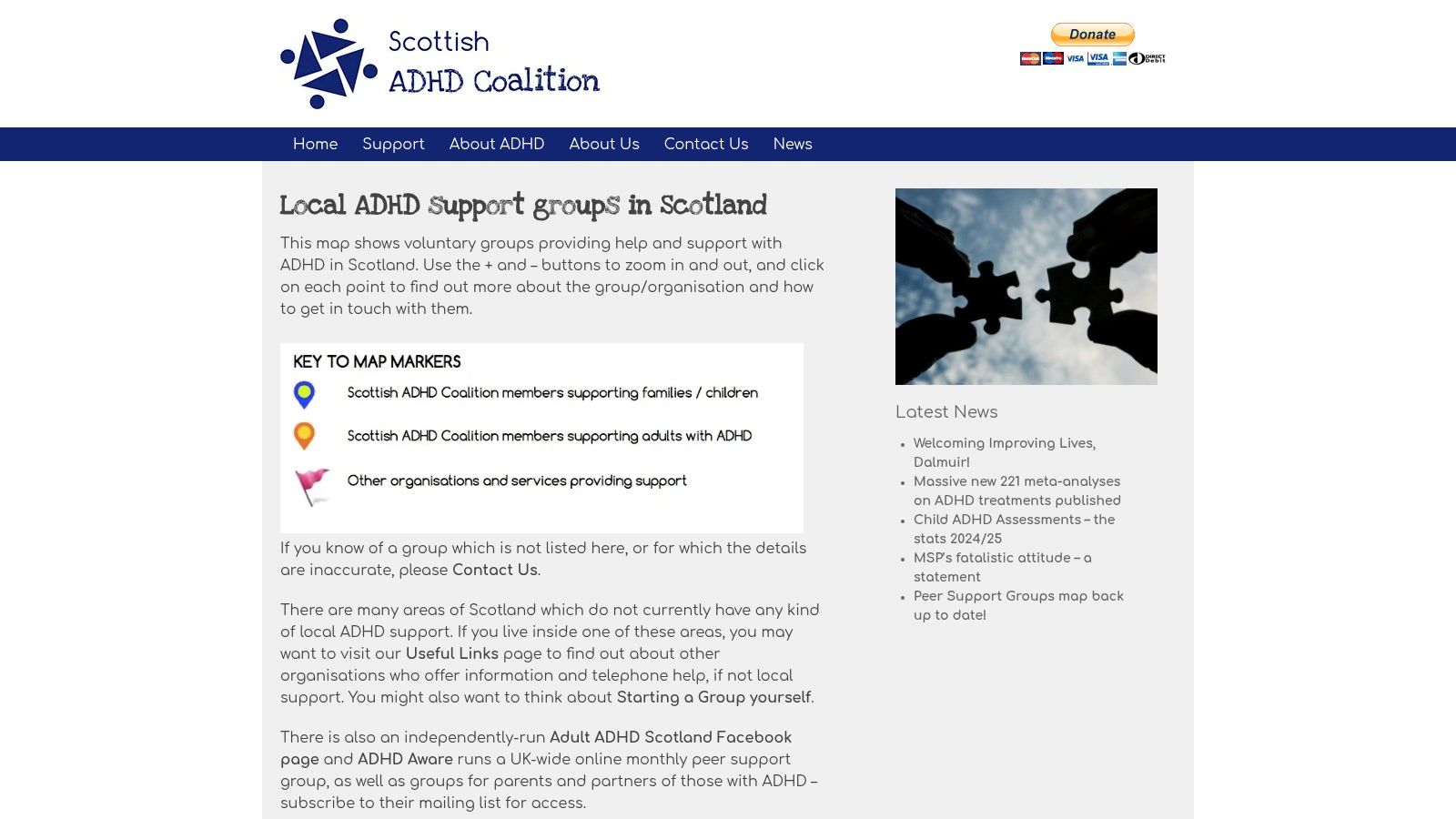
The coalition’s standout feature is its interactive "Local Groups in Scotland" map. This visual tool allows you to easily identify nearby groups, clicking on pins to reveal names, contact details, and links to their online presence. The website also provides valuable guidance for individuals interested in starting their own local support group, empowering communities to fill any existing gaps in provision.
How to Use the Scottish ADHD Coalition Effectively
The most direct way to find a group is by exploring the interactive map. Check the details for your local area and follow the provided links, which often lead to a Facebook Group or an email contact. As many groups use social media as their primary hub, you will likely need a Facebook account to join and see event details. Be proactive in reaching out, as some information may rely on volunteer organisers to keep it current.
The Scottish ADHD Coalition’s strength is its dedicated focus on the Scottish context, acknowledging the unique landscape of healthcare and community support within the nation and championing the growth of new peer-led initiatives.
Key Information:
- Best for: Adults, parents, and carers in Scotland looking for local, peer-run ADHD support.
- Cost: Free to access the directory. Individual groups are typically free or have minimal costs.
- Coverage: Scotland only.
| Pros | Cons |
|---|---|
| Dedicated, Scotland-specific directory and map. | Coverage can be patchy in more rural regions. |
| Signposts both adult and parent/carer groups. | Joining often requires a Facebook account. |
| Includes guidance on starting a new local group. | Relies on external organisers to update info. |
Website: https://www.scottishadhdcoalition.org/local-groups-in-scotland/
12. ADD-NI (ADD Northern Ireland)
ADD-NI is the essential first port of call for anyone in Northern Ireland looking for an ADHD support group near me. As the region’s primary ADHD charity, it offers a central hub for support, information, and services tailored specifically to children, adults, and families living with ADHD across Northern Ireland. Their work consolidates crucial resources that might otherwise be difficult to find.
The organisation's core function is to provide direct support and signpost users to relevant local services. They facilitate various group-based activities and programmes, although the specific schedules for peer support groups can vary. The website details their helpline and multiple contact routes, allowing for self-referral or professional referrals to access their structured support systems and workshops.
How to Use ADD-NI Effectively
To get started, your best approach is to contact ADD-NI directly via their helpline or contact form. While the website provides an overview of their services, direct communication is the most reliable way to get up-to-date information on current peer support groups, family programmes, and other local events. Be aware that some specialised services may require registration or a formal referral to join.
ADD-NI’s unique value is its hyper-local focus. It provides a dedicated, on-the-ground network for Northern Ireland, ensuring access to tailored support where larger, UK-wide directories often have limited listings.
Key Information:
- Best for: Children, adults, and families in Northern Ireland seeking dedicated local support and services.
- Cost: Free to contact. Specific programmes or groups may have associated costs or funding requirements.
- Coverage: Nationwide (Northern Ireland only).
| Pros | Cons |
|---|---|
| The best single contact for ADHD support in NI. | Peer-group schedules can vary and may not be listed. |
| NI-specific coverage fills a key regional gap. | Some activities may require a referral or registration. |
| Offers structured services beyond peer support. | Website focuses more broadly on services than listings. |
Website: https://addni.org/
12 Local ADHD Support Groups Compared
| Service | Core features | Format & access | Cost & booking | Target audience | Unique selling point |
|---|---|---|---|---|---|
| AADD-UK | Nationwide, continuously updated list of ADHD support groups | Web directory; browse by area; contact emails for organisers | Mostly free; no central booking: contact groups directly | Adults, parents/carers, mixed community groups | ADHD-specific, peer-run national directory maintained by adults with ADHD |
| ADHD UK | Live facilitated online groups, topic-based sessions, Facebook communities | Online video sessions + Facebook; national access; email alerts | Mostly free; places can fill quickly: RSVP via email/list | Recently diagnosed adults, parents, carers | Mix of peer-to-peer and expert-led sessions with national reach |
| Hub of Hope | Largest mental-health directory with filters and postcode search | Web & mobile app; location-based results; NHS integration | Free to use; listing detail varies by region | Anyone seeking local mental-health/ADHD support | NHS-backed, wide coverage with crisis routing and hyper-local search |
| Mind – Local Minds finder | Locator for ~100 Local Minds with local service descriptions | Postcode/city search for Local Mind pages across England & Wales | Usually free; services vary by locality | People seeking local facilitated support without GP referral | Trusted national charity with professionally supported local groups |
| ADHD Aware | Brighton in-person meetings + UK-wide online peer sessions | Monthly in-person (Brighton) + Zoom groups; newsletter/Eventbrite booking | Mostly free; Eventbrite RSVPs for online sessions | Adults with ADHD, partners/family | Active, friendly community with clear schedules and signposting |
| Meetup | City-level discovery of informal ADHD meetups and socials | App/website; in-person and online events; RSVP & messaging | Free/organiser-dependent; requires Meetup account | People seeking informal local peer meetups and socials | Broad discovery tool with event calendars and member interaction |
| Eventbrite | Ticketing for ADHD events, cafés, workshops and meetups | Search by location/date; online & in-person events; calendar sync | Mix of free and low-cost tickets; online booking & reminders | People looking to book scheduled ADHD events easily | Simple booking, capacity info and automated reminders |
| Facebook Groups | Large ecosystem of private/local ADHD communities and announcements | Online groups (private/closed); event posts and organiser announcements | Free; Facebook account required; moderation varies | Ongoing peer chat, local community organising | Very active day-to-day interaction and direct links to local meetups |
| ADHDadultUK | Moderated Discord community, UK-focused resources and guides | Discord-based always-on chat + resources and videos | Free; account required; anonymous options available | Adults with ADHD seeking peer chat and UK resources | Anonymous, moderated, UK-focused adult ADHD support hub |
| ADDISS | Weekly structured online groups run by ADHD specialist charity | Recurring timetable via Microsoft Teams; specialist facilitation | Free/possible members-only for some groups | Adults, parents, women seeking structured support | Reliable weekly schedule and specialist charity facilitation |
| Scottish ADHD Coalition | Interactive map and signposts for Scottish local ADHD groups | Scotland-focused map and contact links; guidance to start groups | Free to use; coverage varies by region | People in Scotland seeking local in-person peer groups | Scotland-specific map and practical guidance for starting groups |
| ADD-NI (ADD Northern Ireland) | NI-wide helpline, signposting and group-based services | Northern Ireland coverage; helpline, self- and professional referral | Free/varies by programme; may require registration | Children, adults and families in Northern Ireland | Primary NI charity for ADHD with helpline and local signposting |
Take the Next Step: Connect, Share, and Find Your Community
Your search for "ADHD support groups near me" is the first, and often most significant, step towards building a network of understanding and shared experience. Throughout this guide, we have explored a diverse landscape of resources available across the UK, moving from national charities to hyper-localised, grassroots initiatives. The journey to finding your community is deeply personal, and the right fit for one person may not be the right fit for another.
The key takeaway is the power of choice. You are not limited to a single option. The structured, information-rich environment of a charity-led group like ADHD UK or AADD-UK provides a fantastic foundation for learning evidence-based strategies. In contrast, the informal, peer-led nature of groups found on platforms like Meetup or Facebook Groups offers a more casual space for authentic connection and spontaneous conversation.
Recapping Your Options and Making a Choice
Let’s quickly summarise the pathways you can take, based on your specific needs. This will help you decide where to focus your energy first.
- For Structured, Trustworthy Information: If you're newly diagnosed or seeking reliable, well-moderated advice, start with the established national charities. ADDISS, ADHDadultUK, and the regional bodies like the Scottish ADHD Coalition and ADD-NI are excellent starting points. They often vet their local group listings and provide resources that are aligned with clinical best practice.
- For Hyper-Local, In-Person Connections: When the priority is meeting people face-to-face in your immediate vicinity, digital directories are your best tool. The Hub of Hope and Mind’s Local Minds finder are invaluable for pinpointing services, including peer support, right on your doorstep. These platforms cut through the noise to show you what’s genuinely available nearby.
- For Niche Interests and Socialising: If you're looking for community built around shared hobbies or more casual social gatherings, rather than formal support meetings, Meetup and Eventbrite are ideal. Searching for "neurodivergent" or "ADHD" here can uncover everything from walking clubs to co-working sessions, allowing you to connect in a low-pressure environment.
- For Online, 24/7 Community: When you need support at an unconventional hour or prefer the accessibility of a digital space, dedicated online communities are essential. ADHD Aware’s Zoom meetings and the myriad of specialised Facebook Groups offer a lifeline, providing connection without geographical constraints.
Practical Steps to Get Started
Feeling overwhelmed by the options is a common and valid response. The best approach is to take small, manageable actions.
- Select Two Platforms to Explore: Don't try to investigate all twelve resources at once. Pick one national charity website and one local search tool to begin with. For example, browse the AADD-UK list and simultaneously search your postcode on Hub of Hope.
- Attend a Virtual Meeting First: If you feel apprehensive about an in-person group, an online meeting is a fantastic, lower-stakes way to get a feel for the dynamic. It allows you to observe, or even participate with your camera off, to see if the group's style resonates with you.
- Remember It's Okay to 'Shop Around': You do not need to commit to the first group you find. It is perfectly acceptable to attend a few different meetings to discover the community where you feel most comfortable, seen, and supported. The goal is to find your people, and that can sometimes take a little exploration.
Embarking on this search is a proactive investment in your own well-being. Finding the right ADHD support group near you can be transformative, replacing feelings of isolation with a powerful sense of belonging and validation. Use the tools and strategies outlined in this article as your compass, and take that next brave step towards building the supportive community you deserve.
While peer support is a vital piece of the ADHD journey, it often works best alongside professional guidance. If you are at the beginning of your journey, seeking a formal diagnosis, or require a comprehensive treatment plan, ADHD Private offers a directory of UK-based private clinicians and services. Visit ADHD Private to explore assessment options that can provide the clinical clarity to complement your community support.