A Guide to the ADHD Test for Adults in the UK
Considering an ADHD test for adults? This guide explains the UK process, from NHS and private options to costs and how to prepare for your assessment.
Written and maintained by the ADHD Private editorial team, drawing on NHS, NICE and ADHD UK guidance. This is general information, not medical advice.
If you've been wondering whether you have ADHD, the journey towards getting an ADHD test for adults can feel pretty confusing. It’s not a simple quiz, but more like a detective piecing together clues from your entire life. This guide will walk you through every stage, demystifying the process and giving you a clear, manageable roadmap.
What an Adult ADHD Diagnosis Journey Involves

The thought of getting an ADHD diagnosis as an adult can stir up a lot of feelings—hope, anxiety, and maybe even a bit of doubt. You’ve likely spent years feeling like you were just built differently, battling with organisation, focus, or impulsivity while everyone else seemed to manage just fine. Realising these struggles might be linked to a neurodevelopmental condition is often the first real step towards getting answers.
An ADHD assessment isn't a simple tick-box exercise or one of those online quizzes you see. It’s a detailed clinical process designed to build a complete picture of who you are. A qualified clinician will explore your symptoms, your life history, and how these traits affect you day-to-day. This structured approach makes sure the diagnosis is accurate and rules out other things that might be going on, like anxiety or depression, which often go hand-in-hand with ADHD.
Understanding the Diagnostic Framework
At its heart, an ADHD test for adults is a deep-dive interview with a psychiatrist or a qualified specialist. They use established diagnostic criteria, like those in the DSM-5 (Diagnostic and Statistical Manual of Mental Disorders, Fifth Edition), to guide their evaluation. This framework looks for clear evidence that symptoms were present before you were 12 years old and that they impact you in at least two areas of your life—for example, at work and at home.
This comprehensive process is made up of a few key parts:
- Clinical Interviews: In-depth chats about your childhood, school days, career path, and the challenges you're facing now.
- Rating Scales: Standardised questionnaires for you to fill out. Sometimes, a partner or parent might be asked to complete one too, helping to measure how often and how severe your symptoms are.
- Collateral Information: This is just about gathering extra evidence. Think old school reports or feedback from someone who knows you well. It helps build a historical context for your difficulties.
This multi-faceted approach is so important because it helps tell the difference between ADHD and other conditions that have similar symptoms. The goal isn't just to stick a label on you, but to get a real understanding of how your brain works so you can find support and strategies that actually help.
Taking this on is a big step. Whether you go through the NHS or look at private options, knowing what to expect is half the battle. To get a better sense of the specifics, you can learn more about how to get diagnosed with ADHD and what each step involves. Turning the unknown into a clear, manageable journey starts right here.
Why So Many UK Adults Are Looking for an ADHD Diagnosis
If you’re thinking about getting an ADHD test as an adult, you’re in very good company. There's been a huge shift in awareness across the UK recently, pushing thousands of people to finally question lifelong struggles they've had with things like focus, organisation, and managing their emotions. What might have been brushed off for years as just being "disorganised," "lazy," or "a bit too sensitive" is now being seen for what it often is: potential ADHD.
This isn't just some passing trend. It's more like a long-overdue course correction in healthcare. For decades, the common picture of ADHD was a hyperactive little boy, bouncing off the walls. This incredibly narrow view meant that countless others—especially girls and women—were missed entirely, left to figure out adulthood with a brain that simply works differently, without any support or understanding.
The Hidden Toll of Undiagnosed ADHD
Living with undiagnosed ADHD can feel like you’ve been given all the parts to build something complex, but no instructions. You can see the finished product in your mind—a stable career, calm relationships, a feeling of being on top of things—but you can't for the life of you figure out how the pieces fit together. This constant uphill battle can cause real problems in pretty much every area of life.
- At Work: You might be brimming with brilliant ideas but find it almost impossible to hit a deadline, keep a project on track, or deal with the necessary admin. This often leads to a pattern of underachieving, hopping between jobs, and that nagging feeling you’re not reaching your potential.
- In Relationships: ADHD traits like forgetfulness, intense emotional reactions, or struggling to follow through on promises can easily be mistaken for not caring. Partners, friends, and family can feel hurt, leading to frustrating cycles of conflict and misunderstanding.
- With Mental Health: Just getting through a normal day when your brain is fighting you is mentally draining. It’s hardly surprising that undiagnosed ADHD so often goes hand-in-hand with anxiety, depression, and a lifetime of low self-esteem.
Getting a diagnosis isn't about looking for an excuse. It’s about finally getting the right user manual for your own brain. It gives you the power to understand your wiring and learn how to work with it, not constantly against it.
For so many people, the decision to get assessed is driven by a powerful need for answers and validation after years of feeling like they were somehow broken.
Understanding Why So Many Were Missed
The numbers really bring home why so many adults are only now seeking help. It's estimated that 3-4% of adults in the UK have ADHD, which works out to around 1.875 million people. Yet, the vast majority of them don't know it. In fact, it's thought that over 80% of adults in the UK with ADHD are living without a formal diagnosis. You can explore some of the research behind adult ADHD trends to see the full picture.
This diagnostic gap is even wider when you look at gender. Women have been systemically overlooked for generations. Their ADHD often shows up as the 'inattentive' type, which is far less obvious from the outside. Instead of climbing the curtains, their experience is more internal: a brain that never switches off, feeling constantly overwhelmed, or battling persistent anxiety. Because these signs don't match that classic hyperactive-boy stereotype, they were—and still are—frequently misdiagnosed or simply told to try harder.
The surge in demand for an ADHD test for adults is a sign that people are finally connecting the dots. They're seeing their own lifelong patterns reflected in the stories of others and are motivated by the hope of getting clarity, proper support, and the chance to finally flourish.
What Happens During an Adult ADHD Assessment
The phrase “ADHD test for adults” can sound a bit daunting, maybe bringing up memories of stressful school exams. But it’s not something you can pass or fail. It’s better to think of it as a collaborative investigation, a deep dive into how your brain is wired, led by a specialist who knows what to look for.
The whole process is incredibly thorough, and for good reason. Many ADHD symptoms can look a lot like anxiety, depression, or even the effects of chronic stress. A proper assessment helps untangle all of that, making sure the final diagnosis is accurate and any support you get is genuinely right for you. It’s much more than just ticking boxes on a checklist.
Essentially, the clinician is looking to connect the dots between your struggles today and your experiences growing up. For an ADHD diagnosis, there needs to be a clear, consistent pattern of traits that started in childhood (before you were 12) and still create significant challenges in at least two areas of your life—like your work and your relationships.
The Clinical Interview: It’s All About Your Story
The heart of any ADHD assessment is the clinical interview. This is a long, in-depth chat with a psychiatrist or specialist psychologist, often lasting a couple of hours. It’s your chance to lay everything out and explain what life is actually like for you.
The clinician will guide the conversation, asking about different parts of your life:
- Your School Days: What do you remember about being in the classroom? Do you have old school reports that mention things like being disorganised, chatty, or easily distracted?
- Your Work Life: What are the biggest hurdles you face professionally? Is it meeting deadlines, managing big projects, or maybe navigating office politics?
- Your Relationships: How do your traits show up in your friendships, family life, or with your partner?
- Daily Life: What about the day-to-day grind? Things like managing bills, keeping the house in order, or just remembering to book appointments.
This isn’t an interrogation; it’s a fact-finding mission. The specialist is listening for real-world examples that match the official diagnostic criteria for ADHD, piecing together the puzzle of your life.
Many people with undiagnosed ADHD describe an internal experience that starts with a constantly ‘busy brain’, which spirals into overwhelm and anxiety, as shown below.
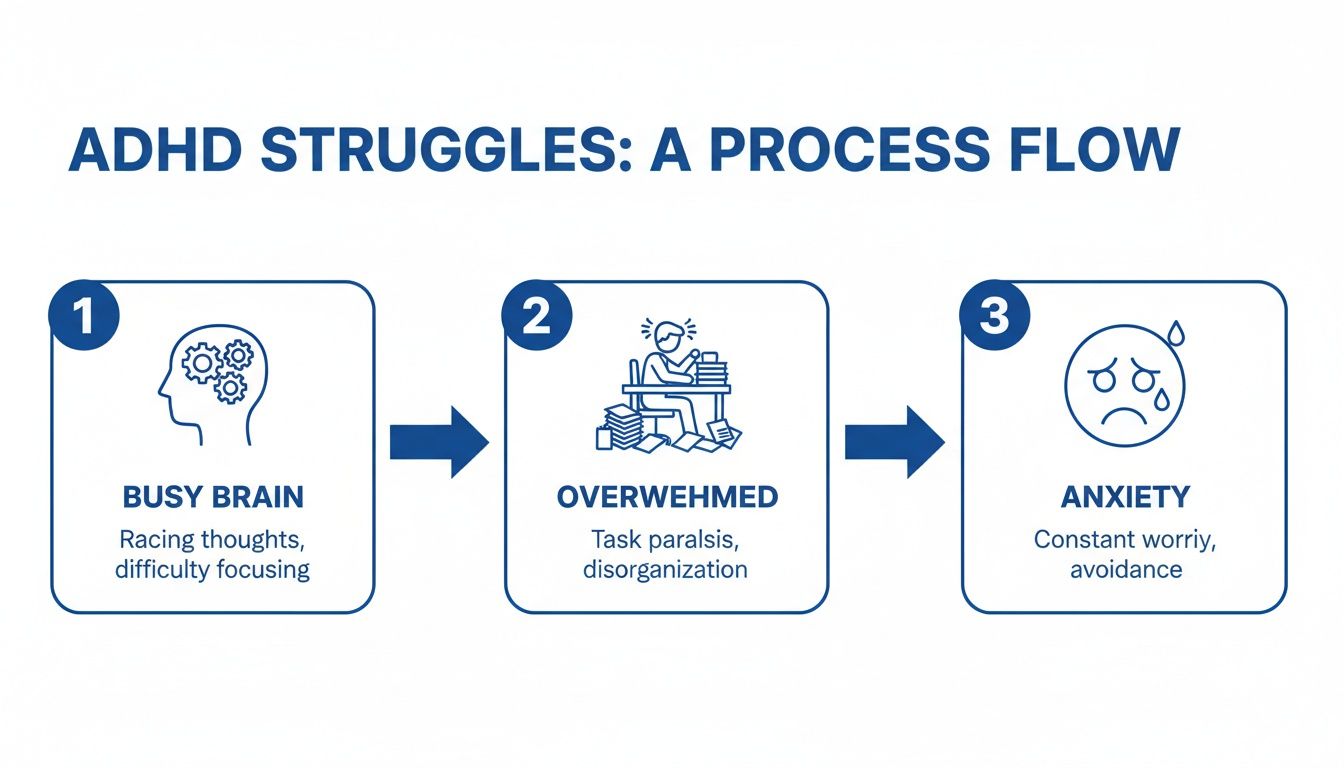
This feeling of a mind that just won’t switch off is often the root cause of the practical difficulties and emotional distress that finally prompt people to seek an assessment.
To add structure and data to the personal stories shared, the assessment process includes several key stages.
Key Stages of a Comprehensive Adult ADHD Assessment
The table below outlines the typical components of the diagnostic process, breaking down what each stage involves and why it’s a crucial part of building an accurate picture.
| Assessment Stage | What It Involves | Why It's Important |
|---|---|---|
| Pre-Assessment Screening | Filling out initial forms and symptom checklists before your main appointment. | This gives the clinician a starting point and helps ensure an ADHD assessment is the right path for you. |
| The Clinical Interview | A long, guided conversation (1-2 hours) about your entire life history, from childhood to the present day. | This is where the clinician gathers the rich, detailed narrative needed to understand your unique challenges and patterns. |
| Rating Scales & Questionnaires | Completing standardised tools like the ASRS or DIVA-5 to rate the frequency and severity of your symptoms. | These provide objective, measurable data to support the information gathered during the interview. |
| Gathering Collateral Info | The clinician may ask for input from someone who knows you well (a parent, partner) or review old school reports. | This provides an outside perspective and historical evidence of lifelong traits, which is essential for a diagnosis. |
| Differential Diagnosis | The specialist will carefully consider and rule out other conditions (like anxiety, depression, or BPD) that can mimic ADHD symptoms. | This ensures the final diagnosis is accurate and that other potential issues aren't being missed. |
| Feedback & Report | A final session where the clinician explains their findings, provides a formal diagnosis (if applicable), and discusses next steps. | This is where you get clarity, can ask questions, and receive a detailed report outlining the assessment and recommendations. |
By combining your personal story, objective data, and historical evidence, the specialist can confidently piece together the full picture.
Standardised Scales and Questionnaires
Alongside the main interview, you’ll definitely be asked to complete some standardised rating scales. These are essentially detailed questionnaires that list common ADHD symptoms and ask you to rate how often they affect you. In the UK, you’ll likely come across the ASRS (Adult ADHD Self-Report Scale) or the DIVA-5 (Diagnostic Interview for ADHD in Adults).
It's crucial to understand these tools are not a diagnosis in themselves. They're a way of gathering structured, objective data. They help the clinician see how your experiences stack up against the established diagnostic criteria, adding a layer of science to your personal story.
If the interview is the rich, colourful movie of your life, the rating scales are the black-and-white data points that back it up. You need both for a clear picture.
Gathering Information From Others
Since ADHD is a neurodevelopmental condition that starts in childhood, clinicians need to find proof that your symptoms aren’t a new thing. But recalling your primary school days in detail can be tough! That's why they often look for collateral information—basically, getting another perspective from someone who knows you well.
This usually means one of two things:
- Getting Input from a Loved One: Your clinician might ask a parent, an older sibling, or your partner to fill out a questionnaire about you. It gives them an outside view of how your traits affect you and others.
- Digging Out Old School Reports: These are gold dust in an assessment. Comments from teachers like “bright but scatty,” “doesn’t live up to his potential,” or “is a constant daydreamer” can be powerful evidence of early ADHD traits.
This supporting evidence helps confirm that the struggles you’re having now are part of a lifelong pattern, which is a cornerstone of a reliable diagnosis.
Ready to compare clinics?
Answer a few questions and we’ll shortlist private ADHD clinics that fit — free to use, and independent.
Navigating NHS vs Private ADHD Assessments
So, you’ve decided to look into an ADHD test for adults. One of the first, and biggest, hurdles you’ll face is figuring out how to get one. In the UK, you’re looking at three main routes, and each one comes with a different trade-off between speed, cost, and the overall process.
Knowing the pros and cons of the traditional NHS route, going fully private, or using the NHS Right to Choose scheme (if you're in England) is the first step. It helps you make a clear-headed decision that actually works for your life right now.
The Traditional NHS Pathway
The most familiar path for any health concern is, of course, the NHS. It all starts with a chat with your GP. You’ll talk through your symptoms and, if they agree it’s appropriate, they’ll refer you to a local specialist adult ADHD service for the full work-up. The biggest plus here is obvious: it’s completely free of charge.
The flip side, however, is the waiting time. And it’s a big one. NHS adult ADHD services are stretched incredibly thin, which has led to staggering waiting lists. Depending on where you live, you could be waiting anywhere from one to five years just for that first assessment. For someone struggling and needing answers now, that kind of delay can feel almost impossible.
The Private Assessment Route
If waiting years simply isn’t an option, going private is by far the fastest way to get clarity. You can often get an appointment booked within a few weeks, completely sidestepping the long NHS queues. This speed does come at a cost, though. A comprehensive ADHD test for adults will typically set you back anywhere from £700 to over £2,000.
What you get for that money is choice and flexibility. You can research and pick a clinic or a specialist whose approach, availability, and expertise you feel comfortable with. It’s a solid choice for anyone who has the funds and urgently needs to understand what’s going on and start getting support.
Choosing a diagnostic pathway is about weighing up your resources. It's a pragmatic decision balancing your available funds against the emotional and practical cost of waiting for an assessment.
To help you compare your options, our detailed guide on the UK ADHD assessment process provides more information on what to expect from both NHS and private providers.
A Hybrid Option: NHS Right to Choose
For people living in England, there’s a fantastic third option that offers the best of both worlds: Right to Choose. This scheme essentially lets you get the speed of a private assessment but have it funded by the NHS. You can ask your GP to refer you to a private clinic that holds an NHS contract, and you won’t have to pay a penny.
This route can slash your waiting time from years down to a matter of months. It’s an incredible middle-ground, giving you a much faster diagnosis without the hefty price tag.
To use Right to Choose, a few things need to be in place:
- You must be registered with a GP in England.
- The private provider you want to use must have a contract with an NHS Integrated Care Board (ICB) somewhere in England.
- Your GP has to agree that referring you for an ADHD assessment is the right clinical step.
To get the ball rolling, you’ll need to do a bit of research on qualified providers (like Psychiatry-UK or ADHD 360) and take your choice to your GP with a formal request. While GPs are legally required to honour a valid Right to Choose referral, it always helps to go in prepared with information on the scheme and your chosen clinic. Being proactive makes the whole process a lot smoother and gets you the help you need, faster.
How to Prepare for Your Assessment

The idea of an ADHD test for adults can feel a lot like prepping for a high-stakes interview. There’s often that nagging fear you’ll forget the most important examples or just won't find the right words to describe a lifetime of challenges. But the good news is, a bit of prep work can make all the difference.
Think of yourself as a detective building a case file. By gathering your evidence and getting your thoughts in order, you can walk into your assessment feeling calm, confident, and prepared. It’s the best way to give the clinician a clear, accurate picture of what’s been going on.
Compile Your Personal Evidence
One of the cornerstones of an ADHD diagnosis is showing that symptoms were present in childhood. Of course, trying to remember what life was like when you were seven is a tall order for anyone! This is exactly why digging up historical documents and personal stories is so helpful.
See if you can find any old school reports. They can be a goldmine. Look for those classic teacher comments: “easily distracted,” “daydreams in class,” or the all-too-familiar “has so much potential if only they would apply themselves.” If you can't track them down, don't panic – your memories are still a vital piece of the puzzle.
It's also a great idea to chat with someone who knew you well as a child, like a parent, an older sibling, or even a close family friend. Their perspective can help fill in the blanks and give the clinician a more rounded view of your early years.
Create a List of Real-Life Examples
The diagnostic interview will dig deep into how your symptoms affect your life today. Simply saying “I’m disorganised” doesn’t quite capture the reality of it all. What the clinician needs are specific, real-world examples.
Take some time to jot down a list of situations where your suspected ADHD traits have caused problems.
To get the ball rolling, think about these parts of your life:
- Work or university: Do you consistently leave projects until the last minute? Do you struggle to get started on big, daunting tasks? Have you hopped between jobs out of sheer boredom?
- Home life: Is your space always cluttered, no matter how hard you try? Do you have a pile of unpaid bills or unopened letters? Are you constantly forgetting appointments or family birthdays?
- Relationships: Do you zone out during important conversations? Does your partner get frustrated because you don’t seem to be listening? Do you interrupt people without meaning to?
The goal here is to paint a vivid picture of your daily struggles. Having a list ready to go means you won't be put on the spot, trying to recall everything while you’re already feeling nervous.
Document Your Current Symptoms and Questions
What’s happening right now is just as important as your past. For a week or two before your appointment, try keeping a simple log. Note down any moments where you felt especially forgetful, impulsive, or inattentive. What were you doing? How did it impact your day?
This is also the perfect time to write down any questions you have for the clinician. What are your biggest worries? What are you hoping to get out of this process? Having your questions prepared means you’re more likely to leave the assessment with the clarity you need.
By following these steps, you’re doing more than just getting ready for an appointment. You're taking an active role in your own health journey. This preparation empowers you to tell your story clearly and effectively, which is the first step toward getting the right answers and the right support.
Finding a Reputable Private ADHD Clinic
Deciding to get a private ADHD test for adults can feel like a huge step forward, getting you answers much faster than other routes. But with the private sector booming, it's absolutely vital to pick the right clinic. While many providers are excellent, some are... less so. Your mission is to find a clinic that delivers a thorough, legitimate, and supportive diagnosis.
Think of it like hiring a specialist builder for a major home renovation. You wouldn't just go with the first name you find. You'd check their credentials, read reviews, and ask them to walk you through their process. You need to apply that same diligence when investing in your health. A proper assessment is a significant commitment, both financially and emotionally, so being an informed consumer is your best defence.
The demand for assessments has skyrocketed, putting incredible strain on services. In fact, it's estimated that almost 2.5 million people in England might have ADHD. This has finally pushed NHS England to launch a new data improvement plan, which started in May 2025, to begin tracking waiting lists and service provision. It’s a long-overdue step. You can read more about these new insights into ADHD service data and reporting.
Red Flags to Watch Out For
Knowing what to look for is only half the battle; knowing what to avoid is just as crucial. Some clinics seem to prioritise speed and profit over clinical rigour, which can easily lead to a rushed, low-quality assessment or even a diagnosis that isn't taken seriously elsewhere.
Keep your guard up for providers that:
- Guarantee a diagnosis: This is a massive red flag. No ethical clinician can ever promise a particular outcome before they’ve even met you.
- Offer a suspiciously fast process: A comprehensive assessment simply takes time. Be very wary of any clinic promising a diagnosis after one brief chat with hardly any background information.
- Are vague about costs: You should know exactly what you’re paying for. All fees—for the assessment, any follow-ups, and medication—should be laid out clearly from the start.
- Use unqualified assessors: Check who will be conducting your assessment. It should be a specialist psychiatrist or a similarly qualified professional with deep expertise in adult ADHD.
Essential Questions to Ask Before You Book
To feel confident you're choosing a reputable clinic, you need to go in armed with the right questions. This is how you can properly compare your options and make a decision you feel good about.
A good clinic will welcome your questions and give you clear, straightforward answers. If they get defensive or brush you off, take it as a sign and walk away. Your peace of mind is non-negotiable.
Before you commit to anything, make sure you get solid answers to these questions:
- What are the clinician's credentials? Are they a consultant psychiatrist or a clinical psychologist? Crucially, are they registered with a professional body like the General Medical Council (GMC)?
- What does the full assessment process involve? Ask how long the main interview is, if they use recognised tools like the DIVA-5, and whether they need to speak to someone who knew you as a child, like a parent or older sibling.
- What happens after the diagnosis? What kind of support is available? Do they help with medication titration? Do they offer therapy or coaching?
- Is the diagnosis recognised by the NHS? This is a big one. Ask if their final report meets NHS standards and if they'll collaborate with your GP on a shared care agreement for prescriptions.
Putting in the research now will ensure your investment leads to a credible diagnosis and a clear plan for what comes next. For a more detailed look at what this process involves, have a look at our guide on getting a private ADHD assessment.
Your Questions About Adult ADHD Testing Answered
Taking the first step towards an ADHD test for adults can feel daunting, and it’s natural to have a lot of practical questions. Getting some clear answers upfront can help demystify the process and make you feel more confident about what’s ahead.
Let's tackle some of the most common queries we see.
How long does the actual assessment take?
One of the first things people want to know is how much time to set aside for the main appointment. It’s definitely not a quick chat. You should expect the core diagnostic interview to last anywhere from 90 minutes to three hours.
This isn't just about ticking boxes; it's a deep dive into your life history, current struggles, and the specific ways symptoms show up for you. Giving it this much time allows the clinician to be thorough and build a complete picture.
Is it possible to get a diagnosis in just one session?
This is a common point of confusion. While the big clinical interview might happen in a single, extended session, the full diagnostic process has a few more steps. It typically starts with pre-assessment questionnaires, moves on to the interview, and finishes with a follow-up feedback session. It’s in that final meeting that you’ll discuss the findings and receive the formal report.
This multi-part structure is a sign of a quality assessment. It’s what ensures the diagnosis is accurate and that other potential causes for your symptoms have been properly considered.
Be cautious of any service that promises a diagnosis after one brief consultation. A credible assessment is a careful investigation, not a shortcut that compromises on clinical standards.
Do I absolutely need my old school reports?
This is a huge source of anxiety for many people, but you can relax. While old school reports are fantastic evidence if you have them, it’s completely understandable if they’re long gone.
Clinicians are used to this. Your own detailed recollections, along with stories and insights from a parent, older sibling, or someone who knew you well as a child, are often more than enough to provide that crucial historical context.
What happens if I’m not diagnosed with ADHD?
It’s a very real worry, especially when you’ve invested time, money, and emotional energy into the process. If the clinician determines that your symptoms are a better fit for another condition, like anxiety or depression, a good clinic won’t just leave you in the dark.
They should provide a clear, detailed explanation for their conclusion. More importantly, they’ll guide you on the right next steps, whether that’s a recommendation for a specific therapy or a referral to another specialist. The ultimate goal of a good assessment is to give you clarity and a path forward, no matter the outcome.
Ready to take the next step? At ADHD Private, we've created a free UK-wide directory to help you find and compare private ADHD clinics. Check transparent pricing, wait times, and services to find the right fit for you. Explore your options at https://adhdprivate.co.uk.