ADHD Assessment UK: Your Complete Guide to Getting a Diagnosis
Struggling to navigate the UK ADHD assessment process? This guide covers NHS, private, and Right to Choose pathways to help you find the right option.
Written and maintained by the ADHD Private editorial team, drawing on NHS, NICE and ADHD UK guidance. This is general information, not medical advice.
Getting started with an ADHD assessment in the UK can feel like you're trying to navigate a maze. The good news is, it boils down to three main routes: the standard NHS pathway, going private, or using the ‘Right to Choose’ scheme if you're in England.
Your Options for an ADHD Assessment in the UK
Deciding to get an ADHD assessment is a huge step. For many, it comes after years of wondering why some things just feel harder. In the UK, the path you take often comes down to a mix of things like where you live, what you can afford, and how quickly you need answers. Each option has its own process, timeline, and price tag.
Getting your head around these pathways is the key to making a decision that feels right for you. The NHS route won't cost you anything, but the waiting lists can be incredibly long. A private assessment gets you seen much faster, but it comes with a hefty financial commitment. Then there's Right to Choose (RTC), which acts as a sort of middle ground for people in England, letting you get NHS-funded care from a private clinic, often much quicker.
The Three Assessment Pathways
When you break it down, the main things that set these routes apart are the waiting times, the cost, and how you get your foot in the door in the first place.
Here’s a quick overview of what to expect from each:
- The NHS Pathway: This is the standard, fully-funded route. It all starts with a referral from your GP, but be prepared for a long wait – in some places, it can be several years.
- The Private Pathway: If speed is your priority, this is the way to go. You can refer yourself directly to a private clinic. It’s the most expensive option, with assessment costs often running over £1,000.
- Right to Choose (England only): This clever scheme lets you choose an approved private provider for your NHS-funded assessment. It can dramatically cut down your waiting time compared to local NHS services, and it won't cost you a penny.
This flowchart gives you a great visual guide to how these different routes work for both adults and children seeking an ADHD assessment in the UK.
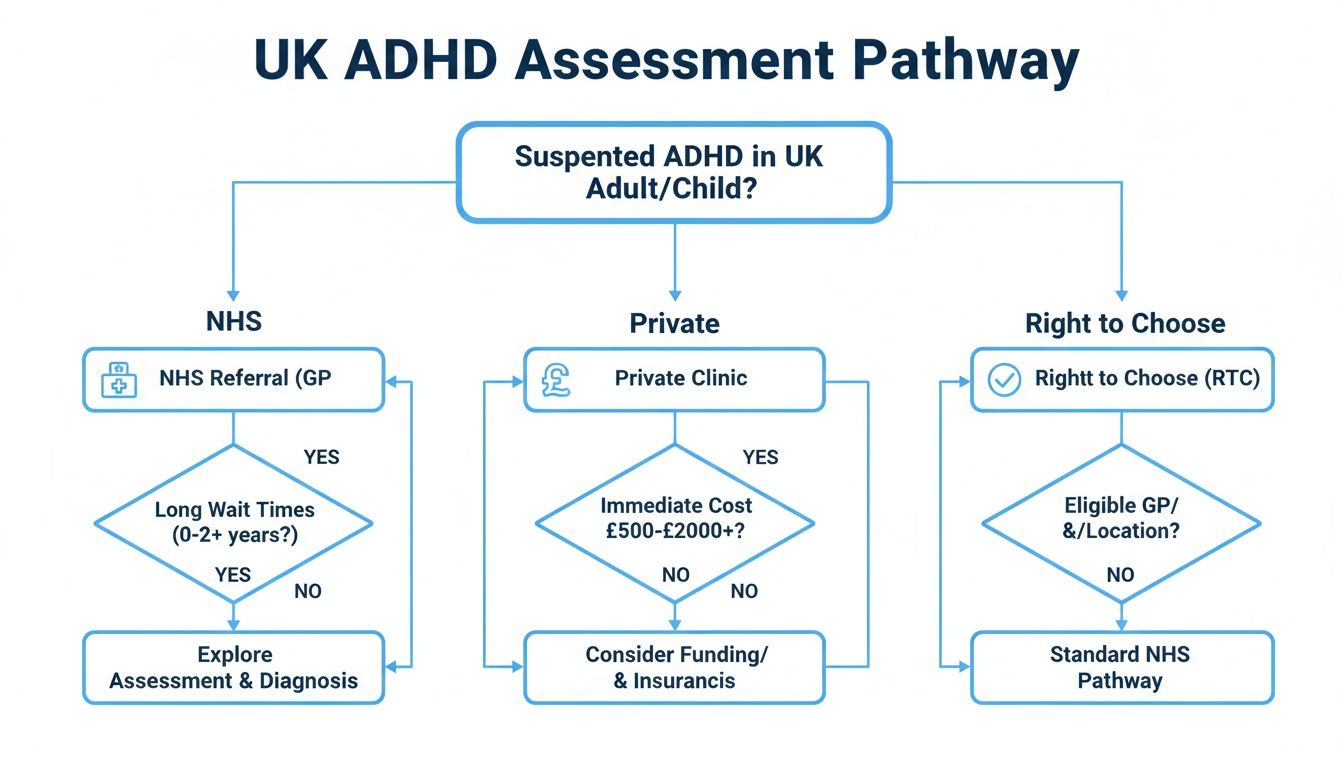
As the flowchart shows, where you live and what you can afford are often the biggest factors when deciding between the NHS, private, or Right to Choose pathways.
It's clear that easier access to diagnosis is desperately needed. A startling look at nine million UK GP records revealed that only 0.32% had an ADHD diagnosis. This suggests that for every nine people with the condition, only one has been officially diagnosed.
UK ADHD Assessment Pathways at a Glance
Seeing the options side-by-side can make the choice much clearer. This table highlights the core differences you'll want to consider.
| Pathway | Typical Cost | Average Wait Time | Referral Route |
|---|---|---|---|
| NHS | Free | 1-5+ years | GP referral |
| Private | £700 - £2,000+ | 2 weeks - 6 months | Self-referral or GP |
| Right to Choose | Free (NHS funded) | 6 months - 1 year | GP referral |
Ultimately, whether you stick with your local NHS service, pay to go private, or use your Right to Choose, each path leads to the same goal: getting clarity.
This guide is here to walk you through each option, making the whole process feel less daunting. If you want to dive deeper into those first crucial steps, our guide on how to get diagnosed with ADHD is a great place to start.
Getting an ADHD Assessment on the NHS
For most of us in the UK, the first thought for any health concern is the NHS. It's the standard, publicly funded route for getting an ADHD assessment, and it’s where the majority of people start their journey. But it's a path that demands a lot of patience and a bit of prep work.
The whole process kicks off at your local GP surgery. This first chat with your doctor is probably the single most important step you'll take. It's your chance to lay out what's been going on and why you think ADHD might be the reason, hopefully leading to a referral to a specialist team.
How to Prepare for Your GP Appointment
It can feel a bit nerve-wracking walking in to talk about ADHD. To get the most out of that short appointment slot, it pays to be prepared. Rather than simply saying "I think I have ADHD," try to bring some real-life examples of how the symptoms are affecting you day-to-day.
Think about the specific struggles you have in different parts of your life:
- At work or university: Are you constantly fighting deadlines, losing track of tasks, or zoning out in important meetings?
- Around the house: Is keeping on top of bills, chores, and appointments a daily battle?
- With friends and family: Have people mentioned that you're forgetful, impulsive, or that you tend to interrupt them without meaning to?
Scribbling a few of these points down beforehand means you can explain things clearly without getting flustered. It helps turn a general feeling into solid, tangible evidence for your GP to work with.
Ultimately, you want to paint a vivid picture of how these issues are impacting your life and your ability to function. Your GP needs this context to see why a referral to a specialist ADHD assessment UK service is necessary.
You really have to be your own best advocate here. A GP appointment flies by, so having your notes ready ensures you don't forget anything crucial in the heat of the moment.
The Referral and the Infamous Waiting Lists
If your GP agrees that an assessment is the right next step, they’ll refer you to your local specialist ADHD or neurodevelopmental service. At this point, you're officially in the system. And you'll be added to a waiting list.
This is where the real test of patience begins. It’s no secret that NHS waiting lists for ADHD assessments are incredibly long, and how long you wait can feel like a postcode lottery. Some people might wait a few months; for others, it can be several years. The huge demand, coupled with limited funding and a shortage of specialists, has created a perfect storm.
The length of these waits can be deeply frustrating. As awareness of ADHD has grown, so has the number of people seeking a diagnosis, putting a massive strain on the system. The situation has become so critical that in England alone, over half a million children and adults are currently waiting for an assessment. This backlog led NHS England to set up an independent ADHD Taskforce to figure out a solution. You can read the full NHS England response to the ADHD Taskforce report to get a sense of just how big the challenge is.
Once your referral is in, the service will eventually get in touch to book your appointment. It’s worth checking with your GP surgery a week or two after your appointment to make sure the referral was sent and received. You can also try contacting the specialist service directly to ask for an estimate of their current waiting times – it helps to have a realistic idea of the timescale you're looking at.
Considering a Private ADHD Assessment
For many people, the idea of waiting years for an NHS appointment is simply unbearable. If the long waiting lists are your biggest hurdle, going for a private ADHD assessment is a much faster, though admittedly more expensive, way to get answers. This route lets you sidestep the long-winded NHS referral process and go straight to a clinic of your choice.
When you go private, what you’re really paying for is speed and control. Instead of being assigned to a local service with a queue that’s potentially years long, you can research and pick a provider that feels right for you. The whole process is dramatically quicker; some clinics can get you an initial appointment in a matter of weeks. This can be a lifeline for those whose symptoms are causing real problems in their daily life.
Of course, this speed comes at a price. The private pathway is a significant financial investment, and it’s vital to get your head around the full costs before you commit.

Breaking Down the Costs of a Private Assessment
The price tag on a private ADHD assessment in the UK isn't just one number. It’s a series of costs that build up over time. The biggest single payment is the initial assessment itself, which usually falls somewhere between £700 and over £2,000. This can vary quite a bit depending on the clinic’s location and reputation.
But that’s just the start. You’ll need to factor in a few other key expenses:
- Follow-Up Appointments: A diagnosis is just the first step. You'll need more consultations to talk through treatment options, and these are billed separately.
- Medication Titration: If medication is the right path for you, there's a process called titration to find the right drug and dosage. This phase requires several appointments over a few months and can easily add hundreds of pounds to the bill.
- Private Prescriptions: Until you can get a Shared Care Agreement sorted with your GP, you’ll be paying the full private cost for your medication. This can be anywhere from £80 to £120 per month, sometimes even more.
Before you sign up with any clinic, insist on a clear, itemised quote. You want to see a full breakdown of their diagnostic package and any ongoing treatment costs so there are no nasty surprises.
How to Choose a Reputable Clinic
The private ADHD sector is a mixed bag, so picking a credible, high-quality clinic is absolutely essential. You need a diagnosis that will be taken seriously by your GP and other healthcare professionals. The trick is to look for official signs of quality and professionalism.
In England, a massive indicator is the clinic's Care Quality Commission (CQC) rating. The CQC is the independent regulator for all health and social care, so a ‘Good’ or ‘Outstanding’ rating is a great sign that you’re dealing with a safe, effective, and well-managed service.
You should also double-check the credentials of the clinicians themselves. Any psychiatrists must be on the General Medical Council (GMC) specialist register, and psychologists need to be registered with the Health and Care Professions Council (HCPC). This is your guarantee that they meet the UK’s strict professional standards.
Understanding Shared Care Agreements
One of the most important things to get your head around in the world of private ADHD care is the Shared Care Agreement (SCA). Just think of it as a formal handover from your private specialist to your NHS GP.
An SCA is an official document that allows your GP to take over prescribing your ADHD medication once you are on a stable dose. Once it’s signed, you can get your prescription via the NHS and only pay the standard charge, not the much higher private rate.
Here’s the catch: your GP is not required to accept an SCA. Some might refuse, perhaps because they aren’t familiar with the private clinic or because their local NHS trust has a policy against it. This is why you must have a chat with your GP before you even book a private assessment. Ask them outright if they would, in principle, be willing to enter into a shared care arrangement with a reputable private provider. That one conversation can save you a world of stress and a lot of money down the line.
Looking for a private ADHD assessment?
Answer a few questions and we’ll shortlist clinics that fit — comparing price and waiting time.
Understanding Your Right to Choose in England
If you live in England, the thought of joining a long NHS waiting list for an ADHD assessment can be disheartening. But there’s a powerful, and often overlooked, route that can get you seen much faster: the NHS Right to Choose (RTC) pathway. This brilliant scheme essentially combines the speed of private healthcare with the free-at-the-point-of-use principle of the NHS.
Think of it like this: instead of automatically being sent to your local NHS mental health team with its potentially long queue, RTC allows you to pick a different, pre-approved private provider to do the assessment instead.
The best part? It’s completely free. The NHS foots the bill for your assessment and any subsequent treatment, just as it would if you’d waited for your local service. The key difference is you’re often seen in months, not years, making RTC a fantastic option if you can’t afford to go fully private but are struggling with a long wait.
How Does Right to Choose Actually Work?
The process is fairly simple, but it does require you to take the lead. With a standard referral, your GP does all the work. With Right to Choose, you’re in the driver's seat. You essentially tell your GP, "I'd like to exercise my right to choose, and this is the specific NHS-approved provider I want to be referred to."
To be eligible, the criteria are straightforward:
- You need to be registered with a GP in England.
- You’re seeking a referral for a condition where an NHS service exists (like adult ADHD).
- The provider you’ve picked must hold an NHS Standard Contract for that service.
The crucial thing to remember is that you can't self-refer through this pathway. Your job is to do the research, choose a clinic, and then present that choice to your GP so they can make the referral.
Your Step-by-Step Guide to Using RTC
Navigating Right to Choose might feel a bit intimidating at first, but it really boils down to a few clear steps. Getting these right will give you the best chance of a smooth referral.
Research and Select a Provider: First things first, you need to find a clinic that accepts RTC referrals. Big names in private ADHD care, like Psychiatry-UK and ADHD 360, are well-established options. Check their websites for up-to-date waiting times for RTC patients – they will still have a wait, but it’s usually much shorter than the local NHS.
Prepare for Your GP Appointment: Once you've picked a provider, book a chat with your GP to talk about your symptoms, just as you would for any referral. It really helps to go in prepared with notes and specific examples of how your symptoms are impacting your daily life.
Draft a Right to Choose Letter: This is the most important part of the process. To make things as easy as possible for your GP, draft a letter that clearly states what you want. Most RTC providers have template letters on their websites you can simply download and fill in. The letter needs to explicitly say you are exercising your NHS Right to Choose and name your chosen provider.
Present Your Request: At your GP appointment, bring your completed letter and any other forms the provider requires. Calmly explain that you’ve done your research on the RTC pathway and would like them to refer you to your chosen clinic. Handing them a pre-prepared letter makes their job a whole lot simpler.
It's worth remembering that while it's your legal right, some GPs aren't familiar with the Right to Choose process. A polite, confident approach backed up with clear, organised paperwork is the best way to get your referral sorted without a hitch.
Your GP can’t refuse your request just because they prefer the local service or don’t know the provider. As long as you and your chosen clinic meet the criteria, the referral should go ahead. Ultimately, this pathway gives you the power to take back some control and get an adhd assessment uk diagnosis in a much more reasonable timeframe.
What Happens During the ADHD Assessment Itself?
Just the thought of assessment day can be enough to set your nerves on edge. That's completely normal. But knowing what’s coming can help turn a scary unknown into a straightforward conversation.
The most important thing to get your head around is this: an ADHD assessment isn't a test. You can't pass or fail. It’s really just a detailed chat between you and a specialist, designed to figure out if your life experiences match the clinical picture of ADHD.
Whether you’re logging in for a video call or sitting in a clinic room, the heart of the assessment is the same. A psychiatrist or a specially trained psychologist will guide you through a discussion to build a clear picture of your life, from childhood right up to today.
The Diagnostic Interview: More of a Guided Chat
The bulk of your appointment will be what's called a 'diagnostic interview'. Forget any images of a formal interrogation; it’s much more like a guided conversation, with the clinician asking questions to help piece your story together.
They'll want to understand how you get on in different parts of your life, exploring the key signs of ADHD and the impact they have. You should be prepared to talk about:
- Childhood and School Days: What were you like as a kid? Did your school reports mention a short attention span or fidgety behaviour? Did you constantly struggle with homework? ADHD is a neurodevelopmental condition, which means the specialist needs to see evidence that symptoms were around before you were 12.
- Life as an Adult: The conversation will then shift to the here and now. How do you cope at work? Are deadlines a nightmare? Do you find your mind wandering in meetings? They'll also ask about life at home – things like managing bills, keeping on top of chores, or just remembering to show up for appointments.
- Relationships and Social Life: The clinician will probably ask about your relationships with your partner, friends, and family. This helps them understand how things like impulsivity or difficulty managing your emotions might be affecting your social world.
What the specialist is looking for are consistent patterns of behaviour that cause real problems in at least two major areas of your life (like at work and at home).
Questionnaires and Clinical Tools
Alongside the main interview, the clinician will likely use some standardised tools to gather information in a more structured way. These aren’t personality tests – they are carefully designed scales that measure the frequency and severity of ADHD symptoms.
You'll almost certainly be asked to fill out a self-report questionnaire. One of the most common ones you'll see is the Adult ADHD Self-Report Scale (ASRS). It's a simple checklist that mirrors the official diagnostic criteria.
Another tool you might come across is the Diagnostic Interview for ADHD in Adults (DIVA-5). This is a much more detailed, structured interview that the clinician goes through with you, asking for specific examples of symptoms from both your childhood and adult life. It helps add some objective data to the personal story you’re sharing.
The whole point of these questionnaires is to bring structure and consistency to the process. They make sure all the key bases are covered, adding a layer of objective clinical data to your personal account.
The Importance of Supporting Evidence
To get the fullest possible picture, it’s really helpful for clinicians to hear from someone else who knows you well. Don't be surprised if you're asked whether a partner, parent, or close friend could contribute. They can offer a valuable outside perspective on behaviours you might not even notice yourself.
It can also be a huge help to bring along any supporting documents you can get your hands on. Old school reports are gold dust here. Any comments from teachers about you being "a daydreamer," "easily distracted," or "not living up to your potential" can be incredibly telling.
Don't panic if you can't find them – it's not a deal-breaker. But if you do have them, they can really help build a strong, clear case.
Life After an ADHD Diagnosis: What Comes Next?
Getting an ADHD diagnosis is a huge milestone. For many, it’s a moment of profound relief and validation. But it’s not the finish line; it's the starting line for a new chapter in understanding yourself and building a life that truly works for you.
Suddenly, years of struggles have a name. This can be incredibly empowering, but it's also a lot to take in. The best way to think about it is that you've just been handed the instruction manual for your brain. Now, the journey is about learning how to use it.
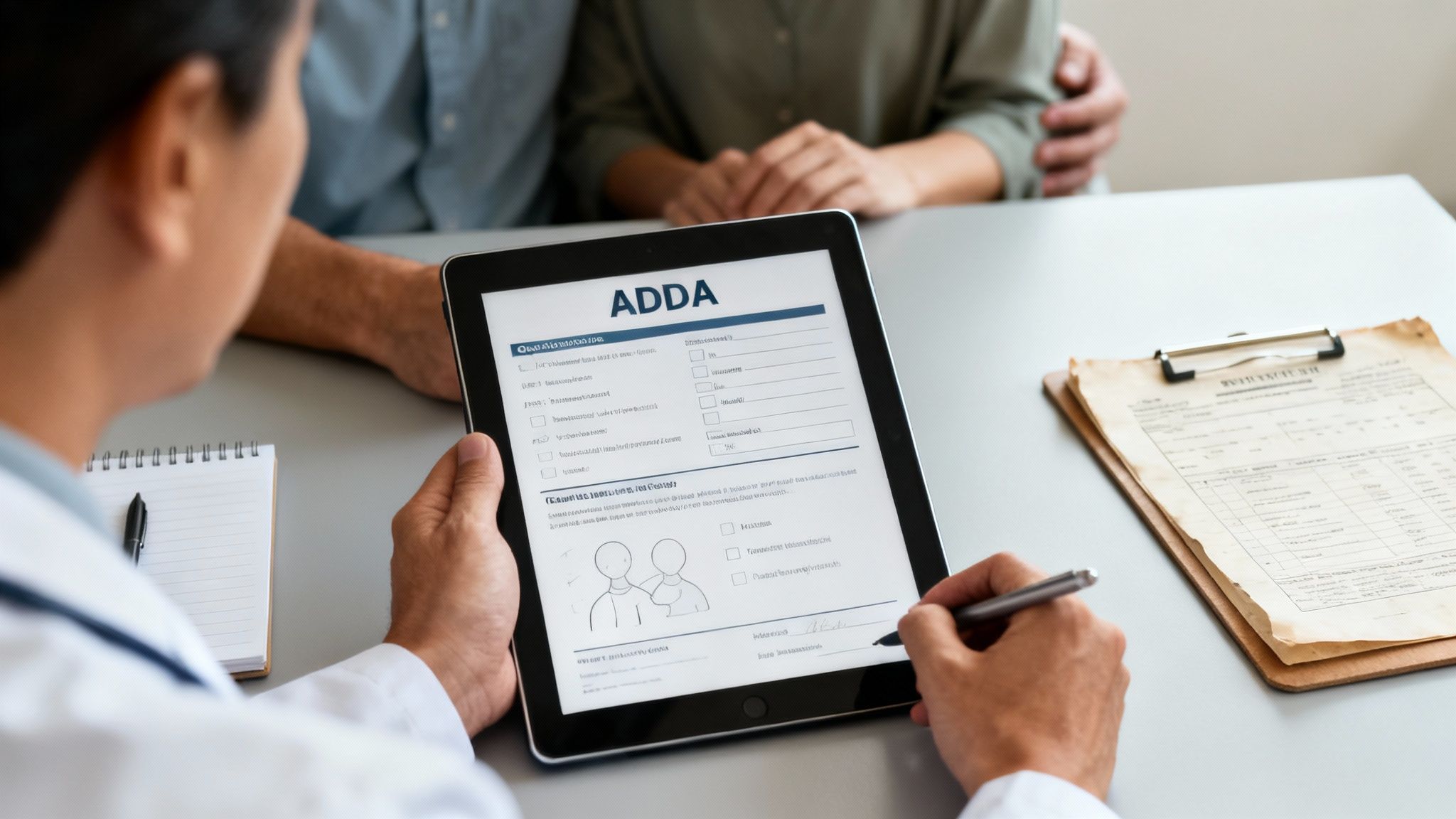
This post-diagnosis path generally focuses on two key areas: medication and specialised therapies.
Exploring Medication and the Titration Process
For many people, medication can be a game-changer. It’s not a magic cure, but it’s an incredibly effective tool for dialling down the noise, improving focus, and managing impulsivity. Finding the right medication and the right dose, however, isn't an overnight thing. It’s a careful, collaborative process.
This is called titration. You can think of it like tuning an old radio to find a clear station. Your clinician will start you on a very low dose and then, over several weeks or even months, gradually increase it. You'll have regular check-ins to talk about how you’re feeling, what’s working, and any side effects, until you hit that sweet spot—the dose that gives you the best results with the fewest downsides.
Patience is key here. It can take a good few months to get this right for your unique brain chemistry, but it's well worth the effort.
Beyond Medication: Therapies and Practical Strategies
ADHD management is about so much more than medication. Building a toolkit of practical strategies and skills is just as crucial for thriving in the long run. Many people find that support tailored specifically to the ADHD way of thinking makes a massive difference.
Some of the most popular and effective options include:
- ADHD Coaching: This isn't therapy; it's practical, forward-looking support. A coach helps you create systems for things like organisation, time management, and tackling procrastination—all designed to work with your brain, not against it.
- Cognitive Behavioural Therapy (CBT) for ADHD: This is a specialised form of CBT. It’s adapted to target the specific thought patterns and emotional hurdles common with ADHD, like rejection sensitivity, low self-esteem, and emotional dysregulation.
A diagnosis is the key that unlocks a new level of self-understanding. The most powerful approach often involves combining medication with coaching or therapy, which tackles both the biological and behavioural sides of ADHD.
Workplace Adjustments and Finding Your Community
Your diagnosis also has practical, legal implications. Under the Equality Act 2010, ADHD is recognised as a disability, meaning you have the right to ask for reasonable adjustments at work. This could be anything from noise-cancelling headphones to a quieter desk, flexible hours, or software that helps with organisation.
Finally, don't underestimate the power of connection. Finding an ADHD community, whether it's an online forum or a local group, can be invaluable. It's a space where you can share stories, get tips, and just feel understood by people who get it. Learning more about the day-to-day realities of living with ADHD helps you feel less alone and more confident as you move forward.
Common Questions About ADHD Assessments in the UK

It’s completely normal to have a lot of practical questions when you’re figuring out how to get an ADHD assessment. Let’s clear up some of the most common things people ask.
Can I Get an ADHD Assessment Online in the UK?
Absolutely. Getting a full ADHD assessment remotely is now very common and just as valid as seeing someone face-to-face. Many private clinics and Right to Choose services offer appointments via secure video calls, which can be a game-changer for flexibility.
This is a brilliant option if you live somewhere remote, have mobility issues, or simply find it easier to manage appointments from home. As long as the provider is properly regulated (for example, by the CQC in England), an online diagnosis is fully recognised.
What Is a Shared Care Agreement and Will My GP Accept One?
Think of a Shared Care Agreement (SCA) as a handover document. It’s a formal plan set up between your private ADHD specialist and your NHS GP. Once you’re settled on a stable dose of medication, the SCA allows your GP to take over writing your prescriptions.
The huge benefit here is that you’ll only pay the standard NHS prescription charge, which massively cuts down your monthly costs.
Crucially, GPs are not required to accept a Shared Care Agreement. Their decision often comes down to local NHS trust policies and whether they are familiar with and trust the private clinic. It’s always a good idea to have a chat with your GP about this before you book a private assessment.
Do I Need Old School Reports for an Adult ADHD Assessment?
They are helpful, but not essential. ADHD is a lifelong condition, so symptoms must have been present in childhood for a diagnosis to be made. Old school reports with teacher comments about you being "daydreamy," "disruptive," or "unable to focus" can provide fantastic evidence.
But please don't panic if you can't find them! A good clinician is skilled at building that picture in other ways. They’ll ask you detailed questions about your childhood and might ask to speak to a parent, older sibling, or someone who knew you well back then.
Finding the right path to an assessment can feel overwhelming, but you're not on your own. At ADHD Private, we've built a free directory to help you compare over 85 private ADHD clinics across the UK. You can see transparent pricing, current wait times, and the services they offer, all in one place. To start your search and find the right fit for you, visit us at https://adhdprivate.co.uk.