UK ADHD Test Online: Guide to Faster Diagnosis and Support
Explore UK ADHD test options online, including private assessments, costs, NHS Right to Choose, and tips for selecting a reputable clinic.
If you’ve found yourself searching for an ADHD test online, let’s get straight to the point. Those quick online quizzes can be a useful first step for personal insight, but they are not a medical diagnosis. A proper, formal 'online ADHD test' is a full clinical assessment, carried out over a video call with a qualified psychiatrist or specialist nurse.
Understanding the Online ADHD Test in the UK

The idea of getting a diagnosis from your living room might feel a bit strange, but it's becoming a well-established and essential option here in the UK. This isn't just about making life easier; it's a direct response to a healthcare system under enormous strain.
NHS waiting lists for in-person ADHD assessments can stretch on for years. For adults juggling careers, relationships, and their own mental health, that kind of delay can feel impossible.
When people talk about an "ADHD test online," they usually mean one of two very different things. Getting clear on this difference is your first, most important step.
Screeners vs Clinical Assessments
It’s easy to get confused between a quick online quiz and a proper clinical assessment. Let’s break down exactly what sets them apart.
| Feature | Informal Online Quiz | Formal Clinical Assessment |
|---|---|---|
| Purpose | Self-exploration and symptom awareness. | To provide a formal medical diagnosis. |
| Conducted By | Yourself (automated questionnaire). | A GMC-registered psychiatrist or specialist nurse. |
| Format | Multiple-choice questions, often taking 5-10 minutes. | A 1-2 hour video consultation, plus detailed forms. |
| Accuracy | Not diagnostically accurate; high risk of false positives. | High degree of accuracy, following NICE guidelines. |
| Outcome | A score suggesting you might have traits of ADHD. | A definitive diagnosis (or ruling out of ADHD). |
| Next Steps | Suggests speaking to a GP or specialist. | A full report, treatment plan, and medication options. |
Think of it this way: a screener is like using a weather app on your phone—it gives you a general idea of what's happening. A formal assessment is like getting a detailed forecast from a meteorologist who has analysed all the data. One is a helpful pointer, the other is an expert conclusion.
The Growing Need for Accessible Diagnosis
So, why does this matter so much? Because a huge number of people in the UK are living with undiagnosed ADHD, completely unaware of why they struggle with certain things.
It's estimated that around 2.5 million people in England have ADHD, but detailed analysis of 9 million GP records found that only 0.32% of people had a formal diagnosis. That means roughly 1 in 9 people with probable ADHD have actually been identified and given the support they need.
This is where reputable online clinics are making a real difference. They offer a legitimate way to get the answers you need, providing the same clinical rigour as an in-person appointment but without the years-long wait.
These services connect you with certified specialists for a thorough evaluation over secure video calls, making a diagnosis possible no matter where you are in the country. If you want a starting point for your own reflection, you can take a preliminary free ADHD test to see how your experiences line up with common ADHD traits before seeking a professional opinion.
What Actually Happens in a Proper Online ADHD Assessment?
The thought of a formal ADHD assessment can feel a bit daunting, but it's important to know what you’re walking into. This isn't a quick quiz or a single test you can pass or fail. Think of it more like a skilled detective piecing together a puzzle – your puzzle. The goal is to build a complete picture of you, looking for a consistent pattern of ADHD traits that have been part of your story since childhood and continue to affect you today.
An online assessment isn't a watered-down version of the real thing. It's just as rigorous as meeting a specialist in person and follows the exact same clinical guidelines set out by NICE (the National Institute for Health and Care Excellence). It's a multi-step process, designed to ensure that any diagnosis is built on a solid foundation of carefully considered evidence.
Stage 1: The Pre-Assessment Paperwork
Your assessment journey actually starts well before you ever speak to a clinician. After you've made contact with a clinic, they'll send over a detailed set of pre-assessment forms. This isn't just admin; it’s the groundwork for your entire evaluation.
You’ll be asked to fill out standardised screening questionnaires, and often they'll ask a parent or partner to complete one too. A very common one you’ll likely see is the Adult ADHD Self-Report Scale (ASRS), which was developed with the World Health Organisation. It asks very specific questions about how things like inattention, hyperactivity, and impulsivity show up in your day-to-day life.
Beyond the questionnaires, you'll dive into your personal history. Be prepared to share details about:
- Your School Days: What did your old school reports say? Did teachers ever comment that you were disruptive, a daydreamer, or just couldn't seem to get organised?
- Your Career Path: Have you jumped between jobs a lot? Do deadlines feel impossible? Is the typical office environment a nightmare for your concentration?
- Life at Home: What are the biggest hurdles you face with home organisation, managing money, or keeping your emotions in check?
- Your Health History: It's vital to be open about any previous mental or physical health diagnoses or treatments, as this all adds to the clinical picture.
All this information gives your clinician a huge head start, providing a rich context to work from before your video call even begins.
Stage 2: The Main Event – The Clinical Interview
This is the heart of the assessment: a video consultation that usually lasts between 60 and 90 minutes. You'll be speaking with a specialist – typically a GMC-registered psychiatrist or a specialist nurse practitioner who lives and breathes adult ADHD diagnosis.
They'll use the forms you filled out as a launchpad for the conversation, asking more questions to dig deeper into your experiences. The whole point is to create a supportive, non-judgemental space where you can talk openly about the challenges you've faced throughout your life.
The clinician's job here is to look for clear evidence of persistent difficulties in at least two major areas of your life (like work and home), which started before you were 12 years old. This is a key part of the official diagnostic criteria.
Stage 3: Backing It All Up with Evidence
A reliable ADHD diagnosis can't be based on your account alone. To make sure the traits aren't just a recent thing, clinicians need what’s called collateral information – basically, evidence from someone else that supports what you've described.
This supporting evidence could be:
- A questionnaire filled out by a parent, an older sibling, or a long-term partner who has known you for years.
- A look through old school reports for any revealing comments about your attention or behaviour.
- A discussion about feedback from past jobs or performance reviews.
Some clinics take this a step further by using an objective computerised test, like the QbTest. This isn't a diagnostic tool on its own, but it provides hard data by measuring your attention, impulsivity, and movement in real-time. It’s one more piece of the puzzle that helps confirm what the clinician observes and what you've reported, making the final diagnosis as accurate and dependable as possible.
Navigating Your Assessment Pathway: NHS vs Private
So, you’ve decided to seek a formal ADHD diagnosis in the UK. This is a big step, and you’ll quickly find yourself at a crossroads with a few different paths you can take. Broadly, you have the NHS route and the private option, but there's also a clever middle ground. Understanding how each works is key to choosing the right one for your situation, budget, and how urgently you need answers.
Think of it like planning a journey. The standard NHS pathway is like the public bus – it's free to use and will get you there eventually, but the timetable can be painfully slow and unpredictable. The fully private route is like hailing a taxi – it’s direct, fast, and works around your schedule, but you’ll be paying the fare yourself.
The Standard NHS Pathway and Its Challenges
The most common starting point for an ADHD assessment is a chat with your GP. If they agree your symptoms warrant a closer look, they'll refer you to your local NHS adult ADHD service for a proper evaluation. On paper, this sounds straightforward and, of course, it's funded by the NHS.
The reality, however, can be quite different. NHS waiting lists for ADHD assessments have become a real problem. Demand has completely overwhelmed the available services, creating a staggering backlog. Right now, over 549,000 children and adults in England are stuck in these queues. It's not uncommon for people to wait anywhere between two to five years just for an initial appointment. This has understandably pushed more and more people towards private options, with over one in five ADHD medication prescriptions now coming from private clinics.
This diagram shows the typical steps you'd go through in a comprehensive online assessment, from initial history-taking to the final diagnostic report.
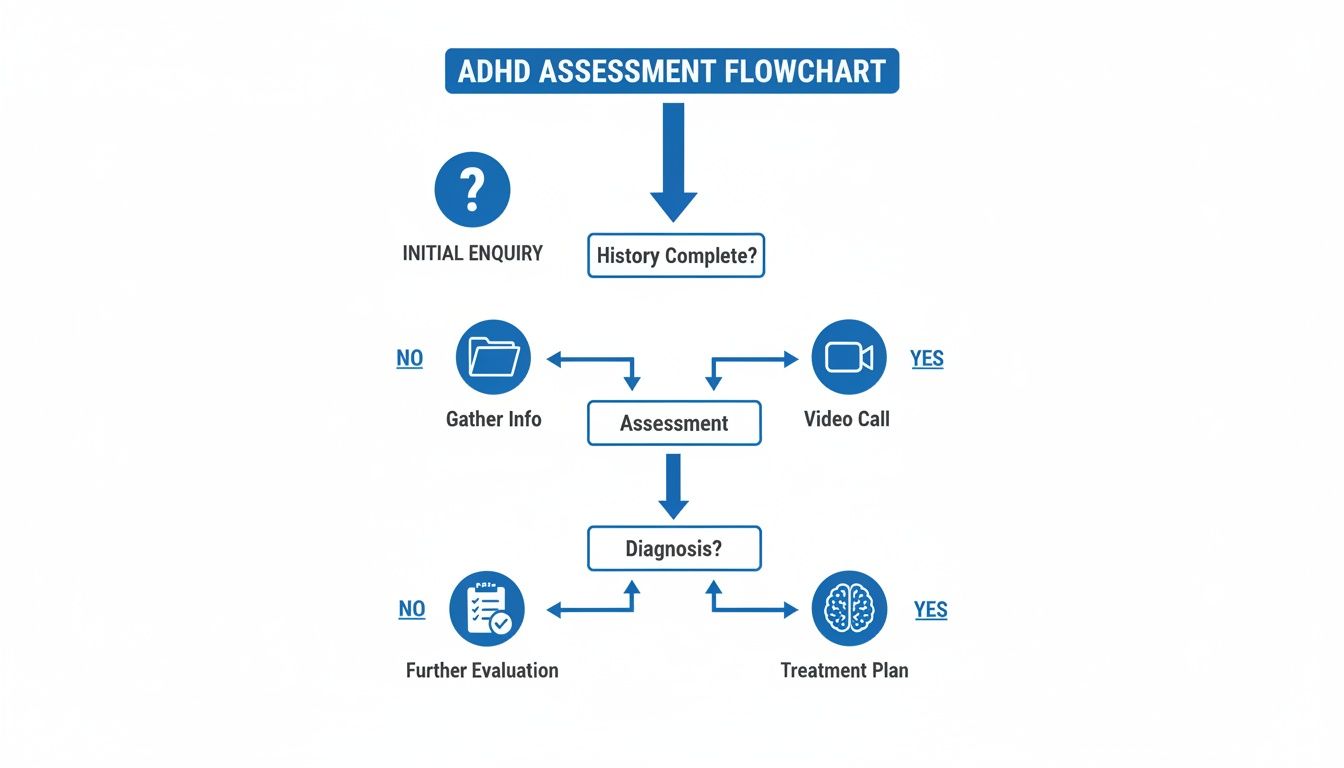
As you can see, a proper assessment is a structured process designed to gather all the necessary information before a clinician can make an accurate diagnosis.
A Hybrid Solution: NHS Right to Choose
Thankfully, for those living in England, there's a fantastic middle-ground option called NHS Right to Choose (RTC). This is a patient right that lets you choose a CQC-registered private provider for your ADHD assessment, and the NHS foots the bill. Think of it as the NHS giving you a voucher to book a faster, private minibus because the public bus is out of action for the foreseeable future.
To use RTC, you need your GP to refer you to a private clinic that's set up to accept these referrals. While it’s not an overnight solution, the wait times are usually much, much shorter than the standard NHS route – you’re typically looking at months instead of years. This makes it a brilliant option if you can't afford to go fully private but can't face a multi-year wait. You can learn more about the whole process in our detailed guide to the ADHD assessment UK process.
The Fully Private Pathway
Your third option is to go fully private from start to finish. This is, without a doubt, the fastest way to get an online ADHD test. You can often get an assessment booked within a few weeks. You simply bypass the NHS system altogether, contact a private clinic directly, and pay for the service yourself.
This is the "private speedboat" option – it offers the ultimate speed and convenience but comes at a price. You'll need to cover the cost of the assessment itself, any follow-up appointments, and the private prescriptions for medication until you can potentially arrange a 'shared care' agreement with your GP.
Comparing ADHD Assessment Routes in the UK
To make things clearer, here’s a quick summary of how the three main pathways stack up against each other.
| Pathway Feature | Standard NHS | NHS Right to Choose | Fully Private |
|---|---|---|---|
| Cost | Free (funded by NHS) | Free (funded by NHS) | Self-funded (£1000+) |
| Wait Time | Extremely long (2-5+ years) | Moderate (months) | Very short (weeks) |
| Availability | UK-wide | England only | UK-wide |
| Referral Needed | Yes, from GP | Yes, from GP | No, can self-refer |
| Choice of Provider | Limited to local NHS service | Choice of approved providers | Full choice of private clinics |
Ultimately, choosing the right path comes down to weighing up what matters most to you. Is it cost, speed, or location? Each route has its own distinct advantages and disadvantages.
How to Choose a Reputable Online ADHD Clinic
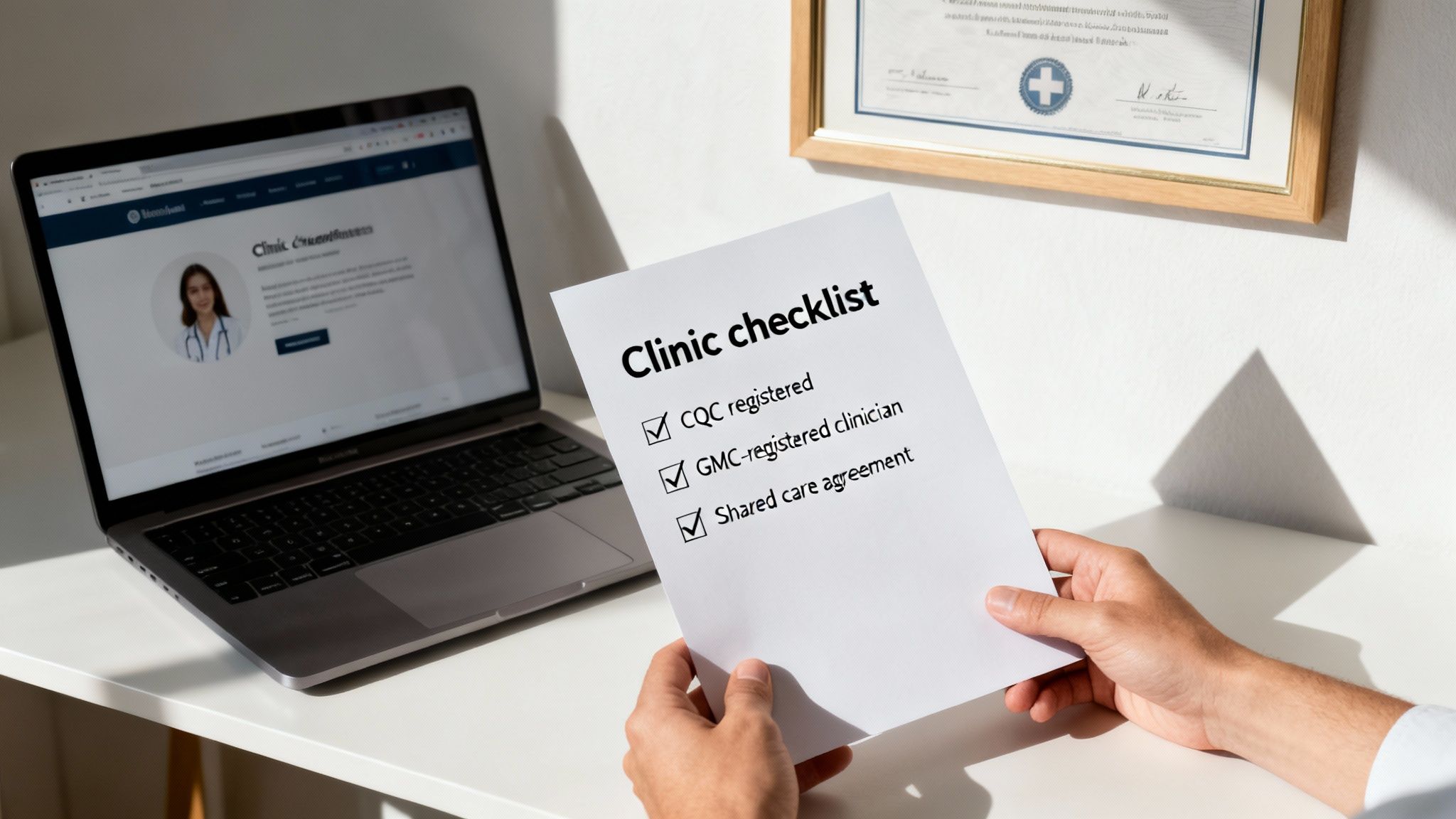
The huge demand for a timely online ADHD test has caused a boom in private clinics. That's great for choice, but it also means you have to be careful – they are definitely not all the same. Working out which ones are legitimate can feel like a challenge in itself, but a few simple checks can help you find a trustworthy, professional service that puts your health first.
Making the right choice isn't just about finding the shortest queue. It's about making sure the diagnosis and any treatment plan you receive will be recognised and respected by other healthcare professionals, especially your GP. Think of it as doing your homework on a major life decision—because that's exactly what it is.
A good clinic will be upfront about everything, professionally regulated, and clear about its processes from the get-go. Taking a bit of time to check these details will give you peace of mind and protect you from unprofessional services that could do more harm than good.
First Things First: Check for Official Regulation
This is the big one. Your first and most important check is to see if the clinic is officially registered with the correct UK healthcare regulator. This is a non-negotiable step and your main guarantee of quality and safety.
For clinics in England, they must be registered with the Care Quality Commission (CQC). The CQC is the independent body that inspects all health and social care services. Their reports give you an unbiased look at whether a clinic is safe, effective, and properly managed. You can pop onto the CQC website and search for any provider to check their status. It’s that easy.
If the clinic is based elsewhere in the UK, look for their equivalent regulator:
- Scotland: Healthcare Improvement Scotland (HIS)
- Wales: Healthcare Inspectorate Wales (HIW)
- Northern Ireland: The Regulation and Quality Improvement Authority (RQIA)
A clinic not being registered with the right national regulator is a massive red flag. Good clinics are proud of their registration and usually display it clearly on their website. It shows they’re committed to high standards.
Who Are the Clinicians? Verify Their Credentials
Next, you need to know who, exactly, will be assessing you. A proper ADHD diagnosis can only be made by a qualified specialist.
You’re looking for clinics with teams made up of:
- Consultant Psychiatrists: These are medical doctors with specialist training in psychiatry. You can check their credentials on the General Medical Council (GMC) register.
- Specialist ADHD Nurses: Many highly skilled and experienced nurses specialise in ADHD and are qualified to diagnose and prescribe. They should be registered with the Nursing and Midwifery Council (NMC).
If a clinic is vague about its team or their qualifications, be wary. Transparency is the hallmark of a professional outfit.
The Million-Dollar Question: What’s Their Shared Care Policy?
This is a really important point that has huge long-term financial implications. A shared care agreement is a formal deal between your private specialist and your NHS GP. It allows your GP to take over prescribing your ADHD medication, which means you can get repeat prescriptions through the NHS instead of paying privately.
Before you book anything, you must ask the clinic about their policy on shared care. A good clinic will actively support this and have a proper process in place. They know it’s essential for making long-term treatment affordable.
If a clinic seems hesitant, dismissive, or woolly about shared care agreements, treat it as a serious warning sign. Without one, you could be stuck paying for expensive private prescriptions forever.
Last but Not Least: Scrutinise Reviews and Pricing
Finally, it’s time to see what other people are saying and get a crystal-clear idea of the total cost.
- Read Patient Reviews: Don't just rely on the testimonials they post on their own site. Look for reviews on independent platforms like Google and Trustpilot. While one person's experience might be an outlier, a consistent pattern of glowing reports or complaints tells you a lot.
- Demand Transparent Pricing: A reputable clinic will have a clear, itemised price list on its website. Make sure you understand the full cost, including the assessment, any follow-ups, and private prescription fees while your medication is being adjusted (the 'titration' period). Hidden fees are a classic sign of a dodgy operator.
By methodically checking these four areas—regulation, credentials, shared care, and transparency—you can choose a high-quality online clinic with confidence and get your journey off to the best possible start.
Breaking Down the Full Cost of a Private Diagnosis
When you decide to get an ADHD test online through a private clinic, the headline price for the assessment is only part of the story. It’s crucial to get a clear picture of the entire financial journey, from that first consultation right through to ongoing treatment, so you don't get caught out by unexpected costs later on.
Think of it as planning a trip. The initial assessment is your flight ticket – the biggest single cost to get you there. But you also need to account for the hotel (finding the right medication) and your spending money (the ongoing cost of prescriptions). A good clinic will be upfront about all this, but knowing what to ask is key.
Phase One: The Initial Assessment
This is the most straightforward part of the cost. A full diagnostic assessment with a specialist psychiatrist or nurse prescriber will typically set you back somewhere between £700 and £1,200. This is a one-off payment that covers the detailed forms you fill out beforehand, the in-depth clinical interview itself (usually done via video call), and the comprehensive diagnostic report you get at the end.
That report is incredibly important. It’s the official document that will confirm if you meet the diagnostic criteria for ADHD and lay out a clear, personalised plan for what to do next. To get a better sense of what’s involved, it's worth looking into what a private ADHD assessment actually includes.
Phase Two: Medication Titration
If you are diagnosed with ADHD and decide that medication is a path you want to explore, you’ll move into what’s called the titration period. This is simply the careful, methodical process of finding the right medication and the right dose for you. Your clinician will start you on a low dose and slowly adjust it over time, keeping a close eye on how you're feeling to maximise the benefits and minimise any side effects.
This stage comes with its own set of costs, which can add up quickly:
- Follow-Up Consultations: You’ll have regular check-ins with your specialist during this time, which usually cost between £150 and £300 a session.
- Private Prescription Fees: Each time the clinic issues a prescription, there’s often an admin fee of around £30 to £50.
- The Medication Itself: You'll be paying the full private price for the medication at the pharmacy, which can range from £80 to £150 per month.
Titration usually takes anywhere from four to twelve weeks, so it’s really important to factor these recurring monthly costs into your budget from the start.
Phase Three: Ongoing Treatment and Shared Care
Once you and your specialist have found a stable and effective medication plan, the aim for most people is to switch the prescribing over to the NHS. This happens through something called a shared care agreement – a formal arrangement where your GP agrees to take over issuing your prescriptions based on the specialist's guidance.
A successful shared care agreement is the key to making long-term ADHD treatment affordable. It moves your prescription costs from the private rate to the standard NHS prescription charge, a significant saving.
The demand for ADHD support has soared recently. In fact, ADHD prescriptions in the UK have gone up by 18% every year since the pandemic began. With NHS waiting lists so long, private clinics are now handling over 20% of these medications. This has made the world of online ADHD tests a busy and sometimes confusing place, as detailed in this clinician's guide to ADHD in 2025.
Before you sign up with any online clinic, make sure you ask them directly about their process and success rate for getting shared care agreements in place. A trustworthy provider will see this as a standard, vital part of their service, not an optional extra. They should be focused on helping you manage the costs for the long haul.
Your Action Plan for Seeking an ADHD Assessment
Figuring out the next steps for an ADHD assessment can feel overwhelming, but breaking it down into a clear plan makes all the difference. Hopefully, you can now see the huge gap between a simple online quiz and a proper, structured clinical ADHD test online.
The single most important thing? Making sure you choose a reputable, properly regulated provider. Let's pull everything together into a simple checklist to help you move forward with confidence.
Your Step-by-Step Guide
A bit of prep work goes a long way. Getting your thoughts and information in order before you speak to your GP or a clinic will make the whole process feel much smoother and more productive.
Prepare for Your GP: Before you go, jot down your main symptoms. Think of specific, real-life examples of how they affect you at work, at home, and in your relationships. This gives your GP a much clearer picture than just saying "I struggle to focus."
Gather Your History: Your clinician will be looking for evidence that these traits have been with you for life. Try to dig out old school reports or performance reviews. It's also incredibly helpful to ask a parent, an older sibling, or a long-term partner for their honest take on your lifelong patterns. This "collateral information" is gold dust for an accurate diagnosis.
Research Clinics Thoroughly: Use trusted sources to find clinics that are CQC-registered (if you're in England). Make a shortlist of a few that are upfront about their pricing, their clinicians' qualifications, and how they handle shared care agreements with the NHS.
Create a List of Questions: Don’t be shy about interviewing potential clinics – you're the one making the choice. Get your questions ready so you can compare them like-for-like.
A few key questions to ask any clinic: "What are your total costs, including the titration period?" "What's your process for setting up a shared care agreement with my GP?" and "Are all of your clinicians registered with the GMC or NMC?"
Following these steps turns a confusing journey into a manageable project. You're now in a much better position to find the right support, whether you go down the NHS Right to Choose route or opt for a private online ADHD test. It's all about taking back control and getting the answers you need.
Got Questions About Online ADHD Tests? We’ve Got Answers.
It’s completely normal to have a few last-minute questions, even when you think you’ve got it all figured out. Getting assessed for ADHD is a big step, and you want to feel sure about it. So, let’s clear up some of the most common things people ask when they’re about to take the plunge.
Think of this as your final pre-flight check – we’ll run through the practical stuff that often comes to mind right before you book, making sure you feel ready and informed.
Is an Online ADHD Diagnosis Actually... Official?
This is probably the most important question on your mind, and the answer is a clear and simple yes – as long as you choose a properly regulated clinic. When a diagnosis is made by a qualified specialist (like a GMC-registered psychiatrist) during a video consultation, it carries the exact same weight as one given in a face-to-face appointment.
These clinics follow the same strict NICE guidelines that the NHS uses. This means your diagnosis should be recognised by your GP, your employer, and any educational institutions. The non-negotiable part is choosing a provider registered with the CQC (Care Quality Commission), as this is your guarantee that they meet official UK healthcare standards.
How Long Does This Whole Online Process Take, Really?
One of the main reasons people go private is speed, and the timeline is certainly much shorter than the NHS. Of course, every clinic has its own queue, but here’s a rough breakdown of what you can expect:
- Booking Your Slot: From the moment you first get in touch, you can often get an assessment booked within 2 to 8 weeks.
- The Assessment Day: The main clinical interview itself is usually done in one go and lasts about 90 minutes to 2 hours.
- Getting the Paperwork: You should have your comprehensive diagnostic report in your hands within 2 to 4 weeks after your assessment.
If medication is part of your plan, the next stage is titration – the process of finding the right medication and dose. This can add another 4 to 12 weeks. All in all, you could go from first enquiry to a stable treatment plan in just a few months.
Can I Get My Child Assessed for ADHD Online?
Yes, absolutely. Many private clinics specialise in assessments for children and teenagers. The core process is similar to the one for adults, but there’s a much greater focus on gathering information from parents and teachers to build a complete picture.
It's crucial to find a clinic that not only says they assess children but also has clinicians with genuine expertise in paediatric ADHD. The way ADHD presents in young people requires a specialist eye, so this isn't something to compromise on.
You’ll be asked to dig out old school reports and fill in detailed questionnaires about your child’s development and behaviour. The video call itself will usually involve both you and your child, allowing the clinician to observe and interact with them directly.
I Have a Diagnosis. What Happens Right Now?
That moment of getting a diagnosis can feel like a massive weight has been lifted. The first thing to do is sit down and really read through the diagnostic report. It will explain the clinical findings in detail and lay out a recommended plan for you.
Your next steps will usually look something like this:
- A Follow-Up Chat: You’ll have another appointment to go over the report with your clinician. This is your chance to ask anything and everything, and to decide together what comes next – whether that’s medication, therapy, or ADHD coaching.
- Starting Titration (If you choose medication): If you and your clinician decide medication is a good option, you’ll begin the titration process, managed carefully by the private clinic.
- Chatting with Your GP: Once your treatment is settled and working well, the clinic will guide you on how to arrange a 'shared care' agreement with your GP. This is the key step to getting your prescriptions on the NHS.
Remember, a diagnosis isn’t the end of the road. It’s the starting line for finally getting the support that works for your brain.
Trying to make sense of the private ADHD assessment world can feel overwhelming, but you're not on your own. At ADHD Private, we've created a free directory to help you compare over 85 CQC-registered clinics across the UK. You can check their real-time wait times, see what services they offer, and find the right provider for you. Start your search with confidence at https://adhdprivate.co.uk.