Your Guide to Finding a Free ADHD Test in the UK
Thinking about a free ADHD test? Our UK guide clarifies what online screeners are, how to find a reliable one, and your next steps for an official diagnosis.
Let's be clear from the start: a free online ADHD test is a screening tool, not a diagnosis. Think of it like a first-pass checklist before you see a specialist. It’s there to help you organise your thoughts and flag up patterns that suggest a professional evaluation might be a good idea.
What a Free ADHD Test Can and Cannot Do
If you’re typing "free ADHD test" into a search bar, you're probably trying to make sense of things you've noticed about yourself—maybe around focus, organisation, or a persistent feeling of restlessness. An online screener can be a fantastic starting point. It acts like a mirror, reflecting back patterns in your life that line up with common ADHD traits. It gives you a structured way to think about your experiences, helping to turn a vague sense of being "overwhelmed" or "different" into something more concrete.
But it's really important to know where these tools draw the line. An online test can’t see the whole you. It doesn't know your personal history, and it can't rule out other conditions that often look a lot like ADHD (such as anxiety, depression, or even sleep problems). Most importantly, it can't properly gauge how much these traits are actually affecting your day-to-day life.
The Screener's Real Job
A good quality screener is built to do one thing and one thing only: to give you an indication of the likelihood that you might have ADHD. Its entire purpose is to help you decide whether it's worth taking the next step and seeking a formal assessment from a qualified healthcare professional.
- What it can do: Help you recognise and put words to your symptoms using established criteria, like those found in the DSM-5.
- What it can do: Give you a bit of confidence to book that GP appointment, armed with specific examples instead of just a feeling that something’s not quite right.
- What it cannot do: Give you a medical diagnosis. Only a trained clinician can do that after a thorough, in-depth evaluation.
- What it cannot do: Get you access to treatment, medication, or any support you might need at work or university.
Here’s a good analogy: using a home blood pressure machine can tell you if your readings are high, but only a doctor can actually diagnose you with hypertension and figure out a treatment plan. A free ADHD test works in exactly the same way—it’s an indicator, not a diagnosis.
Keeping Your Expectations in Check
The trick is to approach any free ADHD test with the right mindset. See it as a tool for self-reflection and a way to prepare for a proper conversation. The results aren't a definitive label; they're just one more piece of information to help guide what you do next. A high score doesn't automatically mean you have ADHD, and equally, a low score doesn't mean you should ignore your concerns if they're still bothering you.
This guide is here to walk you through finding reliable screening tools, understanding what a real clinical diagnosis involves, and figuring out your next steps in the UK. We’ll cover both the NHS and private routes. Your journey started with a question, and a good screener is simply the first signpost on the road to getting clear answers.
Understanding Screeners Versus Clinical Diagnosis
If you're starting to explore whether you might have ADHD, you've probably come across countless free ADHD tests online. It can be a confusing landscape, so let’s get one thing clear right from the start: there’s a massive difference between a quick online screener and a formal clinical diagnosis.
Think of it this way. A free online test is a bit like a first-aid kit. It’s a great first step, a useful tool for a quick check-in when you're concerned about something. It can help you identify a potential issue based on common symptoms, but it’s not meant to give you the full picture.
A full clinical diagnosis, on the other hand, is like getting a complete check-up at a hospital with a specialist. It’s a detailed, multi-step process led by a healthcare professional who pieces together all the evidence to give you a definitive, accurate answer. This is the only way to get a recognised diagnosis that opens the door to proper support and treatment.
What an Online Screener Involves
Most good-quality online screeners are based on validated questionnaires, like the Adult ADHD Self-Report Scale (ASRS). The key thing to remember is that these tools are based entirely on what you report about yourself.
You'll be asked a series of questions about how often you struggle with things like inattention, hyperactivity, and impulsivity. The screener then adds up your answers and gives you a score, indicating whether your symptoms are consistent with common ADHD traits. It’s a snapshot in time, a starting point based purely on your own perception.
This flowchart shows how these two different things—a quick screener and a professional diagnosis—fit into the bigger picture.
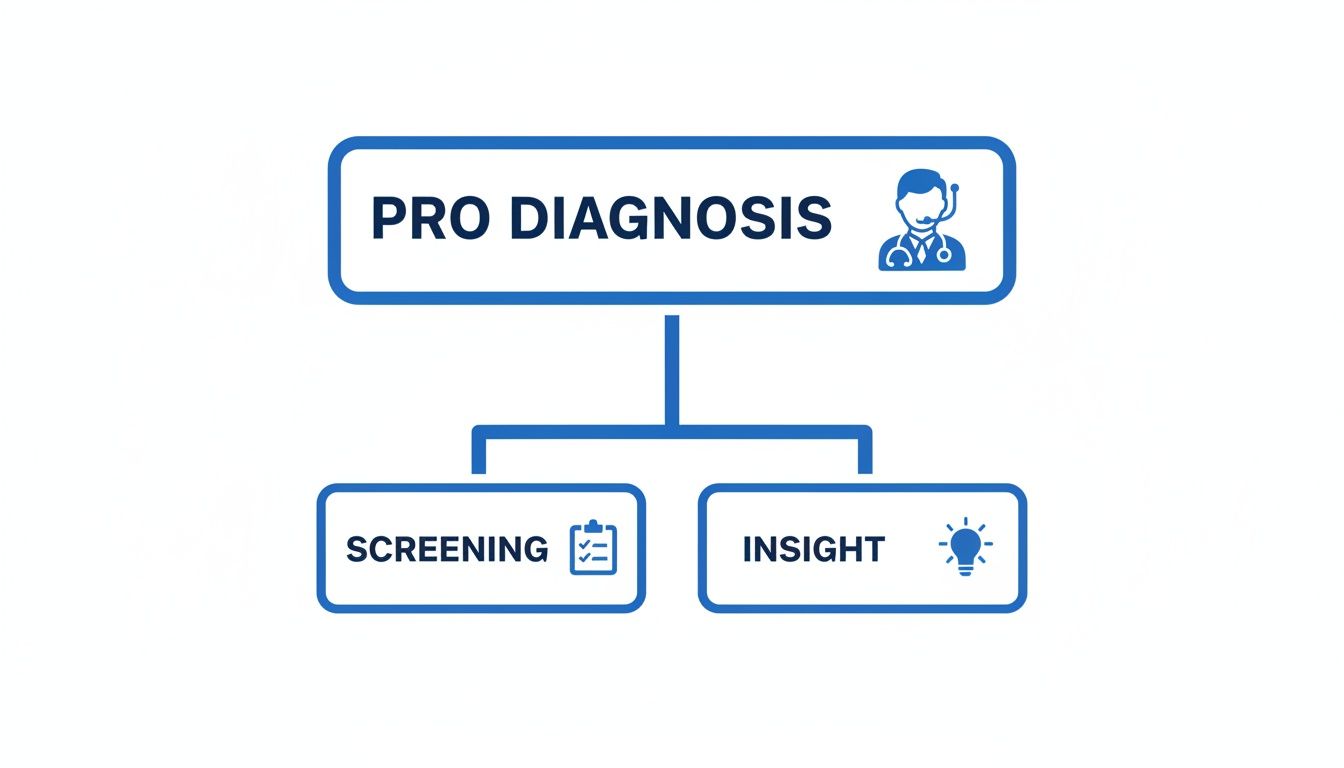
As you can see, a professional diagnosis is the whole journey. Screening is just the first, foundational step that helps you gain some personal insight before moving forward.
The Clinical Diagnosis Process Explained
A clinical diagnosis goes so much deeper than a simple questionnaire. It's a thorough investigation by a qualified psychiatrist or another specialist to build a complete picture of you as a whole person. This is crucial because many other conditions—like anxiety, depression, or even trauma—can have symptoms that look a lot like ADHD.
The process is deliberately rigorous to make sure the final conclusion is as accurate and reliable as possible.
Here’s a look at what a proper assessment usually includes:
- Structured Clinical Interviews: The clinician will have an in-depth chat with you about your current struggles, asking specific questions to understand how symptoms impact your work, relationships, and day-to-day life.
- Developmental History Review: They'll want to hear your life story, often going right back to your childhood and school days. This helps them look for lifelong patterns of behaviour that are consistent with ADHD.
- Gathering External Input: With your permission, the clinician might ask to speak with a partner, parent, or close friend. For children and teenagers, getting feedback from teachers is essential.
- Ruling Out Other Conditions: A huge part of the assessment is what's called a differential diagnosis. This means the clinician carefully considers and rules out other possible causes for your symptoms.
This in-depth approach is exactly why a score from a free online test can never replace a formal, professional evaluation.
Let's break down the differences side-by-side.
ADHD Screener vs Clinical Diagnosis at a Glance
| Feature | Free Online ADHD Screener | Professional Clinical Diagnosis |
|---|---|---|
| Purpose | Initial self-assessment to see if symptoms align with ADHD. | To provide a definitive, medically-recognised diagnosis. |
| Who Conducts It | You. It's a self-report tool. | A qualified healthcare professional (e.g., psychiatrist, psychologist). |
| Process | Answering a standardised online questionnaire. | Clinical interviews, developmental history, external input, ruling out other conditions. |
| Time Investment | Typically 5-15 minutes. | Several hours, often spread across multiple appointments. |
| Cost | Usually free. | Varies (NHS or private fees). |
| Outcome | An informal score indicating a low, medium, or high likelihood. | A formal diagnostic report, treatment plan, and access to support. |
| Can it Diagnose ADHD? | No. | Yes. |
This table really highlights that screeners and diagnoses are two completely different tools serving two very different purposes.
The growing awareness of ADHD in the UK has led to a huge number of people seeking answers. It's estimated that around 2.5 million people in England live with ADHD, but many have never been diagnosed. While 5.8% of adults think they might have the condition, only 1.8% actually have a formal diagnosis. That's a huge gap, and screeners can be a valuable first step in closing it.
A Key Takeaway: An online screener is a signpost, not a destination. It points you in a helpful direction, but a clinical assessment is the journey you need to take to get a real answer and access to care.
Ultimately, understanding the difference empowers you to use these tools for what they are. A screener is a brilliant way to organise your thoughts and prepare for a more productive conversation with your GP or a specialist. If you're ready to take that next step, it's worth learning more about what a comprehensive ADHD assessment in the UK actually involves.
How to Find a Reliable Free ADHD Screening Tool
Searching for a free ADHD test online can feel like trying to find a needle in a haystack. There are countless quizzes and self-assessments out there, but how do you sort the genuinely helpful tools from the digital noise? The secret is knowing what to look for and, crucially, what to avoid.
Let's be clear: not all online screeners are created equal. A reliable one isn't just a random list of questions. It's a carefully designed questionnaire that mirrors the official criteria clinicians use, giving you a helpful first signal—not a final answer.
The Gold Standard: Validated Screening Tools
The most trustworthy screening tools come from reputable health organisations and are built on established diagnostic criteria. The one you'll see mentioned most often, and for good reason, is the Adult ADHD Self-Report Scale (ASRS-v1.1). It was created in partnership with the World Health Organization (WHO) and is widely respected.
In fact, the ASRS is so well-regarded that many GPs and specialist clinicians use it as the very first step in their assessment process. It's a quick, effective way to see if an adult's symptoms might line up with ADHD, helping to point them towards a full evaluation.
Here's a glimpse of what the Adult ADHD Self-Report Scale (ASRS) looks like in practice.
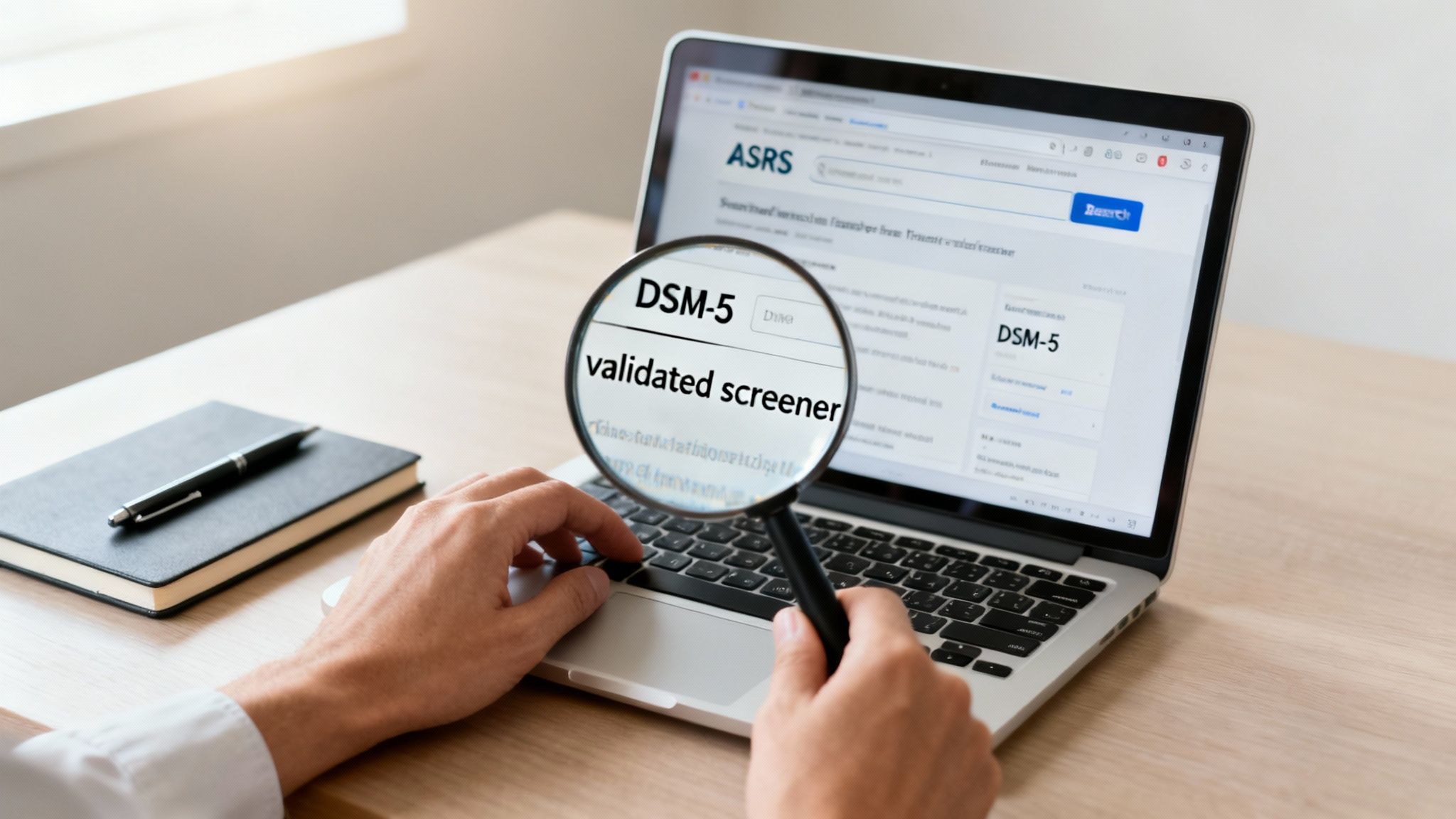
As you can see, the questions are tied directly to real-life challenges—things like finishing the final details of a project or getting sidetracked by things happening around you. This isn't random; it reflects the official DSM diagnostic criteria.
Any credible free ADHD test will be completely transparent. It should state clearly that it is a screening tool, not a diagnostic one. This honesty is the hallmark of a resource designed to genuinely help, not mislead you.
What Makes a Screener Reliable?
When you’re looking at an online test, a few key things signal quality and reliability. Think of this as your personal checklist for finding a tool you can trust.
A trustworthy screener should be:
- Based on Official Criteria: The questions need to align with the diagnostic standards set out in the DSM-5 (Diagnostic and Statistical Manual of Mental Disorders, 5th Edition) or the ICD-11 (International Classification of Diseases, 11th Revision). These are the official handbooks clinicians use.
- Developed by Experts: Look for tools created by recognised mental health organisations, universities, or clinical research groups. A screener from a well-known psychiatric body carries a lot more weight than one from an anonymous website.
- Transparent and Genuinely Free: The tool should be upfront about being a screener and never ask for payment. Its purpose is to give you information, not to sell you something disguised as a "result."
Remember this: The goal of a good screener is to empower you with information. It’s there to help you organise your thoughts and have a more productive conversation with a healthcare professional, not to replace one.
Red Flags: How to Spot a Low-Quality Test
Just as there are signs of a good screener, there are also clear red flags that a test might be unreliable or even predatory. Knowing what to watch out for is vital for protecting yourself from misinformation and needless worry.
Be very cautious if a free ADHD test you find online does any of the following:
- Guarantees a Diagnosis: This is the biggest red flag of all. No online quiz can diagnose a complex neurodevelopmental condition. If a site claims its test provides a definitive diagnosis, it’s making a false and unethical promise.
- Charges for Results: Some websites let you take a "free" test, only to hit you with a paywall to see your score. This is a sneaky marketing tactic, not a legitimate health service. Credible screeners like the ASRS are always free.
- Lacks Transparency: Can't find any information on who created the test or what criteria it's based on? It’s best to steer clear. Reputable tools are proud of their scientific foundation and make that information easy to find.
- Asks for Too Much Personal Information: An email address to send results is one thing, but be wary of any site that demands overly personal or sensitive data that isn't required for the screening itself.
Finding a dependable screener is all about being an informed user. By choosing tools based on established clinical criteria and learning to spot the red flags, you can feel confident that the insights you get are a genuine and helpful first step.
Your Next Steps After Taking an ADHD Screener
So, you’ve taken a free ADHD test, and the results suggest you might have it. That can be a huge moment. For some, it’s a wave of relief and validation; for others, it's confusing or even a bit scary. Whatever you're feeling, the most important thing to remember is that a screener isn't a diagnosis. Think of it as a signpost, pointing you towards the next step: getting a proper, professional opinion.
Here’s your practical guide to what to do next in the UK.

For most of us, the journey starts with booking an appointment with our GP. They’re the main gateway to an NHS assessment. But just turning up and saying, "I think I have ADHD," might not get you very far. To have a really productive conversation and show you’ve thought it through, it pays to be prepared.
Before you go, try to:
- Document Your Symptoms: Jot down real-life examples of how you think ADHD is affecting you. Think about your job, your relationships, managing money, or just keeping the house in order. The more specific, the better.
- Bring Your Screener Results: Have the results from the online test ready on your phone or printed out. Make it clear you know it’s not a diagnosis, but that it’s what prompted you to come in.
- Think About Your Past: ADHD is something you’re born with, so try to recall examples from your childhood. Were you always told you were a daydreamer, disruptive, or not living up to your potential at school?
Navigating the NHS Pathway
If your GP agrees that an assessment is the right next step, they’ll refer you to your local NHS mental health service. And this, unfortunately, is where many people hit a wall. The demand for ADHD assessments has exploded in the UK, creating enormous backlogs.
It's estimated that over 549,000 children and adults in England are currently stuck on a waiting list for an evaluation. The problem has been brewing for years, thanks to chronic under-diagnosis. While experts believe 3-4% of adults have ADHD, a staggering 0.32% actually have it on their GP records, leaving millions of people struggling without the right support.
The tough reality is that an NHS waiting list can mean a delay of several years. For many people, waiting that long just isn't an option. Luckily, if you live in England, you have another route.
Understanding Your Right to Choose
If you're registered with a GP in England, you have a legal right under the NHS Constitution called Right to Choose. This is a powerful tool that allows you to decide where you receive your NHS-funded assessment and treatment.
Right to Choose gives you the power to select a qualified private provider to carry out your ADHD assessment, fully funded by the NHS. It means you can often skip the long local waiting lists and get assessed much faster, without paying a penny.
This isn't the same as going completely private. The assessment is still paid for by the NHS; it's just delivered by a private clinic that has been approved to provide these services.
How Right to Choose Works in Practice
The process is more straightforward than it sounds, but it does require you to be a little proactive.
- Research Providers: Your first job is to find a private clinic that accepts Right to Choose referrals for ADHD. They must be registered with the CQC and offer the specific service you need.
- Book a GP Appointment: Chat with your GP about your concerns, just as you would normally. Then, tell them you want to exercise your Right to Choose.
- Provide the Details: Your GP might not be an expert on this, so it helps to be prepared. Most clinics that accept Right to Choose have template letters on their websites that you can print and take with you. These explain the process to your doctor.
- Referral is Sent: Your GP then sends the referral letter directly to the private provider you’ve chosen, instead of to your local NHS service.
- Assessment Takes Place: The private clinic will get in touch with you to book your assessment, just as the NHS would have.
Right to Choose is a genuine game-changer. It takes the uncertainty of "what now?" and turns it into a clear, actionable plan that puts you back in the driver's seat of your healthcare.
While a free ADHD test for adults is an excellent first step, understanding your rights is the crucial next one.
Navigating Private ADHD Assessment Options
Let's be honest, the NHS waiting times for an ADHD assessment can feel impossibly long. For many, this frustrating reality is what pushes them to look into private healthcare. Going private can certainly get you answers much faster, but it’s a path that requires a bit of careful navigation to make sure you find a provider who is reputable and properly qualified.
Choosing to go private isn't just about paying for a quicker service; it's an investment in a proper clinical evaluation. The last thing you want is to pay for a cheap or rushed assessment from a questionable clinic, only to find the diagnosis isn't recognised by your GP or your university. That puts you right back where you started, but out of pocket.
With so many private clinics out there, it’s easy to feel overwhelmed and unsure who to trust. It really helps to have a clear idea of what you’re looking for before you begin your search. This way, you can be confident you’re getting a high-quality, comprehensive assessment that everyone will take seriously.
What to Look for in a Private Clinic
When you're sifting through different providers, there are a few non-negotiable standards that separate the good clinics from the rest. Think of this as your personal checklist to protect your time, money, and well-being. A trustworthy clinic will always be upfront about its credentials and how it works.
Your first port of call should always be official registration.
- CQC Registration: In England, any clinic providing regulated healthcare services must be registered with the Care Quality Commission (CQC). This is the independent regulator, and their inspection reports give you a fantastic, unbiased insight into a clinic's quality and safety.
- Clinician Qualifications: Your assessment should be carried out by a specialist psychiatrist or another highly qualified healthcare professional who has genuine expertise in diagnosing adult ADHD. Never feel awkward about asking for the credentials of the person who will be assessing you.
- A Comprehensive Process: A proper assessment is not just a quick chat. It should follow the same ‘gold standard’ as the NHS, involving in-depth clinical interviews, a look back at your childhood and developmental history, and the use of professionally recognised diagnostic tools.
A legitimate private assessment isn't a shortcut on quality; it's a shortcut on waiting time. The clinical rigour should be just as high as what you'd expect from the NHS.
Understanding the Costs and What’s Included
Private assessments don’t come cheap, so it’s crucial you know exactly what your money is covering. Costs can vary dramatically from one clinic to another, typically ranging from £700 to over £2,000, so getting a clear, itemised breakdown is a must.
As a rule of thumb, a standard assessment package should include:
- The Initial Assessment: This is the main diagnostic appointment, which can often last for several hours.
- A Full Diagnostic Report: You should be given a detailed report that explains the clinical findings, the final diagnostic conclusion, and personalised recommendations for what to do next.
- A Follow-Up Appointment: This is your opportunity to go through the report, ask any questions you have, and talk about the next steps, like medication or therapy.
The staggering cost of untreated ADHD to the UK's economy really puts the need for accessible assessments into perspective. Untreated cases contribute to an annual burden of £17 billion through things like increased healthcare demands and lost productivity. With 549,000 people currently stuck on waiting lists, private options have become a vital lifeline. You can read the full independent ADHD taskforce report for a deeper dive into these figures.
Before you commit to anything, always ask what isn't included in the initial price. The cost of medication, follow-up appointments to get the dosage right (known as titration), and ongoing prescriptions are usually extra. Understanding the total financial commitment from the outset is key to making a decision you're comfortable with. For a more detailed guide on what to expect, check out our article on finding a private ADHD assessment.
Taking the Next Step: From Screening to Real Support
Taking a free ADHD test can be a powerful, eye-opening moment. It’s often the first time those nagging feelings—that you’re wired differently, that you’re struggling more than you should be—start to click into place. But it’s crucial to see this for what it is: a signpost, not a destination. The real purpose of a screening tool is to give you the confidence to take that next, vital step towards a proper professional assessment.
We’ve covered a lot of ground, from what an online quiz can and can’t tell you to identifying screeners you can actually trust. Now, it's about what you do with that information. The good news is that there are clear paths forward in the UK, and understanding them is the key to getting the answers you need.
A Quick Recap of Your Assessment Options
So, what are your main routes to getting a formal diagnosis?
- The Standard NHS Pathway: This is the most common route, starting with a referral from your GP. The biggest challenge here is often the very long waiting lists.
- NHS Right to Choose: If you live in England, this is a game-changer. It lets you choose an NHS-funded private provider for your assessment, which can slash your waiting time dramatically.
- Private Assessment: This is the quickest path by far. It means paying a private clinic directly for a full diagnostic evaluation.
Remember, the end goal isn’t just about getting a diagnosis. It’s about gaining a deeper understanding of yourself and finding the right support to thrive. Whichever path you choose, being your own best advocate is the most important part of this process.
Deciding which route is right for you will come down to your own situation—how urgent it is, where you live, and what your budget looks like. Your immediate next steps should be to weigh these options and get ready to have a clear, informed conversation with your GP.
Whether you go through the NHS, use your Right to Choose, or decide to go private, taking this step is a huge move towards a better quality of life. You've already started by getting informed; now you have what you need to see this journey through and get the support you deserve.
Your Questions, Answered
Thinking about what comes next after taking a free ADHD test can feel a bit overwhelming. Let's clear up some of the most common questions people have at this stage.
Is There an Age Limit for an ADHD Diagnosis?
Not at all. While the diagnostic rulebook says symptoms need to have been present before age 12, many people don't get diagnosed until they're well into adulthood. There's no upper age limit – it's never too late to find out.
It’s actually quite common for adults to have a lightbulb moment when their own child is diagnosed. They see the same traits in themselves, which makes perfect sense as ADHD often runs in families.
Can I Get Diagnosed by My GP?
Your GP is your first and most important stop on the NHS journey, but they won't be the one to give you a formal diagnosis. Think of them as the gatekeeper.
Their job is to hear you out, go over your symptoms (this is where bringing your screening test results is really helpful), and then refer you on to the specialists – usually a psychiatrist or a dedicated mental health service – who can carry out the full assessment.
How Long Does a Private ADHD Assessment Take?
This is where the private route really differs from the NHS. The assessment itself is just as thorough, often involving an in-depth clinical interview that can last a few hours. But the whole process, from your first phone call to getting the final report in your hands, can often be wrapped up in just a few weeks or a couple of months.
It’s a world away from NHS waiting lists, which can unfortunately be years long in many parts of the UK.
Remember: Faster doesn't mean less rigorous. Good private clinics adhere to the exact same NICE guidelines and diagnostic criteria as the NHS. The quality of the assessment should be identical.
What Happens If I'm Diagnosed with ADHD?
Getting a diagnosis isn't an endpoint; it's a starting point. It opens the door to understanding and support. Your clinician will walk you through a detailed report and work with you to create a treatment plan that fits your life.
This plan is usually a mix of different supports:
- Medication: Often prescribed to help manage the core symptoms of inattention, hyperactivity, and impulsivity.
- Therapy or Coaching: This is where you build practical skills – things like time management, organisation, and handling big emotions.
- Adjustments at Work or Uni: A formal diagnosis is the key to unlocking "reasonable adjustments," like extra time in exams or a quieter workspace.
The aim isn't to 'fix' you, because you aren't broken. It's about giving you the right tools and self-awareness to navigate the challenges, embrace the strengths, and build a better quality of life.
Finding the right path forward starts with having the best information. ADHD Private is a free UK directory designed to help you compare private clinics, check wait times, and read verified reviews, making your next step a confident one. Find the right ADHD clinic for you at adhdprivate.co.uk.