Can You Get Disability Allowance for ADHD in the UK?
This guide explains PIP and DLA eligibility, evidence needed, and how to apply.
Written and maintained by the ADHD Private editorial team, drawing on NHS, NICE and ADHD UK guidance. This is general information, not medical advice.
Yes, you absolutely can get a disability allowance for ADHD in the UK. But it's not the diagnosis itself that qualifies you; it's all about how your ADHD symptoms create significant, real-world challenges in your day-to-day life.
Understanding Disability Support for ADHD

If you're asking yourself whether there's financial support out there for your condition, the answer is a clear and reassuring "yes." Thousands of people with ADHD across the UK are already receiving benefits because the government recognises just how profoundly it can impact daily functioning.
This isn't about simply having a label. It's about getting acknowledgement for the genuine, everyday struggles you face with tasks that others might take for granted.
The whole point of the system is to show how your condition affects your ability to look after yourself or, in some cases, get around. It's helpful to think of your ADHD diagnosis as the "what," while the daily challenges it causes are the "why" you need support.
The Two Main Benefits Available
In the UK, the main disability benefits that aren't based on your income are split by age. Figuring out which one applies to you or your child is the very first step on this journey.
Here's a quick look at the main benefits available.
UK Disability Benefits for ADHD at a Glance
| Benefit Name | Target Age Group | Primary Focus |
|---|---|---|
| Personal Independence Payment (PIP) | Adults aged 16 to State Pension age | Helping with the extra costs of living with a long-term health condition that affects daily tasks and mobility. |
| Disability Living Allowance (DLA) for children | Children under 16 | Covering the extra costs of looking after a child who needs significantly more care or supervision than others their age. |
This table provides a simple overview, but the core principle for both PIP and DLA is exactly the same.
The key thing to remember is that eligibility hinges on the level of help you need, not just the diagnosis itself. Your application needs to paint a vivid picture of how things like executive dysfunction, emotional dysregulation, or impulsivity affect practical tasks like cooking a meal, managing your money, or even getting along with people.
We have a separate, detailed guide for each benefit: PIP for ADHD for adults, DLA for a child with ADHD, Access to Work for ADHD for support at work, and is ADHD a disability? for the legal definition.
It’s also important to realise you are not alone in seeking this support. Statistics from 2023 show that 52,989 individuals in the UK were receiving PIP with ADHD as their main disabling condition. This makes it the fourteenth most common reason for a successful claim.
Interestingly, for these individuals, a massive 98% receive the 'daily living' part of the payment. This really highlights how ADHD predominantly impacts the everyday tasks involved in looking after yourself. You can read more about these important ADHD statistics and learn about the findings in our detailed guide.
Understanding How PIP Works for Adults with ADHD
For adults with ADHD in the UK, the main benefit to look into is the Personal Independence Payment, or PIP. It's crucial to understand what PIP is—and what it isn't. This benefit has nothing to do with whether you're working. Instead, it’s designed to help with the extra costs that come from living with a long-term condition that makes daily life harder.

The best way to think of PIP is as two separate pots of money, each targeting a different area of your life. An assessor from the Department for Work and Pensions (DWP) will review your application and award points based on how much your ADHD affects you across a set of specific activities.
These two parts are:
- The Daily Living Component: This looks at your day-to-day life—things like self-care, household chores, and managing your affairs.
- The Mobility Component: This is all about the challenges you face getting out and about, whether that’s planning a route or physically moving around.
The Daily Living Component Demystified
This is the part of PIP where many adults with ADHD find their daily struggles are recognised. The Daily Living component covers ten different activities, from preparing a meal to managing your money. The secret to a successful claim is showing the direct line between your ADHD symptoms and the difficulties you have with these tasks.
Take cooking, for example. For someone with significant executive dysfunction, making a simple meal can feel like an impossible task. You might struggle to even get started, get hopelessly distracted halfway through, forget key ingredients, or even create a safety hazard by leaving the hob on. This isn't just being a bit forgetful; it's a real, functional impairment that could score you points under the 'Preparing food' activity.
Here are a few more real-world examples:
- Managing therapy and medication: Do you rely on family members to remind you or need constant phone alarms just to take your medication on time? This directly relates to the 'Managing treatments' activity.
- Engaging with other people: Does your social anxiety or emotional dysregulation make interacting with others so draining that you avoid it altogether? This is exactly what the 'Engaging with other people' activity is about.
- Making budgeting decisions: Is impulse spending a major issue? Do you find managing financial paperwork completely overwhelming because of your ADHD? This is a clear-cut example for the 'Making decisions about money' activity.
The Mobility Component and ADHD
When people hear 'mobility', they often think of physical disabilities. But this component is just as relevant for many people with ADHD. It’s not just about whether you can walk; it’s about your ability to plan and follow a journey.
This can be a huge hurdle. Sensory overload in a busy train station can be completely debilitating. Difficulties with planning and organisation could mean you get lost constantly or always miss your bus. For some, severe anxiety makes the very idea of leaving the house alone an immense struggle without someone there to support them.
The crucial thing to remember is that you have to explain why these everyday activities are so hard for you. Just writing "I have ADHD" on the form won't get you anywhere. You need to connect the dots for the assessor: "Because of my ADHD, I experience severe sensory overload on public transport, which triggers panic attacks and means I cannot travel alone."
How the Points System Translates to Payments
The DWP awards points for each of the Daily Living and Mobility activities, depending on how much help you need. The total points you get for each component decide if you get an award and how much it will be.
It works like this:
- Standard Rate: Awarded if you score 8-11 points.
- Enhanced Rate: Awarded if you score 12 or more points.
It’s entirely possible to be awarded one or both components, and you might get different rates for each. For instance, you could get the enhanced rate for Daily Living but the standard rate for Mobility, or the other way around.
The success rates for ADHD claimants are actually quite encouraging. Recent UK government data shows that a massive 73.5% of ADHD claimants who get the daily living award receive it at the enhanced rate. This shows that the DWP does recognise just how severely ADHD can impact a person's life.
If you're interested in the numbers, you can learn about the latest PIP findings on the official government website. It offers a bit of hope and proves that a well-explained, properly supported claim has a very strong chance of success.
Securing DLA for a Child with ADHD
For parents and carers, applying for Disability Living Allowance (DLA) for a child with ADHD can feel like an overwhelming journey. But here’s the key: success isn’t about the diagnosis itself. It's about showing how ADHD affects your child’s life, day in and day out.

The Department for Work and Pensions (DWP) isn't asking, "Does your child have ADHD?" What they really need to know is, "Does your child need substantially more care, attention, or supervision than other children of the same age?" Your application is your chance to paint a vivid picture of what that extra support looks like in your family.
Moving Beyond the Diagnosis to Daily Realities
It’s not enough to simply state that your child has ADHD and is impulsive. You have to connect that trait to a real, tangible need for extra help from you. Think of your DLA application as a story built on concrete examples that bring your child's world to life for the person reading it.
For instance, most seven-year-olds need a nudge to brush their teeth. But a seven-year-old with ADHD might need you to stand beside them, break the task into tiny steps ("pick up the brush," "put on the paste"), and offer constant encouragement just to get it done. That’s the "extra" support DLA is there to recognise.
The heart of a strong DLA claim is showing the gap between what your child needs and what their peers need. It’s all about documenting the constant, additional effort you put in as a carer to keep them safe, well, and involved in everyday activities.
A great way to start is by thinking through your daily routine. Grab a notebook and jot down every single time you provide more support than you would for another child their age.
The Care and Mobility Components of DLA
Just like PIP for adults, DLA for children is made up of different parts: the Care Component and the Mobility Component. A child with ADHD might be eligible for one or both, entirely depending on their individual challenges.
The Care Component covers the extra help they need with personal care, supervision to stay safe, and general attention. It’s paid at three rates—lowest, middle, and highest—based on how much support they need and when they need it.
Here are a few examples of what this extra care can look like:
- Constant Supervision: Needing to watch your child like a hawk near roads because their impulsivity means they have little sense of danger.
- Managing Self-Care: Giving step-by-step instructions for getting washed and dressed because they struggle to follow sequences or stay focused.
- Emotional Regulation: Spending a lot of your time helping your child manage meltdowns or cope with social situations that feel overwhelming.
- Night-Time Needs: Being up multiple times a night to settle a child who can’t sleep or who might engage in unsafe behaviour due to hyperactivity.
Proving the Need for Extra Support
Documenting these needs is everything. Try keeping a diary for a week or two, noting down every time you had to step in or give help that a neurotypical child of that age wouldn't need. This logbook can become powerful evidence.
If your child has been seen by specialist children's ADHD clinics, any reports you have from them will add significant weight to your claim, providing professional validation of their needs.
The Mobility Component is awarded less often for ADHD alone, but it’s certainly not impossible. This applies if your child has severe difficulty walking or—more commonly with ADHD—if their behaviour is so challenging that they need someone with them whenever they go outside to keep themselves and others safe.
This is a growing area of recognition. A recent analysis found that an incredible four-in-five (80%) of the 682,000 children receiving DLA in England and Wales in 2023 had conditions like learning difficulties or behavioural disorders. Of these, 40% received the highest rate of care. This shows that the system does acknowledge the significant support these children require. You can explore more of these disability benefit trends in a recent Resolution Foundation report. The takeaway is clear: a well-evidenced claim that details substantial care needs has a very real chance of success.
Want professional support alongside this?
Answer a few questions and we’ll shortlist private ADHD clinics that fit what you’re looking for.
Building a Powerful Evidence File for Your Claim
Successfully claiming disability benefits for ADHD hinges on one thing above all else: the strength of your evidence. Your diagnosis is the critical first step, but it’s not the finish line. To make a convincing case to the Department for Work and Pensions (DWP), you need to build a file that clearly and consistently shows how ADHD genuinely impacts your day-to-day life.
Think of it as telling your story, backed up with proof. Each report, letter, and personal note helps paint a complete picture of your reality. Simply stating that you have ADHD won't be enough; you have to show them the functional challenges it creates.
The best way to do this is by gathering evidence from three key areas: medical, official, and personal. When you weave these sources together, you create a powerful narrative that leaves little room for doubt.
The Foundation of Your Claim: Medical and Official Documents
This is the bedrock of your application. These are the official documents that DWP assessors are trained to look for, providing the professional validation your claim needs to stand up. Your goal here is to gather as much formal paperwork as you can.
Start with the absolute essentials from your healthcare team:
- Your Formal Diagnostic Report: This is your most important document. A good report goes beyond just confirming a diagnosis; it should detail how your symptoms affect your ability to function daily.
- Prescription Lists: A current list of your medications (and any you’ve tried in the past) shows that your condition requires ongoing management.
- Letters from Professionals: Any letter or report from your GP, psychiatrist, ADHD nurse, or therapist that mentions your struggles can be incredibly valuable.
Beyond your direct medical records, think about other official papers that show the support you or your child needs. For a child's Disability Living Allowance (DLA) claim, an Education, Health and Care (EHC) plan is gold dust. Letters from teachers, SENCos (Special Educational Needs Coordinators), or support workers can also be game-changing, as they often detail the specific help and adjustments needed at school.
The real power of your evidence lies in its consistency. When a teacher’s letter describes the same concentration issues your GP has noted, and that you’ve detailed in your own words, it creates a cohesive and believable picture of your daily struggles.
A report from a private assessment can be a particularly strong piece of evidence. While it’s not a requirement, these reports are often far more detailed than a standard NHS letter. If you're considering this option, you can learn more about what a private ADHD assessment in the UK involves and how it can comprehensively map out the functional impact of the condition.
Bringing Your Struggle to Life with Personal Evidence
Official documents are crucial, but they don't always capture the human side of the story. This is where personal evidence comes in. It’s your opportunity to translate clinical language into real-world scenarios that an assessor can actually understand and connect with.
Your most powerful tool here is a ‘difficulty diary’. For a week or two, keep a simple log of the challenges you face each day. Don't just write "I was distracted"; describe what actually happened. For example: "Tried to cook dinner. Left the hob on and burnt the pan because I got distracted by a notification on my phone. We had to get a takeaway again." An example that specific and vivid is far more impactful than a general statement.
On top of that, ask the people who know you best for help. A letter from a partner, close friend, family member, or carer describing the support they give you adds a vital layer to your claim. Their perspective provides an external voice that confirms the difficulties you’ve described.
Before you even start filling out the forms, it’s a good idea to get all your paperwork in order. This checklist covers the key pieces of evidence you'll want to gather.
Essential Evidence Checklist for ADHD Disability Claims
| Evidence Type | What to Include | Why It's Important |
|---|---|---|
| Medical Evidence | Diagnostic report, GP letters, prescription lists, letters from therapists or psychiatrists. | This provides the formal, clinical validation of your condition and its ongoing treatment. |
| Official Documents | For children: EHC plans, school reports, letters from teachers or SENCos. | This shows the need for support in structured environments like school or work. |
| Personal Diary | A detailed log of daily struggles, specific incidents, and challenges over 1-2 weeks. | It translates your symptoms into concrete, real-world examples that assessors can understand. |
| Supporting Statements | Letters from family, a partner, or carers detailing the help and support they provide you. | It offers a third-party perspective that confirms the level of support you really need. |
By taking the time to gather these documents, you move beyond just telling the DWP you need help. You are showing them, with undeniable proof, exactly why you are asking "can you get disability allowance for ADHD" and why the answer for you should be yes.
Navigating the Application and Assessment Minefield
Let's be honest, the application forms and health assessments can feel like a maze deliberately designed to trip you up. But with the right strategy, you can get through it. Think of this as your step-by-step roadmap to making your case clearly and effectively.
Your first big hurdle is the ‘How your disability affects you’ form, whether it's for PIP or DLA. The single most important rule? Be brutally honest. Don't gloss over the tough stuff or downplay your difficulties. So many people with ADHD are just so used to their daily battles that they forget these challenges aren't what everyone else experiences.
Answering the Questions Effectively
You need to connect every single answer back to your ADHD. Don't just list a problem; explain the why.
For instance, instead of just saying, "I find it hard to cook," you need to break it down. Try something like, "My ADHD's executive dysfunction makes it almost impossible to plan the steps for cooking a meal. I regularly forget ingredients, get distracted, and have even created a fire risk by leaving the hob on. This means I need someone to prompt me every step of the way just to cook safely."
Specific, recent examples are your best friend here. Crucially, describe what you're like on your worst days, not your best. The DWP assessor needs to understand the full picture, not just the moments when you're managing to hold it all together. Keep your story consistent across the form, making sure your answers all line up with the evidence you've sent in.
It's vital to remember that the form isn't a test of your strength or character. It's simply a tool for you to explain the reality of your life with ADHD. Be detailed, be specific, and focus on the help you need—even if that "help" is just someone reminding you to do something or supervising you to keep you safe.
This process flow shows how different types of proof come together to support your application.
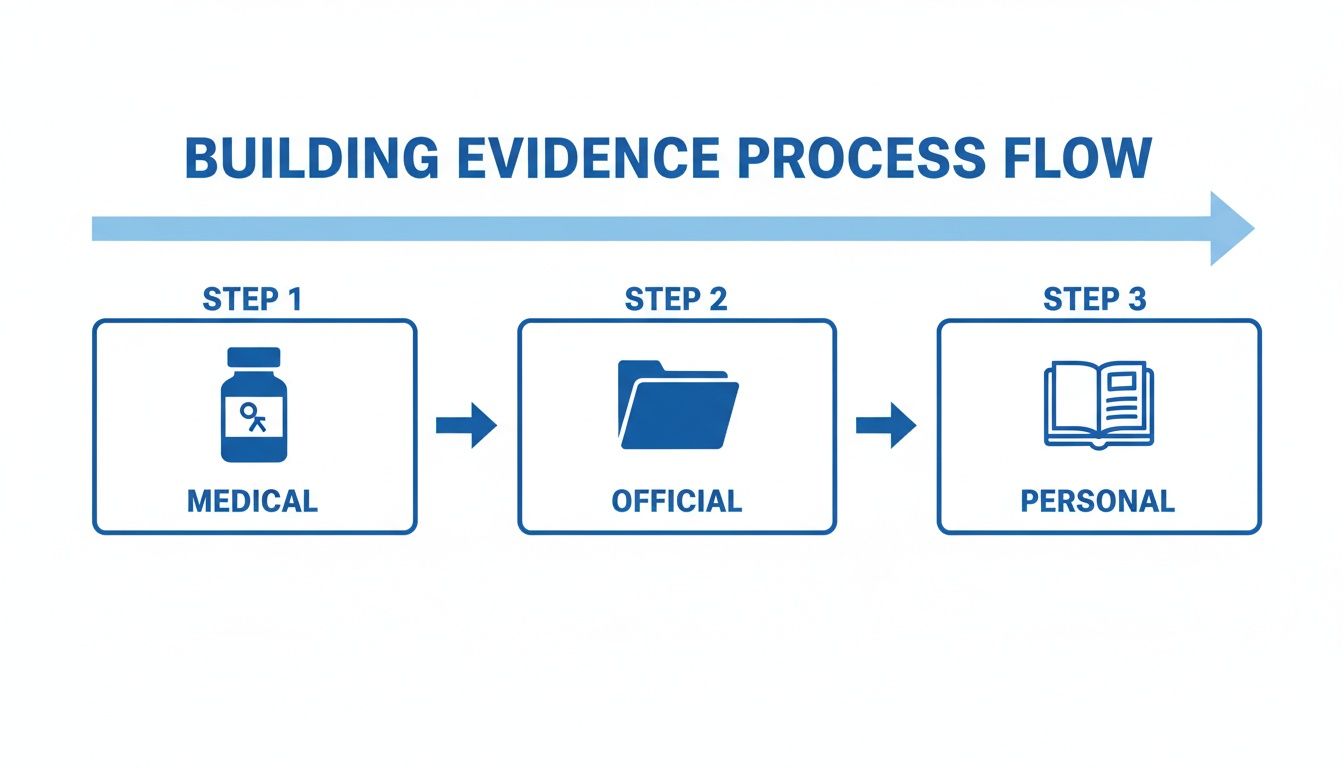
As you can see, blending medical, official, and personal evidence is what builds a solid, compelling claim.
Preparing for the DWP Health Assessment
Once your form is in, you'll most likely be asked to attend a health assessment, which these days is usually a phone or video call. The very idea can be incredibly stressful, but being prepared is the best way to manage that anxiety.
The assessor’s goal is to understand how your ADHD affects you against the specific PIP or DLA criteria. They'll use your application form as their guide, so it’s essential to have your own copy in front of you during the call.
Here’s how you can get ready:
- Review Your Application: Go back and re-read everything you wrote. Jot down the key points and the most powerful examples you want to highlight.
- Don't Be Afraid to Refer to Notes: It is perfectly fine to have your form and some bullet points with you. In fact, explaining that your ADHD affects your memory and organisation, so you need notes to answer accurately, is a great real-time demonstration of your condition.
- Be Ready to Elaborate: The assessor will almost certainly dig deeper into some of your answers. Be prepared to expand on what you wrote with real-life stories and more detail.
- Have a Companion Present: You are absolutely allowed to have someone with you for support. They can take notes, gently remind you of things you might forget, and even add their own observations if the assessor agrees.
This assessment is your chance to give a human voice to the words on the page. It's another opportunity to show the assessor what living with ADHD is really like day-to-day. If you're currently stuck in the complexities of the NHS system, it's worth knowing more about using the NHS Right to Choose for your ADHD assessment, as it lets you choose which NHS-funded provider carries out the assessment you need for your evidence.
Ultimately, both the form and the assessment are about painting an accurate, honest picture. By being prepared, detailed, and truthful, you give yourself the best possible shot at getting the support you're entitled to.
What to Do if Your Claim is Rejected
It's a gut punch. After all the time and emotional effort you’ve poured into the application, getting that rejection letter from the Department for Work and Pensions (DWP) can feel completely devastating. It’s easy to see it as a final, crushing verdict.
But here's something you absolutely must know: this is often not the end of the road.
A huge number of initial decisions get overturned, so the most important thing is not to lose hope. Your very first step is to request a Mandatory Reconsideration. This is the formal way of asking for a different DWP decision-maker to take a fresh look at your entire claim.
You have just one month from the date on your decision letter to ask for this, so time is of the essence. You can kick things off with a phone call, but it's always wise to follow up with a letter to have a clear paper trail.
Building a Stronger Case for Reconsideration
Simply asking the DWP to "look again" probably won't be enough to change the outcome. The Mandatory Reconsideration is your prime opportunity to bolster your case and directly challenge the reasons they gave for saying no.
Treat the DWP's letter as your blueprint. It will spell out exactly why they denied your claim. Did they argue there wasn't enough proof of how your ADHD impacts your ability to cook safely? Now's the time to send in a detailed statement from a family member describing the forgotten pans, the difficulty with sequencing steps, or the distractions that make the kitchen a hazard.
Think of the initial rejection as feedback, not failure. It highlights the exact weak spots in your original application, giving you a clear target for new and more powerful evidence.
This is the perfect moment to submit any new evidence you have. Maybe you’ve since received a new report from a specialist, kept a detailed diary of your daily struggles, or can get a supporting letter from a community psychiatric nurse or support worker. This new information can be what tips the balance in your favour.
Taking it to Appeal and Finding Support
If the Mandatory Reconsideration doesn't change the decision, the next step is to appeal to an independent tribunal. Please don’t be put off if you reach this stage. A very high percentage of PIP and DLA decisions are overturned at tribunal by an impartial panel that is completely separate from the DWP.
The process can feel intimidating, which is why getting some expert help is one of the best things you can do. Organisations like Citizens Advice provide fantastic, free guidance on handling the appeals process.
Their advisors can help you build your case, understand the legal jargon, and may even be able to represent you at the hearing. Tapping into that kind of support can make all the difference in turning that initial 'no' into a successful claim.
Got Questions? We’ve Got Answers
When you're first looking into disability benefits for ADHD, it's natural to have a lot of questions. Let's tackle some of the most common ones head-on so you can get a clearer picture of where you stand.
Can I Claim Disability Benefits Without a Formal Diagnosis?
Yes, you absolutely can. The DWP bases its decisions for both PIP and DLA on how your symptoms affect your daily life, not just on whether you have a specific diagnosis on paper.
That said, a formal diagnostic report is powerful evidence. If you’re stuck on a long NHS waiting list, don’t wait to apply. Go ahead and start your claim with evidence from your GP, old school reports (if you have them), and detailed accounts from yourself and people who know you well. A formal diagnosis will only strengthen your case when you eventually get it.
Does a Private ADHD Diagnosis Guarantee I’ll Get Benefits?
Nothing can guarantee a successful claim, but a comprehensive report from a private specialist can make a huge difference. A good private assessment doesn't just give you a diagnosis; it goes into forensic detail about how your ADHD impacts your ability to manage day-to-day tasks.
That’s precisely the kind of information the DWP needs to make a decision. A thorough, well-written private report that connects the dots between your diagnosis and your specific daily struggles adds a massive amount of weight to your application. It helps you build a much more compelling case.
It's crucial to remember that both PIP and DLA are non-means-tested. This means your income, savings, or whether you're receiving other benefits like Universal Credit don't matter. They're purely there to help with the extra costs that come with having a disability.
Will Getting PIP or DLA Affect My Other Benefits?
It might, but often in a good way. Being awarded PIP or DLA can actually act as a gateway to higher rates of other benefits. For instance, getting the daily living component of PIP could qualify you for a disability premium on other income-related benefits, boosting your overall financial support.
Navigating the path to an ADHD diagnosis can be a challenge, but you don't have to do it alone. ADHD Private offers a free directory of over 300 private ADHD clinics across the UK, helping you compare wait times, costs, and services to find the right support faster. Start your search today at https://adhdprivate.co.uk.