Your Guide to ADHD Medication UK Access and Options
Navigate ADHD medication in the UK. This guide explains NHS vs private routes, stimulants vs non-stimulants, costs, and shared care agreements.
Written and maintained by the ADHD Private editorial team, drawing on NHS, NICE and ADHD UK guidance. This is general information, not medical advice.
Starting your journey with ADHD medication in the UK can feel like a bit of a maze. You know that treatment can make a huge difference, but the long waiting lists and confusing jargon can be pretty off-putting. The good news is that there's a clear path forward, but it helps to have a map.
This guide will break down the two main routes you can take: going through the NHS or opting for a private assessment and treatment plan. Knowing the pros and cons of each will help you decide which is right for you.
Your Starting Point for ADHD Medication in the UK

Taking that first step towards getting treatment is a big deal. It’s a move towards getting your symptoms under control and, frankly, making life feel a bit easier. But let's be honest, the system can seem incredibly complicated, leaving many people feeling overwhelmed before they’ve even started.
At its core, it's quite simple: medication is a well-proven and highly effective tool for managing ADHD. The tricky part is navigating the system to actually get it.
Think of this guide as your no-nonsense manual. Whether you’re an adult looking for help or a parent trying to support your child, understanding the process is the first, most important step.
Navigating the NHS and Private Pathways
So, where do you begin? In the UK, you essentially have two options, each with its own set of timelines, costs, and procedures. Getting your head around these from the start will save you a lot of time and stress down the line.
- The NHS Pathway: This is the publicly funded route. The biggest challenge here is often the very long waiting lists for both assessment and the start of treatment.
- The Private Pathway: This route is much faster, but it means paying for everything yourself, from the initial consultations to the medication and follow-up appointments.
It's worth noting just how much demand has surged recently. Since the COVID-19 pandemic, ADHD prescriptions in England have shot up by an average of 18% each year. We've gone from 25 items per 1,000 people in 2019-20 to 41.55 per 1,000 in 2023-24. That's a huge jump and explains a lot about the current pressures on services.
The one non-negotiable step is getting a formal diagnosis. No specialist, either NHS or private, can prescribe ADHD medication in the UK without one. That's why understanding the ADHD assessment process is just as vital as learning about the treatments.
Key Concepts You Will Encounter
As you start looking into this, you'll hear a few key terms pop up again and again. Getting familiar with them now will make the whole process feel much less intimidating.
Words like titration (the careful process of finding the right medication and dose for you), shared care (when a private specialist gets your treatment stable and then hands over prescribing to your NHS GP), and the Right to Choose scheme (your right in England to choose which NHS-contracted provider assesses you) are all crucial to understand. We’ll dive into what these mean for you, so you can feel confident you’re making the right choices.
Understanding How ADHD Medications Work
To have a productive chat with your doctor about ADHD medication in the UK, it’s really helpful to get your head around the basics of how they work. At its core, ADHD is linked to how the brain handles certain chemical messengers, or neurotransmitters: specifically dopamine and noradrenaline. These are the chemicals that govern things like attention, motivation, and impulse control.
ADHD medications essentially work by fine-tuning this chemical balance, helping different parts of the brain talk to each other more effectively. Think of it like a weak radio signal that keeps cutting out; the medication boosts that signal, making the message come through loud and clear. This helps dial down the core ADHD symptoms like inattention, hyperactivity, and impulsivity.
The treatments generally fall into two main camps: stimulants and non-stimulants. Each works in a different way and is suited to different people, which is why any treatment plan needs to be carefully tailored to you.
Stimulant Medications: The Brain's Spotlight
Stimulants are the most commonly prescribed treatment for ADHD in the UK and are usually the first thing a specialist will consider. They get to work fast (often within an hour) by increasing the levels of dopamine and noradrenaline available in the brain.
Imagine your brain's attention system is a dimly lit room. Taking a stimulant is like flicking on a powerful spotlight. It doesn't change the room itself, but it instantly illuminates what you need to focus on, making tasks clearer and pushing distractions into the shadows. This is why many people feel a noticeable improvement in focus and impulse control so soon after starting.
The two main types of stimulants used in the UK are:
- Methylphenidate
- Lisdexamfetamine
These come in different formulas. Some are short-acting and give you a few hours of coverage, while the long-acting (or ‘modified-release’) versions are designed to last a full work or school day, providing more consistent symptom relief.
Non-Stimulant Medications: Upgrading the System
Non-stimulants take a different route. Instead of giving a quick, targeted boost, they work more gradually to improve the brain's underlying communication network. You typically need to take them consistently for several weeks before you feel the full benefit.
If a stimulant is a spotlight, a non-stimulant is like rewiring the building's entire electrical system. It’s a slower job, but the result is more stable, reliable power across the board. This makes them a great option for people who don't get on well with stimulants, experience side effects, or have other conditions like anxiety or tic disorders.
The main non-stimulant options in the UK include:
- Atomoxetine
- Guanfacine
Because they work more subtly, they provide a steady, 24-hour coverage that can also help with emotional regulation and sleep: things that stimulants can sometimes disrupt.
To give you a clearer picture, here’s a quick side-by-side comparison of the two main types of ADHD medication.
Comparing Stimulant and Non-Stimulant ADHD Medications
| Feature | Stimulant Medications (e.g., Methylphenidate, Lisdexamfetamine) | Non-Stimulant Medications (e.g., Atomoxetine, Guanfacine) |
|---|---|---|
| How They Work | Rapidly increase dopamine and noradrenaline levels. | Gradually adjust neurotransmitter levels over time for a stable effect. |
| Onset of Action | Very fast – effects are usually felt within 30-60 minutes. | Slow – takes several weeks of consistent daily use to reach full effect. |
| When They're Used | Often the first-line treatment due to high effectiveness and rapid action. | A good alternative if stimulants cause side effects, aren't effective, or if 24/7 coverage is needed. |
As you can see, the choice isn't just about which one is "better," but which one is the right fit for an individual's specific needs and biology.
The growing awareness of ADHD means more people are getting the help they need. Recent NHS data showed a 5% surge in ADHD prescriptions in just one quarter, with 297,000 patients receiving medication. This really underlines how vital these treatments are becoming for so many people. Discover more about these prescribing trends in the UK.
Choosing the Right Medication For You
There’s no single "best" ADHD medication: the right one is completely individual. A specialist will look at your specific symptoms, your lifestyle, your medical history, and any other health conditions you might have.
For example, someone who needs intense focus for short bursts of work might do well on a short-acting stimulant. On the other hand, someone needing steady symptom control all day and into the evening might find a long-acting formula or a non-stimulant a better fit.
Finding the right medication and dose is a process called titration. This is a collaborative period where your clinician carefully adjusts your prescription to find that sweet spot: maximum benefit with minimal side effects. Understanding the different options is the first step, empowering you to be an active partner in your own care. As you explore what might work for you, you may want to learn more about the private ADHD treatment process and what it involves.
Treatment starts with an assessment
Answer a few questions and we’ll shortlist private ADHD clinics that fit your needs and budget.
Comparing NHS and Private Treatment Pathways
When you're looking into getting ADHD medication in the UK, you’ll quickly find yourself at a fork in the road. On one side, you have the NHS, and on the other, the private sector. Each path has its own set of timelines, costs, and hoops to jump through, so understanding the landscape is the first step to figuring out what's right for you or your child.
The route you take will have a massive impact on how quickly you get an assessment and can begin treatment. It’s not about one being inherently ‘better’ than the other; they simply cater to different priorities and circumstances.
The NHS Pathway Explained
Going through the NHS is the standard, publicly funded route. The journey almost always starts at your local GP surgery. You'll have a chat about your symptoms, and if your GP agrees that an ADHD assessment is warranted, they’ll refer you to your local specialist ADHD service.
Here's the rub: once you’re referred, you land on a waiting list. And this is often the biggest hurdle. Waiting times can be wildly different depending on where you live, but it's not unheard of for people to wait several years for that first specialist appointment. Even after a diagnosis, another wait often begins before you can start the process of finding the right medication.
The clear advantage, of course, is the cost. If you can handle the wait, everything from the assessment to specialist appointments and prescriptions is covered by the NHS (you'll just have the standard prescription charges in England).
This is a simplified look at how the medication is meant to work, by helping to balance the brain’s chemistry to improve focus.
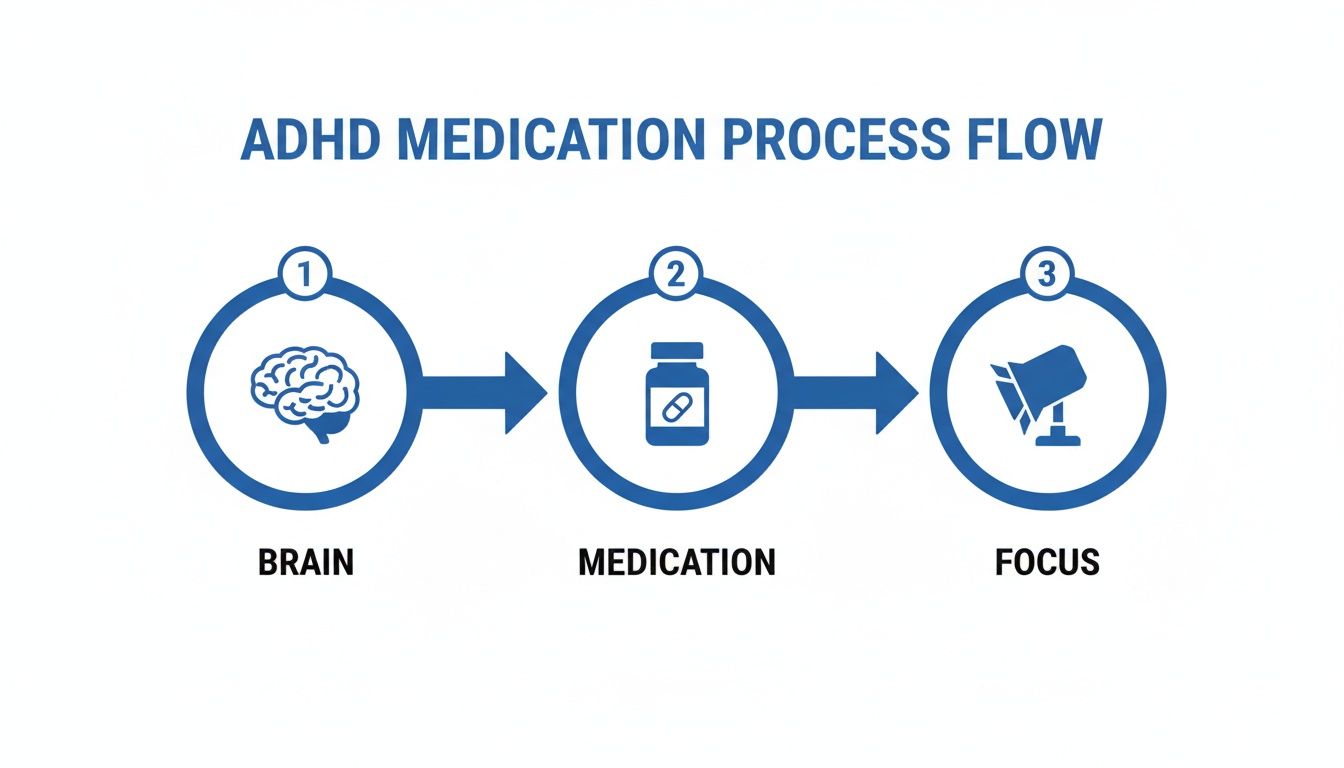
It breaks down the journey from a neurological need to achieving better concentration with the right treatment.
The Private Pathway Explained
For a lot of people, the thought of waiting years for help just isn’t an option. This is where the private pathway comes in, offering a much, much faster alternative. You can typically refer yourself directly to a private clinic and get an assessment booked within a matter of weeks.
The whole process tends to be more direct. Once you have a diagnosis, you can usually start the titration period (the crucial stage of finding the right medicine and dose) almost straight away. That speed and efficiency are precisely why people choose to go private.
But, as you’d expect, that speed comes at a price. You'll be footing the bill for every single step: the initial assessment, all the titration appointments, any follow-up consultations, and the private prescriptions themselves, which can be very costly month-on-month.
Bridging the Gap Between NHS and Private Care
Thankfully, it's not a completely black-and-white choice. The UK system has a couple of clever mechanisms that can help bridge the gap, creating a sort of hybrid approach that blends the speed of private healthcare with the long-term affordability of the NHS.
These options are what make private treatment a realistic and sustainable plan for many families.
A key takeaway is this: A private diagnosis doesn't lock you into paying for private prescriptions forever. The goal for most is to eventually transition care back to the NHS once treatment is stable.
Understanding Shared Care Agreements
A Shared Care Agreement (SCA) is a formal arrangement made between your private specialist, your NHS GP, and you. It comes into play once your private clinician has guided you through titration and settled you on a stable, effective medication dose.
If your GP agrees to the SCA, they take over the prescribing of your ADHD medication, issuing it as a standard NHS prescription. This is a complete game-changer, slashing the ongoing cost from potentially hundreds of pounds a month for a private script down to the standard NHS charge.
- The Process: Your private clinician writes to your GP to propose the agreement once your treatment is stable.
- GP Discretion: It’s crucial to know that GPs are not required to accept an SCA. It’s always a good idea to have a conversation with your GP surgery beforehand to check if they’re open to working with private providers.
- Ongoing Reviews: Even with an SCA in place, you’ll still need to check in with your specialist for periodic reviews (usually once a year) to make sure everything is still on track. This will be a private appointment with an associated fee.
Using NHS Right to Choose in England
If you live in England, the NHS Right to Choose (RTC) scheme is a way to have your assessment funded by the NHS without the private price tag. RTC lets you choose which qualified healthcare provider you are referred to for your assessment, as long as they hold an NHS contract.
Many of these providers are actually private clinics that also take on NHS work. By using your Right to Choose, your GP can refer you to one of them instead of your local NHS service. Waits vary by provider and by NHS area, so ask the clinic about its current wait before your GP refers you.
- GP Referral: You still need to start with your GP; they have to make the referral.
- Provider Choice: You pick an RTC-approved provider that meets your needs.
- NHS-Funded Care: The assessment and any subsequent treatment are funded by the NHS, exactly as they would be if you’d stayed with your local service.
Just be aware that you might still face a wait for medication titration after your diagnosis, depending on that specific provider's capacity.
What to Expect During Titration and Monitoring

So, you’ve got your diagnosis. The next step, known as the titration phase, is arguably the most crucial part of your entire treatment journey.
Think of it like tuning a guitar. Your specialist will carefully and patiently adjust each string until they find the perfect harmony for you. It’s not a one-size-fits-all prescription; it’s a collaborative effort between you and your clinician to find the right medication and the right dose.
The goal is simple: get the maximum benefit for your ADHD symptoms with the minimum number of side effects. This careful, gradual process is absolutely essential for long-term success. After all, a study from King's College London found that around 50% of adults stop their medication within a year, often due to side effects or feeling it isn't quite working. This really drives home how vital a well-managed titration is. You can read more about the study's findings on medication adherence here.
How the Titration Process Works
You'll always start on a very low dose. Your clinician will then guide you on how to increase it slowly, usually over several weeks, while you both keep a close eye on how you're feeling. Regular check-ins, whether by phone, email or appointment, are a standard part of this.
This 'start low, go slow' approach lets your body get used to the medication and helps you and your doctor pinpoint the exact dose where you feel the most benefit. It’s all about finding that “sweet spot”: your optimal dose.
Honestly, your feedback is the most important part of this entire process. Keeping a simple daily diary can be a game-changer. Just jotting down notes on your focus, mood, sleep, and appetite gives your clinician the information they need to get things just right for you.
Managing Common Side Effects
Look, starting any new medication can come with side effects, and ADHD treatments are no different. The good news is that for most people, they’re mild and often fade away as your body adjusts. Knowing what to expect makes them much easier to manage.
Some common side effects with stimulant medications include:
- Loss of appetite: You might find you just don't feel hungry, especially at lunchtime. A good tip is to have a protein-rich breakfast before your medication kicks in and keep healthy snacks nearby for later.
- Trouble sleeping: Taking your dose as early in the day as possible is the best way to prevent this. A relaxing wind-down routine in the evening helps, too.
- Dry mouth: Get into the habit of carrying a water bottle with you and sipping on it throughout the day.
- Feeling anxious or 'jittery': This is often a sign that the dose is a bit too high. It's not something to push through: it’s important feedback for your clinician so they can make an adjustment.
Non-stimulant medications come with their own set of potential side effects, like initial drowsiness or an upset stomach. Your specialist will walk you through the best ways to manage these depending on which medication you are prescribed.
The most important thing is to keep the lines of communication open. You should never feel like you just have to "put up with" a side effect. Tell your clinician what's going on so they can adjust the dose, the timing, or even try a different type of medication.
Essential Safety Monitoring
Throughout titration and for as long as you take the medication, your safety is the number one priority. UK guidelines are very strict on this, requiring regular monitoring to make sure everything is okay with your physical health. This is standard practice for all ADHD medication in the UK, whether you’re with the NHS or a private clinic.
Before you even take your first tablet, your clinic will run some baseline health checks. These usually include:
- Blood pressure
- Heart rate (pulse)
- Weight and height
- Sometimes an ECG to check your heart's electrical activity
These checks are repeated regularly, especially while you're titrating and then at least once a year after that. It ensures that any potential issues are caught early and that your treatment remains safe for the long haul. This isn't just bureaucracy; it's there to give you complete peace of mind that you're in safe, professional hands.
A Realistic Look at Private ADHD Treatment Costs
Going private for ADHD treatment can significantly cut down your waiting time, which is a huge relief for many. But it’s really important to go in with your eyes open about the financial side of things. The cost isn't just one single payment; it's spread across different stages of the process, and knowing what to expect can save you a lot of stress down the line.
Think of the private route for ADHD medication in the UK as an investment in your well-being. Like any investment, you need to budget for it. Costs can vary quite a bit from one clinic to another, so my best advice is to always ask for a complete breakdown of their fees before you sign up for anything.
The Initial Assessment Fee
This is the first hurdle and your starting point. It’s a one-off fee for the comprehensive diagnostic assessment with a specialist, usually a psychiatrist, who will determine if you meet the criteria for an ADHD diagnosis.
- What it covers: This isn’t just a quick chat. It’s a deep dive into your history, often involving detailed interviews and questionnaires to get a full picture.
- Typical cost: Be prepared for a range between £500 to over £1,200. The final figure often depends on the clinic's location and the specialist's experience.
It’s crucial to remember this fee is just for the diagnosis itself. If you are diagnosed with ADHD, the costs for medication and follow-up care are separate.
The Titration Period Costs
Once you have a diagnosis, the next step is finding the right medication and dose for you. This is called the 'titration' period, and it's where your specialist fine-tunes your treatment plan. This phase has its own set of costs, which aren't included in that initial assessment fee.
This stage is probably the most variable in terms of cost and can last anywhere from four to twelve weeks. The entire goal here is to get your treatment stable enough that you can hopefully move over to a shared care agreement with your NHS GP.
Here’s what you’ll likely be paying for during titration:
- Follow-Up Appointments: You'll need regular check-ins with your specialist to see how you're getting on and make any necessary tweaks to your dose. These appointments can cost between £150 and £350 each.
- Private Prescriptions: This is a big one. Until your GP agrees to take over your prescribing under a shared care agreement, you have to cover the full cost of the medication yourself. This can easily be £80 to £200+ per month, depending on the drug and dosage.
Some clinics simplify this by offering a titration 'package', which might cost between £600 and £1,500 and bundle all the appointments and admin together (though usually not the medication itself). Always double-check what's included. To make this more manageable, some clinics offer different ways to pay, and it's worth exploring ADHD clinic payment plans to see if that could work for you.
Typical Private ADHD Service Costs in the UK
To give you a clearer picture, here’s an estimated breakdown of the costs you might encounter on the private pathway. Remember, these are just guide prices and will vary between clinics.
| Service | Typical Cost Range (£) |
|---|---|
| Initial Diagnostic Assessment | £500 - £1,200+ |
| Follow-Up/Titration Appointment | £150 - £350 (per session) |
| Titration Package (excluding meds) | £600 - £1,500 |
| Private Prescription Medication | £80 - £200+ (per month) |
| Annual Review | £250 - £500 |
This table helps visualise the journey, from that first assessment to the ongoing maintenance of your treatment plan.
Ongoing and Long-Term Costs
Once you’re on a stable dose and have a shared care agreement in place with your GP, the costs drop significantly. However, they don't disappear completely. UK guidelines state that you must have at least one check-up a year with your private specialist to review your progress and ensure everything is still working well.
- Annual Review Fee: You should budget between £250 and £500 for this yearly appointment.
Having this financial map (from assessment to titration and the annual reviews) allows you to make a properly informed choice. It lets you find a provider that not only meets your health needs but also fits your budget, ensuring your journey to getting the right support is as smooth and sustainable as possible.
Your Questions Answered: ADHD Medication in the UK
Stepping into the world of ADHD treatment can feel overwhelming, and it’s only natural to have a lot of questions. From "how long will this take?" to "how much will it cost?", getting straight answers is the first step towards feeling in control of your journey.
Here, we'll tackle the most common queries we hear about ADHD medication in the UK, offering practical, clear advice to help you know what to expect.
How Long Does It Take to Get ADHD Medication?
This is usually the very first thing people ask, and honestly, the answer depends entirely on the path you take. The difference in waiting times can be enormous.
- Going through the NHS: Be prepared for a very long wait. Getting an initial assessment can take several years in many parts of the country. Even after a diagnosis, you’ll likely face another waiting list, often for many more months, before you can start the process of finding the right medication (titration).
- Opting for a private clinic: This is by far the fastest route. You can often book an assessment within a few weeks. Once diagnosed, the titration process (where you and your specialist find the right medication and dose) usually begins straight away and takes around 4 to 12 weeks.
- Using NHS Right to Choose (in England): This can be a brilliant middle ground. It lets you choose an approved private provider for your assessment, but it’s funded by the NHS. Just be aware that after your diagnosis, you might still have to join an NHS waiting list for the actual medication titration.
Can My GP Prescribe ADHD Medication?
This is a really common point of confusion. The short answer is no, a GP cannot initiate a prescription for ADHD medication. That has to be done by a specialist, like a psychiatrist, who has the expertise to diagnose the condition and manage the initial treatment.
But here’s the good news. Once your specialist has found a medication and dose that works for you, they can arrange a Shared Care Agreement with your GP. This is a formal agreement where your GP takes over writing your repeat prescriptions. It makes long-term treatment much more convenient and affordable. It's always a good idea to chat with your GP surgery beforehand to make sure they're happy to enter into this kind of arrangement.
Think of a Shared Care Agreement as the crucial handover that connects private treatment with long-term NHS care. It lets you use the speed of the private route for diagnosis and getting started on medication, then switch to the affordability of NHS prescriptions for the long haul.
Are There Shortages of ADHD Medication in the UK?
Yes, unfortunately, medication shortages are a real and ongoing issue. Since late 2022, the UK has been hit by recurring supply problems affecting many of the most common ADHD medications, including stimulants like methylphenidate (e.g., long-acting methylphenidate, immediate-release methylphenidate) and lisdexamfetamine, as well as some non-stimulants.
This isn't an NHS or private issue; it affects everyone. The problem is driven by a combination of manufacturing delays and a huge spike in global demand. A good clinician will be on top of the current supply situation and work with you to navigate it. They might suggest alternative medications that are in stock, different formulations (like liquids instead of capsules), or other strategies to keep your treatment as consistent as possible.
What Happens If I Stop Taking My Medication?
It is absolutely vital that you never stop taking your ADHD medication suddenly without talking to your doctor first. While these medicines aren't addictive in the same way as narcotics, stopping them abruptly can cause problems.
For starters, your ADHD symptoms will likely return, which can be a real shock to the system. You might also get withdrawal-like effects, such as mood swings, extreme tiredness, or irritability, as your brain chemistry readjusts. If you’re thinking about taking a break or stopping for good, your specialist will work with you to taper the dose down slowly and safely. This controlled approach minimises any unpleasant side effects and makes the whole process much smoother.
At ADHD Private, we simplify your search for timely and professional ADHD support. Our free UK-wide directory allows you to compare over 300 private clinics, with clear information on pricing, wait times, and services to help you make a confident and informed decision. Find the right clinic for you at https://adhdprivate.co.uk.