Discover ADHD 360 Right to Choose for Faster NHS Assessments
Explore ADHD 360 Right to Choose and speed up your NHS-funded ADHD assessment with our clear, step-by-step guide.
Are you feeling lost in the seemingly endless queue for an NHS ADHD assessment? You're not alone. But there's a valuable option you might not know about: the NHS Right to Choose pathway. For adults in England, this is a legitimate and established route that allows you to pick an approved specialist, like ADHD 360, for your assessment and get it fully funded by the NHS.
It’s not a loophole or a shortcut; it's your right. It means you can bypass the long wait times of your local service and get the answers you need, often much faster.
How Does NHS Right To Choose Actually Work?

Think of it this way: instead of being automatically sent down the single, often congested, motorway of your local NHS mental health service, Right to Choose lets you take a clear, pre-approved A-road. You get to select any qualified provider that holds an NHS Standard Contract, which includes specialist private clinics like ADHD 360.
This puts you firmly in the driver's seat of your healthcare journey. Once you and your GP agree that an ADHD assessment is the right next step, they can refer you directly to the provider you've chosen. It doesn't matter where they are in England. This flexibility opens up a world of specialists who might have shorter waiting lists or a deeper focus on adult ADHD.
Why This Pathway Is More Important Than Ever
The need for an alternative route has never been more urgent. As of 2025, a staggering 549,000 children and adults are stuck waiting for ADHD assessments on the NHS. In some parts of the country, this can mean waiting for years. It's no wonder so many people are looking for a better way forward, and using ADHD 360 through Right to Choose is one of the most effective solutions available.
The whole concept is built on a simple, powerful idea: patient choice. The NHS Constitution for England gives you the legal right to choose where you go for your first outpatient appointment with a specialist. This is that right in action.
Who Can Use Right to Choose?
The eligibility criteria are quite simple, but it's crucial to make sure you tick all the boxes before you speak to your GP.
You are almost certainly eligible if:
- You're registered with a GP in England.
- Your GP agrees a specialist ADHD assessment is clinically necessary.
- Your chosen provider, such as ADHD 360, holds an active NHS Standard Contract.
Knowing you have this right empowers you to have a proactive conversation with your doctor. It provides a clear, structured path to getting a diagnosis. If you want to understand the finer details, take a look at our complete guide on the Right to Choose.
Why Choose ADHD 360 for Your Assessment
When you start looking at providers under the Right to Choose scheme, you'll see a few names pop up. So, what makes ADHD 360 such a common choice? It really boils down to their deep focus and proven track record working directly within the NHS system. They aren't a jack-of-all-trades mental health clinic; they live and breathe ADHD.
This specialism is a huge advantage. It means their entire system, from the first form you fill out to the final report, has been built specifically for people going through an ADHD assessment. They’ve ironed out the kinks and removed many of the frustrating hurdles you might find in more general services, which often lead to delays.
A Proven End-to-End Care Model
What ADHD 360 offers is a complete pathway, designed to support you from start to finish. This isn't just about getting a diagnosis and being sent on your way; it's about creating a full circle of care.
Their model covers everything you’ll need:
- Initial Assessment: A detailed evaluation with a trained specialist who gets it.
- Diagnosis: A clear and prompt diagnostic decision.
- Treatment Planning: A plan built around you, which can include medication titration.
- Ongoing Support: Continued management to make sure your treatment is actually working for you.
Having this all under one roof provides real continuity. You’re dealing with the same team from the moment your GP's referral lands with them, so you're not getting passed around or left wondering what to do next. For a more detailed look at their offerings, you can check out the ADHD 360 clinic.
Efficiency and Clinical Confidence
One of the most compelling reasons people turn to the ADHD 360 Right to Choose pathway is its efficiency, and they have the numbers to back it up. They’ve really honed their remote assessment process to manage a high volume of patients without letting the quality of care slip. For instance, by January 2025, they were assessing over 1,600 new patients every month—a massive scale that shows they can handle the demand.
How do they do it? They use a smart combination of in-depth screening questionnaires and objective tools like QbCheck. This gives their clinicians a huge amount of data to work with before you even have your appointment, which builds their confidence in the diagnosis and speeds the whole thing up.
This efficiency can be genuinely life-changing. With some NHS trusts having waiting lists that stretch on for years, getting a diagnosis from ADHD 360 within a few months is a game-changer. It means people can get the support and understanding they need to start making real improvements in their lives, whether that’s at university, at work, or just in their day-to-day. The whole system is geared towards getting people help, much, much sooner.
Your Step-by-Step Guide to a Successful Referral
Ready to get the ball rolling? Taking that first step can feel like the biggest hurdle, but a little bit of preparation makes the whole process feel much less daunting. This guide breaks down the journey into clear, manageable actions, so you can feel confident walking into your GP surgery and asking for a referral to ADHD 360 under Right to Choose.
Let's cut through the confusion. I’ll walk you through exactly how to get ready for your GP appointment, which forms you need to fill out, and what happens once the referral is in the post. Think of this as your practical roadmap from start to finish.
Step 1: Prepare for Your GP Appointment
Your GP is the gatekeeper for this whole process, so being well-prepared for your appointment is key. Before you even book it, your first job is to head over to the ADHD 360 website and grab their specific paperwork. They’ve put together a handy pack for Right to Choose patients that makes things much simpler for your doctor.
This pack typically includes:
- A letter for your GP that explains the Right to Choose pathway and your request to be referred to them.
- The Adult ADHD Self-Report Scale (ASRS) screening questionnaire for you to fill in.
- A referral form that your GP needs to complete and send off.
Having these documents filled out and ready to go shows you’ve done your homework and makes it much easier for your GP to approve the request. It signals that you're serious and you understand what's involved, which can save them a lot of time.
This visual from ADHD 360's website gives you a sense of the process they've laid out for patients, from assessment right through to treatment and ongoing care.
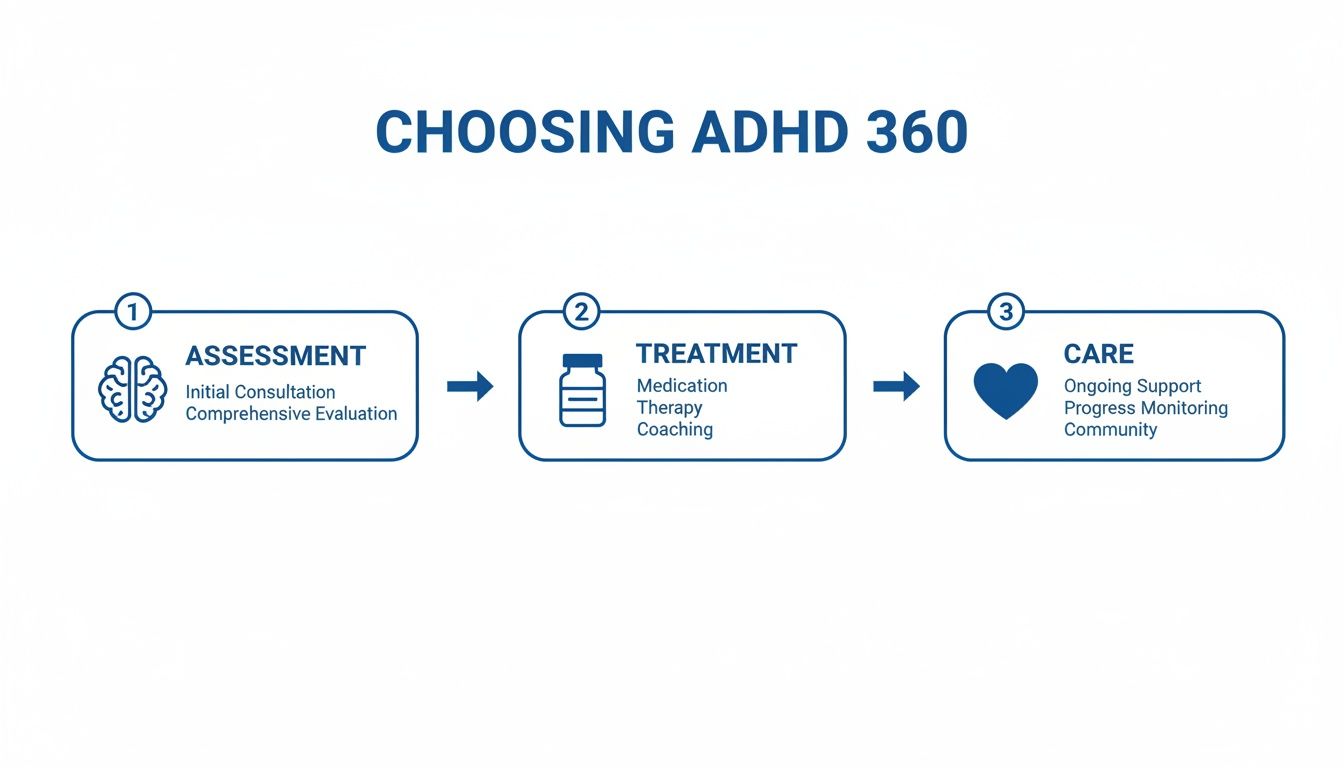
It highlights the structured journey you can expect, confirming that the clinic provides a clear path to getting the support you need.
Step 2: Have a Confident Conversation with Your Doctor
When you're in the appointment, be direct. Start by saying you believe you have symptoms of ADHD and would like to get a formal assessment. Then, clearly state that you want to use your NHS Right to Choose to be referred to ADHD 360.
This is the moment to hand over the forms you prepared. It can also be a massive help to have a few notes jotted down about your key symptoms and how they're affecting your day-to-day life. Try to think of real-world examples – maybe it’s struggling with organisation at work, keeping on top of household chores, or finding it impossible to stay focused in conversations.
Remember: You aren't asking for a special favour; you are exercising a legal right. Be polite, but be firm. If your GP seems unsure about the pathway, don't panic – the letter from ADHD 360 is designed specifically to explain it to them, complete with references to official NHS guidance.
Once your GP is on board, they'll fill out their part of the referral form and send it directly to ADHD 360. It’s always a good idea to ask for confirmation that they’ve sent it.
Step 3: Understand What Happens After the Referral
After your GP sends off the referral, the waiting game begins. ADHD 360 will process the paperwork and should send you a confirmation to let you know they've received it. That’s your sign that you're officially in their system.
Next, the clinic will send you a link to your online patient portal and a set of quite detailed questionnaires. These forms, often combined with objective tools like the QbCheck test, are a fundamental part of their diagnostic process. It’s really important to fill them out thoroughly and as soon as you can to keep things moving.
Once that stage is done, you'll be placed on the waiting list for your virtual assessment with one of their specialist clinicians.
Navigating Medication and Shared Care Agreements
Getting an ADHD diagnosis is a huge moment, but it’s really just the starting line. The next, and arguably most important, part of the journey is finding the right treatment to help you manage your symptoms, which very often involves medication. This brings you to a carefully managed process called titration.
Think of titration like tuning a guitar. You don't just crank the knobs randomly; you adjust each string slowly and carefully to find the perfect note. It’s the same with ADHD medication. A specialist from ADHD 360 will start you on a very low dose and work with you to gradually increase it, finding that sweet spot where the medication is most effective with the fewest possible side effects. An expert leads this entire process, ensuring your treatment is fine-tuned just for you.
Once you and your specialist have found the right medication and a stable dose, the conversation turns to making your long-term care both manageable and affordable. This is where a very important document comes into the picture: the Shared Care Agreement (SCA).
What Is a Shared Care Agreement?
A Shared Care Agreement is essentially a formal handover from your ADHD 360 specialist to your local GP. It’s a document that sets out a plan for your ongoing care, allowing your GP to take over writing your prescriptions once your treatment is stable.
This is a critical step for a couple of big reasons:
- Cost: As soon as your GP takes over, your prescription falls under the NHS. This means you’ll only pay the standard NHS prescription charge, which makes a massive difference to the long-term cost.
- Convenience: It allows you to pick up your repeat prescriptions from your local chemist, just like you would for any other medication. No more dealing with private prescriptions.
The agreement clearly defines who is responsible for what, making sure the transition from specialist-led care to routine GP management is safe and seamless. Without one, you’d be stuck paying for private prescriptions indefinitely, which can be incredibly expensive. To get a better feel for the details, you can read more about the structure of shared care agreements.
A Shared Care Agreement is the bridge between a private diagnosis (even via the NHS Right to Choose pathway) and your ongoing NHS care. It’s designed to make sure that patients using the ADHD 360 Right to Choose route get affordable, continuous treatment long after the initial titration phase is over.
To make things clearer, let's break down who pays for what at each stage.
Cost and Responsibility Breakdown
This table shows how the responsibilities and costs are split between the private provider (like ADHD 360) and your NHS GP under a Shared Care Agreement.
| Treatment Stage | Primary Responsibility | Who Funds It |
|---|---|---|
| Assessment & Diagnosis | ADHD 360 Specialist | The NHS (via Right to Choose) |
| Titration Period | ADHD 360 Specialist | The NHS (via Right to Choose) |
| Private Prescriptions (during titration) | ADHD 360 Specialist | You (the patient) |
| Ongoing Prescriptions (post-titration) | Your NHS GP | The NHS (you pay the standard prescription fee) |
| Annual Medication Review | ADHD 360 Specialist | The NHS (via Right to Choose) |
As you can see, the agreement ensures that the costly, long-term part of your treatment is covered by the NHS, making it a sustainable solution.
What if My GP Is Hesitant?
It does happen. Sometimes a GP might be reluctant to enter into a Shared Care Agreement. This is often down to them being unfamiliar with the process, or perhaps concerns about their workload and expertise with ADHD medications.
If you find yourself in this situation, the first thing to do is not to panic. ADHD 360 is an established NHS-commissioned provider, and they supply all the necessary documentation based on national guidelines to make this as easy as possible for GPs.
The best approach is to have a calm, open conversation with your doctor. Remind them that ADHD 360 was commissioned by the NHS to provide your care and that the agreement means the specialist is still on hand to offer advice if needed. It's a collaborative model, and that partnership is what makes the whole treatment journey work for everyone.
Navigating the Common Hiccups
Let's be realistic: while the Right to Choose pathway is a fantastic option, it's not always a perfectly smooth ride. Knowing what challenges might pop up, and how to tackle them, can make a world of difference and keep things moving forward.
The most frequent stumbling block? It often comes right at the start, with your GP.
Some doctors simply aren't familiar with the Right to Choose rules, or they might feel more comfortable sticking with the local NHS teams they know. Don't panic if this happens; it's a common scenario, and you can absolutely prepare for it.
What to Do If Your GP Is Hesitant
If your GP seems unsure about referring you, it’s rarely because they don't want to help. More often than not, they just don't know the ins and outs of this specific pathway. This is your chance to gently guide them with the right information.
That referral pack from ADHD 360 is your best friend here. It includes a letter written specifically for GPs that lays out the NHS Right to Choose pathway and points to the official guidance.
Here’s a simple game plan for that conversation:
- Arm them with the facts. Hand them the letter from ADHD 360. It clearly explains their duty to refer you if an assessment is clinically appropriate.
- Be patient. Your GP might need a moment to read through everything and even look up the guidance for themselves. Give them that space.
- State your position clearly. You can calmly mention that this is your legal right under the NHS Constitution, not just a personal preference.
Remember, a GP can only really refuse a referral if they don't believe an ADHD assessment is clinically needed. They can't block it just because they're unfamiliar with the provider or the process.
A Reality Check on Timelines and Teamwork
Even when you go down the ADHD 360 Right to Choose route, you won't get an appointment overnight. These private providers are in high demand for a reason—they're a much faster alternative to the years-long NHS waiting lists. But that popularity means they have waiting lists of their own.
The crucial thing to remember is that 'faster' doesn't mean 'instant'. Managing your own expectations is key. Always check the ADHD 360 website for their most current wait time estimates to get a realistic idea.
You might also face some hesitation from your GP when it comes time to set up a Shared Care Agreement after your diagnosis. The best approach here is to treat it as a conversation between partners in your healthcare.
ADHD 360 gives your GP all the paperwork and support needed to make this transition as seamless as possible. By framing it as a team effort for your long-term health, you can help ease any of their worries and lock in your ongoing treatment.
The Life-Changing Impact of a Timely Diagnosis

Wading through referral paperwork can feel like a real slog, but it's crucial to keep your eyes on the prize. Securing a timely ADHD diagnosis isn't just about getting a label—it's about reclaiming your life and finally finding the tools you need to thrive.
For many, untreated ADHD casts a long shadow. It can be the invisible hurdle holding you back at work, the constant source of tension in your relationships, or the quiet thief of your self-worth. You might have spent years feeling like you’re running a marathon with your shoelaces tied, wondering why things that seem simple for others feel impossible for you.
From Confusion to Clarity
A proper diagnosis delivers that lightbulb moment—the "why." It helps you reframe a lifetime of challenges not as personal failures, but as symptoms of a well-understood neurodevelopmental condition. That understanding alone is incredibly powerful. It can lift a huge weight of self-blame and open the door to genuine self-compassion.
This is exactly why the ADHD 360 Right to Choose pathway exists. It's more than a way to skip a queue; it’s a direct route to gaining clarity, confidence, and a sense of control over your own life. With a diagnosis in hand, you can finally access effective strategies and treatments that can completely reshape your day-to-day reality.
The stark reality is that ADHD is still hugely under-recognised in the UK, even though it's estimated to affect 3-4% of adults. In fact, recent NHS data revealed that only 15.6% of adults with the condition have ever received a formal diagnosis in England. This isn't just a personal issue; it's a national one, costing the UK economy an estimated £17 billion annually due to the impact of untreated ADHD. You can read more about the findings on adult ADHD services here.
A New Chapter Awaits
Once you have a diagnosis and a treatment plan, the world can start to look very different. The relentless brain fog begins to clear, focus feels less like a myth, and you can start managing your life with intention instead of just reacting to the chaos.
That’s the life-changing impact we’re talking about. It’s what makes navigating the forms and pushing for your referral completely worth it.
Got Questions? We’ve Got Answers
It’s completely normal to have a few questions when you’re figuring all this out. Let’s tackle some of the most common ones that come up about using Right to Choose for an ADHD 360 assessment.
Is an ADHD 360 Assessment Genuinely Free?
Yes, it really is. When you go down the Right to Choose route, the NHS is footing the bill for your assessment and treatment, just as they would if you stayed within your local service.
Think of it this way: you're not going private in the traditional sense. You're simply telling the NHS where you want to redeem your referral. There are no hidden fees or surprise invoices for the patient.
So, How Long Is the ADHD 360 Waiting List?
This is the big one, isn't it? The wait is much, much shorter than the years-long queues you often find in local NHS trusts. However, because so many people are now using Right to Choose, providers like ADHD 360 do have a waiting list.
The best advice is to check their website directly for the most up-to-date waiting times, as these can change with demand.
The crucial thing to remember is that you're usually looking at a wait of months, not the multiple years you might face otherwise. For someone struggling, that difference is enormous.
What Happens if My GP Says No to the Referral?
This can be a frustrating hurdle, but it helps to know the rules. A GP can only refuse to refer you on clinical grounds – for instance, if they genuinely don't see any evidence that an ADHD assessment is needed.
They can’t refuse just because they're unfamiliar with ADHD 360 or the Right to Choose process itself. If you find yourself in that situation, a polite approach is best. You can share the official NHS guidance on Right to Choose with them to help clear things up.
Does Right to Choose Work Outside of England?
Unfortunately, no. This is a specific piece of legislation that only applies to patients registered with a GP in England.
The healthcare systems in Scotland, Wales, and Northern Ireland are run separately and have their own referral rules, which don't include this particular pathway.