Your Guide to a Private ADHD Diagnosis UK
Thinking about a private ADHD diagnosis in the UK? Learn about costs, wait times, clinic choices, and how the entire assessment process works.
Getting a private ADHD diagnosis in the UK is often the quickest way to get answers. Some clinics can offer an assessment in just a few weeks, which is a world away from NHS waiting lists that can drag on for years. This route can fast-track you to getting a specialist report, medication, and the support you need.
Why a Private ADHD Diagnosis Can Be a Lifeline
If you're looking into private ADHD assessments, you’ve probably already hit the wall of frustratingly long delays on the NHS. When your work, relationships, or just daily life are feeling the strain right now, waiting years for an assessment often isn't a realistic option.
The reasons people choose to go private are always personal, but there’s a lot of common ground. It might be the constant battle to hit deadlines, the feeling that you’re always letting people down, or the sheer exhaustion of trying to keep a chaotic household in order. These aren't just small frustrations; they're significant hurdles that chip away at your mental health and self-worth. A private diagnosis offers a direct and much faster way to get clarity.
The Staggering Wait for NHS Support
Demand for ADHD assessments has skyrocketed, and NHS services are completely swamped. This isn't just a feeling; the numbers tell a grim story. It's projected that NHS waiting lists for ADHD assessments in England could hit a staggering 549,000 people by March 2025. Faced with that reality, many feel they have no choice but to go private to avoid being stuck in limbo.
The promise of an assessment in weeks, rather than years, can feel like a lifeline. You can dig into the full report on the ADHD taskforce findings to see just how big the problem is.
This infographic lays out the key differences you’ll need to weigh up.
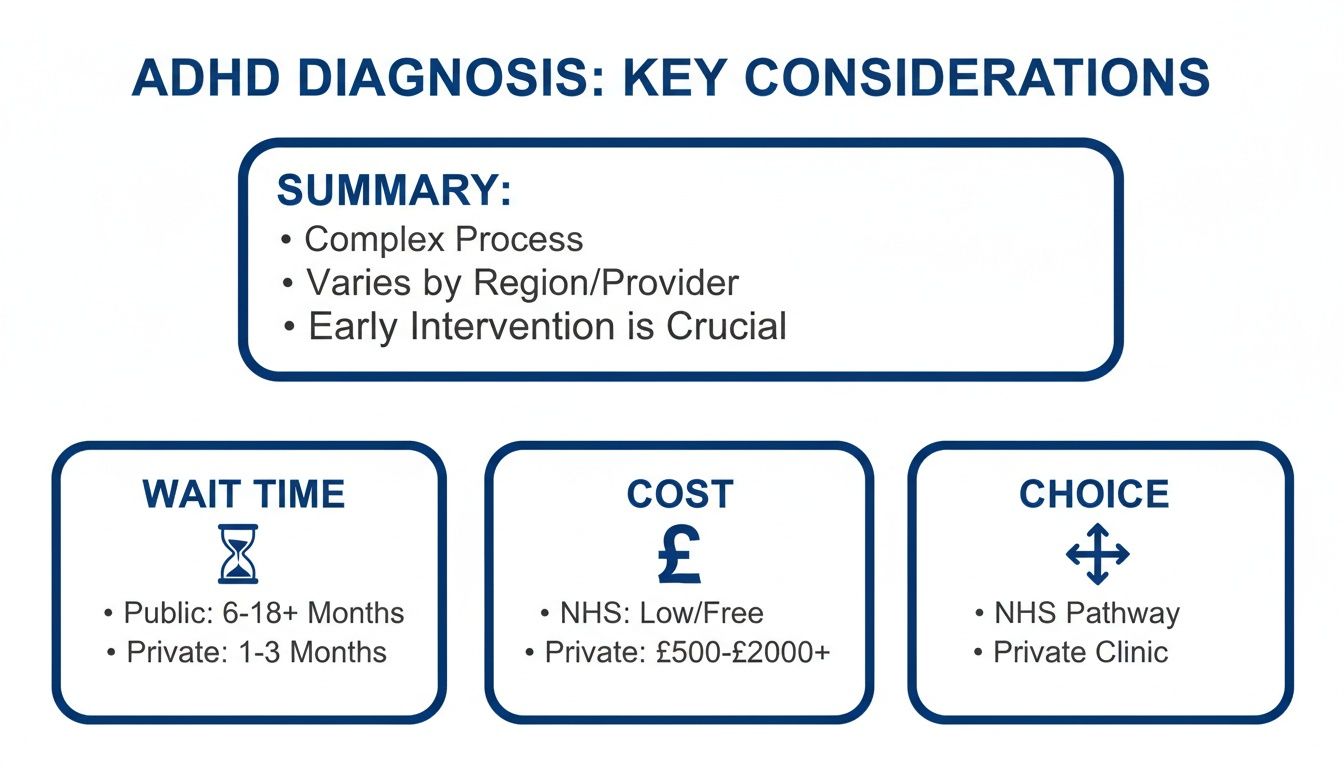
As you can see, the NHS is free at the point of care, but the hidden cost is time and a lack of choice. The private route flips that—it requires a financial investment, but in return, you get speed and control.
Taking Back Control of Your Healthcare
Choosing a private diagnosis puts you firmly in the driver's seat. You have the freedom to research clinics and find one that feels right for you. Maybe you want a specialist with experience in adult female ADHD, or perhaps a provider that offers fully online assessments to fit around your schedule.
This sense of control also applies to scheduling and the kind of support you get after your diagnosis. Some of the biggest draws of going private include:
- Speed: This is the big one. You can slash the waiting time from several years to just a few weeks or months.
- Choice of Specialist: You get to pick your clinician based on their expertise, patient reviews, or their particular approach to diagnosis and treatment.
- Flexibility: Many private clinics offer evening and weekend appointments or remote video calls, making it much easier to fit into a busy life.
A private diagnosis isn't just about skipping a queue. It’s about taking proactive control over your mental health and getting the tools and understanding you need to thrive, not just survive.
To help you compare, here's a quick breakdown of how the two paths stack up.
NHS vs Private ADHD Assessment At a Glance
| Factor | NHS Pathway | Private Pathway |
|---|---|---|
| Wait Time | Extremely long; often 2-7 years | Much shorter; typically weeks to a few months |
| Cost | Free at the point of service | Self-funded; assessments cost £700-£2000+ |
| Choice of Provider | Limited; assigned a local service | Full choice of CQC/HIS/HIW registered clinics |
| Appointment Flexibility | Minimal; usually standard office hours | High; often includes evenings, weekends, and remote options |
| Medication Costs | Standard NHS prescription charge | Private prescription costs (can be £80-£150+ per month) |
Ultimately, the choice comes down to a personal calculation of time, money, and your current circumstances. For an increasing number of adults in the UK, the upfront cost of a private diagnosis is a worthwhile investment in their immediate well-being and future.
Getting Ready for Your ADHD Assessment
Booking your private ADHD assessment is a huge milestone, but the real work begins before you even speak to the clinician. What you do now can make all the difference, helping your specialist get a truly accurate picture of what life is like for you. Think of it less as preparing for a test and more as gathering the evidence that tells your story.
When you take the time to organise your thoughts and document your struggles beforehand, you walk into that appointment feeling prepared and focused. It's the best way to make sure you don't forget the important stuff when you're on the spot.
Start Documenting Your Experiences
Clinicians need more than a gut feeling. They’re looking for concrete, real-world examples of how ADHD traits have shown up throughout your life. I always advise people to start a notebook or a digital document and just start jotting things down as they remember them.
Be specific. Instead of saying, "I'm disorganised," write about that time you missed a crucial deadline at work because you lost track of the details, and the impact it had. Or the time you completely forgot a friend's birthday, even with reminders set.
The Goal: A good assessment isn't just about your struggles today; it's about connecting them to a lifelong pattern of behaviour. The aim is to show how these traits have been present since childhood, even if they looked a bit different back then.
To make this easier for you (and the clinician), try grouping your notes by different areas of your life. This gives a structured overview and helps you cover all the bases during your appointment.
Key Areas to Focus On
- Work & Education: Did school reports call you "daydreamy" or "not living up to your potential"? At work, have performance reviews mentioned careless mistakes, issues with managing big projects, or being chronically late?
- Home & Daily Life: Think about the practical stuff. Is your home filled with "doom piles" (stuff you mean to sort out but never do)? Do you forget appointments or pay bills late, even when you have the money?
- Relationships: Has a partner ever said you don't listen? Do you find yourself getting quickly frustrated or making impulsive comments you later regret? This kind of feedback is really valuable information.
- Childhood: This part is absolutely crucial. A diagnosis requires evidence of symptoms before the age of 12. Dig out old school reports if you can. Better yet, have a chat with your parents, an older sibling, or another relative who knew you well as a child. Their memories can provide the vital evidence of early-onset symptoms that clinicians need to see.
Having a Chat with Your GP
Even if you're going fully private, it's a really smart move to loop your GP in. For one, they have your complete medical history, which any reputable clinic will want to review. But more importantly, this conversation is the first step towards getting a Shared Care Agreement after your diagnosis. This agreement can save you a fortune on medication costs down the line.
You don't need a perfectly rehearsed speech. Just be direct.
Something as simple as, "I've been struggling with focus and organisation for years, and I suspect it might be ADHD. The NHS waits are very long, so I'm looking into a private assessment and just wanted to let you know," is perfectly fine.
Before you go, it helps to be prepared. Some clinics provide a useful ADHD referral form on their website which can guide you on what information to gather. Bringing a short list of your main symptoms, with a couple of clear examples for each, shows you've taken this seriously and helps make the appointment productive for everyone.
Choosing the Right Private ADHD Clinic for You
Finding a trustworthy clinic for a private ADHD diagnosis in the UK can feel like searching for a needle in a haystack. There are so many options out there, each with its own slick website and confusing price list. It's easy to get bogged down.
The secret is to look past the headline cost and figure out what you’re actually getting for your money. You need to be sure the service is not only credible but also a good fit for you. Making a careful choice now can save a world of stress, time, and money down the line, especially when it comes to things like medication and getting your GP on board. It all starts with asking the right questions.
Who Will Be Assessing You and Why It Matters
One of the very first things you should check is who, exactly, will be conducting your assessment. It’s usually either a consultant psychiatrist or a specialist nurse practitioner who's an expert in ADHD. While both are qualified to give a diagnosis, there are some important differences to be aware of.
Consultant Psychiatrists: These are medical doctors who have gone on to specialise in psychiatry. A diagnosis from a psychiatrist, especially one on the General Medical Council's (GMC) Specialist Register, is often considered the 'gold standard'. This can make it much easier for your GP to agree to a Shared Care Agreement for your medication later on.
Specialist Nurses: These professionals are highly trained and have a wealth of experience in diagnosing and managing ADHD. They provide excellent care, but it’s a smart move to check with your GP surgery first to see if they’re happy to enter a shared care arrangement based on a nurse-led diagnosis.
This isn’t about one professional being "better" than the other. It's all about making sure your path to ongoing treatment is as smooth as possible. A quick, two-minute phone call to your GP's receptionist to ask about their policy can prevent a massive headache later.
What a Good Assessment Package Includes
A rock-bottom assessment fee might look tempting, but it can be a huge red flag if key components are missing. A proper private ADHD diagnosis should be a complete package, not just a quick chat.
Stick with clinics that are completely transparent about what their fee covers. A truly comprehensive service should always include:
- Pre-assessment Screening: This usually means filling out detailed questionnaires before your appointment. It gives the clinician a solid background on your history and challenges.
- The Full Clinical Assessment: This is the main event – the diagnostic interview itself. It should last anywhere from 90 minutes to 3 hours and be carried out by a qualified professional following NICE guidelines.
- A Detailed Diagnostic Report: This document is absolutely vital. It needs to clearly state the diagnosis (or lack of one), explain the clinical reasoning behind it, and offer personalised recommendations for treatment and support.
- A Post-diagnosis Follow-up: This is your chance to go through the report, ask any questions you have, and plan the next steps, whether that's medication titration or therapy.
Be very wary of services that offer a cheap "assessment-only" deal. You could easily end up with a flimsy report that isn’t detailed enough for your GP to act on, forcing you to pay all over again for a proper assessment somewhere else.
How to Verify a Clinic's Credentials
This is the big one. In the UK, every independent healthcare provider has to be registered with a regulatory body. This is completely non-negotiable.
- For clinics in England, they must be registered with the Care Quality Commission (CQC).
- In Scotland, the regulator is Healthcare Improvement Scotland (HIS).
- In Wales, you're looking for registration with Healthcare Inspectorate Wales (HIW).
You can pop onto the regulator's official website and search for the clinic's name in seconds. If they're not on the list, walk away. Simple as that. This registration means the clinic is held to strict standards of safety and quality.
Once you've confirmed they're legit, look for real-world feedback. Don't just read the glowing testimonials on the clinic's own website. Head over to independent review sites like Trustpilot and check their Google Reviews. Hearing about other people's genuine experiences gives you invaluable insight into how the clinic communicates, their level of professionalism, and what their aftercare is really like.
Before you commit, it's wise to have a checklist of questions ready. This ensures you're comparing apples with apples and that there are no hidden surprises.
Key Questions to Ask a Private ADHD Clinic
Here’s a quick checklist of essential questions to ask any clinic you're considering. Their answers will tell you a lot about the quality and suitability of their service.
| Question Category | Specific Question to Ask | Why It Matters |
|---|---|---|
| Assessment & Diagnosis | Who will conduct my assessment (Psychiatrist, Nurse)? Are they on the GMC Specialist Register? | GP acceptance for shared care can depend heavily on the clinician's credentials. |
| Service Inclusions | Does the assessment fee include the full diagnostic report and a follow-up consultation? | Avoids hidden costs and ensures you get the necessary documents and support post-diagnosis. |
| Medication & Titration | If I am diagnosed, is medication titration included in the initial cost or is it extra? What are the monthly fees? | Titration costs can add up quickly. You need a clear picture of the total financial commitment. |
| Shared Care | What is your success rate with getting Shared Care Agreements accepted by NHS GPs? | An experienced clinic will have a solid process and reports designed for smooth handover to the NHS. |
| Timelines | What is the current waiting time from booking to assessment, and from assessment to receiving the report? | Helps you manage your expectations and plan accordingly. Long waits can be a sign of a clinic being overstretched. |
| Regulatory Compliance | Can you confirm you are registered with the CQC (or HIS/HIW)? | This is a non-negotiable check to ensure the clinic meets national standards for safety and quality. |
Getting all this information upfront helps you make a truly informed decision, not just a guess. To help you compare your options, our directory provides a detailed look at some of the best private ADHD clinics in the UK, complete with verified reviews and service details.
Ultimately, choosing a clinic is a personal decision. But by checking their credentials, understanding who you'll be speaking to, and clarifying exactly what's included, you can ensure your investment leads to a credible diagnosis and a clear path forward.
Breaking Down the True Cost of Private ADHD Care
So, you’ve seen the headline price for a private ADHD assessment. It’s important to know that this is just the starting line. The real financial picture—the one you need for proper budgeting—involves everything that comes after the diagnosis, especially if you plan to explore medication.
Think of it less as a one-off payment and more as a complete care pathway. The total cost can swing wildly between clinics, all depending on their package structure, prescribing policies, and how they handle ongoing support. Let's get into what that actually looks like.

Beyond the Initial Assessment Fee
A private ADHD diagnosis in the UK is a journey, not a single transaction. Once you have that diagnostic report in hand, a new set of costs often comes into play, particularly around medication.
Here’s a realistic breakdown of what to factor into your budget:
- Medication Titration: This is the critical phase where you and a specialist figure out the right medication and dose for you. It's an intensive process involving several check-ins, and the cost reflects that. Expect to pay anywhere from £200 to £600, sometimes more, depending on how many appointments it takes to get it right.
- Follow-Up Appointments: Regular check-ins are standard, both during titration and for annual reviews afterwards. These consultations typically cost between £150 and £350 a session.
- Private Prescriptions: This is the big one. Until you can get a Shared Care Agreement sorted, you’ll be paying the full private price for your medication. This can easily be £80 to £150 a month, depending on what you're prescribed.
Why is private care so in demand? It’s a direct result of the squeeze on the NHS. Astonishingly, only 0.32% of over 9 million GP records show an ADHD diagnosis. With millions potentially undiagnosed and unsupported, it’s no wonder people are seeking alternatives. You can read more on ADHD statistics to grasp the full scale of the diagnosis gap.
The Game-Changer: A Shared Care Agreement
A Shared Care Agreement (SCA) is your golden ticket to making long-term treatment affordable. It's essentially a formal handover from your private specialist to your NHS GP.
Once an SCA is in place, your GP takes over writing your prescriptions. You go from paying the full private cost to just the standard NHS prescription charge. It’s a huge saving. For this to happen, though, your GP has to trust the private diagnosis. This is exactly why choosing a clinic that provides a robust, NICE-guideline-compliant report is non-negotiable. After your medication is stable, the private clinic will formally reach out to your GP to request the agreement.
What to Do If Your GP Is Hesitant
It’s not always a smooth process. GPs aren't required to accept an SCA and some will refuse. Their reasons can vary—from workload pressures and unfamiliarity with the private provider to restrictive local NHS policies.
If you hit this roadblock, don't despair. You have options.
- Have a Conversation: Book an appointment specifically to discuss their concerns. Go in prepared with your full diagnostic report and show them the correspondence from your specialist. A calm, informed chat can make all the difference.
- Get Your Clinic Involved: Your private provider should be more than willing to speak directly to your GP’s surgery to answer clinical questions and offer reassurance.
- Look for a Different GP: You always have the right to register with another practice. A great tip is to ask in local online ADHD support groups. People are often happy to recommend GPs in your area known for being supportive of SCAs.
Managing these costs can feel overwhelming, but many clinics get it. It’s worth looking into providers who offer flexible payment plans for ADHD assessments, which can really help spread the financial load.
What Happens During and After Your Assessment
The day of your ADHD assessment can feel like a pretty big moment. It's completely normal to feel a bit on edge, but knowing what's coming – both during the appointment and afterwards – can really help take the mystery out of it. A good assessment isn't about trying to catch you out; it's a joint effort to build an honest, accurate picture of your life.
Whether you’re seeing someone in person or on a video call, the core of the assessment is pretty much the same. The clinician’s job is to listen and steer the conversation, making it easier for you to share what they need to know.
Inside the Assessment Itself
At the heart of any private ADHD diagnosis is a long, detailed clinical interview. The specialist will ask you a lot of open-ended questions about your life, starting right back in childhood and working their way through your school days, career, and relationships. It’s a crucial part of the diagnostic criteria to see if your symptoms have been around since you were young.
You can expect to be asked about real-life situations, like:
- Organisation: How do you keep on top of things? Are you constantly losing your keys, phone, or wallet?
- Focus: What happens when you’re in a long meeting or try to read a book? Does your mind tend to drift off?
- Impulsivity: Do you find yourself interrupting people or making rash decisions you wish you could take back?
- Emotional Control: How do you cope with frustration or unexpected setbacks? Do you have really intense mood swings?
They'll also go over any questionnaires you filled out beforehand and look at old school reports or feedback from your partner if you were able to provide them. This isn't an interrogation, it's just a conversation. The more open and honest you can be, even about stuff that feels a bit embarrassing, the more accurate the outcome will be.
Remember, the specialist is piecing together a lifelong puzzle. A single symptom isn't enough for a diagnosis; they are looking for a consistent pattern of traits that significantly impact multiple areas of your life.
Getting Your Diagnostic Report
You probably won’t get an answer right there and then. The clinician needs time to pull everything together – the notes from your interview, the questionnaire results, and any other documents – into a single, comprehensive report. Honestly, this document is the most important thing you’ll get from the whole process.
A solid diagnostic report should be several pages long and packed with detail. It will usually cover:
- Your Background: A summary of your developmental, medical, and social history.
- Clinical Findings: A breakdown of how your experiences line up with the official diagnostic criteria for ADHD.
- The Conclusion: A clear statement confirming or ruling out ADHD, with the clinical reasoning behind it.
- Personalised Recommendations: This part is vital. It should suggest practical next steps, like medication, therapy (such as CBT), workplace adjustments under the Equality Act, or ADHD coaching.
This report is your golden ticket to getting support. It’s what you’ll show your GP to get a Shared Care Agreement sorted and what you’ll use to ask for reasonable adjustments at work. If a report looks a bit thin or vague, there’s a risk the NHS won’t accept it.
What to Do After a Diagnosis
Getting a private ADHD diagnosis in the UK can be a huge relief – a moment of real validation. But it's also just the starting line. The next phase is all about taking action and building the right support system for you.
If medication is recommended and you decide to go for it, the next step is titration. This is the carefully managed process where you and your specialist find the right type of medication and the perfect dose. It’s not a quick fix; it can take several weeks, or sometimes a few months, of regular check-ins to get it just right.
Beyond medication, that report unlocks other types of help. You can now look into ADHD-specific therapy to build coping strategies, find a coach to help with executive function skills, and have confident discussions about your needs at university or in the workplace. The journey from that first assessment to feeling fully supported is a process, but getting a clear diagnosis is the essential first step that makes everything else possible.
Next Steps: Finding Support and Building Your Toolkit
Taking the step to get a private ADHD diagnosis in the UK is a massive milestone. It's not just about getting a label; it’s about finally getting answers and figuring out how to move forward in a way that works for you. You're now equipped with the knowledge to find the right clinic and prepare for your assessment, so let's turn that into action.
This is your roadmap. The goal isn't just to get through the assessment, but to come out the other side feeling empowered and ready for what comes next.

UK Charities and Communities You Can Trust
Remember, you don't have to figure this all out by yourself. There are some incredible UK-based charities and communities packed with people who just get it. They offer a goldmine of free, reliable information and support, both before you get a diagnosis and long after.
- ADHD UK: This is a brilliant charity run by people with ADHD, for people with ADHD. You'll find support groups, practical advice, and a real sense of community.
- The ADHD Foundation Neurodiversity Charity: A fantastic resource for information, they also do a lot of work with schools and businesses to raise awareness and improve understanding.
- Local Support Groups Online: Don’t underestimate the power of local knowledge. Facebook often has really active ADHD groups for specific towns or counties. They can be invaluable for getting recommendations for understanding GPs or just sharing experiences with neighbours.
It’s More Than Just a Medical Report
A diagnosis is a powerful tool, but it's the start, not the end. It opens doors to so much more than just medication, giving you access to non-medical support that can genuinely change your day-to-day life.
Think of your diagnosis not as a label, but as a key. It gives you the language—and the legal backing—to ask for what you need at work or in your studies, finally levelling the playing field.
Once you have your report, it's worth looking into things like:
- ADHD Coaching: A good coach won't just tell you what to do. They'll work with you to build practical, real-world strategies for tackling challenges with time management, organisation, and focus.
- Workplace Accommodations: ADHD can be considered a disability under the Equality Act 2010. This is huge. It means you have a legal right to ask for "reasonable adjustments" at work, like flexible hours, noise-cancelling headphones, or getting instructions in writing.
By taking these next steps and connecting with the right support, you can turn a clinical diagnosis into a practical, powerful plan for building a life that truly works for you.
Got Questions? We've Got Answers
Thinking about a private ADHD assessment can feel like a big step, and it's natural to have a lot of questions swirling around. Let's tackle some of the most common ones we hear from people navigating this path in the UK.
Will the NHS Even Recognise a Private Diagnosis?
This is probably the biggest question on everyone's mind, and the short answer is: generally, yes. As long as your assessment is carried out by a qualified psychiatrist who sticks to the official NICE guidelines, the diagnosis itself should be perfectly valid.
The real test, however, comes when you try to arrange a Shared Care Agreement with your GP for medication. This is where a high-quality, comprehensive diagnostic report from your clinic is worth its weight in gold. Your GP has the final say, and a detailed, professionally prepared report makes it much easier for them to say "yes".
What's This "Right to Choose" I Keep Hearing About?
If you're in England, Right to Choose is a game-changer. It’s your legal right to ask your GP for a referral to a specific provider that has a contract with the NHS, even if they're a private organisation like Psychiatry-UK or ADHD 360.
You get the assessment and subsequent treatment on the NHS, meaning you don't pay a penny. The waiting lists are often dramatically shorter than going through your local NHS mental health service. It’s a fantastic middle-ground option that’s definitely worth looking into.
Think of Right to Choose as a way to access the speed of the private sector, but with NHS funding. You get more control without the cost.
I Live in the Middle of Nowhere. Can I Still Get Assessed?
Absolutely. This is where modern healthcare really shines. The widespread adoption of online assessments means your postcode is no longer a barrier to getting help.
Most reputable clinics now offer comprehensive assessments via secure video calls. So, whether you're in a tiny village in the Peak District or a remote corner of Wales, you have access to the same top-tier specialists as someone in central London. Just make sure the clinic you're looking at offers a fully remote service.