Chart pack · 21 September 2026
Private ADHD care in charts, September 2026
Every chart from our September 2026 research on private ADHD clinics in the UK, in one place. Each one carries its own source line, the figures as a table, the CSV behind it, an image, and a link to the section explaining how it was counted.
The charts are free to republish with credit to ADHD Private and a link to this page. The study they come from is Who checks private ADHD clinics? and the clinic-level data behind it is published in full at /data/uk-private-adhd-standards-2026-09.
Which total is this a share of?
Different questions have different denominators, and quoting a share against the wrong one is the easiest mistake to make with this data. Every population used on this page is listed here, and each chart states its own beneath the picture.
Populations used on this page
| Population | Clinics | What it is |
|---|---|---|
| Clinics listed on ADHD Private | 342 | The population for regulator status and Right to Choose. |
| Clinic websites we could read | 337 | 5 sites needed JavaScript we do not run, or blocked us. |
| Clinics searched on the CQC register | 304 | Those with a presence in England. CQC covers England only. |
| Clinics with a presence outside England | 46 | Checked against the Scottish, Welsh and Northern Irish registers. |
| Clinics whose adult appointment length we could classify | 99 | A stated length on the adult pathway, read against one written rule. |
| Of those, with a figure in minutes | 69 | A single comparable contact time, rather than a range or a session count. |
| Adult pathways read for online or in person | 297 | Clinics whose readable site describes an adult pathway. |
| Clinics in the July 2026 price study | 332 | A different, earlier population. July figures are never mixed with these. |
Two rules for reading every number here. Not stated is not the same as not done: most of these counts record what a clinic publishes, and a clinic that says nothing may still do the thing. Unmatched is not unregistered: a clinic we could not match to a register entry may need no registration at all.
How many private ADHD providers there are, and how fast that is growing
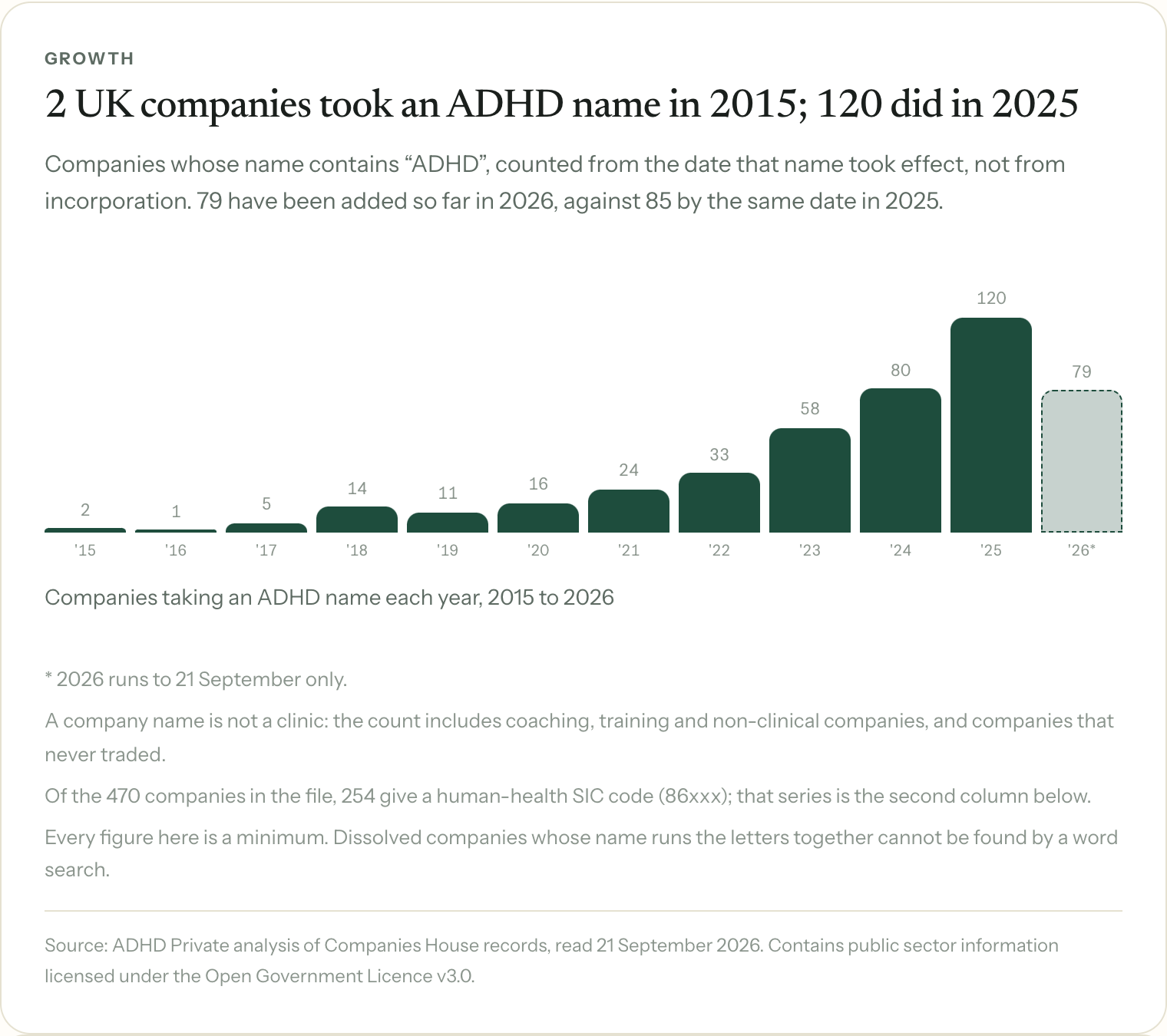
There is no register of private ADHD providers, so there is no true total. What can be counted is companies: those that carry ADHD in their name on the Companies House register, dated from the day that name took effect rather than from incorporation. A company is not a clinic, and every count here is a minimum.
Growth
2 UK companies took an ADHD name in 2015; 120 did in 2025
Companies whose name contains “ADHD”, counted from the date that name took effect, not from incorporation. 79 have been added so far in 2026, against 85 by the same date in 2025.
- * 2026 runs to 21 September only.
- A company name is not a clinic: the count includes coaching, training and non-clinical companies, and companies that never traded.
- Of the 470 companies in the file, 254 give a human-health SIC code (86xxx); that series is the second column below.
- Every figure here is a minimum. Dissolved companies whose name runs the letters together cannot be found by a word search.
Source: ADHD Private analysis of Companies House records, read 21 September 2026. Contains public sector information licensed under the Open Government Licence v3.0.
View the figures as a table
| Year | ADHD-named companies | Of which health SIC 86xxx |
|---|---|---|
| 2,015 | 2 | 1 |
| 2,016 | 1 | 0 |
| 2,017 | 5 | 1 |
| 2,018 | 14 | 9 |
| 2,019 | 11 | 4 |
| 2,020 | 16 | 7 |
| 2,021 | 24 | 16 |
| 2,022 | 33 | 21 |
| 2,023 | 58 | 24 |
| 2,024 | 80 | 41 |
| 2,025 | 120 | 83 |
| 2,026 | 79 | 40 |
Download this chart’s data (CSV)Download the image (PNG)How this was counted
Growth
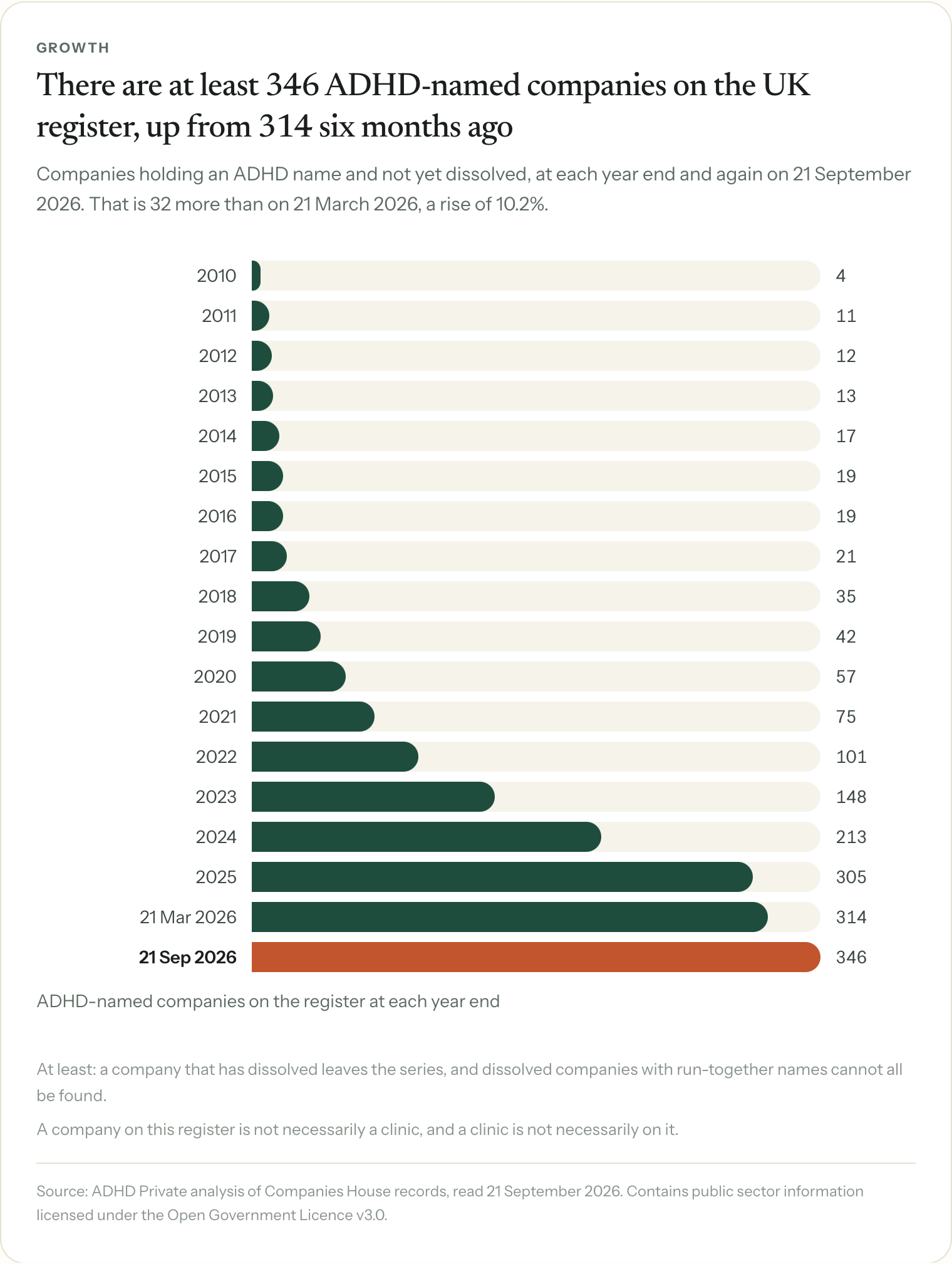
There are at least 346 ADHD-named companies on the UK register, up from 314 six months ago
Companies holding an ADHD name and not yet dissolved, at each year end and again on 21 September 2026. That is 32 more than on 21 March 2026, a rise of 10.2%.
- At least: a company that has dissolved leaves the series, and dissolved companies with run-together names cannot all be found.
- A company on this register is not necessarily a clinic, and a clinic is not necessarily on it.
Source: ADHD Private analysis of Companies House records, read 21 September 2026. Contains public sector information licensed under the Open Government Licence v3.0.
View the figures as a table
| Date | ADHD-named companies on the register |
|---|---|
| 2010 | 4 |
| 2011 | 11 |
| 2012 | 12 |
| 2013 | 13 |
| 2014 | 17 |
| 2015 | 19 |
| 2016 | 19 |
| 2017 | 21 |
| 2018 | 35 |
| 2019 | 42 |
| 2020 | 57 |
| 2021 | 75 |
| 2022 | 101 |
| 2023 | 148 |
| 2024 | 213 |
| 2025 | 305 |
| 21 Mar 2026 | 314 |
| 21 Sep 2026 | 346 |
Download this chart’s data (CSV)Download the image (PNG)How this was counted
Growth
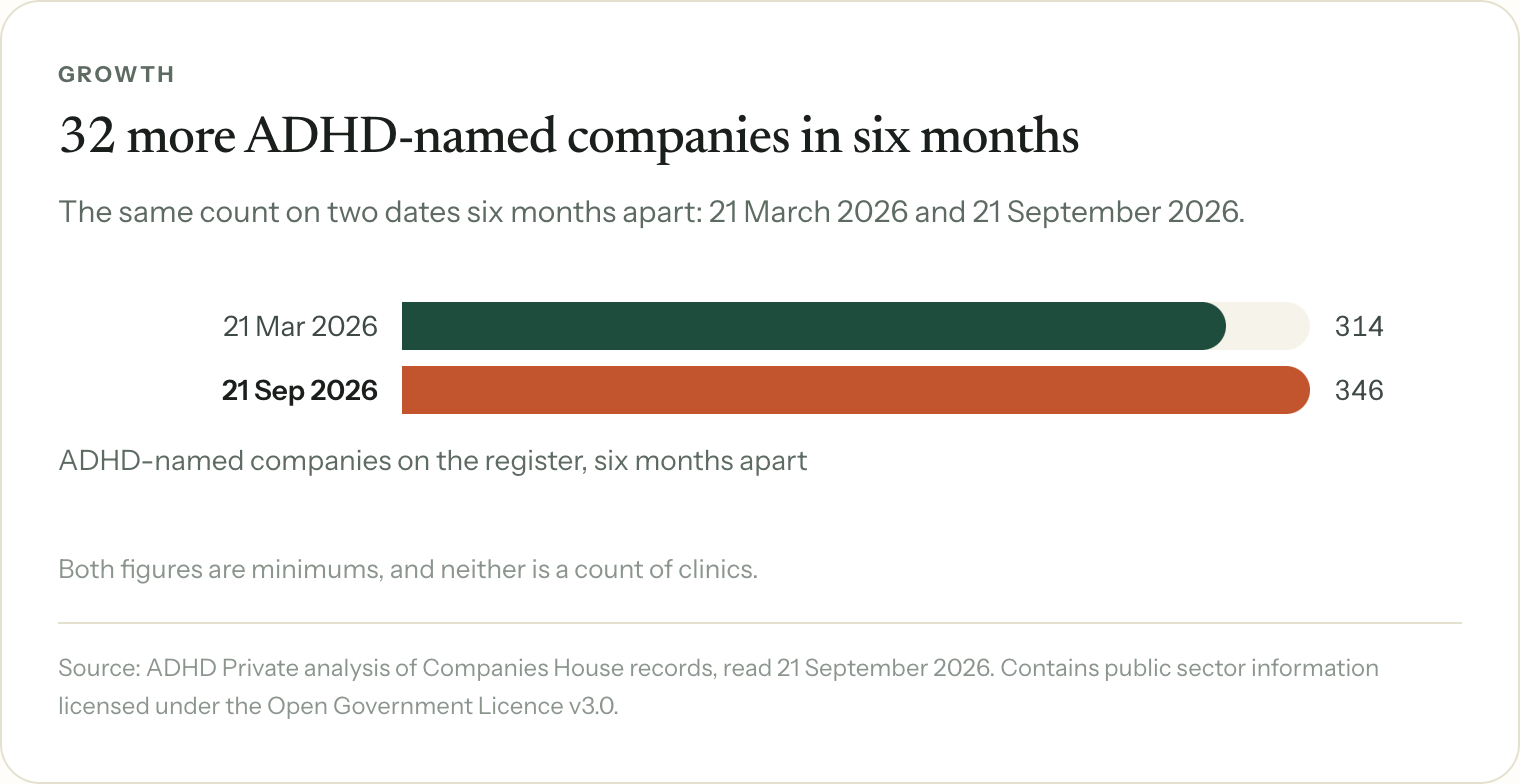
32 more ADHD-named companies in six months
The same count on two dates six months apart: 21 March 2026 and 21 September 2026.
- Both figures are minimums, and neither is a count of clinics.
Source: ADHD Private analysis of Companies House records, read 21 September 2026. Contains public sector information licensed under the Open Government Licence v3.0.
View the figures as a table
| Date | ADHD-named companies on the register |
|---|---|
| 21 Mar 2026 | 314 |
| 21 Sep 2026 | 346 |
Download this chart’s data (CSV)Download the image (PNG)How this was counted
Growth
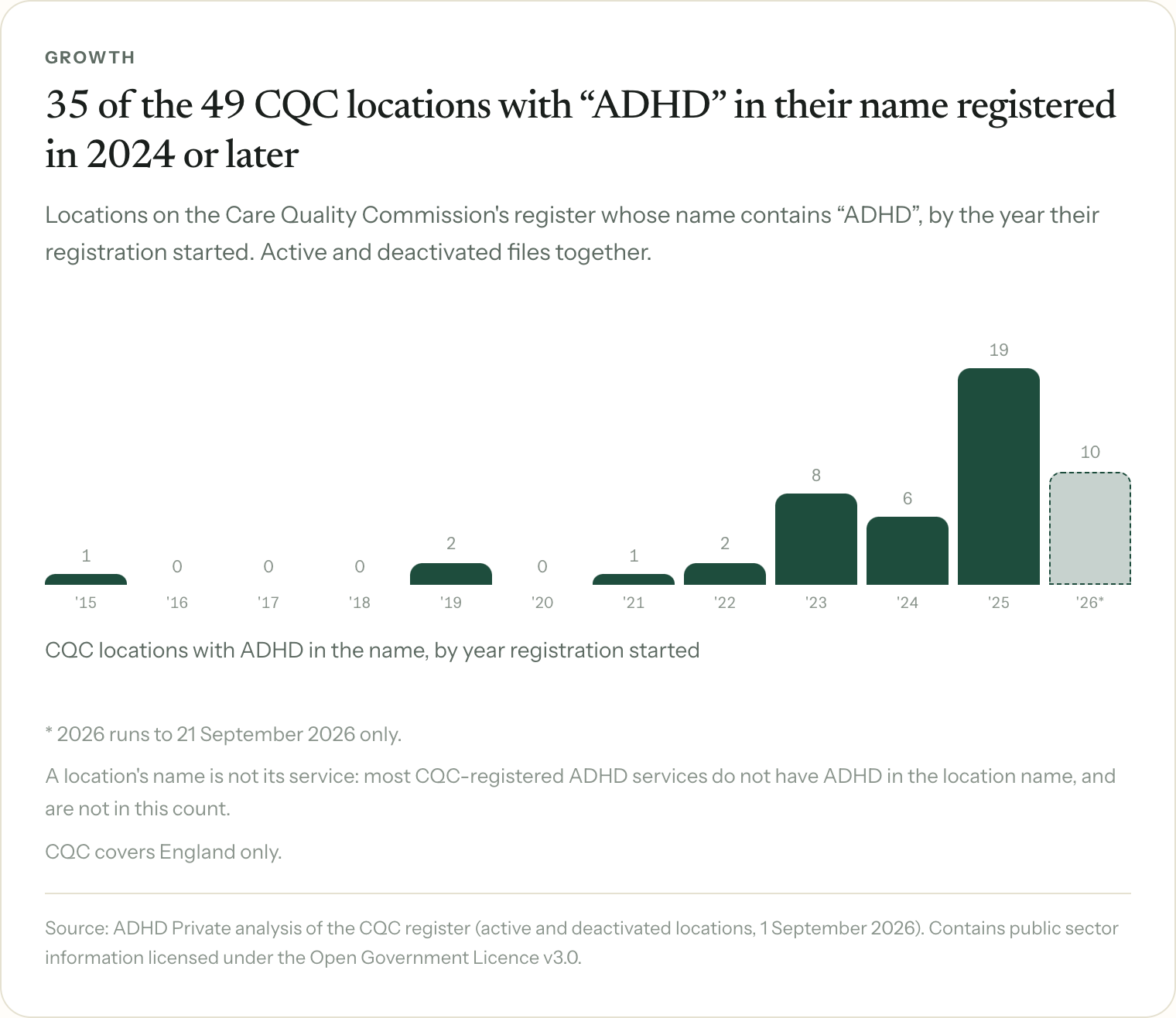
35 of the 49 CQC locations with “ADHD” in their name registered in 2024 or later
Locations on the Care Quality Commission's register whose name contains “ADHD”, by the year their registration started. Active and deactivated files together.
- * 2026 runs to 21 September 2026 only.
- A location's name is not its service: most CQC-registered ADHD services do not have ADHD in the location name, and are not in this count.
- CQC covers England only.
Source: ADHD Private analysis of the CQC register (active and deactivated locations, 1 September 2026). Contains public sector information licensed under the Open Government Licence v3.0.
View the figures as a table
| Year registration started | Locations |
|---|---|
| 2,015 | 1 |
| 2,016 | 0 |
| 2,017 | 0 |
| 2,018 | 0 |
| 2,019 | 2 |
| 2,020 | 0 |
| 2,021 | 1 |
| 2,022 | 2 |
| 2,023 | 8 |
| 2,024 | 6 |
| 2,025 | 19 |
| 2,026 | 10 |
Download this chart’s data (CSV)Download the image (PNG)How this was counted
Who checks them
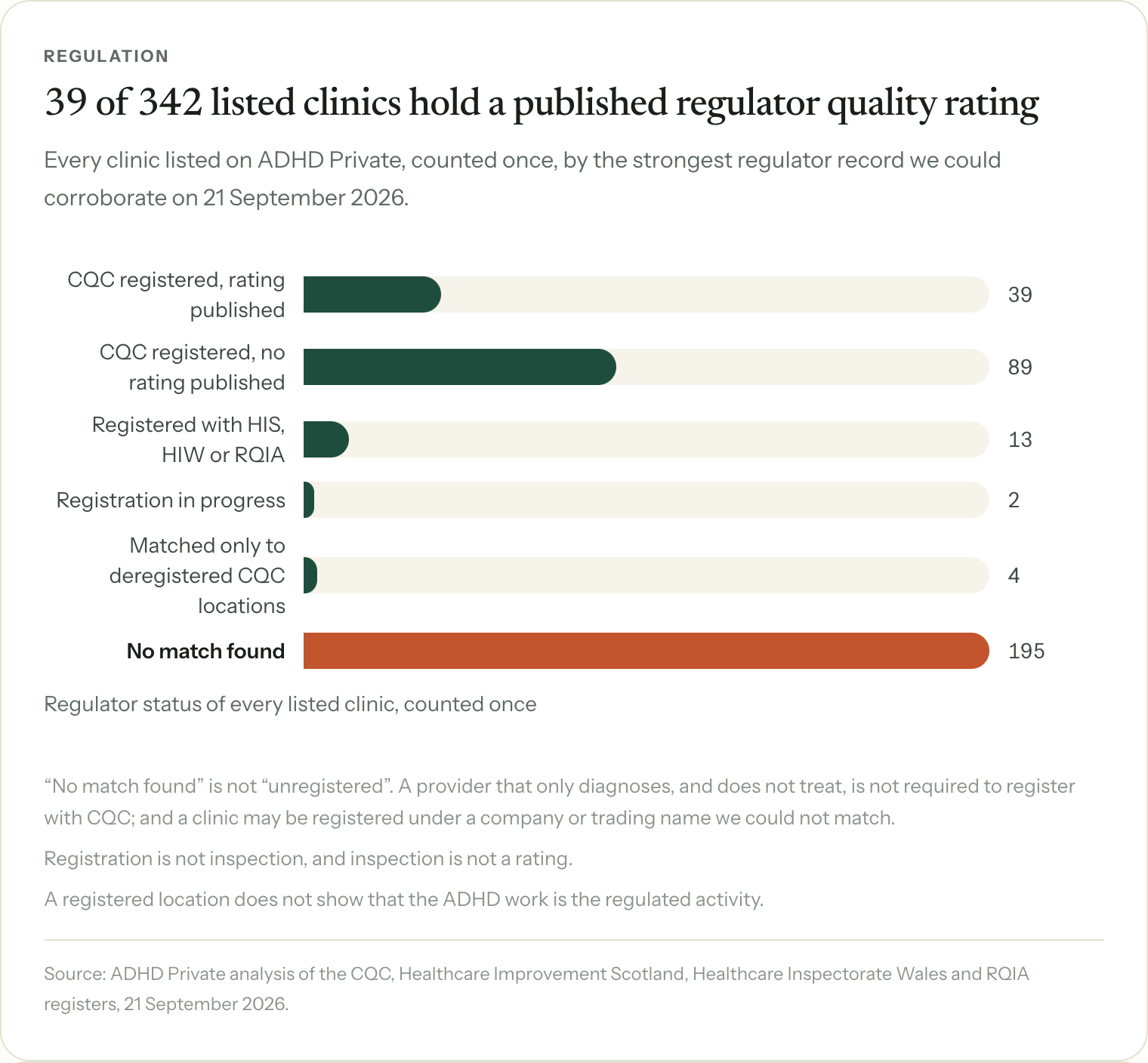
Each of the 342 clinics we list was searched by hand against the register that covers it: the Care Quality Commission in England, and Healthcare Improvement Scotland, Healthcare Inspectorate Wales or the RQIA elsewhere. A clinic is counted once. No match is not the same as no registration — a provider that only diagnoses, without any treatment, is outside CQC's scope and needs no registration at all.
Regulation
39 of 342 listed clinics hold a published regulator quality rating
Every clinic listed on ADHD Private, counted once, by the strongest regulator record we could corroborate on 21 September 2026.
- “No match found” is not “unregistered”. A provider that only diagnoses, and does not treat, is not required to register with CQC; and a clinic may be registered under a company or trading name we could not match.
- Registration is not inspection, and inspection is not a rating.
- A registered location does not show that the ADHD work is the regulated activity.
Source: ADHD Private analysis of the CQC, Healthcare Improvement Scotland, Healthcare Inspectorate Wales and RQIA registers, 21 September 2026.
View the figures as a table
| Regulator status | Clinics | % of listed clinics |
|---|---|---|
| CQC registered, rating published | 39 | 11.4 |
| CQC registered, no rating published | 89 | 26 |
| Registered with HIS, HIW or RQIA | 13 | 3.8 |
| Registration in progress | 2 | 0.6 |
| Matched only to deregistered CQC locations | 4 | 1.2 |
| No match found | 195 | 57 |
Download this chart’s data (CSV)Download the image (PNG)How this was counted
Regulation
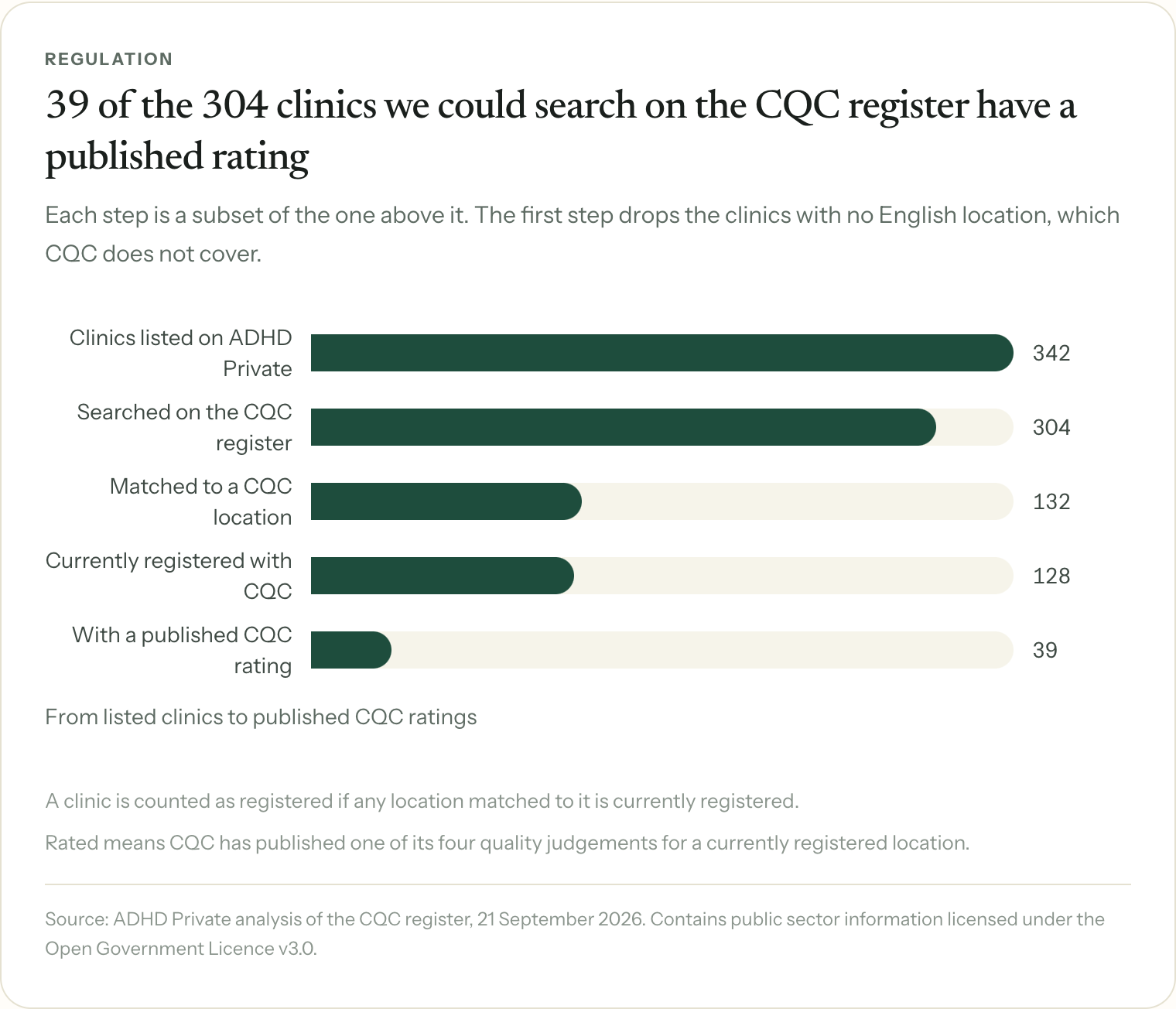
39 of the 304 clinics we could search on the CQC register have a published rating
Each step is a subset of the one above it. The first step drops the clinics with no English location, which CQC does not cover.
- A clinic is counted as registered if any location matched to it is currently registered.
- Rated means CQC has published one of its four quality judgements for a currently registered location.
Source: ADHD Private analysis of the CQC register, 21 September 2026. Contains public sector information licensed under the Open Government Licence v3.0.
View the figures as a table
| Step | Clinics |
|---|---|
| Clinics listed on ADHD Private | 342 |
| Searched on the CQC register | 304 |
| Matched to a CQC location | 132 |
| Currently registered with CQC | 128 |
| With a published CQC rating | 39 |
Download this chart’s data (CSV)Download the image (PNG)How this was counted
What clinics show about who their clinicians are
Every figure here is what a clinic publishes about itself, read from its own website with the sentence stored beside it. It is a count of what is displayed, not a check of whether it is true: we did not verify a single registration, and a clinic that shows nothing may still employ registered clinicians. No accreditation scheme is specific to ADHD assessment, so an accreditation claim points at a general scheme, at a body that runs none, or at nothing named at all.
Credentials
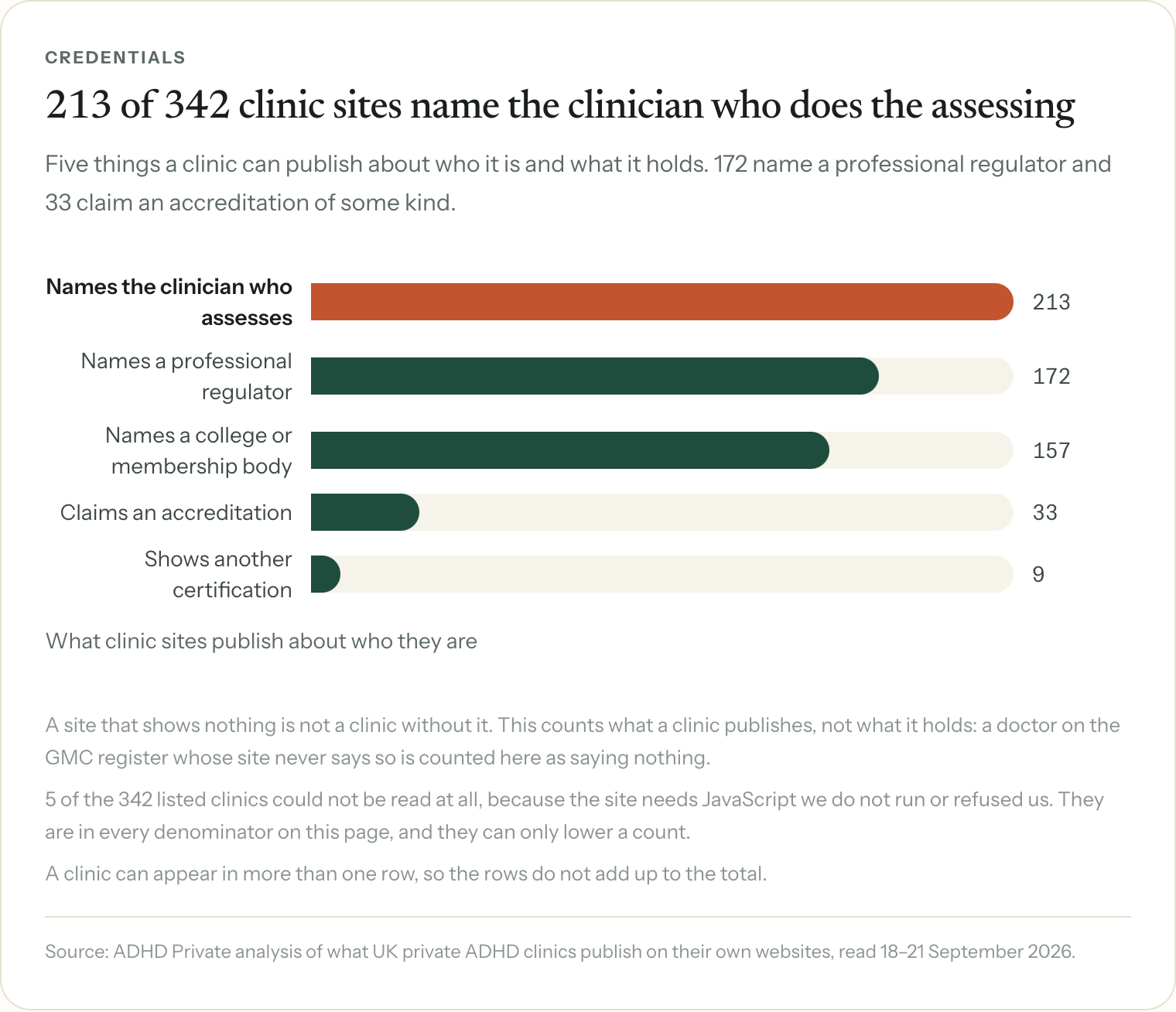
213 of 342 clinic sites name the clinician who does the assessing
Five things a clinic can publish about who it is and what it holds. 172 name a professional regulator and 33 claim an accreditation of some kind.
- A site that shows nothing is not a clinic without it. This counts what a clinic publishes, not what it holds: a doctor on the GMC register whose site never says so is counted here as saying nothing.
- 5 of the 342 listed clinics could not be read at all, because the site needs JavaScript we do not run or refused us. They are in every denominator on this page, and they can only lower a count.
- A clinic can appear in more than one row, so the rows do not add up to the total.
Source: ADHD Private analysis of what UK private ADHD clinics publish on their own websites, read 18–21 September 2026.
View the figures as a table
| What the site shows | Clinics | % of listed clinics |
|---|---|---|
| Names the clinician who assesses | 213 | 62.3 |
| Names a professional regulator | 172 | 50.3 |
| Names a college or membership body | 157 | 45.9 |
| Claims an accreditation | 33 | 9.6 |
| Shows another certification | 9 | 2.6 |
Download this chart’s data (CSV)Download the image (PNG)How this was counted
Credentials
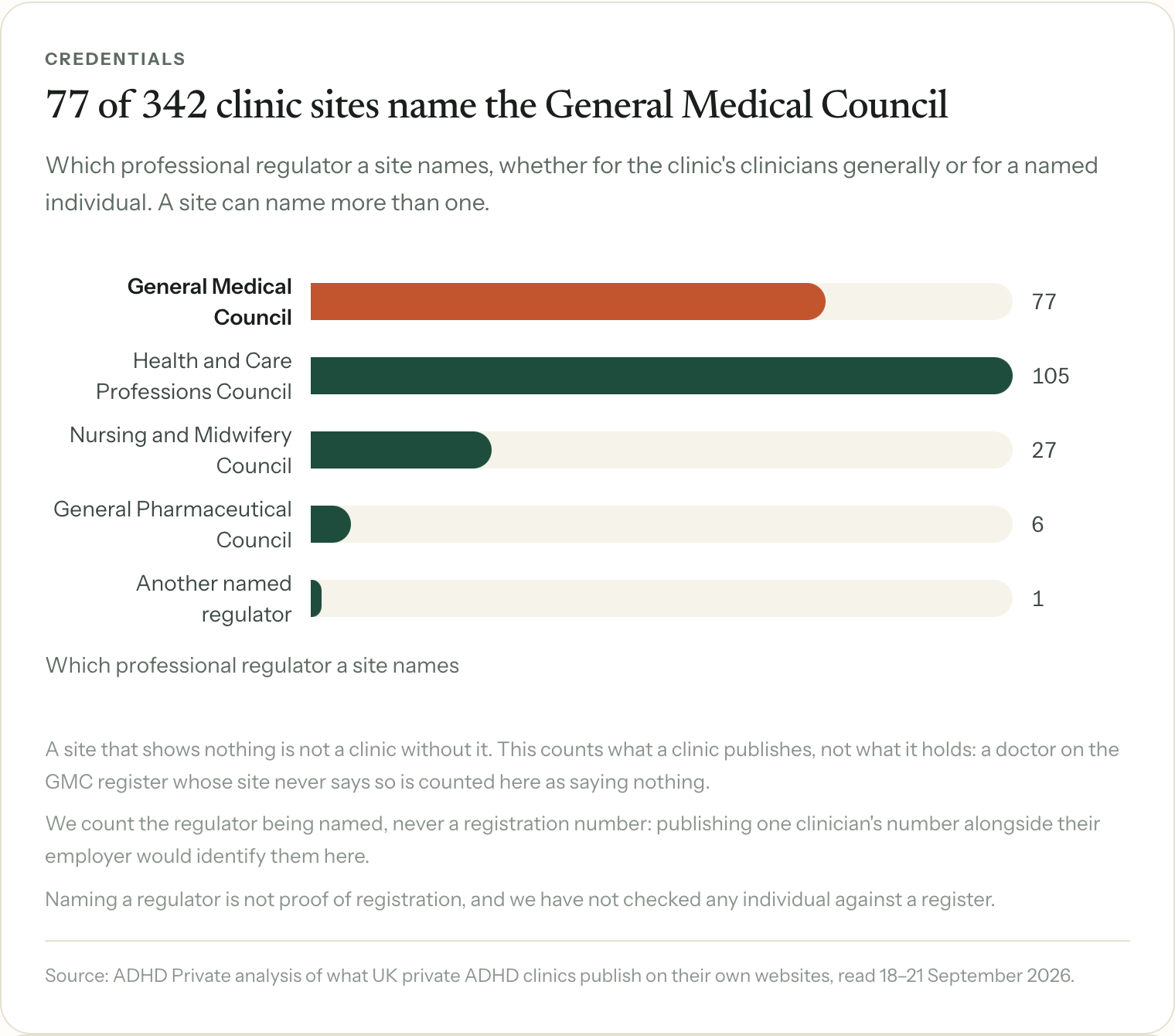
77 of 342 clinic sites name the General Medical Council
Which professional regulator a site names, whether for the clinic's clinicians generally or for a named individual. A site can name more than one.
- A site that shows nothing is not a clinic without it. This counts what a clinic publishes, not what it holds: a doctor on the GMC register whose site never says so is counted here as saying nothing.
- We count the regulator being named, never a registration number: publishing one clinician's number alongside their employer would identify them here.
- Naming a regulator is not proof of registration, and we have not checked any individual against a register.
Source: ADHD Private analysis of what UK private ADHD clinics publish on their own websites, read 18–21 September 2026.
View the figures as a table
| Regulator named | Clinics |
|---|---|
| General Medical Council | 77 |
| Health and Care Professions Council | 105 |
| Nursing and Midwifery Council | 27 |
| General Pharmaceutical Council | 6 |
| Another named regulator | 1 |
Download this chart’s data (CSV)Download the image (PNG)How this was counted
Credentials
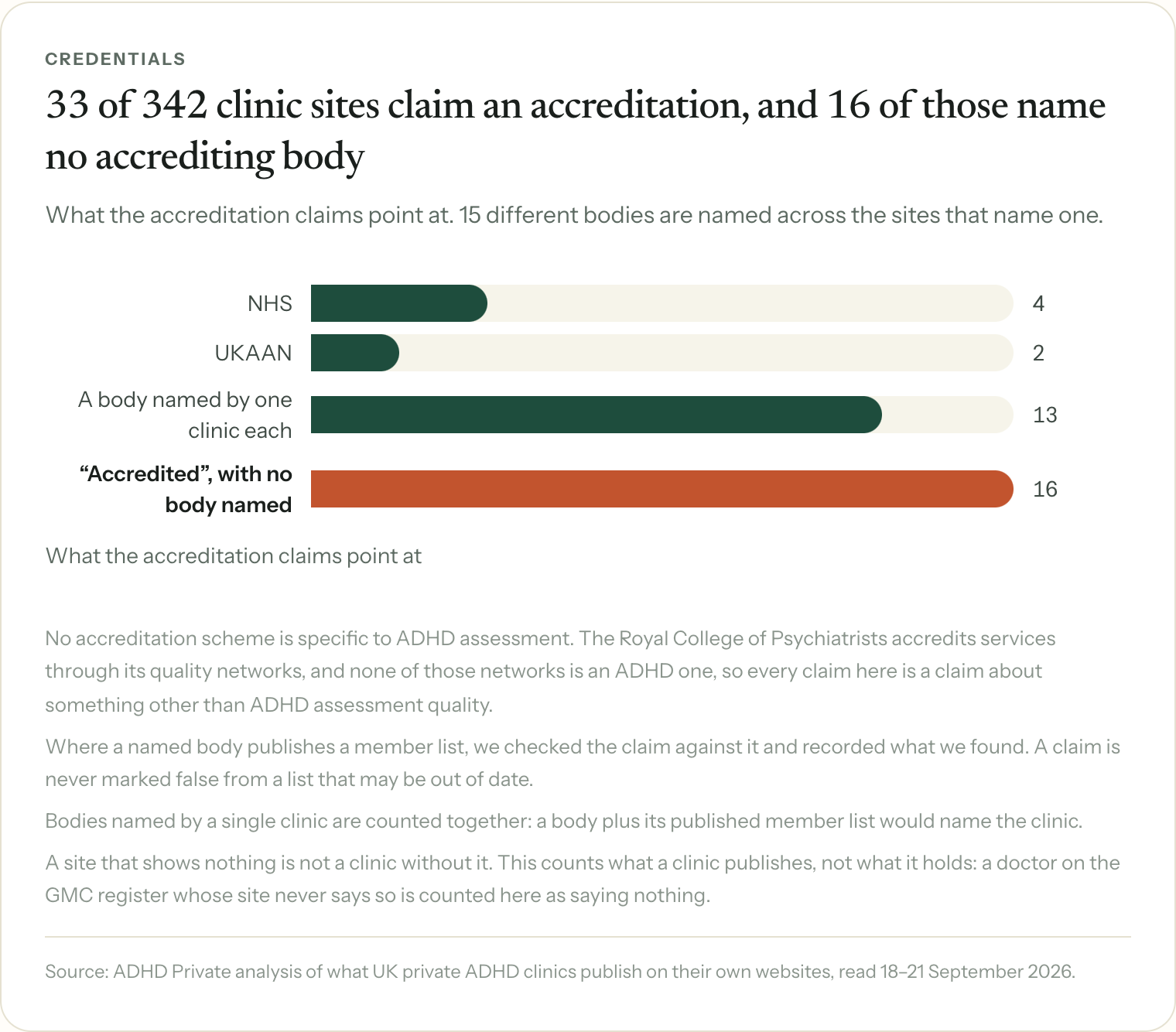
33 of 342 clinic sites claim an accreditation, and 16 of those name no accrediting body
What the accreditation claims point at. 15 different bodies are named across the sites that name one.
- No accreditation scheme is specific to ADHD assessment. The Royal College of Psychiatrists accredits services through its quality networks, and none of those networks is an ADHD one, so every claim here is a claim about something other than ADHD assessment quality.
- Where a named body publishes a member list, we checked the claim against it and recorded what we found. A claim is never marked false from a list that may be out of date.
- Bodies named by a single clinic are counted together: a body plus its published member list would name the clinic.
- A site that shows nothing is not a clinic without it. This counts what a clinic publishes, not what it holds: a doctor on the GMC register whose site never says so is counted here as saying nothing.
Source: ADHD Private analysis of what UK private ADHD clinics publish on their own websites, read 18–21 September 2026.
View the figures as a table
| Accreditation claimed | Clinics |
|---|---|
| NHS | 4 |
| UKAAN | 2 |
| A body named by one clinic each | 13 |
| “Accredited”, with no body named | 16 |
Download this chart’s data (CSV)Download the image (PNG)How this was counted
NHS Right to Choose
Right to Choose lets a patient in England ask their GP to refer them to an approved independent provider for an NHS-funded assessment. It applies in England only and needs a GP referral: the legal right does not extend to self-referrals. These counts come from what each clinic states on its own website, with the quote and the page stored beside it — not from our directory's own field.
Right to Choose
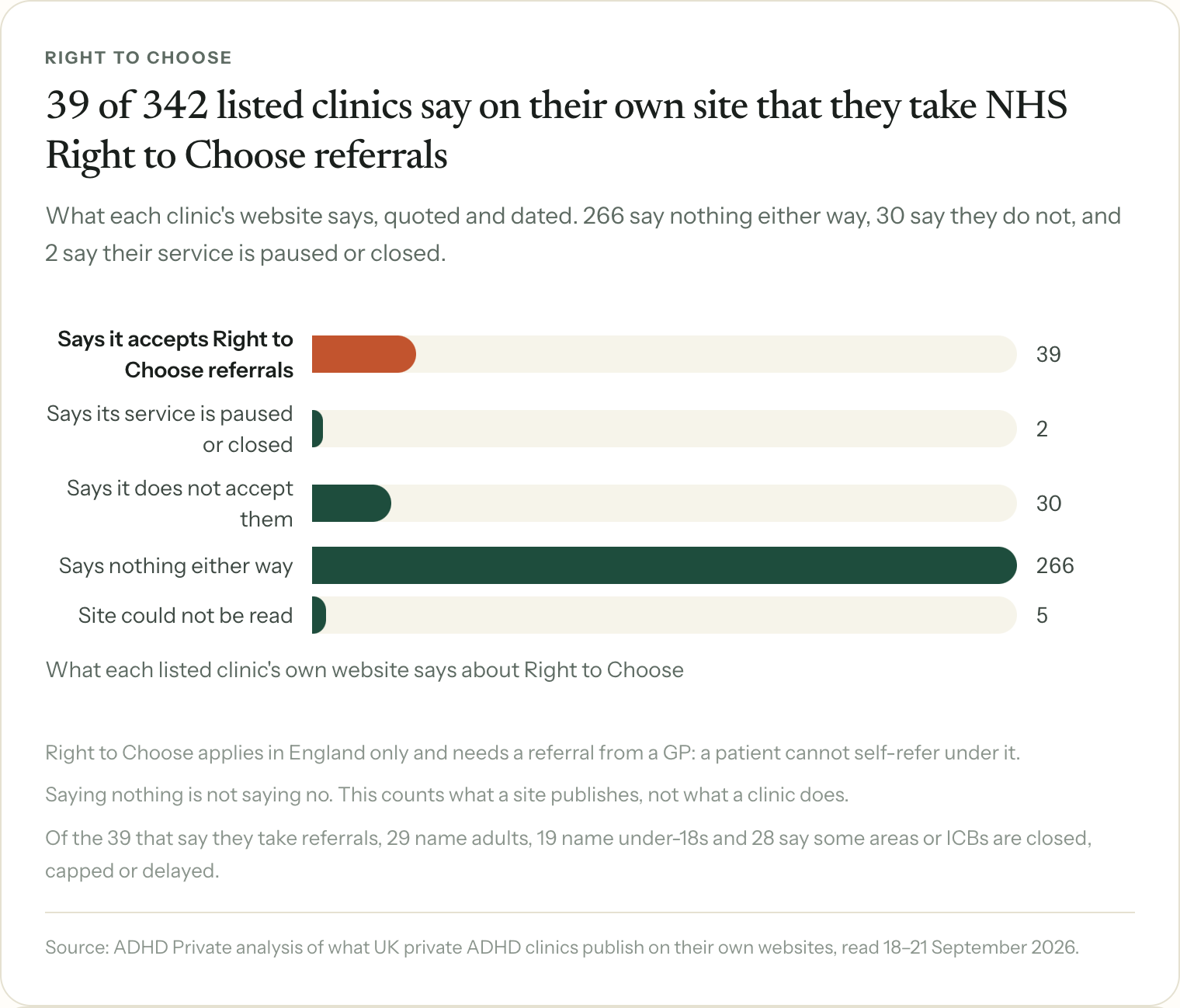
39 of 342 listed clinics say on their own site that they take NHS Right to Choose referrals
What each clinic's website says, quoted and dated. 266 say nothing either way, 30 say they do not, and 2 say their service is paused or closed.
- Right to Choose applies in England only and needs a referral from a GP: a patient cannot self-refer under it.
- Saying nothing is not saying no. This counts what a site publishes, not what a clinic does.
- Of the 39 that say they take referrals, 29 name adults, 19 name under-18s and 28 say some areas or ICBs are closed, capped or delayed.
Source: ADHD Private analysis of what UK private ADHD clinics publish on their own websites, read 18–21 September 2026.
View the figures as a table
| What the site says | Clinics |
|---|---|
| Says it accepts Right to Choose referrals | 39 |
| Says referrals go to a named partner | 0 |
| Says its service is paused or closed | 2 |
| Says it does not accept them | 30 |
| Says nothing either way | 266 |
| Site could not be read | 5 |
Download this chart’s data (CSV)Download the image (PNG)How this was counted
What clinics publish, against the published standard
The adult ADHD assessment quality assurance standard (AQAS) sets a total assessment time of "at least 2 hours in most cases", counted as direct consultation, which it defines as face-to-face or remote by video. These charts show what clinics publish about their own appointments. They are a record of what is advertised, not an audit of what happens, and no clinic is graded here.
Against published standards
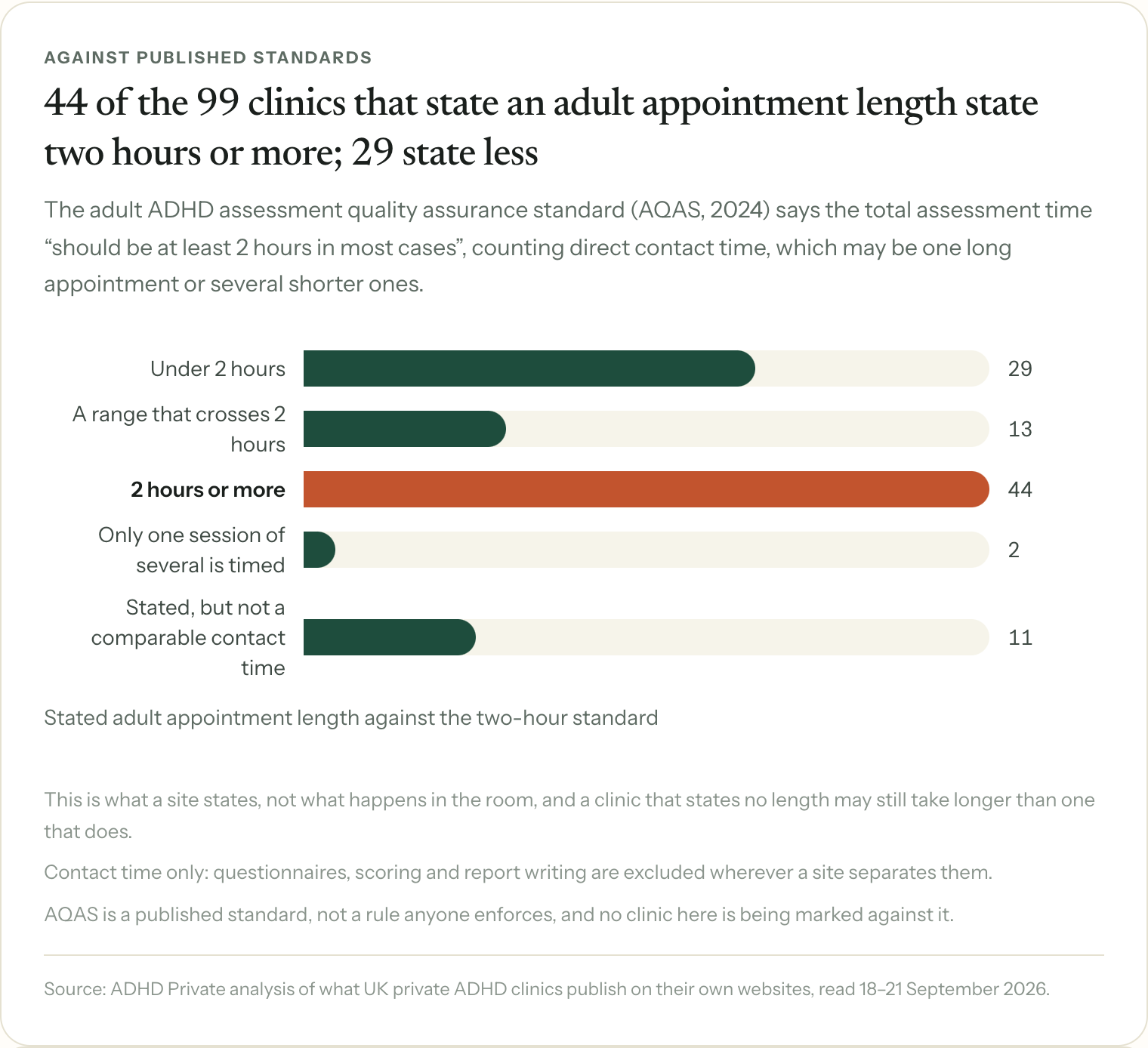
44 of the 99 clinics that state an adult appointment length state two hours or more; 29 state less
The adult ADHD assessment quality assurance standard (AQAS, 2024) says the total assessment time “should be at least 2 hours in most cases”, counting direct contact time, which may be one long appointment or several shorter ones.
- This is what a site states, not what happens in the room, and a clinic that states no length may still take longer than one that does.
- Contact time only: questionnaires, scoring and report writing are excluded wherever a site separates them.
- AQAS is a published standard, not a rule anyone enforces, and no clinic here is being marked against it.
Source: ADHD Private analysis of what UK private ADHD clinics publish on their own websites, read 18–21 September 2026.
View the figures as a table
| Stated adult appointment length | Clinics | % of those stating a length |
|---|---|---|
| Under 2 hours | 29 | 29.3 |
| A range that crosses 2 hours | 13 | 13.1 |
| 2 hours or more | 44 | 44.4 |
| Only one session of several is timed | 2 | 2 |
| Stated, but not a comparable contact time | 11 | 11.1 |
Download this chart’s data (CSV)Download the image (PNG)How this was counted
Against published standards
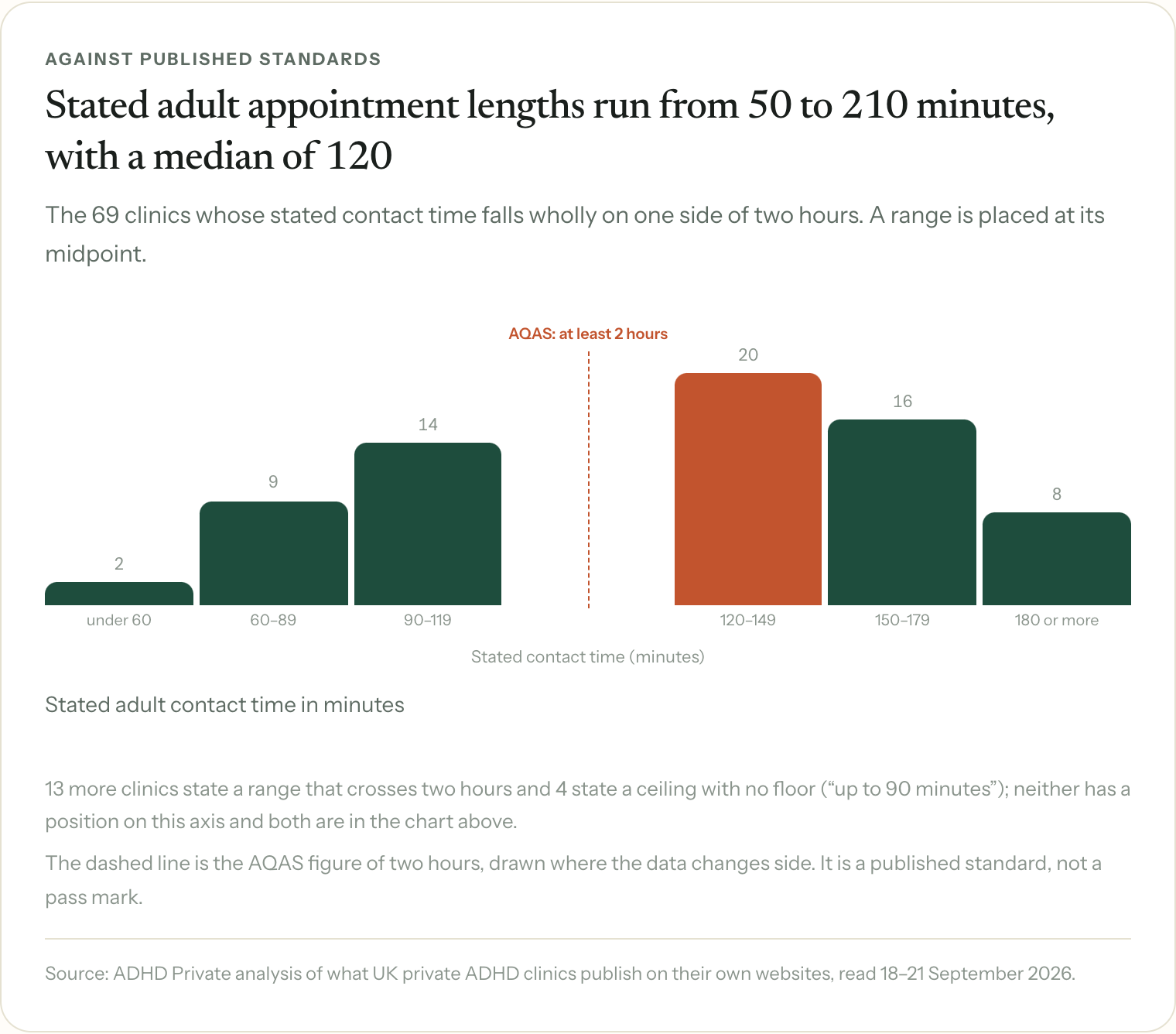
Stated adult appointment lengths run from 50 to 210 minutes, with a median of 120
The 69 clinics whose stated contact time falls wholly on one side of two hours. A range is placed at its midpoint.
Stated contact time (minutes)
- 13 more clinics state a range that crosses two hours and 4 state a ceiling with no floor (“up to 90 minutes”); neither has a position on this axis and both are in the chart above.
- The dashed line is the AQAS figure of two hours, drawn where the data changes side. It is a published standard, not a pass mark.
Source: ADHD Private analysis of what UK private ADHD clinics publish on their own websites, read 18–21 September 2026.
View the figures as a table
| Stated contact time (minutes) | Clinics |
|---|---|
| under 60 | 2 |
| 60–89 | 9 |
| 90–119 | 14 |
| 120–149 | 20 |
| 150–179 | 16 |
| 180 or more | 8 |
Download this chart’s data (CSV)Download the image (PNG)How this was counted
Against published standards
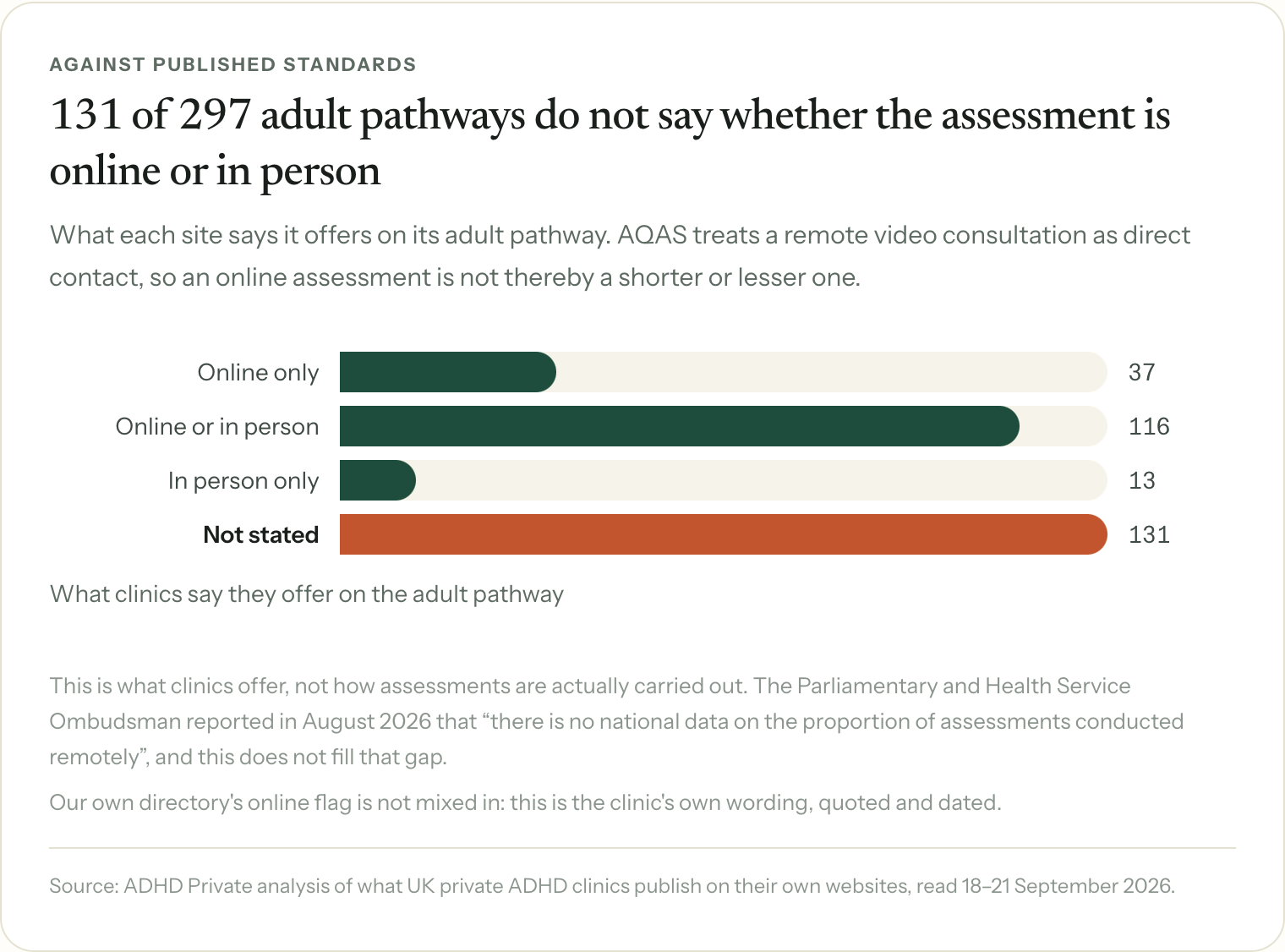
131 of 297 adult pathways do not say whether the assessment is online or in person
What each site says it offers on its adult pathway. AQAS treats a remote video consultation as direct contact, so an online assessment is not thereby a shorter or lesser one.
- This is what clinics offer, not how assessments are actually carried out. The Parliamentary and Health Service Ombudsman reported in August 2026 that “there is no national data on the proportion of assessments conducted remotely”, and this does not fill that gap.
- Our own directory's online flag is not mixed in: this is the clinic's own wording, quoted and dated.
Source: ADHD Private analysis of what UK private ADHD clinics publish on their own websites, read 18–21 September 2026.
View the figures as a table
| What the site says it offers | Clinics | % of adult pathways |
|---|---|---|
| Online only | 37 | 12.5 |
| Online or in person | 116 | 39.1 |
| In person only | 13 | 4.4 |
| Not stated | 131 | 44.1 |
Download this chart’s data (CSV)Download the image (PNG)How this was counted
What clinics advertise about access and payment
These are the clinics' own published claims about how soon they can see someone and how it is paid for. We report that a claim is made and how often; we do not repeat it as a fact, and we did not test whether any clinic can see a patient in the time it advertises. The NHS comparison row counts sites that draw that contrast themselves — it is not a comparison of our own.
Marketing
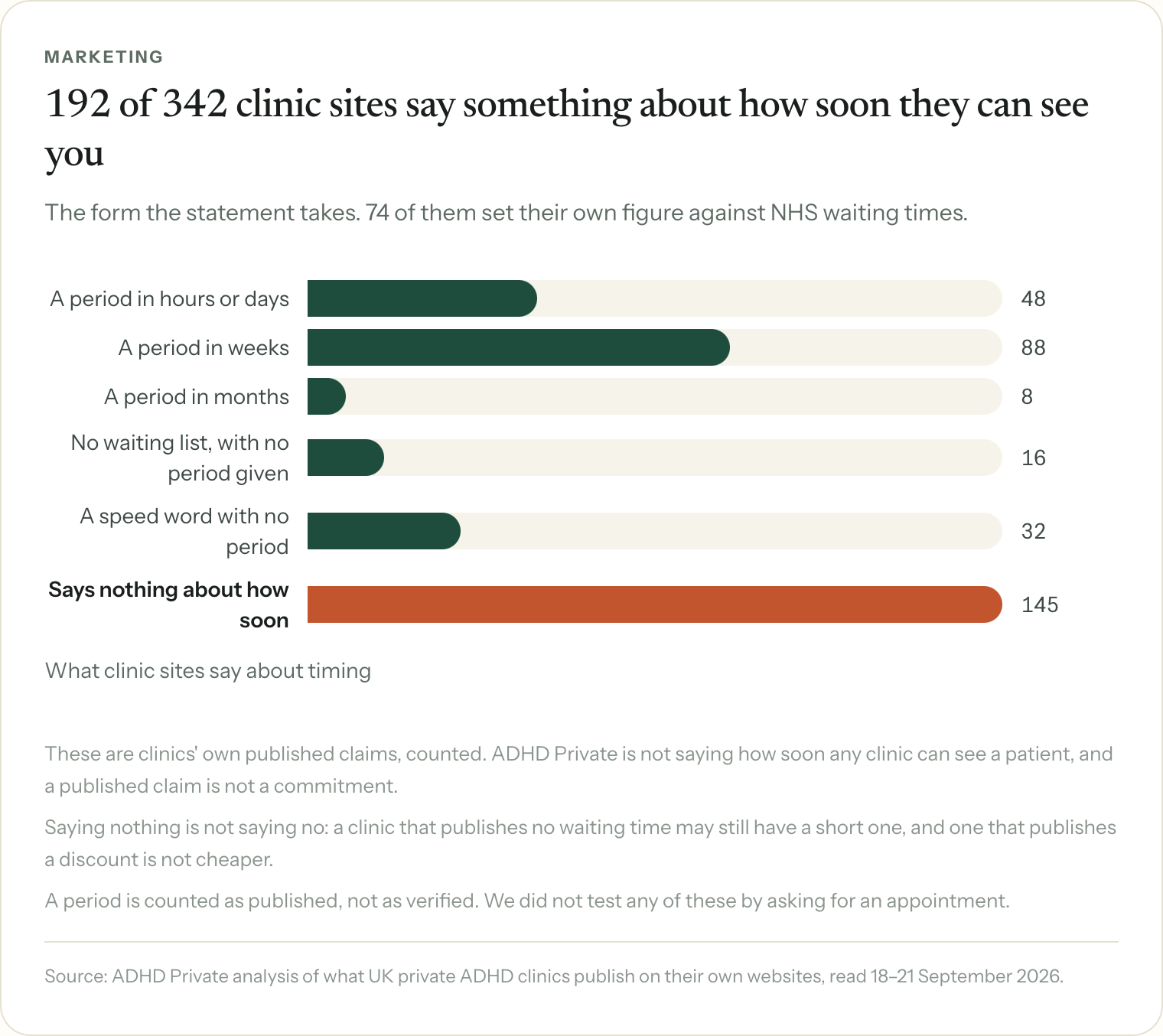
192 of 342 clinic sites say something about how soon they can see you
The form the statement takes. 74 of them set their own figure against NHS waiting times.
- These are clinics' own published claims, counted. ADHD Private is not saying how soon any clinic can see a patient, and a published claim is not a commitment.
- Saying nothing is not saying no: a clinic that publishes no waiting time may still have a short one, and one that publishes a discount is not cheaper.
- A period is counted as published, not as verified. We did not test any of these by asking for an appointment.
Source: ADHD Private analysis of what UK private ADHD clinics publish on their own websites, read 18–21 September 2026.
View the figures as a table
| What the site says about timing | Clinics |
|---|---|
| A period in hours or days | 48 |
| A period in weeks | 88 |
| A period in months | 8 |
| No waiting list, with no period given | 16 |
| A speed word with no period | 32 |
| Says nothing about how soon | 145 |
Download this chart’s data (CSV)Download the image (PNG)How this was counted
Marketing
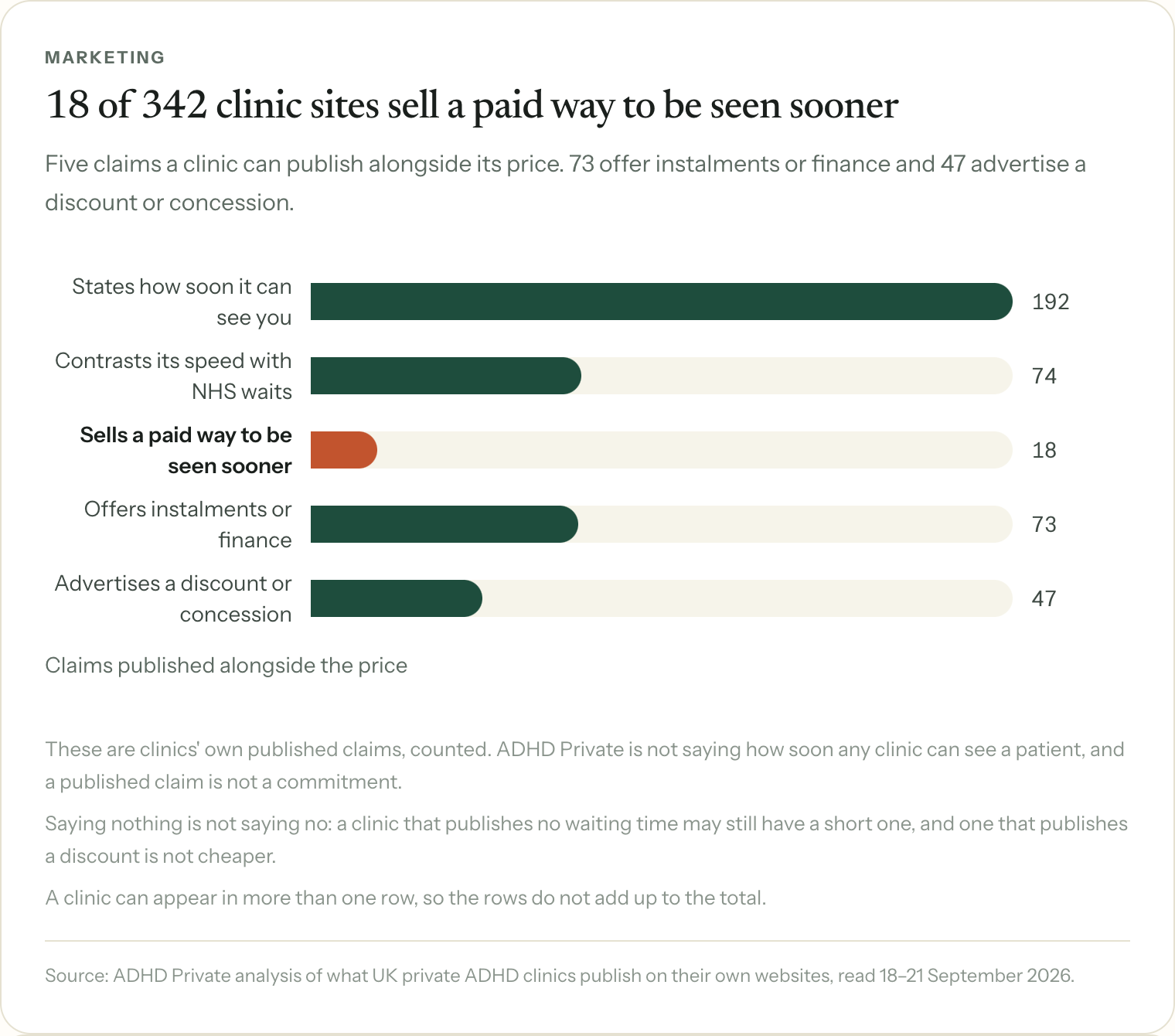
18 of 342 clinic sites sell a paid way to be seen sooner
Five claims a clinic can publish alongside its price. 73 offer instalments or finance and 47 advertise a discount or concession.
- These are clinics' own published claims, counted. ADHD Private is not saying how soon any clinic can see a patient, and a published claim is not a commitment.
- Saying nothing is not saying no: a clinic that publishes no waiting time may still have a short one, and one that publishes a discount is not cheaper.
- A clinic can appear in more than one row, so the rows do not add up to the total.
Source: ADHD Private analysis of what UK private ADHD clinics publish on their own websites, read 18–21 September 2026.
View the figures as a table
| What the site publishes | Clinics | % of listed clinics |
|---|---|---|
| States how soon it can see you | 192 | 56.1 |
| Contrasts its speed with NHS waits | 74 | 21.6 |
| Sells a paid way to be seen sooner | 18 | 5.3 |
| Offers instalments or finance | 73 | 21.3 |
| Advertises a discount or concession | 47 | 13.7 |
Download this chart’s data (CSV)Download the image (PNG)How this was counted
How clinics say they assess children
CAAQAS, published by UK clinicians in 2024, sets out the elements of a child and adolescent ADHD assessment. These charts count how many clinics describe each element on their own website, out of those we have evidence see children or teenagers. Describing an element is not meeting a standard, and a clinic that publishes nothing may still do all of it: this measures what a family can find out before booking, which is the thing a family actually has.
Children
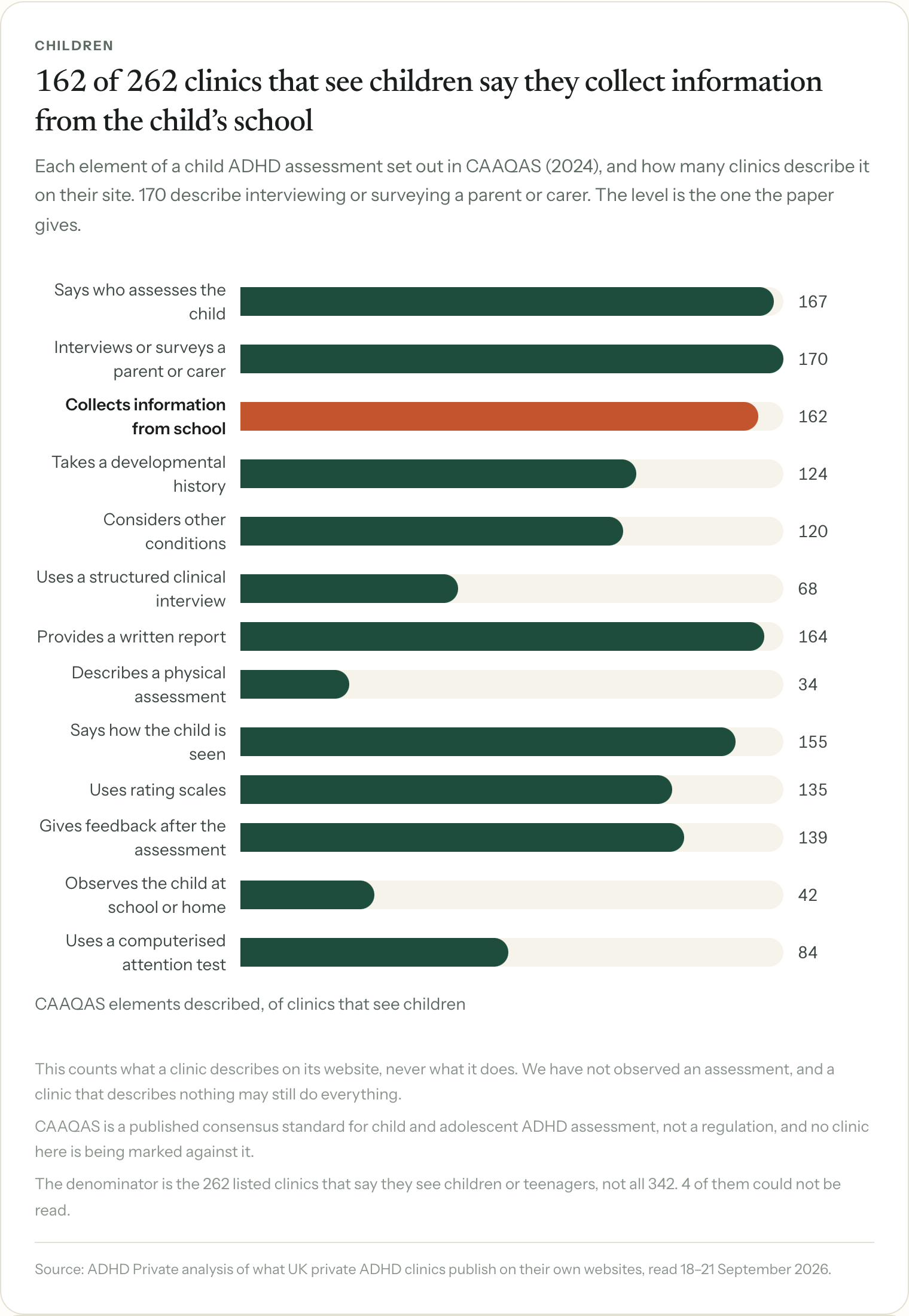
162 of 262 clinics that see children say they collect information from the child’s school
Each element of a child ADHD assessment set out in CAAQAS (2024), and how many clinics describe it on their site. 170 describe interviewing or surveying a parent or carer. The level is the one the paper gives.
- This counts what a clinic describes on its website, never what it does. We have not observed an assessment, and a clinic that describes nothing may still do everything.
- CAAQAS is a published consensus standard for child and adolescent ADHD assessment, not a regulation, and no clinic here is being marked against it.
- The denominator is the 262 listed clinics that say they see children or teenagers, not all 342. 4 of them could not be read.
Source: ADHD Private analysis of what UK private ADHD clinics publish on their own websites, read 18–21 September 2026.
View the figures as a table
| Element | CAAQAS level | Clinics describing it | % of clinics seeing children |
|---|---|---|---|
| Says who assesses the child | essential | 167 | 63.7 |
| Interviews or surveys a parent or carer | essential | 170 | 64.9 |
| Collects information from school | essential | 162 | 61.8 |
| Takes a developmental history | essential | 124 | 47.3 |
| Considers other conditions | essential | 120 | 45.8 |
| Uses a structured clinical interview | essential | 68 | 26 |
| Provides a written report | essential | 164 | 62.6 |
| Describes a physical assessment | essential for medical practitioners | 34 | 13 |
| Says how the child is seen | highly recommended | 155 | 59.2 |
| Uses rating scales | highly recommended | 135 | 51.5 |
| Gives feedback after the assessment | highly recommended | 139 | 53.1 |
| Observes the child at school or home | optional | 42 | 16 |
| Uses a computerised attention test | optional | 84 | 32.1 |
Download this chart’s data (CSV)Download the image (PNG)How this was counted
Children
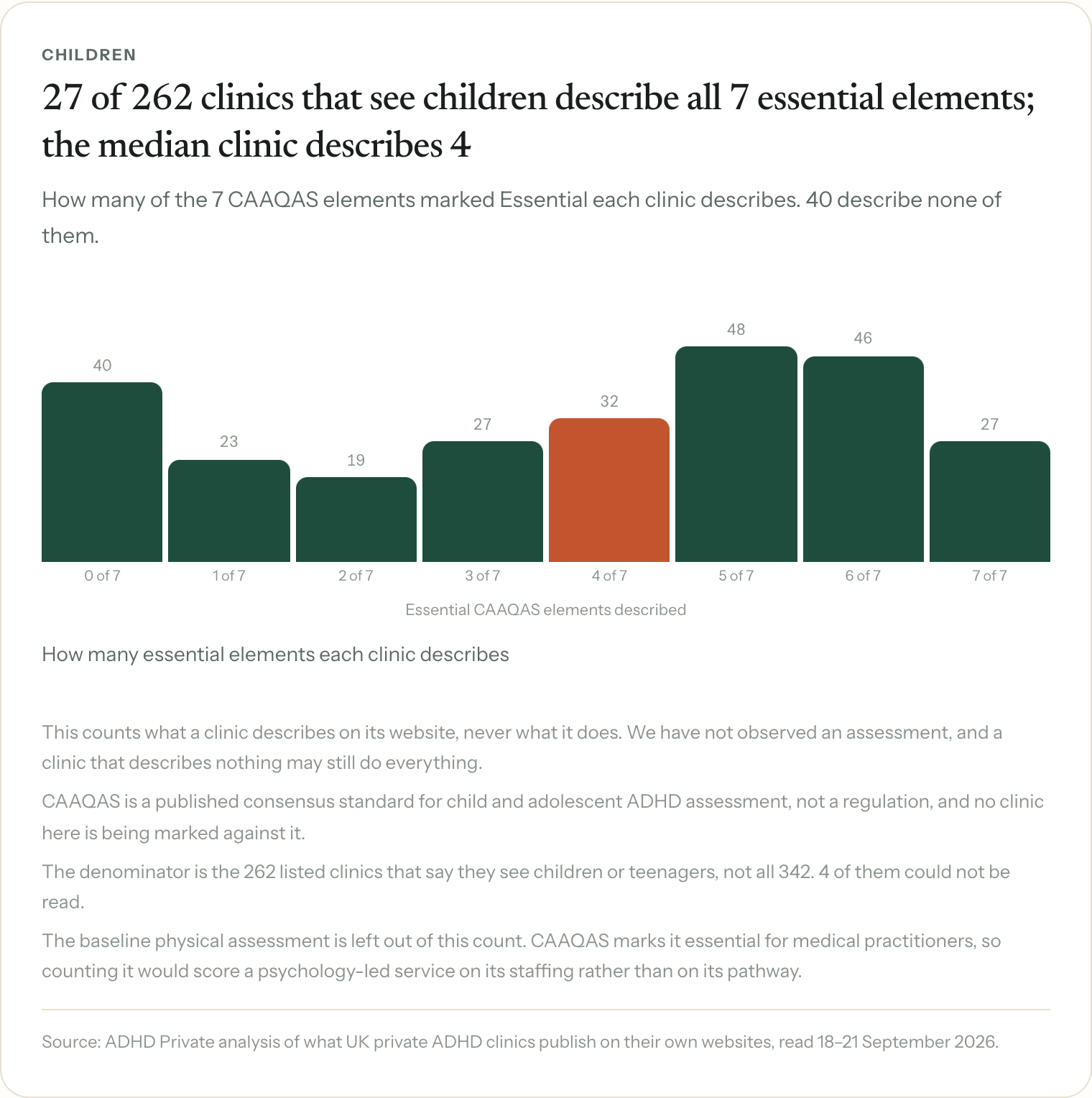
27 of 262 clinics that see children describe all 7 essential elements; the median clinic describes 4
How many of the 7 CAAQAS elements marked Essential each clinic describes. 40 describe none of them.
Essential CAAQAS elements described
- This counts what a clinic describes on its website, never what it does. We have not observed an assessment, and a clinic that describes nothing may still do everything.
- CAAQAS is a published consensus standard for child and adolescent ADHD assessment, not a regulation, and no clinic here is being marked against it.
- The denominator is the 262 listed clinics that say they see children or teenagers, not all 342. 4 of them could not be read.
- The baseline physical assessment is left out of this count. CAAQAS marks it essential for medical practitioners, so counting it would score a psychology-led service on its staffing rather than on its pathway.
Source: ADHD Private analysis of what UK private ADHD clinics publish on their own websites, read 18–21 September 2026.
View the figures as a table
| Essential elements described | Clinics |
|---|---|
| 0 of 7 | 40 |
| 1 of 7 | 23 |
| 2 of 7 | 19 |
| 3 of 7 | 27 |
| 4 of 7 | 32 |
| 5 of 7 | 48 |
| 6 of 7 | 46 |
| 7 of 7 | 27 |
Download this chart’s data (CSV)Download the image (PNG)How this was counted
Children
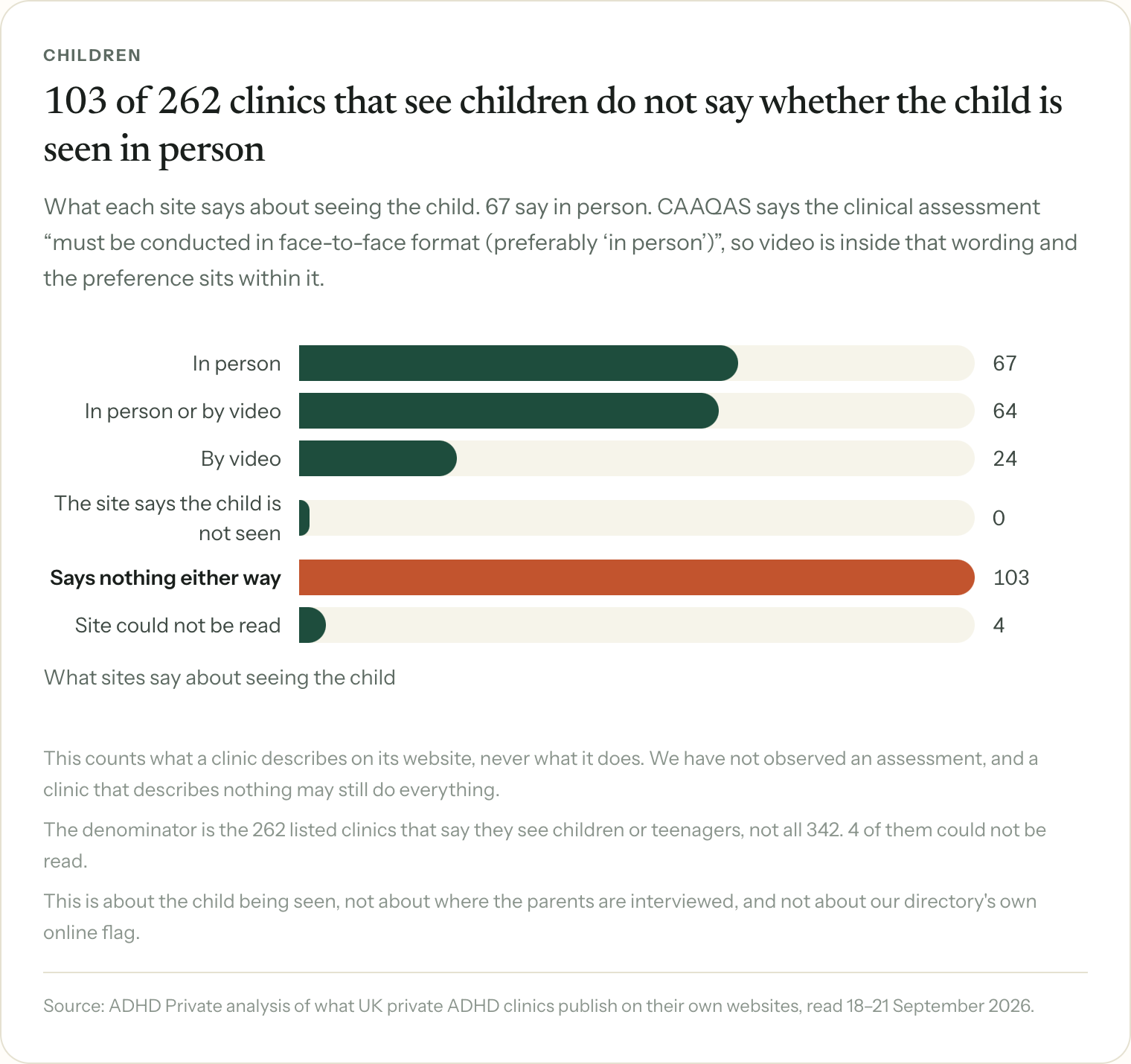
103 of 262 clinics that see children do not say whether the child is seen in person
What each site says about seeing the child. 67 say in person. CAAQAS says the clinical assessment “must be conducted in face-to-face format (preferably ‘in person’)”, so video is inside that wording and the preference sits within it.
- This counts what a clinic describes on its website, never what it does. We have not observed an assessment, and a clinic that describes nothing may still do everything.
- The denominator is the 262 listed clinics that say they see children or teenagers, not all 342. 4 of them could not be read.
- This is about the child being seen, not about where the parents are interviewed, and not about our directory's own online flag.
Source: ADHD Private analysis of what UK private ADHD clinics publish on their own websites, read 18–21 September 2026.
View the figures as a table
| What the site says | Clinics |
|---|---|
| In person | 67 |
| In person or by video | 64 |
| By video | 24 |
| The site says the child is not seen | 0 |
| Says nothing either way | 103 |
| Site could not be read | 4 |
Download this chart’s data (CSV)Download the image (PNG)How this was counted
Children
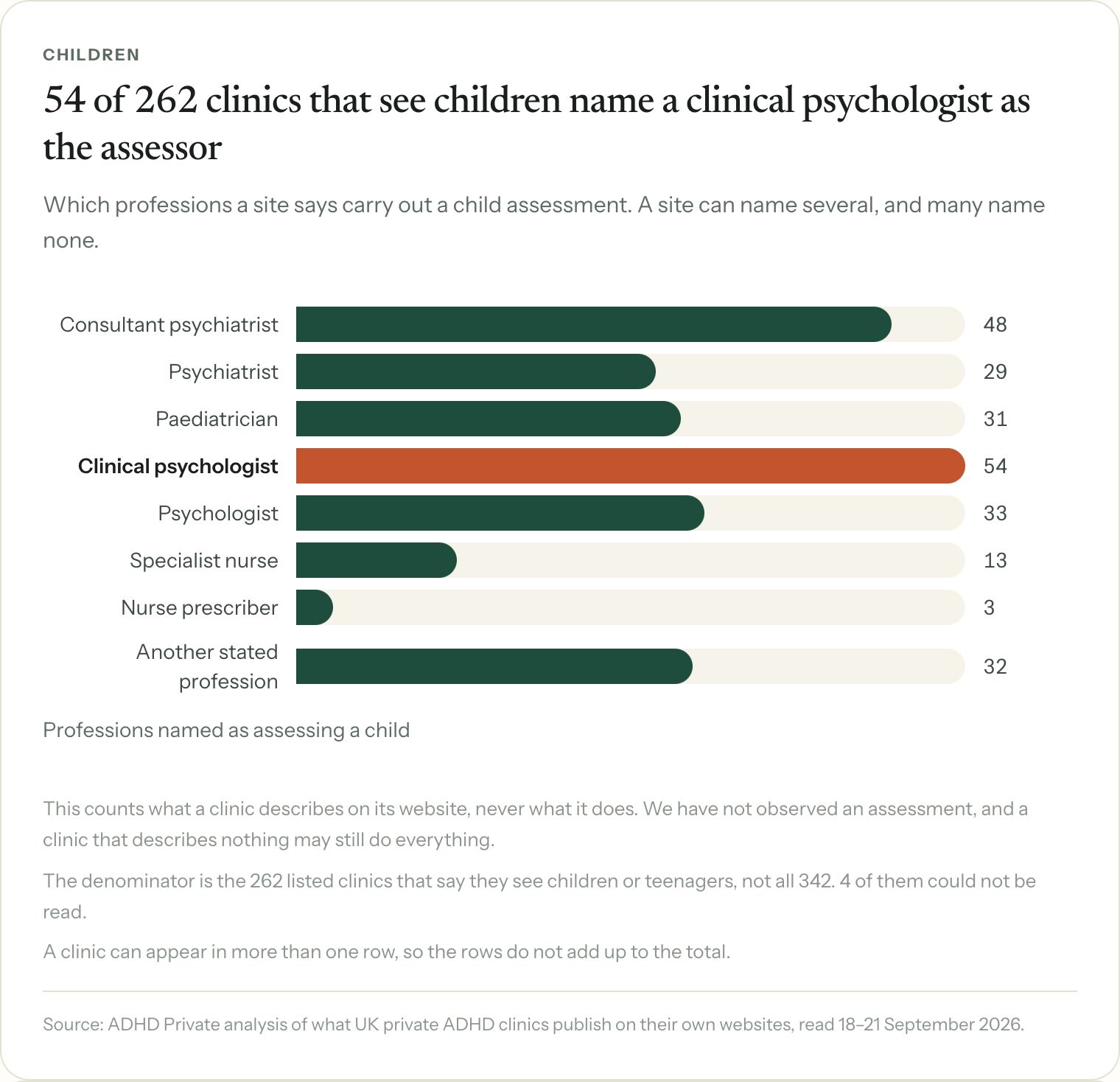
54 of 262 clinics that see children name a clinical psychologist as the assessor
Which professions a site says carry out a child assessment. A site can name several, and many name none.
- This counts what a clinic describes on its website, never what it does. We have not observed an assessment, and a clinic that describes nothing may still do everything.
- The denominator is the 262 listed clinics that say they see children or teenagers, not all 342. 4 of them could not be read.
- A clinic can appear in more than one row, so the rows do not add up to the total.
Source: ADHD Private analysis of what UK private ADHD clinics publish on their own websites, read 18–21 September 2026.
View the figures as a table
| Profession named | Clinics |
|---|---|
| Consultant psychiatrist | 48 |
| Psychiatrist | 29 |
| Paediatrician | 31 |
| Clinical psychologist | 54 |
| Psychologist | 33 |
| Specialist nurse | 13 |
| Nurse prescriber | 3 |
| Another stated profession | 32 |
Download this chart’s data (CSV)Download the image (PNG)How this was counted
Children
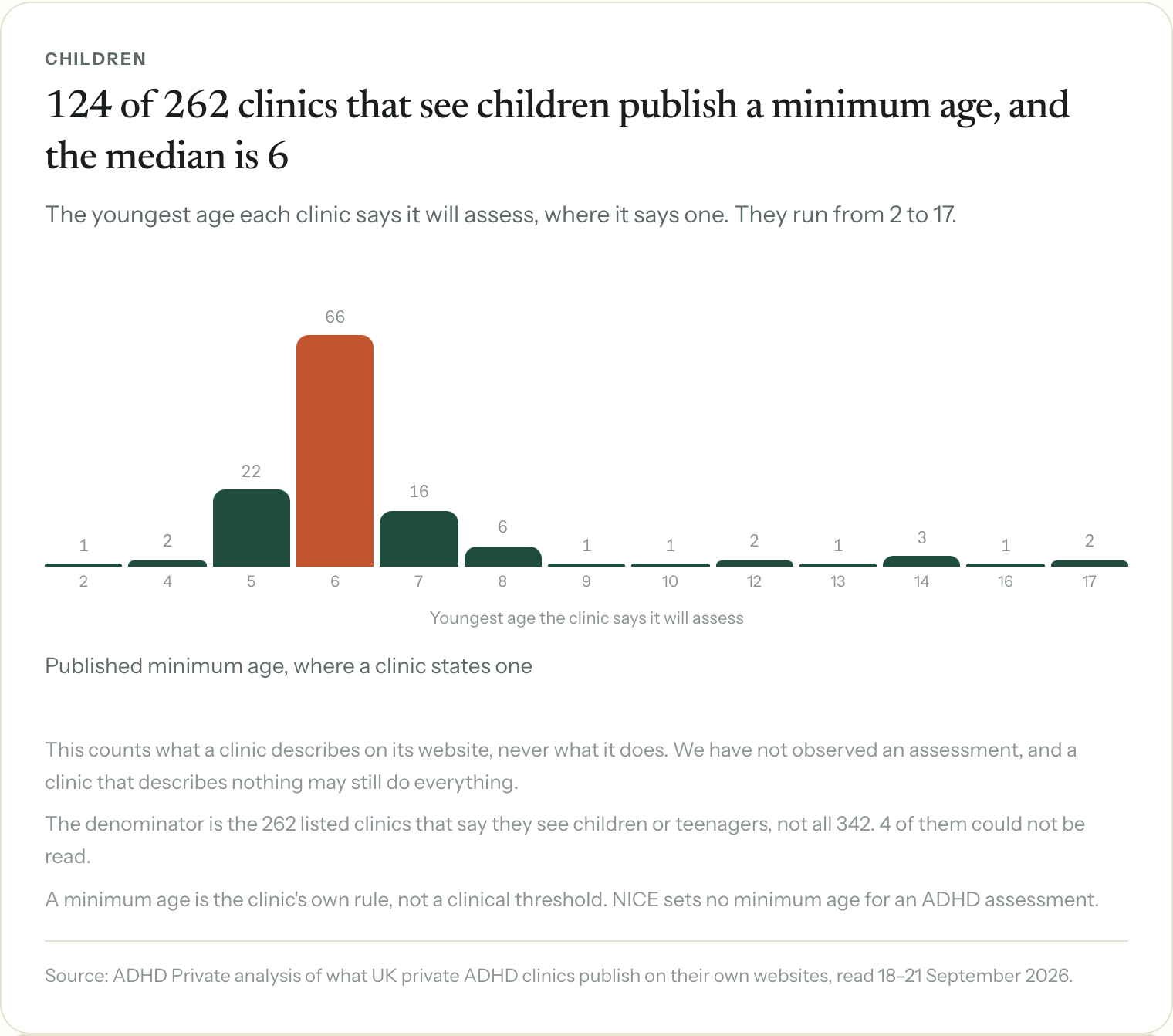
124 of 262 clinics that see children publish a minimum age, and the median is 6
The youngest age each clinic says it will assess, where it says one. They run from 2 to 17.
Youngest age the clinic says it will assess
- This counts what a clinic describes on its website, never what it does. We have not observed an assessment, and a clinic that describes nothing may still do everything.
- The denominator is the 262 listed clinics that say they see children or teenagers, not all 342. 4 of them could not be read.
- A minimum age is the clinic's own rule, not a clinical threshold. NICE sets no minimum age for an ADHD assessment.
Source: ADHD Private analysis of what UK private ADHD clinics publish on their own websites, read 18–21 September 2026.
View the figures as a table
| Minimum age stated | Clinics |
|---|---|
| 2 | 1 |
| 4 | 2 |
| 5 | 22 |
| 6 | 66 |
| 7 | 16 |
| 8 | 6 |
| 9 | 1 |
| 10 | 1 |
| 12 | 2 |
| 13 | 1 |
| 14 | 3 |
| 16 | 1 |
| 17 | 2 |
Download this chart’s data (CSV)Download the image (PNG)How this was counted
Children
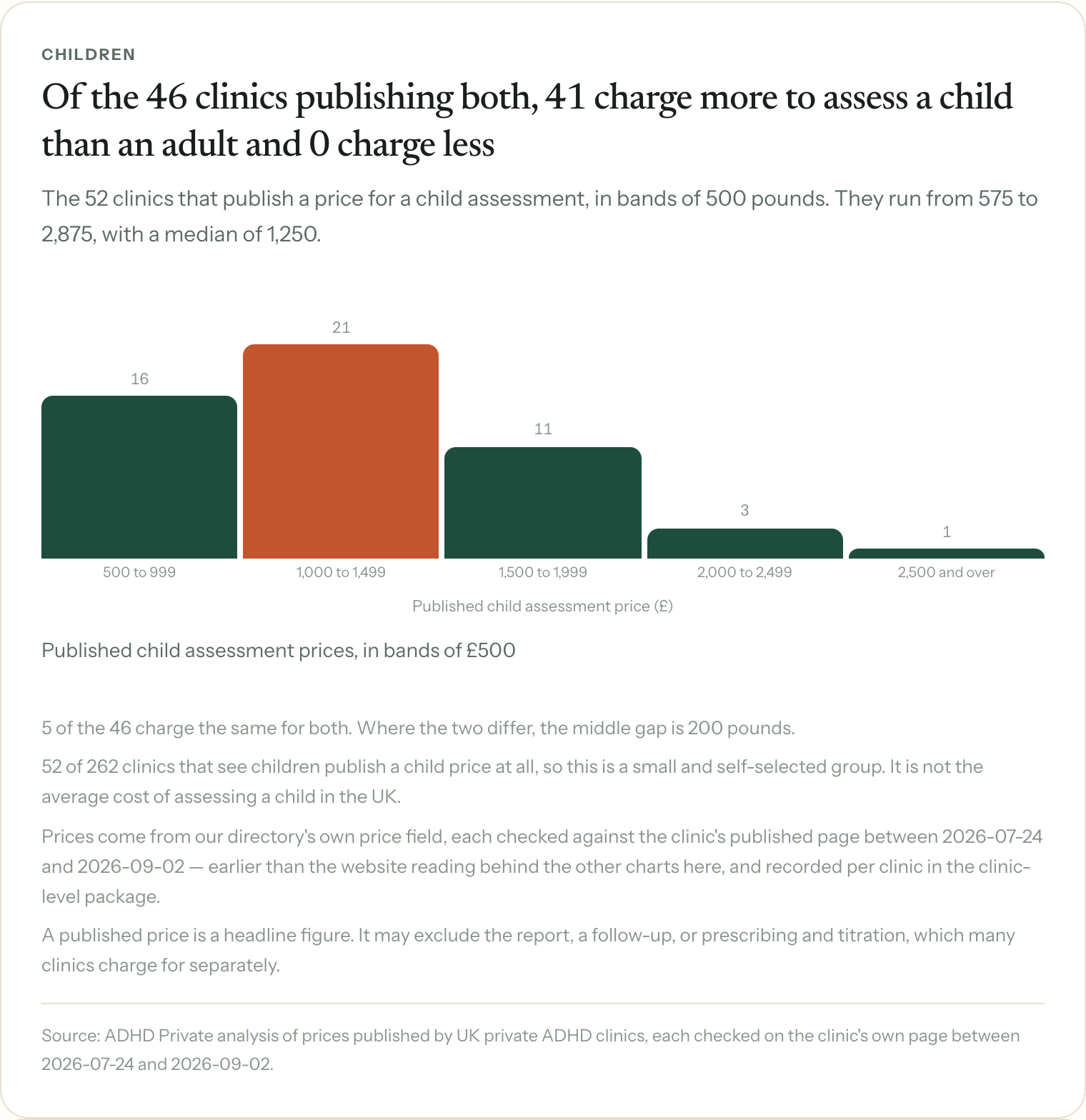
Of the 46 clinics publishing both, 41 charge more to assess a child than an adult and 0 charge less
The 52 clinics that publish a price for a child assessment, in bands of 500 pounds. They run from 575 to 2,875, with a median of 1,250.
Published child assessment price (£)
- 5 of the 46 charge the same for both. Where the two differ, the middle gap is 200 pounds.
- 52 of 262 clinics that see children publish a child price at all, so this is a small and self-selected group. It is not the average cost of assessing a child in the UK.
- Prices come from our directory's own price field, each checked against the clinic's published page between 2026-07-24 and 2026-09-02 — earlier than the website reading behind the other charts here, and recorded per clinic in the clinic-level package.
- A published price is a headline figure. It may exclude the report, a follow-up, or prescribing and titration, which many clinics charge for separately.
Source: ADHD Private analysis of prices published by UK private ADHD clinics, each checked on the clinic's own page between 2026-07-24 and 2026-09-02.
View the figures as a table
| Price band (GBP) | Clinics |
|---|---|
| 500 to 999 | 16 |
| 1,000 to 1,499 | 21 |
| 1,500 to 1,999 | 11 |
| 2,000 to 2,499 | 3 |
| 2,500 and over | 1 |
Download this chart’s data (CSV)Download the image (PNG)How this was counted
From the assessments study, re-surfaced
Three charts from our July and September work on what clinics publish about the assessment itself, repeated here so every figure in this release can be quoted from one page. They are read back from that study's own published figures rather than recomputed, so the numbers on both pages are the same numbers.
Against published standards
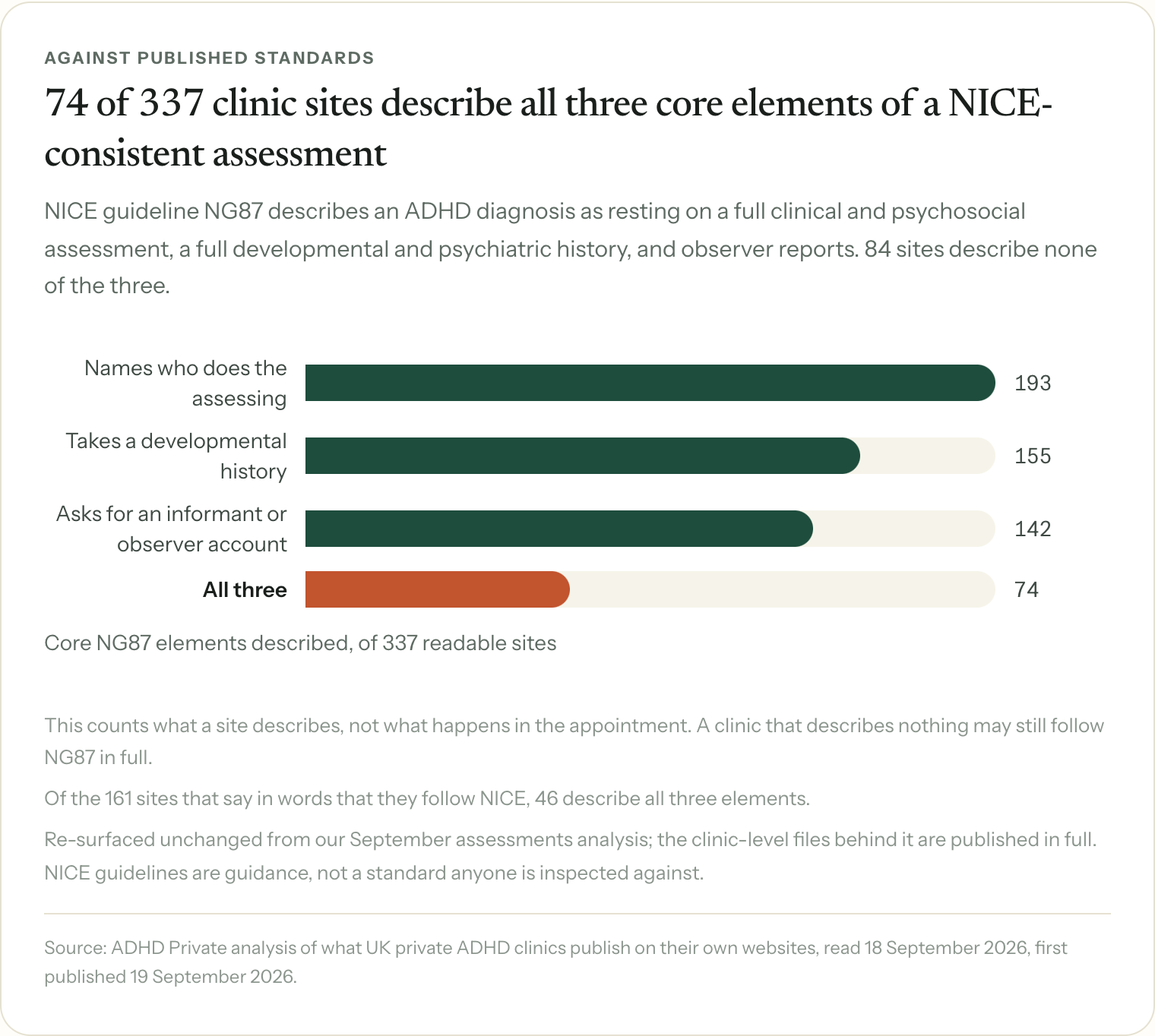
74 of 337 clinic sites describe all three core elements of a NICE-consistent assessment
NICE guideline NG87 describes an ADHD diagnosis as resting on a full clinical and psychosocial assessment, a full developmental and psychiatric history, and observer reports. 84 sites describe none of the three.
- This counts what a site describes, not what happens in the appointment. A clinic that describes nothing may still follow NG87 in full.
- Of the 161 sites that say in words that they follow NICE, 46 describe all three elements.
- Re-surfaced unchanged from our September assessments analysis; the clinic-level files behind it are published in full. NICE guidelines are guidance, not a standard anyone is inspected against.
Source: ADHD Private analysis of what UK private ADHD clinics publish on their own websites, read 18 September 2026, first published 19 September 2026.
View the figures as a table
| Core element | Sites describing it | % of readable sites |
|---|---|---|
| Names who does the assessing | 193 | 57.3 |
| Takes a developmental history | 155 | 46 |
| Asks for an informant or observer account | 142 | 42.1 |
| All three | 74 | 22 |
Download this chart’s data (CSV)Download the image (PNG)How this was counted
Marketing
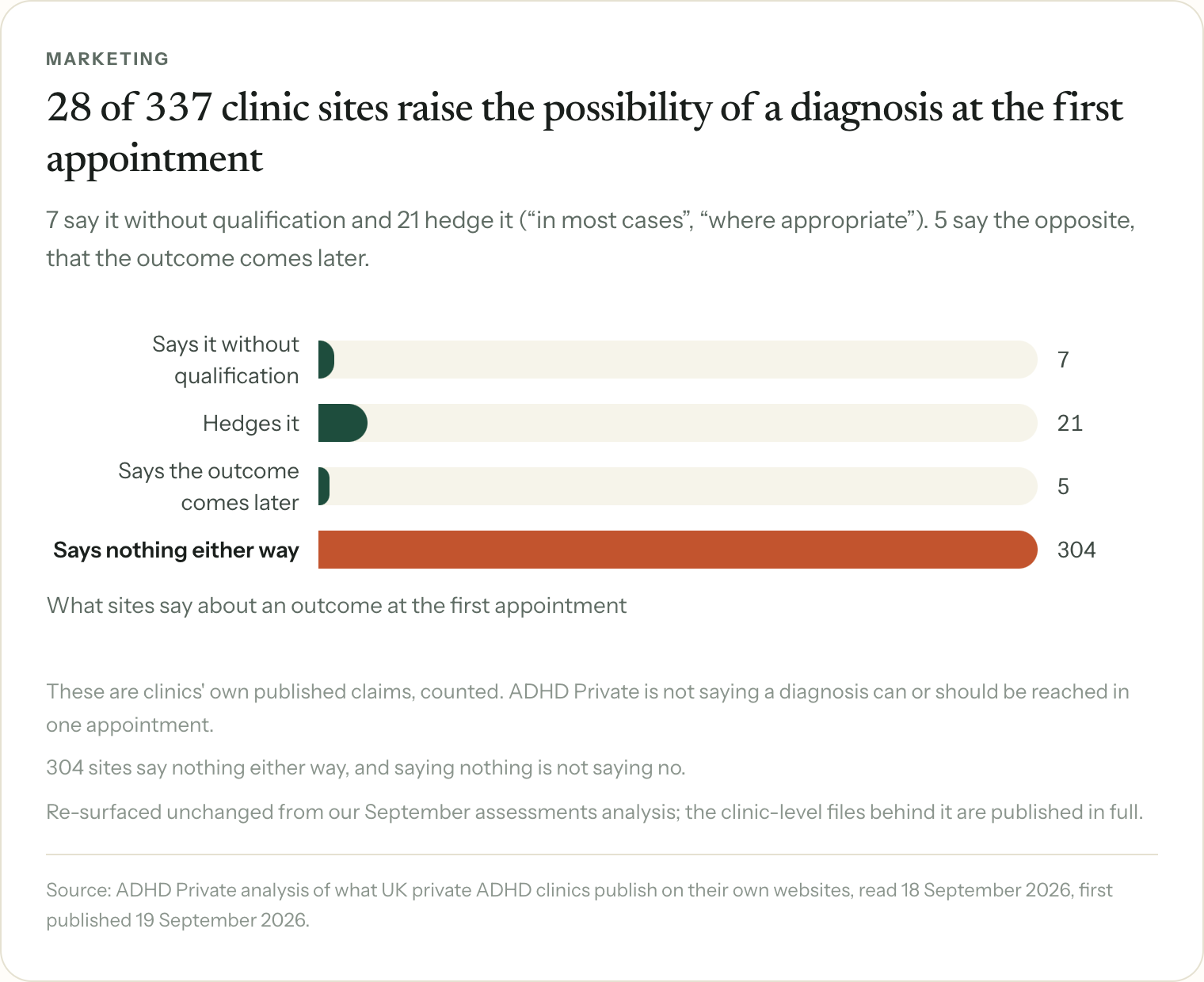
28 of 337 clinic sites raise the possibility of a diagnosis at the first appointment
7 say it without qualification and 21 hedge it (“in most cases”, “where appropriate”). 5 say the opposite, that the outcome comes later.
- These are clinics' own published claims, counted. ADHD Private is not saying a diagnosis can or should be reached in one appointment.
- 304 sites say nothing either way, and saying nothing is not saying no.
- Re-surfaced unchanged from our September assessments analysis; the clinic-level files behind it are published in full.
Source: ADHD Private analysis of what UK private ADHD clinics publish on their own websites, read 18 September 2026, first published 19 September 2026.
View the figures as a table
| What the site says about a first-appointment outcome | Sites |
|---|---|
| Says it without qualification | 7 |
| Hedges it | 21 |
| Says the outcome comes later | 5 |
| Says nothing either way | 304 |
Download this chart’s data (CSV)Download the image (PNG)How this was counted
Price
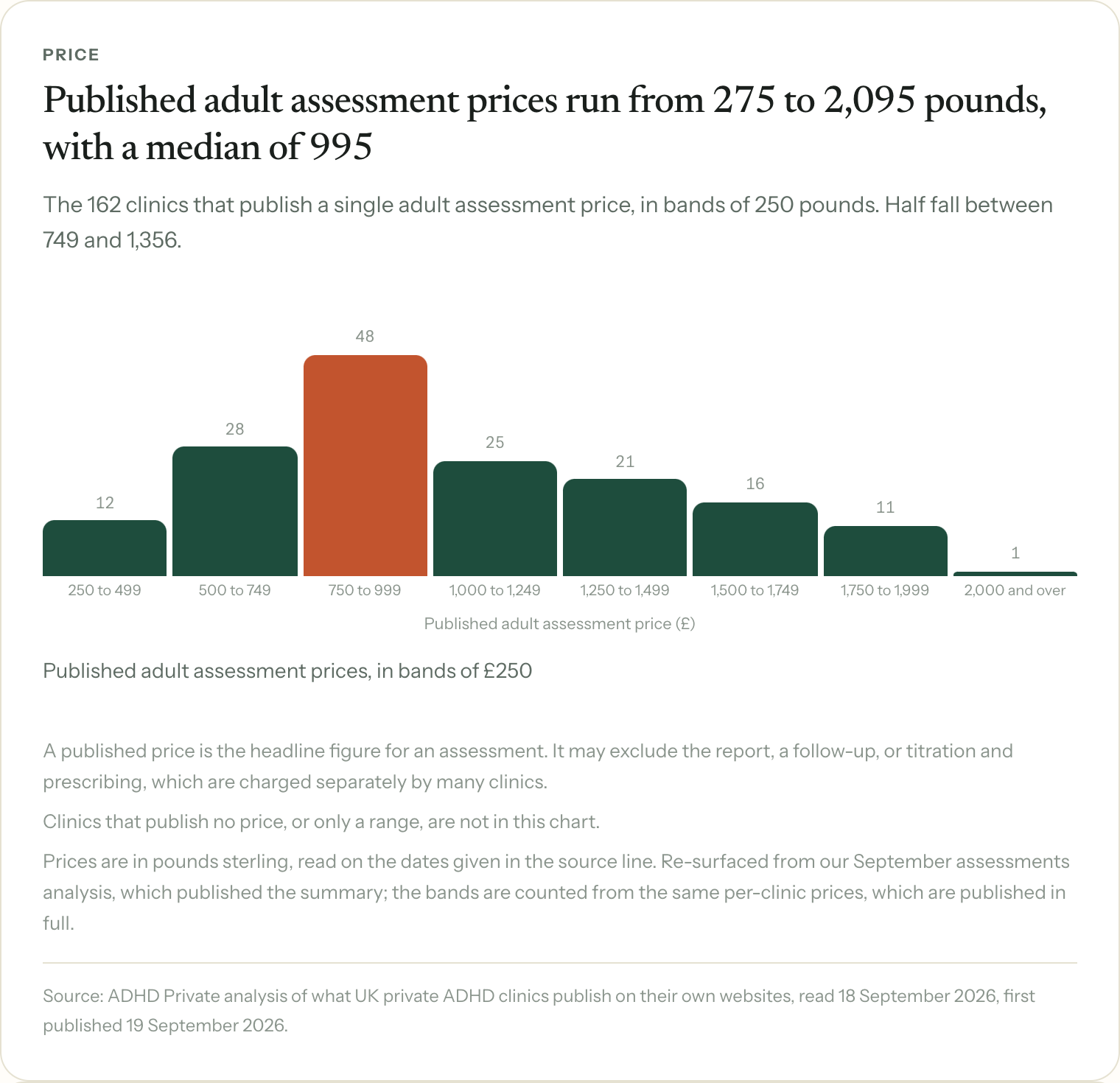
Published adult assessment prices run from 275 to 2,095 pounds, with a median of 995
The 162 clinics that publish a single adult assessment price, in bands of 250 pounds. Half fall between 749 and 1,356.
Published adult assessment price (£)
- A published price is the headline figure for an assessment. It may exclude the report, a follow-up, or titration and prescribing, which are charged separately by many clinics.
- Clinics that publish no price, or only a range, are not in this chart.
- Prices are in pounds sterling, read on the dates given in the source line. Re-surfaced from our September assessments analysis, which published the summary; the bands are counted from the same per-clinic prices, which are published in full.
Source: ADHD Private analysis of what UK private ADHD clinics publish on their own websites, read 18 September 2026, first published 19 September 2026.
View the figures as a table
| Price band (GBP) | Clinics |
|---|---|
| 250 to 499 | 12 |
| 500 to 749 | 28 |
| 750 to 999 | 48 |
| 1,000 to 1,249 | 25 |
| 1,250 to 1,499 | 21 |
| 1,500 to 1,749 | 16 |
| 1,750 to 1,999 | 11 |
| 2,000 and over | 1 |
Download this chart’s data (CSV)Download the image (PNG)How this was counted
What we can see of the appetite for private assessment
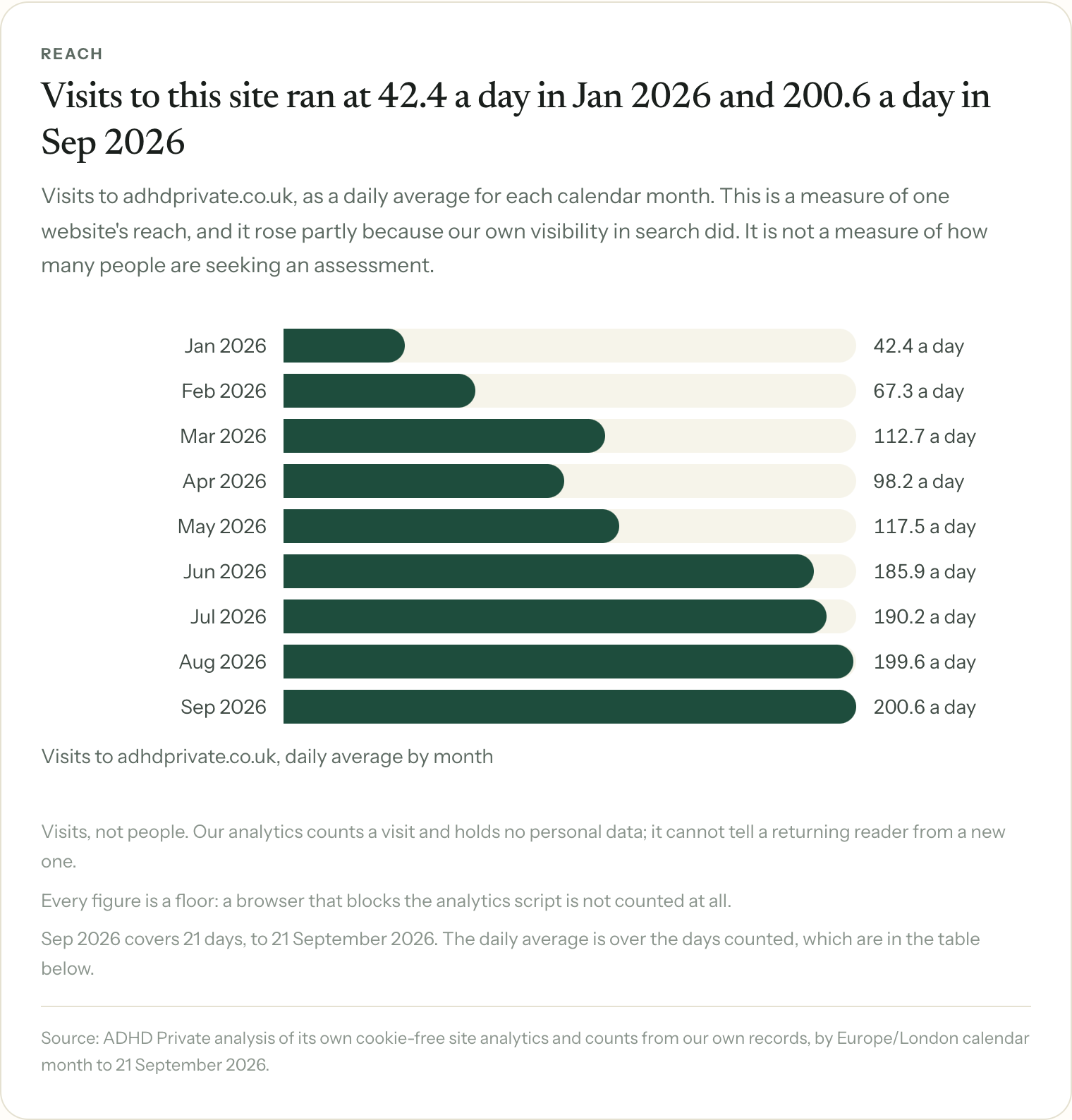
There is no national count of people seeking a private ADHD assessment. What we can publish is what one website sees: visits to adhdprivate.co.uk, and how many people complete the questionnaire that matches them to clinics. Both series measure this site's reach — which grew partly because our own visibility in search grew — and neither is a measure of national demand. The official series is NHS England Digital's ADHD Management Information, linked in the method section. Months with fewer than ten people are not published, and no total is published from which one could be worked back.
Reach
Visits to this site ran at 42.4 a day in Jan 2026 and 200.6 a day in Sep 2026
Visits to adhdprivate.co.uk, as a daily average for each calendar month. This is a measure of one website's reach, and it rose partly because our own visibility in search did. It is not a measure of how many people are seeking an assessment.
- Visits, not people. Our analytics counts a visit and holds no personal data; it cannot tell a returning reader from a new one.
- Every figure is a floor: a browser that blocks the analytics script is not counted at all.
- Sep 2026 covers 21 days, to 21 September 2026. The daily average is over the days counted, which are in the table below.
Source: ADHD Private analysis of its own cookie-free site analytics and counts from our own records, by Europe/London calendar month to 21 September 2026.
View the figures as a table
| Month | Visits a day | Visits | Days counted |
|---|---|---|---|
| Jan 2026 | 42.4 | 1,315 | 31 |
| Feb 2026 | 67.3 | 1,885 | 28 |
| Mar 2026 | 112.7 | 3,493 | 31 |
| Apr 2026 | 98.2 | 2,945 | 30 |
| May 2026 | 117.5 | 3,643 | 31 |
| Jun 2026 | 185.9 | 5,578 | 30 |
| Jul 2026 | 190.2 | 5,897 | 31 |
| Aug 2026 | 199.6 | 6,188 | 31 |
| Sep 2026 | 200.6 | 4,213 | 21 |
Download this chart’s data (CSV)Download the image (PNG)How this was counted
Reach
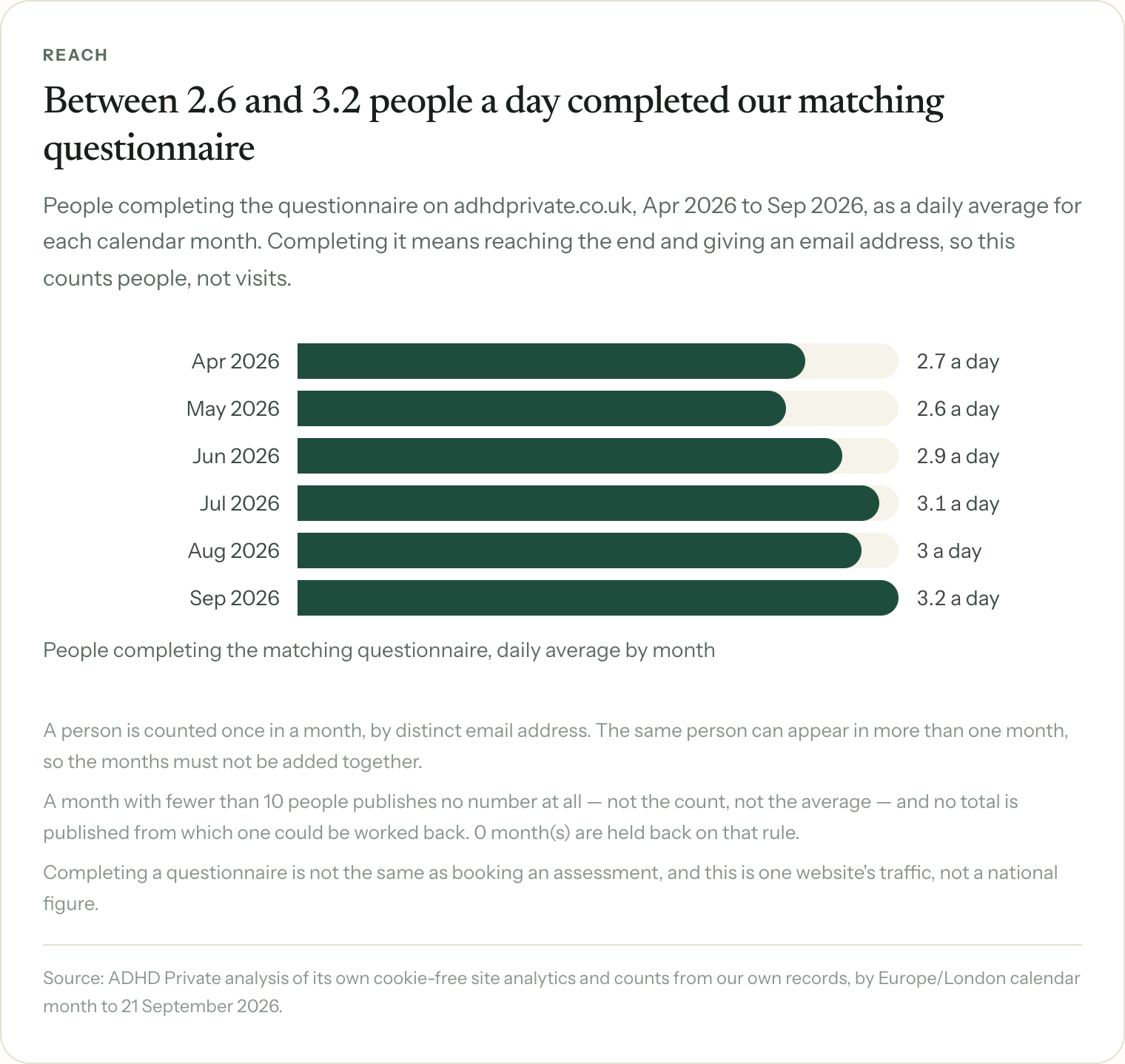
Between 2.6 and 3.2 people a day completed our matching questionnaire
People completing the questionnaire on adhdprivate.co.uk, Apr 2026 to Sep 2026, as a daily average for each calendar month. Completing it means reaching the end and giving an email address, so this counts people, not visits.
- A person is counted once in a month, by distinct email address. The same person can appear in more than one month, so the months must not be added together.
- A month with fewer than 10 people publishes no number at all — not the count, not the average — and no total is published from which one could be worked back. 0 month(s) are held back on that rule.
- Completing a questionnaire is not the same as booking an assessment, and this is one website's traffic, not a national figure.
Source: ADHD Private analysis of its own cookie-free site analytics and counts from our own records, by Europe/London calendar month to 21 September 2026.
View the figures as a table
| Month | People a day | People | Days counted |
|---|---|---|---|
| Apr 2026 | 2.7 | 81 | 30 |
| May 2026 | 2.6 | 80 | 31 |
| Jun 2026 | 2.9 | 87 | 30 |
| Jul 2026 | 3.1 | 95 | 31 |
| Aug 2026 | 3 | 93 | 31 |
| Sep 2026 | 3.2 | 68 | 21 |
Download this chart’s data (CSV)Download the image (PNG)How this was counted
Using these charts
The charts, the figures behind them and the clinic-level files are published under the Creative Commons Attribution 4.0 licence, with two exceptions named in the data package README: material taken from Companies House, the CQC and Healthcare Inspectorate Wales is public sector information licensed under the Open Government Licence v3.0, and the Northern Irish RQIA register extract is excluded from our own grant because no reuse statement was published with it.
To credit a chart: “Source: ADHD Private analysis, 24 September 2026”, linking to this page. If you are redrawing a chart rather than using the image, the CSV beneath it holds exactly the rows we plotted.
Questions about method, or a figure you would like checked before you publish it, go to [email protected]. We would rather answer a question than see a number used against the wrong denominator.
ADHD Private is an independent directory of private ADHD clinics. Clinics can pay for a clearly labelled Featured placement, which never changes the order clinics appear in or which clinics a search returns, and we take no commission on bookings or referrals. This page is informational only — it is not medical advice.