What we found
- In England, whether a clinic is regulated turns on whether it treats. CQC’s published guidance is that diagnosis without treatment needs no registration. In Scotland, Wales and Northern Ireland the test is different: it turns on the profession of the person providing the service, so a diagnosis-only clinic staffed by a doctor is in scope there. The same clinic can be regulated on one side of a border and not the other.
- Registration is not a rating. 39 of the 342 clinics we list hold a published quality judgement. 89 more are currently registered with CQC without one, 13 are registered with a devolved regulator, and 195 are matched to no register entry we could corroborate.
- The company register is growing, fast. 2 UK companies took a name containing “ADHD” in 2015; 120 did in 2025. At least 346 such companies are on the register today, 32 more than six months ago. A company name is not a clinic, and every figure is a floor.
- Right to Choose is thinly documented on clinic sites. 39 of 342 clinics state on their own website that they accept Right to Choose referrals; 266 say nothing either way. Our own directory flag previously put the figure at 40 of 332, which we have now replaced with the quoted count.
- Published appointment lengths straddle the adult standard. Of the 99 clinics publishing a comparable adult contact time, 44 state two hours or more, 29 state less, and 13 state a range that crosses it. The stated times run from 50 to 210 minutes.
How many private ADHD providers are there, and how fast is that growing?
Nobody can say how many there are, because no register of them exists — but at least 346 companies with “ADHD” in their name sit on the Companies House register, 32 more than six months ago. That is a count of company names, not of clinics: it includes coaching, training and non-clinical businesses, and companies that never traded. It also misses every provider whose name does not contain the letters, which is most of them. Read it as a floor and as a shape, not as a total.
A company is counted from the date its ADHD name took effect, not from incorporation, because a company that traded for years under another name and renamed itself in 2025 joined this market in 2025. 33 of the 470 companies in the file took their ADHD name after incorporation, and one of them held such a name, dropped it and took another later; the published file carries every ADHD-named period so you can recompute the series a different way if you disagree with ours.
Growth
2 UK companies took an ADHD name in 2015; 120 did in 2025
Companies whose name contains “ADHD”, counted from the date that name took effect, not from incorporation. 79 have been added so far in 2026, against 85 by the same date in 2025.
- * 2026 runs to 21 September only.
- A company name is not a clinic: the count includes coaching, training and non-clinical companies, and companies that never traded.
- Of the 470 companies in the file, 254 give a human-health SIC code (86xxx); that series is the second column below.
- Every figure here is a minimum. Dissolved companies whose name runs the letters together cannot be found by a word search.
Source: ADHD Private analysis of Companies House records, read 21 September 2026. Contains public sector information licensed under the Open Government Licence v3.0.
View the figures as a table
| Year | ADHD-named companies | Of which health SIC 86xxx |
|---|---|---|
| 2,015 | 2 | 1 |
| 2,016 | 1 | 0 |
| 2,017 | 5 | 1 |
| 2,018 | 14 | 9 |
| 2,019 | 11 | 4 |
| 2,020 | 16 | 7 |
| 2,021 | 24 | 16 |
| 2,022 | 33 | 21 |
| 2,023 | 58 | 24 |
| 2,024 | 80 | 41 |
| 2,025 | 120 | 83 |
| 2,026 | 79 | 40 |
Download this chart’s data (CSV)Download the image (PNG)How this was counted
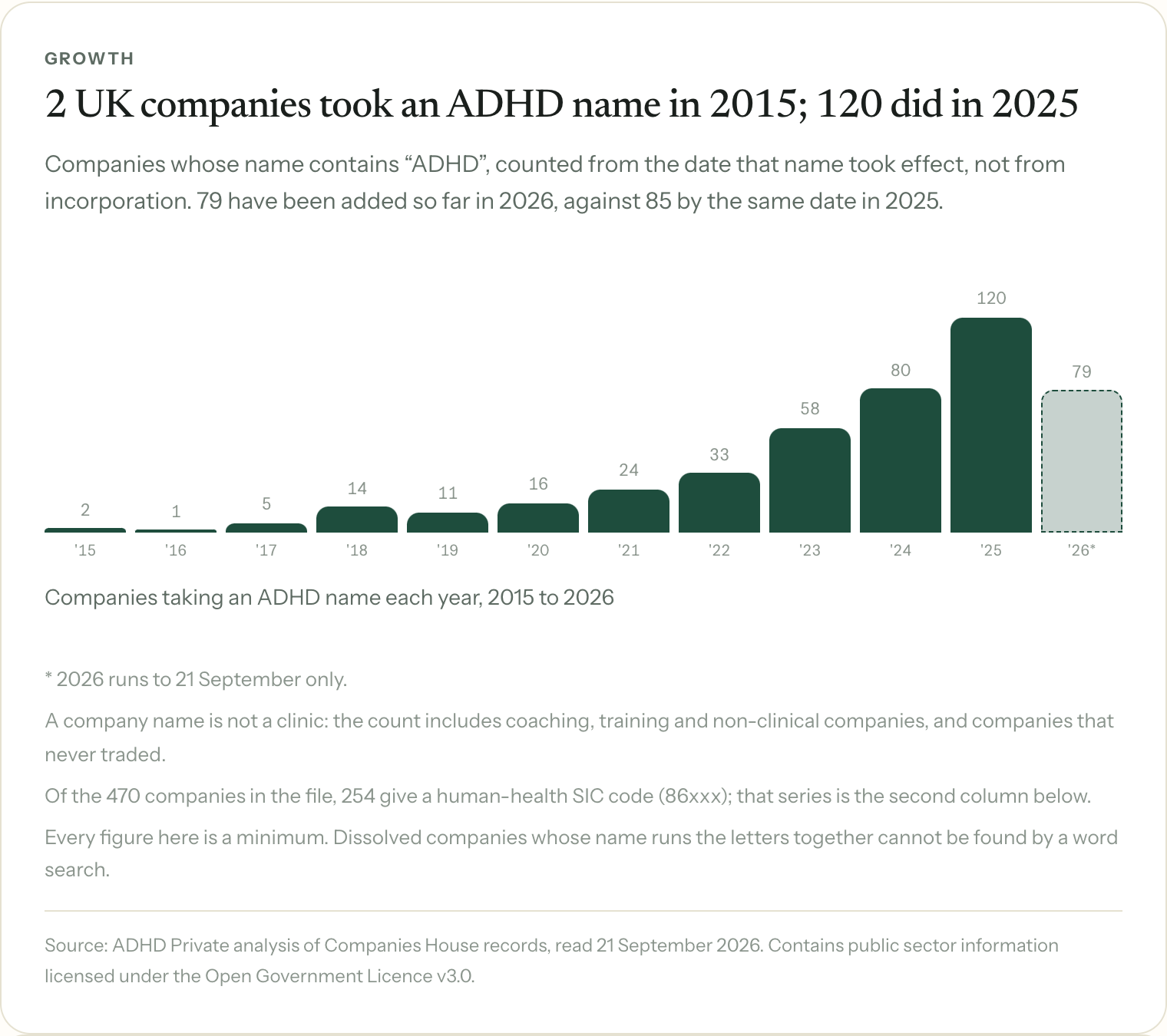
The part year matters. 79 companies have taken an ADHD name so far in 2026, against 85 by the same date in 2025. Among those giving a human-health SIC code, the gap is wider: 40 against 61. Two part years are a weak basis for calling a turn, and SIC codes are self-declared at registration, so we state the figures and leave the reading open.
Growth
There are at least 346 ADHD-named companies on the UK register, up from 314 six months ago
Companies holding an ADHD name and not yet dissolved, at each year end and again on 21 September 2026. That is 32 more than on 21 March 2026, a rise of 10.2%.
- At least: a company that has dissolved leaves the series, and dissolved companies with run-together names cannot all be found.
- A company on this register is not necessarily a clinic, and a clinic is not necessarily on it.
Source: ADHD Private analysis of Companies House records, read 21 September 2026. Contains public sector information licensed under the Open Government Licence v3.0.
View the figures as a table
| Date | ADHD-named companies on the register |
|---|---|
| 2010 | 4 |
| 2011 | 11 |
| 2012 | 12 |
| 2013 | 13 |
| 2014 | 17 |
| 2015 | 19 |
| 2016 | 19 |
| 2017 | 21 |
| 2018 | 35 |
| 2019 | 42 |
| 2020 | 57 |
| 2021 | 75 |
| 2022 | 101 |
| 2023 | 148 |
| 2024 | 213 |
| 2025 | 305 |
| 21 Mar 2026 | 314 |
| 21 Sep 2026 | 346 |
Download this chart’s data (CSV)Download the image (PNG)How this was counted
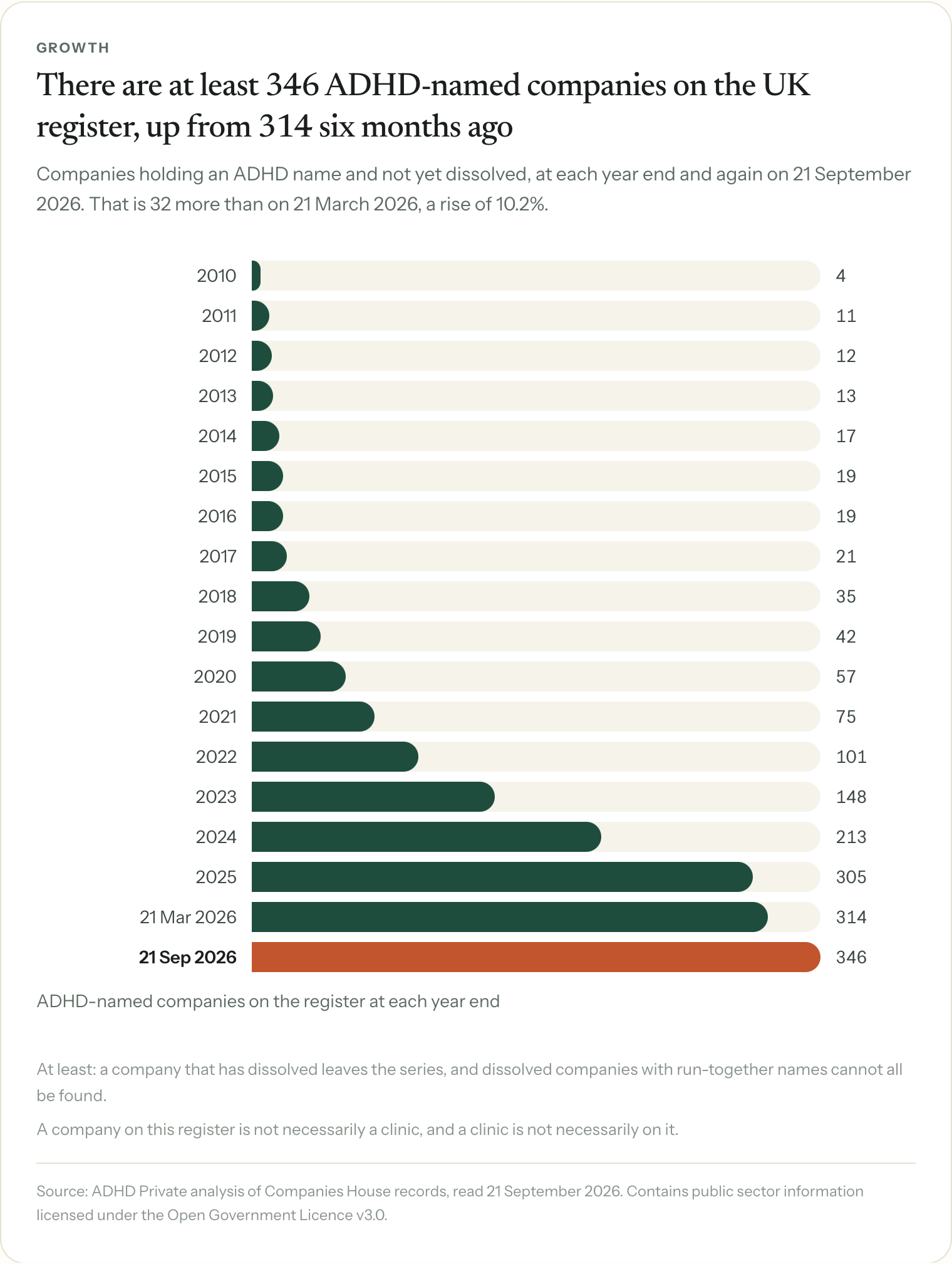
110 of the 470 companies have been dissolved, which is why the standing count rises more slowly than the yearly one. Dissolved companies are also where the undercount bites hardest: Companies House name search matches whole words, so a dissolved company that ran the letters together is invisible to it. We added the monthly bulk file of live companies to catch run-together names among the living, and 3 charitable incorporated organisations with no usable incorporation date are left out of the yearly series entirely.
Growth
35 of the 49 CQC locations with “ADHD” in their name registered in 2024 or later
Locations on the Care Quality Commission's register whose name contains “ADHD”, by the year their registration started. Active and deactivated files together.
- * 2026 runs to 21 September 2026 only.
- A location's name is not its service: most CQC-registered ADHD services do not have ADHD in the location name, and are not in this count.
- CQC covers England only.
Source: ADHD Private analysis of the CQC register (active and deactivated locations, 1 September 2026). Contains public sector information licensed under the Open Government Licence v3.0.
View the figures as a table
| Year registration started | Locations |
|---|---|
| 2,015 | 1 |
| 2,016 | 0 |
| 2,017 | 0 |
| 2,018 | 0 |
| 2,019 | 2 |
| 2,020 | 0 |
| 2,021 | 1 |
| 2,022 | 2 |
| 2,023 | 8 |
| 2,024 | 6 |
| 2,025 | 19 |
| 2,026 | 10 |
Download this chart’s data (CSV)Download the image (PNG)How this was counted
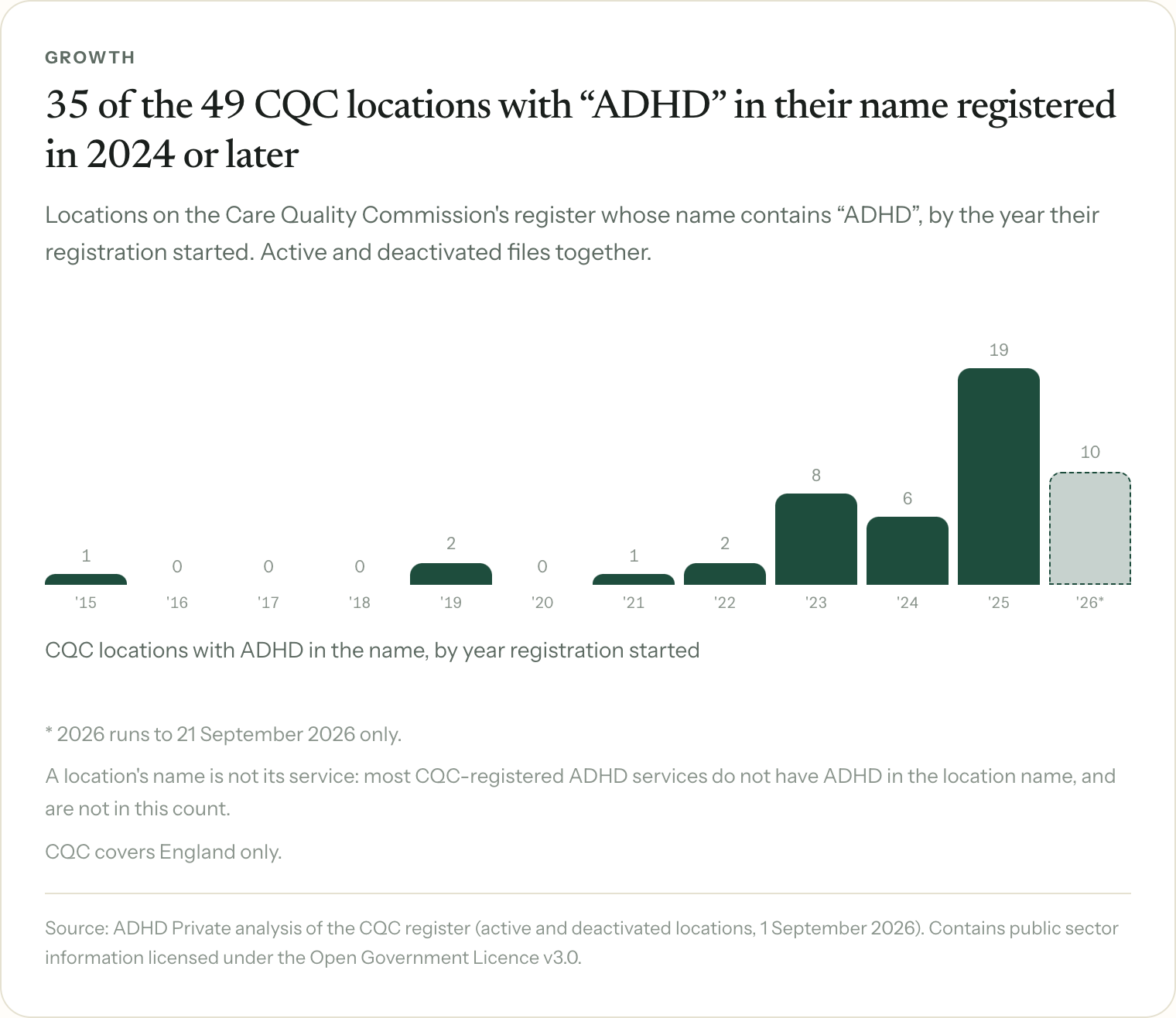
49 CQC locations carry “ADHD” in their name across the active and deactivated files of 1 September 2026, and 44 of them are on the active file. That is a small and unrepresentative slice of regulated ADHD provision — naming a location after the condition is a choice, not a requirement — but it is a slice counted the same way each year, and it turns upward at the same point the company series does.
How to check thismarket_adhd_companies.csv in the data package, one row per company, with the company number, the date its ADHD name took effect, every ADHD-named period, its status, SIC codes and a link to its Companies House page. The CQC series comes from the register’s own monthly files, named in Method.
How many of the clinics we list are registered with a health regulator?
39 of 342 hold a published quality judgement; 195 are matched to no register entry we could corroborate. Before reading either number as a scandal or as reassurance, read the rule that produces it.
“If you only provide diagnosis of ADHD and/or autism (without any form of treatment) you will not need to register for this regulated activity”
Care Quality Commission, scope of registration: treatment of disease, disorder or injury
That is CQC’s own guidance, and it means an unregistered diagnosis-only clinic in England is doing nothing wrong. A clinic that prescribes or titrates medication is treating, and does need to register. In August 2026 the Parliamentary and Health Service Ombudsman said the consequence of that wording should be dealt with:
“Although diagnostic and screening procedures are regulated activities, the wording of current regulations means that diagnosis of ADHD and autism does not currently fall into scope of CQC registration and inspection. As such, diagnostic-only providers of ADHD and autism assessments are not required to register with CQC. … We believe this regulatory gap should be addressed urgently.”
Parliamentary and Health Service Ombudsman, Improving access to ADHD and autism assessment and treatment: commissioning with confidence, recommendation 3, 26 August 2026
The Ombudsman recommended that the Government consider revising the Health and Social Care Act 2008 (Regulated Activities) Regulations 2014 “to bring diagnosis of ADHD and autism into scope of CQC registration and inspection”. Until that happens, the categories below are what exists to check.
Regulation
39 of 342 listed clinics hold a published regulator quality rating
Every clinic listed on ADHD Private, counted once, by the strongest regulator record we could corroborate on 21 September 2026.
- “No match found” is not “unregistered”. A provider that only diagnoses, and does not treat, is not required to register with CQC; and a clinic may be registered under a company or trading name we could not match.
- Registration is not inspection, and inspection is not a rating.
- A registered location does not show that the ADHD work is the regulated activity.
Source: ADHD Private analysis of the CQC, Healthcare Improvement Scotland, Healthcare Inspectorate Wales and RQIA registers, 21 September 2026.
View the figures as a table
| Regulator status | Clinics | % of listed clinics |
|---|---|---|
| CQC registered, rating published | 39 | 11.4 |
| CQC registered, no rating published | 89 | 26 |
| Registered with HIS, HIW or RQIA | 13 | 3.8 |
| Registration in progress | 2 | 0.6 |
| Matched only to deregistered CQC locations | 4 | 1.2 |
| No match found | 195 | 57 |
Download this chart’s data (CSV)Download the image (PNG)How this was counted
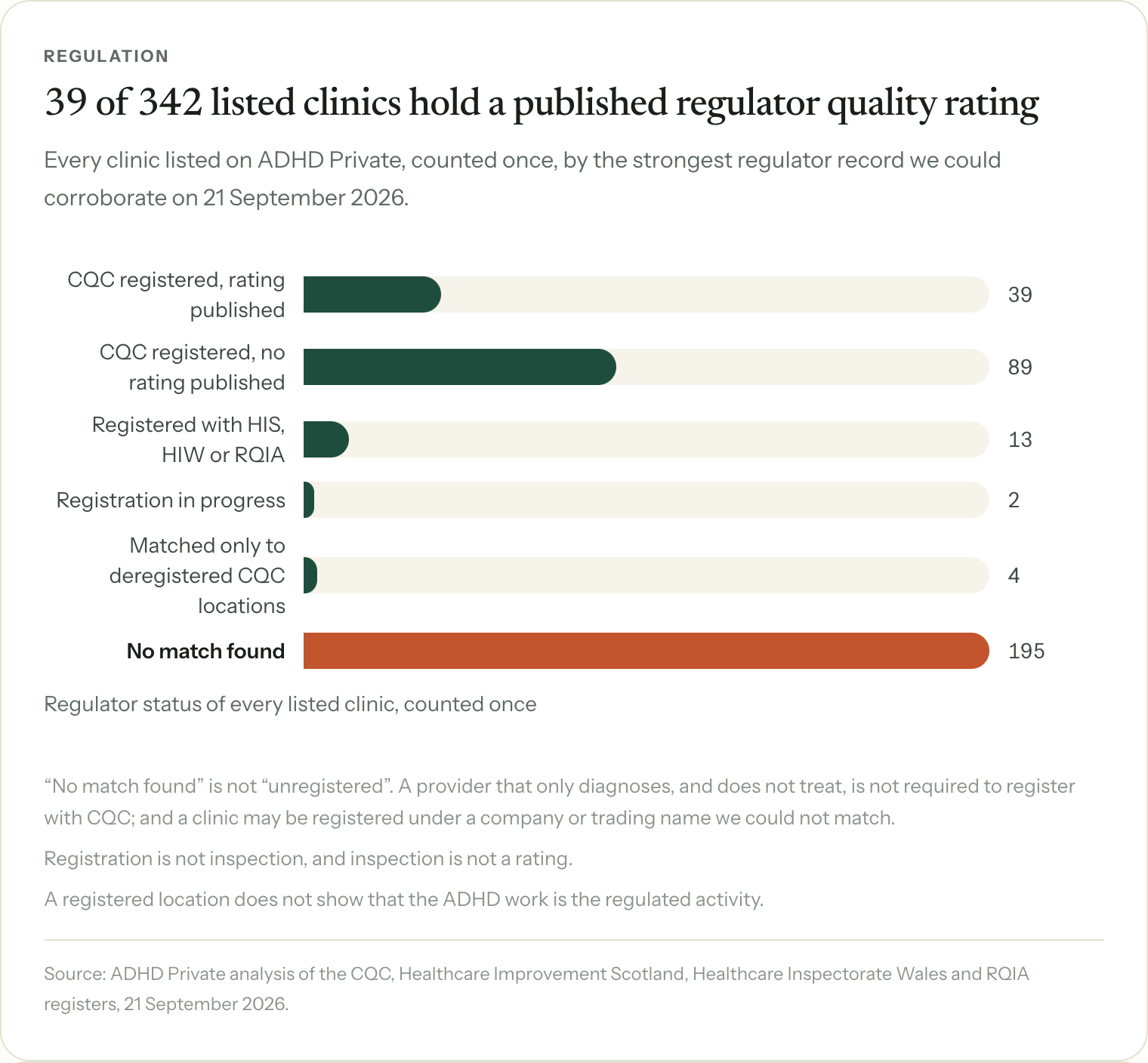
Each clinic appears once, under the strongest record we could corroborate, so the five categories sum to 342. A current registration with Healthcare Improvement Scotland, Healthcare Inspectorate Wales or the RQIA sits beside a CQC one, never beneath it: they are different regulators applying different tests, not rungs on a ladder.
Regulation
39 of the 304 clinics we could search on the CQC register have a published rating
Each step is a subset of the one above it. The first step drops the clinics with no English location, which CQC does not cover.
- A clinic is counted as registered if any location matched to it is currently registered.
- Rated means CQC has published one of its four quality judgements for a currently registered location.
Source: ADHD Private analysis of the CQC register, 21 September 2026. Contains public sector information licensed under the Open Government Licence v3.0.
View the figures as a table
| Step | Clinics |
|---|---|
| Clinics listed on ADHD Private | 342 |
| Searched on the CQC register | 304 |
| Matched to a CQC location | 132 |
| Currently registered with CQC | 128 |
| With a published CQC rating | 39 |
Download this chart’s data (CSV)Download the image (PNG)How this was counted
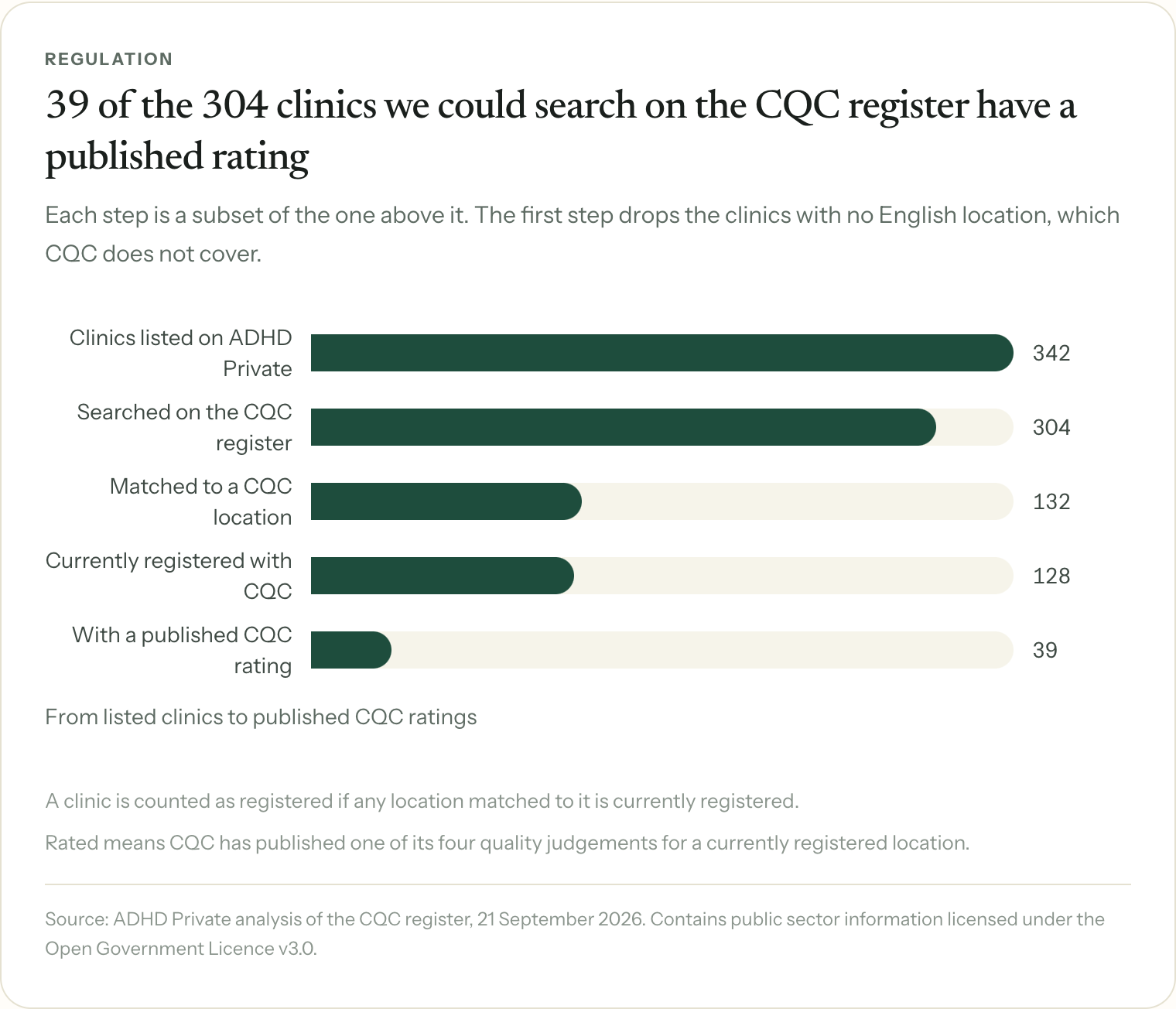
The first step drops 38 clinics with no English location, whom CQC does not cover. Of the 132 matched, 117 matched on a strong signal and 15 on a weaker one that a human then confirmed; both are flagged in the data so you can drop the weaker set and recompute. And a registered location does not show that the ADHD work is the regulated activity: an inspection covers a whole location, and some of these locations provide much else besides.
The border changes the question
England asks what the service is. The other three nations ask who provides it. Healthcare Improvement Scotland registers an independent clinic as one “in or from which services are provided by a medical practitioner, dental practitioner, registered nurse, registered midwife, registered pharmacist, registered pharmacy technician or dental care professional”, and adds that “The term ‘service’ includes consultations, investigations and treatments”. Healthcare Inspectorate Wales registers “establishments in Wales where private only medical services are provided regularly by medical practitioners”, and independent medical agencies where there is no fixed establishment. Northern Ireland’s 2003 Order defines an independent clinic as an establishment “in which services are provided by medical practitioners”.
So a diagnosis-only ADHD clinic staffed by a doctor falls inside the registering net in Scotland, Wales and Northern Ireland, and outside it in England. That is the opposite of what we wrote in July, when we said the same diagnosis-only distinction limited what the devolved registers captured; it does not, and that study now carries a dated correction. We are reading published registration guidance, not giving legal advice, and each regulator decides its own scope.
View the devolved-nation checks as a table
| Check | Clinics |
|---|---|
| Listed clinics with a presence outside England | 46 |
| — of which Scotland | 27 |
| — of which Wales | 13 |
| — of which Northern Ireland | 9 |
| Registered with Healthcare Improvement Scotland | 11 |
| Registration in progress with Healthcare Improvement Scotland | 2 |
| Registered with Healthcare Inspectorate Wales | 4 |
| Registered with the RQIA | 2 |
| Registered with at least one devolved regulator | 16 |
| Also inside the CQC search, and checked there too | 3 |
| In scope of the July study, which searched by name only | 38 |
In July, Wales and Northern Ireland were covered by a name search that returned nothing, and we published that there was no Welsh or Northern Irish file to compare against. Checking clinic by clinic instead produced 5 Welsh and 2 Northern Irish register rows, both published in this package, and a dated correction in corrections.csv. The lesson is not about Wales: a name search over a register that lists services by provider name will miss any clinic that registered under a different one.
How to check thisclinic_checks.csv has one row per listed clinic, with every check flag, the match method and confidence, the rating and its date, and the status_category this chart counts. Group that column and you get the chart. The register rows themselves are in wales_hiw_register.csv and northern_ireland_rqia_register.csv.
What do clinics show about who their clinicians are?
213 of 342 clinics name the clinician who carries out the assessment, and 172 name the professional regulator that clinician is registered with. Those are the two facts a patient can actually check for themselves: a name and a regulator together turn a website claim into a public register entry, in a way that neither does alone.
Credentials
213 of 342 clinic sites name the clinician who does the assessing
Five things a clinic can publish about who it is and what it holds. 172 name a professional regulator and 33 claim an accreditation of some kind.
- A site that shows nothing is not a clinic without it. This counts what a clinic publishes, not what it holds: a doctor on the GMC register whose site never says so is counted here as saying nothing.
- 5 of the 342 listed clinics could not be read at all, because the site needs JavaScript we do not run or refused us. They are in every denominator on this page, and they can only lower a count.
- A clinic can appear in more than one row, so the rows do not add up to the total.
Source: ADHD Private analysis of what UK private ADHD clinics publish on their own websites, read 18–21 September 2026.
View the figures as a table
| What the site shows | Clinics | % of listed clinics |
|---|---|---|
| Names the clinician who assesses | 213 | 62.3 |
| Names a professional regulator | 172 | 50.3 |
| Names a college or membership body | 157 | 45.9 |
| Claims an accreditation | 33 | 9.6 |
| Shows another certification | 9 | 2.6 |
Download this chart’s data (CSV)Download the image (PNG)How this was counted
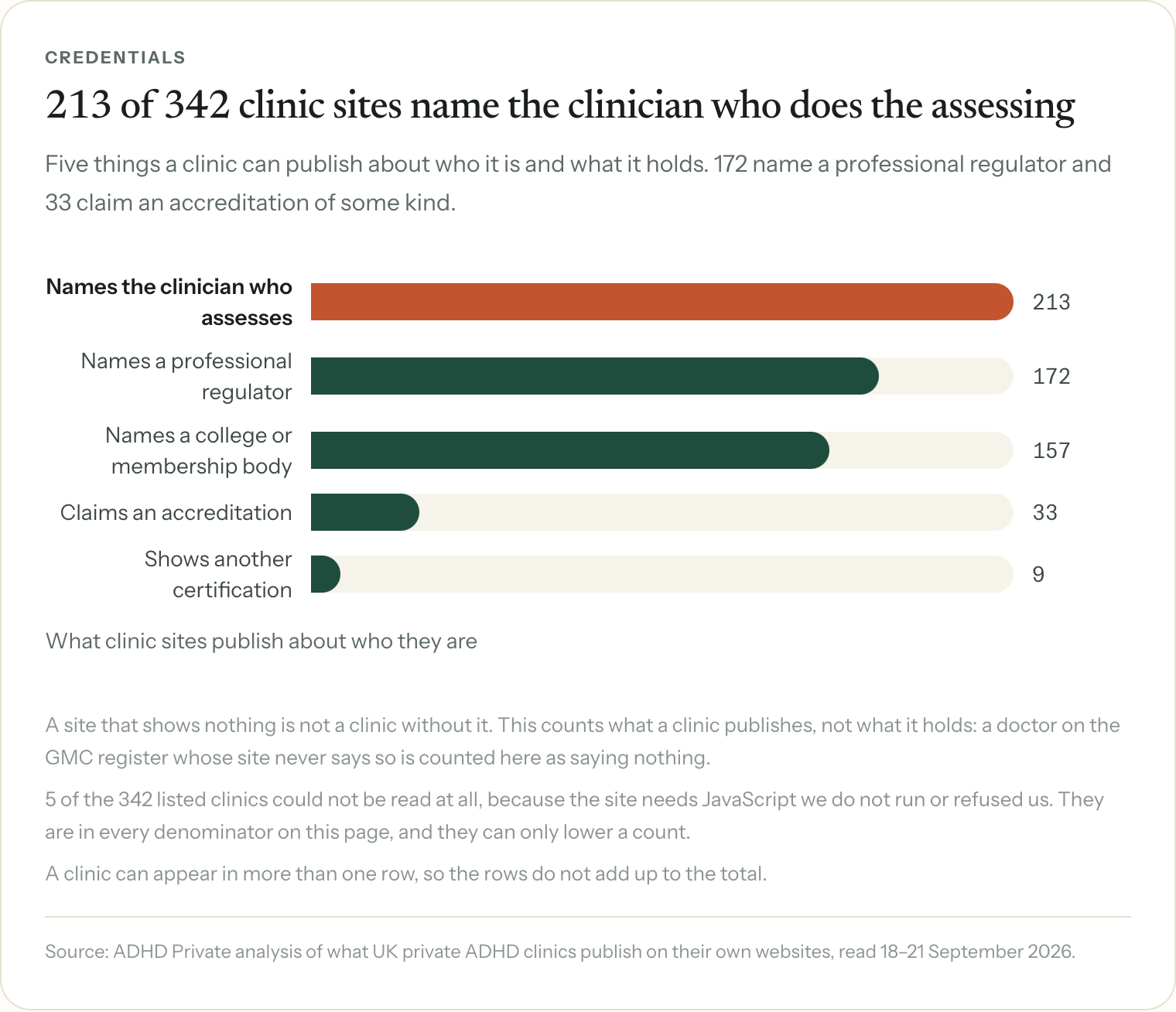
We read 337 of the 342 sites; 5 could not be read at all and stay in every denominator, so each share here is a floor. 324 publish something about their clinicians’ credentials. Nothing in this chapter is a check that a claim is true, with one exception set out below.
Credentials
77 of 342 clinic sites name the General Medical Council
Which professional regulator a site names, whether for the clinic's clinicians generally or for a named individual. A site can name more than one.
- A site that shows nothing is not a clinic without it. This counts what a clinic publishes, not what it holds: a doctor on the GMC register whose site never says so is counted here as saying nothing.
- We count the regulator being named, never a registration number: publishing one clinician's number alongside their employer would identify them here.
- Naming a regulator is not proof of registration, and we have not checked any individual against a register.
Source: ADHD Private analysis of what UK private ADHD clinics publish on their own websites, read 18–21 September 2026.
View the figures as a table
| Regulator named | Clinics |
|---|---|
| General Medical Council | 77 |
| Health and Care Professions Council | 105 |
| Nursing and Midwifery Council | 27 |
| General Pharmaceutical Council | 6 |
| Another named regulator | 1 |
Download this chart’s data (CSV)Download the image (PNG)How this was counted
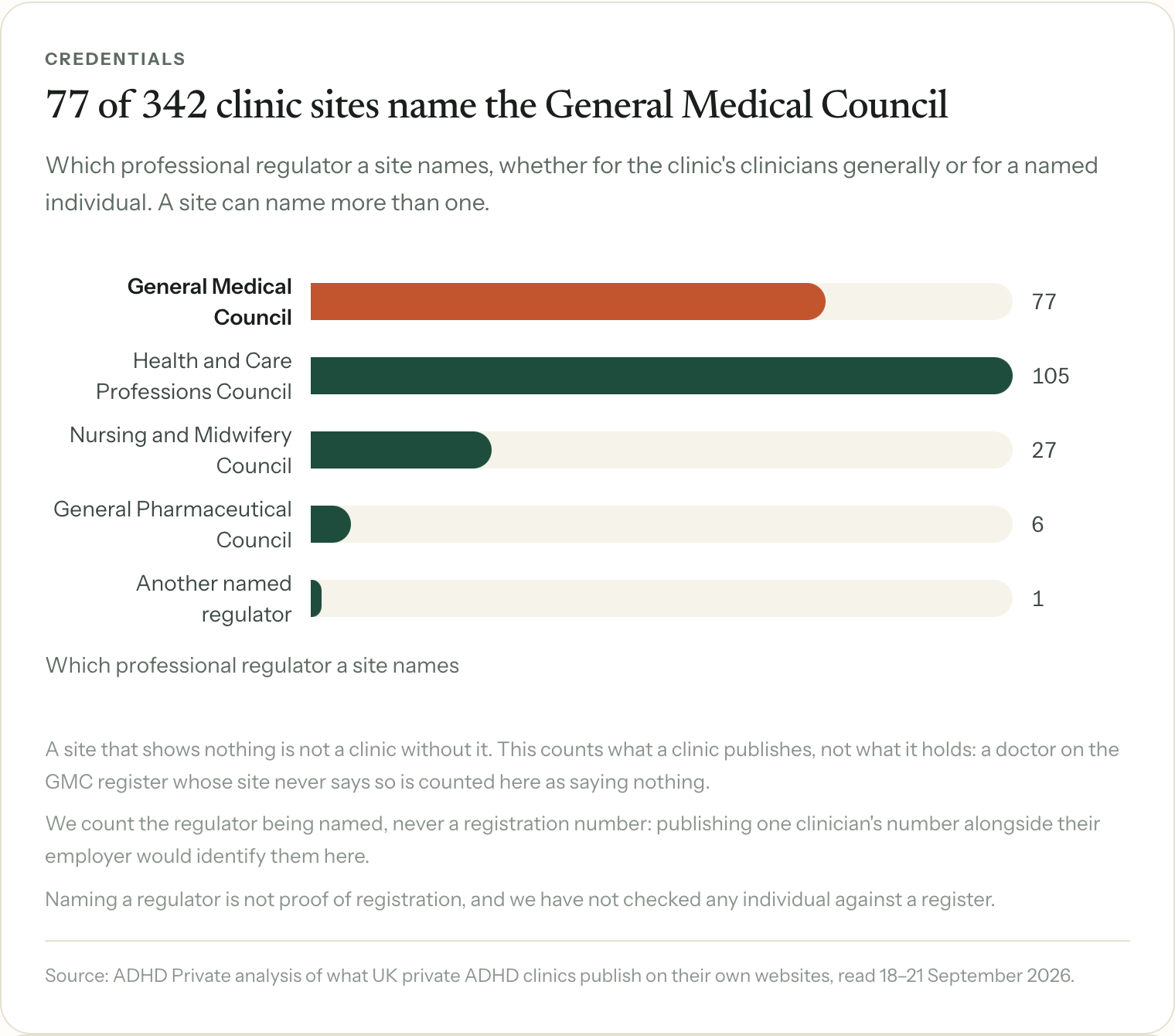
Which regulator a clinic names is itself informative, because the regulators cover different professions: 77 name the General Medical Council, 105 the Health and Care Professions Council and 27 the Nursing and Midwifery Council. 1 clinics name some other regulator, counted together rather than listed, because a regulator named by one clinic plus that regulator’s own register identifies the clinic, and no clinic is named in this study.
157 clinics name a college or membership body. A membership is not a regulator and not an inspection: most of these bodies admit members on qualification and subscription, and none of them audits an ADHD service. The same goes for the 9 clinics showing some other certification, which in practice are information-security and quality-management schemes — 2 show ISO 9001 and 4 Cyber Essentials. They say something about how a business is run, and nothing about an assessment.
Credentials
33 of 342 clinic sites claim an accreditation, and 16 of those name no accrediting body
What the accreditation claims point at. 15 different bodies are named across the sites that name one.
- No accreditation scheme is specific to ADHD assessment. The Royal College of Psychiatrists accredits services through its quality networks, and none of those networks is an ADHD one, so every claim here is a claim about something other than ADHD assessment quality.
- Where a named body publishes a member list, we checked the claim against it and recorded what we found. A claim is never marked false from a list that may be out of date.
- Bodies named by a single clinic are counted together: a body plus its published member list would name the clinic.
- A site that shows nothing is not a clinic without it. This counts what a clinic publishes, not what it holds: a doctor on the GMC register whose site never says so is counted here as saying nothing.
Source: ADHD Private analysis of what UK private ADHD clinics publish on their own websites, read 18–21 September 2026.
View the figures as a table
| Accreditation claimed | Clinics |
|---|---|
| NHS | 4 |
| UKAAN | 2 |
| A body named by one clinic each | 13 |
| “Accredited”, with no body named | 16 |
Download this chart’s data (CSV)Download the image (PNG)How this was counted
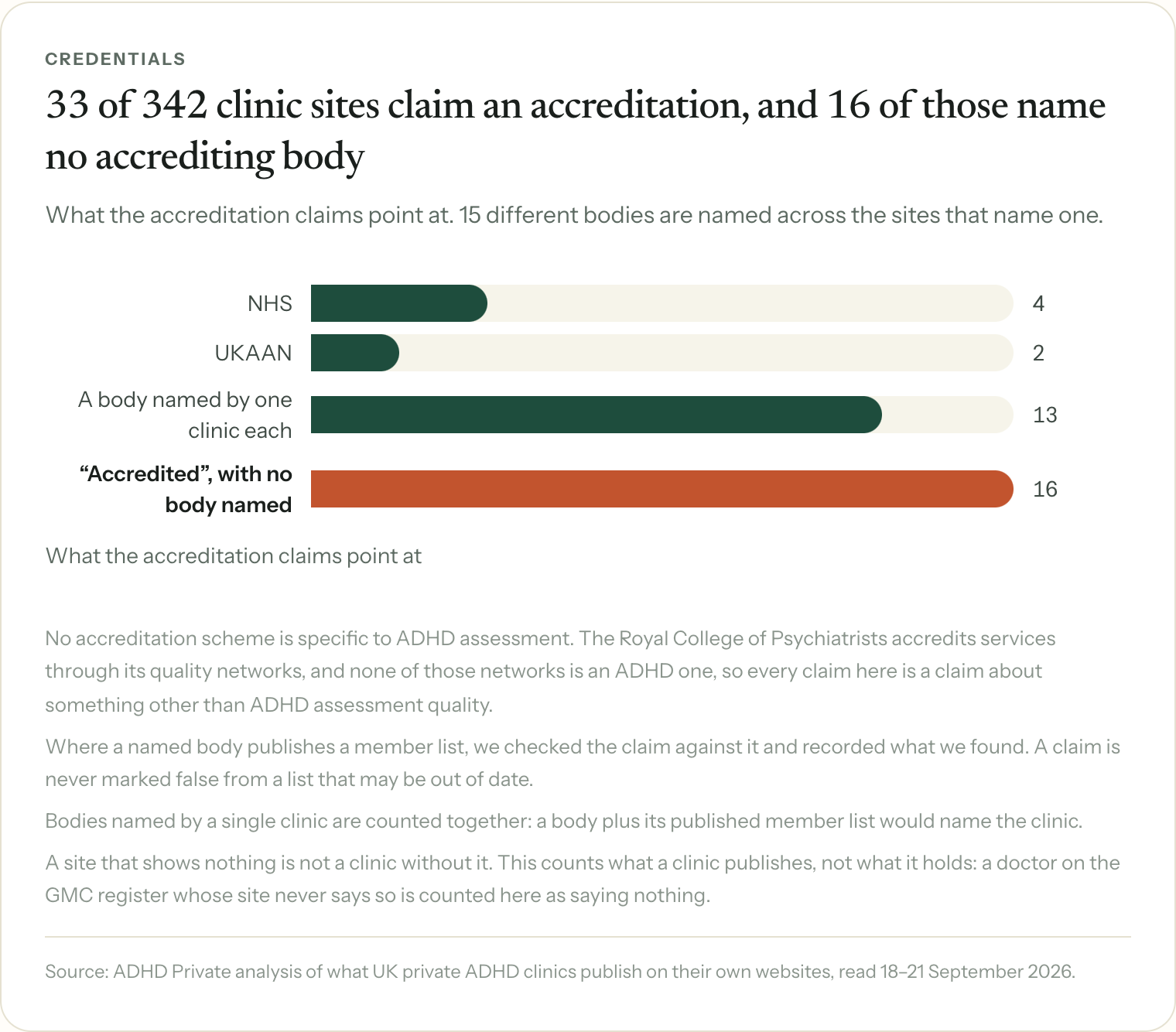
No accreditation scheme is specific to ADHD assessment, so every accreditation claim on this chart is a claim about something else. Two published standards exist — the adult one quoted above and its counterpart for children and teenagers — but a standard is not a scheme, and no body certifies a clinic against either. The Royal College of Psychiatrists runs quality networks that do accredit services, none of them ADHD-specific. 16 clinics describe themselves as accredited without naming a body at all, which is the claim a patient can do least with.
Where a clinic named a body that publishes a member list, we looked the clinic up on that list and recorded what we found in the row’s notes. We never mark a claim false from a list that may be out of date or that may hold the clinician rather than the clinic; a claim we could not corroborate is recorded as exactly that.
How to check thissite_claims.csv in the data package, one row per listed clinic, with clinicians_named, professional_registration_shown, memberships_shown, accreditation_claims and other_certifications_shown, each non-empty value carrying the clinic’s own words and the page they were read on.
How many clinics say they take NHS Right to Choose referrals?
39 of 342, in their own published words. Right to Choose lets a patient in England ask to be referred to any provider that holds an NHS contract for the service and meets NHS standards, at no cost to them. It applies in England only, and it needs a GP referral: the right attaches to a referral from or on behalf of a GP, dentist or optometrist, and NHS England’s guidance is explicit that “The legal rights do not extend to self-referrals”. Patients in Scotland, Wales and Northern Ireland have no equivalent right.
Right to Choose
39 of 342 listed clinics say on their own site that they take NHS Right to Choose referrals
What each clinic's website says, quoted and dated. 266 say nothing either way, 30 say they do not, and 2 say their service is paused or closed.
- Right to Choose applies in England only and needs a referral from a GP: a patient cannot self-refer under it.
- Saying nothing is not saying no. This counts what a site publishes, not what a clinic does.
- Of the 39 that say they take referrals, 29 name adults, 19 name under-18s and 28 say some areas or ICBs are closed, capped or delayed.
Source: ADHD Private analysis of what UK private ADHD clinics publish on their own websites, read 18–21 September 2026.
View the figures as a table
| What the site says | Clinics |
|---|---|
| Says it accepts Right to Choose referrals | 39 |
| Says referrals go to a named partner | 0 |
| Says its service is paused or closed | 2 |
| Says it does not accept them | 30 |
| Says nothing either way | 266 |
| Site could not be read | 5 |
Download this chart’s data (CSV)Download the image (PNG)How this was counted
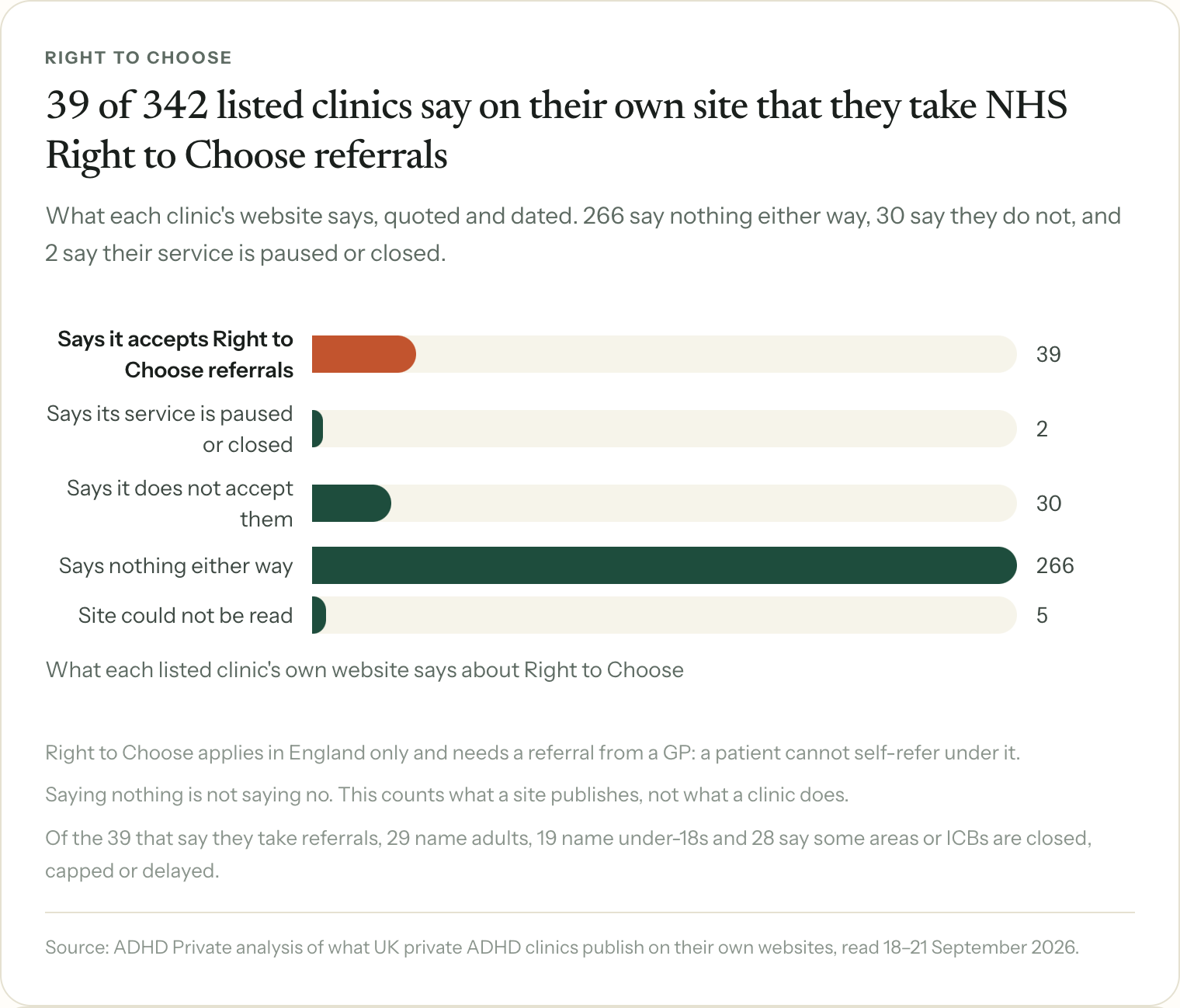
Only a statement on the clinic’s own site counts here. We re-read the stored pages of every clinic carrying any Right to Choose signal, fetched the sites that were silent, and checked the sitemaps of the rest for a Right to Choose page, giving 153 sites read for this question and 87 with any Right to Choose text at all. Of the 39 that accept referrals, 29 state that adults are covered and 19 that children or young people are; 28 name the areas or Integrated Care Boards they can take referrals from, which is the detail most likely to decide whether a particular patient can use a particular clinic.
Our July study put this at 40 of 332 clinics. That figure came from our own directory field, which records what we had been told rather than what a clinic publishes, and it is superseded by the quoted count here. Both are now labelled as such wherever they appear.
How to check thisright_to_choose.csv, one row per listed clinic: the status, the verbatim quote, the URL it was read on, the date, the ages covered and any area restriction. A row with no quote is a row we did not count.
How do published assessments compare with the adult quality standard?
Of the 99 clinics that publish a comparable adult contact time, 44 publish two hours or more and 29 publish less. There is no regulator standard for how an ADHD assessment is conducted, but there is a professional one. In 2024 a group of UK clinicians specialising in ADHD published the adult ADHD assessment quality assurance standard, known as AQAS:
“the total assessment time should be at least 2 hours in most cases. This may take the form of one 2–3-hour consultation (often with a break), or a number of shorter consultations, totalling at least two hours in most cases”
Adamou and colleagues, The adult ADHD assessment quality assurance standard, Frontiers in Psychiatry 2024;15:1380410, section 3.4.1 [Essential]
AQAS counts “two hours or more of direct patient contact time”, and treats a consultation held over video as direct contact. So we coded contact time only: where a site separates questionnaires, scoring or report writing from the appointment, those minutes are excluded, and where it states several sessions, the stated contact minutes are totalled. The rule was written before the data was read, and it is published in full in Method.
Against published standards
44 of the 99 clinics that state an adult appointment length state two hours or more; 29 state less
The adult ADHD assessment quality assurance standard (AQAS, 2024) says the total assessment time “should be at least 2 hours in most cases”, counting direct contact time, which may be one long appointment or several shorter ones.
- This is what a site states, not what happens in the room, and a clinic that states no length may still take longer than one that does.
- Contact time only: questionnaires, scoring and report writing are excluded wherever a site separates them.
- AQAS is a published standard, not a rule anyone enforces, and no clinic here is being marked against it.
Source: ADHD Private analysis of what UK private ADHD clinics publish on their own websites, read 18–21 September 2026.
View the figures as a table
| Stated adult appointment length | Clinics | % of those stating a length |
|---|---|---|
| Under 2 hours | 29 | 29.3 |
| A range that crosses 2 hours | 13 | 13.1 |
| 2 hours or more | 44 | 44.4 |
| Only one session of several is timed | 2 | 2 |
| Stated, but not a comparable contact time | 11 | 11.1 |
Download this chart’s data (CSV)Download the image (PNG)How this was counted
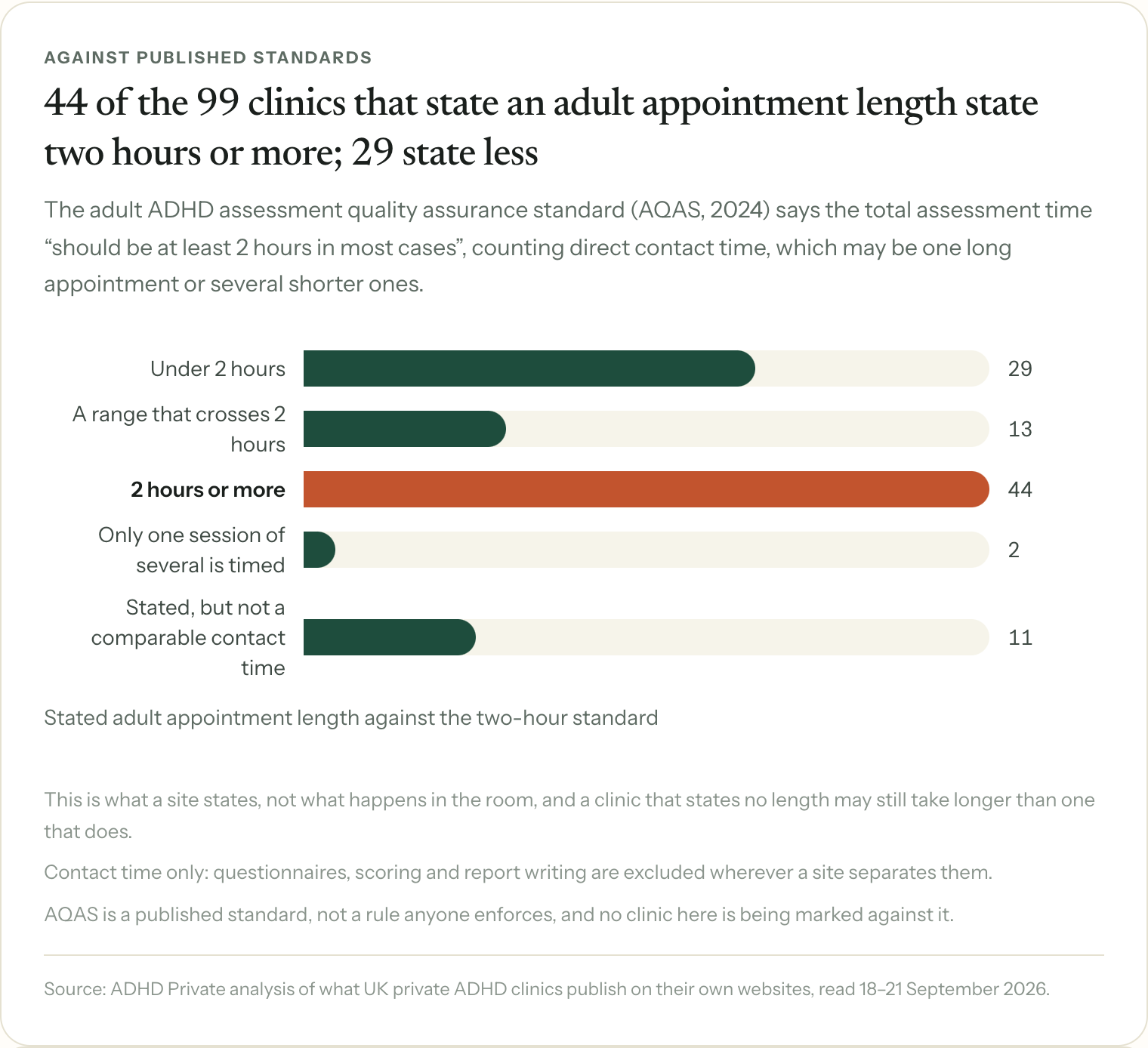
112 clinics publish an adult or child appointment length we could read; 13 of those state it only for a child pathway and are counted in the children’s study instead, leaving the 99 here. The point of the middle categories is that they are not failures: a clinic advertising “90 minutes to 2.5 hours” has told you something true and unclassifiable, and folding it into either side would manufacture a finding.
Against published standards
Stated adult appointment lengths run from 50 to 210 minutes, with a median of 120
The 69 clinics whose stated contact time falls wholly on one side of two hours. A range is placed at its midpoint.
Stated contact time (minutes)
- 13 more clinics state a range that crosses two hours and 4 state a ceiling with no floor (“up to 90 minutes”); neither has a position on this axis and both are in the chart above.
- The dashed line is the AQAS figure of two hours, drawn where the data changes side. It is a published standard, not a pass mark.
Source: ADHD Private analysis of what UK private ADHD clinics publish on their own websites, read 18–21 September 2026.
View the figures as a table
| Stated contact time (minutes) | Clinics |
|---|---|
| under 60 | 2 |
| 60–89 | 9 |
| 90–119 | 14 |
| 120–149 | 20 |
| 150–179 | 16 |
| 180 or more | 8 |
Download this chart’s data (CSV)Download the image (PNG)How this was counted
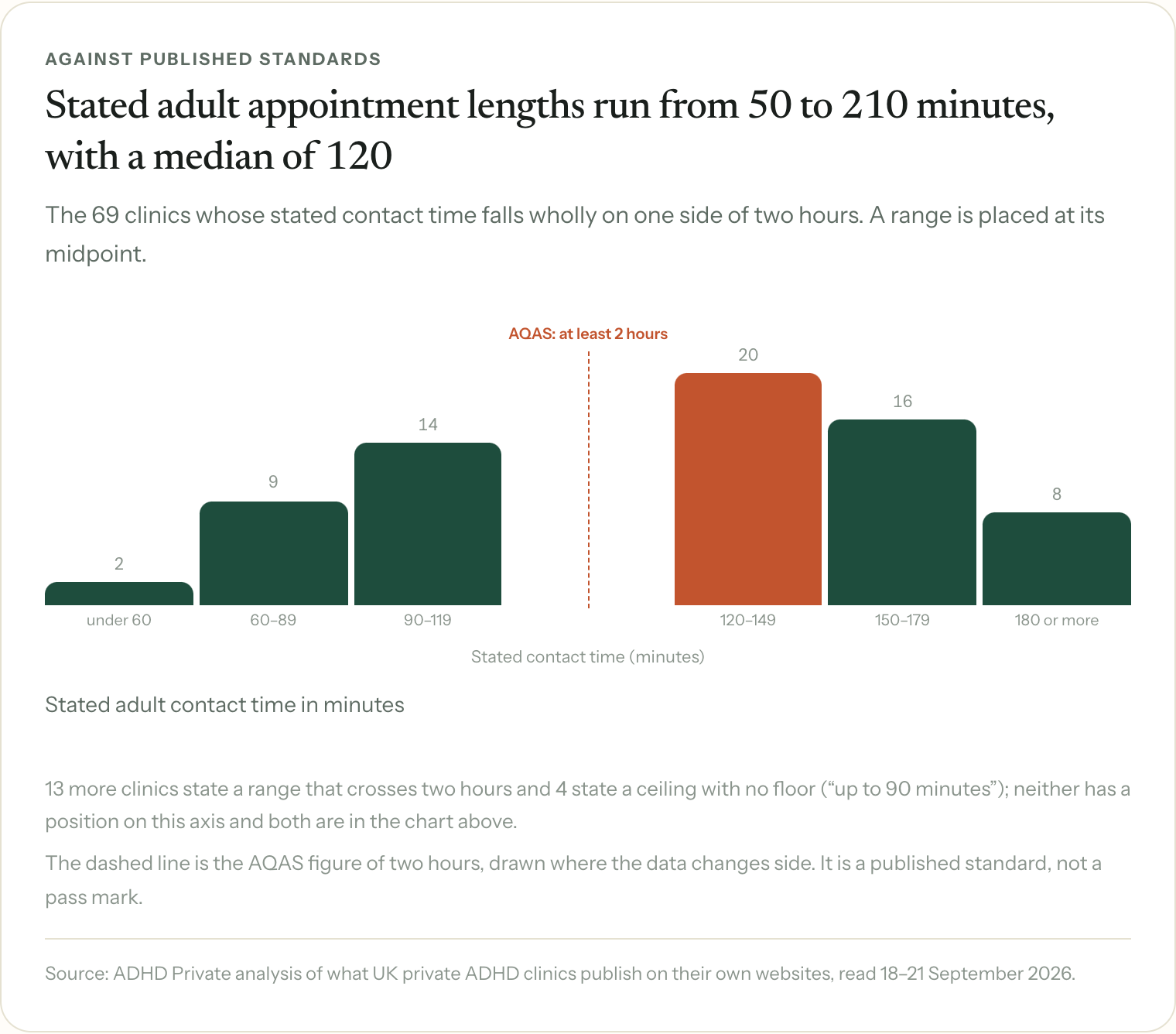
The dashed line is where the standard sits, not a pass mark, and nothing here places a clinic on the wrong side of a rule: AQAS is a published professional standard that no body enforces, and it says “in most cases”. The 69 clinics in this chart are those whose stated time falls wholly on one side of two hours; the 13 with a range crossing it and the 4 publishing a ceiling with no floor have no position on this axis, and appear in the chart above instead.
Online or in person
AQAS asks for “direct consultation (face-to-face, or remote using video-conferencing)”, so a video assessment is not a lesser one under the standard, and nothing below should be read that way. The Ombudsman reported in August 2026 that “Many Right to Choose and independent providers conduct most of their assessments remotely” and that “there is no national data on the proportion of assessments conducted remotely”. This does not fill that gap. It records what clinics say they offer.
Against published standards
131 of 297 adult pathways do not say whether the assessment is online or in person
What each site says it offers on its adult pathway. AQAS treats a remote video consultation as direct contact, so an online assessment is not thereby a shorter or lesser one.
- This is what clinics offer, not how assessments are actually carried out. The Parliamentary and Health Service Ombudsman reported in August 2026 that “there is no national data on the proportion of assessments conducted remotely”, and this does not fill that gap.
- Our own directory's online flag is not mixed in: this is the clinic's own wording, quoted and dated.
Source: ADHD Private analysis of what UK private ADHD clinics publish on their own websites, read 18–21 September 2026.
View the figures as a table
| What the site says it offers | Clinics | % of adult pathways |
|---|---|---|
| Online only | 37 | 12.5 |
| Online or in person | 116 | 39.1 |
| In person only | 13 | 4.4 |
| Not stated | 131 | 44.1 |
Download this chart’s data (CSV)Download the image (PNG)How this was counted
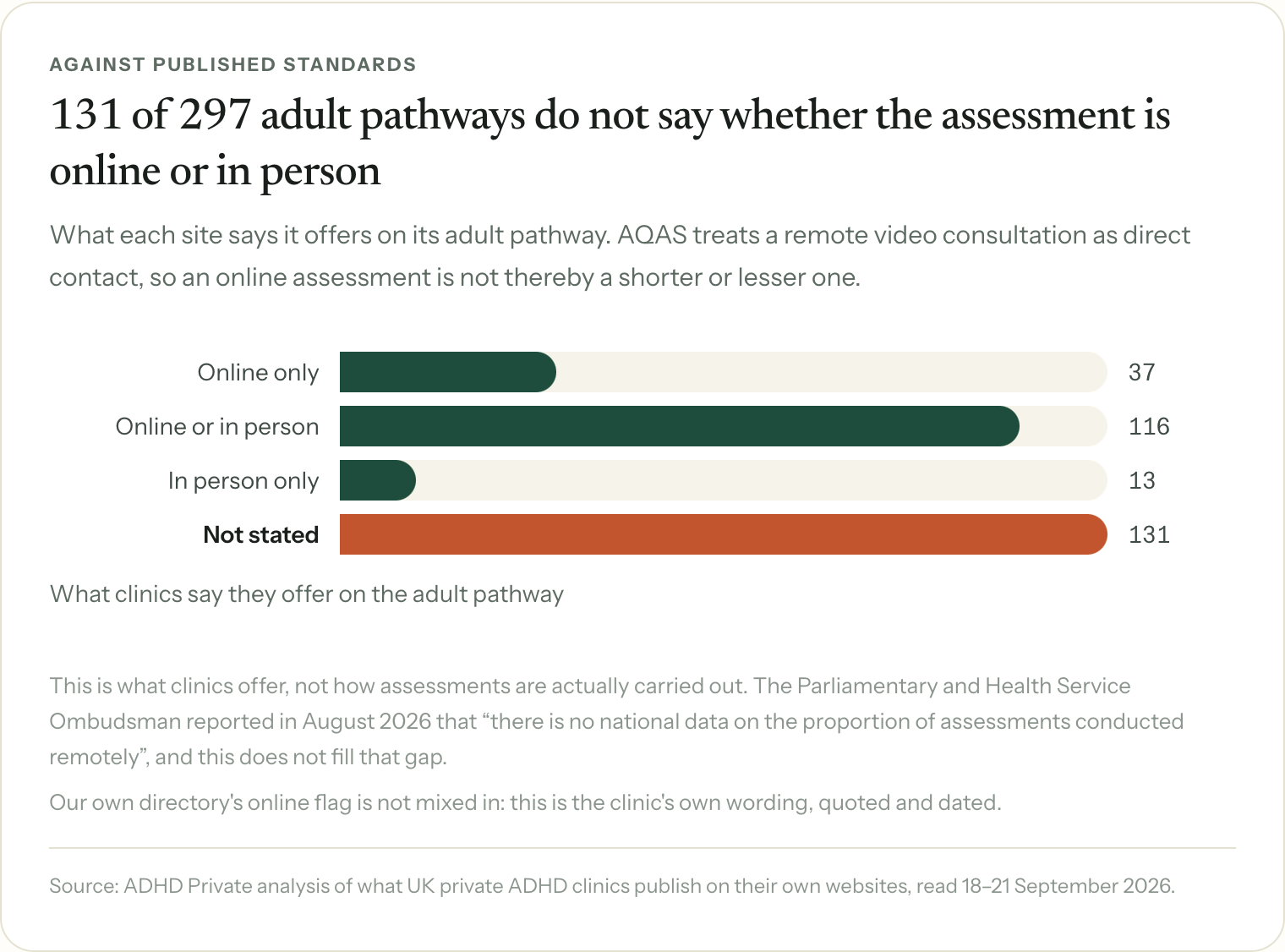
131 of 297 adult pathways leave it unstated, which is a practical finding rather than a statistical one: a patient who needs to know whether they will be seen in a room or on a screen cannot find out from nearly half of these websites without asking. Our own directory carries an online flag; it is deliberately not mixed in here, because this chart is the clinic’s wording, quoted and dated.
What NICE asks for, and what sites publish
The clinical guideline in England and Wales is NICE NG87, and our September study of the same 337 websites found that 74 of them describe all three elements at the centre of its assessment recommendation — who assesses, a full developmental history, and an informant or observer account — falling to 63 of 297 when only the adult pathway is counted. Those figures are re-surfaced here unchanged from the September assessment-standards study that produced them, because a chapter about standards that ignored the clinical guideline would be a strange one.
How to check thisappointment_length.csv, one row per clinic with a stated length: the quote, the URL, the minutes we read from it, the class the rule assigns and the reason. Every class in the chart is a value of one column, so a reader can re-apply the rule differently and see what changes.
What do clinics advertise about access and payment?
192 of 342 clinics state on their own site how soon they can see you, and 74 set that against NHS waiting times. This chapter counts what clinics advertise. It is not our claim about how long anyone waits, and nothing here compares private provision with the NHS: it records how many clinics draw that contrast themselves, which is a different and checkable thing.
Marketing
192 of 342 clinic sites say something about how soon they can see you
The form the statement takes. 74 of them set their own figure against NHS waiting times.
- These are clinics' own published claims, counted. ADHD Private is not saying how soon any clinic can see a patient, and a published claim is not a commitment.
- Saying nothing is not saying no: a clinic that publishes no waiting time may still have a short one, and one that publishes a discount is not cheaper.
- A period is counted as published, not as verified. We did not test any of these by asking for an appointment.
Source: ADHD Private analysis of what UK private ADHD clinics publish on their own websites, read 18–21 September 2026.
View the figures as a table
| What the site says about timing | Clinics |
|---|---|
| A period in hours or days | 48 |
| A period in weeks | 88 |
| A period in months | 8 |
| No waiting list, with no period given | 16 |
| A speed word with no period | 32 |
| Says nothing about how soon | 145 |
Download this chart’s data (CSV)Download the image (PNG)How this was counted
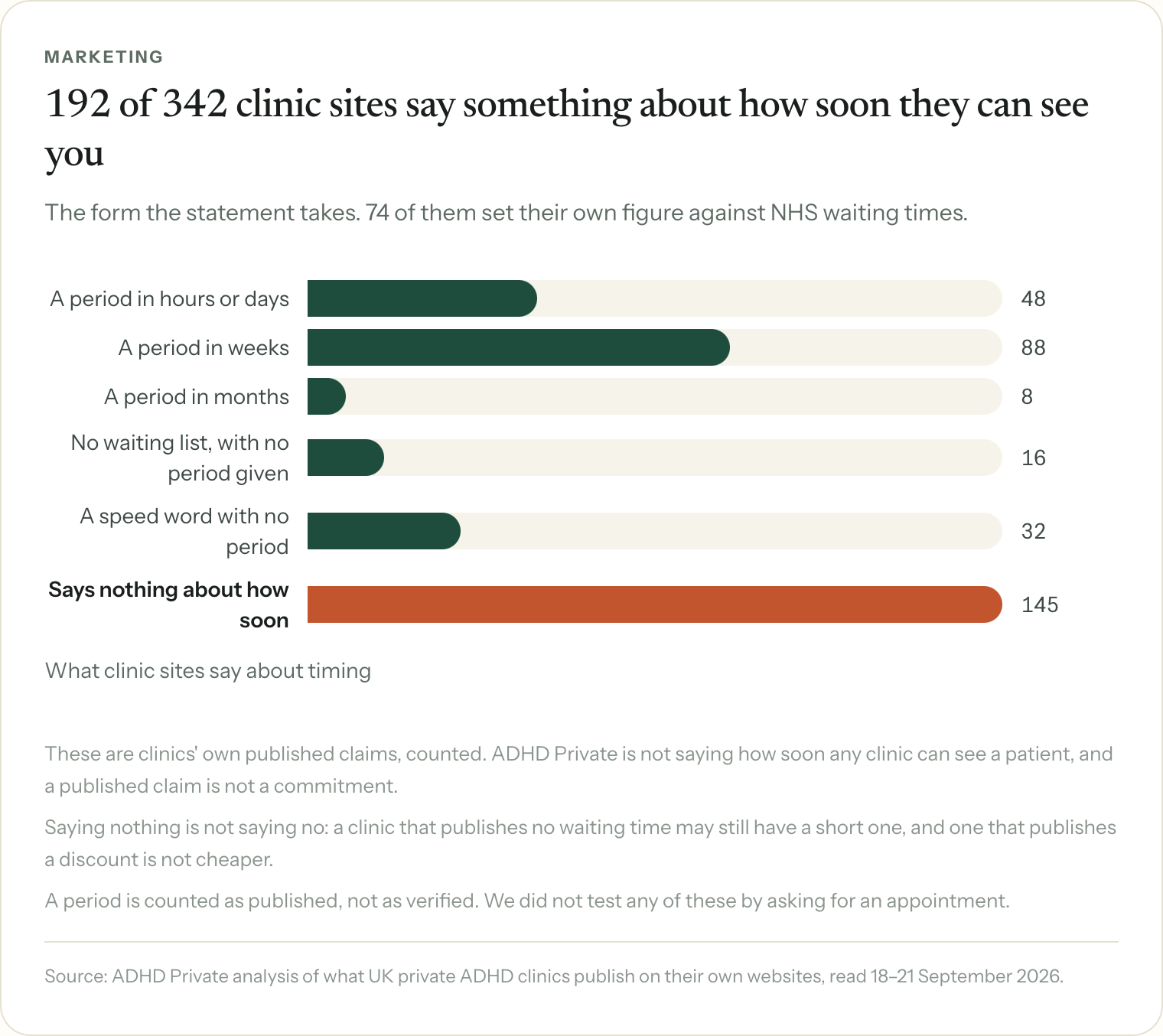
The unit a clinic chooses is part of the offer. 48 give a period in hours or days, 88 in weeks and 8 in months. 32 use a speed word with no period attached, and 16 say they have no waiting list without saying what that means in time. A stated period is not a measured wait, and none of these is a promise we have tested.
Marketing
18 of 342 clinic sites sell a paid way to be seen sooner
Five claims a clinic can publish alongside its price. 73 offer instalments or finance and 47 advertise a discount or concession.
- These are clinics' own published claims, counted. ADHD Private is not saying how soon any clinic can see a patient, and a published claim is not a commitment.
- Saying nothing is not saying no: a clinic that publishes no waiting time may still have a short one, and one that publishes a discount is not cheaper.
- A clinic can appear in more than one row, so the rows do not add up to the total.
Source: ADHD Private analysis of what UK private ADHD clinics publish on their own websites, read 18–21 September 2026.
View the figures as a table
| What the site publishes | Clinics | % of listed clinics |
|---|---|---|
| States how soon it can see you | 192 | 56.1 |
| Contrasts its speed with NHS waits | 74 | 21.6 |
| Sells a paid way to be seen sooner | 18 | 5.3 |
| Offers instalments or finance | 73 | 21.3 |
| Advertises a discount or concession | 47 | 13.7 |
Download this chart’s data (CSV)Download the image (PNG)How this was counted
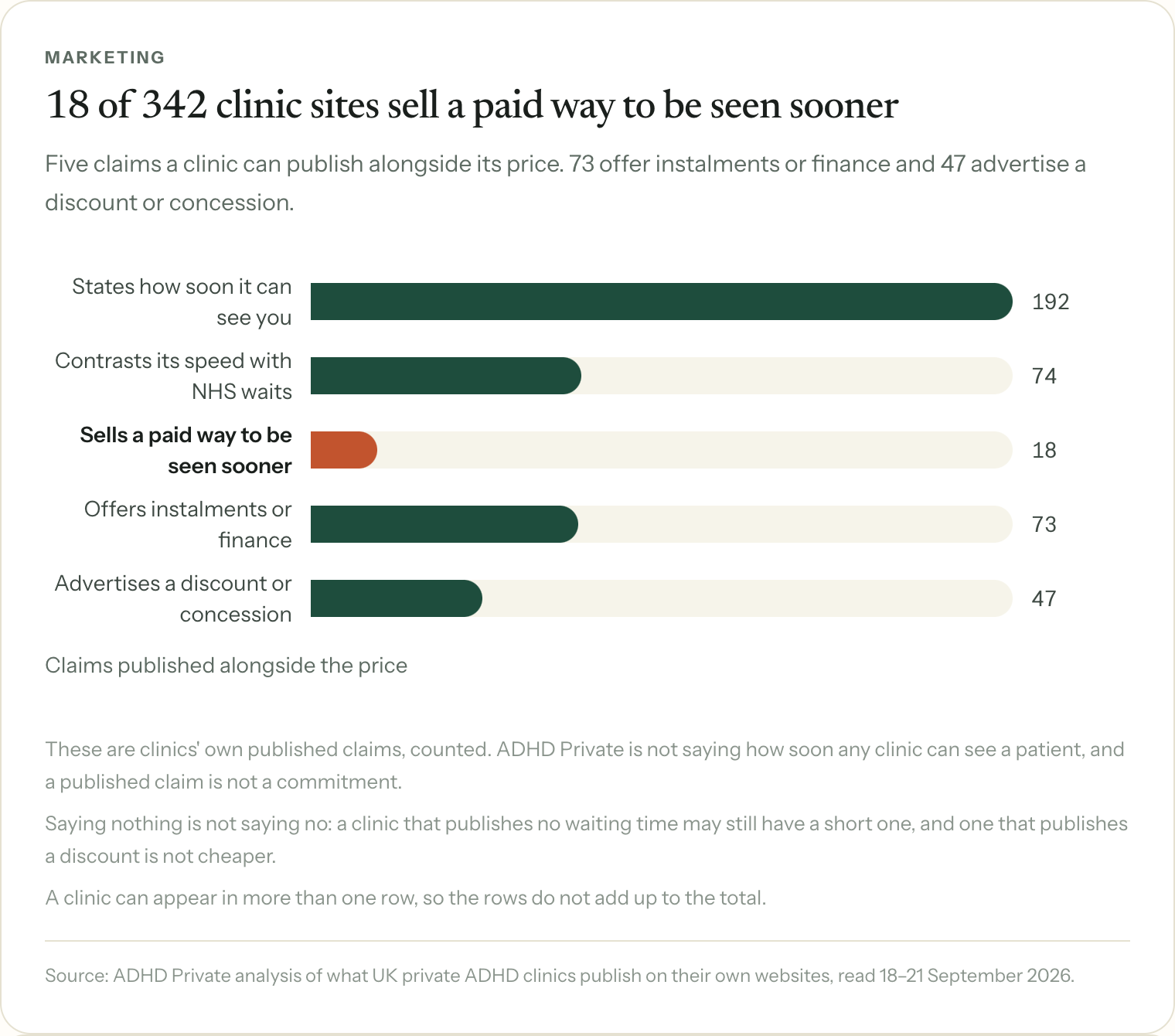
18 clinics sell a paid option to be seen sooner than their standard route. That is a legitimate thing to sell and it is disclosed on the page where we found it, but it is worth seeing counted, because it prices access itself rather than the assessment. 73 offer instalments or third-party finance, and 47 advertise a discount or concession.
We record these because the independent review into mental health conditions, ADHD and autism is expected to consider how private ADHD services are advertised, and because a count is the part of that argument nobody has published. We take no view here on whether any of it should be permitted; that is a question for a regulator, and this is a measurement.
How to check thissite_claims.csv, columns speed_statement, nhs_wait_comparison, paid_fast_track, finance_offered and discount_offered. Every non-empty value carries a verbatim quote and the URL it was read on, so each count can be re-derived claim by claim.
How this was done
- The clinics
- All 342 private ADHD clinics listed on this site on 21 September 2026. It is a census of a directory, not of the market: no public register of private ADHD providers exists, so no one can enumerate the market, and we do not claim to. 5 sites could not be read at all, which is why some denominators are 337.
- Regulator matching
- Clinics were matched to CQC by location identifier, or by postcode plus a distinctive shared name token, and weak matches were rejected rather than guessed, which makes every matched count a floor. All 46 clinics with any presence outside England were checked against the Healthcare Improvement Scotland, Healthcare Inspectorate Wales and RQIA registers by hand, clinic by clinic, including the 3 that were also inside the CQC search. Each regulator’s scope was read from its own published guidance, quoted above and recorded with the date and a digest of the page it came from.
- The appointment-length rule, written first
- Contact time is totalled across the sessions a site presents as the diagnostic assessment. A clinic is counted as under two hours only when the whole stated range is below 120 minutes, and as two hours or more only when the whole range is at or above it; a range that crosses 120 is its own class. Where only one session of several is timed, or where a figure is open-ended (“up to 90 minutes”), self-contradictory, or includes non-contact work such as questionnaires or report writing, it is classed as such rather than forced to a side. The rule was fixed before the rows were read, and is applied through a published override file so every decision is visible.
- What clinics publish
- Every value read from a clinic website carries a verbatim quote and the URL it was read on. A language model proposed each value from the stored page text; a script then checked the quote appeared on that page, character for character, and blanked any value whose quote did not. A second pass could only weaken a value, never strengthen it, and a hand pass worked through what it flagged. Every change is published in
corrections.csvwith its before, after, reason and the pass that made it. - Companies
- Companies House advanced search, its dissolved-company index and its monthly bulk file of live companies, all read on 21 September 2026, matched on “ADHD” anywhere in a name. Every company’s profile was fetched for its previous names and their dates, so a company counts from the date an ADHD name took effect. The CQC location series uses the register’s own active and deactivated files of 1 September 2026. Each downloaded file is recorded with its URL, the time it was fetched and its digest.
- Reproducibility
- Every number on this page is generated from the published files by a script in our repository, not typed by hand, and cross-checked against the figures in our September study before the page builds. If you recompute a figure from the files below and get a different answer, we would like to know.
What this study cannot tell you
- It is not a quality assessment. We list clinics; we do not rate them. Registration, a published length and a regulator judgement are facts about records and websites, not about what happens in an assessment, and nothing here is a clinical opinion about any provider.
- Every count is a floor. Conservative matching, name searches that miss run-together names, and up to six pages read per website all push in the same direction: towards undercounting.
- Company names are not clinics. The market series counts companies whose names contain four letters. It includes businesses that never traded and excludes every provider trading under some other name.
- We cannot chart waiting times over time. Our own wait field is a category rather than a measured wait, and its change log only begins in July 2026, so there is no six-month series to publish. For waits, NHS England Digital’s quarterly ADHD Management Information is the official series; its August 2026 release is the latest.
- No registration rate for the whole market. Joining the company register to the regulator registers would produce one, and it would be wrong: a company-name search cannot tell a trading clinic from a dormant, non-clinical or non-English company, and diagnosis-only providers need not register in England at all.
- Websites change. This is a snapshot taken in the week to 21 September 2026, and registers are updated continuously. Some of these pages will already have been rewritten.
Work this builds on
The Centre for Health and the Public Interest reported in January 2026 on the NHS-funded end of this market, using freedom of information requests to Integrated Care Boards to reach spending and contracting that no website study can. NHS England’s ADHD taskforce reported in November 2025 on demand and capacity across the system. The Parliamentary and Health Service Ombudsman’s August 2026 report set out the regulatory gap this study measures against, from complaints rather than from registers. The independent review into mental health conditions, ADHD and autism, chaired by Professor Peter Fonagy, published an interim report in March 2026; its final report had not been published when this page went live.
What is new here is the clinic-level join: each listed clinic’s regulator record, its own published Right to Choose position and its own published appointment length, in one row, with the quote and the URL attached to every value. Our companion studies cover how clinics say they assess children and what those assessments cost across the UK.
Sources
- Care Quality Commission, Scope of registration: treatment of disease, disorder or injury
- Care Quality Commission, Scope of registration: diagnostic and screening procedures
- Care Quality Commission, public register of providers and locations
- Parliamentary and Health Service Ombudsman, Improving access to ADHD and autism assessment and treatment: commissioning with confidence — recommendations (26 August 2026)
- Parliamentary and Health Service Ombudsman, Improving access to ADHD and autism assessment and treatment: commissioning with confidence — variation in the quality of assessments (26 August 2026)
- Healthcare Improvement Scotland, regulation of independent healthcare: background and legislation
- National Health Service (Scotland) Act 1978, section 10F (meaning of independent health care service), as amended
- Healthcare Inspectorate Wales, who needs to register with us
- Care Standards Act 2000, section 2, as it applies in relation to Wales
- RQIA, registration guidance
- The Health and Personal Social Services (Quality, Improvement and Regulation) (Northern Ireland) Order 2003, article 2
- NHS Commissioning Board and Clinical Commissioning Groups (Responsibilities and Standing Rules) Regulations 2012, Part 8 (choice of health service provider)
- NHS England, patient choice guidance
- Adamou M, Arif M, Asherson P, Cubbin S, Leaver L, Sedgwick-Müller J, Müller-Sedgwick U, van Rensburg K, Kustow J. The adult ADHD assessment quality assurance standard. Frontiers in Psychiatry 2024;15:1380410
- NICE guideline NG87, Attention deficit hyperactivity disorder: diagnosis and management
- Companies House public data
- Independent review into mental health conditions, ADHD and autism (GOV.UK collection)
- Centre for Health and the Public Interest, Market failure: how the under-regulated market in NHS funded ADHD services impacts patients and the finances of the NHS (January 2026)
- NHS England, ADHD taskforce final report (November 2025)
Using this research and the data
Our contribution — this page, the aggregate figures and the compilation — is published under a Creative Commons Attribution 4.0 licence. Reproduce the charts and figures, including commercially, with credit.
How to cite: ADHD Private, Who checks private ADHD clinics? Registration, credentials and standards in 2026, 21 September 2026. https://adhdprivate.co.uk/research/uk-private-adhd-clinic-regulation-2026
Download
Aggregate figures behind every chart (CSV) — one row per plotted value, with its denominator. Each chart above also has its own CSV.
The clinic-level data is published too: the same files every figure above was computed from, one row per clinic, nothing withheld. Start with the README, which is the data dictionary, the method in full, and the known limits of each column.
- README.md — 44 KB
- clinic_checks.csv — 52 KB, 342 rows
- right_to_choose.csv — 100 KB, 342 rows
- site_claims.csv — 259 KB, 342 rows
- children_pathway.csv — 430 KB, 342 rows
- appointment_length.csv — 34 KB, 112 rows
- wales_hiw_register.csv — 1 KB, 5 rows
- northern_ireland_rqia_register.csv — 1 KB, 2 rows
- market_adhd_companies.csv — 109 KB, 470 rows
- corrections.csv — 24 KB, 48 rows
Licences within the data. Companies House, CQC and Healthcare Inspectorate Wales content is Crown copyright, reproduced under the Open Government Licence v3.0. The RQIA register text is theirs and is excluded from our CC BY grant — treat it as quotation. Clinic website extracts are reproduced for the purpose of reporting, with a link to the source page in every case.
Corrections. If a row about your clinic is wrong, tell us through contact and we will correct the data, the files and this page, and record the change below. We do not remove a row because a clinic dislikes what its own website says, and we will say so if asked.
Questions
Are private ADHD clinics required to register with the CQC?
How many private ADHD clinics hold a regulator quality rating?
Does no match on a regulator register mean a clinic is unregistered?
Is there an accreditation scheme for private ADHD assessment?
How many private ADHD clinics accept NHS Right to Choose referrals?
How long should an ADHD assessment take?
Can online reviews show which clinics are good?
How many private ADHD providers are there in the UK?
Can I reuse this research and the underlying data?
Related research
- Every chart, with its data — the September 2026 chart pack, each chart with a CSV, an image and a link back to the method.
- How private ADHD clinics say they assess children — the children’s pathway the same clinics describe, against the published children’s assessment quality standard.
- What a private ADHD assessment costs across the UK — prices and provision, July 2026.
Changes to this report
No corrections have been made since publication on 24 September 2026. Any change to a figure will be listed here with its date and reason, and the published files will be regenerated at the same time. Corrections this release makes to our earlier studies are listed in corrections.csv and on the pages concerned.
About this research and how we are funded
ADHD Private is a comparison directory for private ADHD clinics. Patients use it free. We make money from clinics: some pay for a clearly labelled "Featured" placement. We take no commission on bookings or referrals. Paid placement is always labelled and never changes a clinic's position in organic listings or matching results. The clinics that pay were checked, coded, corrected and counted here exactly as every other clinic was, and no clinic was contacted before publication.
We are not connected to any similarly named company. In particular, a CQC-registered provider called ADHDPrivate Ltd appears in the data behind this report and has no relationship with ADHD Private or Sellframe Ltd.
Informational only — not medical advice. Clinic details change; verify with the clinic before booking.
Figures as of 21 September 2026. Compare private ADHD clinics.