What we found
- Most clinics that see children publish very little about how they assess them. The median clinic describes 4 of the 7 elements the published standard marks Essential and applicable to any profession, and 40 of 262 describe none of them.
- School information is the element families are least likely to see described. 162 of 262 clinics mention collecting anything from a school, though the standard asks for independent evidence from previous and current educational settings.
- 167 clinics name the profession that assesses the child. The rest leave a family to ask. Where a profession is named, it is most often clinical psychologist.
- A child assessment usually costs more than an adult one. Of the 46 clinics publishing both prices, 41 charge more for the child, 5 charge the same and 0 charge less, a median difference of £200.
How many private ADHD clinics see children, and from what age?
262 of the 342 clinics we list see children or teenagers. 244 of them record a child or teenager age group with us (225 children, 240 teenagers). The other 18 record none, and belong here anyway: their own websites sell a child assessment, which is how we found them. That gap is ours, not theirs — a parent filtering our directory for a clinic that sees children would not have been shown those 18, and we are fixing it. Counting only our own age groups would have hidden them from this study too. That is the population every share on this page is out of. Adult-only clinics have a row in the published file and appear in no denominator here, because dividing by all 342 would mix clinics that see no children into a count about children.
We could read pages from 258 of them. 4 sites could not be read at all — they need JavaScript we do not run, or they refuse an automated reader — and those clinics are recorded as not collected rather than as silent. 248 publish text about assessing children specifically, as opposed to listing a child age group and saying nothing more.
Children
124 of 262 clinics that see children publish a minimum age, and the median is 6
The youngest age each clinic says it will assess, where it says one. They run from 2 to 17.
Youngest age the clinic says it will assess
- This counts what a clinic describes on its website, never what it does. We have not observed an assessment, and a clinic that describes nothing may still do everything.
- The denominator is the 262 listed clinics that say they see children or teenagers, not all 342. 4 of them could not be read.
- A minimum age is the clinic's own rule, not a clinical threshold. NICE sets no minimum age for an ADHD assessment.
Source: ADHD Private analysis of what UK private ADHD clinics publish on their own websites, read 18–21 September 2026.
View the figures as a table
| Minimum age stated | Clinics |
|---|---|
| 2 | 1 |
| 4 | 2 |
| 5 | 22 |
| 6 | 66 |
| 7 | 16 |
| 8 | 6 |
| 9 | 1 |
| 10 | 1 |
| 12 | 2 |
| 13 | 1 |
| 14 | 3 |
| 16 | 1 |
| 17 | 2 |
Download this chart’s data (CSV)Download the image (PNG)How this was counted
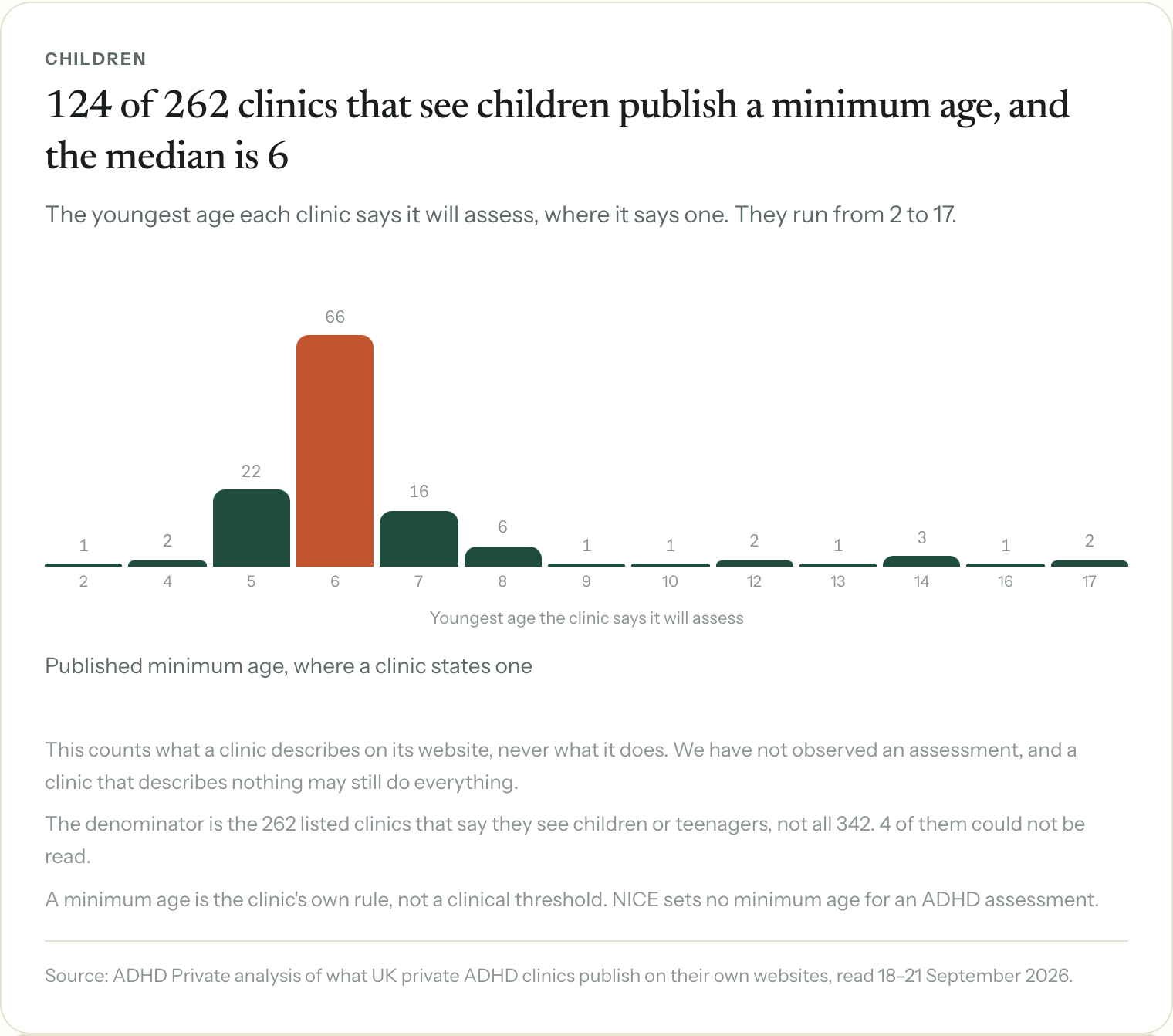
124 of the 262 clinics state a minimum age, from 2 to 17, with a median of 6. The clustering matters to a parent of a young child: a clinic that accepts children from four and one that starts at eleven are not substitutes, and the age is often the single fact that decides where a family can go at all.
How to check thischildren_pathway.csv in the data package, one row per listed clinic, with min_age, pages_read and site_fetch_status. The child and teenager age groups come from clinics.csv in our September clinic-level package.
How much of the published standard do clinics describe?
The median clinic describes 4 of 7 essential elements, and 27 of 262 describe all of them. The standard is CAAQAS, published in 2024 by UK clinicians in a peer-reviewed journal. It marks each element Essential, Highly recommended or Optional. It is a standard, not an accreditation scheme: no body certifies a clinic against it, and no one inspects against it, so a low count is a fact about a website and not a finding about a clinic.
The composite counts only the elements marked Essential that apply whatever profession runs the assessment. One essential element is deliberately excluded: the baseline physical assessment, which the standard addresses to medical practitioners in particular. Counting it against a psychologist-led service would mark it down for a requirement the standard does not put on it.
“Medical practitioners must include a baseline physical assessment for diagnostic purposes and before starting medication.”
CAAQAS, section 2.6, on the baseline physical assessment — the essential element this study leaves out of its composite
Children
162 of 262 clinics that see children say they collect information from the child’s school
Each element of a child ADHD assessment set out in CAAQAS (2024), and how many clinics describe it on their site. 170 describe interviewing or surveying a parent or carer. The level is the one the paper gives.
- This counts what a clinic describes on its website, never what it does. We have not observed an assessment, and a clinic that describes nothing may still do everything.
- CAAQAS is a published consensus standard for child and adolescent ADHD assessment, not a regulation, and no clinic here is being marked against it.
- The denominator is the 262 listed clinics that say they see children or teenagers, not all 342. 4 of them could not be read.
Source: ADHD Private analysis of what UK private ADHD clinics publish on their own websites, read 18–21 September 2026.
View the figures as a table
| Element | CAAQAS level | Clinics describing it | % of clinics seeing children |
|---|---|---|---|
| Says who assesses the child | essential | 167 | 63.7 |
| Interviews or surveys a parent or carer | essential | 170 | 64.9 |
| Collects information from school | essential | 162 | 61.8 |
| Takes a developmental history | essential | 124 | 47.3 |
| Considers other conditions | essential | 120 | 45.8 |
| Uses a structured clinical interview | essential | 68 | 26 |
| Provides a written report | essential | 164 | 62.6 |
| Describes a physical assessment | essential for medical practitioners | 34 | 13 |
| Says how the child is seen | highly recommended | 155 | 59.2 |
| Uses rating scales | highly recommended | 135 | 51.5 |
| Gives feedback after the assessment | highly recommended | 139 | 53.1 |
| Observes the child at school or home | optional | 42 | 16 |
| Uses a computerised attention test | optional | 84 | 32.1 |
Download this chart’s data (CSV)Download the image (PNG)How this was counted
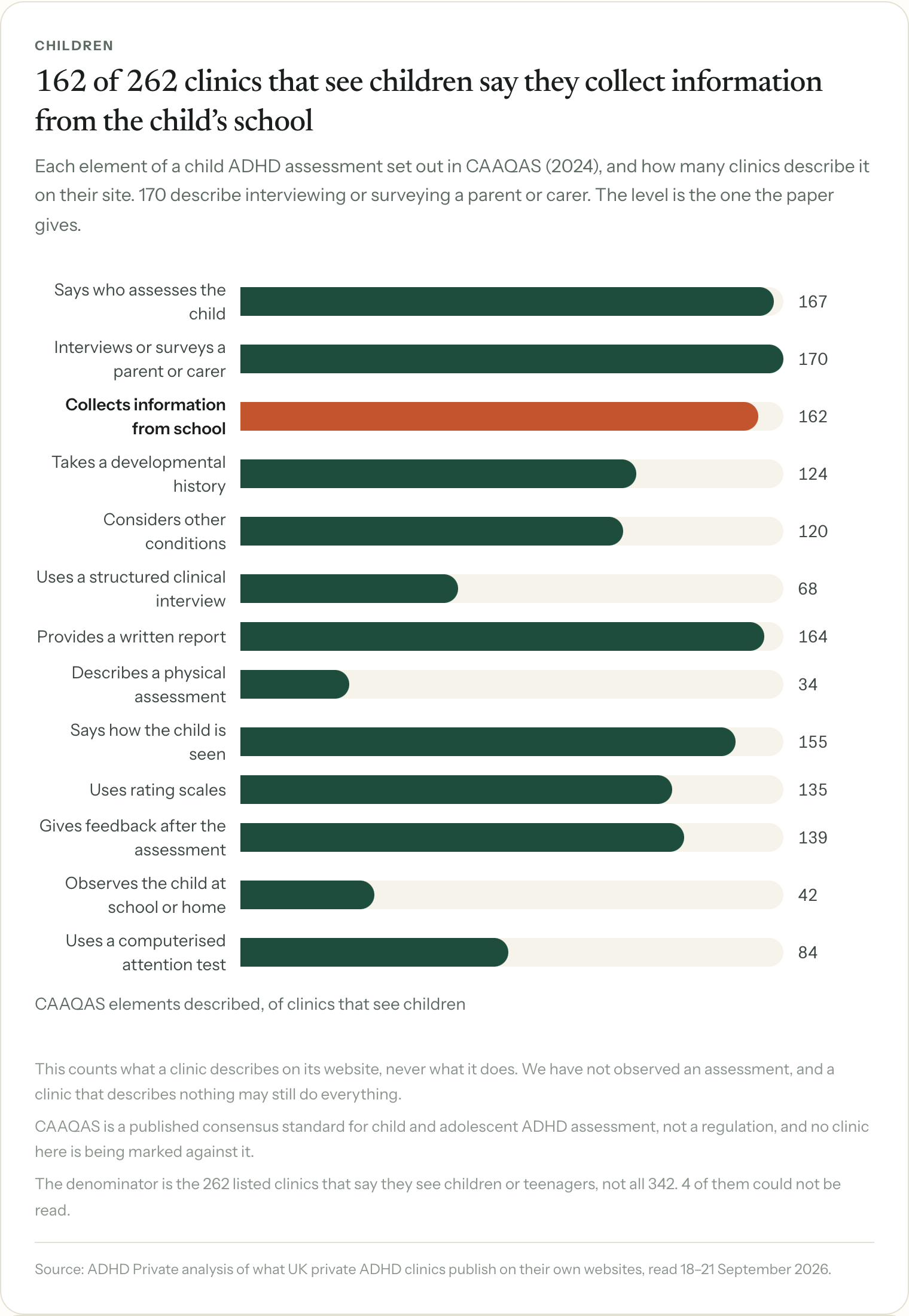
The essential element most often described is “Interviews or surveys a parent or carer”, by 170 clinics. The least often is “Uses a structured clinical interview”, by 68. The spread is not random. The elements that are easy to write as a benefit — a report, an interview — appear far more often than the ones that cost a clinic time and co-ordination, such as chasing a school.
Children
27 of 262 clinics that see children describe all 7 essential elements; the median clinic describes 4
How many of the 7 CAAQAS elements marked Essential each clinic describes. 40 describe none of them.
Essential CAAQAS elements described
- This counts what a clinic describes on its website, never what it does. We have not observed an assessment, and a clinic that describes nothing may still do everything.
- CAAQAS is a published consensus standard for child and adolescent ADHD assessment, not a regulation, and no clinic here is being marked against it.
- The denominator is the 262 listed clinics that say they see children or teenagers, not all 342. 4 of them could not be read.
- The baseline physical assessment is left out of this count. CAAQAS marks it essential for medical practitioners, so counting it would score a psychology-led service on its staffing rather than on its pathway.
Source: ADHD Private analysis of what UK private ADHD clinics publish on their own websites, read 18–21 September 2026.
View the figures as a table
| Essential elements described | Clinics |
|---|---|
| 0 of 7 | 40 |
| 1 of 7 | 23 |
| 2 of 7 | 19 |
| 3 of 7 | 27 |
| 4 of 7 | 32 |
| 5 of 7 | 48 |
| 6 of 7 | 46 |
| 7 of 7 | 27 |
Download this chart’s data (CSV)Download the image (PNG)How this was counted
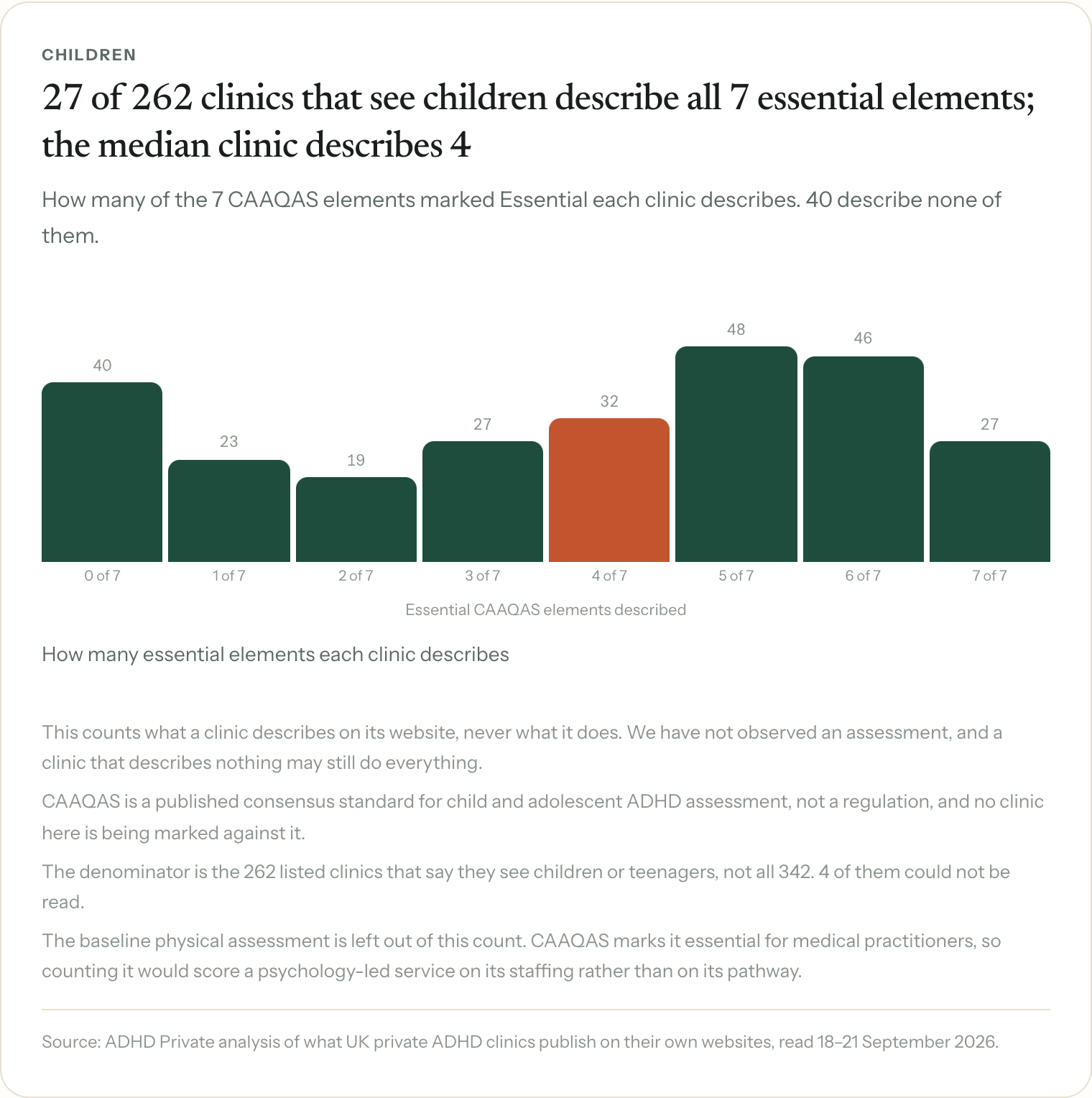
The shape of that distribution is the finding. A long tail of clinics describing nothing at all sits beside a small group describing almost everything, and the difference between them is at least partly the difference between a marketing page and a clinical one. We cannot tell which clinics assess thoroughly. We can tell which ones let a family find out.
How to check this
One column per element in children_pathway.csv, each with a _quote and a _source_url beside it. The composite is the count of essential columns whose value is not not_stated, not_collected or an explicit no, recomputable from the file in one pass.
Do clinics say they collect information from school?
162 of 262 clinics that see children say so, or 61.8%. A further 42 describe observing the child at school or at home, which the standard marks Optional rather than Essential.
“Independent evidence should be obtained from previous and current educational settings (eg, teacher questionnaires and/or interview, school/SEN reports, examination results).”
CAAQAS, sections 1.2 and 2.18, marked Essential
This is the element that most clearly separates an assessment built around a child’s life from one built around a single appointment. The diagnostic criteria used in the UK require evidence that difficulties show up in more than one setting, which is why school is not an optional extra to a child’s assessment: it is one of the settings. A clinic that does not publish anything about collecting it may still collect it in every case — but a family choosing between clinics cannot know that, and this is a reasonable question to ask before paying.
170 clinics describe interviewing or surveying a parent or carer, which is the other half of the same requirement and far more often published. The gap between the two figures is the useful comparison: both are essential, both are about evidence from the people around the child, and only one of them requires the clinic to contact someone outside the family.
How to check thisschool_information and school_observation in children_pathway.csv, each with the clinic’s own words and the page they were read on, so you can check every one of them.
Is the child seen, and in person or by video?
67 clinics say the child is seen in person, 64 say in person or by video and 24 describe video only. 103 say nothing either way, and 4 could not be read.
“The clinical assessment must be conducted in face-to-face format (preferably ‘in person’).”
CAAQAS, section 2.5, marked Highly recommended
Read that wording carefully, because it is easy to overstate. Face to face is the requirement; in person is a preference expressed inside it. A video appointment is within that wording rather than outside it, and nothing in this chapter says a video assessment of a child falls short of the standard. The standard for adults, published the same year by a different group, is explicit that direct consultation may be face to face or remote by video-conferencing.
Children
103 of 262 clinics that see children do not say whether the child is seen in person
What each site says about seeing the child. 67 say in person. CAAQAS says the clinical assessment “must be conducted in face-to-face format (preferably ‘in person’)”, so video is inside that wording and the preference sits within it.
- This counts what a clinic describes on its website, never what it does. We have not observed an assessment, and a clinic that describes nothing may still do everything.
- The denominator is the 262 listed clinics that say they see children or teenagers, not all 342. 4 of them could not be read.
- This is about the child being seen, not about where the parents are interviewed, and not about our directory's own online flag.
Source: ADHD Private analysis of what UK private ADHD clinics publish on their own websites, read 18–21 September 2026.
View the figures as a table
| What the site says | Clinics |
|---|---|
| In person | 67 |
| In person or by video | 64 |
| By video | 24 |
| The site says the child is not seen | 0 |
| Says nothing either way | 103 |
| Site could not be read | 4 |
Download this chart’s data (CSV)Download the image (PNG)How this was counted
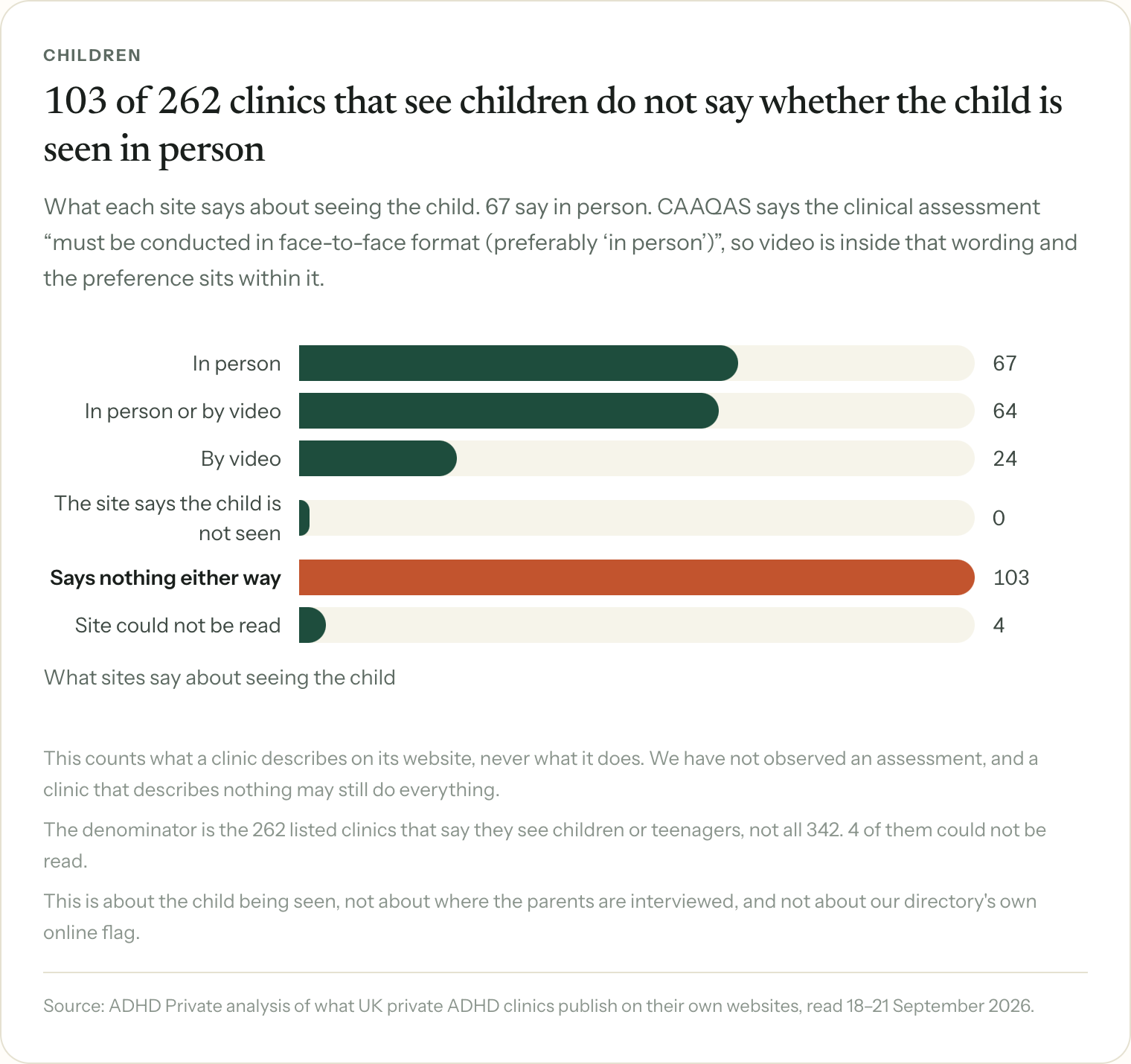
The Parliamentary and Health Service Ombudsman noted in August 2026 that “there is no national data on the proportion of assessments conducted remotely”. This chapter does not fill that gap, and should not be read as though it does. It counts what clinics say they offer, which is a statement of availability, not a measurement of what happens.
How to check thischild_seen in children_pathway.csv, one of in_person, in_person_or_video, video, not_seen, not_stated or not_collected, each non-empty value carrying a quote and a URL.
Who does the assessment?
167 of 262 clinics name at least one profession that carries out a child’s assessment. The published standard asks a service to say who assesses; NICE guideline NG87 says a diagnosis should only be made by a specialist psychiatrist, paediatrician or other appropriately qualified healthcare professional with training and expertise in diagnosing ADHD.
Children
54 of 262 clinics that see children name a clinical psychologist as the assessor
Which professions a site says carry out a child assessment. A site can name several, and many name none.
- This counts what a clinic describes on its website, never what it does. We have not observed an assessment, and a clinic that describes nothing may still do everything.
- The denominator is the 262 listed clinics that say they see children or teenagers, not all 342. 4 of them could not be read.
- A clinic can appear in more than one row, so the rows do not add up to the total.
Source: ADHD Private analysis of what UK private ADHD clinics publish on their own websites, read 18–21 September 2026.
View the figures as a table
| Profession named | Clinics |
|---|---|
| Consultant psychiatrist | 48 |
| Psychiatrist | 29 |
| Paediatrician | 31 |
| Clinical psychologist | 54 |
| Psychologist | 33 |
| Specialist nurse | 13 |
| Nurse prescriber | 3 |
| Another stated profession | 32 |
Download this chart’s data (CSV)Download the image (PNG)How this was counted
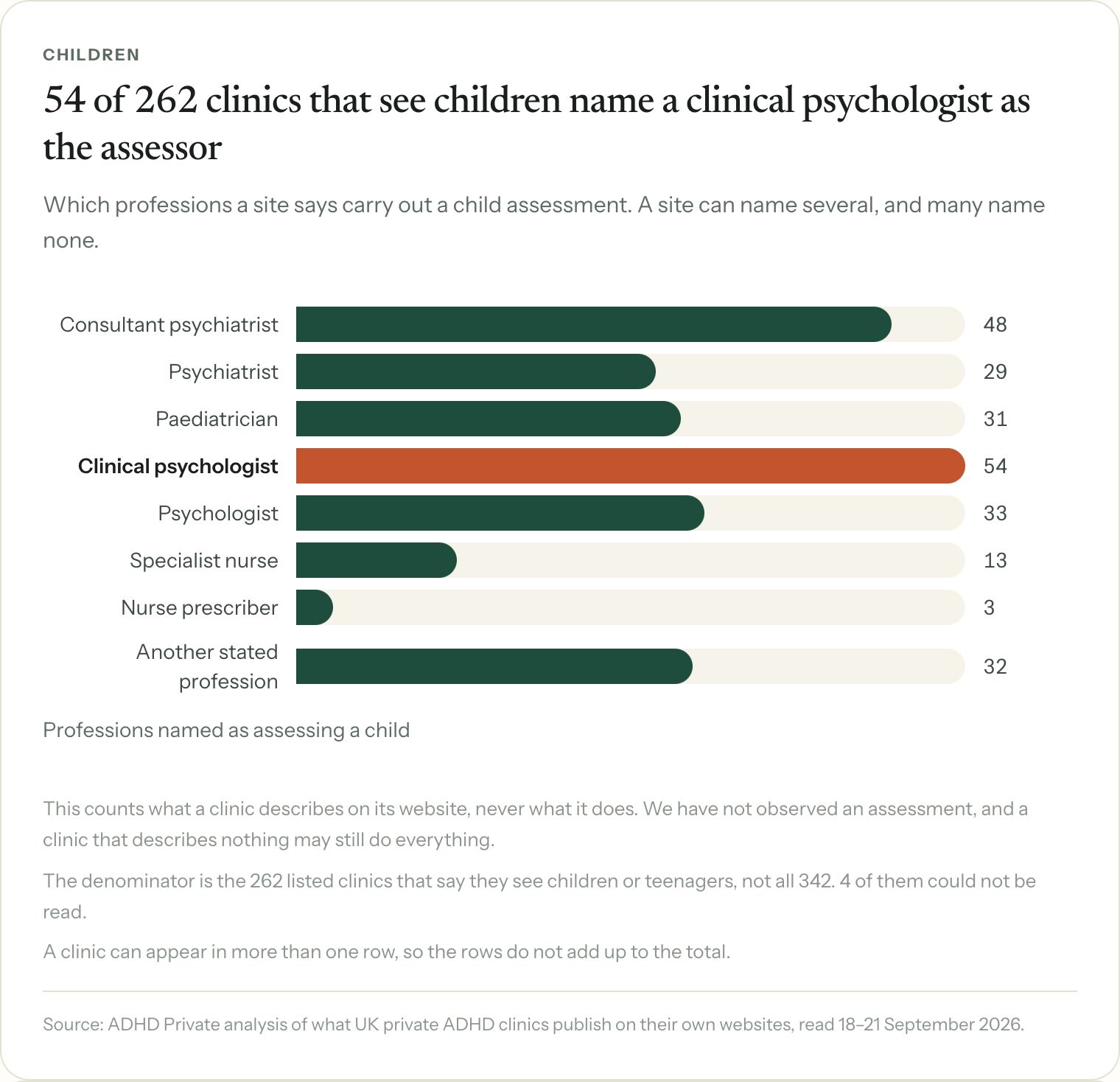
A clinic may name more than one profession, so these figures do not sum to the number of clinics. Naming a profession is not the same as naming the person: a family should ask which named clinician will see their child, what they are registered as, and with which regulator, because that is checkable on a public register in a way a job title is not.
How to check thisassessing_roles in children_pathway.csv, a semicolon-separated list drawn from a fixed vocabulary, with one quote per row. Professions outside that vocabulary are grouped rather than dropped, and the raw wording stays in the quote.
What does a private child assessment cost?
Among the 52 clinics that publish one, a child assessment runs from £575 to £2,875, with a median of £1,250. Half of them sit between £945 and £1,500. Only 52 of the 262 clinics that see children publish a child price at all, so this is a distribution of the clinics willing to put a number on a page.
Children
Of the 46 clinics publishing both, 41 charge more to assess a child than an adult and 0 charge less
The 52 clinics that publish a price for a child assessment, in bands of 500 pounds. They run from 575 to 2,875, with a median of 1,250.
Published child assessment price (£)
- 5 of the 46 charge the same for both. Where the two differ, the middle gap is 200 pounds.
- 52 of 262 clinics that see children publish a child price at all, so this is a small and self-selected group. It is not the average cost of assessing a child in the UK.
- Prices come from our directory's own price field, each checked against the clinic's published page between 2026-07-24 and 2026-09-02 — earlier than the website reading behind the other charts here, and recorded per clinic in the clinic-level package.
- A published price is a headline figure. It may exclude the report, a follow-up, or prescribing and titration, which many clinics charge for separately.
Source: ADHD Private analysis of prices published by UK private ADHD clinics, each checked on the clinic's own page between 2026-07-24 and 2026-09-02.
View the figures as a table
| Price band (GBP) | Clinics |
|---|---|
| 500 to 999 | 16 |
| 1,000 to 1,499 | 21 |
| 1,500 to 1,999 | 11 |
| 2,000 to 2,499 | 3 |
| 2,500 and over | 1 |
Download this chart’s data (CSV)Download the image (PNG)How this was counted
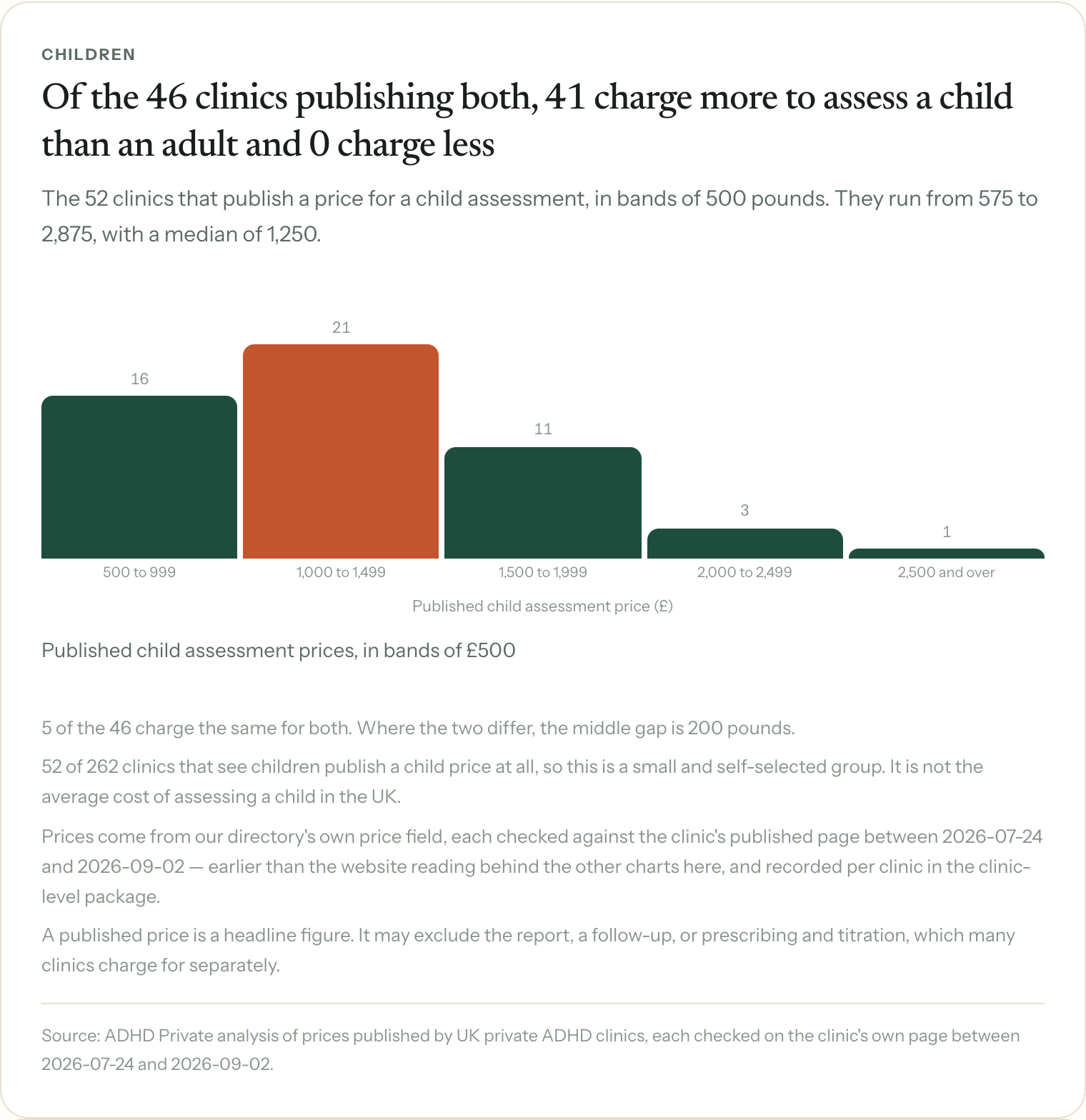
The comparison with adults is the part we had not expected to be so one-sided. Of the 46 clinics that publish both a child and an adult price, 41 charge more for the child, 5 charge the same and 0 charge less. The median difference is £200.
View the child and adult price comparison as a table
| Comparison | Clinics |
|---|---|
| Publish both a child and an adult price | 46 |
| Child assessment costs more | 41 |
| Same price | 5 |
| Child assessment costs less | 0 |
That is not surprising on its face — an assessment drawing on a parent and a school is more work than one that does not — but it is worth putting beside the school figure above. A family paying the higher price cannot generally see, from the website, whether the extra work is the extra evidence.
These prices are older than the rest of this study. They come from our clinic-level directory data rather than from this reading of child pages, and each was verified on its own date, between 2026-07-24 and 2026-09-02. Treat them as a summer 2026 picture. A published price is also rarely the whole cost: reports, follow-ups and any ongoing care are frequently charged separately, and our July study covers pricing in far more detail.
How to check thischild_assessment_price_gbp and adult_assessment_price_gbp in clinics.csv in our September clinic-level package, each with its own child_assessment_price_verified_on date.
What should a family ask before booking?
This study cannot tell you which clinic is right for your child, and it is not medical advice. What it can do is turn the elements of the published standard into questions that a clinic can answer on the telephone, before anyone pays anything. Every one of these is something at least some clinics already publish.
- Will you ask my child’s school for anything? A teacher questionnaire, a school report, examination results. If the answer is no, ask how the assessment establishes difficulty in more than one setting.
- Who will actually see my child, and what are they registered as? A profession and a regulator you can check on a public register.
- Will my child be seen, and in person or by video? Both are within the standard’s wording; knowing which one you are buying is not.
- Will I get a written report, and what will it contain? A report is what a school or a GP will later be asked to act on.
- What is the total cost, including the report and any follow-up? The headline price frequently is not the whole of it.
- What happens after the diagnosis? Ask what ongoing care the clinic provides itself, what it expects the NHS to provide, and what has been agreed with anyone before you rely on it.
If a clinic will not answer these, that is information too. And if the answers differ from what its website says, we would like to know: the data behind this page is published in full, and we correct it.
How this was done
- The clinics
- The 262 clinics listed on this site on 21 September 2026 that we have evidence see children or teenagers, out of 342 listed in total: 244 carrying a child or teenager age group in our own records, and 18 more whose websites describe assessing a child while our records do not. The two halves are evidenced differently and the second is the weaker: those 18 were read from general pages rather than a children’s page, so they describe fewer elements than average and every share here is slightly lower for their inclusion than it would be without them. It is a census of a directory, not of the market: no public register of private ADHD providers exists, so no one can enumerate the market and we do not claim to.
- The pages
- Up to four pages about assessing children per clinic website, fetched no faster than one request per second per site, stored, and read from the stored copy. Sites that need JavaScript we do not run, or that refuse an automated reader, are recorded as not collected rather than as silent; there are 4 of them, and they stay in every denominator so the shares are not quietly inflated.
- The standard, read first
- The elements and their levels were taken from CAAQAS before any clinic page was read, and each element is recorded with the section of the paper it comes from. The composite covers the elements marked Essential that apply whatever profession runs the assessment, which is why the baseline physical assessment — addressed to medical practitioners — sits in the element chart but not in the composite. CAAQAS sets no minimum duration for a child’s assessment, so this study charts none.
- Quote or blank
- Every value carries a verbatim quote and the URL it was read on. A language model proposed each value from the stored page text; a script then checked the quote appeared on that page, character for character, and blanked any value whose quote did not. A second pass could only weaken a value, never strengthen it, and a hand pass worked through what it flagged, including a full re-read of every clinic that pays us for a Featured placement. Every change is published in
corrections.csvwith its before, after, reason and the pass that made it. - Prices
- Child and adult assessment prices come from our clinic-level directory data, not from this reading, and each carries its own verification date. Those dates run from 2026-07-24 to 2026-09-02, which is earlier than the week these pages were read, so the price chapter is dated separately and says so.
- Reproducibility
- Every number on this page is generated from the published files by a script in our repository, not typed by hand. If you recompute a figure from the files below and get a different answer, we would like to know.
What this study cannot tell you
- It is not a quality assessment. We list clinics; we do not rate them. What a website describes is not what happens in a consulting room, and nothing here is a clinical opinion about any provider.
- It is not a compliance audit. No body certifies clinics against this standard and no one inspects against it. A clinic describing every element has not been found compliant, and a clinic describing none has not been found deficient.
- Every count is a floor. Up to four pages per site, sites we could not read at all, and a rule that blanks any value whose quote we could not verify all push in the same direction: towards undercounting what clinics describe.
- It says nothing about outcomes. We cannot say whether any assessment reached the right answer, for a child or for anyone else. No website study can, and a study that claimed to would be worth less than this one.
- Prices are older than the rest. They are a separate directory field with its own verification dates, and they are not a trend: two snapshots are not a series.
- Websites change. This is a snapshot taken in the week to 21 September 2026. Some of these pages will already have been rewritten.
Work this builds on
CAAQAS itself is the work this study measures against, and it is the reason a study like this is possible at all: before 2024 there was no published, element-by-element statement of what a child’s ADHD assessment should contain, against which anything could be compared. NICE guideline NG87 remains the clinical guideline. The Parliamentary and Health Service Ombudsman’s August 2026 report set out the regulatory gap around diagnosis-only providers, from complaints rather than from websites. NHS England’s ADHD taskforce reported in November 2025 on demand and capacity. The independent review into mental health conditions, ADHD and autism, chaired by Professor Peter Fonagy, published an interim report in March 2026; its final report had not been published when this page went live.
What is new here is the clinic-level join for children specifically: each clinic’s own published pathway, element by element, with the quote and the URL attached to every value. Our companion studies cover who checks private ADHD clinics and what those assessments cost across the UK.
Sources
- Young S, Absoud M, Al-Attar Z, et al. The ADHD Assessment Quality Assurance Standard for Children and Teenagers (CAAQAS). Neuropsychiatric Disease and Treatment 2024;20:2603-2628
- NICE guideline NG87, Attention deficit hyperactivity disorder: diagnosis and management
- Adamou M, Arif M, Asherson P, et al. The adult ADHD assessment quality assurance standard. Frontiers in Psychiatry 2024;15:1380410
- Parliamentary and Health Service Ombudsman, Improving access to ADHD and autism assessment and treatment: commissioning with confidence — recommendations (26 August 2026)
- Parliamentary and Health Service Ombudsman, Improving access to ADHD and autism assessment and treatment: commissioning with confidence — variation in the quality of assessments (26 August 2026)
- Independent review into mental health conditions, ADHD and autism (GOV.UK collection)
- NHS England, ADHD taskforce final report (November 2025)
- Care Quality Commission, Scope of registration: diagnostic and screening procedures
- NHS England Digital, ADHD Management Information (quarterly)
Using this research and the data
Our contribution — this page, the aggregate figures and the compilation — is published under a Creative Commons Attribution 4.0 licence. Reproduce the charts and figures, including commercially, with credit.
How to cite: ADHD Private, How private ADHD clinics say they assess children, 21 September 2026. https://adhdprivate.co.uk/research/uk-private-adhd-child-assessments-2026
Download
Aggregate figures behind every chart (CSV) — one row per plotted value, with its denominator. Each chart above also has its own CSV.
The clinic-level data is published too: the same files every figure above was computed from, one row per clinic, nothing withheld. Start with the README, which is the data dictionary, the method in full, and the known limits of each column.
- README.md — 44 KB
- clinic_checks.csv — 52 KB, 342 rows
- right_to_choose.csv — 100 KB, 342 rows
- site_claims.csv — 259 KB, 342 rows
- children_pathway.csv — 430 KB, 342 rows
- appointment_length.csv — 34 KB, 112 rows
- wales_hiw_register.csv — 1 KB, 5 rows
- northern_ireland_rqia_register.csv — 1 KB, 2 rows
- market_adhd_companies.csv — 109 KB, 470 rows
- corrections.csv — 24 KB, 48 rows
Licences within the data. Clinic website extracts are reproduced for the purpose of reporting, with a link to the source page in every case. The standard this study measures against is a copyrighted journal article; it is quoted here and cited above, and it is not reproduced in the data files.
Corrections. If a row about your clinic is wrong, tell us through contact and we will correct the data, the files and this page, and record the change below. We do not remove a row because a clinic dislikes what its own website says, and we will say so if asked.
Questions
Is there a quality standard for assessing children for ADHD?
If a clinic does not mention school reports, does that mean it does not use them?
Does a child have to be seen in person for an ADHD assessment?
Who is qualified to diagnose ADHD in a child?
How much does a private ADHD assessment for a child cost?
Why does this study not say which clinics meet the standard?
Related research
- Who checks private ADHD clinics? — registration, NHS Right to Choose and the adult quality standard, September 2026. Right to Choose applies in England only and needs a GP referral.
- Every chart, with its data — the September 2026 chart pack, each chart with a CSV, an image and a link back to the method.
- What a private ADHD assessment costs across the UK — prices and provision, July 2026.
Changes to this report
No corrections have been made since publication on 24 September 2026. Any change to a figure will be listed here with its date and reason, and the published files will be regenerated at the same time.
About this research and how we are funded
ADHD Private is a comparison directory for private ADHD clinics. Patients use it free. We make money from clinics: some pay for a clearly labelled "Featured" placement. We take no commission on bookings or referrals. Paid placement is always labelled and never changes a clinic's position in organic listings or matching results. The clinics that pay were read, coded, corrected and counted here exactly as every other clinic was, and no clinic was contacted before publication.
Informational only — not medical advice. If you are worried about your child, speak to your GP. Clinic details change; verify with the clinic before booking.
Figures as of 21 September 2026. Compare private ADHD clinics.