ADHD in men: what the evidence says about symptoms
The NHS in England lists one set of ADHD symptoms for adults. What England’s 2023/4 survey and research say about men, and what they cannot show.
Written and maintained by the ADHD Private editorial team, drawing on the sources listed at the end of this article. This is general information, not medical advice.

Illustration: ADHD Private
England’s NHS website lists adult ADHD symptoms once, with no separate list for men. In England’s 2023/4 survey, 12.4% of men and 14.9% of women screened positive on a self-report scale, not a diagnosis, while 1.7% of each reported a professional diagnosis at some point in life. In England’s GP records, which sex has more ADHD recorded depends on age. A 2024 review found small or no significant differences in symptom severity scores between adult men and women with ADHD.
We read every source on this page on 10 November 2026. Read this as general information, not medical advice.
The sources below use different words for men, and some count people in different ways. This page keeps each source’s word and says what was counted. The survey and GP-record figures are for England. We did not open figures by sex for Northern Ireland, Scotland or Wales.
What the NHS, NICE and the government say about men
England’s NHS website puts adult ADHD symptoms in two groups, one for inattention and one for hyperactivity and impulsiveness. It gives them once, with no split by sex. We searched the page’s text on 10 November 2026 for the words men, man, male and males. They appear once, in this sentence:
ADHD is thought to be recognised less often in women than men.
The next sentence gives a possible reason, and it is about women. The page says this may be because inattentive symptoms are more often found in women with ADHD, and can be harder to spot than hyperactive symptoms. The page shows the date 19 March 2025. This page does not repeat the NHS lists of signs.
NHS 111 Wales says its adult page was adapted from nhs.uk content, and the page carries the same sentence. It was last updated on 4 July 2025. The same search on 10 November 2026 found none of those four words on NHS inform’s page for Scotland, last updated on 23 June 2026. It found none on the nidirect page for Northern Ireland either. That page shows no date.
NICE describes its guidelines as evidence-based recommendations for England and Wales. NG87, its guideline on ADHD, was published on 14 March 2018. The same search of its Recommendations, Context, and Rationale and impact chapters on 10 November 2026 found none of the four words. The word “women” appears once, in recommendation 1.2.2, on ADHD being “thought to be under-recognised in girls and women”.
On adult ADHD, the Royal College of Psychiatrists has a page dated June 2023. In its section on gender, which names no nation, the page says diagnosis is more common in boys than in girls, and then:
However, in adults the diagnosis of ADHD in men and women is more equal.
The Men’s Health Strategy for England was published by the Department of Health and Social Care on 19 November 2025. Its page was last updated on 15 December 2025. Its accessible version includes this sentence:
For example, men and boys are more likely to be diagnosed with attention deficit hyperactivity disorder (ADHD), likely due to underdiagnosis in girls.
The sentence is about boys as well as men. The accessible version gives no figure for it, and no link or note is attached to it. Both this line and the Royal College’s are statements, not counts. The next two sections set England’s own counts beside them.
England’s 2023/4 survey: men, women and a screening scale
England’s 2023/4 Adult Psychiatric Morbidity Survey is labelled accredited official statistics. It covers adults aged 16 and over who live in residential households in England. Fieldwork took place between March 2023 and July 2024. Interviewers carried out 6,912 first-phase interviews. The ADHD chapter shows 27 November 2025 as its publication date and 15 October 2026 as the date it was last edited.
The ADHD questions are six items on a self-report scale. They ask about inattention, hyperactivity and impulsivity in the six months before the interview. In the report, scoring four or more counts as a “positive screen for ADHD”. The report says a positive screen does not mean a person has ADHD. It means they warrant “a more comprehensive assessment”. It adds that the scale does not take account of whether symptoms persist across different parts of a person’s life. Nor does it take account of how impairing they are.
The report mostly breaks results down by gender identity. That means whether people identified as a man, a woman or another gender identity such as non-binary. People who identified in another way are in the totals but are not shown as a separate group. So the numbers of men and women together can be lower than the total number of adults. The table shows two counts.
| Measure | Men | Women |
|---|---|---|
| Screened positive on the six-item scale (past six months) | 12.4% | 14.9% |
| Reported a professional diagnosis of ADHD (at some point in life) | 1.7% | 1.7% |
The report says women were more likely than men to screen positive. It says the differences it comments on can be described as statistically significant. It adds that such differences are “not necessarily meaningful or relevant”. For a reported professional diagnosis, it says men and women were equally likely.
These are two different counts. The first counts answers on the scale. The second counts answers to questions. People were asked if they thought they had ever had ADHD. If so, they were asked if a professional had diagnosed them. The report says considerably fewer people are likely to have ADHD than screen positive.
The chapter also compares the 2007, 2014 and 2023/4 surveys, which all used the same six-item scale. For this it uses sex at birth, male or female, not gender identity, so that results can be compared back to 2007. These are not the same groups as the men and women above, and the 2023/4 figures differ. This table gives the share who screened positive.
| Survey year | Males | Females |
|---|---|---|
| 2007 | 8.8% | 7.7% |
| 2014 | 10.0% | 9.5% |
| 2023/4 | 13.0% | 14.8% |
The report says the increase over time was evident in both males and females. For 2007 and 2014, its discussion says “men and women were equally likely to screen positive for ADHD”. Its trend tables use the words male and female. The report also says there may be “reasons other than an increase in ADHD” for the rise. Its examples are reduced stigma and increased awareness. It adds that the 2023/4 survey had a lower response rate than the earlier surveys, and that the profile of the sample may have changed.
Wondering what the next step looks like?
Only a qualified clinician can diagnose ADHD. Answer a few questions and we’ll shortlist clinics that assess people like you.
ADHD recorded in England’s GP records, by age
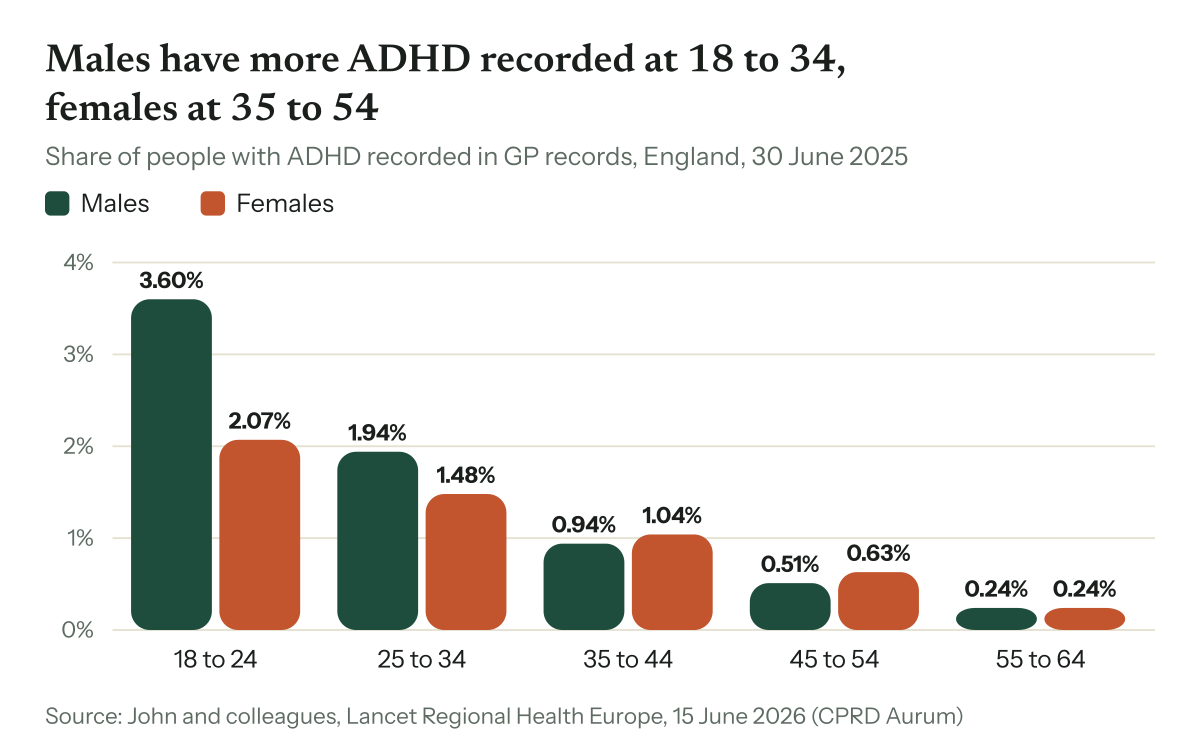
John and colleagues used CPRD Aurum, a large database of records from primary care practices across England. Their paper is dated 15 June 2026 (Lancet Regional Health Europe). They counted 3,536,476 people who were registered at 298 general practices as of 30 June 2025. The people counted include children. The table shows ages 18 to 64.
A person counts as having ADHD “recorded” if their record holds at least one ADHD code. That can be a code for a diagnosis or a code for a prescription. The sex is the one written in the record, male or female. The authors had data on sex, not on gender. Each cell is the share of people of that sex in that age group with ADHD recorded.
| Age group | Males | Females |
|---|---|---|
| 18 to 24 | 3.60% | 2.07% |
| 25 to 34 | 1.94% | 1.48% |
| 35 to 44 | 0.94% | 1.04% |
| 45 to 54 | 0.51% | 0.63% |
| 55 to 64 | 0.24% | 0.24% |
A higher share of males than females has ADHD recorded at 18 to 24 and at 25 to 34. A higher share of females than males has it recorded at 35 to 44 and at 45 to 54. The shares match at 55 to 64. At 65 and over the share is 0.05% for males and 0.05% for females. The authors say the sex gap was largest in childhood and young adulthood, and narrowed in older age groups.
A record is not a count of the people who have ADHD. It shows who has had ADHD written down. The authors say using diagnosis and prescription codes can wrongly classify some people and miss some cases. ADHD diagnoses, they say, are typically made in specialist services, either in the NHS or in private practice, and in most cases a diagnosis should be communicated back to the GP for recording. They add that some cases may be missed, particularly where a diagnosis is made in private practice.
See also our page on how ADHD changes with age, which draws on this study. For older figures by sex from UK GP records, for diagnoses on record by 2018, see our page on women with ADHD.
Does ADHD look different in men?
None of the pages in the first section describes ADHD in men separately. Research can compare men and women who have ADHD on their symptoms. Two sources we read do this.
The first is a 2024 review in Psychological Medicine by Young and colleagues. It searched for published studies from 1996 to 2021 that report symptom severity in female and male participants with ADHD. It compared the severity scores. It does not count how many men have ADHD. In separate analyses, it kept scores from rating scales apart from scores from clinical interviews. The authors describe interviews as diagnostic and rating scales as not diagnostic. The abstract does not name the countries of the studies. The table shows the adult results for inattention and for hyperactivity/impulsivity.
| Score and method | Adult studies | Result for men compared with women |
|---|---|---|
| Inattention, rating scales | 4 | Men were rated as having significantly more severe inattention |
| Hyperactivity and impulsivity, rating scales | 3 | No significant difference |
| Inattention, clinical interviews | 9 | No significant difference |
| Hyperactivity and impulsivity, clinical interviews | 8 | No significant difference |
The authors say all the review’s significant differences were of small effect size. They list the small number of studies in some of their analyses as a limit. The review compares group averages, so it describes groups of men and women, not any one man.
The second source is a study of US survey data by Cortese and colleagues (Journal of Clinical Psychiatry, 2016). We have read its abstract, but not the full paper. Face-to-face psychiatric interviews, to DSM-IV criteria, were conducted with 34,653 adults. The adults came from the US National Epidemiologic Survey on Alcohol and Related Conditions (Wave 2, 2004 to 2005).
The study looked at both “lifetime” ADHD and “persistent” ADHD. The abstract does not define either term. It says the prevalence of lifetime ADHD was significantly higher in men than in women, and that the rate of persistent ADHD did not differ significantly across genders. For persistent ADHD, it says the profile of ADHD subtypes and the rates of risky behaviours were similar, except for reckless driving. Which group had the higher rate of reckless driving is not stated in the abstract.
Both studies describe groups. Neither can show how ADHD looks in one man.
Other conditions that go with ADHD in men and women
England’s NHS website says other conditions may often occur alongside ADHD, with depression, anxiety and addictions as examples. It does not split that by sex.
A 2023 review by Hartman and colleagues (Neuroscience and Biobehavioral Reviews) looked at this in adults. Again our reading was limited to the abstract, which does not name the countries involved. The review focused on large studies of more than 10,000 people: surveys, claims data and population registries. It compared adults who have ADHD with adults who do not, for anxiety disorders, major depressive disorder, bipolar disorder and substance use disorders. The abstract says the pooled results indicate “strong differences” between the two groups. On sex, it says:
Moderation by sex was not found: high comorbidity held for both men and women with sex-specific patterns as in the general population
The abstract names those patterns. Anxiety disorders, major depressive disorder and bipolar disorder were higher in women. Substance use disorders were higher in men. It describes these as patterns that are also seen in the general population.
The abstract compares these conditions between adults who have ADHD and adults who do not. It does not say that either one causes the other. The authors say there were not enough data to draw conclusions about changes across adult life. Our page on anxiety and ADHD covers where the two overlap.
Questions people ask
What are the signs of ADHD in a grown man?
England’s NHS website describes the signs of adult ADHD once, in two groups, with no separate list for men. For how the NHS words them, see our page on adult signs. A positive result on a survey scale is not a diagnosis.
How can you tell if a man has ADHD?
England’s NHS website says an ADHD assessment is with a specialist, for example a psychiatrist. It says that specialist asks about the person’s symptom history, especially symptoms that began in childhood, and their effect on school life. NHS inform, which covers Scotland, says no single test can confirm ADHD. This page gives no way to spot ADHD in another person.
If you need urgent help
If you need urgent mental health help, the table shows where each service says to turn. We read each page on 10 November 2026.
| Where | Urgent mental health help | In an emergency |
|---|---|---|
| England (NHS website) | 111 online, or 111 by phone (mental health option). Or an urgent GP appointment. | Life at risk, or you feel you cannot stay safe or keep someone else safe: 999 or A&E now. |
| Scotland (NHS inform) | Your GP practice, if it is open. Otherwise, NHS 24 (call 111, mental health option). | Someone’s life at immediate risk: 999 or A&E. |
| Wales (Welsh Government; NHS 111 Wales) | 111, then option 2: at any hour, on any day, and free from landlines and mobiles. | If you have seriously harmed yourself, or feel you might be about to do so: 999 for an ambulance, or straight to A&E. |
| Northern Ireland (Lifeline; Minding Your Head) | Lifeline: 0808 808 8000. Calls are free. Available around the clock, every day. | You or someone else in immediate danger of suicide, or needing urgent medical attention: 999. The page also lists your local emergency department. |
Samaritans: call 116 123, day or night. It is free from any phone.
Finding a clinic
England’s NHS website suggests seeing a GP if ADHD symptoms affect study, work or relationships. Our directory lists private clinics that assess adults. It does not list every UK clinic.
Sources
- NHS England: adult ADHD
- About the NHS website
- NHS England: urgent help
- NHS inform: ADHD adults
- NHS inform: urgent help
- NHS 111 Wales: adults
- 111 Wales: suicidal thoughts
- Welsh Government: option 2
- nidirect: ADHD page
- Public Health Agency: Minding Your Head, I need help now
- Lifeline helpline, Northern Ireland
- Samaritans: contact page
- NICE NG87: Recommendations
- NICE NG87: Context
- NICE NG87: Rationale
- About NICE guidelines
- Royal College: adult ADHD
- DHSC: strategy publication page
- DHSC: strategy, accessible version
- England survey, ADHD chapter
- England survey, introduction
- England survey, reading results
- John 2026: GP records
- Young 2024: severity review
- Hartman 2023: other conditions
- Cortese 2016: US survey
Sources checked on 10 November 2026.