A Guide to Adult ADHD Assessment in London
Your guide to getting an adult ADHD assessment in London. Compare private vs. NHS routes, understand costs, and learn how to choose the right clinic.
Written and maintained by the ADHD Private editorial team, drawing on NHS, NICE and ADHD UK guidance. This is general information, not medical advice.
"I can't keep living like this."
It’s a thought that echoes in the minds of so many professionals across London. You're juggling a high-pressure career, but inside, it feels like chaos. You’re missing deadlines, your focus drifts during crucial meetings, and that constant mental static is just exhausting.
Deciding to finally get an adult ADHD assessment in London can feel like a massive breakthrough. That is until you hit the first, and often most daunting, hurdle: the waiting list.
The Reality of Seeking an ADHD Diagnosis in London
The journey to an ADHD diagnosis often starts with a moment of clarity, quickly followed by a stark reality check.
Picture a marketing executive in Canary Wharf who finally connects their lifelong struggles with focus and organisation to ADHD. They book a GP appointment, full of hope, only to be told the NHS waiting list for a specialist referral could be years long. In some London trusts, that wait can stretch to over a decade.
This isn't an isolated story; it's a city-wide challenge. That feeling of being stuck in limbo is incredibly frustrating, especially when all you want are answers to improve your work and daily life. The demand for assessments has simply exploded, leaving NHS services stretched to their absolute limit.
In England, an estimated 2.5 million people live with ADHD. A huge number of these are undiagnosed adults, which puts immense pressure on the system. It’s a situation that validates the tough choice many people face when weighing up their options.
This bottleneck is exactly why it’s so important to understand all the pathways available to you. While the NHS route is overwhelmed, there are other options that offer a much faster path to clarity and support.
For anyone who simply can't put their life on hold for years, looking into private clinics becomes the logical next step. These services offer a direct and timely way to get a full evaluation, often within weeks. You can even use a directory of the best private ADHD clinics in London to start shortlisting providers who can help you finally move forward.
Getting an ADHD Assessment in London: NHS, Private, or Something in Between?
So, you’ve decided to seek an adult ADHD assessment in London. That's a huge step. Now you’re at a crossroads, with three main routes you can take. Getting to grips with each one – the traditional NHS route, the fast-track private option, and the lesser-known 'Right to Choose' – is the key to finding the right path for you.
The Standard NHS Pathway
For most people, the journey starts with a chat with their NHS GP. You'll talk through your symptoms and why you think you might have ADHD, and from there, your GP can refer you to a local specialist mental health service for a proper assessment. The biggest plus? It’s funded entirely by the NHS, so there’s no direct cost for the diagnosis or any treatment that follows.
The catch, however, is the waiting time. And it's a big one. NHS waits for adult ADHD assessments in London have become incredibly long. We’re not talking months; we’re often talking years. Some recent reports have highlighted waits stretching beyond a decade in certain areas, which is a genuinely daunting prospect. This stark reality is why so many people are now looking at private options. You can read more about these staggering delays in a report on the rising trend of adult ADHD assessments from bda.uk.com.
The Private Pathway: What It Involves
If waiting years just isn't an option, going private is a much faster alternative. By approaching a private clinic directly, you can often get an assessment booked within weeks or a few months, completely bypassing the NHS queue.
The process is simple: you research and choose a clinic, book yourself in, and pay for the service directly. It’s definitely a financial commitment, but for many, the cost is a price worth paying for a timely diagnosis and the support that comes with it. This route puts you firmly in control of the timeline and allows you to choose your specialist.
The flowchart below neatly lays out the decision you're facing.
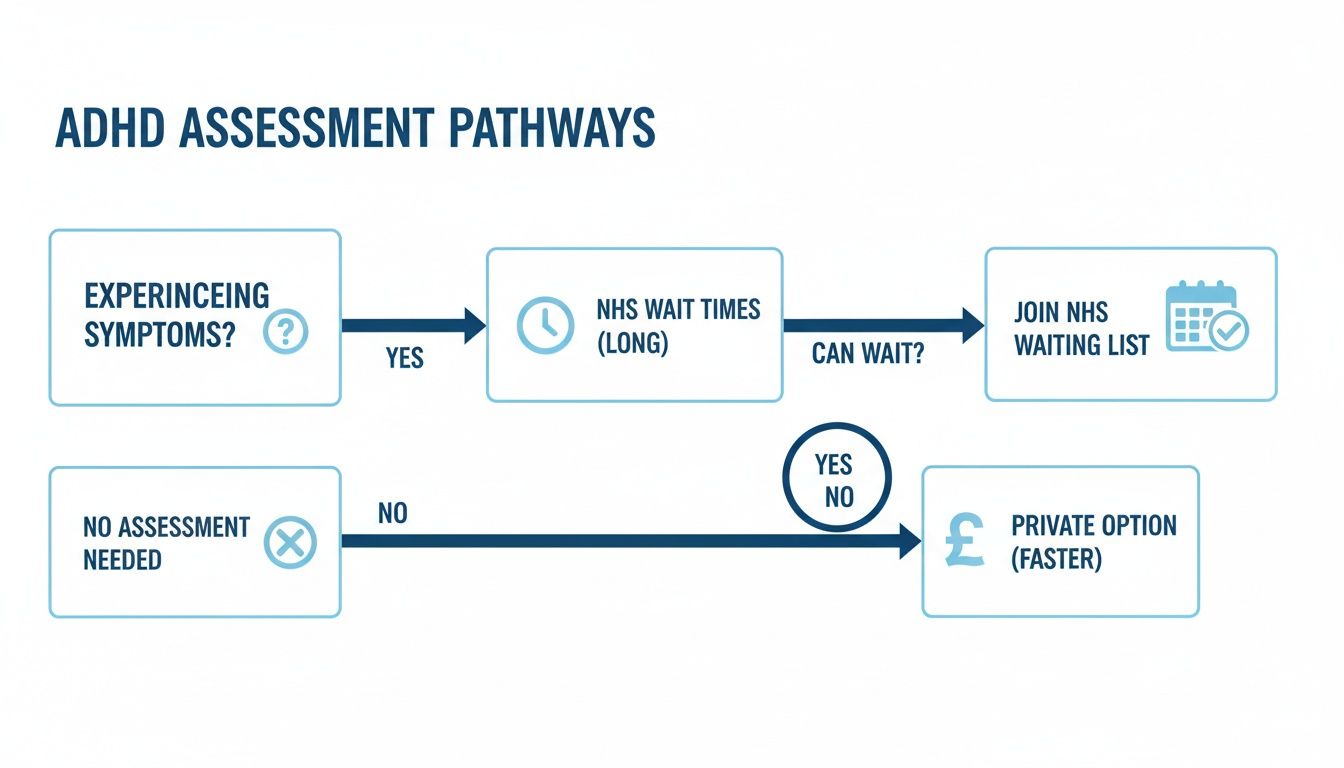
It really boils down to that central dilemma: the free but slow NHS path versus the fast but costly private one. But what if there was another way?
NHS Right to Choose: The Best of Both Worlds?
There is a third option that acts as a fantastic middle ground: NHS Right to Choose (RTC). This is a patient right in England that allows you to choose which qualified provider you're referred to for your assessment, as long as they hold an NHS contract.
In simple terms, Right to Choose means you can often access a private-level service, but it’s paid for by the NHS. It blends the speed of the private sector with the no-cost benefit of the NHS.
To go down this route, you’ll need a referral from your GP, but you must specifically ask them to refer you to an RTC-approved provider of your choice. This lets you pick a clinic with a much shorter waiting list than your local NHS service. While it’s not instant, RTC can slash your wait time from several years down to just a few months, making it a truly game-changing option for anyone seeking an adult ADHD assessment in London.
Comparing ADHD Assessment Pathways in London
To help you weigh everything up, here’s a side-by-side look at the three pathways. Think about what matters most to you – cost, speed, or choice – to figure out which route fits your situation best.
| Feature | NHS Pathway | Private Pathway | NHS Right to Choose |
|---|---|---|---|
| Cost | Free (funded by NHS) | Self-funded (£700 - £2,000+) | Free (funded by NHS) |
| Wait Time | Very long (2-7+ years) | Very short (weeks to a few months) | Moderate (typically 6-12 months) |
| Referral Needed? | Yes, from your GP | No, you can self-refer | Yes, from your GP |
| Choice of Provider | Limited to your local NHS trust | Complete freedom of choice | Choice of any RTC-approved provider |
| Treatment | NHS-funded medication and therapy | Privately funded treatment | NHS-funded treatment |
Ultimately, there's no single "best" option – it all comes down to your personal circumstances. By understanding the pros and cons of each, you can make an informed decision and take the next step with confidence.
Getting to Grips with Private Assessment Costs
Deciding to go private for an ADHD assessment in London is a big step, and a key part of that is figuring out the costs involved. While it's undoubtedly a quicker path to getting answers, you're making a real investment in your wellbeing, so it pays to be clear on what that investment covers.
The price you see isn't just one flat fee. Think of it more like a package deal. The main chunk of the cost is for the initial diagnostic assessment, which almost always includes an in-depth clinical interview with a specialist psychiatrist and the comprehensive diagnostic report that follows. This is your first and most important step towards clarity.
The demand for these services in London is huge, largely because of the bottlenecks in the NHS system. With an estimated 3-4% of UK adults having ADHD, that’s millions of people, many of whom are undiagnosed. This immense pressure on public services has stretched wait times from months to, in some cases, over a decade. You can see the latest ADHD incidence figures from ADHDUK.co.uk to get a better sense of the scale.
Breaking Down the Fees
When you're budgeting for an assessment, it helps to see the costs as a series of stages. Every clinic has its own way of structuring payments, so it's absolutely vital to ask for a full, itemised breakdown before you sign up for anything.
Generally, you can expect the costs to include:
- The Initial Assessment Package: This is the core diagnostic part of the journey. In London, you can expect this to be anywhere from £700 to over £1,500.
- Follow-Up Consultations: If you receive a diagnosis and decide to try medication, you'll need these. They're often called 'titration' appointments, and they're all about carefully finding the right type and dose of medication for you.
- Private Prescriptions: This is the cost of the actual medication during that initial titration period, which you'll pay directly at the pharmacy.
For a deeper dive into what makes up these figures, check out our guide to the private ADHD assessment cost.
The Shared Care Agreement: Your Financial Lifeline
The thought of paying for private medication long-term can be daunting, but there's an incredibly important system in place to make it manageable: the Shared Care Agreement.
A Shared Care Agreement is essentially a partnership between your private psychiatrist and your NHS GP. Once you're on a stable and effective dose of medication, your GP can agree to take over writing your prescriptions. This means you can get your medication through the NHS at the standard prescription charge.
Honestly, this agreement is a total game-changer for managing the ongoing costs. It lets you get the speed and expertise of a private diagnosis while tapping into the affordability of the NHS for the long run. When you're researching clinics, make it a priority to ask them about their process and success rate with setting up Shared Care Agreements.
Looking for a private ADHD assessment?
Answer a few questions and we’ll shortlist clinics that fit — comparing price and waiting time.
What to Expect During Your Assessment
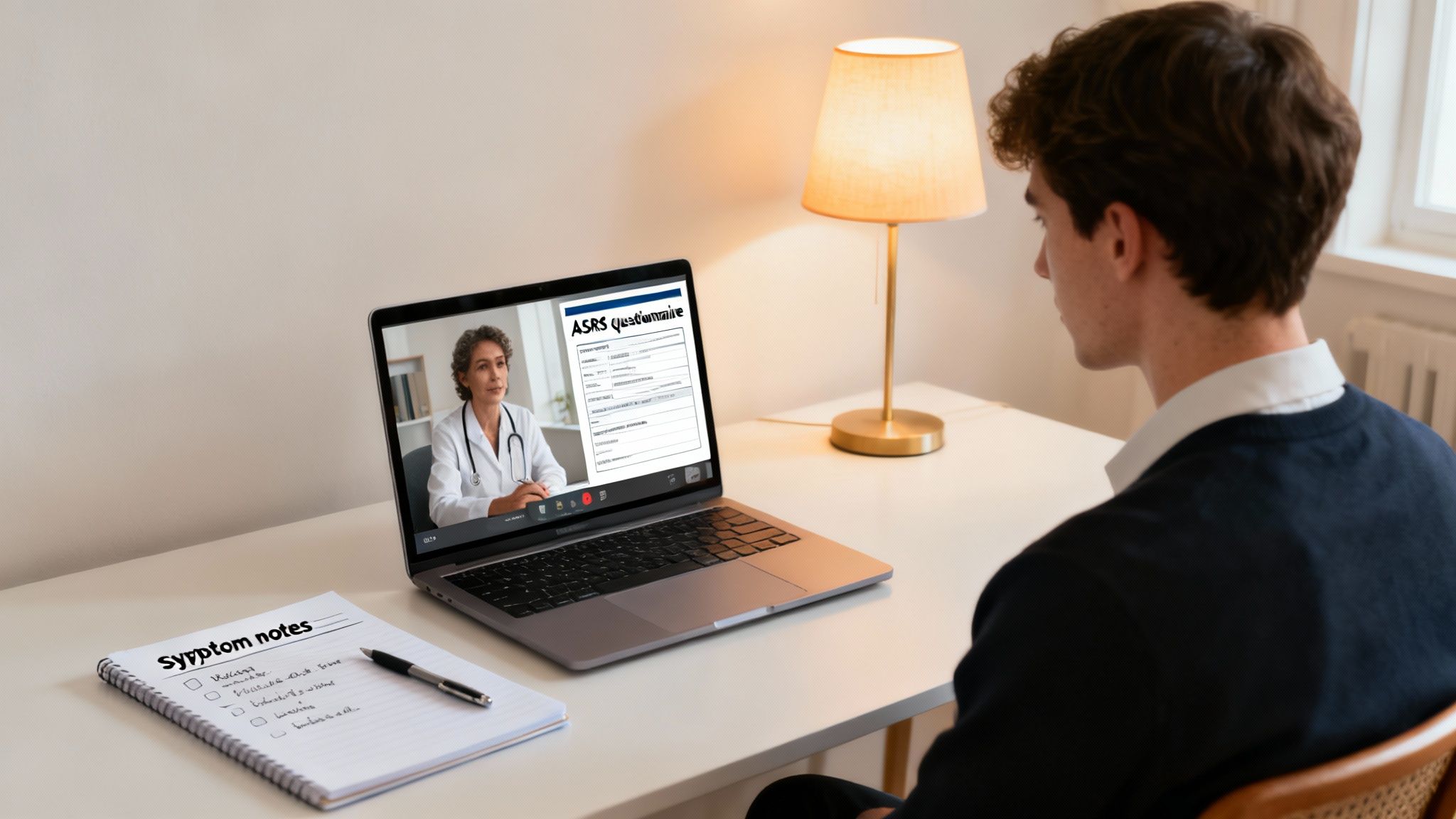
Walking into an ADHD assessment can feel a bit daunting, but it’s not a test you can pass or fail. Think of it more as a guided conversation. The entire point is to piece together a clear and complete picture of you and your life experiences.
Your journey usually starts before you even sit down with the specialist. Most clinics kick things off by sending you some pre-assessment questionnaires. These forms, like the widely used Adult ADHD Self-Report Scale (ASRS), are designed to get an initial snapshot of your symptoms and how they affect you day-to-day.
This first step is incredibly helpful. It gives your clinician a bit of a head start, so when you do meet, the conversation can be focused and make the most of your time together.
The Clinical Interview
The heart of any adult ADHD assessment in London is the clinical interview. This is a deep-dive conversation with a psychiatrist or another qualified specialist that typically lasts anywhere from 90 minutes to three hours. It's a comprehensive look at your life story, from childhood right up to the present day.
Since ADHD is a neurodevelopmental condition that begins in childhood, you’ll spend some time talking about your early years, especially your time at school. Expect to chat about old report cards, how you got on with other kids, and any struggles you remember with things like organisation or staying focused.
From there, the discussion will move into your adult life. The specialist will want to understand how potential ADHD traits might be showing up in your career, relationships, and even simple daily tasks. They are essentially looking for consistent patterns that match up with the official diagnostic criteria for ADHD.
Remember, this is your story. The clinician isn't there to judge you but to understand your world from your perspective. Being open and honest is the best way to get an accurate outcome.
Gathering a Complete Picture
A reliable diagnosis isn't based on a single chat; it's more like a puzzle being put together from different pieces. To get the full picture, your clinician will need to look beyond just your own account of things.
They might ask to see or hear from:
- Someone who knows you well: This could be a parent, a long-term partner, or a close friend. Their perspective can offer valuable insights into how your traits appear to others, providing a more rounded view.
- Old school reports: These can be a goldmine of information. It’s not uncommon to find old teacher comments about being "a daydreamer," "restless," or "disruptive"—potential clues from long before ADHD was on anyone's radar.
- Other relevant documents: Any past medical records or psychological evaluations can help fill in the gaps for the psychiatrist.
This holistic approach is what makes for a robust and accurate diagnosis. It ensures the final conclusion is built on a lifetime of evidence, giving you a solid foundation for whatever support you need moving forward.
How to Choose the Right Clinic and Prepare for Your Appointment
Choosing the right clinic for your adult ADHD assessment in London is a huge step. Getting it right can make the whole experience feel less daunting and far more productive. Think of it as laying the groundwork for a big project – a bit of prep upfront can make all the difference to the outcome.
London has a lot of providers, so knowing what to look for is key. You're not just looking for a diagnosis; you're looking for a reputable clinic that genuinely understands adult ADHD and can support you with long-term care if you need it.
Vetting Potential Clinics
Let's be honest, not all clinics are the same. To make sure you get a high-quality assessment that your GP and other healthcare professionals will actually recognise, you need to do a little homework. It starts with checking their credentials.
Here are a few non-negotiables to look for:
- CQC Registration: The Care Quality Commission (CQC) is the independent regulator for health and social care in England. If a clinic isn't CQC registered, walk away. It’s a basic mark of quality and safety.
- NICE Guideline Compliance: The clinic should explicitly state they follow the National Institute for Health and Care Excellence (NICE) guidelines. This is the gold standard for ADHD diagnosis in the UK, and any legitimate provider will adhere to it.
- Specialist Credentials: Your assessment must be with a GMC-registered Consultant Psychiatrist who has a specialism in adult ADHD. Anything less just won't cut it.
Most good clinics make this information easy to find, often right on their homepage. It gives you instant confidence that you're in the right place.

As you can see, the best providers are proud of their accreditations and specialist-led teams, making it simple for you to verify their legitimacy.
Key Questions to Ask Before Booking
Once you've got a shortlist, it's time to dig a little deeper. Don't be afraid to ask direct questions – their answers will tell you everything you need to know about their process and how much they value their patients.
- What does the assessment fee actually include? Get a full breakdown. Is it just the initial chat, or does it cover the full diagnostic report and a follow-up appointment to discuss it?
- How do you handle Shared Care Agreements? This is a big one for making medication affordable in the long run. Ask about their success rate and what support they offer to get it set up with your GP.
- Who exactly will be conducting my assessment? You have a right to know the name and qualifications of your psychiatrist. Looking into a private psychiatrist in London and their experience can help you find someone you click with.
- What happens if I don't get a diagnosis? A responsible clinic will still provide a comprehensive report that explains their findings and might suggest other possibilities or what to do next.
Getting clear answers to these questions before you part with any money is one of the most important things you can do. It prevents nasty surprises down the line and helps you find a true partner for your health journey, not just a one-off service.
Preparing Your Personal Evidence
Finally, it’s time to get your own information in order. Your psychiatrist needs to understand the full picture, which means seeing how symptoms have shown up throughout your life – from childhood right up to today.
Start gathering anything you can find:
- Old School Reports: You'd be surprised what you can find. Teacher comments like "daydreams in class," "very chatty," or "struggles to focus" are gold dust. They provide powerful historical evidence.
- A Symptom Journal: In the weeks leading up to your assessment, just jot down daily examples of your struggles. Note down when you missed a deadline, felt overwhelmed by mess, had an emotional outburst, or lost focus on a simple task.
- Input from a Loved One: Sometimes, others see things we don't. Ask a parent, partner, or a friend who has known you for years to write a few words about how they see your symptoms affecting your life. Their perspective is invaluable.
By carefully vetting clinics and taking the time to prepare your evidence, you're putting yourself in the strongest possible position for a clear, accurate, and genuinely helpful adult ADHD assessment in London.
Your ADHD Assessment Questions, Answered
Working out how to get an ADHD assessment can feel a bit like a maze. You’ve got the NHS, private options, and Right to Choose all swirling around, so it’s completely normal to have a few final questions before you make a move. Let’s clear up some of the most common things people ask when looking for an adult ADHD assessment in London.
Think of this as your last-minute checklist – a chance to get those nagging queries sorted so you can move forward with confidence.
Can I Get an Adult ADHD Assessment in London Online?
Yes, you absolutely can. Most of the top private clinics now offer assessments entirely online, using secure video calls with their consultant psychiatrists. For a busy Londoner, this is a game-changer – it cuts out travel time and makes the whole process much more straightforward.
These online assessments are every bit as legitimate and rigorous as a face-to-face appointment. The most important thing is to do your homework. Make sure any provider you consider is registered with the Care Quality Commission (CQC) and that their diagnostic process is built squarely on the official NICE guidelines. That’s your guarantee of a quality diagnosis that will be taken seriously.
How Much Does a Private ADHD Assessment Cost in London?
You can expect the initial diagnostic assessment package in London to cost anywhere from £700 to over £1,500. This price should cover the in-depth clinical interview with a specialist and the formal report you receive afterwards.
But here’s a crucial tip: always ask exactly what that initial fee includes. Follow-up appointments for managing medication (a process known as 'titration') and the cost of the private prescriptions themselves are nearly always extra. Get a full, transparent breakdown of all potential costs before you sign up to anything.
What Happens After a Private Diagnosis?
Once you have a diagnosis, the clinic will give you a detailed report explaining everything. If medication is part of the recommended treatment, you’ll then start the 'titration' process with your specialist. This is just a careful, step-by-step period of finding the right type and dose of medication that works best for you.
The long-term goal for most people is to get a Shared Care Agreement set up with their NHS GP. Once you and your specialist have found a stable medication plan, this agreement allows your GP to take over prescribing. It means you can get your medication for the standard NHS prescription charge, making your ongoing treatment much more affordable.
Is a Private ADHD Diagnosis Recognised by the NHS?
It should be, yes – provided it comes from a reputable private clinic that follows the National Institute for Health and Care Excellence (NICE) guidelines to the letter. This is precisely why it’s so vital to check a clinic’s credentials and their commitment to these national standards.
However, getting a Shared Care Agreement isn't automatic. It's up to your individual GP surgery, and some are more willing than others. Your best bet is to choose a high-quality clinic that has a proven history of working well with NHS GPs. This gives you the strongest chance of a smooth transition from private diagnosis to long-term NHS support.
Finding the right path to an ADHD assessment can feel like a huge task, but you don't have to figure it all out on your own. ADHD Private runs a free, UK-wide directory to help you easily compare clinics, check their current wait times, and find a provider that’s right for you. Start your search and take the next step towards clarity today at https://adhdprivate.co.uk.